It wasn’t enough for Rimbaud to disassociate himself from his society, which he found decadent, hypocritical, false – in a word, selfish. He would also derange his language and senses, and when he was finished, or abandoned, that writing life project, but which would survive to influence so many still working on literature, he moved on and rejected his and all other writing:
“When a friend asks him [Rimbaud] whether he is writing nowadays, he replies with annoyance and scorn: ‘I don’t do anything with that anymore’; and when, on the eve of his departure the next spring, he hears one of his friends congratulate another on having just bought some Lemerre editions – Lemerre had been the publisher of the Parnassians – he bursts out: ‘That’s a lot of money wasted. It’s absolutely idiotic to buy books – and especially books like that. You’ve got a ball between your shoulders that ought to take the place of books. When you put books on your shelves, the only thing they do is cover up the leprosies of the old walls’” (Wilson, 279).
For Edmund Wilson, the question of lighting out for the territory ahead of the rest meant reading and sitting down to his journal. (What might Wilson have done with a blog?) He quotes Yeats, from his “Vision”:
“It is possible that the ever increasing separation from the community as a whole of the cultivated classes, their increasing certainty, and that falling in two of the human mind which I have seen in certain works of art is preparation….It will be concrete in expression, establish itself by immediate experience, seek no general agreement, make little of God or any exterior unity, and it will call that good which a man can contemplate himself as doing always and no other doing at all….Men will no longer separate the idea of God from that of human genius, human productivity in all its forms” (291-292).
The problem then, for Wilson, is indeed what to do:
“Nor can we keep ourselves up very long at home by any of the current substitutes for Rimbaud’s solution – by occupying ourselves exclusively with prize-fighters or with thugs or by simply remaining drunk or making love all the time….The question begins to press us again as to whether it is possible to make a practical success of human society, and whether, if we continue to fail, a few masterpieces, however profound or noble, will be able to make life worth living even for the few people in a position to enjoy them” (293).
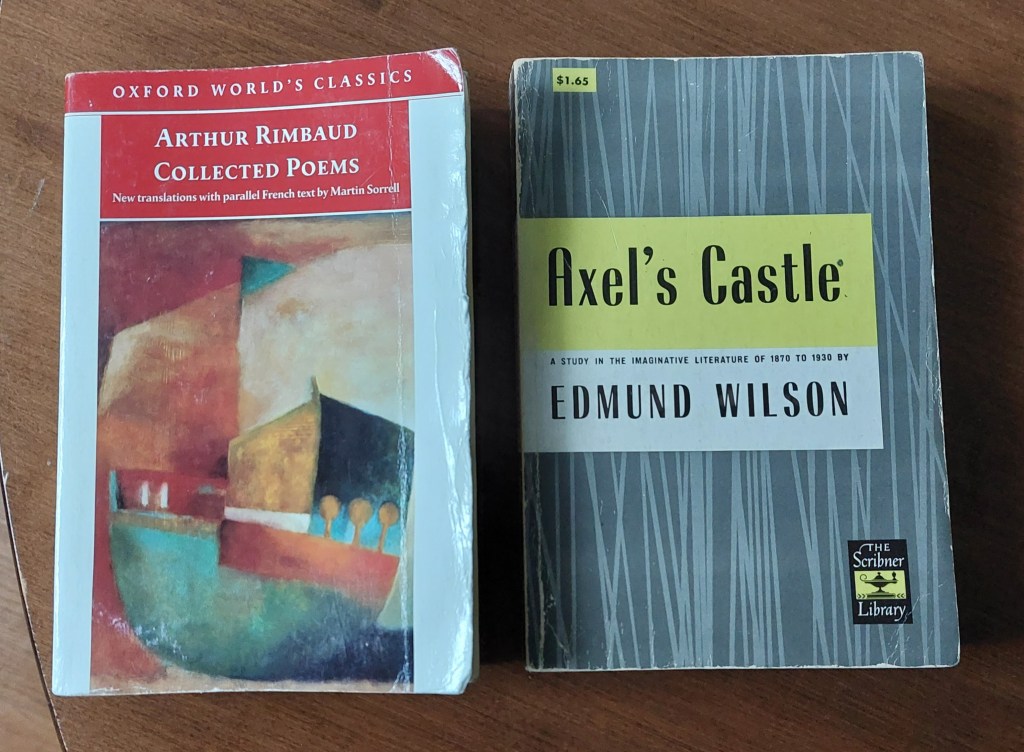
Quotes from “Axel’s Castle: A Study in the Imaginative Literature of 1870 to 1930,” by Edmund Wilson. Scribner Library, 1931, 1959.
 The Coming of the Toads