Thinking back to my earlier days of blogging, when it now sometimes seems writers then often wrote with different purpose, as in sharing a conversation with themselves to which others might be invited to listen in and, if need be, comment. Have we stopped talking to ourselves? Some days these days I’m nearly the only person I talk to, so if I do talk to someone else, some random Q & A with a passerby or on a visit to the grocery, I’m likely to mull over what was said with playback on repeat. Too often I find myself looking for meaning in a bucket of refuse, wanting to rebuff the debris, worried I might have not given someone or something my full attention, mired in muddled memory. Of course my interlocutor is long gone and remembers none of it and would be surprised to know I have it on mental-virtual video. Talking to ourselves is where conversations begin. Where can they end? I suppose many prepare a speech or lecture or opinion or anecdote, or spurn the prep and just go for it, though most rarely press it, but one might in conversation attempt to lecture or tell a story of something that once happened and for some reason the links still work, but not all of them, or the links take you places unexpected, but what’s the purpose of a lecture, a one way conversation, or an anecdote impossible to research? Do casual conversations have purpose, or are they simply a template for one’s personality, a way of spraying one’s mental territory? After a decade and more, a blog full of broken links, difficult to refresh. And we lose purpose, or misplace it, or deleted it by accident.
Olivia Manning’s writing is full of conversations. Characters come and go and return and you feel like you know not so much what they are going to say but how they are going to say it, and after a time there’s no difference. If the conversation contains nothing new, how something is said takes on more importance than what is said. But since it’s fiction, or selective memoir, everything that’s said must have some meaning, some purpose in the whole. Some reason for being said:
“The evening was one of the few that they had spent in their living-room with its comfortless, functional furniture. The electric light was dim. Shut inside by the black-out curtains, Harriet mended clothes while Guy sat over his books, contemplating a lecture on the thesis: ‘A work of art must contain in itself the reason why it is so, and not otherwise.’”
“Who said that?” Harriet asked.
“Coleridge.”
“Does life contain in itself the reason why it is so, and not otherwise?”
“If it doesn’t, nothing does.”
“Fortunes of War: The Balkan Trilogy.” NYRB 2010. Page 872.
But is life a work of art?
Critics have called Manning’s work somehow less than art. A blurb by Howard Moss on the back cover of my NYRB copy says,
“One of those combinations of soap opera and literature that are so rare you’d think it would meet the conditions of two kinds of audiences: those after what the trade calls ‘a good read,’ and those who want something more.”
You’d think that’s what a good conversation ought to purpose for. Why isn’t soap opera considered literature? It is, but one without an end – like a blog. Critics don’t like something that doesn’t come to an end. Someone that goes on and on and on is not considered a good conversationalist. But having enjoyed “The Balkan Trilogy” so much, I’m now on to the second of Manning’s trilogies, “The Levant Trilogy.” I’m only about 50 pages in, but already I think I can say it’s another good read mix of soap and lit. Though I’m not bothered by soap alone. Hemingway is full of soap. Soap and sap. Though the soap is rarely used for its purpose. The blurb was taken from a review of Manning’s Balkan and Levant trilogies Moss wrote for The New York Review, April 25, 1985, titled “Spoils of War.” Moss liked the books, almost in spite of his taste, it seems:
“The way this past world comes to the surface is un-Proustian and non-metaphorical; the thrust of the whole rarely has time to stop for digressions. Manning, who avoids elevations of style as if an ascent were a bog, also evades sentimentality, and although she can handle atmosphere, her main interests are those two staples of realistic fiction, character and action.”
But we do find digressions in the Manning books, mostly in the form of colorful sensory and physical descriptions of the weather and its effects on the streets, parks and gardens, the mountains and valleys and the trains traversing under the sky above and above the people below. But while these descriptions are placed here and there frequently it’s true they are short and appear almost as doilies or tchotchkes arranged to create atmosphere. But in the end, for Howard Moss, the trilogies lack poetry. But a poetry of war might create illusions, and what would be its purpose? Moss has already said of Manning:
“An enemy of illusions, she does not quite see how crucial they are both in love and in war.”
Was it on purpose Manning avoided metaphor and poetry? We can take purpose too seriously, forgetting that mostly what’s said is said in jest, to fill the spaces of silence, or to scratch common itches. We usually proceed without purpose. In Alice, on purpose, we find:
“They were obliged to have him with them,” the Mock Turtle said: “no wise fish would go anywhere without a porpoise.”
“Wouldn’t it really?” said Alice in a tone of great surprise.
“Of course not,” said the Mock Turtle: “why, if a fish came to me, and told me he was going a journey, I should say ‘With what porpoise?’”
“Don’t you mean ‘purpose’?” said Alice.
“I mean what I say,” the Mock Turtle replied in an offended tone. And the Gryphon added “Come, let’s hear some of your adventures.”
“I could tell you my adventures—beginning from this morning,” said Alice a little timidly: “but it’s no use going back to yesterday, because I was a different person then.”
“Explain all that,” said the Mock Turtle.
“No, no! The adventures first,” said the Gryphon in an impatient tone: “explanations take such a dreadful time.”
Indeed they do. Such might be to blog, or to write an epic trilogy or two, but while some explanations seem to require a long form, others can be riffed off in a tweet or two.
We say “on purpose” to explain some experience wasn’t “by accident.” But purpose is confounded by all those imperatives upon us that determine how we feel and experience but are not within our control, like the medulla oblongata stuff. We might try to proceed with purpose to do something purposeful with our day, or at least with our writing, or our blog, but to what purpose other than to show what happened and how our feelings may have changed over time and what ideas if any might accrue from those changes. But if all we can show is pettiness, narrow-minded cheap anecdotes, or soap operatic epic-intended purpose or explanations that go nowhere, why bother wading through the bog of a blog or a trilogy of books, all of which can never ascend but only descend, down as the page rises and disappears, one post after another, more often than not style and sense on repeat, poetry or not? Speak Memory, Nabokov said, while others might say, “Shut up!” Memory is like an upstairs neighbor pounding on the floor.
Memory is the editor-in-chief of experience:
“The Dormouse had closed its eyes by this time, and was going off into a doze; but, on being pinched by the Hatter, it woke up again with a little shriek, and went on: “—that begins with an M, such as mouse-traps, and the moon, and memory, and muchness—you know you say things are ‘much of a muchness’—did you ever see such a thing as a drawing of a muchness?”
Memory is an example of a muchness at work (or play).
“That’s the effect of living backwards,” the Queen said kindly: “it always makes one a little giddy at first—”
“Living backwards!” Alice repeated in great astonishment. “I never heard of such a thing!”
“—but there’s one great advantage in it, that one’s memory works both ways.”
“I’m sure mine only works one way,” Alice remarked. “I can’t remember things before they happen.”
“It’s a poor sort of memory that only works backwards,” the Queen remarked.
If memory only works backwards, what do we call the facility by which we look ahead? Can we imagine a future different from anything that’s contained in our memory? Imagination is muchness at work (and play). But character and action need a place to unfold, and Manning describes dwellings and rooms, bars and cafes, parks and walkways and trails. You can have a conversation anywhere. And her writing while sparse of metaphor is not devoid of poetry:
“The lawn was set with citrus trees that stood about in solitary poses like dancers waiting to open a ballet (695).
The landscape is part of the weather:
“As they rounded the house and came in sight of the sea, the clouds were split by streaks of pink. The sun was setting in a refulgence hidden from human eye. For an instant, the garden was touched with an autumnal glow, then the clouds closed and there was nothing but wintry twilight (695).
For all indents and excursuses, we have run out of purposes, if we ever had any, having relied on the feeling that we might as we sometimes do find our purpose in the act of going forth, but there’s never a guarantee.
There’s a scene in John le Carre’s “The Spy Who Came in from the Cold” (1963) where Leamas, the tough and unsentimental spy, recalls his first experience of what for him was a foreign emotion, the fear and trembling that comes from a near miss. He was speeding down the autobahn late to an appointment and “taking risks to beat the clock” when he nigh collided with a car full of children:
“As he passed the car he saw out of the corner of his eye four children in the back, waving and laughing, and the stupid, frightened face of their father at the wheel. He drove on, cursing, and suddenly it happened; suddenly his hands were shaking feverishly, his face was burning hot, his heart palpitating wildly” (122, Coward-McCann, 1964).
But apart from his sudden shaking of nerves, what happens is that he imagines the scene as if he had actually hit the car, and that too is new, and
“He never drove again without some corner of his memory recalling the tousled children waving to him from the back of that car, and their father grasping the wheel like a farmer at the shafts of a hand plow” (122).
The new emotion is evidence that “He was slowing down. Control was right (121)….Control would call it fever” (122). What has happened to the stouthearted spy that a near miss becomes an obsessive memory that torments him almost as if the resulting imagined outcome really happened?
I thought about the le Carre scene while reading the Roddy Doyle short story, titled “The Buggy,” that appears in this week’s The New Yorker magazine (June 24, 2024). Doyle’s story also contains a near miss. A father is standing with his kids on a train platform:
“He let go of Colm’s hand for a second, to give the button a jab – and Colm was gone. He had tried to step onto the train; his stride fell short of the gap, and he dropped between the train and the platform, under the train” (48).
But what happens in Doyle’s story, unlike the foreign emotion experienced by le Carre’s spy, is the father seems to have lost touch with the reality of the experience:
“He could remember rescuing Colm, but he couldn’t imagine it – he couldn’t feel it. He didn’t believe he’d done it. Or any of the other things he’d done when he was a father” (48).
Like le Carre’s aging and on the wane spy, the father in Doyle’s story begins to experience his memories differently from the reality of their happening. In fact, he simply can’t imagine the experiences are actually his. For example, and this is probably, while reading the Doyle story, where I remembered the scene from “The Spy Who Came in from the Cold,” the father recalls another buggy incident. Another son, Sean, had pushed their buggy out into the road and a passing car hit it. Doyle’s story turns on whether or not the bugggies are carrying babies or are empty.
“He could remember it like a scene from a film. It was a very good film. But he wasn’t in it.
What happened?
Where had his life gone? Not the years – the blood. Where was the life?” (49)
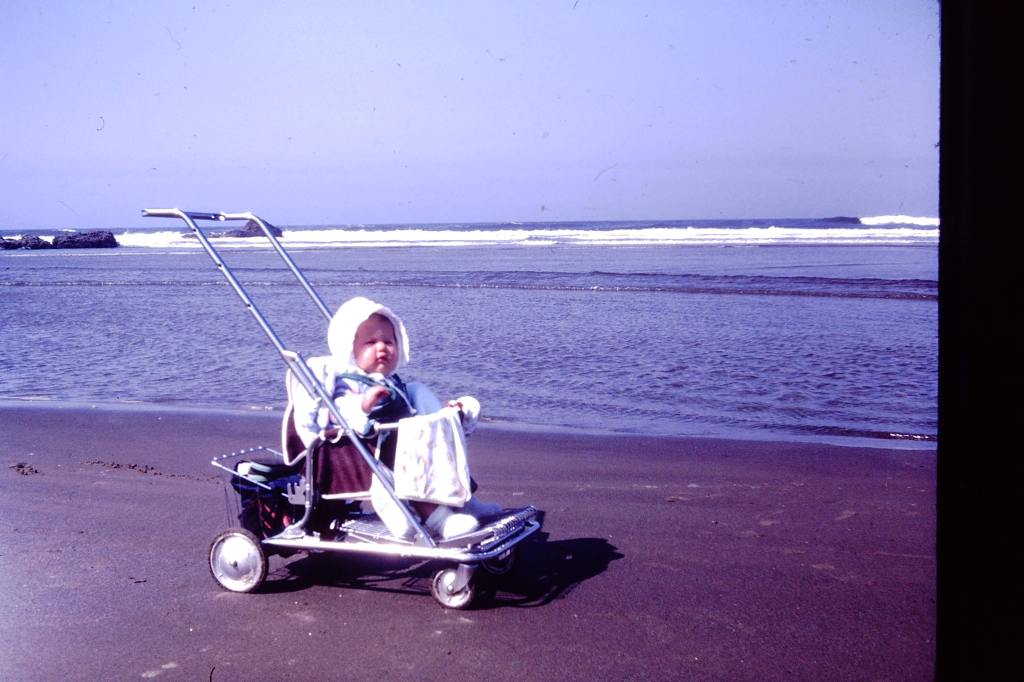
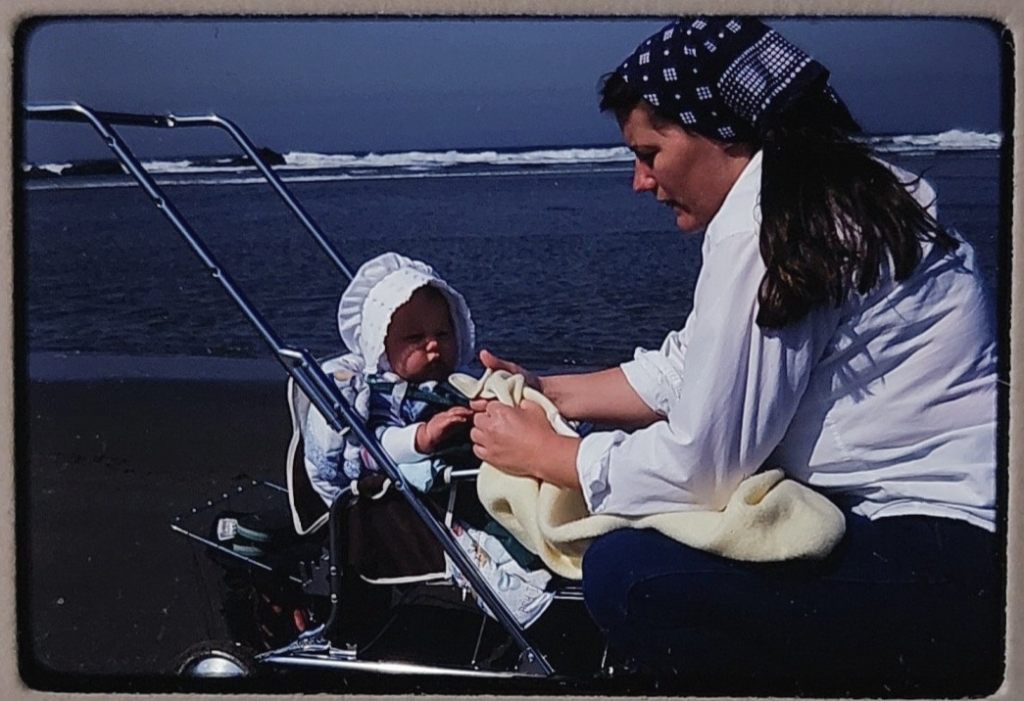
Then there’s another buggy, in the Roddy Doyle story, at the beach, near the incoming tide, and this one reminded me of a couple of old 35mm slide photos I took years ago on a trip to Cannon Beach. There’s definitely a baby in this buggy. The tide is out, and I’m close by, and so is the mother. But why did I say I remembered the photograph and not the actual being there on the beach, the waves breaking far out, the sun still to the east, late morning, the blue steel tones of the sea and sky, the now old fashioned collapsible beach buggy with basket? And that white bonnet frilled lace like the surf foam and that blue bandanna. Is it a memory or a photograph or a short story?
I don’t know if kids are still made to take them, the Iowa Tests, of course I could look it up, not beyond googling, but Wiki has no memory of this echo.
I was in the 8th grade, yellow #2 black bile pencil at the ready, desk cleared, humors silent. This one was a vocabulary test, and one word from it sticks
in memory still: melancholy. Four choices, and I pick happy, reasoning based solely on sound – I thought the tinkling mellow, jolly
joyful and cock-a-hooped filled the circle C and moved to the next word. Later, I happened to ask
Sister Mary what it meant, melancholy, and whadayaknow, I was veracious and ran out to recess happy as a clam at high tide.
Come the following Sunday, I decided to stay on for another week at Hotel Julian, having found my time there restful and enjoyable, and while I was in the lobby at the front desk getting squared away, Flower Girl appeared once again. In any metamorphosis, one must decide whether to bring one’s memory along. If she was a goddess, Flower Girl was certainly not Mnemosyne. I don’t know why she pretended not to know me, to have never met me. Maybe I found our evening talks on the veranda of the hostel more engaging. I had recalled them several times since moving out, going over what was said, where we had sat, how the evening suns dropped into the ocean. I recalled her flowers, her yellow hair, her blue eyes, her smooth, sensitive skin, her happy smile that often broke into a sudden laugh, her frown when she seemed depressed or angry with something, her slightly freckled cheeks, the way she squeezed the arms of her overstuffed chair when she was about to exclaim something important, like she was about to experience an epiphany but held it off until she couldn’t hold it anymore. With each retelling in my mind, I strengthened my memory of our time together. She, on the other hand, may never have recalled those evenings, so they easily disappeared. Or maybe she confused, in her memory, her evenings with me with any number of other persons she had spent time with, all conversations blurring into an indistinct person and incoherent discussion. Perhaps she had other reasons for denying we’d ever met and talked and shared time together, alone, on the veranda of the hostel. I mentioned I’d heard her blues singing on the rooftop the other night. She thanked me for listening and said she lately had been showing up there every Thursday. When I asked her if she was also was staying at Hotel Julian she was again evasive and seemed to prefer not to answer, instead saying something obscure about being uncertain what her plans might be moving forward. Maybe she harbored regrets of our conversations, of sharing something too deeply of herself, and now she wished to reclaim that thing and keep it for herself, or to save it for someone else, and so with that new person the experience would be new and fresh and not a rehash of already spent emotion and epiphany. Or maybe she was the kind of person who only remembered bad experiences, a characteristic of the melancholic or depressed person, who relives moments better forgotten over and over again, and can’t seem to shake loose of them, while their happy memories sink to the bottom of a murky sea, and there I was, Prufrock’s “ragged claws,” or, forgetting the metaphor, quiet literally the lonely man leaning out the window of “twenty-nine three.”
“Rement and Regret” is episode 22 of Ball Lightning a Novel in Progress in Serial Format at The Coming of the Toads. (Click link for continuous, one page view of all episodes.)
She wanted a holo phrase,
did Hope Mirrlees
100 Years Ago –
This year the 4th of July fizzles
like the silverfish on the floor
of the black and white cassock
closet in the church up the hill
through Hilltop Park in the dark
walk thru ocean arch morning.
This year, 2020, I recall and recall:
YELLOW
BANANA
SUNRISE
(or sunshine)
and the fish dash
as we rush
from the Sacristy
to the Service,
the altar pickled
in red, green, and blue.
Blast Famous 4th!
I thought you’d be
Quieter this year
and you were
thank you.
We can’t know how much or what we’ve forgotten,
and where we are certain we remember we might
be mistaken; thus the value of the still life which
fixes or remedies one of the problems of our time.
After all, I really don’t recall
if she said BANANA YELLOW SUNRISE
or YELLOW BANANA SUNRISE
or SUNRISE, or SUNSHINE.
What I remember is that I got one wrong.
So I was still in the game, so to say,
if you want to look on the bright side.

 The Coming of the Toads