Over the weekend, I read two articles somewhat related to one another: “How Much Are We Paying for Newsletters” (apparently some subscribers are losing track) in The New York Times, and “Is the Next Great American Novel Being Published on Substack?” (If a tree falls in the forest?) in The New Yorker. Too many subscriptions, paid or free, and the emails begin to pile up like old zines on a rusty rack in an empty barbershop, and come to be treated like spam and deleted, at issue, at bottom, simply this: more than we have resources to profitably or efficiently manage. Millions of miles of Substack track and only one effort is nominated. And part of the success formula is still will you get picked up by a traditional publisher. But there are great novels precursors to Substack serials: Dickens, George Eliot, Trollope. Maybe serializing your novel no one hears on Substack is the theme of the Great American Novel.
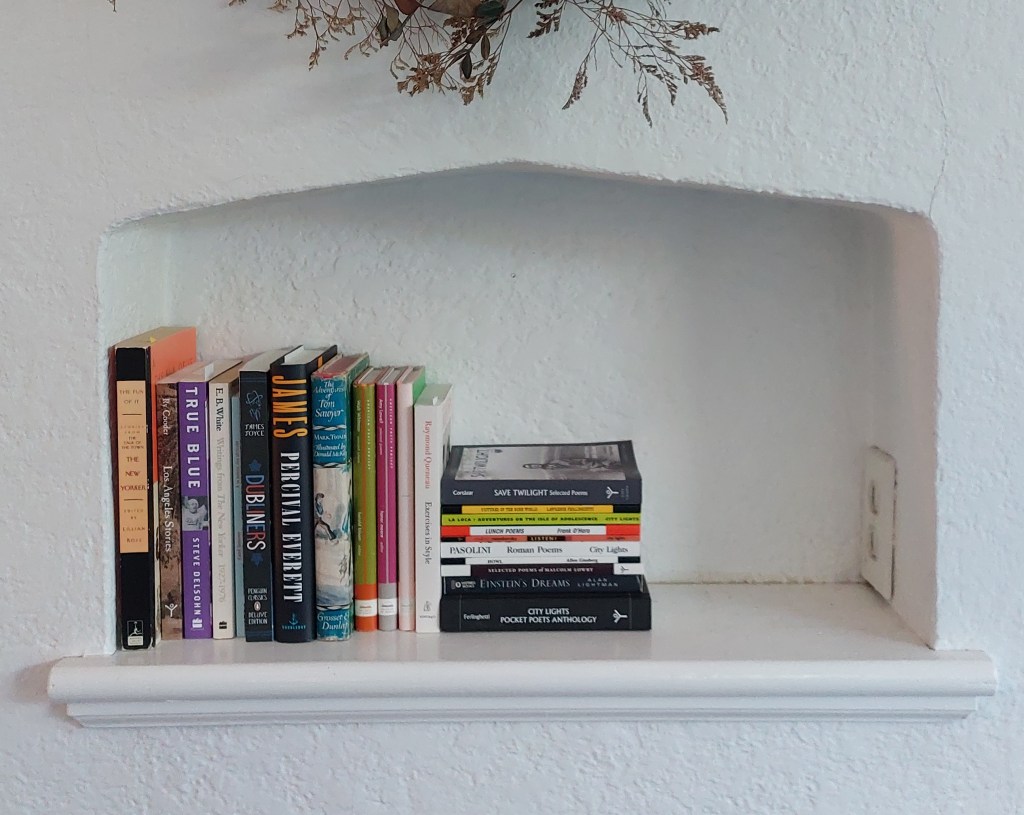
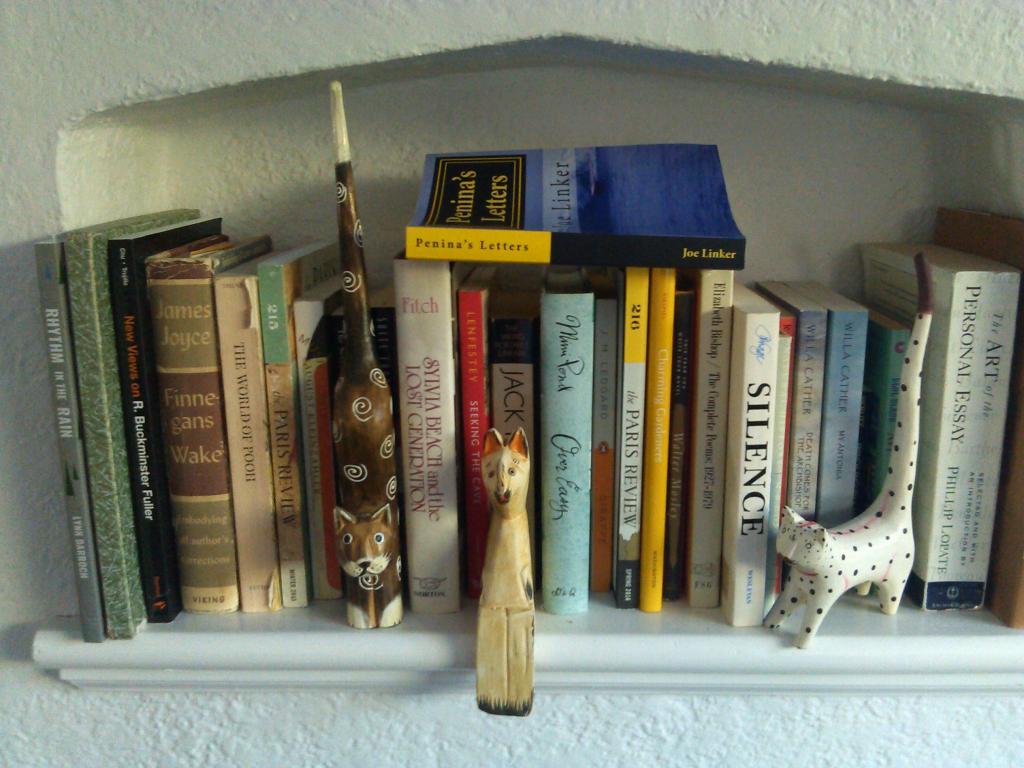
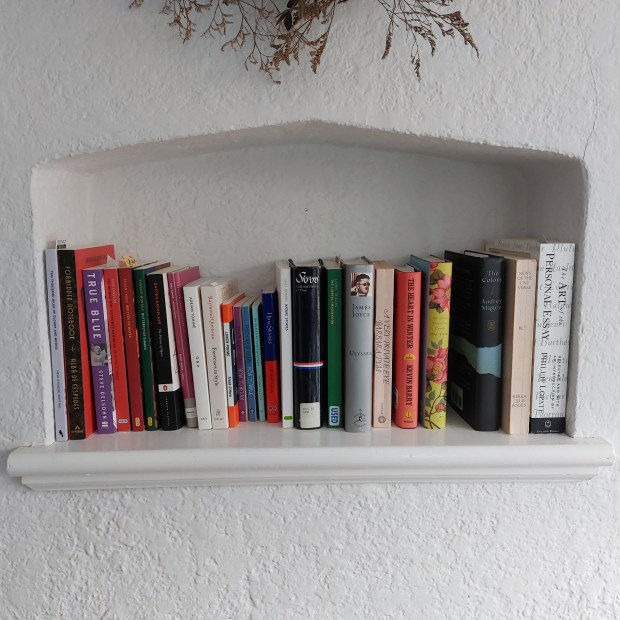
Having finished “The Paris Library,” and in long pause from Substack, I perused my small shelf (24 and 1/2 inches, to be exact) usually full of still barely opened or half read or unread books, but also some to-read-again books (as over the last few years I seem more inclined to reread something I particularly liked in a previous reading life rather than risk something new to me that might leave a bad taste or go permanently unfinished, a yucky slice of green pizza). Today, I counted 25 books on the to-read shelf. I feel no urgency about reading from the shelf. Every so often (periodically, but without a period), I wipe it clean and replace the books with a little vase of a freshly cut sprig or two.
About that phrase above, “to be exact.” Am I the type of guy who says things like “to be exact”? I don’t want to be. I knew a guy who habitually talked about other guys, and he frequently introduced his comments or opinions using the phrase, “He’s the type of guy….” He was the type of guy who used the phrase, “He’s the type of guy.” Well, there you have it. And even if he didn’t use the phrase, you felt categorized nonetheless. You got typed, along with the other guy, for you are either the type or not the type, and if you’re not that type, you’re some other type. So, to correct matters, it’s best to avoid any such shorthand phrases, for they are cliched and unnecessary, like most comments or opinions, I hasten to add, this one included. In fact, and in any case, the shorthand ends up making things longer, as I think I’m in the process of showing here. Of course, once you start to strike through stuff, you might end up with nothing. Hang out the shingle, “No Post Today.”
From the shelf of the unread, I picked “Traveling Sprinkler” (Penguin, 2013) by Nicholson Baker. I like Nicholson Baker, though I’ve only read one of his novels, “The Anthologist” (2009), which I enjoyed. But I’ve read most if not all of his New Yorker pieces (but I’ve not seen him there in awhile). I purchased “Traveling Sprinkler” used from Alibris some time ago. It’s a sequel to “The Anthologist.” It must have got wiped from the to-read shelf, not sure when, because it was just a few weeks ago I discovered it on another shelf and moved it back to the unread shelf. It had been sitting next to Baker’s “U and I: A True Story,” which twice I’ve tried to break into, both times unsuccessfully. “U and I” sat on the to-read shelf for weeks before I consigned it to a distant shelf. But I’ll get back to it, sooner or later, maybe.
Anyway, I like Nicholson Baker for several reasons. First, I very much enjoyed “The Anthologist.” I even did a bit of research, the basis for a fun post titled “Nicholson Baker, Nicholas Carr, and Googling Clothespins.” Second, Nicholson seems like a nice guy. For example, he seems to be one of the few fairly well known writers who if you follow them, on Instagram, for example, they’ll follow you back. Not that they actually check you out ever, but still, it’s nice to get followed back once in a while. I’ve not conducted a study on this, but I’m willing to guess that more than, say, 99 followers or following, assuming regular postings from either, and keeping up becomes an impossible challenge.
Baker’s latest appearances on Instagram tracked his efforts to draw, and then he came out with a new book, “Finding a Likeness: How I Got Somewhat Better at Art” (April, 2024). I’ve not read it, nor am I likely to add it to the to-read shelf anytime soon. Speaking of his wife, who’s an artist, Baker says: “She also draws with colored pencils and weaves fabric. She doesn’t make a big deal of it, she just does it.” I like that, not making “a big deal of it.” I saw it in the “Read sample” of “Finding a Likeness” at Amazon. Anyway, “Finding a Likeness” looks like a cool book, but I’m already out of room on the to-read shelf. Not that I have to self-limit to the 24 and 1/2 inches, but really, enough is enough.
And I’m enjoying “Traveling Sprinkler.” I’m only about a third of the way through it, through page 109, which ends Chapter 12, to be exact, so I probably shouldn’t try saying too much about it, until I finish it. It’s about the type of guy that’s largely unsuccessful in his career, though he doesn’t seem to have put that much into a career. In fact, I’m not exactly sure what his career is. He’s a poet of some sort, but I don’t think being a poet qualifies as a career. One reason you become a poet is to avoid a career, or to hide what you really care about from a career. Although there’s not much need to hide anything in a poem, given the unlikelihood anyone’s going to read it anyway, or if they do, understand it. He, Paul Chowder is his name, the narrator, started off as a musician, playing the bassoon. He gave up on the bassoon because he didn’t think he’d ever be good enough to make a fixed go of it. He sold his bassoon, a gift to him from his grandparents, for $10,000. I didn’t know bassoons cost that much. And that’s old dollars, before a tariff or two. He had a Heckel bassoon. He comes to regret having sold it. A major regret. I looked up bassoons just now. You can get a Moosman bassoon today for around ten grand. And if you don’t have that kind of dough (or a well endowed grandfolk) to blow on a bassoon, you now have two words to juxtapose in a poem. But what Paul wants now, and, in fact, has purchased, at Best Buy, no less, is a cheap acoustic guitar.
I didn’t know Best Buy sold guitars. Best Buy is where I bought the Chromebook I’m now typing on. I’m pretty sure I didn’t see any guitars in the Best Buy where I purchased this laptop. And Paul wants to ditch poems for songs. You might begin to understand why I said I like Nicholson Baker and “Traveling Sprinkler.” You learn a lot of footnote worthy stuff reading Nicholson Baker, that the poet Archibald MacLeish was a founder of the CIA, for example (105-107). And Baker himself played the bassoon. So is Paul a stand-in for Baker? No, I don’t think so. It doesn’t work like that. That’s too easy. All I wanted to suggest is that what Paul says about bassoons is probably reliable. He says Debussy was a fan of the bassoon, but then anyone could look up something like that.
Paul reads a lot, and attends Quaker meetings, though he’s not a full member. When he was younger (he’s on his 55th birthday as the book opens), he wanted to be a composer. He listens carefully to popular music now, but he divulges he’s never really heard or paid attention to lyrics, but he does now. I’ve made a note of a few of the songs he mentions, that I’ve never heard of, thinking I might look for them on YouTube. Kind of funny, looking a song up now, since the book is now 12 years old, and I’ve never heard of the songs he mentions, and most popular songs don’t have a very long shelf life. But then why would I have heard of his songs? And even if I had, I don’t hear lyrics either, unless it’s a Patti Page or Hank Williams song. In most rock songs, the voice is just another instrument, part of the noise. So he goes on about songs and poems, and Paul gives us the good lines from some poems, so we don’t have to waste time reading the whole poem. There’s much so far, in the first 109 pages, that I relate to. Not that you need to relate to everything you read, or anything you read. It might be better if you don’t relate. Develop new tastes. I wish I’d have discovered Penelope Fitzgerald, Barbara Pym, Elizabeth Taylor, Elizabeth Bowen, and Henry Green earlier, but sometimes you have to wait until you’re ready for something.
Paul clarifies the difference between the oboe and the bassoon, and I was reminded of the jazz appreciation class I took in college, and the instructor told the class the oboe was not played in jazz, no jazz oboe players, and I raised my hand and corrected her, pointing out that Yusef Lateef played jazz oboe. Turned out, she didn’t know that much about jazz, lectured from notes, said I was wrong about Lateef and jazz oboe. Yusef Lateef also played the bassoon. Paul probably knows that, or Nicholson Baker does, but they haven’t mentioned it yet, through page 109 of “Traveling Sprinkler.”
And so Paul buys the cheap guitar, takes a lesson, though it doesn’t sound like the lesson was much help, but he’s enthusiastic about making up some songs:
“Everything’s different when you write a song. The rhymes sound different and they happen naturally, and the chords don’t sound like the same chords played on a piano. Your fingers make choices for you. The guitar is your friend, helping you find chords you’d never have found on your own, and then these chords help you find tunes you’d never have thought to sing. It’s such a simple and glorious collaboration” (104-105).
That’s a perfect rebuttal to the academic’s put down of popular song lyrics when compared to poetry.
 The Coming of the Toads