Wanting for a word of good fit, I’ll ramble through a dictionary, in etymological pursuit. For example, just now I looked up the word pursuit and found that in a physiology context pursuit means what the eyes do, for example, when following the flight of a bird. I then looked up physiology, when what I had started looking up to begin with wasn’t pursuit at all but post. And it occurs to me that readers are like birds, flocks of readers: whodunit white-eared night herons; bibliophile bowerbirds; book-bosomed doves; frizzle-brood chickens; shelved-book house finches. Genres of readers flocked in clubs like a quarrel of sparrows, an asylum of cuckoos, a booby of nuthatches, a conspiracy of ravens, and this old couple who still perform the walk-on-water-dance of the grebes. But I can’t now seem to find the connection between post and pursuit, but perhaps it’s obvious. Even familiar words have family history and we don’t know half the story as we rush to tell.
To post on a blog is to post in effect on nothing, the original posts one might post to being a mile marker, a signboard, road sign, doorpost, or a telephone pole, for example, on which one stuck a note giving notice, information or invitation or direction, or entertainment or argument, to passers-by, readers at random, on display in a public place. Such posts usually have (though not always obvious) some purpose, unlike graffiti, say, which usually is gratuitous. So far so good, a blog post is just that, what folks used to affix to a physical post, but there is no such real post to a blog post, unless one considers this open space where we seem to be (the internet, the web, the cloud, the blogosphere, the device – whatever it’s called) a post, but not a post like a milled fir 4 x 4, a tree shorn of its branches, returned into the ground, where to post something we might need a fashioned sign and a hammer and a nail.
                      "I have nothing to say

    and I am saying it                     and that is

poetry                 as I need it      ."
And post it. But this, this post, to return to it, is not poetry; this is a blog post, a post on a blog. About nothing. But what is nothing, if not something? Cage also prepared something called “Lecture on Something,” but the above quote is from Cage’s “Lecture on Nothing,” from page 109 in Silence (1961). But then again I hesitate to call this (thing that I write on, post to) a blog. A blog is a form as a poem or a song or an advertisement is a form. What is a form? We grow so weary of nothing (unless we are one of the cognoscenti of relaxation). Nothing to do. Nothing to say. Nothing to eat. Nothing to drink. Nothing in the kitty.
So we create and tend to forms. To blog is to write, but not quite, since some blog posts are devoted exclusively to the posting of pics, often posted without referent rhyme or reason. Content without form. How is that even possible? Anyway, aren’t there enough pics posted already? Yes, and words too. Is a pic a word? If you look up pic, you’ll probably see it’s classified as informal. It does not wear a cummerbund or a gown. But of course a picture is worth a thousand words. And where does that come from, that saying? We can look it up, and do. From advertising, apparently. The ads on the sides of trolley cars, which, passing as they do, a Clanging of Birdsong, provide for a moving post on which to post in pic form enough to imprint on the random viewer in passing a brand, a product, and a suggested desire or want, to follow up on later. Soap, cigarettes, auto parts, perfumes, hats, guitar picks. Are pictures worth more than words? Something called Picture Superiority Effect, from Wiki:
The advantage of pictures over words is only evident when visual similarity is a reliable cue; because it takes longer to understand pictures than words (Snodgrass & McCullough, 1986[15]). Pictures are only superior to words for list learning because differentiation is easier for pictures (Dominowski & Gadlin, 1968[16]). In reverse picture superiority it was observed that learning was much slower when the responses were pictures (Postman, 1978[17]). Words produced a faster response than pictures and pictures did not have an advantages [sic] of having easier access to semantic memory or superior effect over words for dual-coding theory (Amrhein, McDaniel & Waddill 2002[18]). Similarly, studies where response time deadlines have been implemented, the reverse superiority effect was reported. This is related to the dual-process model of familiarity and recollection. When deadlines for the response were short, the process of familiarity was present, along with an increased tendency to recall words over pictures. When response deadlines were longer, the process of recollection was being utilized, and a strong picture superiority effect was present.[19] In addition, equivalent response time was reported for pictures and words for intelligence comparison (Paivio & Marschark, 1980[20]). Contrary to the assumption that pictures have faster access to the same semantic code than words do; all semantic information is stored in a single system. The only difference is that pictures and words access different features of the semantic code (te Linde, 1982[21]).
With regard, then, to pics and words, as used in posts on blogs, one (pics) probably is not inherently, or intrinsically, worth more than the other (words). But what’s being measured in terms of worth is the value of advertising. Where pictures meet advertising in a meld (as in to announce, where the announcement and messenger are the same) is Instagram. Originally a place to post pics for folks with a hankering for photography, Instagram has become a wake of buzzards, a commotion of coots, a swatting of flycatchers. It’s an elevator of advertisements, the etymology of advertisement including a statement calling attention to itself and at the same time a warning. An advertisement is a solicitation, to be solicited, the more notoriously so, the better. Advertisement is a form.
That music is   simple to make   comes from   one's willingness to ac-
cept       the limitations    of structure          Structure is
simple      be-cause         it can be thought out, figured out,
measured       . (111)
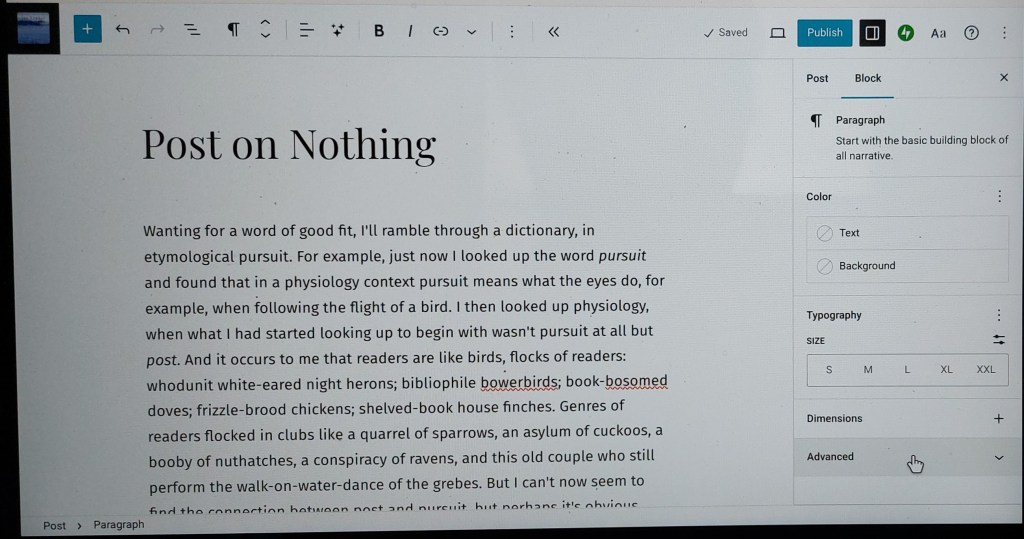
In Cage’s “Lecture on Something” entire pages are left blank. “Let no one imagine that in owning a recording he has the music,” Cage said (128). Nor, if we own a book, do we necessarily have the poetry. Cage often left sections of music blank, too, the better to hear, presumably, the truck passing through the street below the window within a piece. If Cage had had a blog, he might have expressed issues of frustration regarding the “limitations of structure.” And it’s amazing to see what he accomplished with a typewriter. Here on WordPress, poetry, modern poems, often difficult to arrange on a blog page or post, are given, in the so-called “block” format used to make the WordPress page, somewhat easily to the functional white needs of poetry. WordPress predicates the paragraph as the primary foundation (block) of writing. Maybe for prose, but not so much for poetry, and probably not at all for the writing of music or tablature. That said, I’m not an expert at WordPress styles and options. I want to write, not do computer programming, so maybe I’m missing formatting possibilities, but the WordPress Preformatted and Verse blocks seem to work flexibly enough to attempt some creative forms. But the block is self-contained – I don’t see the possibility of a block within a block, where, for example, the typography of one word might change in size relative to the typography of another word in the same line or block, or of letters to letters in the same word.
     writing      verse (unblocked words)     on  WordPress
                  is as             simple as       writing
music
           if one        accepts          the
                      limitations (rules)
                                         of structure
the structure of limits (that which can't be measured)
nothing has no limits
What limitations was I talking about again? And anyway, doesn’t verse have all the limits it needs, without bringing WordPress into the discussion? Even a piece of doggerel has its limits, its boundaries. But notice Cage said “make” music, not write music, not compose music. One can make music if one has access to any kind of sound making device. To make silence is probably the most difficult challenge. If we take a pic of this post, we’ll find a picture is not worth a thousand words, since we can’t fit a thousand words into the pic, a post of 1,453 words, 8 minutes read time.
 The Coming of the Toads