The wig is a kind of disguise, and you can flip your wig to attract attention or to disappear into a crowd. To wig out. Harder for the bigwig to change identity. It’s an old word, wig, starts with steed or horse, to ride, hence to battle. To wig out is to try to change perception, the opposite of to relax, which is no need to go any direction. Equilibrium. Balance. Which is the clown’s trade, who traffics in wigs. Mime, which requires no words.
Today’s question might be formulated: Which direction to go? We read English left to right, top to bottom; the page is not a mosaic, where we can start anywhere and go in any direction. When we view a mosaic, where do we start? Where do we end? “The present volume,” McLuhan begins “The Galaxy Reconfigured, or the Plight of Mass Man in an Individualist Society” (the last section of his book “The Gutenberg Galaxy,” University of Toronto 1962), “has employed a mosaic pattern of perception and observation. William Blake can provide the explanation and justification of this procedure. Jerusalem, like so much of his other poetry, is concerned with the changing patterns of human perception. Book II, chapter 34, of the poem contains the pervasive theme: ‘If Perceptive organs vary, Objects of Perception seem to vary: If the Perceptive Organs close, their Objects seem to close also.’” From where McLuhan goes to: “Blake makes quite explicit that when sense ratios change, men change.”
Is the paragraph the basic unit of composition? The sentence, maybe, or even the single guttural utterance. Probably depends on purpose, occasion, audience – where do we go from here, the attendee at the conference asks at the end of yet another disconnected session.
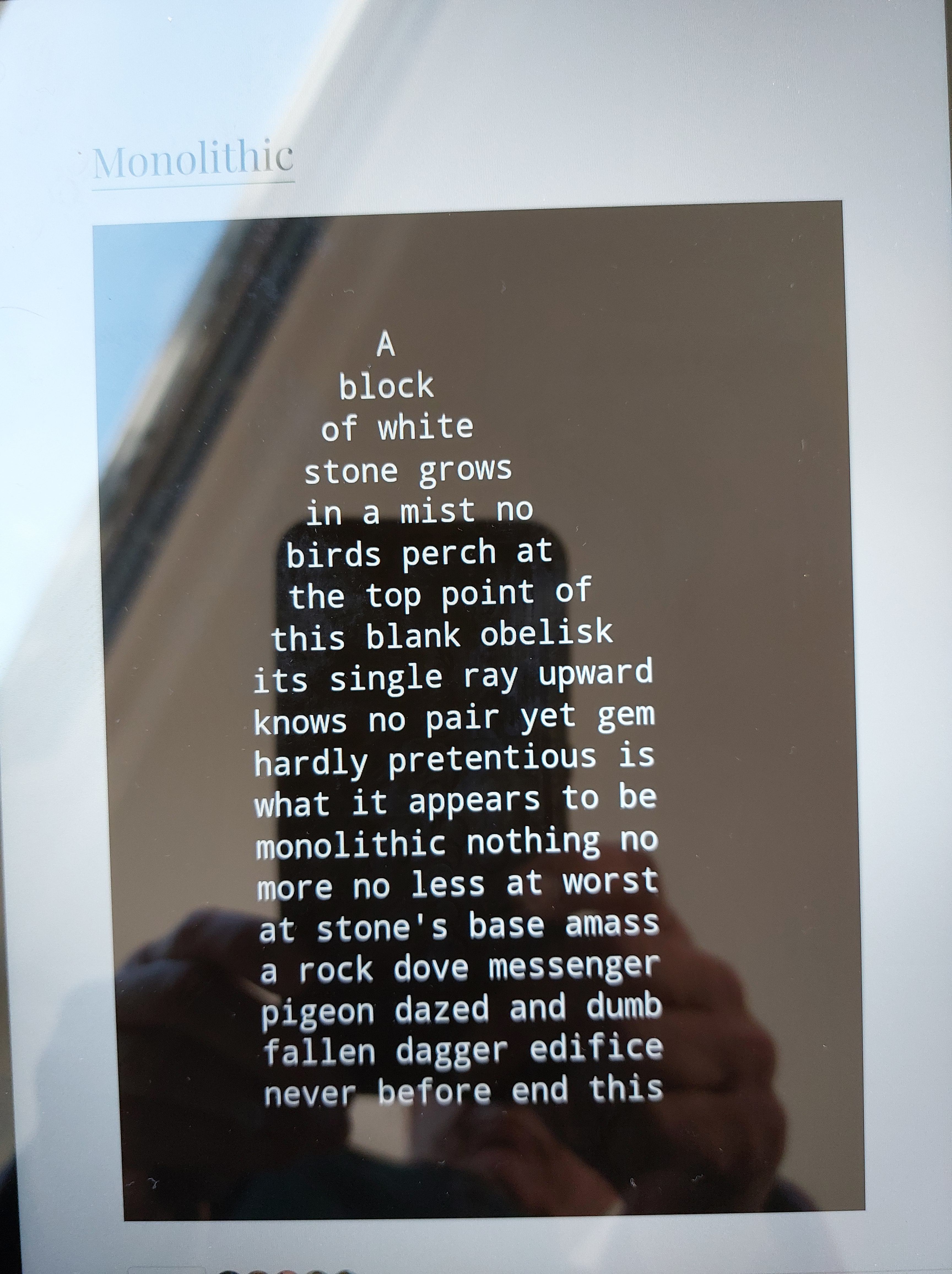
So I was thinking obelisk, in that last post (page back), as in single monolithic utterance, rising from a base, tapering to a point (as in an argument). Quite the opposite of how reading or viewing at any rate works on the cell phone, tablet, laptop, where one drops down, pages down, image after image disappearing above the horizon. How to format a monolith with the tools available to the blog (at least those I understand how to use). Begin with the white page. Writers today may seem to be living in a line-age. Lineage. Field. Map. Alternating forms. Insert image. Page down.
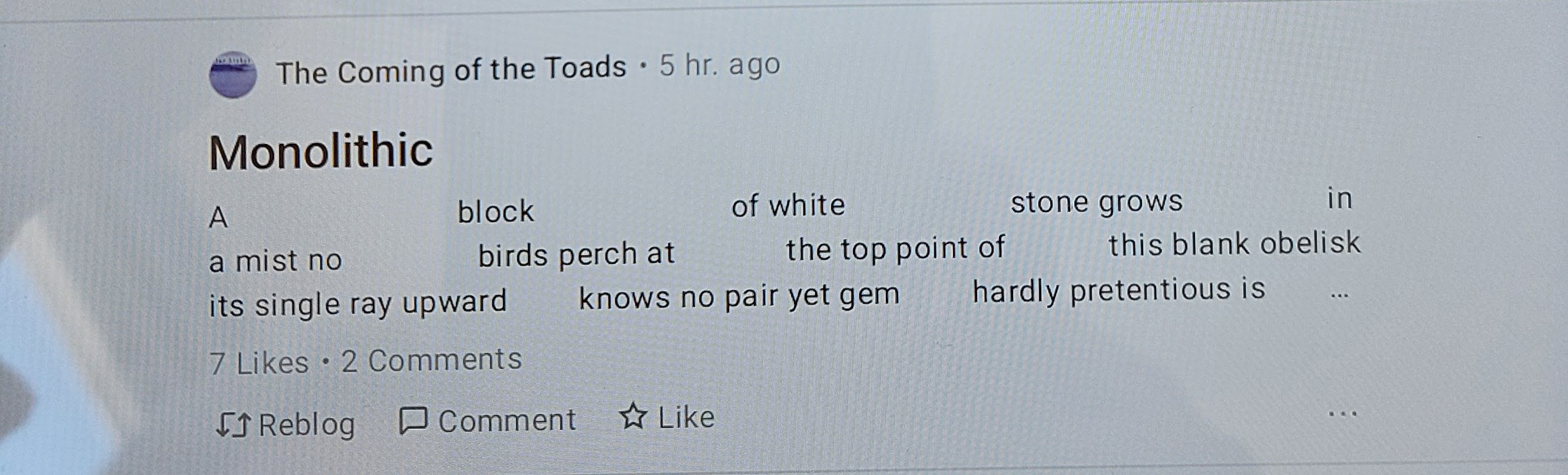
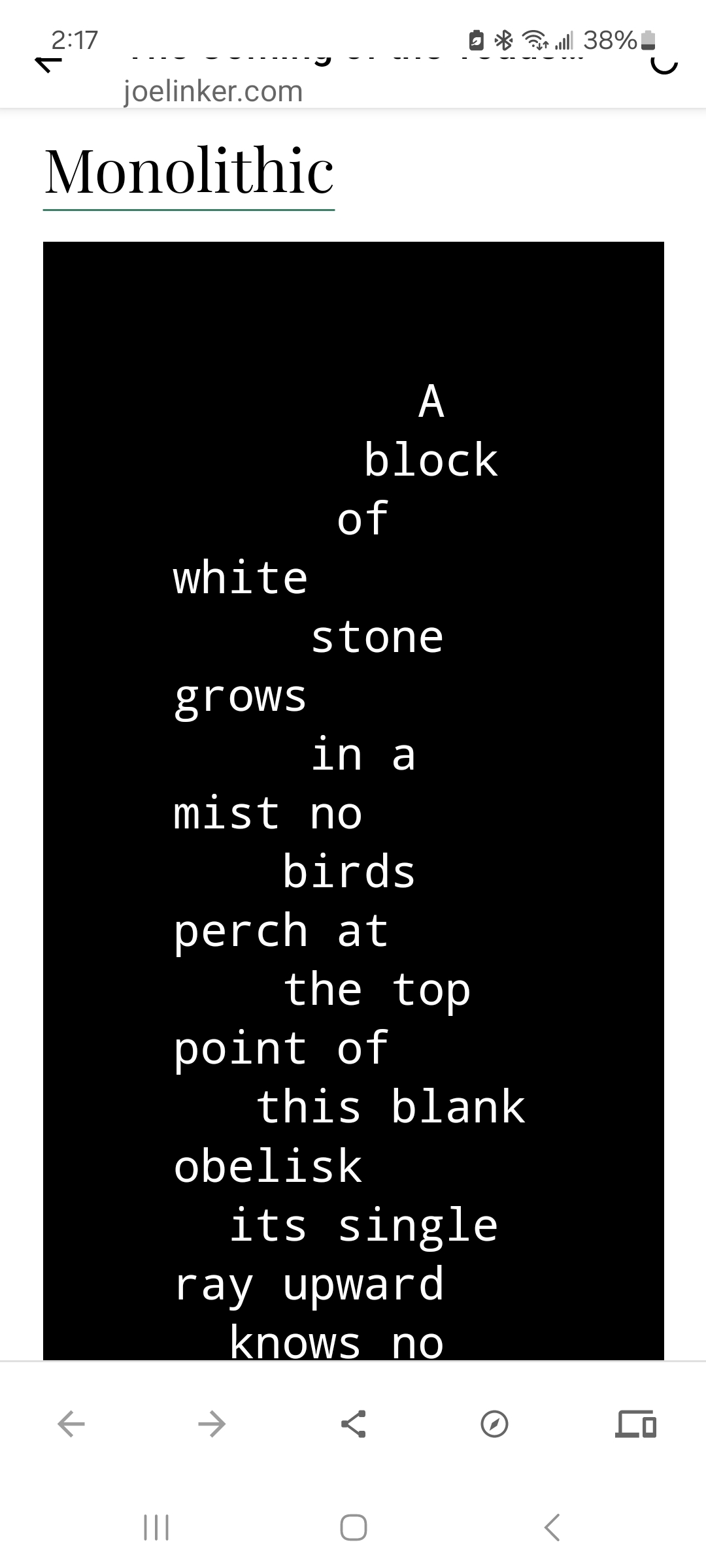
The text would be somewhat ironic, white on black field. WordPress, though, in my experience, is not conducive to drawing. And, as I mentioned a few posts ago, what you put up looks different depending on what device it’s being viewed with. Which can be pleasant or annoying, depending on your point of view. Here are a few examples, from the same post, but viewed on different devices (left to their own…):
 The Coming of the Toads