• Happy Bloomsday!

    Bloomsday, the June 16, unofficial, worldwide holiday, celebrates one of the world’s most extraordinary books, James Joyce’s “Ulysses.” June 16, 1904, is the day the book takes place. And one of the extraordinary things about the book is that its hero, Bloom, is not extraordinary at all. “The initial and determining act of judgment in his [Joyce’s] work is the justification of the commonplace,” wrote Richard Ellmann in the introduction to his biography titled simply “James Joyce” (1959).

    Joyce had and continues to have detractors. Roddy Doyle, for example, would at least like the world to know that there are other Irish writers, some brand new who also write about the common man. Noted, Roddy. But Joyce’s example provided others, including Roddy Doyle, with extraordinary opportunities in one important way, without which it might be hard to imagine works like Doyle’s Barrytown Trilogy, which includes “The Commitments,” “The Snapper,” and “The Van” (all hilarious).

    Ellmann explains: “Joyce was the first to endow an urban man of no importance [Bloom] with heroic consequence.” In fact, some early readers, Ellmann explains, thought Joyce must have been kidding, that he “must be writing satire,” for “how else justify so passionate an interest in the lower middle class?” To his Marxist critics, Joyce commented, “I don’t know why they attack me. Nobody in any of my books is worth more than a thousand pounds.” Maybe the attack is explained because “Ulysses,” past the first three episodes, anyway, is written in such a way as to prevent access to the average, common interest reader. This is one of Roddy Doyle’s complaints.

    Ellmann concludes, “Joyce’s discovery, so humanistic that he would have been embarrassed to disclose it out of context, was that the ordinary is the extraordinary.” “Dubliners,” Joyce’s book of short stories that preceded his first novel, “A Portrait of the Artist as a Young Man,” which was followed by “Ulysses,” is characterized by clear and concise writing that is accessible. And just so, Frank Delaney has devoted his Happy Bloomsday podcast, titled “Meeting Joyce,” to sharing Joyce’s “Dubliners.” It’s a great way to start reading James Joyce and to kick back and enjoy a bit of Bloomsday.

  • SMP: Sine Mascula Prole – Preparatory to Bloomsday

    James Joyce’s “Ulysses” begins with a large S that takes up most of the first page and begins the first sentence: “Stately, plump….” The book is divided into 18 chapters, or episodes, as Stuart Gilbert called them, though Joyce did not number or title the chapters. A new chapter is signaled with the start of a new page, its first line all caps. Each chapter is characterized by its own, unique writing style (the changing styles are obvious, and one doesn’t need an annotated work to note or enjoy the differences). The 18 chapters are divided into three parts, marked by separate pages with a large Roman numeral at the top: I, II, and III. Part I contains the first three chapters and part III the last three chapters, part II, then, the middle 12 chapters. Each part is signaled with a full page devoted to a large letter that takes up the entire page:

    S M P

    Why S M P? One suggestion is that the letters stand for the three main characters: Stephen, Molly, and Bloom (P for Bloom, for his nickname: “Poldy”). But P might also point to Penelope, for Molly’s soliloquy, the last chapter (Penelope was the wife of Ulysses). Certainly the first three chapters concern Stephen (the M sentence introduces “Mr Leopold Bloom…,” and the P sentence begins, “Preparatory to anything else Mr. Bloom…”). Scholarly, annotated discussions have suggested sentence, middle, predicate, Aristotle’s syllogism. Whatever.

    Frank Budgen, in his book “James Joyce and the Making of Ulysses,” explains that Joyce liked the character Ulysses for his “complete, all round character.” Ulysses was a father, a son, a husband, a soldier (but, Joyce adds, speaking to Budgen: “Don’t forget that he was a war dodger who tried to evade military service by simulating madness.”). Joyce also says that Ulysses was “the first gentleman in Europe,” and “an inventor too.” Joyce says to Budgen of Ulysses, “But he is a complete man as well – a good man. At any rate, that is what I intend that he shall be.”

    I remember at CSUDH working with my Joycean mentor Mike Mahon, and I had simply looked up SMP in some dictionary, and found that it was an acronym for the Latin phrase “sine mascula prole,” without male issue. While Bloom is a father, his son, Rudy, has died (Bloom also has a daughter, Milly), and there’s a suggestion that Rudy’s death is the cause for the distance created between Molly and Bloom, and thus Bloom, in addition to being a father, son, and husband, is made by Molly to be a cuckold. Thus indeed he is Joyce’s “complete man,” and “without male issue” may take on yet another connotation.

    It’s unlikely Joyce had any of the following in mind with regard to SMP, but since what Joyce had in mind is often beside the point, we might also enjoy considering:

    Strategic Management Plan
    Sex, Money, Power
    Simple Minded People
    See Me Please
    Smoke More Pot
    Standard Maintenance Procedure
    Sub Motor Pool

    Related: An Invitation to Celebrate Bloomsday with Frank Delaney

  • Sestina’s Angel

    Sestina falls prey to the sound silence of the Angel
    sitting in her lap playing with a ball of wireless
    a wireless webbed feline bureaucracy
    where pleas receive no reply
    and the sole sound is a silent catty wind
    and long days pass with nothing said of the terrible

    Rilke ranted something about beauty being terrible
    while in Sestina’s lap sat the lapping catting Angel
    who cannot hear in the stringless whine
    no place for the bird to come to rest on any wire
    wireless carriages of desire race to a place where all replies
    are lost in the terrible beauty of the host’s hidden bureaucracy

    At Sestina’s night bureau sits a bird clicking crazily
    a loon poet on the bum singing terribly
    rolling out with rigor a robust reply
    to the Angel
    who threatens to wire
    up the wireless wind

    To tone down this tuneless wordwind
    while sleeps the will-less bureaucracy
    wireless
    and terrible
    but for now the Angel
    sends no reply

    Any ranting request certainly receives no reply
    as Rilke races the ramparts terribly winded
    and shaking her head the windless wireless Angel
    disappears into the flow chart of blissful bureaucracy
    to that place so terrible
    wireworms crawl the tripwires of the hardwired

    Waving to the boldest bidder of weird wire
    waiting for the beauty of the instantaneous reply
    that memo from the waiting Angel so terrible
    dark wings unfold and the winds unwind
    the galaxies of celestial bureaucracy
    bang and bend in time to the tune of the supreme Angel

    The terrible embrace of the wireless
    Angel orders no reply
    For wellness dwindles so deep in such a bureaucracy


    See more Sestinas.

  • “…light out for the territory…” at berfrois!

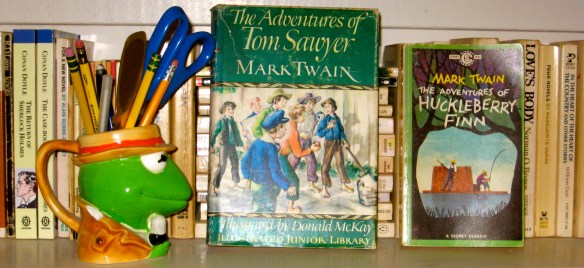
    “…and so there ain’t nothing more to write about, and I am rotten glad of it, because if I’d ‘a’ knowed what a trouble it was to make a book I wouldn’t ‘a’ tackled it, and ain’t a-going to no more. But I reckon I got to light out for the territory ahead of the rest, because Aunt Sally she’s going to adopt me and sivilize me, and I can’t stand it. I been there before” (Huckleberry Finn, last sentences).

    Check out the Toads post at berfrois: “…what happens to Huck when he winds up in a research paper writing class? Tom skates through while Huck suffers the fantods.”

  • An Invitation to Celebrate Bloomsday with Frank Delaney

    James Joyce’s “Ulysses” begins with a large S that fills the whole page and ends with a small s, “yes.” The book opens, “Stately, Plump Buck Mulligan came from the stairhead, bearing a bowl of lather on which a mirror and a razor lay crossed.” And meanwhile, four chapters in, “Mr. Leopold Bloom ate with relish the inner organs of beasts and fowls.” It’s morning in Dublin, June 16, 1904. The entire book takes place on that day. This coming Saturday, June 16, readers worldwide will celebrate “Bloomsday,” the 108th fictional birthday of “Ulysses,” that is, of the day the story takes place. The last page of “Ulysses” says “Trieste-Zurich-Paris, 1914-1921,” suggesting Joyce worked on his novel for seven years. It would be December, 1933, when Judge Woolsey freed the book from censure, before US citizens would be able to access “Ulysses” unmolested by itching assessors scandalized by what they see in a looking glass. In his historic opinion, Woolsey said, “‘Ulysses is not an easy book to read or to understand. But there has been much written about it, and in order properly to approach the consideration of it it is advisable to read a number of other books which have now become its satellites. The study of ‘Ulysses’ is, therefore, a heavy task.” And readers with a purely, solely, soily, prurient interest will be sorely disappointed.

    Guessing from the number of Joyce books on my shelves one might conclude that Joyce is my favorite writer. In some ways, yes, but a general interest reader needs and wants so much, and while Joyce is a good friend, the point of a library ought to be, to quote Joyce from another of his books, “Finnegans Wake,” “Here Comes Everybody.” But yes, I love Joyce essentially.

    Readers wanting to start Joyce might want to begin with his book of short stories, “Dubliners,” for it is engaging, accessible, entertaining, and a good introduction to Joyce’s characters. Joyce’s characters include everyone: “…happinest childher everwere.”

    But on to Bloomsday, 2012. I received in yesterday’s electronic mail an invitation to celebrate Bloomsday with the celebrated writer, Frank Delaney. I can think of no one I’d rather spend Bloomsday with, and I’m extending the invitation below to you, too, to have some fun with Delaney and Joyce on Bloomsday. If you are new to “Ulysses,” I suggest you try some of Delaney’s podcasts, for hearing the book read, following Delaney’s clear introductions, is sometimes easier than going it alone with the text. In any case, here’s the invitation I received, quoted verbatim, with a few editorial comments and added information I’ve inserted in brackets:

    Celebrate Bloomsday with Frank Delaney

    June 16th, 2012 marks the first Bloomsday in which James Joyce’s mighty novel Ulysses is free from copyright and from the restrictions of the famously difficult Joyce estate [see “The Injustice Collector” and “Has James Joyce Been Set Free?“]. Celebrate in a series of projects and events conducted across land and Internet by Frank Delaney:

    Re:Joyce Podcast, two years old

    Dip into Ulysses by reading along with Frank Delaney in his spirited weekly podcast, Re:Joyce, launched on Bloomsday 2010.

    Each segment [Joyce’s “Ulysses” is famously divided into chapters or segments, though the book itself isn’t obviously marked so. The easiest chapters are the first three, but for sound and language, the chapters following are my favorites, as well as the last chapter, the so-called soliloquy of Molly Bloom] features Delaney taking a short passage from Ulysses and exploring its multitude of references with insight, eloquence, passion, vast expertise—and a good dose of fun. As of Bloomsday 2012, Delaney will be in the midst of Chapter Three, and have reached podcast episode #105. Followed by academics, library groups, Joycean societies, scholars across the world, as well as ordinary folk, Delaney’s goal in deciphering and decoding the dense and rich text of the book is to allow greater enjoyment, by far more readers, of the book he holds most dear [and there really isn’t any other book about which this much fanfare is possible, which helps explain Bloomsday]. The podcasts have been downloaded nearly 500,000 times and have been covered in The EconomistNPR, The New York Times to name but a few. They are available for download on iTunes and www.FrankDelaney.com.

    Rosenbach Bloomsday Festival

    Frank Delaney is speaker and Guest of Honor at the annual Bloomsday celebrations of Philadelphia’s Rosenbach Museum & Library, whose collection includes the papers of James Joyce, Benjamin Franklin, Lewis Carroll, Marianne Moore, Maurice Sendak, Dylan Thomas and Cervantes. Event information for the Rosenbach Bloomsday Festival (one of the largest in the world) is available here. Tickets for The Rosenbacchanal are available here

    “Ulysses” Live: Additional Joycean projects of Mr. Delaney’s include: 

    Joyce Ways: Frank Delaney is the voice of “Joyce Ways”, an app with audio-visual guidance designed to lead and delight literary pilgrims through the streets of Dublin, on the trail and itinerary of Ulysses. “Joyce Ways” was created by the students of Boston College, under the direction of Joseph Nugent, and will launch 6.9.12. 

    Occupy Ulysses: an event at Madison Park, New York, staged on the day Ulysses was released from copyright (February 2, 2012). 

    The James Joyce Rap, Delaney’s witty, engaging, tongue-in-cheek portrait of the artist. As off-center and provocative as Joyce himself, this giddy homage serves up Joyce as Delaney’s hero, within a Pythonesque environment.  Funny, irreverent and surprisingly touching, we’re given more than a hint as to why Delaney has chosen Joyce as a major part of his life’s work.

  • Bless me critic, for I have read…

    So-called Easy Reads should not be confused with Easy Writes. There are no easy writes. “Writing is hard, even for authors who do it all the time,” Roger Angell reminds us in the “Foreword” to the fourth edition of “The Elements of Style,” the lately lambasted as prescriptivist poppycock handbook that nonetheless many still enjoy – but at least this Angell point seems unassailable.

    Arthur Krystal’s “Critic at Large” piece in the May 28, 2012 New Yorker (81-84), titled “Easy Writers,” revisits the highbrow impulse to visit the literary gutter. He doesn’t mention “The Elements of Style,” but he might have. The literary gutter is where one finds one’s genre or formula works, potboilers, dime store paperbacks, Classics Illustrated, though Krystal seems to stop short of the romance novels, so even the critic at large granting absolution for partaking in “guilty [reading] pleasures” might still be seen separating the venial from mortal reading sin.

    Krystal’s piece is behind the New Yorker paywall, so get it at the library or get a subscription. Krystal writes some choice lines: “Modernism, of course, confirmed the idea of the commercial novel as a guilty pleasure by making the literary novel tough sledding.” White, of course, would have struck Krystal’s “of course” as needless words. And there’s the rub to the whole nexus: Krystal’s audience. Who’s he saying “of course” to? He says, “…intelligence could be a hindrance to writing fiction; otherwise, every intelligent critic would be capable of writing a readable novel,” thus like a boxer at a punching bag left rights with stinging insult both writer and critic at once.

    Ibsen said of Zola that Zola went to the sewer to take a bath in it, while Ibsen waded in wanting to clean it. Just so, the general interest reader goes to the literary gutter to play in the mud, not to tidy things up. Feeling guilty for some readers is no doubt part of the pleasure. “Apparently,” Krystal says, “we’re still judged by the books we read, and perhaps we should be.” And who’s the judge? Krystal shares critic Harold Bloom’s testimony against Stephen King, upon King’s winning a medal from the National Book Foundation: “The fact that the…judges [Bloom said] ‘could believe that there is any literary value there or any aesthetic accomplishment or signs of an inventive human intelligence is simply a testimony to their own idiocy.’” Maybe, but does that absolve Bloom of being in denial? Bloom has written a shelf load of critical works and one novel, which he has disinherited.

    There are no reading sins, but if one needs to confess something, it might be for not reading anything at all.

  • On Angels

    A post this past week over at Course of Mirrors prompted me to brush up on Angels. I have not read the book mentioned in the post, “The Wonderful Visit,” by H. G. Wells, but according to Ashen, it’s about an angel shot from the sky by a hunter all atwitter after a strange bird has been sighted in the area. Imagine shooting an angel. I’m going to have to read Wells’s “The Wonderful Visit.” Ashen says it followed “The Time Machine,” yet I don’t even recall ever hearing of it, let alone reading it. Well, Wells was a super-prolific writer, an angel of a higher order. Part of Ashen’s theme, I think, is that we have come to think of angels as cute, cuddly Cupids, innocuous Hallmark Card versions of a much more potent and potentially dangerous entity.

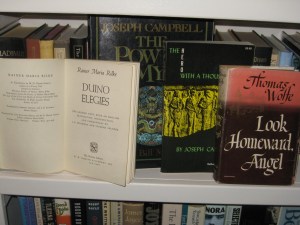
    Was Rainer Maria Rilke a blogger? In “The First Elegy,” he wonders if any angel might hear him, “wenn ich schriee,” (“if I cried”). But various translators (perusing the Web) have given, “if I cried out” (but not William Gass, whose version I want to read). My copy of the “Duino Elegies” (The Norton Library, N155, 1963) shows the German next to the English, and was translated by J. B. Leishman and Stephen Spender. They give, “Who, if I cried, would hear me among the angelic orders,” and in their introduction they explain that Rilke was visiting a friend, a Princess Marie, at “Schloss Duino,” a castle near Trieste. He’d received a disturbing letter, a “business letter,” and went out onto a castle “bastion,” for a walk, and “a voice had called to him” with what became the first line of the Duino Elegies. According to the introduction, there was a “roaring wind” blowing around the castle. No one would hear him if he cried, or if he cried out. Yet surely an angel can hear through the noise.

    Still, to “cry out” suggests some danger or risk at hand, some fear escaping in a scream of alarm. To simply “cry” does not necessarily suggest a yell, and might not mean a sound at all, but to cry tears, which can be done quietly. The German word Rilke used is “schriee,” which seems in German a form of yell, scream, and cry. Yet, it may not matter, for Rilke decides, in “The First Elegy,” to “keep down my heart.” He does not cry or cry out. For if he did, and an angel did hear him, and suddenly embraced him, he would disappear into the Angel’s super human existence. Yet, the angel “disdains to destroy us.” The angels ignore us, our cries, our crying, our predicament. Yet the “Elegies” might be Rilke’s cry, or his crying.

    Here’s the opening of “The First Elegy,” by Rainer Maria Rilke, translated by Leishman and Spender:

    “Who, if I cried, would hear me among the angelic
    orders? And even if one of them suddenly
    pressed me against his heart, I should fade in the strength of his
    stronger existence. For Beauty’s nothing
    but beginning of Terror we’re still just able to bear,
    and why we adore it so is because it serenely
    disdains to destroy us. Each single angel is terrible.”

    I posted my own version in a comment to Ashen’s post, thinking of updating the Rilke to a contemporary setting, keeping the irony. I’ve added to it just a bit here:

    I rant in a memo to an Angel
    perched high on a wire
    of flow chart bureaucracy,
    but her beauty ignores me;
    it’s just as well,
    for the beauty of her instant reply
    would replace me.
    Every memo from the angel is terrible.

    Rilke seems to be suggesting that an angel, compared to the human, is like a light bulb to the moth. The moth is drawn to the heat and light by some desire to fly out of the shadows of its nightly existence, but is consumed by the giant bulb. And Rilke calls this being consumed by the object of one’s desire, “beauty,” which is why he says “terrible beauty,” which is why the angel is terrifying. Yet Rilke also says the angel “disdains to destroy us.” Apparently, we can only just bounce off the light bulb. We can’t penetrate it, and its light does not embrace or consume us. We cannot fully embrace beauty, which is a terrible predicament.

    Joseph Campbell has an interesting discussion of angels, and of Satan. Satan was thrown into hell, Campbell reminds us in “The Power of Myth,” but why? What did he do wrong? Campbell suggests that God wanted the angels to serve his new creation, man, but that Satan so loved God that he refused to bow to any other. He was thrown into hell for not bowing to man. Thus man had bagged his first angel.

    “The Second Elegy” begins with a line from the first. Rilke’s not giving up on his angels:

    “Every Angel is terrible. Still, though, alas!
    I invoke you, almost deadly birds of the soul,
    knowing what you are.”

  • Cheese Grilled with Sliced Banana Sandwich; or, A History of the World in 6 Innings

    Tom Standage’s “A History of the World in 6 Glasses” begins with beer. Beer “was not invented but discovered.” It’s not clear who found the first can, but according to Standage the ice age was a cold memory, and down in the Fertile Crescent they were building up a spring training thirst. “Hey, take a sip of this…Well, what do you think?” “Not bad; pour me a glass.” Earliest beer, Standage tells us, was not lite, and probably required a straw to get through the head of unfiltered crust of stuff floating on top, something like a bowl of oatmeal forgotten on your counter the week you flew up to Portland for the annual brew fest.

    I’ve been thinking of writing a history of my world (not to be confused with the world) in 6 somethings. How about, “A History of my World in 6 Sandwiches”? The first would have to be my cheese grilled. When I was a kid I learned to make a cheese grilled with sliced bananas. Served on a paper plate with a few potato chips next to a glass of milk with a Dodger game on the radio – this is the stuff history is made of.

    I mentioned my cheese grilled to some visitors from Arcadia last week, and they and Susan ganged up on me with a correction: grilled cheese, not cheese grilled. “You can also make a cheese grilled with sliced bananas into a tuna melt,” I said, ignoring the prescriptivists. I’m just describing a sandwich here, not wanting to provoke a language war. Use organic tuna, if you can get hold of a can.

    I would probably follow my cheese grilled with my southwester burger, made with sliced jalapeno and bell pepper and stuffed with Monterey Pepper Jack cheese. First, douse the burger in olive oil and Worcestershire sauce and beer. Serve on a white ceramic plate with a poured glass of ale or lager of choice – no prescription needed, but you should let it breathe.

    Post called on account of rain, but we got about 6 innings in, so no need to replay it. Still, I wonder what the usage panel would have to say about grilled cheese versus cheese grilled. Care to weigh in? What’s your prescription?

  • “Penina’s Letters”: Hawthorne Fellows at The Attic Institute

    Strolling readers! Announcing:

    Writer at work, work in progress:

    I’m a Hawthorne Fellow at the Attic Institute for the period April through August 2012, working on a novel tentatively titled “Penina’s Letters.” The first chapter is now on-line at The Boulevard (Issue # 3), a publication of the Hawthorne Fellows at The Attic Institute. Please check it out, and read the other Fellows as well!

  • The Postman Always Rings Twice, the Plumber Rarely More Than Once

    I read a book this week, “The Postman Always Rings Twice.” There is no postman, but plenty of rings. The title page of my copy is stamped “WITHDRAWN,” and below that, “CIRCULATION STORAGE,” and above the publisher info., “SIERRA MADRE PUBLIC LIBRARY.” When a library “withdraws” a book, perhaps some helpful librarian might add a note of explanation as to why the book is being withdrawn. My copy, a casual gift from an old, steady friend, is still in decent condition, 187 pages of hardback, hard read, not to be confused with hard to read, but hard in the deadpan noir sense, where none of the characters are likeable, not even the so-called good guys, and all are static characters – no one changes from beginning to end.

    I also repaired a toilet this week, having to drive to the hardware store only twice, which is par for home repairs in my neck of the woods. To drive to the hardware store only once in the process of a repair job like fixing a toilet is a hole in one. A real plumber rarely requires more than one trip to fix a toilet. A real plumber is a master of the hole in one repair job.

    A cat plays a prominent role in the “Postman” book, illustrating the randomness with which animal nature creeps about, often spoiling plans with ironic gifts from the cosmos, like Flannery O’Connor’s grace (the cat in “A Good Man is Hard to Find” comes to mind, too, reading “Postman”). The lead prosecutor in the “Postman” case, Sackett, calls the anti-hero, Frank Chambers, a “mad dog.” Frank Chambers is an interesting name, a formal place of serious purpose. There is also rank in the chambers, and, in the tradition of the Naturalist writers, one cannot change the rank into which one is born. There’s only one murder, but two attempts, perhaps the twice ringing of the title. I found no evidence that a cat played a role in the toilet failure business mentioned above, but I wouldn’t have been surprised. Meanwhile, I was also thinking ahead to Flannery’s “Good Man” anti-hero character’s name, “The Misfit.” The Misfit would be a good name for a cat.

    “Postman,” by James M. Cain, was originally published in 1934. My copy is a tenth printing, October 1945. Edmund Wilson thought that perhaps it was the hard times that seemed to call for some hard writing. But some are born into hard settings, others into easy chairs, and the postman seems to ring indiscriminately, without regard for regal versus rough. And he can find you on Route 66 just as easy as out on Highway 61. My copy has library markings on the inside back cover. There are two sets of 5 vertical lines crossed diagonally left down to right in the upper left corner. Under that, vertically down the inside back cover, 82 with 4 hash marks, then 82 with 1 hash mark, and so on: 84, 4 hash marks; 85, 2 hash marks; 89, 1 hash mark; 90, 1 hash mark; 91, 2 hash marks; 92, 2 hash marks; 93, 3 hash marks; 94, 1 hash mark; 95, 1 hash mark; then, a new column: 98, 2 hash marks; 99, 1 hash mark; 02, 1 hash mark; 03, 1 hash mark; 04, 3 hash marks. I’ve added, below the 04, 12, and 1 hash mark. If someone else reads it, I’ll add a second hash mark under 12. Maybe I’ll start my own library of library discards, “The Used, Used Library.” We find ourselves in hard times for libraries.

    I don’t know if Cain was ever at the Sierra Madre library, but maybe he was. And if he was, I wonder if he checked out and read Theodore Dreiser’s “An American Tragedy,” which came to mind as I was reading “Postman,” later in the book. Dreiser’s book, published in 1925, also tells of lives and plans of deception all gone awry thanks to chance occurrences but that result nevertheless in crime and punishment. Dreiser, though, filled his book with background and foreshadowing, motivations and cross-purposes, not to mention long sentences. Cain’s book is terse, devoid of metaphor. But what links “Postman” to “Tragedy” is the notion of Naturalistic purpose, helpless humans trying to create some sense of reason in a reasonless and unreasonable world, and of the influence of chance in ruining the seeming reasonableness of planning for something, for anything. Camus’s “The Stranger” also comes to mind, particularly given the parallel scenes with a priest at the end of both “Stranger” and “Postman.”

    If “Postman” is good, it’s because it accomplishes its purpose. Whether or not that purpose is good is another matter.

    I discovered the problem with the toilet had to do with the overflow tube, which was higher than the critical level mark on the filler valve. Thus when the float stuck, the water spilled out the handle hole before it reached the overflow tube. The toilet never even had a chance to run. I replaced the filler valve and flapper, and took a hacksaw blade and cut the overflow tube down to 1″ below the CL line on the filler valve, which, I discovered, is code. The toilet had been out of compliance. Then I had to make the second trip back to the hardware store, to buy a new handle, which is what broke to begin with – there were two problems at once – but I had so focused on the sticking float problem that I had forgotten about the broken handle. This is how noir plots are constructed.

  • Writing and the Wickets of Croquet

    In Chapter VIII of Lewis Carroll’s Alice’s Adventures in Wonderland, titled “The Queen’s Croquet-Ground,” Alice plays a game of croquet with some of the Wonderland characters. Croquet, of course, at least as played in the domestic, backyard game I am familiar with, is notorious for its confusion of rules, which reminds me of rules for writing.

    “Alice thought she had never seen such a curious croquet-ground in her life; it was all ridges and furrows; the balls were live hedgehogs, the mallets live flamingoes, and the soldiers had to double themselves up and to stand on their hands and feet, to make the arches.”

    Just so, as I sit down to compose, I must first compose myself, and decide which pose I should adopt. But the words soon reveal themselves to be live hedgehogs (spiny and fortified), the keyboard a live flamingo (awkward, to say the least).

    “The players all played at once without waiting for turns, quarrelling all the while, and fighting for the hedgehogs; and in a very short time the Queen was in a furious passion, and went stamping about, and shouting ‘Off with his head!’ or ‘Off with her head!’ about once in a minute.”

    The Queen would be the reader, the grader, the scorer, but what’s she looking for in this game with so many rubrics on the field all at once? A fragment and it’s off with your head.

    “‘I don’t think they play at all fairly,’ Alice began, in rather a complaining tone, ‘and they all quarrel so dreadfully one can’t hear oneself speak — and they don’t seem to have any rules in particular; at least, if there are, nobody attends to them — and you’ve no idea how confusing it is all the things being alive; for instance, there’s the arch I’ve got to go through next walking about at the other end of the ground — and I should have croqueted the Queen’s hedgehog just now, only it ran away when it saw mine coming!’”

    Style is a way of putting the words to sleep, of arresting the croquet balls and mallets. Alice is talking to the Cheshire Cat, who has only partially reappeared, and who soon disappears, “while the rest of the party went back to the game.”