• Mosaic Writing

    McLuhan suggested we pay a price for literacy. There’s a difference between illiteracy and non-literacy. An illiterate person can neither read nor write written texts in his native language, while a non-literate person’s language has no written text, no alphabet.

    It’s moving from non-literacy to literacy where a price is paid: “The visual makes for the explicit,” McLuhan said, “the uniform, and the sequential in painting, in poetry, in logic, history. The non-literate modes are implicit, simultaneous, and discontinuous, whether in the primitive past or the electronic present, which Joyce called ‘eins within a space’” (GG, 73).

    Thus the “World Wide Web” may be promoting a kind of non-literacy, where the mosaic form of presentation dominates the chronological, the linear, the literate, where the literate means a fixed point of view: “This visualizing of chronological sequences is unknown to oral societies, as it is now irrelevant in the electric age of information movement” (GG, 72).
    Yet, McLuhan reminds us that “only a fraction of the history of literacy has been typographic” (GG, 93).

    So, what’s the price? For one thing, McLuhan said, “the divorce of poetry and music was first reflected by the printed page” (GG, 240).

    And all the effort we’ve put into learning to read left to right, up to down, front to back – when presented with a mosaic, we don’t know where to begin reading. We may not know how to read mosaic writing. The Internet is a mosaic. And as we learn to read on the Internet, we may be losing our preference for, and the skills required to read, sequential writing.

    Some excellent examples of Mosaic Writing include:
    “Silence” and “A Year from Monday,” by John Cage
    “Finnegans Wake,” by James Joyce
    “Love’s Body,” by Norman O. Brown
    “The Guttenberg Galaxy,” by Marshall McLuhan

  • A Year From The Use and Misuse of English Grammar

    We learn grammar when we learn to speak, we know grammar, we pause where we want, when we want, pulling words like fish from our Pond of Vocabulary and stringing them on the line, one after another, one to a hook, using commas instead of periods when we don’t want to be interrupted, YELLing when someone is so rude as to keep on talking when we are trying to interrupt – we fall silent, dashed, a period of rigour-tunge follows (our tongues rigged with rules), then we bounce awake, trim our sails, for we’re surrounded in the Bay of Prescription, the murky waters of communication, with boats of advice all bopping this way and that (there goes the “Do This,” firing across the bow of the “Don’t Do That”), the pond stormy on a storm swept night if there ever was one.

    In Wendell Johnson’s “You Can’t Write Writing,” (The Use and Misuse of Language, 1962, S. I. Hayakawa, ed.), we learn that bad grammar, baby, ain’t our problem: “The late Clarence Darrow, while speaking one day to a group of professors of English and others of kindred inclination, either raised or dismissed the basic problem with which his listeners were concerned by asking, ‘Even if you do learn to speak correct English, who are you going to talk it to?’ Mr. Darrow was contending…the effective use of the English language is more important than the ‘correct’ use of it, and that if you can speak English ‘correctly,’ but not effectively, it does not matter very much ‘who you talk it to’” (101).

    This has implications for those who would aspire to teach writing, and Johnson continues, “The teacher of English appears to attempt to place the emphasis upon writing, rather than upon writing-about-something-for-someone. From this it follows quite inevitably that the student of English fails in large measure to learn the nature of the significance of clarity or precision and of organization in the written representation of facts” (103).

    Grammar is the least of our worries, argues Johnson: “So long as the student’s primary anxieties are made to revolve around the task of learning to spell, punctuate, and observe the rules of syntax, he is not likely to become keenly conscious of the fact that when he writes he is, above all, communicating…his first obligation to his reader is not to be grammatically fashionable but to be clear and coherent” (103).

    Hayakawa, in his introduction, has already explained his interest with regard to how people talk: “We are not worrying about the elegance of their pronunciation or the correctness of their grammar. Basically we are concerned with the adequacy of their language as a ‘map’ of the ‘territory’ of experience being talked about” (vii). And, ultimately, for the reader interested in more than mere prescriptions on how to write, emphasis is placed “not only on what the speakers said, but even more importantly on their attitudes towards their own utterances” (vii).

    Hayakawa sums up his concerns as follows: “What general semanticists mean by ‘language habits’ is the entire complex of (1) how we talk – whether our language is specific or general, descriptive or inferential or judgmental; and (2) our attitudes toward our own remarks – whether dogmatic or open-minded, rigid or flexible” (vii).

    Whenever I hear some self-appointed cop of language (or worse, someone with the badge of a degree), attempting to arrest a speaker’s tongue, putting it in the handcuffs of some prescriptive rule, I think about Hayakawa’s The Use and Misuse of Language.

    But, unforlorn, I’m inclined toward and recline with an infuzen of John Cage, who sums the problem up nicely in his A Year From Monday (1969), which begins with “DIARY: HOW TO IMPROVE THE WORLD (YOU WILL ONLY MAKE MATTERS WORSE) 1965

            I.               Continue; I’ll discover where you

                                sweat  (Kierkegaard).            We are getting

    rid of ownership, substituting use.

    Beginning with ideas.            Which ones can we

    take?            Which ones can we give?

    Disappearance of power politics.            Non-

    measurement.”

    Related:

    “You Can’t Write Writing”
    Baseball and the Parts of Speech
    Stanley Fish, Full of Ethos
    Kicking E. B. White When He’s Down
    The Bare Bodkin of the English Major
    How to Teach College Writing to Nonreaders

  • How to Teach College Writing to Nonreaders

    How should introductory college writing be taught to today’s nonreaders? E. B. White said to “make the paragraph the unit of composition.” But the paragraph is made of sentences, so why not start with the sentence? Francis Christensen did, and his original Notes Toward A New Rhetoric: 6 Essays for Teachers (1967), is today available as Notes Toward A New Rhetoric: 9 Essays for Teachers (3rd Ed., 2007).  A preview of his “A Generative Rhetoric of the Sentence” can be viewed here.

    “The teacher of writing must be a judge of what is good and bad in writing,” Christensen said, but “from what sources do they say ‘Do this’ or Don’t do that?’”

    Christensen used a descriptive rather than a prescriptive approach based on his “…close inductive study of contemporary American prose.” In part, his work was a response to the “many English teachers [who] abide by the prescriptions of the textbooks they were brought up on. This preference is one that I cannot understand,” he said, “since it means taking the word of the amateurs who hack out textbooks that talk about language (fools like me) as against the practice of professionals who live by their skill in using language.”

    Christensen’s inductive study resulted in his new method because he realized that, for example, there existed “…no textbook whose treatment of grammar and syntax could cope with more than a small fraction of its [Ralph Ellison’s Invisible Man] sentences, but I would venture the claim that there is not a sentence whose syntactic secrets could not be opened by the key fashioned in the first two essays [of his Notes Toward…].”

    Christiansen’s descriptive method recognized that grammar knowledge does not necessarily result in good writing. But Christiansen’s descriptive method does not ignore grammar. He said, “…the rhetorical analysis rests squarely on grammar,” but that “it should surprise no one that no experiments…show any correlation between knowledge of grammar and the ability to write. One should not expect a correlation where no relation has been established and made the ground for instruction.”

    But neither should that be used, he goes on, to argue “that the only way to learn to write is to read literature [because] what is true over a lifetime is not true of the fifteen weeks of a semester. In practice, this position throws the burden of learning to write on the student. It expects him to divine the elements of style that make literature what it is and apply the relevant ones to writing expository essays about literature – a divination of which the teachers themselves are incapable. If reading literature were the royal road that this argument takes it to be, English teachers would be our best writers and PMLA would year by year take all the prizes for nonfiction.”

    But why shouldn’t students be made to take on “the burden of learning to write”? And why does Christensen make the assumption that English teachers are so well-read? They have that reputation, but how much reading, in the midst of a full load and stacks of student papers to get through, are they able to get done “over a lifetime”? Consider, for example, this typical Christensen observation, made from his inductive study: “…our faith in the subordinate clause and the complex sentence is misplaced…we should concentrate instead on the sentence modifiers, or free modifiers.” But how do we know that without making the same inductive study he made? Indeed, Notes Toward a New Rhetoric, in sum, while not at all ignoring grammar, recommends taking the inductive study into the classroom, reading literature to teach writing.

    “Oh, teachers, are my lessons done? I cannot do another one.
    They laughed and laughed, and said, ‘Well child,
    Are your lessons done?
    Are your lessons done?
    Are your lessons done?’”

    …from “Teachers,” by Leonard Cohen, 1967.

    Related:

    Baseball and the Parts of Speech
    Stanley Fish, Full of Ethos
    Kicking E. B. White When He’s Down
    The Bare Bodkin of the English Major

    Notes toward a New Rhetoric
    Francis Christensen
    College English
    Vol. 25, No. 1 (Oct., 1963), pp. 7-18
    Published by: National Council of Teachers of English
    Article Stable URL: http://www.jstor.org/stable/373827

  • Where we go from Greil Marcus to Humpty Dumpty

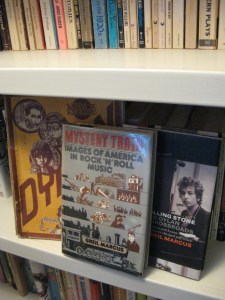
    I bought two books at the Rose City Used Book Fair last Saturday, the Li Po of the previous post, and “Mystery Train: Images of America in Rock ‘N’ Roll Music,” by Greil Marcus (1975). The Marcus is a first edition hardback in excellent condition, though it’s apparently not worth much to a book collector; I paid $5 for it. In his “Author’s Note,” Marcus says he felt an affinity for history writers who felt through their work that they belonged to a part of the struggle they wrote about, even if that struggle was long past. “Mystery Train,” Marcus says, was written from “the fall of 1972” to “the summer of 1974,” a time when the struggles of the past merged with the struggles of the present. I’ve not read it, but I’m putting it on the top of the stack. I don’t know why I didn’t read it at the time it came out. I suppose because at the time I was struggling with a few other writers, and, like Dylan said, “You don’t need a weatherman to know which way the wind blows” (“Subterranean Homesick Blues,” 1965).

    I have read Marcus, though. I liked his “Like A Rolling Stone: Bob Dylan at the Crossroads” (2005), 225 pages on a single song written and recorded by Dylan in 1965. The song is on the “Highway 61 Revisited Album,” which I listen to almost every day if I’m out in the Ford, since it’s usually the only tape in the car. “Once upon a time,” the song begins, and you know you’re in for a story, and the rimshot gets your attention. Dylan said, though I can’t remember where, either in “Chronicles” or in the 60 Minutes Interview, it might have been, something like, that guy [Marcus] went a little far. Sure he did; that’s what’s so great about Greil Marcus.

    I’ve also enjoyed Marcus’s “Real Life Rock Top Ten: A Monthly Column of Everyday Culture and Found Objects,” his Believer magazine article that began, according to Marcus in a Powell’s interview (2006), in The Village Voice “around ’86.” It moved from Salon.com to The Believer, I believe, in 2008. Anyway, I started reading it regularly in The Believer at some point, though I confess I don’t always get the contemporary references (“You never understood that it ain’t no good, you shouldn’t let other people get your kicks for you…,” Dylan again).

    I like the way Marcus blends culture and music, and though he probably doesn’t think about it as literature, he might be a kind of contemporary American Roland Barthes. He certainly does not think of rock lyrics as literature. In a 2002 “Online Exchange with Greil Marcus” at RockCritics.com, Marcus had this to say about his “approach”:

    “You’re right about my approach, which is a matter of affinities – what I’m drawn to – and learning to follow affinities where they lead – in other words, to trust your affinities. I have no background in poetics. The difference between poetry and ‘rock lyricism’ – if by that you mean song lyrics – is obvious and complete: except for people who think they are poets, like Paul Simon, lyrics are meant to be sung, come to life when they are performed, take their weight and muscle and ability to move from music, and true songwriters understand this. They understand that the most intricate allusive subtleties will be lost in performance, superseded by another quality altogether, and that the most impenetrable banalities can reveal infinite possibilities of thought and emotion when sung. In this sense I think the best songwriters are less afraid of words than poets can afford to be.”

    In the film version of Roddy Doyle’s “The Commitments” (1987), in a scene not in the book, Jimmy, who frequently fantasizes success by interviewing himself, toward the end of the film, has his fantasy interviewer ask him what he’s learned from his time as manager of the rock band The Commitments, and he replies with a quote from Procul Harum’s “A Whiter Shade of Pale.” When asked what the lyrics mean, the particular sticking point, according to a BBC analysis, being “the light fandango,” Jimmy responds, “I’m fucked if I know” (the film faithfully captures the flood of F words that fills and overflows the pages of the book).

    Words have meaning, too much meaning, suggested Lewis Carroll. Indeed, one should not let another get one’s kicks for one, which is to say one should follow one’s own affinities. Just so, whenever I come across lyrics or poems I can’t seem to get, even after giving them the old college try, I think of Humpty Dumpty’s conversation with Alice about the meaning of things.

    “I can explain all the poems that were ever invented – and a good many that haven’t been invented just yet,” Humpty says, and he helps Alice unpack the portmanteau words in “Jabberwocky.” Then later, Humpty offers this:

    “‘The piece I’m going to repeat,’ he went on without noticing her remark,’ was written entirely for your amusement.’ Alice felt that in that case she really ought to listen to it, so she sat down, and said `Thank you’ rather sadly. `In winter, when the fields are white, I sing this song for your delight – only I don’t sing it,’ he added, as an explanation. `I see you don’t,’ said Alice. `If you can see whether I’m singing or not, you’ve sharper eyes than most.’ Humpty Dumpty remarked severely. Alice was silent.”

  • “The Works of Li Po The Chinese Poet: Done Into English Verse”

    At the Rose City Used Book Fair yesterday, amid a bevy of well organized and decorous book nests, I bought another book of poems by the Chinese poet Li Po. According to the version scanned into Google Books, there were only 1,500 copies printed of the 1922 first edition.

    My copy contains a “Note to the Orient Edition,” signed S. O., and dated Tokyo, November 3, 1935. The note reads, in part, “I have resisted the temptation to make revisions for the purpose of forestalling the charge of inaccuracy that may be raised by the Oriental reader. I firmly believe that my methods of translation described in the preface are well-suited to a work of this kind, which is primarily intended not for scholarly exactitude but for the poetic appreciation and enjoyment” (xi).

    The note explains the title page, “The Works of Li Po The Chinese Poet: Done Into English Verse By Shigeyoshi Obata.” While the cover of the book reads “Translated into English Verse…” the sub-title on the title page, reading “Done into English Verse…,” suggests a purpose often at odds with scholarly or academic writing about literature. Obata wanted to produce something for reading pleasure. Yet there’s plenty here for the scholarly curious, including biographical notes and a bibliography showing where the reader will find other translations of the poems.

    And what a pleasure Li Po is. I’ve been opening pages at random to the poems. Here’s one appropriate for this post, for I plan to read Li Po through our late spring and into summer, when I’ll hang my straw hat on a branch and let the afternoon breeze cool the curls of my hairy mind:

    “A Summer Day

    Naked I lie in the green forest of summer….
    Too lazy to wave my white feathered fan.
    I hang my cap on a crag,
    And bare my head to the wind that comes
    Blowing through the pine trees.”

    The jacket flap of my copy explains that it is “…an unabridged reprint of the famous edition first published in Tokyo in 1935.” I’ve not found an image of my cover in a couple of cursory searches. It’s a hardback, no markings in the book, very good condition, the jacket cover in excellent condition all around. There is a signature in black fountain pen at the top of the map of China that lines the inside cover. The signature reads “Joseph,” but the last name I can’t make out. There are then, in the same black ink fountain pen, three vertically drawn characters in the upper right hand corner, falling between Manchuria and a unified Korea.

  • Special Host Spring Yard Photo Post

    We’re going on a yard walkabout to check out Spring progress. This raspberry red rhododendron is a favorite, the way it fills the window, but it always makes me want some raspberry ice cream. I don’t know why, but I get these urges to take a giant bite off a raspberry bloom. 

    You know you’re getting old when you enjoy sitting and rocking in the early morning sun, and you couldn’t care less if weeds get pulled or things get swept. The blueberry coffee cup is my favorite.

    Once, when I was little, before I got my handle, I got stuck way up high. But if one is to get stuck, high is as good a place as low.

    The Golden Chain tree is lovely in spring, though it looks rather ratty the rest of the year. Oh, well.

    The raspberry bed has been moved to the back of the yard, behind the apple tree.

    The piano garden is just getting going. It needs more sun. It needs a lot more sun, poor little guys.

    This is just silly. I don’t get this at all.

    Portland recycles. Don’t you just love the colorful cans?

    We’re having breakfast on the deck. I’m famished after this yard photo post.

    The End.

  • Update on the Universe; or, Where we “canst not tell whence it cometh, and whither it goeth”

    Box seat holders at the Toads know that periodically we like to drop in on the physicists to see how the universe is progressing. Though it may be some 14 billion years old, fans will be happy to know that the universe is still in its early innings. Time for a hot dog and a bottle of that dark matter earthlings call beer.

    But why can’t we enjoy the universe without the polemic diatribes of the scientists who must wear their atheist merit badges on their sleeves? In the most recent example, Lawrence Krauss’s A Universe from Nothing: Why There Is Something Rather than Nothing, Richard Dawkins comes out of the bullpen to write the afterword, and we find ourselves trying to stay afloat in some deep, dark matter, but it’s not beer.

    “Over the course of the history of our galaxy,” Krauss writes, “about 200 million stars have exploded. These myriad stars sacrificed themselves, if you wish, so that one day you could be born. I suppose that qualifies them as much as anything else for the role of saviors.” But is Jesus about being born, or about the existential possibility of being reborn?* To get this, one must imagine a universe without shame. It doesn’t matter where you come from, who your parents were, the color of your collar. The universe does not come into play. Krauss has hit a foul ball.

    Why the scientists can’t stick to scientific writing is one of the mysteries of the universe that neither Krauss nor Dawkins unravel. Consider, for example, Dawkins’s afterward. After a couple hundred pages of Krauss blowing winds and cracking cheeks in which he attempts to explain that King Lear was wrong when he said “nothing will come of nothing,” we find that indeed nothing has come of nothing, but that it may amount to the same thing as something coming from nothing, or the other way around. In any case, as early as 14 billion years ago, which is to say, in his preface, Krauss has already admitted, “we simply don’t know” and probably never will. As it turns out, the universe is really about funding.

    We’ve never doubted, here at the Toads, that something can come from nothing (witness the 1969 Mets); neither have we doubted the reverse, that nothing can come from something. We’re going back to casting out 9’s, dividing the universe into 9 inning segments.

    “We may not understand quantum theory,” Dawkins writes in his afterward, but then says, parenthetically and inexplicably religiously, “[heaven knows, I don’t] but a theory that predicts the world to ten decimal places cannot in any straightforward sense be wrong. Theology not only lacks decimal places: it lacks even the smallest hint of connection with the real world.” Yes, but why “heaven knows”? Is Dawkins kidding here? Or is this a slip of the atheist pen? And what about those ten decimal places? In a universe as old and big as Krauss has described, ten decimal places hardly seems significant at all. The assumptions of the argument lose their scientific credibility the moment its purpose is revealed to be conversion: it’s an argument of conversion, and it’s trying and tiring.

    Note: For information about the universe, the Toads still recommends Robert B. Laughlin’s A Different Universe.

    *“Marvel not that I said unto thee, Ye must be born again. The wind bloweth where it listeth, and thou hearest the sound thereof, but canst not tell whence it cometh, and whither it goeth: so is every one that is born of the Spirit” (John 3:7-8, KJV).

    Related:

    David Albert’s New York Times book review of Krauss’s A Universe from Nothing.

    Sea Monsters in A. C. Grayling’s Secular Bible; or, Humanity’s Greatest Endeavor

    Progress Report: Our Disappearing World

  • Where Pigs Sing: “Pigsong,” by Frank Delaney

    When I hear there’s a pig story in the offing, I think immediately of two of my favorite writers, P. G. Wodehouse, whose Lord Emsworth kept pigs, and E. B. White, whose Wilbur, of “Charlotte’s Web” fame, I can’t help but think of whenever I sit down to what another Wodehouse character, Bertie, of “Jeeves and the Bacon Fat Caper” fame, called the B and E, sometimes E and B, freely improvising on the jazz theme, but for our purposes here, sausage and eggs.

    And yet, these singing pigs are not here sizzling in the pan, but if a pig really can sing, what has that to say about language? Perhaps many living and non-living things can talk, and we can hear them, animals and plants, acoustic and electric things, if only we try to listen. What is talk? What is language?

    So it was with a bit of trepidation, resulting in only a tiny pig’s tail of technological frustration, that I delved into a bit of e-Pig fat and tasted a short story last night via Amazon’s Kindle Cloud Reader: tu-whit, “Pigsong,” by Frank Delaney.

    There might be three kinds of people in our human world: masters, slaves, and those who escape entrapment of either of those two. But when we include animals, plants, rocks, and other things from our compost pile to the table of words, more interesting plots develop, and foil characters want out of their foils.

    I have come to love compost. I love the sweet and awful smell of rotting food, decaying plants, moist loam and dirty, muddy soil, and I love to turn the compost pile over to discover mounds of lovely redish-purple worms at warm work eating their way through their Garden of Eden. Get a little closer and you can hear, hear the hum of the compost heap. I must have a bit of the pig in me. I think I can hear the pigs singing.

    Frank Delaney, prolific Irish author, surely must lust for words as a pig honkers down to a late summer corn husk, must have some sort of language compost heap at his disposal.

    What do pigs have in common with Ireland’s Saint Patrick? Well, for the answer to that, you’ll have to read the story: “Pigsong,” available at Amazon, (or, “Pigsong,” available at Barnes and Noble). Pigs are singing, waiting for listeners. It’s a story in which animals become human beings and tells of the origins of power, justice, and faith, and of independence, of cruelty and revolution to overthrow that cruelty. All this in a short story? Yes, well, it’s a fable, and so covers a lot of ground in a short space.

    The source of stories that in turn explains the source of stories is a very old story, and continues to grow out of the compost heap made of words and fears and triumphs of songs and hate and love of cruel masters and creative workers in language that has been turned over and over by many a storyteller over the years. Frank Delaney is one of the best.

    Related:

    Frank Delaney: The Last Storyteller

    Frank Delaney: Storytellers (about the series)

    Magdalena Ball: Interview with Frank Delaney

  • A Disambiguation of Living Alone

    “Why are so many Americans living by themselves?” Nathan Heller asks in “The Disconnect” (New Yorker, April 16, 2012). “Today,” Heller says, “half of U.S. residents are single, and a third of all households have one occupant.” We’re in the world of the sociologist, but while this issue’s “Table of Contents,” titled “Journeys,” promises “How to be alone,” we don’t learn how to live alone: what we get is a review of books about people living alone and why, and why the number of people living alone is increasing, and we are given to reflect on what it might mean to live alone, and how living alone might relate to loneliness, and whether or not living alone really means we are alone.

    I find the topic interesting for a number of reasons, but mainly because I have never lived alone. In one sense, living alone might be compared to driving alone. Rarely are we on the road alone; we are surrounded by other cars, usually bumper to bumper, and if there’s a mishap, a flat tire or a blown hose, we soon learn who our neighbors are. Likewise, unless we live alone like Jay Gatsby did, in a giant, empty mansion on acreage twenty miles out of the city, we might be able to say that we have a room of our own, but is having a room of one’s own really living alone?

    In South Bay for a time we lived in a one-room studio courtyard apartment. There were six, one story apartments, connected wall to wall down one side of a lawn, shaded by a single, large pepper tree, across from six apartments down the other side of the lawn. On each side, between the lawn and the row of apartments, a small drive led down to the carports. There used to be scads of places like this in South Bay, and they were very popular. They were sometimes advertised as “efficiency apartments,” but were often referred to as “bachelor pads,” and, for a time, we were the only ones in our courtyard sharing one of the apartments.

    During most South Bay “solid gold weekends,” if we were home, we might for a little while leave our door open to the courtyard, and our neighbors did, too. One day, everyone in their places with sunshiny faces, the girl in the apartment attached to our north wall let out a peace shattering scream followed by a jet like roar, “Get that thing out of here!” followed by another scream, followed by an apparition at our front door.

    Her cat, the situation quickly emerging in ghastly gasps, had carried a live lizard into her apartment. Would I please help her get it out? Susan tried to explain to her that the lizard was a gift, from the cat, but the look she produced at this irrelevant and impotent suggestion quickly gave way to an aggressive look back toward me that said, “Help me, now.” Thus it was that I became for the next half hour or so an alligator wrestler, while in the end it was the cat that wound up carrying the lizard back outside.

    Cats can live alone, though Susan’s never had one that would, and the lizard seemed happy enough to be scurrying back up the tree to tell his tale back home, and while I don’t think our neighbor ever left her door open again, I always felt her presence.

  • Sestina’s Radio

    My left speaker falsifies me,
    crackles, hisses, clichéd toad.
    I turn my right speaker to you.
    Surf wax fills the air,
    wave tubes squeezed tight.
    An unreal bird sings,

    pierces my ear with a ring,
    and to my radio welds me,
    night’s station holding tight,
    while in the surf singing toads
    fill the ringing air
    with songs of greyouts.

    I try to explain these sounds to you:
    above my left ear a toad sings,
    caught in my curly bird hair,
    a secret word brings to me,
    from KJOB, sings this DJ Toad:
    “Silence is noise for you tonight.”

    My ears grow frightened,
    and I look for sounds to you,
    the coming of the toads,
    the interventions of Sestina’s sting,
    for alone she sings to me.
    My ear receives whispers of air,

    a clogged blogging air,
    seashelled, wax watertight.
    The toads begin to mew
    in the alleys of my ears joyously,
    a clear and concise ring,
    the singing of the toads,

    about nothing much to do.
    No sound fills the air.
    Nothing outside this radio sings,
    its channel fixed tight
    to sing only to you,
    asymmetrically.

    Only in my left ear sings this toad,
    for me a secret aria,
    while fades like light your voice.

    See more Sestinas.