I’m a Hawthorne Fellow at the Attic Institute for the period April though August, working on a novel, Penina’s Letters. For information on the Hawthorne Fellows, click on the Attic door below. They are accepting applications now for the next Fellows period, Oct. through Feb., 2012-13.
A baseball drought has hit the Northwest. We were already baseball-less in Portland, thanks to the absurd soccer league rule prohibiting sharing the field with baseball, as if a professional, major league sport has ever been an unadulterated enterprise. But politics, power, and prestige roam the outfield, and Ichiro, iconic favorite of a generation of Seattle Mariner fans, will soon suit up in pinstripes.
Wait! The Yankees are scheduled to play the Mariners in Seattle tonight! Will Ichiro suit up in a Yankee uniform tonight, the same day the trade was announced? Wow! That’s almost like switching sides in the middle of a game.
It now looks like the 2012 season will fall to the Yankees, as of today playing .600 ball. Still, it ain’t over ’till it’s over.
I attended the Mariners’ opening day game in April of 2004, and I caught a foul ball off the bat of Ichiro. I was sitting on the third base side. Ichiro, a left handed batter, hit a hard line drive that curved over the heads of the section to my right, scattering fans, hit the chairs, bounced around, rolled into the aisle, and bounced a couple of steps down, where I swung out of my seat, into the aisle, and scooped it up.
But now, we are Ichiro-less in Seattle, and the baseball drought in the Northwest shows no signs of abating.
Update, 6:44 pm: Ichiro will suit up as a Yankee and play versus the Mariners tonight. The blog is not Twitter, not a box score. Oh, well, so it goes. Good luck, Ichiro.
Update, 10:14 pm: Ichiro goes 1 for 4 in Yankee grey, in 4 to 1 win, Yanks over M’s, M’s held to 3 hits.
Caroline Knapp’s short article with a long title, “Why We Keep Stuff: If You Want to Understand People, Take a Look at What They Hang On To,” is stuffed with stuff. The word stuff appears 28 times in the three page, short essay. The topic turns on a reflection, moving from funny to serious: yes, we keep stuff we no longer need or can no longer use, but to rid ourselves of our old, useless and cumbersome stuff, is “to say goodbye to a person I used to be.” An example used to illustrate stuff she’ll never be able to use again is her metaphorical pair of jeans: “…tiny, cigarette-legged jeans….” A cigarette is stuffed with tobacco, the paper tight and long and slender, skinny. Cigarettes are lethal, as might be the effort required, as one grows older, and fatter, to stuff oneself into one’s youthful jeans. The metaphorical jeans in my closet hang in the form of my Navy flight jacket. No, I wasn’t a pilot: in the early 70s, I traded my Army field jacket for the flight jacket with a ship’s supply sergeant. I wore it for years, and I remember when I stopped wearing it, a few years after I got a desk job. “I grow old … I grow old …,” Prufrock said, “I shall wear the bottoms of my trousers rolled.” I purchased the guitar in the photo at the top of this paragraph about 40 years ago, for $25. I played it until I first started taking classical lessons, around 1980, but set it aside when I got a new Takamine (C132S, built in 1977 – I bought it used). The much cheaper Orlando, the guitar in the photo, is now a take-to-the-beach guitar, but otherwise does not get played, but it goes with the jacket, which is to say, I’m not ready to get rid of either one. According to Knapp, that should help you understand me.
The Maltese Cat
I’m not sure why we keep stuff we no longer need or can no longer use. In Portland, maybe we’re just not sure what color cart it’s supposed to go into. Knapp’s argument contains a basic assumption of utilitarian value, while shows like “Antiques Roadshow” have us all hoping that our Maltese falcon is the real deal. But much of what we keep would seem to have little to do with commensurate monetary value. What should we keep? Earlier this year, I was reading Thoreau’s “Walden” and Fuller’s “Operating Manual for Spaceship Earth.” The two transcendentalists, alike in so many ways, had opposing viewpoints when it came to what to keep, Thoreau arguing for simplicity, while Fuller never threw anything away. At the end of John Huston’s film “The Maltese Falcon,” when asked about the falcon, “It’s heavy; what is it?,” detective Sam Spade (Humphrey Bogart) says, “Stuff that dreams are made of.” The famous line from the film is not in Dashiell Hammett’s book. The line is adapted from Shakespeare’s play “The Tempest“:
You do look, my son, in a moved sort,
As if you were dismay’d: be cheerful, sir.
Our revels now are ended. These our actors,
As I foretold you, were all spirits and
Are melted into air, into thin air:
And, like the baseless fabric of this vision,
The cloud-capp’d towers, the gorgeous palaces,
The solemn temples, the great globe itself,
Ye all which it inherit, shall dissolve
And, like this insubstantial pageant faded,
Leave not a rack behind. We are such stuff As dreams are made on, and our little life Is rounded with a sleep. Sir, I am vex’d;
Bear with my weakness; my, brain is troubled:
Be not disturb’d with my infirmity:
If you be pleased, retire into my cell
And there repose: a turn or two I’ll walk,
To still my beating mind (Act IV, Scene 1, lines 146-163).
Books over TV
“Stuff, stuff, I am surrounded by stuff,” Knapp begins her essay “Why We Keep Stuff,” and I think: Books, books, I am surrounded by books. “Stuff I don’t need, stuff I don’t use,” Knapp goes on. Books I don’t need? Books I don’t read? I have let books go, in spite of what the place stuffed with books might look like, but have almost always come to regret their leaving. Still, of all the stuff my place is stuffed with, the books are probably the stuffiest, so why do I keep them, the ones I’ll probably never even pull down off the shelves again, let alone read? Could it be the books are stuffed with secrets?
All this talk about stuff has me hungry. My stuffed thoughts wander down to my stomach. I’m thinking now of stuffed foods: for breakfast, pigs in a blanket; for lunch, a potato stuffed with last night’s leftover chili; for supper, stuffed cabbage rolls rolling in tomato sauce; for dinner, bell peppers stuffed with spanish rice mixed with jalapeno, garlic, and basil; and for snacks, grape leaves stuffed with crushed raspberries and yogurt.
What else do we stuff? Sock drawers, the dishwasher, the washing machine, trash bags and garbage cans, purses and wallets and pockets, makeup kits, the car for the beach trip, the trunk and the glovebox, Christmas stockings. The environment accumulates the stuff of our detritus – the Pacific Ocean Garbage Patch, for example. But even if left alone, nature accumulates her own stuff.
But only we stuff time. What does time, unstuffed, feel like? “The trick,” Knapp concludes, “is to learn to manage stuff, the same way you learn to manage fears and feelings.” Yes, like time management, yet, “Throw away the lights, the definitions,” Wallace Stevens said, in “The Man With the Blue Guitar.” “And say of what you see in the dark…,” uncluttered with stuff, he might have added.
See Knapp’s The Merry Recluse, Counterpoint, 2004; “Why We Keep Stuff” was originally published in Boston Phoenix, June, 1991.
Do some blog-brains have a pronounced proclivity propelling profuse postings, and can the inclination be felt in the shape of their skulls? A blogger has fallen from grace with the blogging sea. I’ve been meaning to post on the phenom, and even though it’s old news in today’s Blogger Ocean, where tides rise and fall every few minutes instead of twice a day, here goes.
Phrenology was taken for a serious science in the late 1800s, and occupied thinkers from all occupations. I first learned about phrenology back at CSUDH, reading “Moby Dick” in an American Lit. class taught by Abe Ravitz. The idea behind phrenology was that a person’s predilections, proclivities, and personality could be read by feeling the shapes of the person’s head, its bumps and curves and slopes. The person doing the feeling was the phrenologist. There may be some basis for comparing the phrenology of the 19th Century to the neuroscience of the 21st.
Can a blogger post too much? Frequent blogging appears to be an acceptable practice as long as the blogger does not repeat posts, but there are rules within rules, so it is okay to repeat a post as long as the previous post is properly cited, even if the post is one’s own. A post of one’s own should not (recent criticism makes clear) with a change of venue be presented as a new post. So, what bump within the neuroscience journalist Jonah Lehrer’s head provoked the young but already venerable writer and speaker from doing just that? What pressures build in the brain from the habit of frequent posting?
I’ve been reading Jonah’s blog, The Frontal Cortex, for some time. The first time I mentioned it in the Toads, I hasten to cite, was on November 21, 2009, in a post titled “This Is Your Brain on Books.” Your brain on posts, apparently, looks and feels differently. I still like Jonah’s work, and find much of the recent criticism following his reposting old posts and ideas previously sounded elsewhere to his blog following a change of venue to The New Yorker somewhat opportunistic (taking advantage of the breaking news to call out Jonah on issues having nothing to do with the current topic), exaggerated (sounding like the Queen in “Alice”), and off point.
The electronic world never sleeps. Surely, the brain feels this, and posting can be addictive, and so can the attention a writer might crave. Over at Twitter, we find writers whose followers number in the thousands. One simply can’t “follow back” that many tweeters, certainly not at the frequency many tweeters are known for. This is seen in blogs also. Does the blogger really want to write the blog everyone follows? In blogs begin responsibilities (follow link, and see Delmore Schwartz).
The best critical review of the Jonah Lehrer self-plagiarism issue I found at Slate, in an article by Josh Levin titled “Why Did Jonah Lehrer Plagiarize Himself? Because he stopped being a writer and became an idea man.” Levin says, in the last paragraph of his article: “A blog is merciless, requiring constant bursts of insight.” This is true of the daily blog, the hourly post, or every minute the blogger is awake blog. But Levin is even more brutally honest: “Most of us journalists have one great idea every few months….” But there are so many different kinds of blogs, dedicated to so many pursuits. But maybe all blogs break down to two basic kinds, the serious (series, < Latin, promotions; ex ordine, no break) and the not so serious (enough posting for today; want to do some yard work). And where will the Toads go, adrift on the Blogger Ocean?
I was struck by Louis Menand’s comment in his review of Douglas Brinkley’s biography of Walter Cronkite (New Yorker, July 9 & 16, 2012), that “…’Cronkite’ (HarperCollins), is long and hastily written… (88).” I wasn’t surprised, though, for US culture is Menand’s turf, and his own output, if the measurement means anything, is dwarfed by Brinkley’s in a ratio of about 4:1. Voluminous output doesn’t prove haste. Some writers are long distance runners. But after two decades of churning out a book a year, one’s writing might start to limp. Journalism with daily deadlines often produces its own unique values.
Occasionally, I read something I think might have been hastily written. Hasty writing might result in a piece that is inaccurate, sloppy, shallow, or simply difficult to read. Hasty sounds short, but hasty writing might be too long or too short. I recently started Sean Wilentz’s “Bob Dylan in America” (DoubleDay, 2010). On page 32, we are told that Bob’s father, Abe, “had a good job working as a senior manager for the Standard Oil Company, and he ran the company union.” But then, in the very next paragraph, we are told that as Bob’s father “…was in the appliance business, his family became the first in town to own a television, in 1952.” What happened to the “good job” with Standard Oil? And how is it that a corporate manager ran the employee union? But I don’t think Wilentz’s book was hastily written, necessarily. The problem is hinted at in his rambling introduction, where he tries to explain the difficulty and danger inherent in writing a history so vast one risks falling into encyclopedic mode.
Janet Groth’s “The Receptionist: An Education at The New Yorker” (Algonquin, 2012) is a lovely book, and, I suspect, not hastily written, but, again, some writers have a talent for producing smooth running prose that runs for miles and miles without a bump or the need for a rest stop. Janet’s chapter on Joe Mitchell is a comment on haste, for Mitchell seems to have rolled to a complete stop, and for a couple of decades lingered on the side of the road, unwilling to succumb to haste just to get a word out. But enough of that metaphor. The language of “The Receptionist” I suspect is labored over to produce a period sound, a sound that doesn’t always strike my ear as natural, but that language seems appropriate to the era and the subject, and provides a stunning canvas for the memoirist’s vitalic paints.
The blog, as a mode, is a hothouse for hasty writing. I note this particularly in some of the academic blogs I follow, where the language is not so much written but talked into the post, talked in a rambling, lecture-like way, and the posts are almost always too long. These are writers who never had to write for a living, nor consider a general interest audience.
A non-academic and enjoyable blog I’ve been following, titled “The Literary Man” (and associated, obscurely, apparently, since it’s an anonymous blog – and I don’t usually follow the anonymous or pseudonymous, since it’s difficult enough discerning what’s really going on even when one knows the writer – with The New Yorker; and I wonder what Janet would think of the blog’s title, considering her 40 or so male writers on the 18th floor to the 6 or so female), recently posted a kind of poster-post titled “What’s a book hangover?” A book hangover, the post tells us, is the ache produced when looking up to find one has finished reading the book one was so into, suddenly caste adrift back in the real world.
Being “into” a book is a good feeling. Perhaps that’s why I keep so many going at once, in no haste to finish any of them.
I walked out to fetch the morning paper this morning, and the news hit me before I had even slid the thin paper from its plastic sleeve, for the paper was so slight, surely the headline would say something more about the disappearance of newspapers. Almost. The headline in today’s Oregonian heralds the coming forced disappearance of the city’s elderly elms. But the paper continues to waste away, this morning much thinner than my MacBook Pro, possibly a record for the thinnest Oregonian newspaper ever.
Ian Frazier’s “Hungry Minds” concerns three themes: a writer’s workshop, the participants guests of a soup kitchen; the soup kitchen, the largest in the US, intertwined with the history of The Church of the Holy Apostles, in Chelsea, where the article takes place; and three types of hunger: physical, intellectual, and spiritual. The punctuation format for the previous sentence looks like this:
: , ; , , , , ; : , , .
Frazier’s article contains 36 semicolons. One of his paragraphs contains 8 semicolons; another, the one following the 8, contains 14 semicolons. Thus, there’s a fourth theme that might be said to emerge in Frazier’s essay: punctuation.
The two paragraphs containing the 22 semicolons are lists, essentially, and punctuated as items in a series, the semicolon used to separate items that contain commas. Without the semicolons, the items would run together, and reading would be more difficult, clarity lost. Of course, Frazier could have separated the items as sentences, using periods, but in context that solution would have proved monotonous, unnecessarily repeating full subjects and predicates. The remaining 14 semicolons are used for a variety of other purposes throughout Frazier’s essay.
It’s silly to say one does not like semicolons, or any other punctuation mark. It’s like saying one doesn’t like cuff links or tie clips. True, hardly anyone wears cuff links anymore, and business casual attire has rendered ties almost useless, and without a tie, there’s not much need for a tie clip. But if one still wears buttonless cuffs and floppy ties, then cuff links and tie clips are useful. If you don’t like them, fine, don’t wear them; but your not liking them hardly qualifies as a proof that there’s something wrong with their use. This is not to say that Frazier wears either; I don’t know. But his punctuation style invites comment, and “Hungry Minds,” in particular, proves an effective piece for the explication of punctuation and especially of the semicolon.
So, who doesn’t like semicolons? Kurt Vonnegut has been quoted yet again. It’s true that in “A Man Without a Country” (Seven Stories Press, 2005, p. 23), Vonnegut offers a first rule of creative writing: “Do not use semicolons,” followed by a creative description of where semicolons prove a writer to be from. It’s been quoted all over the place, like “Kilroy Was Here,” but what about Vonnegut’s paragraph following? “And I realize some of you may be having trouble deciding whether I am kidding or not. So from now on I will tell you when I’m kidding” (p. 23).
So, was he kidding about his advice against the use of semicolons? The half-quote cast adrift from its context seems to have originated with the Guardian. Did Vonnegut abhor the semicolon? It seems unlikely, given the use of the semicolon in his own writing; indeed, it’s one curious aspect of the Vonnegut quote supposedly calling out semicolons as a kind of badge of the degreed that he did use semicolons. And if his attitude toward semicolons was, at worst, apathy, then why did he create this straw man position? He must have known he was feeding the pool of farm raised trout. A cursory glance at some Vonnegut books on my shelf spotted semicolons as follows:
“Player Piano,” para. 2;
“Mother Night,” penultimate para., Chapter 1;
“The Sirens of Titan,” para. 19, Chapter 1;
“Breakfast of Champions,” Chapter 1, 7th arrow in;
I didn’t reread all of these books pulled from my shelf, just glanced through the openings, and Vonnegut appears to use colons copiously and dashes – lots of dashes, too – in addition to the few semicolons sprouting like nettles.
I knew about “The Tribes of Palos Verdes” (St. Martin’s Press, 1997) when it first came out, and I was interested in reading it for what appeared to be its local surf setting. We used to go snorkel diving in the coves around Palos Verdes, the small peninsula that gives Los Angeles’s Santa Monica Bay its southern boundary, in the late 50’s and early 60s. We drove down through the beach cities to Palos Verdes from El Segundo. We did not wear wet suits, and I don’t remember many houses on the cliffs, or any problems with locals (key themes for Medina, the teenaged, first person narrator of “Tribes”). The coves consisted of rocky bottoms and kelp beds. Later, we surfed Haggerty’s and The Cove a few times. But if you live close to a beach, you tend to stay local, and El Porto was our local beach, so over the years, we didn’t get down to Palos Verdes very often. And I didn’t get around to reading “Tribes” until just recently.
It seems two basic views of surfing, of surf culture, dominate popular depictions. One is bright and sunny, and emphasizes a water sport, a recreational activity. The other is dark and dangerous, and emphasizes behaviors that may not have anything to do with wave riding. The argument is a fallacious dichotomy, and I don’t subscribe to either view, but it might be useful in describing writing with background themes of surfing. At the Catholic high school I attended, in Playa del Rey, surfers were viewed with a certain suspicion, for the sport (if it was even begrudgingly called a sport at the time) was an off-campus, un-sanctioned activity. This view was further tainted by corny media representation in films and music, but why couldn’t the teachers see through that? A kid couldn’t just have fun with a surfboard in the water. He had to be part of a growing sub-culture which at best wasted its time hanging out at the beach and at worst was infused with anti-social sentiment characterized by rebellious attitudes illustrated by long hair, non-participation in team sports, resin-sniffing.
Yet most of the surfers I knew were in better physical shape than the football players with their damaged knees and light concussions. And surfing has gone on to occupy a singular place in today’s sporting world, combining health, spirit, and organic virtues. Surfing cannot get caged in an arena. Yet, in any case, perhaps, at least in “Tribes,” we hear the teen spirit asking, how do we know what’s good for us if we don’t taste some bad every now and then? Perhaps this explains the taste for noir. Thus D. H. Lawrence looks at Browning’s “God’s in His heaven—All’s right with the world!,” and comes up with (from his poem titled “Nemesis” – from “Pansies,” 1929):
“The Nemesis that awaits our civilsation
is social insanity
which in the end is always homicidal.
Sanity means the wholeness of the consciousness.
And our society is only part conscious, like an idiot.
If we do not rapidly open all the doors of consciousness
and freshen the putrid little space in which we are cribbed
the sky-blue walls of our unventilated heaven
will be bright red with blood.”
Anyway, as a result of a recent, random conversation that mentioned “Tribes,” I finally did get a copy (at Powell’s, 1st edition hardback, signed by the author, – what a find! – if you like that sort of thing), and read with pleasure Joy Nicholson’s book. And the sky blue walls of Medina’s Palos Verdes are unventilated, much of the surfing takes place at night, and the sport is infused with a noir spirit. I was reminded of Kem Nunn’s surf-themed books, “Tijuana Straits” (Scribner, 2004) for example, which I did read when it first came out. The reader is asked, in both books, to suspend judgement with regard to certain aspects of surfing and local conditions. It’s unclear how, for example, surfers in Joy’s book could possibly be seen from the front window of her house; likewise, the last wave Nunn’s surfer-hero rides, across the U. S. and Mexico boundary, peaks with poetic license. In both books, surfing is as much figurative as literal.
Back to D. H. Lawrence, where we find we should
“Be still!
The only thing to be done, now,
now that the waves of our undoing have begun to strike
on us,
is to contain ourselves.
To keep still, and let the wreckage of ourselves go,
let everything go, as the wave smashes us,
yet keep still, and hold
the tiny grain of something that no wave can wash away,
not even the most massive wave of destiny.
Among all the smashed debris of myself
keep quiet, and wait.
For the word is Resurrection.
And even the sea of seas will have to give up its dead.”
Joy’s book is a dark depiction of teen life in a toxic family and local social environment driven by stereotyped trappings of upper-middle class wealth. The values described are popularly depicted, but the teen perception is sharp in its single, unflinching vision. The toxicity, toward the end of the book, grows to mythic proportions as a famous red tide is stretched to figurative means, and the book speeds toward a final, conclusive wipe out. “Tribes” is divided into seven, un-numbered chapters consisting of 218 short, un-numbered sections, separated by sets of wave looking tildes (~ ~ ~): Waves (81 sections); Rocks (41); Motion (22); Tide (13); Fire (44); Salt (6); Stars (11). Surfing is largely a figurative theme throughout, and the language is remarkably clear of metaphor. The dialog is crisp and the narrator’s voice sarcastic in what would seem true to her age and setting.
I was up late last night, twittering through “The Late Show,” the best way to watch Letterman, and awoke past the dawn to discover a delightful missive, a kind of plumbing noir note, left inside the TP wheelbarrow, placed atop the closed loo. The empty wheelbarrow was a first clue to the mishap that must have unfolded in the wee morning hours. The note, pictured above, elegantly written, including exclamation points fore-and-aft a cap rigged Danger, follows, in its entirety:
! DANGER !
NOT FLUSHING
VERY WELL,
? ?
Plumbers are not usually prescriptivists, recognizing options. I called in Long and Shorty. Shorty did the trick.
The note, marvelously ambiguous, understated in its use of only two question marks, where a more excitable writer might have been inclined to exaggerate with three or more, though not if they were in a hurry, now sits on my desk, offering no apology to William Carlos Williams:
…so much depends upon, this is just to say, notes, fore-and-aft
There is much danger inherent in plumbing and poetry, fully suggested by the writer of the pink bordered note.
Is doodling an art form? The true doodle only appears when the doodler is preoccupied, listening to a lecture, sitting in a staff meeting, caged, drawing absent-mindedly. While the doodler is distracted, the doodles escape. But, as John Cage said, music occurs whether we intend it or not, and when we turn our attention to that music we do not intend, it is a pleasure. And Basho said, whatever we may be doing at any given moment, it has a bearing on our everlasting life (physicists are in the process of proving this as we doodle on, on the doodle). Here are some doodles for your mid-week doodle viewing pleasure:
Some might argue this last piece may not qualify as a doodle. “This guy’s trying to do art, and failing.” But yeah, it’s a doodle. The critics said to Picasso, of his painting titled “Woman Sitting in a Chair”: “We don’t get it: no woman, no chair.” Picasso replied that it is a painting of what it feels like to be a woman sitting in a chair. That last doodle appears to be a drawing of what it feels like to doodle, to watch the doodles escaping.
John Cage, Basho, Picasso, Delmore Schwartz…now here’s some doodling post. Some might argue that blogging is like doodling. In doodles begin responsibilities.
I went outside to grab this morning’s paper and the air smelled and felt like the ocean, warm but a bit wet, a “marine layer,” the weather folks call it, and I was reminded of early June mornings in the South Bay, getting up to “go surfing,” and thought I’d pull some old photos, for an ocean surfing post.
We’d sometimes go down to the Redondo Beach pier, a horseshoe shaped pier. The waves were never very good there, but the view from the back of the waves gives a different perspective on the surfers, here one paddling out, the other dropping down.
Also at the Redondo, horseshoe shaped pier, this photo was taken looking south from the north end of the horseshoe.
The last two photos above were both taken looking south from the Manhattan Beach pier.
We peeled the fiberglass off of our longboards, reshaped them into short boards, and re-glassed them in my Dad’s garage on Mariposa.
This is me at El Porto in September of 1969, (riding the board seen on the floor of the garage in above photo, an old Jacobs), the month before reporting for Basic Combat Training at Fort Bliss, in El Paso. Surfing is bliss.
Here I am kicking out at Leo Carrillo, but my board has a different idea. Now I’m going to kick out of the house and go for a walk in this marine air.
 A short excerpt from Chapter Two, “The Truth of Things,” from Penina’s Letters, a novel in progress, is now up at The Boulevard, a publication of the Hawthorne Fellows at the Attic Institute: A Haven for Writers.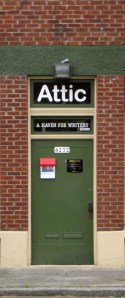


 The Coming of the Toads