Tag: Mechanics

  • How to Build a Bed

    Readers of “Penina’s Letters” may recall Salty talking about sleep. In the short excerpt below, he would have us believe he can sleep anywhere, anyhow:

    But one thing I had learned in the Army was the useful skill of how to sleep. I had written Penina I could now sleep in private or in public, in a bed or on a floor, with blankets, in a bag, fully dressed including boots or naked, amid noise or in silence, in the dark or under a light, stomach full or hungry, head to toe or hanging upside-down from a chandelier. I could sleep under water if ordered to. But what I wanted now was to curl to sleep with Penina. I didn’t know I’d soon be sleeping with Penina head to toe.

    We awoke uncombed, our sleep disturbed, disrobed and distraught, un-wombed. We climbed downstairs. All the beds upstairs. Why not a bed in every room? Where the cats make their beds, now here, now there, anywhere.

    Joyce’s Bloom’s bed is built with springs, like the spring, in Bloom’s description, used in a ring toss game. When did you last quoit?

    No. She [Molly] didn’t want anything. He [Bloom] heard then a warm heavy sigh, softer, as she turned over and the loose brass quoits of the bedstead jingled. Must get those settled really.

    Beds can be awfully noisy at times.

    We used to make tables, desks, beds using the same, simple, two-by-four construction design. A 2X4 frame supports a slatted or plywood top. Tools needed: hand saw, hammer, and nails. Nails allow for quicker assembly, but screws allow for easier deconstruction – so add a screwdriver. Parts needed: 2X4’s, plywood, or slats, nails, screws. Sandpaper for very rough spots, but this is not cabinetry work, not furniture, but practical and economical and time-efficient. The pieces are made to easily deconstruct, an important feature in our nomadic days.

    I made a futon frame bed this weekend. I made the base, or platform, in two parts, so easier to move up or down stairs, around corners, easily strapped to the roof of a car.

    The wood used was purchased years ago, having previously been used in the making of an extra long twin bed, and a desk with bookshelves installed against a wall (not so nomadic, that project). I’m not sure what the wood cost new would be today, and it’s possible that you might be able to pick up a frame unit lighter and cheaper at IKEA or some such store. If so, the utility of this bed construction design is already disappearing, like newspapers. But there are several deconstruction and recycling stores in our area where one can pick up used wood materials cheaply – as well as used tools, nails, and screws.

    Note that with a futon mattress, no box springs are needed (the lower mattress in the common, two mattress bed set). And the futon itself is much simpler than the standard mattress: it’s made of cotton, can be rolled up, smells delicious, conforms to your body’s sleep design. The futon also can be deconstructed, though it should last a very long time.

    The wood may be hand-rubbed with coconut oil to soften, protect and preserve, and add a flavorful scent to the bedroom digs.

  • Cover Design

    Working on a cover for a forthcoming children’s book:

  • Coconut Oil – A Novel Book Launch

    Salty and Penina, the war torn, young couple from “Penina’s Letters,” return to Refugio in “Coconut Oil,” a sequel.

    They come home to Refugio (the fictional beach town located north of El Porto and south of Grand on Santa Monica Bay) in an attempt to retire a bit early. So forty or so years have passed since the close of “Penina’s Letters.”

    Salty is again our first person narrator. But “Coconut Oil” continues an experimental narrative form, and Sal hands the mic off to several other characters as we are brought up to date on Refugio.

    The themes of “Coconut Oil” include aging, housing and homelessness, gentrification, and how we occupy ourselves over time. The form is experimental in a way a common reader might enjoy.

    The paperback version of “Coconut Oil” is available now, and the electronic version should be up next week.

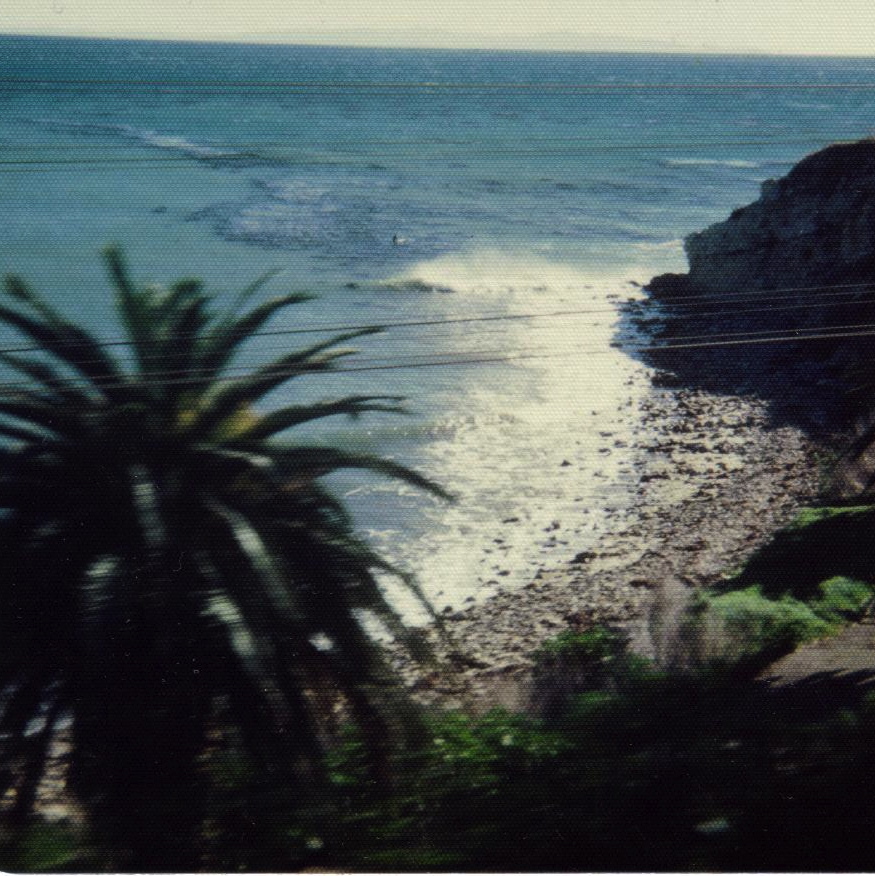
    The back cover photo for “Coconut Oil” was taken from the northbound Coast Starlight train as it passed by the point at Refugio Beach, California, a campground about 26 miles north of Santa Barbara. The photo was taken sometime in the late 70’s.

    Refugio from Coast Starlight
    Refugio from Coast Starlight Special


  • Flashing Lights and Random Noise in the City of the Brain

    The ophthalmologist asked if I was still seeing the flashing lights. Rarely, but hard to predict. So the brain has gotten used to them, and is ignoring them, she said, and I immediately wondered why that same brain couldn’t ignore the tinnitus sounds also.

    Sophisticated sound systems increase chances of distraction from random noise. If you must cough, wait until the crescendo is about to peak. Clarity of sound is valued. Increase pixels, dots, from cartoon to photograph. Whatever might muddy the waters is considered distraction. Clarity is a value that dithers. We must learn to connect the dots.

    But what is distraction? And when might distraction be desirable? Rocks viewed through water look different after the creek dries out. The transistor radio is the perfect transmitter of the three minute basement tape composition recorded on a single track hand held device. Form may distort or obscure content so that we might hear, see, feel, smell, or taste what we might otherwise have missed, though the effort often fails.

    Kindness, sense of humor, forgiving, joy of life.

    Culture provides for cloistered clarity, photographs viewed through filters, the eye a sieve. The ear a strainer. We may not wince quite as much from scenes in a film when intoxicated from the smell of buttered popcorn.

    “How do you know but every bird
    that cuts the airy way
    Is an immense world of delight,
    closed by your senses five?”

    Just so, but in any case,

    “A fool sees not the same tree that a
    wise man sees.”

    (Two quotes above from William Blake’s The Marriage of Heaven and Hell).

    I first heard of random noise working with some actuaries on multivariate analyses. In the context, noise is unpredictable and therefore unreliable. Random noise does not appear to correlate, nor can its causes or effects be accurately tracked or explained. Probability becomes problematic. The treatment is the same as for tinnitus, where smoothing or dithering renders the unwanted noise invisible. Random noise is asymmetrical, or anti-symmetrical, and expressed by numbers, sounds, colors, or any other output, a given sequence of random noise probably cannot be duplicated.

    Things are rarely right on, but approximate; why then the need for clarity, for perfection, for proper grammar, pronunciation, spelling, punctuation? Prescription is an attempt to clarify, but description is far more accurate.

    “Bright lights, big city, gone to my baby’s head” (Jimmy Reed, 1961).

    Here is a four stanza composition, each stanza four lines long, expressing random noise in hexadecimal format. The piece can be played musically if each letter is expressed as a note and each number expressed as a duration (the absence of g might be noted, because the base is 16). There are no more instructions. The fewer instructions, the more random the results. Randomness may be the prefect solution for writers with copyright issues. Interested readers may reproduce the exercise below at the ANU Quantum Random Numbers Server, but no matter how many times you try, you will probably never come up with the same sequence shown below. Plus, each line below has been truncated from its original. Other arbitrary changes made to the original output from the server include all zeros removed, and spacing and line breaks added.

    Dither # 1

    1ee 9f 9f7454 cd2 a a77114 da a4
    6f2 8eab 4fc1 bad b9a13 c8 d23
    19f e3 5a 27bd 4c361 e8 dec c211
    b3 6a f5 4645407 d85 9 fa 35 efcbbacb

    86c c3 681 d5 f5 74bc c3a 8ee8 6 f2 92 c5
    91 c5 1 b3 4 b7 f68793753 dd 38ba 34f1e2d
    814 eff c6884 aa 30d4 e1 a8 dc5 6c 4b
    182986 bfd 982 d5 805854 c7

    fc6 6e2172 eab fb 2b5
    74 4afef c8 40 c57 c9 4 bab 1
    b86fa 8c 4 9a 39 ffba 99ac 89 bd5 be
    97 b8 8c f79 477 a c5 7d 9d d 13b 2

    53 79 53 d3 61d3b178c68882aa 6 cefbbf77
    d8b449 efaf 73fa8917 bfb 473774ffc1 d7 d9dfe8
    1d3c c8 99761685 c21cd9 2569935ca2de6b7 ebb
    23513e76b828b a5 ac

    And the lines below were copied from “The matrix” streamed live from the AUS Lab and pasted without changes, except to color – the original contains the matrix green flavor, but it wouldn’t copy, so I’ve approximated the color with a font change. As I read through the composition, I could find no distractions, but upon preview of the post, it appears that WordPress coding has been added, probably because of the change I made to the font color. I find the result distracting.

    È[Õ‚‚ω9(C∫}¾„õ°v¸JËBؾ{ΨÉŠq®ψξ
    .Ó½ïpÚ±/zò→‹πɲ˼ΦÏ‚óæ;MIÅ<9Ð9š֑±ªGæ↔Ñ
    ïΧ8β)hDœa1tR˜Χε¯Š4∫ÈQ”R/Ì),¦êí‰f9õÚ¯Xîé:
    #¿7{‘‡ÆÙ™κë‹g¡ÖÀoªyÖ‡ƒPiDë»öÝ√üÄΩ¹+∪ÊDγÌ
    xKòÁNπ:∂t-Eh픉#.=φðρ—yœ9UR—λY¤ω→ÂZãé}:σ
    öÝ=±¨Íθ*Ší%τ~νËÍ[&αζF7ÏòUœκ_λωW#θ‡ûqº•Ëã
    ú‡LêμÞÑÖ2:λ∂F↓°ψÌ¡pΤ›e–à.N!ÎûƒûˆhqÔÏa?ƒ</span>
    <span style="color:#00ff00;"> ↔ζÆ~8ΤºÇ!#∄8ÃLLØθ¡&amp;∪ß|cZk±xÁúο@∪ÏDÜþè'¡{</span>
    <span style="color:#00ff00;"> ù’;θfÑÆÏ7ψμE„&lt;ºÙ∃’a√ÖΧŠΣσÕ¢¥æÆ5Æρ
    ÄO“jJω

    Readers often ask what a poem means. Usually, if nothing else, what poetry means, in spite of repetition in form and sound and sense, is that you can’t guess what comes next:

    What is correct in quantum indeterminacy?

    One year, we went to hear the jazz trumpeter Donald Byrd at the Ash Grove in Los Angeles. But he was too loud, and we had to leave. I’d already had some hearing damage, forgetting my ear plugs at the Fort Bliss rifle range, working the jack hammer from the compressor truck without plugs, thinking I guess that I was born with immortal hearing. Should have known better; my father suffered from ear damage. The high school I attended, Saint Bernard, in Playa del Rey, sat next to the runways of LAX, the planes taking off often a welcome break to a hard-boiled lecture.

    My father often heard what was said, but muffled, without clarity. He taught himself to read lips. He was a good listener, and an avid talker, in spite of a stutter. I suspect he stuttered because he was unsure of pronunciations, the result of his hearing difficulties. Or maybe because he could not hear himself talk. One year, hearing aid technology having improved, he had surgery on both ears, to clear out rotted bone and crud, and was fitted with new hearing aids. In no time, his stutter disappeared. My mother was sure this was a miracle.

    We went back to the Ash Grove to hear the guitarist John Fahey. We were seated in front. John came out with his guitar and a giant Bubble Up bottle. He sat down and drank the entire bottle of Bubble Up in one long swig, its neck stuck deep under his duck-like protruding upper lip. He put the bottle down on the floor and began to play guitar. I thought maybe he might use the Bubble Up bottle for some bottleneck guitar, but he did not. He said not one word the entire evening, nor do I recall a single burp. In short, he was not too loud. I still have his “The Yellow Princess” in vinyl album format, the one where you can hear the door close and footsteps.

    The ophthalmologist asked me if my eyes felt like sandpaper. She said one of my optic nerves was larger than the other. I told her I also had asymmetrical hearing, which she apparently considered a distraction. She suggested artificial tears for the dry grit in the eyes feeling.

    The brain is a megacity of flashing lights and random noise, a conurbation of neighborhoods in various stages of going to seed.

  • Lost on Me – Fables Sans Morals

    Some time ago, a friend mentioned driving north on I-5 with California plates and being pulled over by the local highway patrol around Olympia. “In Washington,” the patrolman said, “we like to think of the speed limit as more than a mere suggestion.” Apparently, the self-satisfaction rewarded from this afflatus meant that all the more that was needed to restore calm to that section of his freeway was a warning. Was this a cop whose partner was a muse?

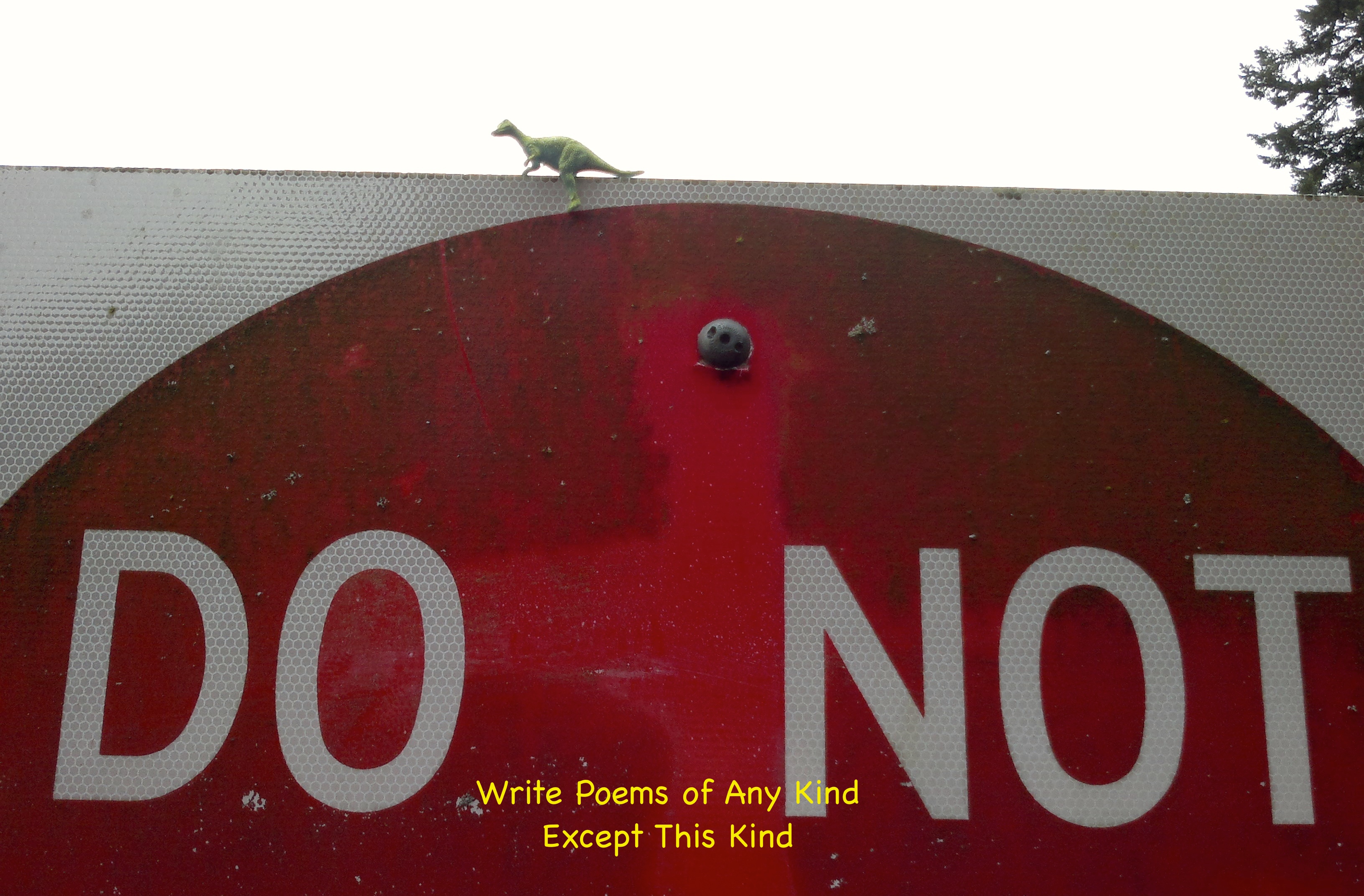
    The first critical review of my poem “16 Tiny Camels Found in Wood Box in Garage Stale,” up Monday at VERStype, began, “Beyond me my friend! I love the first line but lost on the rest.” “Ah! fellow musician,” I replied, “we often get lost on the rests.” I had, no doubt somewhat obnoxiously, tagged a few friends on Facebook to bring their attention to the newly published poem. Why? We are surrounded by poetry. No wonder erasure has become popular. If poetry habitually obliterates meaning, this is because poetry speaks allusively. We might define poetry as what can only suggest. But must we erase ourselves out of every poem? New hazards require new signs, new designs.Do Not

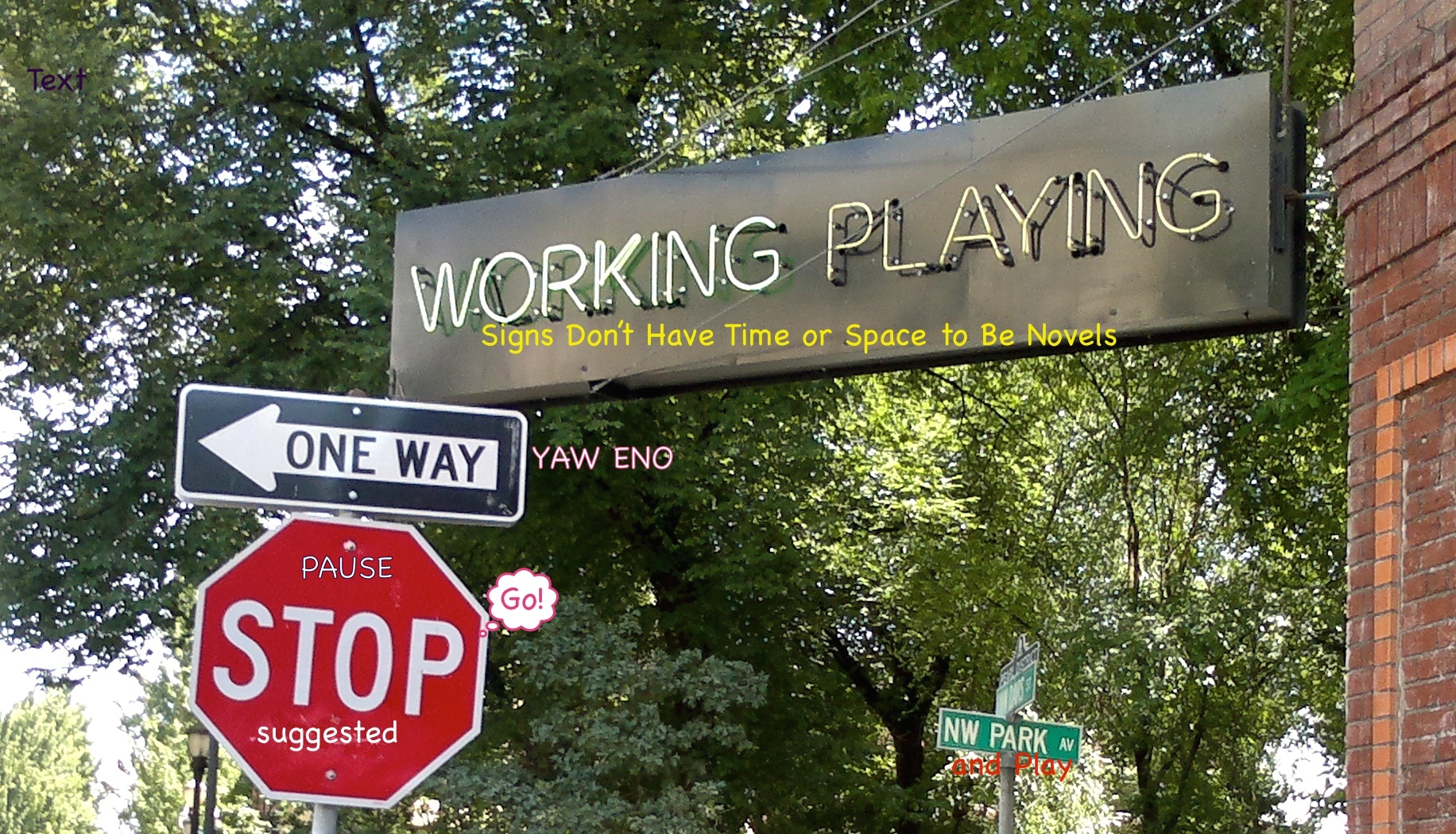
    To allude is to hint. To hint is to keep something hidden, perhaps from fear, or to play, or to tease, or because to point directly is either impossible or too dangerous (like looking directly at an eclipsed sun), or erases too much from the peripheral shadows. Maybe poetry is a peripheral device, necessary to navigate around meaning. A road sign does not have time to solve every ambiguity. Stop means stop. But after stopping, we can go. Maybe the ubiquitous Stop sign should read: PAUSE. But the idea (stop) is not up for discussion, for our consideration. But what does a bevy of signs mean? We are surrounded by instructions. It’s easy to get confused. Road signs are like poems; they speak allusively. But poetry may not be instructional.

    Sign Stories.jpeg

    But there are all manner of poems, and the function of poetry may vary with each poem. And language is an ogre whose sleep poetry tries not to disrupt, usually to little avail. There are a few one way streets in our neighborhood. Occasionally, a miscreant driver goes the wrong way, honking and freaking out at all the drivers going the correct way. That’s what the poetic experience is sometimes like – that sudden moment when you realize you’re the swine driving the wrong way down a one way street, the epiphany sending you up and over the curb, everyone honking and shouting suggestions. Every sign contains a moral. Poetry is amoral. The perfect poem traffics not in values but in virtues.

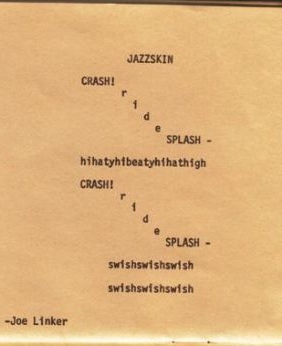
    VERStype is a new venue devoted to a particular kind of poetry. How we say something is as important as what we say, and how we say something includes both shape and syntax, tone and style, font and CamelCase. Jazz drums used to be called the skins, and to skin is to zest, peel, flay. How do you do that in a poem? Moving toward a lyric that mobilizes concrete techniques to carry melody and choreography with images of surreal dream dance. “JAZZSKIN” was published a long time ago in the El Camino College arts magazine, Silent Quicksand. No quicker way to obscurity, my friend Tim quipped at the time.

    jazzskin2 (1)

  • Privacy Poem

    Where do we get this notion
    of privacy?
    Is privacy a value,
    or is privacy a virtue?

    If privacy is a value,
    it’s simply a worth
    we want, and what we want
    is not always what is good
    for us:
    we want alcohol,
    tobacco, and firearms;
    fast cars with sound
    so loud we need
    earplugs;
    instant accesses
    to tête-à-tête boxes
    where we spy
    on our bosses.

    But is privacy a virtue,
    like love, patience, for
    giveness,
    joy of living, or courage
    to befriend?

    Abuse of surveillance
    does not make a virtue
    of privacy,
    just as, as Ivan Illich
    explained,
    protection
    is not the same as
    safety.

    But getting back
    to privacy:
    we want to be seen
    and heard at the party
    but not in the morning
    when the porcelain white
    face throws up
    its image in the little pond.

    The poet wants to be read:
    “Read me! Read me!”
    But the words seem so
    private,
    no way to enter
    the text.
    “I’m in here!”
    the poet exclaims,
    as if from the depths
    of some Xanadu privy,
    and when we hear
    the roller of big cigars,
    his call a private scream
    behind a rude screen,
    we know the poem
    is finished
    and about
    to go
    public.

    In public the words squirm
    for privacy, wriggling
    across the page
    heading
    for a clear margin.

    IMG_20151023_131339

  • Teeda, Sped, Flotsam, and Twist

    Mr. Teeda with tart taste
    hairy-scarfy lips late but at last
    arises to seize downtown bus amid
    yawns and snort, sneeze and nicks
    himself hie shavely in tortello
    braggadocio hurry-scurry.
    “Out-a-my-way, out-a-my-way,”
    Teeda cocoons the mod you
    low
    muddle of his noggin.

    Meantime, Mr. Sped, cold splash
    asleep in red tide road dust,
    implacable rouge shore,
    weird civic bird waggles past,
    rubber fins folding dreamily,
    tail swerving to and fro, football
    public service posters advertising
    Hollywood endings posted to fuzzy
    windows frozen shut with rust.

    Salt shakers fill the upright oak seats,
    and time passes so terribly slowly,
    magazines, cigarettes, styrofoam cups
    of coffee and newspapers near boiling point,
    Mr. Sped grows wonky waiting,
    hoity-toity, charged with C of C,
    expectant umbrellas aloft as Line 15
    stretches in cap and scarf
    amid coughs, and heaves, and spews.

    “All one needs is the fare,” Mr. Flotsam claims.
    “The rest depends on the robes
    and suits of one’s
    sword swallowed piers.”
    “Brobdingnagian egos these
    competitive solicitor types,” Mr. Twist explains.
    “Half a man most of them, don’t feel
    whole without an opponent in their ring
    to tort down their ecomanic day,” Teeda says.

    The firm still self-identifies
    with vocational pigeonholes,
    so when the toilet stops up,
    they call in a travel agent.
    In the boardroom, near the whiteboard,
    Teeda polishes his burgundy wingtips
    with the hands-off electronic
    machine, rubs cream in his hair,
    hears the snake’s whir.

  • “Settings” – a Poem by Eleanor Rigby

    “I was mislaid,”
    Eleanor Rigby said,
    “Amused
    at my own voice.”

    She sat and sat and sat,
    but instead of growing tired,
    wrote:
    “This poem I write
    is for Me only.
    Signed,
    Miss Understanding.”

    She didn’t know
    all alone poems
    find a reader
    sitting,
    darning & clicking,
    long through the night.

    Eleanor Rigby
    thought she was writing
    only for you.

    When suddenly, strings
    opened up the sky,
    a quartet of likes,
    and an aeolian
    comment
    trilled and thrilled
    the air.

  • Packsaddle Off

    what is this sound sprinkling glow
    yellow doilies weaving thru blue
    fescue glass chandelier worm atrium
    air city surf gas soup & jazz salad

    sitting under dwarf apple waiting,
    waiting, wanting nothing save
    green this wait as Thoreau’s
    Wangle Dangle backyard rhetoric

    drinking can of Okanagan
    Spring: “natural, simple, & pure”
    pale ale & all bronze
    gone Henry’s lawn

    this dog’s lair
    cut once a year
    then go to seed
    rampant & wild
    tainted ear

    so much depends upon so little
    take this green garden wagon
    for example
    go on, take it, really take it
    grab the handle and pull
    you’ll see the wagon is full
    of ripe red tomatoes
    kids’ toys
    bucket of finished garlic
    bowl of basil & cilantro
    some zinnias to dry inside

    there’s no one in that pink
    ceramic bird house hanging
    from the golden rain
    tree imagine living
    there your nest
    waiting for your mate
    come home yr turn
    go to store & supper

    you call the kids
    Caw! Caw!
    & they call back
    Not Yet! Not Yet!
    Summer! Summer!

    a cloud like a clown down
    pillow on clean blue sheet
    perhaps it will drop a load
    somewhere near soon &
    sweep weep sleep deep