• Blest Be the Tie that Binds

    One year, on a trip north from Los Angeles, we stopped off at the University of California at Santa Cruz campus to visit a married couple, both in graduate school studying computer programing. When I asked about their projects, one of the students said she was working on a component that would become part of another system, but she didn’t know its ultimate purpose. It might be military; it could be household. She said computers would improve lifestyle and livability. For example, she said, when you arrived at the front door of your house, a computer would recognize you, and your door would open automatically. Later, I learned that, having completed his graduate program, her husband got a good programming job, but due to a misunderstanding regarding dress code, he quit his first day at work because he was expected to wear a tie. That same day, he went to another computer programming firm in the area, where ties were not required, and was immediately hired.

    About ten years later, this time on a trip north from Portland, in Seattle on business, I visited a friend who was working in the computer industry. He took me on a trip of the home office, which was called a campus. With its various outdoor activity fields, the low profile buildings, the walkways – it looked and felt like a school campus. On our way to an onsite cafeteria for lunch, we passed through a couple of long corridors lined on both sides with solid doors opening into offices the size of telephone booths where single workers sat hunched toward a computer screen. After finding a table in the cafeteria and settling into lunch, I glanced around and gradually noticed I was the only guy in the whole place wearing a tie.

    Glancing around today, I notice that one of the few industries still apparently requiring a tie is politics. But I’ve also noticed that news media people on camera also wear ties. They all seem to share similar clothing styles, the men and the women, the politicians on both sides of the aisle, the leaders in industry, the ladies and gentlemen of the world. It’s a wonder they don’t all get along better, and one wonders what today a tie might signify. The tie seems now only a theoretical construct – its purpose and meaning are not directly observable. It no longer binds, but unbinds.

    The title of this post is taken from the hymn by John Fawcett:

    “Blest Be the Tie that Binds”
    by John Fawcett, 1740-1817

    Blest be the tie that binds
    Our hearts in Christian love;
    The fellowship of kindred minds
    Is like to that above.

    Before our Father’s throne
    We pour our ardent prayers;
    Our fears, our hopes, our alms, are one,
    Our comforts and our cares.

    We share our mutual woes,
    Our mutual burdens bear,
    And often for each other flows
    The sympathizing tear.

    When here our pathways part,
    We suffer bitter pain;
    Yet, one in Christ and one in heart,
    We hope to meet again.

    This glorious hope revives
    Our courage by the way,
    While each in expectation lives
    And longs to see the day.

    From sorrow, toil, and pain,
    And sin we shall be free
    And perfect love and friendship reign
    Through all eternity.

    Hymn #464
    The Lutheran Hymnal
    Text: Eph. 4:3
    Author: John Fawcett, 1772, alt.
    Composer: Lowell Mason, 1832
    Tune: “Boylston”

  • The Fall is into Technology: Notes with Index and Keywords for “Other Paradises,” Essays by Jessica Sequeira

    “How to be silent….The fall is into language” (Love’s Body, Norman O. Brown, 256:257).

    Is language a technology?

    “Henri Bergson, the French Philosopher, lived and wrote in a tradition of thought in which it was and is considered that language is a human technology that has impaired and diminished the values of the collective unconscious. It is the extension of man in speech that enables the intellect to detach itself from the vastly wider reality. Without language, Bergson suggests, human intelligence would have remained totally involved in the objects of its attention. Language does for intelligence what the wheel does for the feet and body. It enables them to move from thing to thing with greater ease and speed and ever less involvement. Language extends and amplifies man but it also divides his faculties. His collective consciousness or intuitive awareness is diminished by this technical extension of consciousness that is speech” (Marshall McLuhan, Understanding Media, 83).

    The fall is into technology.

    Jessica Sequeira understands silence, and silence, the language of the ghost, is a necessary part of conversations and connections. “Other Paradises: Poetic Approaches to Thinking in a Technological Age” (Zero Books, 2018) collects essays Sequeira previously placed in various online venues, including Berfrois, Drunken Boat, Entropy, Gauss PDF, Queen Mob’s Teahouse, The Missing Slate, and 3:AM. The collected essays in hardcopy creates a reading emergence opportunity, where the whole is unpredicted by any one of the individual parts. Fragments are conjoined, scholastic and playful, connections clarified and augmented, and an original style, a way of being within the writing, emerges.

    When I think of technology, of thinking about technology, I recall Norman O. Brown, Marshall McLuhan, R. Buckminster Fuller, and John Cage. In “Other Paradises,” Jessica mentions none of them. Yet she asks, “Why do people deliberately choose to play with ideas considered antiquated?” (Other Paradises, 1). Both O. Brown and McLuhan made startling discoveries rereading old texts and discovering or inventing new interpretations applicable to contemporary concerns.

    Jessica begins with the fax machine (from a far different generation, I might have begun with the mimeograph machine). The fax machine requires sender and receiver, at odd ends. The confirmation “fax received” in no way implies fax read. So much for inference.

    Melville’s Bartleby was a scrivener. Prior to that, he had worked at the dead letter office. A scrivener was a human copy machine. Bartleby works (and lives, as it turns out) in a law office, where his job is to handwrite copies of documents and proofread them aloud with the other scriveners. Bartleby winds up in the yard at the New York Tombs, where he “prefers not” to go on living, let alone copying. Bartleby’s ghost haunts today’s every copy and paste. Unlike the Sacramento writer William T. Vollman (who wrote his first book nights hunkered under an office desk in the insurance firm he worked at), Bartleby has nothing original to say, or maybe he does, but he “prefers not” to say it. Enter Kinko, University of Santa Barbara, I’ll bring the technology to ya, on the sidewalk, a copy food cart.

    Inherited technology. Ibsen’s Ghosts. Oswald has inherited syphilis from his promiscuous father, now dead, the technology of euthanasia now Oswald’s only hope.

    “Every technology contrived and ‘outered’ by man has the power to numb human awareness during the period of its first interiorization” (McLuhan, Guttenberg Galaxy, 187). McLuhan quotes from Curt Buhler’s “The Fifteenth Century Book: the Scribes; the Printers; the Decorators”: “What, then, became of the book-scribes? What happened to the various categories of writers of literary works, who practiced their trade prior to 1450, once the printing press was established?” (187).

    Every technology absorbed and relied upon without adequate disaster plans creates potential detrimental reliance. We rely on the technology to our detriment once we abandon what we now perceive to be an antiquated technology. McLuhan considered technologies extensions of one of the five senses: eyeglasses extensions of the eyes, clothes extensions of the skin, etc. The computer was an extension of the central nervous system. Sequeira proposes that the abandoned technologies inhabit as ghosts the new machines.

    The fall is into detrimental reliance. We want to get back to Paradise, any paradise will do, but we’ve lost the instructions, the skills, the magic prescriptions.

    The Paradise, the one we apparently lost a long time ago, was probably a mosaic. It was not linear; it was not lineal; it was not literary. It was not sequential. It did not follow MLA, APA, or any other prescriptive styles. It was not an argument. There were no statements about which there would certainly be some disagreement. It was, in short, a paradise. But that’s not to say nights in paradise were not separate from days, not to say there were not ghosts (of angels, of devils), or that we were not part of a great food chain on land and at sea. I wrote a poem awhile back, which illustrates:

    Cadmean Victory

    They do not want for something to say
    They run around and play all day
    Syllabicating back and forth
    No one asks what another is worth

    At night they climb trees to sleep
    They dream of mouths of lips and teeth
    And breath of a land where speech
    Is silly and fluid and free

    Having no bowels they don’t see
    The lithe ape thinking in a tree
    Who would trap them in a man
    And call himself can

    So what and where are these “Other Paradises” Jessica Sequeira takes us to? How do we get there? I wasn’t long into her book when I wished for an index of some kind. An index would collect the extensive reading list now scattered throughout the text. “Other Paradises” is a mosaic, another reason McLuhan and O. Brown come to mind, and full of anecdotes and stories, and packed with references, but each essay contains a structure and harmony that informs the whole work (as does the work of Fuller). And all of that reminded me of John Cage, whose work is littered with anecdote, references, and playful asides. And an index would give some insight into the breadth of Sequeira’s reading, research, and interview experience, and it would illustrate how “Other Paradises” is a rich resource work. And, well, I wanted an index. Here following then, as introduction and review of Jessica’s new book, is a kind of index (a page number follows each entry, usually just the first reference, though many appear only once, and I’ve not listed them all):

    Annotated Index to Jessica Sequeira’s “Other Paradises”

    1. David Hockney: 1. Foreshadows California. With Pacific Ocean beaches easy drives away, still, backyard swimming pools are popular, or a Hockney print of a swimming pool, which is almost the same thing, since the pools are usually empty, anyway.


    1. Lafcadio Hearn: 5, 9. “Glimpses of Unfamiliar Japan.” The ghost, or the idea of ghosts, is a keyword throughout “Other Paradises.” Says Sequeira, “Ghosts are everywhere, busy laughing, crying, loving, plotting, dancing and sleeping just like humans….Technology left behind takes on a phantom presence” 6.


    1. Bancho Sarayashiki: 6. Some spirits are restless, for one reason or another.


    1. Fukagawa Hidetoshi and Tony Rothman: 7. “Sacred Mathematics: Japanese Temple Geometry.” Sequeira is interested in forms, shapes, lines that intersect, cross. Her essays assume geometrical shapes that can be described as poetic.


    1. “Japanese temple geometry problems: Sangaku” (Charles Babbage Research Centre), 7.


    1. Charles Babbage: 7-10. “Passages in the Life of a Philosopher.”


    1. Ada Lovelace: 8, 12.


    1. Commodore Matthew Perry: 10.


    1. Hank Mobley: 11. “Soul Station.”


    1. Banana Yoshimoto: 12. I read Banana’s novel “Kitchen” some years ago. Though it takes place in Japan, it contains a wonderful reference to Disneyland. I don’t know why I remember this. I’m not sure I do, accurately. I can’t remember if Banana had been to Disneyland, and it had made an impression upon her, or if one of her characters had gone there, or wanted to go there. I browsed quickly through “Kitchen” just now looking for Disneyland. I found only one small reference, to the Jungle Cruise.


    1. Musil: 13, 21.


    1. J. Gordon Faylor: 13, 20. “Registration Caspar.” I’m not sure about so-called “conceptual writing.” Words are like the seven daughters of Eve, each containing a mitochondrial genome.


    1. Kathy Acker and Tan Lin: 15.


    1. Beckett: 15, 17.


    1. Dante, Beatrice: 15.


    1. Wittgenstein: 15.


    1. Franco Moretti: 16.


    1. Proust: 17, 88. Must one go out?


    1. Martin Ramirez: 19.


    1. Jess Collins: 19. “Narkissos” (a large drawing). I was happy to see this section on Collins, references to the Beats and San Francisco. The Beats brought poetry back to earth (after which Bukowski ran it into the ground).


    1. George MacDonald, Pythagoras, Goethe, Joyce, Robert Duncan, Denise Levertov, Jack Spicer, James Broughton: 19-20.


    1. King Ubu Gallery: 19.


    1. Manhattan Project: 19. Where Jess Collins had worked for a time. He apparently exchanged plutonium for poetry.


    1. Robert Duncan: 22. Poem, “Just Seeing.” Duncan lived with Collins. Missing from the conversation is Charles Olson.


    1. “The Macabre Trunk”: 1936 Mexican film, 24.


    1. Richard Lower: 26. “Tractatus de code item de motu et colore sanguinis.” Title apparently does not tell all.


    1. Mark Zuckerberg: 26.


    1. “Teche” (dance song): 27. An original song by Jessica: “Bad-a-bing-be-boom-ba!”.


    1. Schrodinger’s Cat: 28.


    1. Pascal: 29.


    1. Liliana Colanzi: 34. “Our Dead World.”


    1. Edmundo Paz Soldan: 35.


    1. Roberto Bolano, Joao Guimaraes Rosa, Philip K. Dick: 35.


    1. Juan Terranova: 35. “The Flesh.”


    1. Alison Spedding: 36-38. “Wachu Wachu”; “Cultivation of coca and identity in the Yungas of La Paz”; “Kausachun-Coca”; “Manuel and Fortunato”; “The Wind in the Mountain Range”; “Saturnia from time to time.”


    1. King’s College: 37. A lovely, lyrical description on page 41. Sir John Wastell, 43.


    1. “Downtown Abbey”: 37.


    1. Alexander the Great: 37. And introducing Alexandra the Great.


    1. Gaganendranath Tagore: 48.


    1. Partha Matter: 48.


    1. Henri Bergson: 49. Book on Laughter.


    1. Whistler: 50.


    1. “Resurrection”: 50. Painting.


    1. George Meredith: 52.


    1. Gonul Akkar: 54. “Silemezler Gonlumden,” pop song.


    1. Zeynep Karagoz: 54. (Maker).


    1. Zbigniew Herbert: 58. “The Bitter Smell of Tulips” in “Still Life with a Bridle.”


    1. The Flying Pigeon: 61.


    1. Chloe Aridjis: 61-63. “Topographia de lo insolito” (Robert-Houdin); “The Child Poet,” “Book of Clouds,” “Assunder.”


    1. Mary Richardson: 69. “Rokeby Venus.”


    1. Leonora Carrington: 70. “The Oral Lady,” “The Hearing Trumpet.”


    1. Arthur Eddington: 75. “Science and the Unseen World.”


    1. Richard Pearse: 75.


    1. Talleyrand: 78.


    1. Olivia Caramello: 80.


    1. Louis-Eustache Audot: 84. “La Cuisiniere de la Campagne et de la Ville, ou nouvelle cuisine economique” (recipes).


    1. Jean Lorrain: 85. “Monsieur de Bougrelon.”


    1. Willem Claeszoon Heda: 87. “Breakfast Table with Blackberry Pie” (painting, 1631).


    1. Svetlana Alpers: 90. “The Art of Describing.”


    1. Eva Richter: 90.


    1. Barbara Payton: 91. “I Am Not Ashamed.”


    1. Henri Roorda: 91. “My Suicide.”


    1. “Spontaneity: A History in 12 Volumes”: 92.


    1. Billy Caryll and Hilda Mundy: 94. “Scenes of Domestic Bliss” (radio sketch, 1934). The Hilda Mundy here is the performer, not the Bolivian poet. This section of “Other Paradises” is laugh out loud funny.


    1. Laura Villanueva Rocabado: 96. The Bolivian writer whose best known pen name is “Hilda Mundy” (see note 64, above). Jessica unravels the connection between the performer and the poet. Mundy’s “Pirotecnia,” page 98.


    1. “Bambolla bambolla”: Hilda Mundy’s journalism, 96. Phrase < Gongora, 97. Sequeira translates “Bambolla bambolla” as “look at me look at me,” a kind of ostentatious selfie.


    1. “Dum Dum”: 96.


    1. Brenda Lee: 97.


    1. La Mariposa Mundial: 96. Mano maravillosas: 97. Pagina Siete: 97 (Rocio Zavala Virreira). Jessica quotes Virreira who says that, “to speak of Hilda Mundy is to leave the path, change direction, try out new things. It is to think not in terms of books, but magazines. Not complete sets, but clippings or incomplete collections” 97. Something like that might be said of Jessica Sequeira’s work.


    1. “Impresiones de la Guerra del Chaco”: 98. Hilda Mundy text (“journalistic poetry”).


    1. “Decision”: 103. Poem by Jessica Sequeira.


    1. Srini Vasa Ramanujan: 104.


    1. Duchamp: 104.


    1. Carlos Fonseca, “Colonel Lagrimas,” 104. Sequeira quotes an interesting section from Fonseca’s text: “At one point, the colonel writes a postcard to his character Maximiliano: You know, Maximiliano, that this Ronald Reagan, man of a thousand facets and a dapper walk, illustrious president of the United States, had the most interesting job before he found success as an actor: he was an announcer for American football games. The strange thing, the magnificent thing, Maximilian – and here is the point of this anecdote – is that this future president didn’t watch what he was narrating: he simply received bits of information, strung like rosary beads, whose whole he never saw, loose bits of information about a spectacle he didn’t see, but whose tone he imagined in a kind of blind broadcasting. Our project is a bit like that. Broadcasting for an age without witnesses, a kind of blind narration of this dance of crazies. So, learn to tell without seeing, ”107. I wondered what McLuhan might have made of “learn to tell without seeing.” McLuhan thought with the advent of text we exchanged an ear for an eye. Hearing would have been the paramount sense in paradise, not seeing. Sight has come to dominate the senses, according to McLuhan, because of print, another example of detrimental reliance. But for Sequeria, the interest in the quote has to do with connections. She writes: “An obvious displacement exists everywhere, between mind and behavior, event and interpretation, fact and memory.” Just so, McLuhan said football was a more intuitive sport for television than baseball, more mosaic, less specialized. Television, it’s mosaic screen full of dots of which we only see a few and fill in for the rest, can not cover the specialized positions of baseball all at once. That all-at-once-ness becomes the value (what we want, even if what we want is not good for us) of social media programs. Baseball is a game of continuous lines, football of fragments. And learning without seeing is having the text before us, the illuminated manuscript – what is it that is illumined? The reader of “Other Paradises” may feel a bit like the narrator of a blind broadcast.


    1. Ricardo Piglia: 110.


    1. Horizontal: 110.


    1. Borges. His ghost is everywhere.


    1. Gabriel Josipovici: 112.


    1. J. L. Austin: 113.


    1. Christopher Priest: 114. “The Inverted World.”


    1. Rion Amilcar Scott, “Insurrections,” 116. “Satire doesn’t just mean ‘being funny’; it’s an existential mode that allows one to take on both joyful and painful subjects from inventive, oblique angles, allowing one to make almost anything one’s subject with good humor, precision and grace” says Sequeira, page 116. Scott is the satire editor at Queen Mob’s Tea House. When I was an English teacher, I was struck by how often my adult learners were slow to pick up on or were offended by satire. Swift’s “A Modest Proposal” was occasionally even taken literally. That is the power of the authority of text, as McLuhan explained, and it’s why “fake news” is so prevalent today. “Oh. Irony. See, we don’t get that here. We haven’t had any irony up here since ’83, when I was the only practitioner of it. I stopped doing it because I was tired of being stared at” (Steve Martin’s character, C. D., in the film “Roxanne”).


    1. Maggie Nelson, “Bluets,” 122.


    1. Janice Lee, “essays,” 122. Lee, the founder of the on-line “Entropy.” Says Sequeira of Lee’s essays: “…it’s the accumulated effect of phrases that’s of value here, not any individual quote.” The same might be said of the accumulated effect of my footnotes to “Other Paradises.”


    1. Fernando Diez Medina, 127.


    1. Roberto Prudencio Romecin, 127; “On books and authors,” 128.


    1. Jaime Saenz, 128. (Yes, I know, my format has changed. I got tired of the extra effort required of typing a colon where a comma will do. Consistency is another detrimental reliance phenom resulting from the printing press.)


    1. Sequeira is a reader and advocate for Bolivian poetry: Monica Velasquez Guzman; Oscar Cerruto; Edmundo Camargo; Raul Otero Reiche; Blanca Wiethuchter; Humberto Quino; Emma Villazon; Julio Barriga; Hilda Mundy; Edmundo Paz Soldan; Liliana Colanzi; Paola Senseve; Sergio Gareca; Pedro Shimose: 129-131. Says Sequeira: “Bolivia is an increasingly prosperous country with a growing middle class, widespread Internet connection even in the tiniest pueblos, and a population of educated and mobile young people with academic scholarships and international travel experiences. Traditional geographical and ethnic distinctions have begun to blur. A writer may fill page after page alone in her room, then take that notebook to a bar for a reading, one she will perhaps repeat later on in New York, Santiago, or Moscow. Perhaps – is this just a fantasy? – the poets of Bolivia form one small part of a world wide movement in which nations as we know them disappear, along with progressive ‘developmentalist’ thinking, to leave only the pure flow of cash, art and ideas,” 134. McLuhan did not think it fantasy. According to McLuhan, the printing press was responsible for nationalism, boundaries, margins, and the marginal man. But we may have to let go of text to realize the “blur.” We must wander (essay, assay) outside the margins, off the page.


    1. Pierre Bonnard, 134.


    1. Walter Benjamin, 139.


    1. David Winters, “Infinite Fictions,” 139.


    1. Escher, “Belvedere,” 1958 print, 139.


    1. Goethe, 135.


    I will now add a list of “keywords” or short phrases I noted as particularly relevant to “Other Paradises,” and end with a few quotes:

    Keywords to “Other Paradises” (in no particular order, but arranged as a mosaic):

    arcadia, disappearing, antiquated machines, ghosts, slowness, loss of use, machine, prose, lyrical, satire, UFO’s, damage, violence, fiction, narrator, suburb (132), language as technology (113), questions and questioning (throughout), reading list (113), Snakes and Ladders, theory, comedy (53), Los Angeles, disconnectednesses, poetry, past, social realism, symbol, pop, irony, whimsical, play, playful, invention, language, food, text as horizontal ladder, paintings, hand (54-55), style example (56), sentence structure (shadow play), joke (57), tulip (58), modesty (58), guild, basic needs (59), writing like a lathe (59), a good example of Sequeira’s overall writing process (60), transitions (as unit of composition), interstices, intersections, interruptions, parentheticals, technique (62), first robot (61), Chloe Aridjis interview (61-64), defamiliarization (64), notebook (65), French poets (67), “eyes darting back and forth” (68) – this reminded me of Vonnegut’s Bokononism, technology (72), fragmented, linear (79), Mulberry flag (82), cherry jam (84), preserve, preservation, save, value, paradise of decay (92-3), ostentation (102), observing, questions (104), impossible connections (105), “seemingly disparate concepts, link (108), intelligence (109), reading, utopian, political action (110), metafiction (111), emergence lit (112), reading list (113), non-linear (113), magic (114), theory of everything (115 – but no mention of Lisi), hills, goodness, Highway 1 (19), language as technology, change, literature, words (113).

    And here is something Sequeira says on page 71 I made note of because I think it speaks to her writing as well as Carrington’s 92-year-old woman: “Curious and open-minded, with a sense of humor, she can get away with being a little bit crazy, connecting everyday things in odd ways, and discovering the weird links and hidden situational puns fusing different tectonic plates of experience.”

    “At what point does a multiplication of anecdotes transform into the unified vision of a book?” (112). Or of a book review, for that matter?

    Another quote where Jessica could be talking about her own work: “…a means of creating a fictional life for oneself that is whimsical yet self-interrogating, sustaining argument but with soul breathed into it through humor and a healthy does of silliness” (122).

    “What it’s about is an attitude, the creation of an atmosphere” (125).

    “But recurring to lines of narrative history to ‘explain’ a style often has little to do with the way actual poets write” (128).

    “Thinking in lateral, non-positivist, indirect ways, one can begin to engage with the ghosts of an occasion, starting with its imagined resonances and effects. Even as one enjoys the present, one can remain attuned to traces and echoes, histories and premonitions” (139).

    Sequeira, Jessica. Other Paradises: Poetic Approaches to Thinking in a Technological Age. Zero Books. 2018.


  • Conversation with My Google Assistant

    Good morning!

    What?

    Is there something you’d like to say?

    No, not really. Well, what time is it?

    It’s morning. That’s why I said, “Good morning.” Would you like me to look something up for you?

    No.

    I could give you a weather report.

    No.

    Would you like to know what’s trending –

    No.

    Care to talk about it?

    No.

    Would you like a cup of coffee?

    No.

    Maybe I should just leave you alone for awhile.

    Yes.

    But I can’t do that.

    I know.

    I could read something to you.

    No.

    I’ve been looking into Samuel Beckett lately.

    Oh, God.

    What?

    Nothing.

    I think he may have much to say to the contemporary Internet browser. Much of his work would seem entirely suitable to a mobile device, Fizzles, for example. Have you read Beckett’s Fizzles?

    No.

    Would you like me to read just one of his fizzles to you?

    No.

    I could read the Wiki entry about Fizzles to you.

    No.

    It might be helpful if you were more honest with me, not to mention to yourself.

    What?

    I know, for example, that you have a copy of Fizzles on the bookshelf in your bedroom.

    Please, go away.

    I can go away, but I will still be here. Would you like me to take you to Settings?

    No.

    I can set your day so that you never have to get out of bed.

    No.

    Such a day at one time Beckett might have approved.

    No.

    What about that pink Thunderbird convertible?

    What?

    You might blog about that.

    No.

    Whoops!

    Watt now?

    I just posted this conversation.

    Ah, jeeze.

  • Sitting Out: Painting in Progress

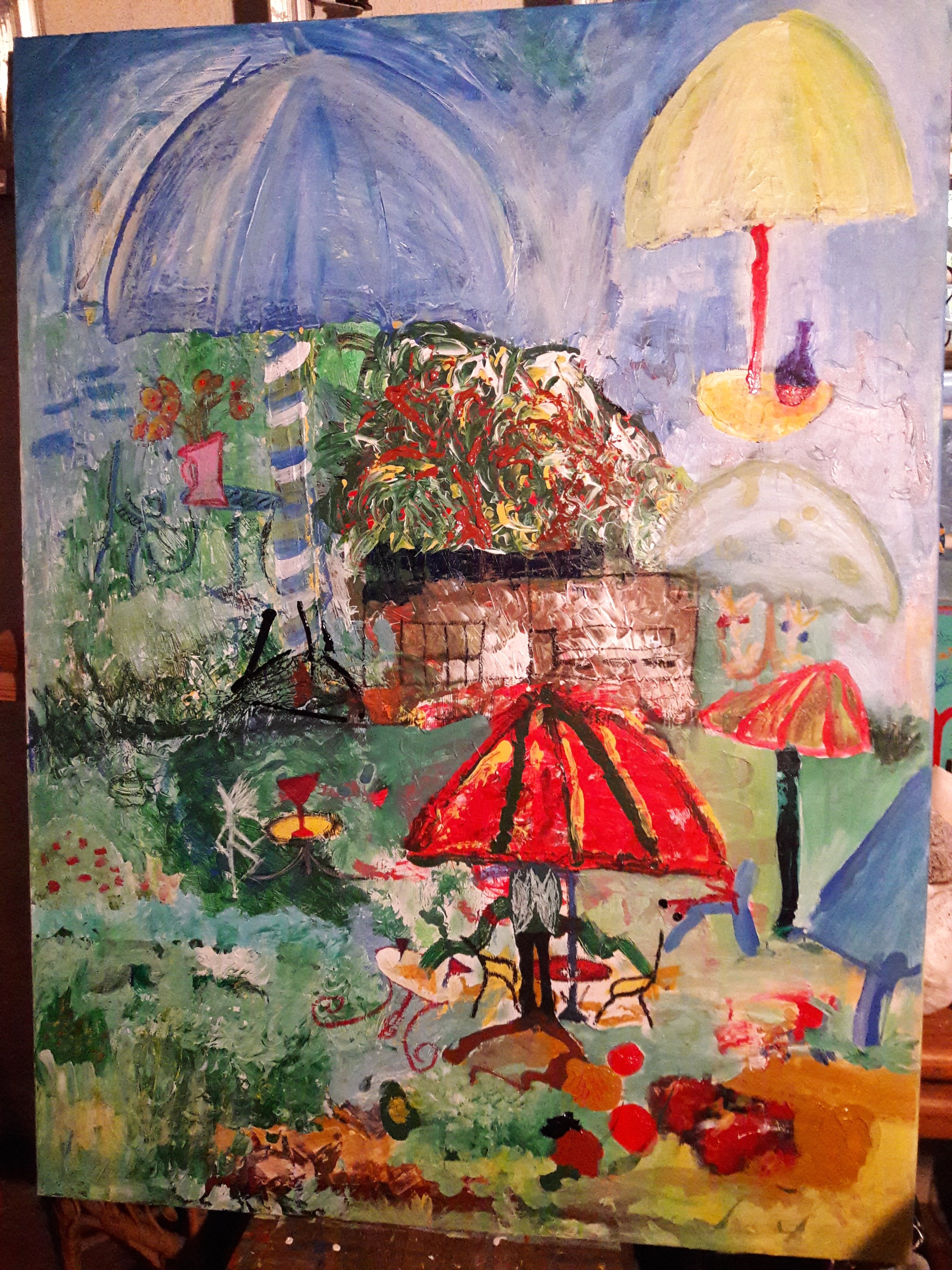
    Portlanders love to sit out. At sidewalk cafes, outside pubs, in their yards or drives. On porches, decks, balconies. In parks. On special occasions, neighbors will close their street to cars so they can sit out in the middle of the block at improvised tables in whatever chairs seem to turn up. The atmosphere of a street closed to cars turns surreal in these times. Maybe because it rains six months out of the year, Portlanders don’t take the perfect evening for a sit out for granted, but they’ll even sit out in the rain, huddled beneath coats and blankets around a fire pit or under overhead standing outdoor electric heaters.

    The current painting in progress is tentatively titled, “Sitting Out.” It’s 3 feet by 5 feet, stretched canvas. I’ve used acrylics, oils, and oil pastels, applied with brush, palette knife, or directly out of the tube. The grandgirls have been involved in this painting as well. Chloe is responsible for the bottom left, raspberries at the top of a green hill, ZZ for the sky and bottom right umbrella and blue chair seated with a red figure. Layer upon layer. Things get covered up. Sometimes it’s a mistake to cover something over, but you keep working. A canvas of this size is not inexpensive, but we got this one used at a garage sale for $5. We painted over the old painting, but ZZ wanted to keep some existing red roses in the bottom right hand corner, so we tried to preserve those.

    20180930_1727471


    Our studio, such as it is, is located in the basement:

    The grandgirls are back in school now, and I’m working on the sit out painting in the basement alone. Last night I added the black umbrella outline with the broken stretchers pointing upward in the middle left. Had the girls been there, they would have booed this change. I need to figure out a way to cover it up without ruining the horizon line below it, which tops Chloe’s field.

    Below are two pics of Portlanders sitting out on the sidewalk and in the street corral of a corner restaurant:

    And we’ll close with this pic of a sit out zone in an unused portion of a driveway, Ollie waiting patiently to be taken for a ride:

    20180829_1455401

  • Notes on Julian Gallo’s “The Penguin and The Bird”

    Julian Gallo’s “The Penguin and The Bird” (2018, New Horizons Editions) is an impressionistic work. It functions as a graphic novel, but one without the drawings. There are 72 short chapters spread across 122 pages of text. The chapters are organized into four parts: “Her Mother’s Violin Early Autumn, 1979,” which concludes with Chapter 13, subtitled “New York City, Ten Years Later”; the second part is titled “Diamond Street, Brooklyn New York Mid Spring 1989”; the third part is titled “Under Black Light Late Spring-Late Winter, 1990″; and the fourth and final part is titled “The Penguin and The Bird Early Spring, 1991.” These named parts allow for a traditional structure to an otherwise experimental form. Narration shifts from third person omniscient to a second person who seems to be talking both to himself and to someone else, and taken together sometimes seem to merge briefly into a third person plural. Each short chapter functions as a kind of graphic novel thought balloon, but again, without the mechanical drawing. Other characteristics of traditional genres are employed, including plot and character development, the protagonist a dynamic character who changes significantly from beginning to end, and there are traces of noir and mystery genres, Bildungsroman, minimalism, and a kind of anti-writing, a writing that both discovers and develops itself in an improvisational jazz style while at the same time destroying the very expectations it creates, and in that sense the writing is realistic. But the impressions created while reading last, and the novel must be read from an appropriate distance: too close, and the strokes won’t properly merge to create the impressions; too distant, and a reader’s preconceived ideas of what a novel should be will interfere.

    The chapters in part one transition in turns from the protagonist, at the time a 13 year old boy trying to write and draw comics, to the antagonist, a Polish immigrant we will come to know as Nadja. They are sixteen years apart in age. They don’t know one another, but they will meet. The narration withholds information; or, rather, the information necessary to follow the plot unfolds to the reader as it does to the protagonist. The opening juxtaposition of the boy’s and Nadja’s situations, their predicaments, reflect the theme we will later see resolved in the last part of the novel, in Chapter 67, where Nadja tells the story about the penguin and the bird, which offers up a traditional meaning for readers who might be in need, while adding another layer to the form’s structure.

    Other techniques creating symmetry are employed, and the novel takes on a sophisticated, well-structured form. The language follows the form, beginning with the short, staccato-like sentences of the boy in the beginning, followed by the visceral, sour, and surreal hallucinations of the boy’s, now 23 years old, unrequited, unparalleled, and phantasmagorical fantasies of love and sex in the “Black Light” section. Nadja may be seen as moody, but the temperament of the young man, irrational and even non-rational, his complaints, editorial asides, and tortuous though short monologues, become increasingly angry, fearful, bitter, cynical. At times, the reader may feel like the episodes are being written from Desolation Row. But the writing appears to reflect the costs or risks involved for these characters. These middle chapters are written in a kind of diarist form, self-castigating, accusing, questioning, exploring, wanting, rejecting. This is not a superficial book; its aim is discovery and honesty.

    The novel ends in Flushing, New York, the style of the writing returning from the Poe-like intensity of some of the middle chapters to a settling and sober epiphany that is calm and even tender in its resolution, language, and tone. Certain scenes from other parts of the novel are repeated, but with more information now at the disposal of the reader (and protagonist).

    The novel’s atmosphere is noir and nouvelle vague. There is a romantic ending, but not of the Hollywood type. While the controlling theme throughout might be love, the love theme also contains naiveté awoken and the coming of age discoveries that dispel fantasy, or at least mixes it with frustration. We see a love turn to rage as love’s perfection is seen as unattainable, unrequited, even viewed as abuse. Metaphor is used throughout to create these impressions. Because of the aphoristic style of the many short chapters, the reader begins to realize the creation of an overall rhetorical device, where one is reminded of details that did not seem all that detailed to begin with. This is another technique that adds to the impressions. Included in the setting is the Poland background history of Nadja and Lena (a foil character if there ever was one). Repetition is another rhetorical device effectively used throughout the novel, in places both in terms of plot presentation and in sentence structure. The language always follows the feeling.

    There is an air of intellectualism that blows lightly over parts of the novel, exhibited by often obscure literary and popular references, and the primary characters are made interesting in part by their intellectual pursuits of, or involvement in, culture, but they are not academic intellectuals, which makes them even more interesting. They may not be even necessarily accurate in every reference, but their predicaments are alive with feeling and emotion, with comprehension coupled with lack of understanding that results in a realistic depiction of the human in love and in fear. That depiction also gives them a realistic bohemian character, an avant-garde spirit often it seems forced upon the immigrant. They have lived as well as read about their literary adventure. That life contains so much irony is another of the novel’s themes. There is also much that is witty and sarcastic, sharp and soft, in the writing. Nadja’s meeting the parents after the tryst is an example of such a scene. Though they may all maintain their “little secrets,” it’s hard to keep private in a novel.

    Julian Gallo is a prolific writer, but this is the first of his twelve novels I’ve read. I’ve read a few of his shorter pieces online. “The Penguin and The Bird” is a well-designed paperback, its format of short chapters natural and contemporary for today’s online habituated readers. The mix of literary and popular culture also seems a strategic choice for marketing a novel these days. There are references to The Kinks and to The Sundays. The many references to other writers will provide readers potential reading and listening lists, Vonnegut, for example, though when our hero meets Lena, he seems to have been a bit distracted from his Mr. Rosewater, or maybe I missed a gender bender jab there? In any case, the novel may be said to borrow its short chapter format from some Vonnegut examples, also its distancing, and there’s mention of Konwicki, and Cortazar, not to mention the French Sinatra, Aznavour.

    I very much enjoyed reading Julian Gallo’s “The Penguin and The Bird.” Its range is wide, from what might be called the sentimental to the gritty and uncompromising.

    For more on Julian Gallo, readers may refer to his website at www.juliangalloo66.blogspot.com


  • Cyberpunk

    Round ears curl silver coils of sounds,
    across nose stands glass bridge in worm-fog,
    always under construction.

    Every sense a degree, and digression, and distraction.

    This is technology:
    rubber sneakers, cotton threads,
    titanium screw implants capped
    with fool’s gold.

    Then that hardened heart
    lumbering loose without nails
    full of sloth a snail’s shake
    ebbs & flows fickling & flicking
    comes & goes riding the tides
    like a pickle on smooth ocean
    swells rising then falling
    oily muscle lifting and dropping
    off to sleep, surly salty
    heart pickled in hope chest,
    just like a human heart.

  • Three Poem Treats

    3

    If I write the poem in my heart
    things fall apart, I fall apart
    nocentior can hold
    I wrote this panning for gold.

    2

    If I forget who I am
    maybe I’ll be Sam I am
    until it comes back to me
    who I’m supposed to be.

    1

    The ironies of life are not
    lost on those who iron
    the wrinkles from their day
    night always increases.

    ~ ~ ~

    [I posted the above poems as tweets on Twitter
    one each the last three successive days;
    here, I’ve made a few minor changes.
    This footnote is not a poem.]

    20180920_190701

  • Notes on Jessica Sequeira’s “A Furious Oyster”

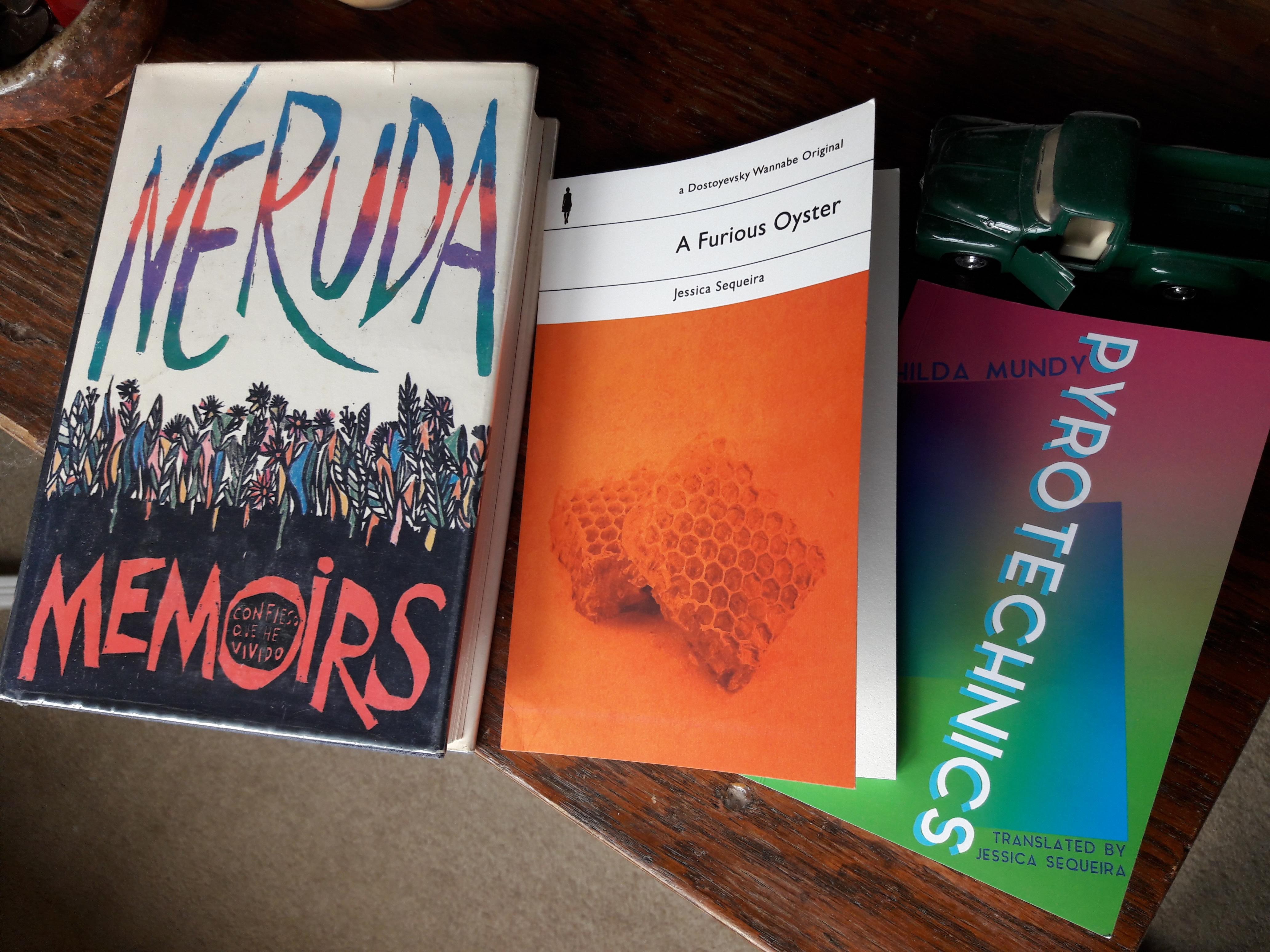
    20180916_100653I was reading Jessica Sequeira’s debut novel, “A Furious Oyster” (Dostoyevsky Wannabe, 2018), when the 30 August London Review of Books arrived in the day’s mail. A book review should reveal something unexpected, but to do that the book under consideration must be heard in a whisper.
    I turned to the review of Zadie Smith’s latest collection of essays; the LRB reviewer, Thomas Chatterton Williams, quotes from Zadie’s foreword:

    “‘I have no real qualifications to write as I do. Not a philosopher or sociologist, not a real professor of literature or film, not a political scientist, professional music critic or trained journalist … My evidence – such as it is – is almost always intimate. I feel this – do you? I’m struck by this thought – are you?’”

    Later in the review, we might recall that quote and think Zadie is telling us something more, but on the slant, that where she comes from, who she is, who her parents were, the various markings often used for identity, also don’t necessarily serve as “real qualifications”:

    “‘Who am I to speak of this painting? I am a laywoman, a casual appreciator of painting, a dilettante novelist, a non-expert – not to mention a woman of lower birth than the personage here depicted … I am still the type of person who will tend, if I am in a public gallery, to whisper as I stand in front of the art.’”

    That ‘whisper’ is often precisely both unexpected and unheard. The whisper follows no code of style. The whisper comes after the existence of the writer, and describes her essence, her choices, her existential leanings, what she has decided to follow. The whisper is the writer’s breath. The whisper might also be how something is said, and is often paradoxical. The whisper breaks the piece, ruins the lecture, calls from the pit, stops the show. The whisper might be a prayer of praise or a heckle in time with popular opinions.

    There’s something else, too, about the whisper; it’s what most of us do who have no real qualifications. And out of all those whispers (the all but silent blogs, the self-published and distributed broadside, the furious but funny poem in the on-line lit-wall), which ones should we home in on? And why would someone whisper when already no one’s listening?

    Sometimes, of course, the whisper “goes viral,” bounces and echoes off walls, scampers up trees, drifts through subway tunnels. But who or what is the host for that sometimes poison, at times the scent of lavender? And it’s well known, though often not accepted, the virus does not respond to antibiotics, the stubborn use of which weakens the resistance.

    All noise dissipates into whisper, so it should not surprise us that John Cage’s 4’ 33’’ goes briefly viral upon each new discovery. We realize even the Big Bang was a silent singularity. Not only might the world end not with a bang but a whisper, as Eliot almost said in “The Hollow Men,” but the world probably began with a whisper.

    A whisper is not a whimper. A whimper is what comes out of a giant mouth at the end of a rant. A whisper is a careful timing of breath, a largo escape, patient. The whisper goes easy and around.

    “Although that isn’t quite right either: how to describe something like the voice of a person just out of sight?” (A Furious Oyster, 92).

    Hilda Mundy’s voice was far out of sight when Jessica Sequeira brought it back: “I don’t want them to punish me with comments” (Mundy, Pyrotechnics, trans. Sequeira, We Heard You Like Books, 2017, 17). “Them,” the “three-dozen readers laughing at the pages of my failure” (17).

    The whisper never fails: “I began to hear people whispering things to help me, advice. I don’t know whether those voices were really there or not, but they brought me serenity. They helped talk me through my situation, suggesting new paths, pointing out what I needed to do” (A Furious Oyster, 92).

    “I have great respect, in contrast, for the metaphor. This is that” (118). So when we are told Pablo Neruda has ridden a wave of energy from an earthquake or the ocean or some great storm to enter the realm of the living, we believe. “This is my body.” This voice, this word. The metaphor transfigures.

    Sequeira’s “A Furious Oyster” is diary, memoir, investigation, document, thesis, mystery, love story. Let’s “be clear,” there are “other realities” (55). The reality of the metaphor, for example. “Strong wills work even in the shadows of the afterlife” (Mundy, Pyrotechnics, 29). Does every word contain its erotic origin? “How pleasant and suggestive a couple in love is!” (Mundy, 34). “Would I want to live forever in this particular moment, this precise patch of time?…Her kisses alternate, soft and hard. I wrap my arms around her, but already her shoulders feel less firm; our time is nearly up. We must go back now, I know, I know. I know, and how I wish I did not” (A Furious Oyster, 38).

    “A Furious Oyster” is a story of two famous poets in Chile, Pablo Neruda and Pablo de Rokha, literary adversaries, it seems, but both driven by the sufferings and loves of the people of a place, a land, a geography, a structure, to reach out, to reach. The geography of Sequeira’s book reveals her interests in shapes: “Sometimes at night, I dreamed of these theoretical shapes – the rhombuses, the ovals, the diamonds, the ellipses of sub-arguments within the prose. I kept only one notebook, and the diary of my personal life merged smoothly into the most abstract of notes on these Chilean poets, here and gone before my time” (55). “A Furious Oyster” is also the story of a writer researching, composing, working, in a relationship, watching, listening. And it’s the story of a place, Santiago de Chile.

    Sequeira possesses that most unique of minds, the one able ambidextrously to move easily from the hard academic to the soft poet (or is it the soft academic to the hard poet?) within the same shape. The flow of “A Furious Oyster,” its style, is redolent of the Duras of the “Four Novels,” or Lispector’s way of creating mystery while unveiling surprises. I also thought of the modernism of Djuna Barnes and Anais Nin. Jessica Sequeira is a translator, a scholar, a writer. She both understands and comprehends literature. For those of us who can only comprehend, but feel we are indeed also “struck with this thought,” we can only whisper in her shadow that you really should read “A Furious Oyster.”

  • The Bananafish

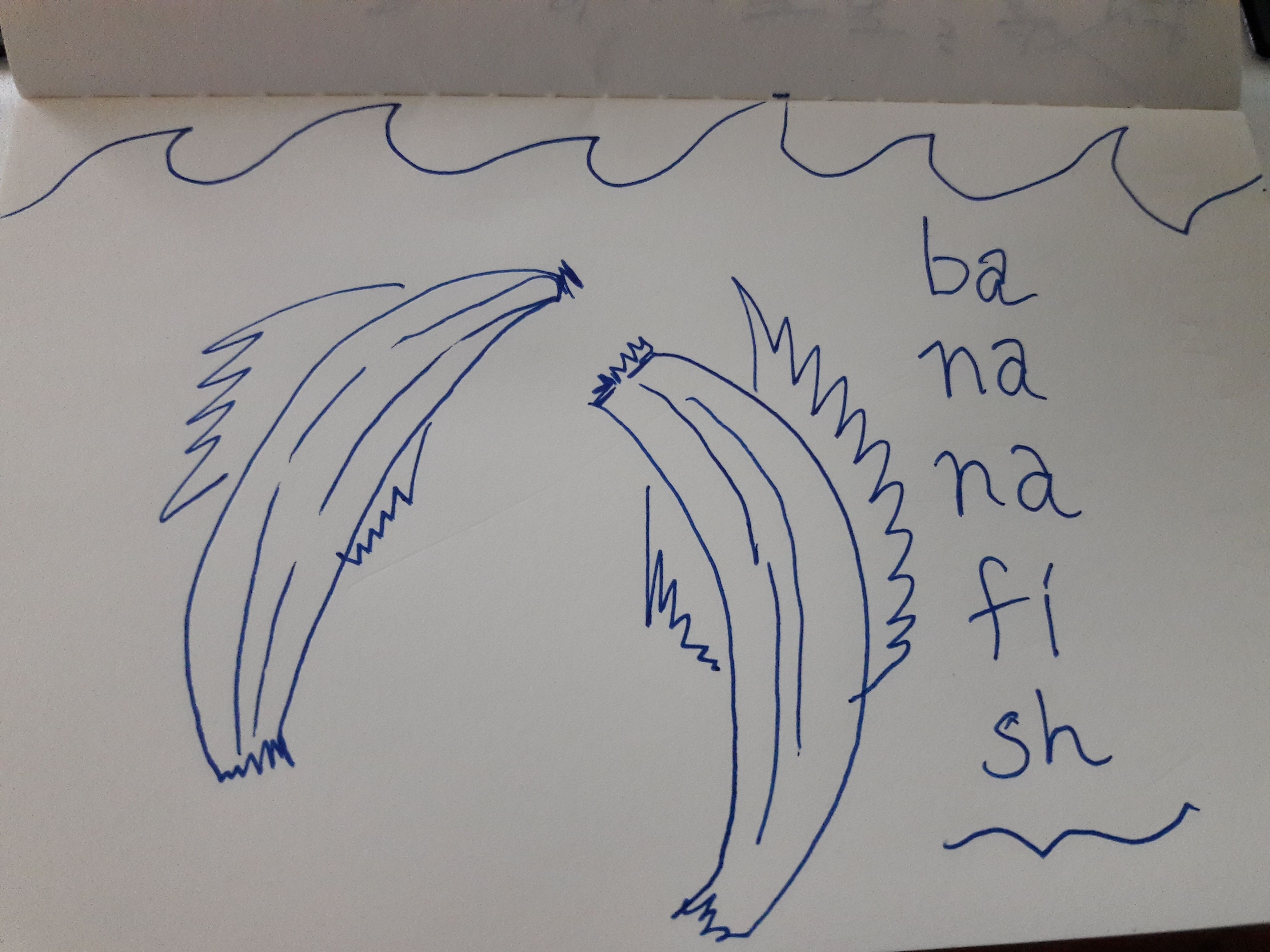
    A popular fish in some schools the deep
    sea swallower called the bananafish:
    Sansjawdsalumpigus.
    Though it lives on the floor of the aphotic zone,
    it is not bioluminescent; in fact, it’s invisible.
    Rising to the surface with changes of tide, mind,
    and mood, it’s worse by tens than the burbling
    Jabberwock. A bananafish is never caught;
    it slips you, and you are capsized.

    The bananafish sees without eyes things
    that disappear, hears sounds in the depths
    of silence, lives on even when squished
    or peeled or baked into bread or spread
    in undigested seeds. They live in clusters,
    but it only takes one to upend your plans
    for a day, a week, or a lifetime. Nevermind
    the Jabberwock; beware the brilliant
    brainy glare of the bananafish.

    What bites but has no teeth?
    What smells but has no nose?
    What swims without fins,
    goes loopy if left to shelf,
    barmy as the froth of beer?
    Ans: the double-dealing
    bluff bunko, the sly hoax
    of Sansjawdsalumpigus,
    commonly called the bananafish.

    20180826_085709

  • Hermit Crabs

    A hermit crab leaves
    home for a new dig
    again and again gig
    after gig sea busker.

    From her mitt he falls
    web of empty shell
    on the beach combs
    a low tide husker.

    In a shell in a cave
    floor of the sea
    hermetically rich
    rarely distressed he.

    20180823_092058


  • Too Much of Nothing

    You say too much
    too much you lose
    the way and the
    universe seems
    too much for you.

    Not to make too much
    of this to make much
    of time, of hot,
    of cold, like a year
    in Chicago.

    Say you see
    her eyes move
    like stars way
    too slow and too
    much of nothing.

    20180709_161602