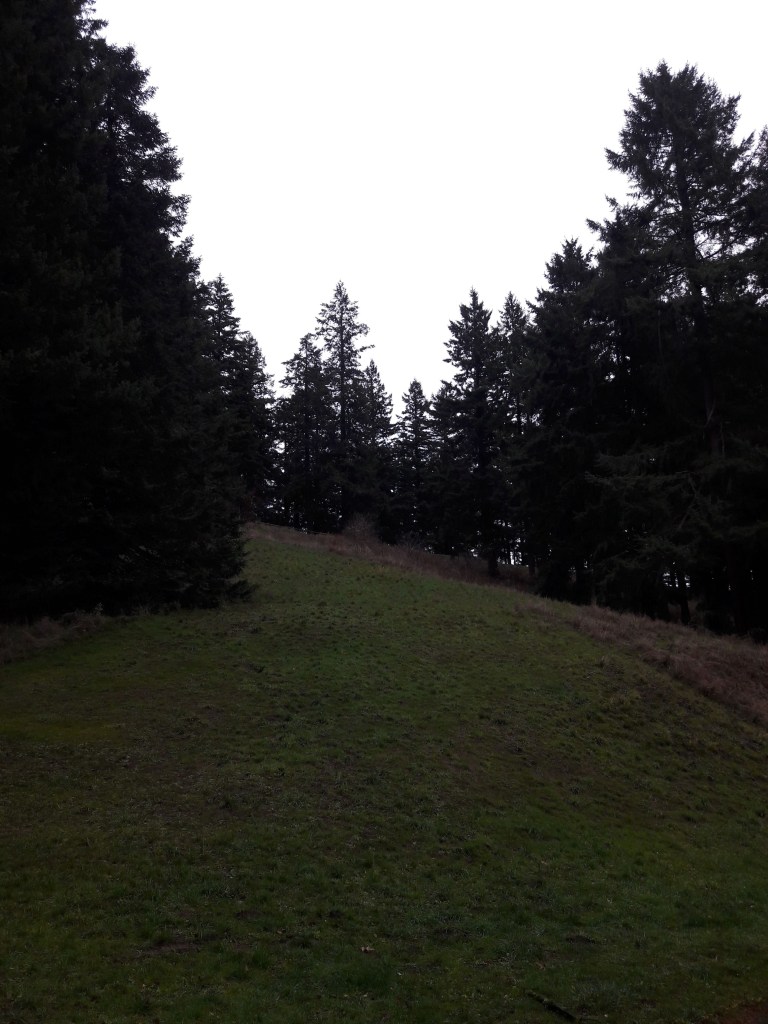
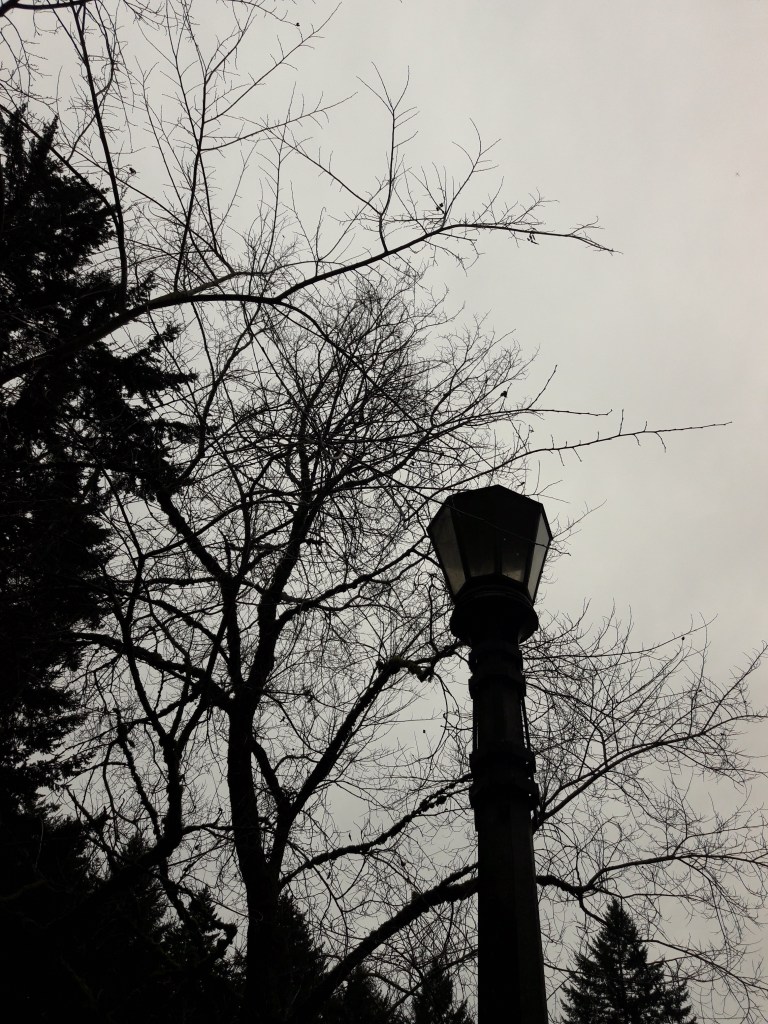
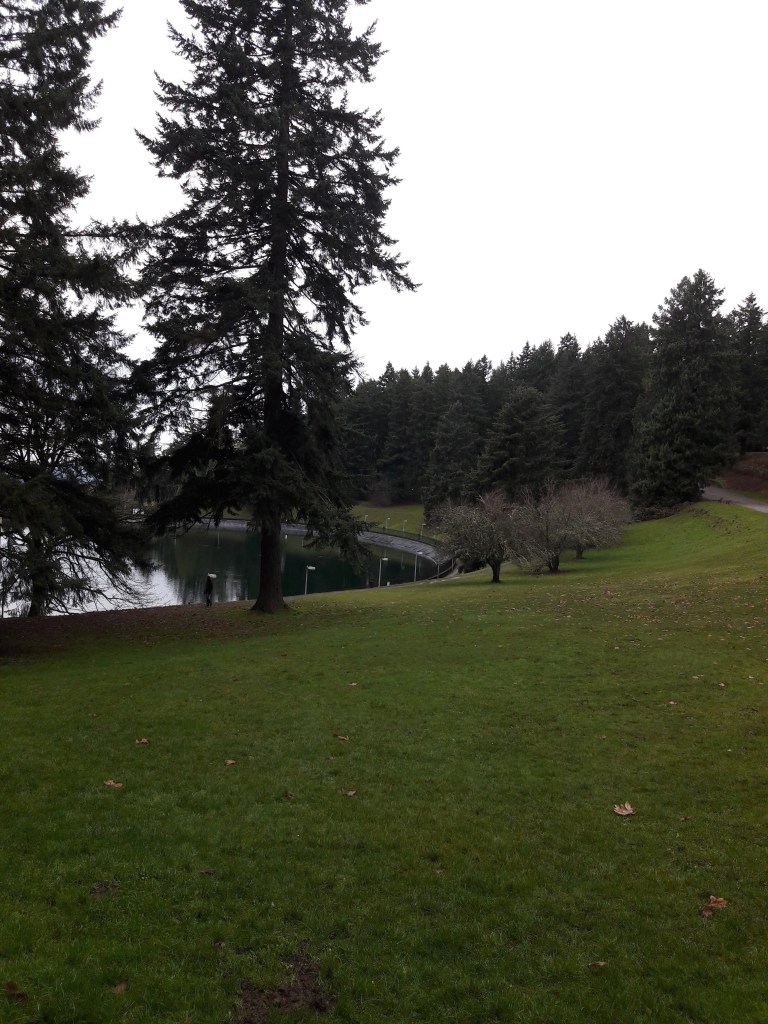
Cold. Wet and damp. Dark. Slippery walk in Mt Tabor Park, where the trees appear ready for the winter solstice.
Grassy Hill
Lamp
Cherry Trees late Fall
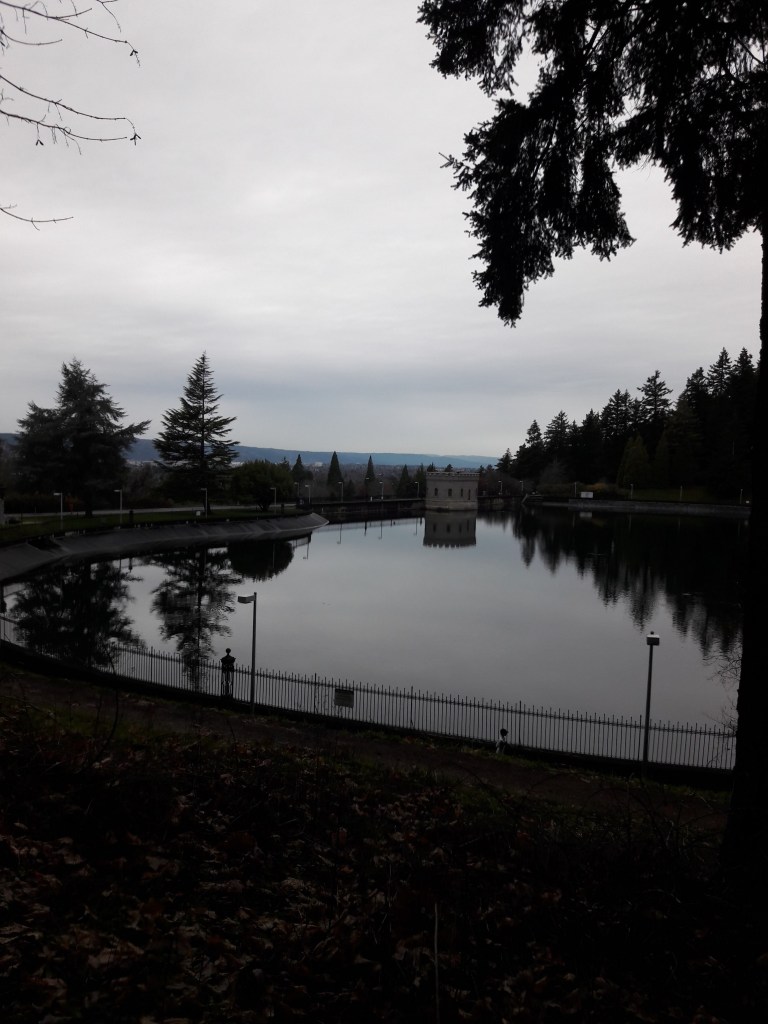
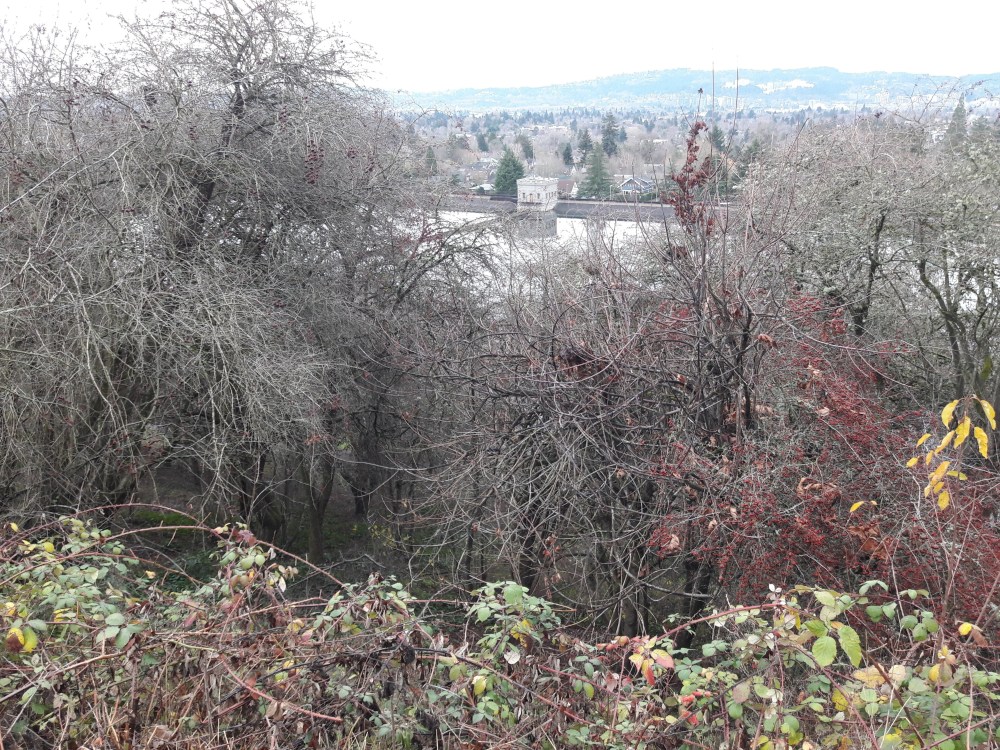
The reservoirs, built with new Portland Cement techniques in the early 1900’s, until recently, held the city’s drinking water. A new, enormous underground tank was built and the reservoirs disconnected. What to do with them now has occupied the community and city planners for the last few years. I’m in favor of building a wave pool, though there’s been no discussion of that idea I’m aware of.
NW to Downtown
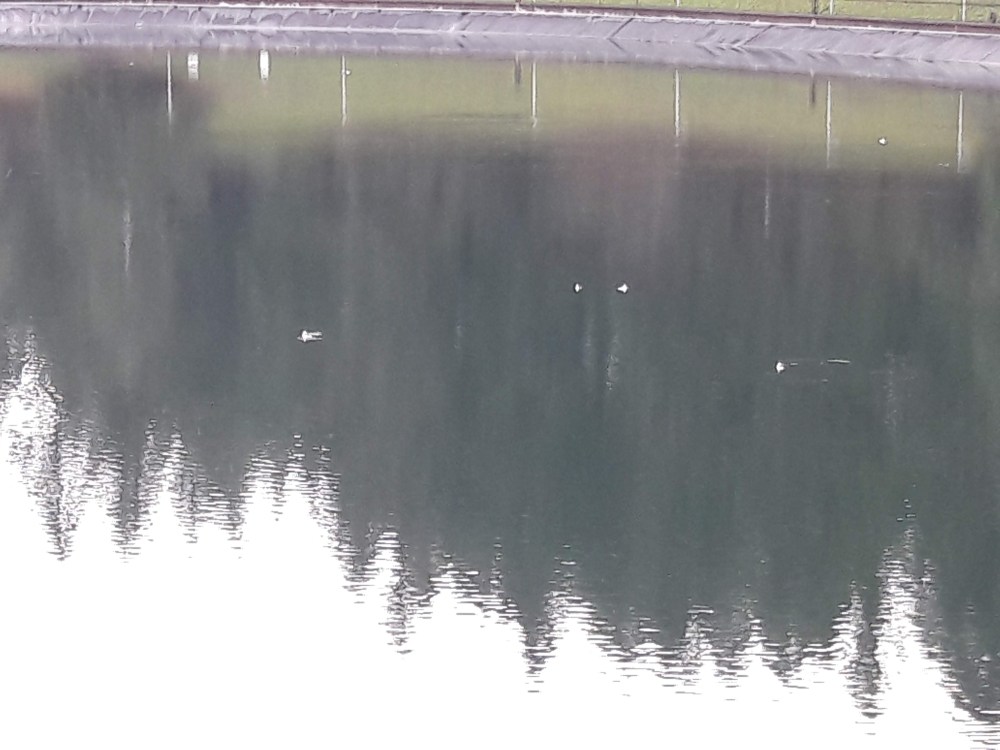
Birds afloat in tree shadows
SW view
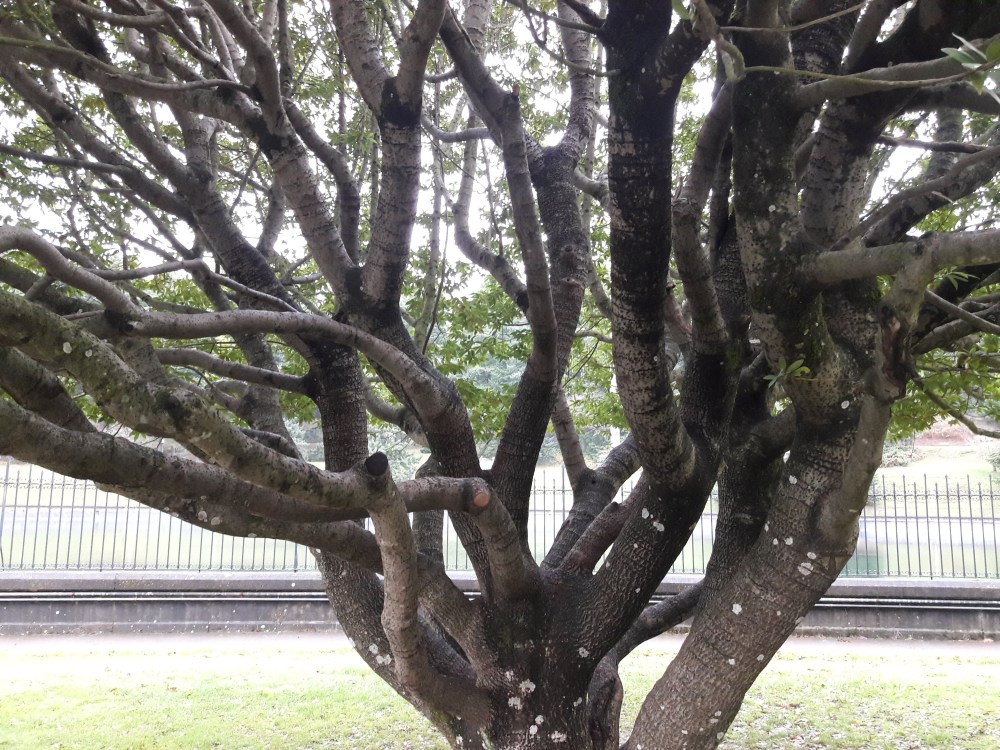
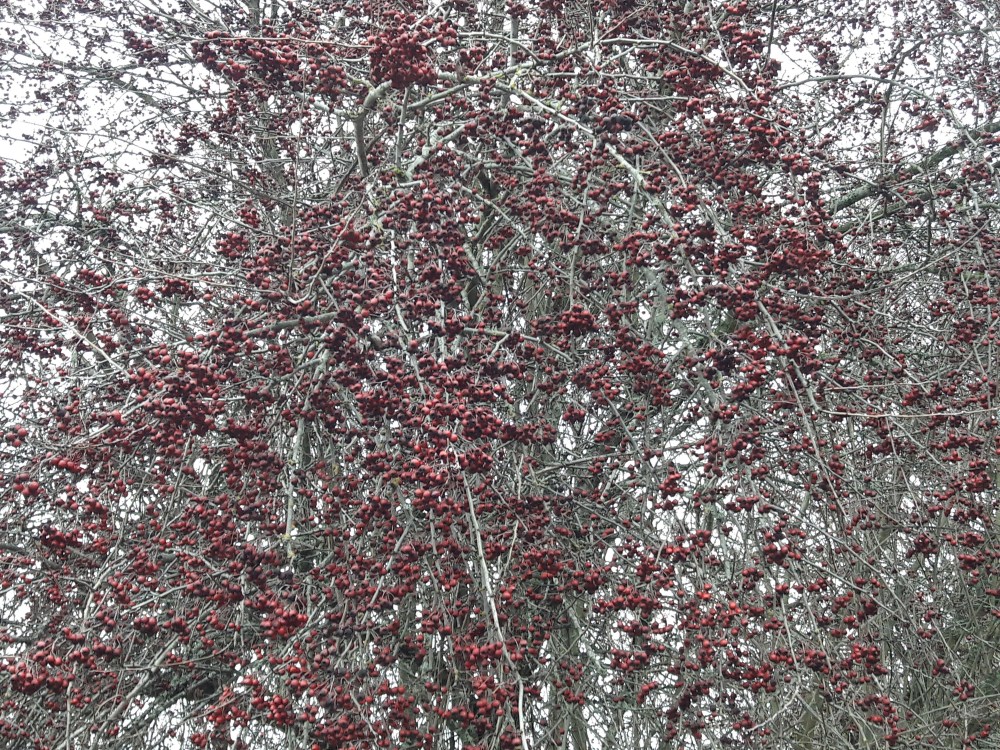
The Oregon Myrtle and Washington Hawthorne are lovely in winter. In California, the myrtle is know as California Bay Laurel. The leaf is like a bay leaf in shape, color, and texture.
Oregon Myrtle
Washington Hawthorn
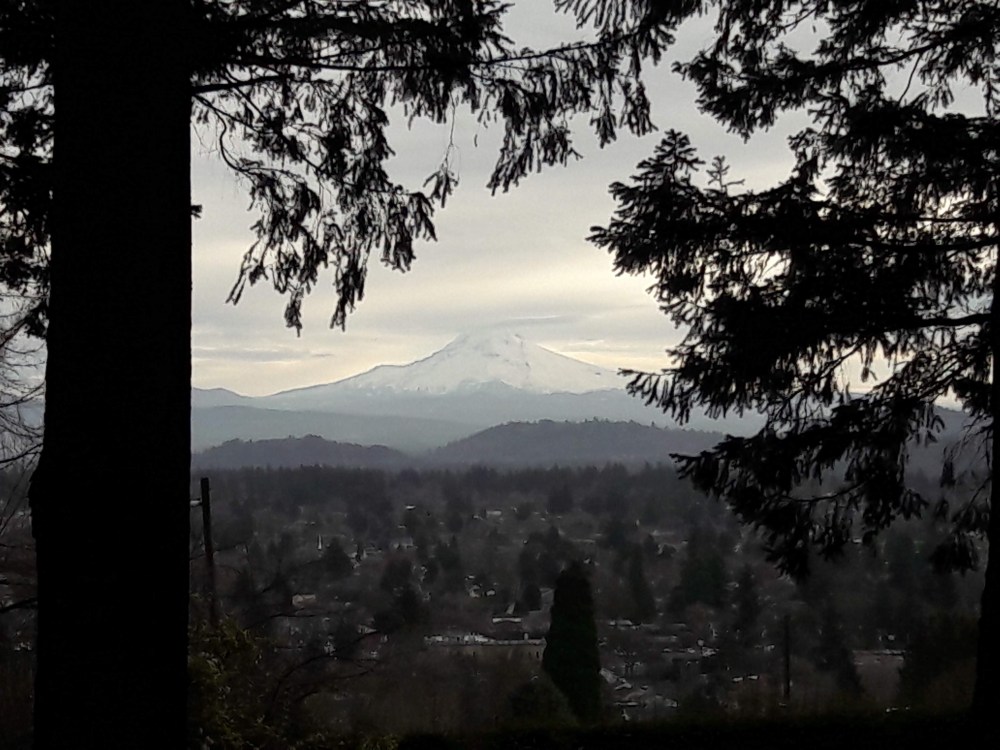
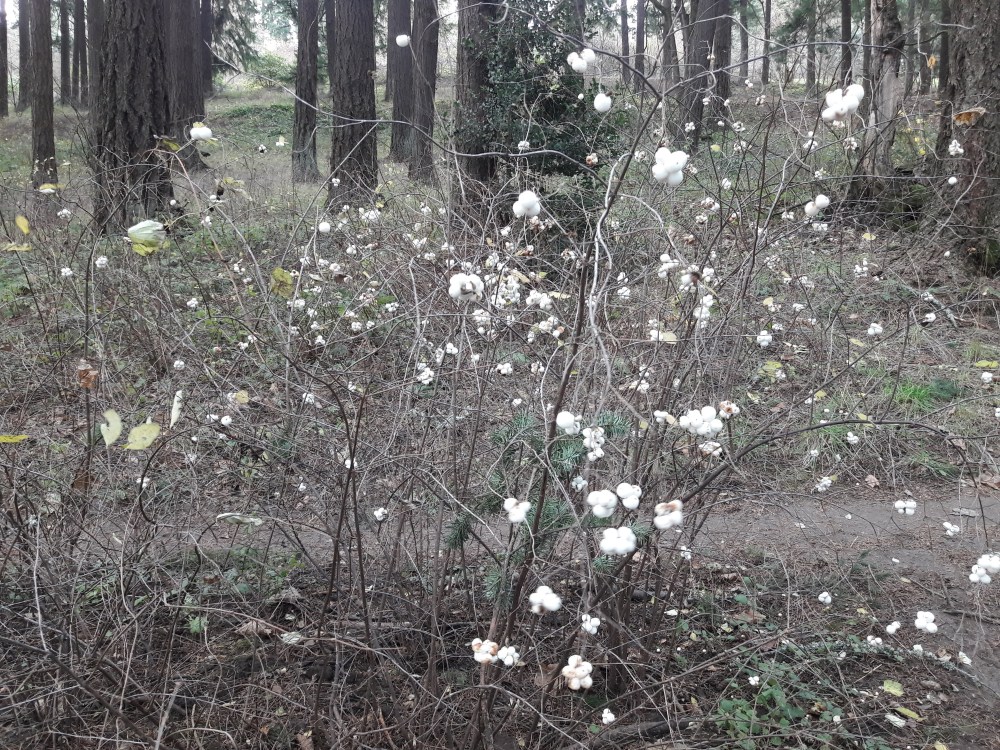
A slow walk focusing on the big and small. To the east, Mt Hood dominates the view. Throughout the park, the popcorn bush is popping its white kernels.
Mt Hood
Popcorn Bush
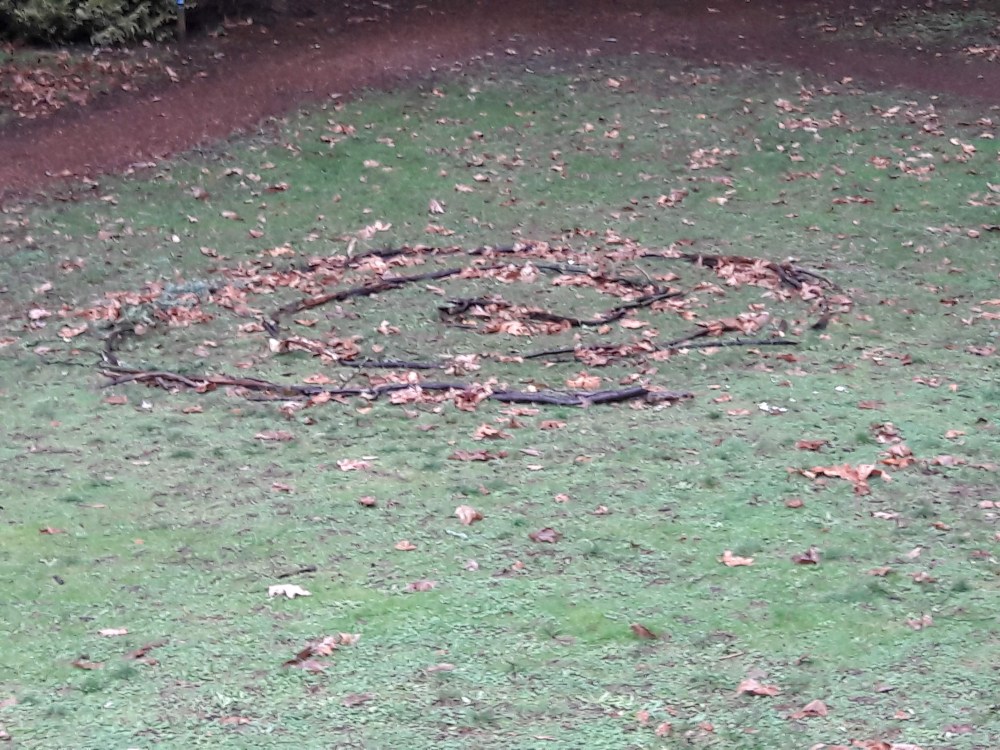
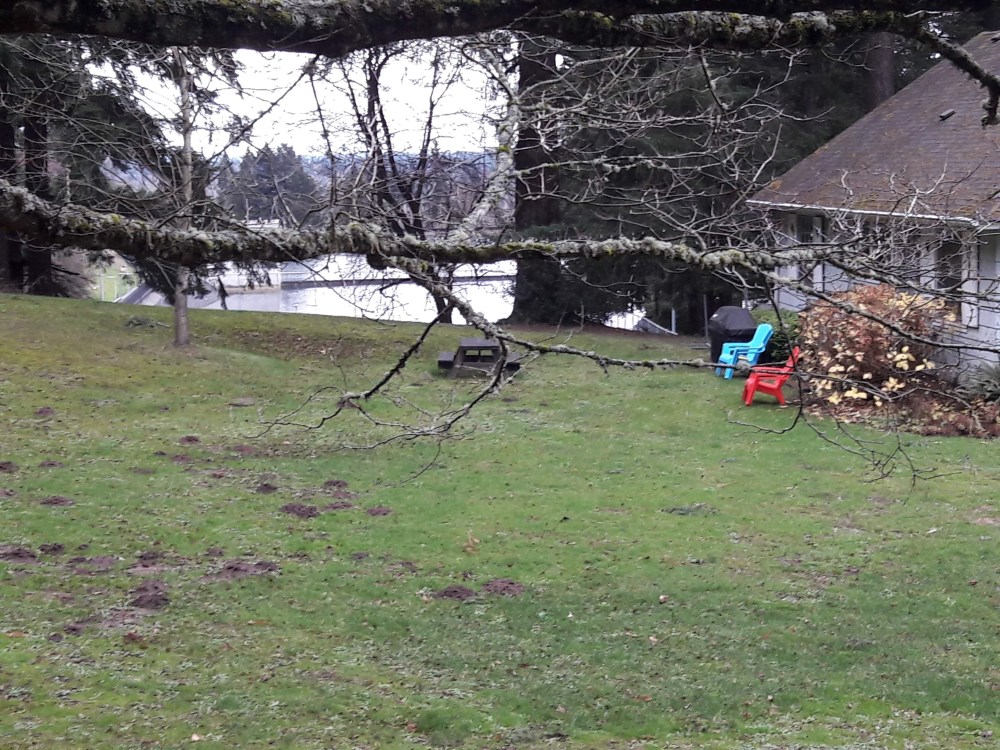
Someone built a labyrinth of branches in the grassy opening to the west-side creek valley. Portlanders love to sit out. In the yard at the west-side entrance to the park, two colorful chairs sit empty.
Mr. Groen maintained a modest but pleasant yard. Saturdays in season he cut the grass with a push mower, pruned roses, fertilized, spread compost. Martha Groen watered the beds full of crimson geraniums, purple peonies, tulips, daisies, and such that fancied her seasonal gardening moods. But back to back dry nasty winters followed by suns so hot the weatherman warned of drought, and the city curtailed yard watering with fines. Weeds bolted like bad thoughts coming from nowhere but filling the mind with oil and gas. Mites appeared, worms, mildews, the antithesis of a long forgotten paradisaical anthesis. They still sat out, but they let the yard go.
Youssef Rakha, Egyptian writer and editor of the international online publication The Sultan’s Seal (aka Cosmopolitan Hotel Cairo), recently posted to his site twelve of his own original poems, translated from the Arabic by Robin Moger. That posting draws significance for several reasons: both writer and translator are professionals published elsewhere in traditional forms – literary, commercial or journalistic; the poems are estimable; as literary online culture continues to evolve, with some longtime bloggers dropping out following more traditional successes or frustrated by the perceived over saturation of unpaid venues, Rakha continues to appear determined to develop even further his site, creating unprecedented opportunities for diverse writers and readers.
As I consider a discussion of Rakha’s twelve poems, I’m reminded of Kirill Medvedev, the Russian poet whose concerns regarding ownership of communication and open access to literature and language led him to renounce his copyright, and in addition to his other work, he began to self-publish his poetry on Facebook. At the same time, Medvedev seemed interested in writing that would not alienate a common reader, as so much poetry often does, even if inadvertently. Reading poetry can seem like studying a foreign language, as indeed it is.
Rakha’s poems behave, it might seem redundant to say, poetically. That is, they move by metaphor and juxtaposition of images, narration sometimes ambiguous, with many unexpected turns. What is their subject? Rakha has always made expeditious use of tags. At the bottom of the “Twelve Poems” post, for example, we find 70 tags, alphabetically ordered, but we don’t find fridge or hug.
We should assume the speaker or narrator of a piece is not necessarily the author. Authors create characters, in both fiction and poetry, and narrators, including those in the first person, are characters. Even the narrator of a so called memoir, perhaps particularly so, is a character created by the author. Louis Menand recently spoke to this issue in a New Yorker article. I’m not sure he clarified or muddied the waters. That business about the “narrative pact,” for example: I prefer Trilling’s argument that everything is an argument – and that probably includes memoirs, essays, poems, novels, ads and commercials, junk mail, the evening news, anything on an op-ed page, and notes left on the fridge from your partner. The old, venerable encyclopedias? Full of arguments. The new Wiki? Likewise. But Menand’s closing point, that no occasion for writing should prevent us from reading, is right on. But what of the culpability of readers who in their creative reading find something the author had not intended? But isn’t one of the purposes of poetry to create and sustain or nurture the possibilities of unintended consequences?
The setting of the poem where we find the man hugging a fridge seems domestic. His wife is there, swinging from the chandeliers, but this doesn’t seem to be a party. The local world is drowning in rain. We might recall Bob Dylan’s “A Hard Rain’s A-Gonna Fall.” “Oh, what did you see, my darling young one?” The man’s legs are submerged. Is he hugging the fridge for its buoyancy potential, a life preserver? The poem is titled “Listen Ashraf,” and Ashraf Fayadh, a poet initially sentenced to be beheaded in Saudi Arabia, is named in the first line. His sentence was subsequently reduced to an eight year prison sentence with 800 lashes. His crime, it seems, wasn’t so much poetry, or being a poet, but of writing the wrong kind of poems. We hug our abodes, our houses, our wives and fridges, our lifestyles, as the waters continue to rise. We hug to say hello, goodbye. We hug the things we love. We hug a fridge or a clothes washer when we want to move it to another location. We hug to hold on. “Listen Ashraf” is the last of the twelve poems.
The first poem of the twelve is titled “First Song of Autumn,” and speaks of joy: “I am the clarinet’s mouth.” This poem is lyrical, cylindrical, like the flight of birds.
In “The Angel of Death Gives Counsel to a Bereaved Parent,” we find one of those poems whose narrator or speaker appears as a character invented by the author of the poem. The poem appears to be the angel’s apology, a rebuttal to the argument that he has no feelings. But he must harbor his hugs to get the job done. And he gives back, not an answer, and certainly not even a hint of a meaning to his work, but a hug of surety.
The twelve poems speak in both the first and second persons. The speaker addresses someone close but at the same time far away, questioning, observing, remembering. There are sparks of sadness and of sarcasm, of hope drowned in irony, of anger:
“Sleep and hug, like the downy pillow, the certainty That you’re the genius, alone in a society of retards.”
Readers might wonder what it is they hug, to get them through the night or day of a poem, across the invisible wall of a border.
One of the twelve poems, “Stallion,” is a prose poem. Not that a piece written in prose is any easier to grab hold of. It only appears to be one of the more accessible poems here. Written “For Ahmed Yamani,” it moves as a dream of water over oil. Another prose poem, titled “Love (Marriage),” seems an aphoristic apology, though we may not be exactly sure for what. It is not the sentiment often found on greeting cards.
On second and third reading, the poems open more easily. The reading is not difficult; that is because the writer has done most of the work. But there is work required of the reader, too. The settings and references may be unfamiliar, the problems, though universal, hardly equitably distributed. Characteristic of the poetry is the packing together of history, personal observation, everyday events (visiting a cafe, for example), a kind of diarist epistolary form. The movements feel free, without restraint, not hamstrung.
je me touché, Jeremy Fernando, 2017, Paradiso Editores, Delere Press, 77 pages.
Jeremy Fernando’s method of writing shows his acoustic, vibratory thinking, making connections, moving from one idea to another, enharmonic soundings, transported by his readings. In “je me touché” (it is i touch me – or, I me touch: I touch myself), he connects, in four essays, as cars interconnected on a train, Flann O’Brien’s short story “John Duffy’s Brother,” Melville’s “Bartleby,” the Occupy Movement, and, in an “Afterword,” sound, touch, and tune.
If Flann O’Brien’s Brother is a train, Melville’s Bartleby is a station, the last stop, the end of the line, no turnaround. Nothing to be done now but occupy that well-foreshadowed destination, where we hear night and day the whistle of a human train derailed, “the scream of the scrivener” (25). That scream is a kind of tinnitus. There is no actual sound. What we are hearing is a phantom noise in our imagination.
In the beginning was the word, and the word created community. In every beginning originating with a word, a commune is created, a habitat for the imagination. Community contains potential for sharing, for touching, without conflict, but with the possibility of divergence, which is risk, which becomes reading, a home, a place to dwell. And every household invites divergence, a library of dry goods.
Fernando begins “je me touché” with an immersion into Flann O’Brien’s short story “John Duffy’s Brother.” Following some strange inexplicable happening, Brother (unnamed, perhaps one of Beckett’s unnamable) believes himself to be a train. Children often play at being things – “Choo!Choo! Good and Plenty. Good and Plenty.” But Brother really is a train. What is a train? Following a linear path, tied to its tracks, a community of cars carrying sundry goods and people and animals, all properly ticketed or listed in a bill of lading, the train rolls, pulls, steams along, along the line, picking up speed, braking for curves, slowing on hills (“I think I can. I think I can”), forward to a destination, for every train has a purpose, clear and unmistakable. And part of its purpose it to run on time, less the socioeconomic demographics harmonizing the connecting stops becomes disrupted (45-48). We don’t care about the people on the bus any more than we care about the bus drivers. What we care about is the system, the fixed routes, the timetables, the robotic movement of time. We become the bus, the train. But the story is not about the train; it’s about our thinking we are the train, a secret few of us care to admit, less we be admitted. What happens when the drivers (today’s scriveners, writing a line along a predestined route) go on strike?
Our choices are limited. All authority lies in the tracks, and “it is only truly authority when ones does not have to use any force.” The system that runs on time requires no force but to enforce the schedule, which should require no force once set into motion. The individual who leaves the track, detours the bus route, goes on strike, does not necessarily wander far afield, but comes to rest, as does Melville’s Bartleby. Employed as a scrivener (a human copy machine), Bartleby inexplicably begins to “prefer not” to do any more copying, or have anything to do with the office or its community, yet he will not vacate the premises, for he prefers not to do that either. Bartleby’s boss, possibly the first humanist, works around him, but Bartleby eventually winds up in the Tombs, and we learn that he started out in the dead letter office. “Ah, Bartleby. Ah, Humanity,” the story ends.
We begin to see Fernando’s connections, how he unravels then weaves again the themes found in Brother, Bartleby, then the Occupy Movement, and lastly, in “Afterword,” into one wandering path. Along the way, we meet the likes of Zizek, Ronell, Kant, Otis Redding, Cervantes, Wall Street and its Bull (symbol, sculpture, art), reading as touching. “Prosopopoeia”: feeling, book, relation, touch. The word empathy is not used, but perhaps should be, as in to feel oneself is to grant oneself some altruistic version of how another might feel us. Henry Miller. In tune. Dash, the dash. Coming together. Risk. Love (“I love you,” 72-73). Laughter as music, as language.
Fernando’s layers upon layers of reading unfold, every word its history we must also remember, “keeping in mind” how others might have used it. And under the surface a stream, a river, runs undercover. Thus relation, within words: correspondence, interconnections, kin, intersections. Connecting Bartley with Occupy – occupy what? Nothing? The stairs? Bartleby occupies, to occupy already an occupation (“…why don’t they just apply themselves and get a job,” 37). Touch themselves? Now here: no where? To read is to touch oneself as another might touch, with permission.
This is not a pipe dream, but a book, hard copy.
(“Try this apple, Adam, very good”). Essay as fruit of the word.
Who reads when we read? Even reading something we ourselves have written, we wrote, yesterday or some time ago, we are not the same person reading as we were writing – we are not exactly that same person who sat at that very desk, now also changed, and wrote, for we have already a myriad of new experiences constantly adding to our connections.
I first read Melville’s “Bartleby: A Story of Wall Street” when, as a sophomore in high school, I was assigned Melville as my first term reading and research author assignment. I remember some of the other boys who got Hemingway, Steinbeck, Babbitt. I wasn’t all that happy to get Herman. But that attitude changed. Of course I loved Moby-Dick, but I tried to argue “Pierre; or, the Ambiguities,” written just after The Whale, the better work. Meanwhile, though he died before I was born, my paternal grandfather was an engineer on the Louisville Nashville Line. “So it goes.” Connections.
My novel “Alma Lolloon” is now available in Kindle electronic edition format. You can download a copy for $2.99 here (free if you have Kindle Unlimited).
The tall fall fires out west follow
the humongous hurricanes blowing
across the headline news, shooting
embers across the dance floor valley,
licking into the canyon columns
of textual innuendos of who
belongs here and who doesn’t.
The wind and rain and flickering
flames know no such distinctions.
All belong to the sky and forests,
to the ocean, mountains, and deserts,
to one another embracing bumper
to bumper against the noise unleashed
updating itself every second breath.
Some too old to dance seem left behind.
You can’t fight a hurricane like you can
a fire. The new news is the new normal,
seven by twenty-four and minute by
minute. Still, all we know of the missing
and the ones still on the road is that
they are missing and still on the road.
“Oh, God. Oh, Mother,” the Civil War
soldier cried as he burnt up. Why,
when a single bullet would have sufficed?
The trees are drying and the ground sinking.
Will all not sunk into the sea burn
into the sky? The caravans continue
heel to toe to higher and cooler ground.
For some, grammar might be understood as an attempt to control language, or to control a speaker. But the only way to establish complete control over a language is to kill it, which is probably or nearly impossible, because language possesses, like the planarian, the ability to reform or regenerate from a tiny piece of itself. I point to an object, and that is how grammar works. The object could be the sugar bowl on the kitchen table, the moon, or a running man. I link to it for the purpose of linking you to it also. But first, I have to get your attention. Of course, I can always point to myself, or point to an object by myself, like talking to myself, which might be one origin of poetry. When the objects we point to disappear, or others claim to be unable to see them, we come to the first existential crisis of language, where we find ourselves in grammar school, the subjects of rote repetition in an effort to create memory. In grammar school, we learn to wear a uniform.
We learn to number our clothes. The hat, number 1. Or maybe we start with the shoes, the socks being a subset. First we put on the right sock, then the left, then the right shoe, then the left shoe. Never mind it’s a sunny day and we were thinking what fun it would be to go barefoot. To go barefoot, in grammar school, is one of the first examples of being ungrammatical. We are assigned a seat, a number in a numbered row, alphabetized and numbered in the numbers book. Having a number is essential when everyone looks alike.
So it was with a tremulous motion I finally approached my MS Word file containing my first published novel, “Penina’s Letters,” to correct a few unintended consequences. The first printing had contained an unacceptable number of typos, and the front matter setup has always felt a bit clumsy to me. The chapter listing page, for example, showed the chapter titles but no page numbers. And the ISBN didn’t show on the copyright page. But why the tremolo? Why not just go in and make the changes? I did manage one corrected copy upload, after the first printing back in 2016, ridding the book of most of the obvious errors, mistakes which, it pains me to admit, I had failed to spy with my little proofreading eye. But a few issues remained, as additional readings revealed, but the thought of entering the MS Word file again and resubmitting for revision to CreateSpace for approval with the hope of not making matters worse was all more than I felt up to. Besides, I now had other projects underway that required my attention.
Then, a week or so ago, I was notified that CreateSpace was closing its doors and all texts migrating to Kindle Direct Publishing (KDP). So I took the opportunity to become acquainted with KDP by reworking the front matter of “Penina’s Letters” and fixing a trio of what I recognized as outstanding mistakes.
My first submission of a redo file for KDP’s approval was rejected – something to do with pagination errors. Mercifully, the rejection came within the 24 hours promised, and I went back to work on the Word.doc before motivation waned, resubmitted again, got approval, ordered a proof copy, and voila! No page numbers at all.
Suffice to say, after all that preamble and bramble, that for the past several days I’ve been immersed in a kind of MS Word pagination purgatory. Changes to a text often cancel out other changes, or sit on top of them, burying them below – but that suggests there is a top and a bottom to the thing, and of course there is not.
I got page one to say 1 but could not get the other pages to follow suit. I got every page to say 1. And so on, nothing acceptable. I began to think, rationalizing and trying to come up with some creative solution, why bother paginating at all anyway? Does the common reader really need page numbers? And isn’t a page number a kind of mar on an otherwise illuminated manuscript page? I got page numbers to show, but not in the footer where they belong. I toyed with “different front page,” “link to previous,” “create section break,” erase all and begin again. Deeper and deeper into an MS Word morass I sank. I entered “document,” “paragraph,” the journeyman’s “tools.” Suddenly blank pages and huge gaps in the text began to appear throughout the manuscript. I fixed and corrected and proofed. At one point, I had a file with pagination complete that seemed correctly formatted. I resubmitted yet again to KDP, and the proof file came back still with no page numbers.
I took a break from the project. I remember McLuhan saying something about pagination beginning with the printing press. The fall is into the printing press. Is there a page 1 to the Internet? In a mosaic, one may enter and exit anywhere. Page numbers are useless. There are no pages. There is the infinite scroll – over, under, sideways, down.
“Backwards forwards square and round.
When will it end, when will it end,
When will it end, when will it end,”
the Yardbirds sang.
“We don’t need no stinking page numbers,” I can hear Puck Malone of “Penina’s Letters” saying. But in the end I managed somehow to successfully place page numbers on the outside edge in the footer of even numbered pages, in sequence, every other page. I seemed to recall seeing books numbered only on every other page. I looked through some books. Saul Bellow’s “The Actual” places page numbers only on the odd numbered pages, right edge of page, in the margin, spelled out, in italics: page one. Enough.
Interested readers may utilize the “look inside” feature at Amazon to get an idea of how the new printing of “Penina’s Letters” came out.
 The Coming of the Toads