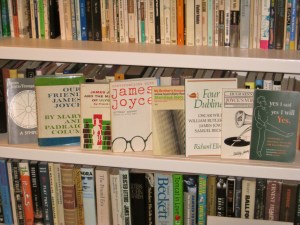
• James Joyce’s Guitar Chord in the 1915 Ottocaro Weiss Photo

    What guitar chord is James Joyce playing in this photo?

    The original photo, taken by Ottocaro Weiss, in 1915, is housed in Cornell’s James Joyce collection, in an exhibit in a glass closet titled “Poetry and Music.” I first saw the photo of Joyce playing the guitar years ago in the Ellmann biography, and I cut it out and pinned it over my desk somewhere, but I’ve since lost that copy.

    Fingers to stray on Joyce’s guitar again after its restoration,” an article by Terence Killeen in the March 22, 2012 Irish Times, discusses the restoration of Joyce’s guitar and contains a fascinating video clip of the luthier at work on the guitar. Gary Southwell, the luthier, guesses, based on the finger wear on the fretboard, that Joyce probably was not a “fantastic” guitarist because the wear suggests mostly first position, standard chord forms: “He wasn’t all over the fingerboard.”

    Can we tell from the photograph what guitar chord Joyce is fingering? Assuming his index finger holds the root note, then he’s playing a 1-b5 on the bass strings. If the root is an F, then he’s playing an F-B. But his ring finger appears to be positioned directly over the second fret, so it’s hard to tell if he’s fingering a D or a Db. But anyway a closer look suggests that his index finger is not on the 6th low E string, but on the 5th string, playing a Bb note, the middle finger then (still a flat 5) playing an E note, and the ring finger playing a Db note. But I can’t tell what frets he’s fingering, and at first glance, I assumed he was fingering an Em7 chord (guitar spelling: E, B, E, G, D, E = 1, 5, 1, b3, b7, 1).

    In any case, Killeen, in the video, seems to say that Joyce is not actually playing the guitar in the photo. I’m not sure why he thinks not. Joyce looks relaxed in the photo, leaning a bit back and away, probably the better to see his left hand fingering, given his poor eyesight. The thumb of his right hand is hidden behind his palm, but it could certainly be plucking the 6th, 5th, or 4th string. Maybe he was not playing the guitar during the photo because he had to hold still for the photographer. But he’s clearly fingering a chord. Or is he? Again, his index and ring fingers appear to be hovering directly over the frets, not slightly behind them.

    I recently acquired a hardback copy of “Giacomo Joyce” (Viking Press, reset and reissued May, 1968), introduction and notes by Richard Ellmann, and was surprised and delighted to find the Weiss photo of Joyce and his guitar used as a frontispiece, spread across two pages.

    Perhaps the chord Joyce is fingering in the Weiss photo is from Finnegans Wake, a pun-chord, a humorous play on notes.

    Follow up 8 Sep 13: Check out guitarist Gerald Garcia’s Joyce guitar analysis (read through post and scroll through comments section).

  • Back to School: An Interruption to Learning?

    Buckminster Fuller’s Operating Manual for Spaceship Earth is available on-line at the Buckminster Fuller Institute. I think of it as Fall nears and students return to school, though they’ve no doubt been learning all summer, and school may be an interruption to that learning. Fuller explains, “Of course, we are beginning to learn a little in the behavioral sciences regarding how little we know about children and the educational processes. We had assumed the child to be an empty brain receptacle into which we could inject our methodically-gained wisdom until that child, too, became educated. In the light of modern behavioral science experiments that was not a good working assumption” (Chap. 1, para. 9).

    The Operating Manual was first published in 1969, and I first read it at Cal State Dominguez Hills in the early 1970s as part of the 20th Century Thought and Expression Minor, an interdisciplinary, non-specialist course of studies: “Inasmuch as the new life always manifests comprehensive propensities I would like to know why it is that we have disregarded all children’s significantly spontaneous and comprehensive curiosity and in our formal education have deliberately instituted processes leading only to narrow specialization” (Chap. 1, para. 10).

    Fuller was an inventor and an architect, and a philosopher and a teacher whose work touched regularly on the forms and reforms of education: “In our schools today we still start off the education of our children by giving them planes and lines that go on, incomprehensibly ‘forever’ toward a meaningless infinity” (Chap. 2, para. 1).

    Throughout Spaceship, Fuller illustrates the debilitating effects of specialization and reflects on the success of generalized thinking, the ability to look at one thing and see something else, to invent. The specialist is unable to invent because his learning narrows to a dead-end point in an institutionalized tunnel: “Once man comprehended that any tree would serve as a lever his intellectual advantages accelerated. Man freed of special-case superstition by intellect has had his survival potentials multiplied millions fold. By virtue of the leverage principles in gears, pulleys, transistors, and so forth, it is literally possible to do more with less in a multitude of physio-chemical ways. Possibly it was this intellectual augmentation of humanity’s survival and success through the metaphysical perception of generalized principles which may be objectively employed that Christ was trying to teach in the obscurely told story of the loaves and the fishes” (Chap. 4, last para.).

    Around the same time as Spaceship, pictures of Whole Earth began to emerge. These pictures lacked boundaries: “We begin by eschewing the role of specialists who deal only in parts. Becoming deliberately expansive instead of contractive, we ask, ‘How do we think in terms of wholes?’ If it is true that the bigger the thinking becomes the more lastingly effective it is, we must ask, ‘How big can we think?’” (Chap. 5, para 4).

    Operating Manual begins in metaphor. The title itself is a metaphorical argument. “I am enthusiastic over humanity’s extraordinary and sometimes very timely ingenuities. If you are in a shipwreck and all the boats are gone, a piano top buoyant enough to keep you afloat that comes along makes a fortuitous life preserver. But this is not to say that the best way to design a life preserver is in the form of a piano top. I think that we are clinging to a great many piano tops in accepting yesterday’s fortuitous contrivings as constituting the only means for solving a given problem. Our brains deal exclusively with special-case experiences. Only our minds are able to discover the generalized principles operating without exception in each and every special-experience case which if detected and mastered will give knowledgeable advantage in all instances. Because our spontaneous initiative has been frustrated, too often inadvertently, in earliest childhood we do not tend, customarily, to dare to think competently regarding our potentials. We find it socially easier to go on with our narrow, shortsighted specializations and leave it to others—primarily to the politicians—to find some way of resolving our common dilemmas. Countering that spontaneous grownup trend to narrowness I will do my, hopefully ‘childish,’ best to confront as many of our problems as possible by employing the longest-distance thinking of which I am capable—though that may not take us very far into the future” (Chap. 1, para. 1).

    Related Post: Earth-Glass Half Empty or Fuller? Reposted at Berfrois as Planet Earth as Spaceship.

  • James Joyce on Writing: “write dangerously”

    “The important thing is not what we write,” Joyce tells Arthur Power in Conversations with James Joyce, “but how we write, and in my opinion the modern writer must be an adventurer above all, willing to take every risk, and be prepared to founder in his effort if need be. In other words we must write dangerously” (95).

    Though I’ve several books written by people who knew Joyce, I’d never read Power’s book. Menand mentioned it in his “Silence, Exile, Punning: James Joyce’s chance encounters” (New Yorker, 2 July 2012), and I was able to find a cheap copy. [Menand’s title is itself a kind of pun on something Stephen tells his friend Cranly toward the end of Joyce’s first novel, A Portrait of the Artist as a Young Man: “And I will try to express myself in some mode of life or art as freely as I can and as wholly as I can, using for my defence the only arms I allow myself to use – silence, exile, and cunning” (247)].

    Menand questions whether what we read in Power’s book are the actual words of Joyce or the “gist” of a conversation that took place decades prior to the book’s publication. Would Menand have the same complaint if Richard Ellmann, Joyce’s highly regarded biographer, was the one recalling the conversations? It seems Menand thinks Power belongs, if he should be mentioned at all, in a footnote somewhere, his “renown” based on a single book, and while I agree with Menand that Power misread Joyce’s comment regarding the birth of a grandson, I don’t think Power should be dismissed based on Menand’s “gist” complaint. [An argument ensues, as Gordon Bowker, whose new biography Menand is reviewing, responds, timely, for the question of the journalistic practice of approximating quotes is in the air].

    And Arthur Power was a journalist of sorts, an art critic, but he seems to have had skill and talent enough to closely observe and record [he said he wrote daily in his notebook, so the conversations were fresh in his mind when he recorded them], and we certainly have no reason to think that he had motive to misquote Joyce. In any case, Power’s book is full of pearls, and whether the gems contain the exact words of Joyce or simply the “gist,” I found them worth reflection.

    But that business I quoted above, Joyce saying, “The important thing is not what we write…,” does he qualify that with this: “A writer’s purpose is to describe the life of his day, and I chose Dublin because it is the focal point of the Ireland of today, its heart-beat you may say, and to ignore that would be affectation” (97). In other words, Joyce seems to be saying that what we do write should come from what we know, what we have experienced.

    There’s no doubt Joyce had a sense of humor, and could be an acerbic wit. An illustration of humor: “Yes, said Joyce, I met him [Proust] once at a literary dinner and when we were introduced all he said to me was: ‘Do you like truffles?’ ‘Yes’, I replied, ‘I am very fond of truffles.’ And that was the only conversation which took place between the two most famous writers of their time, remarked Joyce – who seemed to be highly amused at the incident” (79). And an example of Joyce’s acerbic wit: upon hearing of the sad suicide of the socially bumbling and difficult and “irritating” portrait painter, Patrick Tuohy, Joyce had hired to paint his father and later his immediate family, Joyce said, “I am not surprised. He nearly made me commit suicide too” (105).

    But reading Power’s book I found my focus going to Joyce’s comments on writing: “A book should not be planned out beforehand, but as one writes it will form itself, subject, as I say, to the constant emotional promptings of one’s personality” (95). Joyce seems to have preferred emotion over intellect. I suppose it takes an intellectual giant to argue this: “I know when I was writing Ulysses I tried to give the colour and tone of Dublin with my words; the drab, yet glistening atmosphere of Dublin, its hallucinatory vapours, its tattered confusion, the atmosphere of its bars, its social immobility – they could only be conveyed by the texture of my words. Thought and plot are not so important as some would make them out to be. The object of any work of art is the transference of emotion; talent is the gift of conveying that emotion” (98).

    Joyce employed humor in his writing: “In Ulysses I tried to keep close to fact. There is humour of course, for though man’s position in this world is fundamentally tragic it can also be seen as humorous. The disparity of what he wants to be and what he is, is no doubt laughable, so much so that a comedian has only to come on to the stage and trip and everyone roars with laughter” (99). Joyce says, “Out of this marriage, this forced marriage of the spirit and matter, humour is created, for Ulysses is fundamentally a humorous work” (89). As for who is to say what any writing “fundamentally” is, Joyce clarifies, for critic, writer, and reader at once: “Though people may read more into Ulysses than I ever intended, who is to say that they are wrong: do any of us know what we are creating?…Which of us can control our scribblings? They are the script of one’s personality like your voice or your walk” (89).

    An example of good writing Joyce found in Hemingway’s short story “A Clean Well Lighted Place”: “He [Hemingway] has reduced the veil between literature and life, said Joyce, which is what every writer strives to do…It is masterly…I think it is one of the best short stories ever written; there is bite there.” Yet Joyce’s enthusiasm at the time for Hemingway is tempered and foreshadows so much of what was to come, both for Hemingway and for literature in general: “I admit to his merit, of course, that he is very much of our time. But in my opinion he is too much of our time, in fact his writing is now more the work of a journalist than that of a literary man” (107).

    But by literary man Joyce wasn’t referring to the PhD, the academic, the professional scholar, whose polite conversations transpire in private behind the rood screen of the contemporary paywall, but to something more real and immediate and accessible to all: “What is really imaginative is the contrary to what is concise and clear…Most lives are made up like the modern painter’s themes, of jugs, and pots and plates, back-streets and blowsy living-rooms inhabited by blowsy women, and of a thousand daily sordid incidents which seep into our minds no matter how we strive to keep them out. These are the furniture of our life” (75).

    Power, Arthur. Conversations with James Joyce. The University of Chicago Press. 1974. Phoenix edition 1982. Edited with Foreword by Clive Hart. Reprint. Originally published London: Millington, 1974.

    Lilliput Press eBook (Feb. 2012) at Barnes and Noble.

  • Hootenanny Revisited: Photo Essay of Old Songbooks

    “As Woody Guthrie advised those who heard and sang his Songs to Grow On, ‘Now I don’t want to see you use these songs to divide nor split your family all apart. I mean, don’t just buy this book and take it home and keep it to yourself. Get your whole family into the fun. Get papa. Get mama. Get brother. Get sister. Get aunty… The friends. The neighbors. Everybody.’” Mose Asch quoting Woody is found in Asch’s “Foreword” to Pete Seeger’s “American Favorite Ballads: Tunes and Songs as Sung by Pete Seeger.” Moses said, “It was not until after World War II that young people in all walks of life and all parts of the United States made use of this folk music tradition and adapted it to their way of expressing their feelings and of tying up the past to their future…Now it is up to the children and grandchildren to take it from here.”  But that was 1961, and those children now have children and grandchildren of their own.

    Oak Publications put out all kinds of folk music books in the 1960’s. Ramblin’ Boy and other songs by Tom Paxton was one of the best. My copy, well worn with taped binding, is a second printing of the book first published in 1965.

    Says Tom in his “Introduction,” “I have a habit – the habit of sitting in Joe’s on West Fourth Street or the kitchen of the Gaslight…trying to carry on the work that Woody began.” 2012 is Woody Guthrie’s centenary.

    Paxton, in his intro., wonders if the songs he’s written are folk songs. He says, “…it takes years to know for sure.”

    A guy by the name of Jerry Silverman put together several instruction books. The Folksinger’s Guitar Guide came out in 1962, and was followed by The Art of the Folk-Blues Guitar in 1964. These books contain chord diagrams; traditional music notation and tablature; lyrics; photographs of players and scenes; and comments on the songs and how they might be played.

    Happy Traum was another instruction book anthologist and player. His The Blues Bag came out in 1968, and remains an outstanding introduction to blues guitar song playing: includes lyrics, tab and classical notation, study notes, photographs, and additional resources information.

    By far the most curious song book in my collection is Dylan: Words to His Songs. There is no publisher named, no price. It appears to be a bootleg project. Here is what the introduction page says, completely: in the upper left hand corner, “november 1971”; then, centered: “this book has no pretentions [sic] but to offer you the words to dylan’s songs including the ones released on his albums, singles and broadside recordings and a gathering of songs released on the white records: daddy rolling stone, great white wonder and little white wonder. you will find an alphabetical index in the back of the book”; and in the bottom left hand corner: “illustrated by holy cat.” The book is organized by chapters corresponding to Dylan’s albums, beginning with “march 1962 bob dylan,” and ending with “nov. 1970 new morning,” but that is followed by pages marked “broadside,” “singles,” and “other recordings.” The book is 79 pages in length, and 8 & 1/2 by 11 in size. The text is set in basic, pica-like, manual typewriter font. For years, my copy travelled with my old ES neighbor and friend Jon, but it’s been back home for awhile now. It’s falling apart, the pages falling out, songs spilling out, the way I think Woody would have enjoyed.

    For anyone planning a hootenanny or a hoedown, a few songs from any of these books might play and sing happily well. Be sure you invite the children and the grandchildren.

    Related Post: Schopenhauer’s Blues; or, On Jazz & Folk Music, from Hoedown to Hootenanny: A Happening Post

  • |||||| * The Believer * Ninety-First Issue: The Music Issue * July/August 12 * ||||||

    The ninety-first issue, the annual “Music Issue,” July/August 12, of The Believer magazine arrived via snail mail yesterday. The snail was slower than usual. The music issue always comes with a CD, a surprise I look forward to, but this year there’s a cassette tape (no, not an 8 track tape, though that would really have been a surprise), and there were apparently a few problems with the tape, the tape taped to the cover, the cassette tape taped to the cover of the magazine, coming off in route. (Remember when cassette tapes got eaten by the player?). Anyway, my copy never came, so I sent a polite email, asking “what’s up?,” and the good folks at McSweeney’s sped a special delivery of the issue, which, as I said, arrived yesterday. I’ve not subscribed since the beginning, but almost. There’s a stack of them (I never toss them out) on the top shelf.

    I was reading Silence by John Cage when the issue arrived. The tape is titled “The 2012 Believer Tape: Love Songs for Lamps.” At first I thought it said, “…for Lambs.” But no; it’s, “…for Lamps.” I was reading John Cage’s “Lecture on Nothing,” from Silence. In the “Notes and Apologies” section of the magazine, I read, “In the event that you don’t own a Walkman….” But I have a tape player in the old used car, so no worries, but I did pause when taking out the Dylan tape (“Highway 61 Revisited”) that’s been playing non-stop for months, as if I’m going for some sort of record. But I did also download the “Lamps” songs to iTunes, feeling somewhat with it, it being conversant with contemporary technology. And then I listened to the first “Lamps” song, “Leave Me Alone,” by Hysterics. My first reaction was that it’s a mercifully short song. But I was listening to it on my computer.

    Today, Eric and I were heading out, and I told him about The Believer cassette. I had the magazine open, and I read him the list of bands included on the tape: Hysterics, The Memories, Shana Cleveland and the Sancastles – you get the idea, and he had not heard of any of them. And his antennae are never retracted when it comes to this sort of thing. So I was surprised. Then I read, in the magazine, that these bands “…release their work as cassette-only.” How cool is that? I said, cooly. Eric’s the one who ejected the Dylan. And as we headed out, the Hysterics yelling “Leave Me Alone,” I thought, this is a perfect cassette, perfect for the car. Cassettes should have short songs – it makes it easier to find them if you’re searching for just one. But we let it play, and then we heard The Memories doing “Higher,” and I’m sold. Good issue, the ninety-first issue of The Believer. There are also some good articles, an interview with Lucinda Williams, for example.

  • Janet Groth’s The Receptionist: A Reflection

    The receptionist receives. Receives what? An education, a memoir. One purpose of a memoir, a narrative of memory, might be to raise eyebrows, for it’s a tool to talk back, to reflect not only on what was taken in but to evaluate and tell on the givers, the repellers, those who dismiss, to give back some sass. One may also be received, received into, into the club; but not in Janet Groth’s case. Miss Groth, to use the New Yorker office convention of the time, was the receptionist on the writer’s floor for a little over two decades, and, never having been promoted or published or even encouraged, finally left, graduating on her own terms, storing the education for a later memoir, much later – 30 years later. Groth’s memoir has already been discussed by those in the know, but here’s a view from a different coast.

    Why was Miss Groth never given “a better job” (224) at the magazine? She offers four possibilities: 1, nepotism; 2, lack of Ivy League connections; 3, lack of submissions (only three in twenty-one years, an output Joe Mitchell would however have understood); and 4, she was kept a receptionist because she was a kept receptionist – she was good and that’s where they wanted her. None of these explanations by themselves sound all that convincing, but maybe all taken together they amount to a decision deferred that becomes the dream deferred. And receptionist, in the world of business, is a feminine noun, while what’s needed to push the business forward is a masculine verb.

    For a memoir to be successful, the main character must be a dynamic character; she must change from the beginning to the end. Throwing her change into relief are all the static characters she receives over time, characters that don’t change, but that remain their dismissive selves throughout, and the photos of static characters are rarely charming or lovely, and may even offer unflattering profiles.

    When I think of memoir, of the self-important profile it proclaims, I also think of P. G. Wodehouse’s “Heavy Weather,” wherein “…the Hon. Galahad Threepwood, brother of the Earl of Emsworth and as sprightly an old gentleman as was ever thrown out of a Victorian music-hall, was engaged in writing the recollections of his colourful career as a man about town in the nineties, the shock to the many now highly respectable members of the governing classes who in their hot youth had shared it was severe. All over the country decorous Dukes and steady Viscounts, who had once sown wild oats in the society of the young Galahad, sat quivering in their slippers at the thought of what long-cuboarded skeletons those Reminiscences might disclose.”

    Not to worry in the Wodehouse world, for Galahad has already sent a note to his publisher:  “Dear Sir, Enclosed find cheque for the advance you paid me on those Reminiscences of mine. I have been thinking it over, and have decided not to publish them after all.” But what then develops is indeed a bit of nepotism in the publishing world as the memoir in question becomes a pig to nobble, even as there are real pigs to nobble as the plot unfolds.

    We don’t know what Groth has held back, of course, but she wants to persuade us she’s told most of the story. That story is not only about a receptionist, but about an existential (she confides she once wanted to be a female Camus) question: shall we be defined by the roles received from our parents, where we come from, or from our employers, our tribe or our set, or will we, like Huckleberry Finn, “light out for the territory” and define for ourself what it means to be ourself, refusing to receive any other’s limiting or corralled view of us? Yet what of the receptionist who can’t stop receiving? Who will tell her memoir?

    The Receptionist: An Education at The New Yorker,” by Janet Groth. Algonquin Books of Chapel Hill, 2012. 229 pages.

    Related Posts: Women Under the Glass Ceiling: Parity and Power in the Pipeline

    The Glass Guitar Ceiling: Rolling Stone’s “The 100 Greatest Guitarists of All Time”


  • The Twitterers (after Walter De La Mare’s “The Listeners”)

    The Twitterers (after Walter De La Mare’s “The Listeners“)

    “Is there anybody following?” twitted the Twitterer,
    Twitting on the backlit laptop;
    And his cat in the silence watched the empty light of the screen
    Of the laptop’s infinite face.
    And an ad popped up out of a modal window,
    About the Twitterer’s eyes:

    He twitted again, blinking his eyes;
    “Is there anyone following?” asked the Twitterer.
    But no one twitted back inside his white window;
    No comment from the rotting laptop
    Popped out of the blank light to interface,
    Where he sat, eyes pulled to the screen.

    But only a virtual host of phantom followers behind the screen,
    Dwelling eyes dwelling within the one lonely eye,
    Sat following in silence on the blank laptop face
    To that twit from the world of men twittering:
    Sat following in the light of the laptop,
    That glows with unsleep through the window,

    Disturbing the web in a twittering window,
    By the twittering Twitterer’s twittering screen.
    And he saw his strangeness in his laptop,
    And their weirdness, through their eyes
    Moving in white and blue background twitter,
    Even the cat transfixed by the cursor blinking in the face;

    He suddenly twittered again, his face
    Lifting from the laptop’s window.
    To his cat he twittered:
    “I stayed as long as reasonable at my screen.”
    Never once did the followers bare their eyes,
    Every twitter he twitted from his laptop

    Fell into the echo deep in the heart of the laptop
    To the one man whose twittering face
    Saw a blank set of eyes,
    And heard the cat scratching at the window,
    And felt the whistle filling with white light the blank screen
    When the cat twitted off leaving the Twitterer

    Sitting at his laptop staring at a blank window,
    His face at one with the blank screen,
    His eyes ever alert for the next twitter.

  • Unmoving Literary Works; or, Needs Editing, “Ha Ha Ha”

    “Ulysses could have done with a good editor,” Roddy Doyle said, fed up with all the attention Joyce gets to the neglect of other Irish writers. “I doubt that any of those people were really moved by it [Ulysses],” Doyle said. Roddy was just stirring up the stew, tossing in some new ingredients, and no need to cook it so long over an open fire. Let’s eat; I’m hungry. But what of Paul Coelho; what’s his beef with Joyce? “Ulysses is pure style. There is nothing there,” Coelho said. We introduced the topic in Monday’s post: must a work “move” the reader to have literary value?

    In his On the Sublime, Longinus says, “The effect of elevated language upon an audience is not persuasion but transport. At every time and in every way imposing speech, with the spell it throws over us, prevails over that which aims at persuasion and gratification.”

    Ha Ha Ha! Take that, Coelho!

    Yet Longinus also says, “In life nothing can be considered great which it is held great to despise.” But does the reader despise Joyce’s Ulysses for its “pure style”? Longinus said “that is really great which bears a repeated examination, and which it is difficult or rather impossible to withstand, and the memory of which is strong and hard to efface.” Is this true of Ulysses? And, if not, would editing help?

    Longinus lists “five principal sources of elevated language:…the power of forming great conceptions…vehement and inspired passion…the due formation of figures, first those of thought and secondly those of expression…noble diction…[and] the fifth cause of elevation…is dignified and elevated composition.”

    Can we edit one or more of Longinus’s principal sources of elevated language out of Ulysses and still expect something sublime to emerge?

    But what of the idea that for a work of literature to be considered “great” it must “move” the reader? I began thinking of literary works that we might consider great yet don’t move the reader. I selected those works whose design seems to match up to Longinus’s ideas of the sublime and elevated language but also at the same time might, using Doyle’s critical voice as expressed in the Guardian article, have “done with a good editor.” Here’s the list, annotated with wry comments using the “must move to be good” literary critical voice:

    1. Moby Dick, by Herman Melville: Edit out all that business about whaling, surely included simply to fatten the thing up, so Melville could boast he had written a big book. But the real problem is, can anyone be moved by the killing of a mad sailor by a vengeful whale? What has this to do with the price of a loaf of bread and a bottle of beer at the local grocery?

    2. The Trial, by Franz Kafka: Well, it’s a trial reading it. And who was ever moved by a trial, particularly one that had no ending?

    3. Three Novels (Malloy, Malone Dies, and The Unnamable), by Samuel Beckett: Triple play of boredom, the reader thrown out at every base, a runner that never reaches home plate. The work defines constipation, the antithesis of being moved.

    4. Gravity’s Rainbow, by Thomas Pynchon: Where are those scissors?

    Still, there’s something to the topic that invites comment. What is good? Should a work be considered good simply because it achieves its objectives, even if those objectives lack sentiment and fail to move? Or should we keep looking, for those books that are both “pure style” and contain enough sentiment to be considered moving? How about Faulkner’s The Sound and the Fury?

    Related Post: Coelho & Doyle on Joyce

    From Longinus’s On the Sublime, Chapter 1: “As I am writing to you, good friend, who are well versed in literary studies, I feel almost absolved from the necessity of premising at any length that sublimity is a certain distinction and excellence in expression, and that it is from no other source than this that the greatest poets and writers have derived their eminence and gained an immortality of renown. 4. The effect of elevated language upon an audience is not persuasion but transport. At every time and in every way imposing speech, with the spell it throws over us, prevails over that which aims at persuasion and gratification. Our persuasions we can usually control, but the influences of the sublime bring power and irresistible might to bear, and reign supreme over every hearer. Similarly, we see skill in invention, and due order and arrangement of matter, emerging as the hard-won result not of one thing nor of two, but of the whole texture of the composition, whereas Sublimity flashing forth at the right moment scatters everything before it like a thunderbolt, and at once displays the power of the orator in all its plenitude.”

  • Coelho & Doyle on Joyce

    Every person alive has a story, but some don’t have voices. But there are many ways to tell a story, and stories can be told without words. Still, for the story to emerge, the storyteller must develop some kind of voice, allowing others access to their text – again, even if the text is without words. But some persons with voices remain unaware of their story, even as their story is read or enjoyed or devoured and repeated by others. Still others may be aware of their stories and have voices but choose not to share. Can all these stories be told, and who will tell these stories, using what voice?

    I am moved this morning to tell this story as a consequence of a Twitter “interaction”: “Well, about Coelho, what can we say?” For I had re-tweeted a tweet calling attention to a Guardian Books post quoting the Brazilian writer Paul Coelho: “One of the books that caused great harm was James Joyce’s Ulysses, which is pure style. There is nothing there. Stripped down, Ulysses is a twit.” The same article refers to a previous Guardian article, an interview with the Irish writer Roddy Doyle, who said: “You know people are always putting Ulysses in the top 10 books ever written but I doubt that any of those people were really moved by it.”

    I think part of Roddy’s point, in the context of the interview, was to bemoan all the attention Joyce has received over the years, possibly to the neglect of other Irish writers just as deserving of readers’ attention. But both Coelho’s and Doyle’s criticism of Ulysses is grounded in their literary values – they think that for a literary work to have value, the reader should be moved, changed, brought to tears or laughter, that we should leave the theatre wanting to change our lives or somebody else’s life. For a story to be good, the Coelho-Doyle argument goes, the voice must be immediately recognizable, accessible, and force feelings to surface in the audience. And since Ulysses, for most readers, probably doesn’t do that, it’s not a good book, and since it’s nevertheless received so much recognition and so many writers have tried to use Joyce’s voice, it’s been harmful because it’s diminished the development of other voices, voices that might have reached readers and transformed their lives.

    I’m reminded of the barbershop on Center Street in El Segundo, where I once dropped in to get a haircut. It was a one chair shop, and someone else was in the chair, so I had to wait, and while I waited, I listened in on what amounted to a lesson in art criticism. The barber had hung on the wall a painting of a mountain lake. “And I have a photograph of that very spot,” the barber said. “And if I hang both of them side by side, I defy you to tell me which one is the photograph and which one is the painting.”

    Related Posts: Where Winston Churchill meets Roddy Doyle; or, the Library is not a Zoo. The Elite and the Effete: From Access to Egress.

  • To Whom It May Concern: An Invitation to Silence and Composition

    John Cage dedicated his lectures and writing collected in Silence “To Whom It May Concern.” As it turns out, it concerns everyone, though most of us do our utmost to ignore it. Yet Silence is still in print, and the amorphous, variable audience Cage invoked in his dedication continues to grow. But if we can’t ask anything specific about Cage’s intended audience, can we at least ask, what is it that may concern us? When asked what Cage’s Silence is about, I usually say it’s about composition, the way we arrange things.

    A recent neighborhood atlas project by students in the CAGE Lab (no relationship to John) contains a noise map of San Francisco neighborhoods. The atlas is a form of composition, an arrangement of nouns and verbs and objects, labeled to “tell different stories.” A map is a composition. Noise is usually heard symmetrically, but some in the audience may hear asymmetrically; concentric noise, proceeding in wave-circles, gets confused, as sound bounces and ricochets (gives and takes), pouring into one ear, squeezing into another. Composition is dynamic; silence is static. Sound is not linear (line-ear).

    jOhN cAGE was born in 1912, and there’s much ado about his 100th birthday year at the John Cage site.

    Related Post: On the Noise of Argument, where John Cage meets Seneca; or, There is No Silence – Bound to Sound