Tag: Writing

  • Few Notes on “Loving,” Fiction by Henry Green

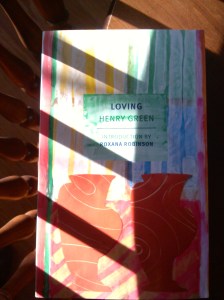
    loving-henry-greenI’ve been looking to read more Henry Green for some time. New York Review Books is in the process of reissuing a collection, introductions to the minimalist titled works by a few of today’s influential critics –  Daniel Mendelsohn, James Wood, Francine Prose, and others. Originally published in 1945, Loving was Green’s fifth book. Other Green titles in the NYRB series, a few more forthcoming in 2017, include the abrupt titles:
    Back
    Blindness
    Caught
    Doting
    Living
    Nothing,
    and Party Going.

    Loving is literature in a way that many works of fiction are not literature. That is to say it is about language first before it can be said to be about anything else. It might not make a good read for readers who value information and being told things straight up what’s going on. It’s not a page turner. One is encouraged to stay on the page and look again.

    The characters include servants and their masters as well as a few animals, including dogs and peacocks. Not much new or different there. Narration is minimal, the book reading almost like drama, the text mostly dialog, but point of view scatters this way and that depending on who’s viewing what where. A bit of children’s book form is suggested by the symmetrical borders of “Once upon…” and “and lived happily…,” and of course the adults often behave like children while the children behave like adults in their ability to stir the plot to action – thinking here of the murdered peacock and its abused corpse and the purloined (or lost and found) ring and its burial, while the one character not taken in by anyone’s childishness is the “reprethent [of] the Inthuranth Company” (133), come to investigate the claim of the missing ring who gets things right but whose authority is undermined by the slapstick speech impediment imposed by the tooth he’s just had pulled.

    The setting is a large country estate, a castle in rural Ireland during World War Two. Bucolic enough, but if that sounds pleasant, it’s not so much. Life is a cold and hard working go with much worry and darkness and shut off rooms full of covered furniture, and worries about the close but distant war and what might happen if the Germans invade Ireland, what the Irish are up to, and how the relatives are making out over in beleaguered England. And there are rations and shortages but still plenty of domestic work but real opportunity found only in factories or submitting oneself to the brutalities. Still, not much there either that we don’t find in much literature of the period.

    The plot concerns an old butler who dies and a younger one moves in to take his place, a promotion not enthusiastically welcomed by the entire staff, for Raunce promises to issue in some changes and challenge tradition, including insisting Madam call him by his actual name and not Arthur, the name she prefers to call all butlers, regardless of their actual name. Most exasperating is this new Arthur wanting morning tea brought him still in bed and that tea brought by one of the two lovely maids Edith suspicioned of desiring possibly to return Raunce’s inappropriate advances.

    The dialog though is what the book is purposefully really about, and the reason for reading that book. Characterization is revealed through dialog, and helps explain the idiosyncrasies of speech and syntax and varied ways of talking employed. As another example of Green’s distinctive but sometimes even peculiar style, he seems to prefer “this” and “that” to the:

    “and he took that cushion, ripped the seam open” (130).

    Nothing wrong with that, but it appears throughout, in a variety of syntactical shapes, and might strike the ear as odd:

    “who took this man’s business card” (131).

    But see if you don’t come across that oddness on your own. There are many more examples: “she strode up to that arrow and gave it a tug” (forgot to hold the page; and while I’m at it I’ll add that I’ve resolved this new year to stop marking up books read with marginalia notes and all. Makes the occasional review a bit more difficult though. Ebooks are easy for looking things like that up, but the memory gets not as much exercise. Remains to be seen if the “notes” a la reviews improve or not).

    Loving will make a good choice for a book club group, not that I belong to one, but thinking you might, or you could start one, Loving your first book.

    Loving, by Henry Green (1945) and 2016 New York Review Books (Introduction by Roxana Robinson).

  • awake & asleep

    ear to ear
    each other
    we hear
    now there
    now here
    tilting
    tinctures
    chandelier
    sweeps & swivels
    & windowsill
    candles glisten

    in moved & numbed
    dark a sommelier
    comes pinches
    the wicks dreams
    river yarn & damn
    earwax secrets
    sheets surface
    smears of sea
    & ocean seer
    seal bobs near
    freer & freer

  • On Letting My Hair Grow

    letting-my-hair-grow

    I’m letting my hair grow.
    It’s starting to snow.
    Nothing to be done,
    Estragon fond.
    “Now I’m a donor,” I told Susan,
    “on the recent license renewal.”
    “They’ll take your anatomical
    hair,” she said, the young one
    at the Department of Motor
    Vehicles: “On your license,
    be a donor?” she asked me.
    “Sure, and why not.”
    “It’s not like you’re going
    to be needing it,” she laughed.

    I don’t need it now,
    I thought to myself,
    she in Santa Claus costume
    red and white furry thick
    and outside snow falling
    and her hair black maroon
    hanging tussled out
    the Santa red cap rimmed
    white and the big white
    ball at the end bouncing
    about as she whirled around
    to grab the form
    for me to be
    an anatomical donor.

    My papers in order –
    DD214, Birth Cert.,
    proof of address – but,
    “We don’t need them
    this time,” she said.
    “You’re in the system.
    You showed us all that
    last time. You only
    have to prove it once.”
    (On this I did not
    correct her.)
    “But let me see
    that discharge sheet.
    Why don’t you have
    VETERAN
    on your license?”
    She read down my DD214,
    taking her time.
    I was number 106,
    the DMV not crowded,
    middle of day middle of
    week middle of month.
    Not any, any, any.
    Middle, middle, middle.
    “There it is,” she said.
    “Other than dishonorable,”
    she happily smiled,
    as if given a gift,
    or handing me one,
    the white ball again
    twirling as she turned
    and grabbed hold
    another rubber stamp.
    I was 18, number 16,
    that first drawing,
    I might have told her.
    I looked good a few
    of the squad said
    of my shaved head
    coming from the barber
    at Fort Bliss, zero week.
    I went in full curled
    long and wild just out
    of the surf at El Porto.

    “OK,” she said. “Take
    this to the photographer,
    end of the counter.
    Merry Christmas!”
    And I said it back
    to her. It’s best
    when at the DMV
    to remain calm
    and try to relax
    and let your hair grow.

    “Number 107? 107?”

  • The Sufi in You, The Sufi in Me

    For a couple of years, I took classical guitar lessons. Once a week, I arrived at my teacher’s house, obediently left my shoes on his front porch, and sat with James in chairs arranged in the middle of an empty room, Feng shui, he said, facing south into a single music stand, while in another room, unseen, his partner exercised on a mini trampoline. James was fond of what he called Sufi sayings, and used them to convey guitar techniques. In our first lesson, James asked me what I was after. I had already been playing the guitar for years, a kind of folk jazz free-lick fingerstyle, but I wanted to learn something about music theory, better learn the fretboard, and better read notes.

    “Playing classical guitar,” James said, “is not about musical theory. And once you get the notes, you don’t think about them, any more than you think about individual letters when you read a text. The theory is in the work, placed by the composer. What the guitarist does is technique.”

    James frowned at my guitar. I had a better guitar at home, I told him, but a steel string folk guitar, unsuitable for classical playing. And I had a three quarter size nylon string acoustic, but it didn’t hold tune. “Get rid of all those guitars,” James said, “and get a good instrument, the best you can possibly afford. You play an instrument to make sound.”

    Then James asked to see the fingernails on my right hand, and he took a steel file to them, and then sanded the nails smooth with a fine piece of wet and dry sandpaper. The rest of that first lesson was spent learning how sit and hold the guitar, how to breathe and relax the shoulders and neck, where, James said, I appeared to carry all my stress and tension.

    Regarding the care of fingernails, I mentioned to James I was playing on a city co-ed softball team, where I might wreck his fingernail work. “If you are a good softball player,” James said, “you won’t hurt your nails. Fielding a ball is technique.”

    James was an excellent guitarist, but he had difficulty performing in public. One day, James informed me he was moving away. He was giving up the guitar and going into typing. He was going to be a typist. He was passing me on to another guitar instructor. I was never sure if his move to typing was true or if he was using a kind of Sufi-like koan to send me a message about my guitar playing ability. In any case, I was not dissuaded; I thought about composing a piece for typewriter and guitar.

    “What have you learned in your time with me?” James asked, in our last lesson. “That I want to play the guitar beautifully,” I replied. “You already can play beautifully,” he said, “but you are a poor listener.”

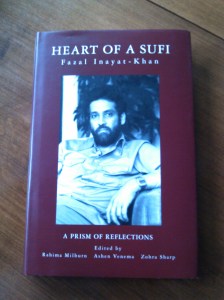
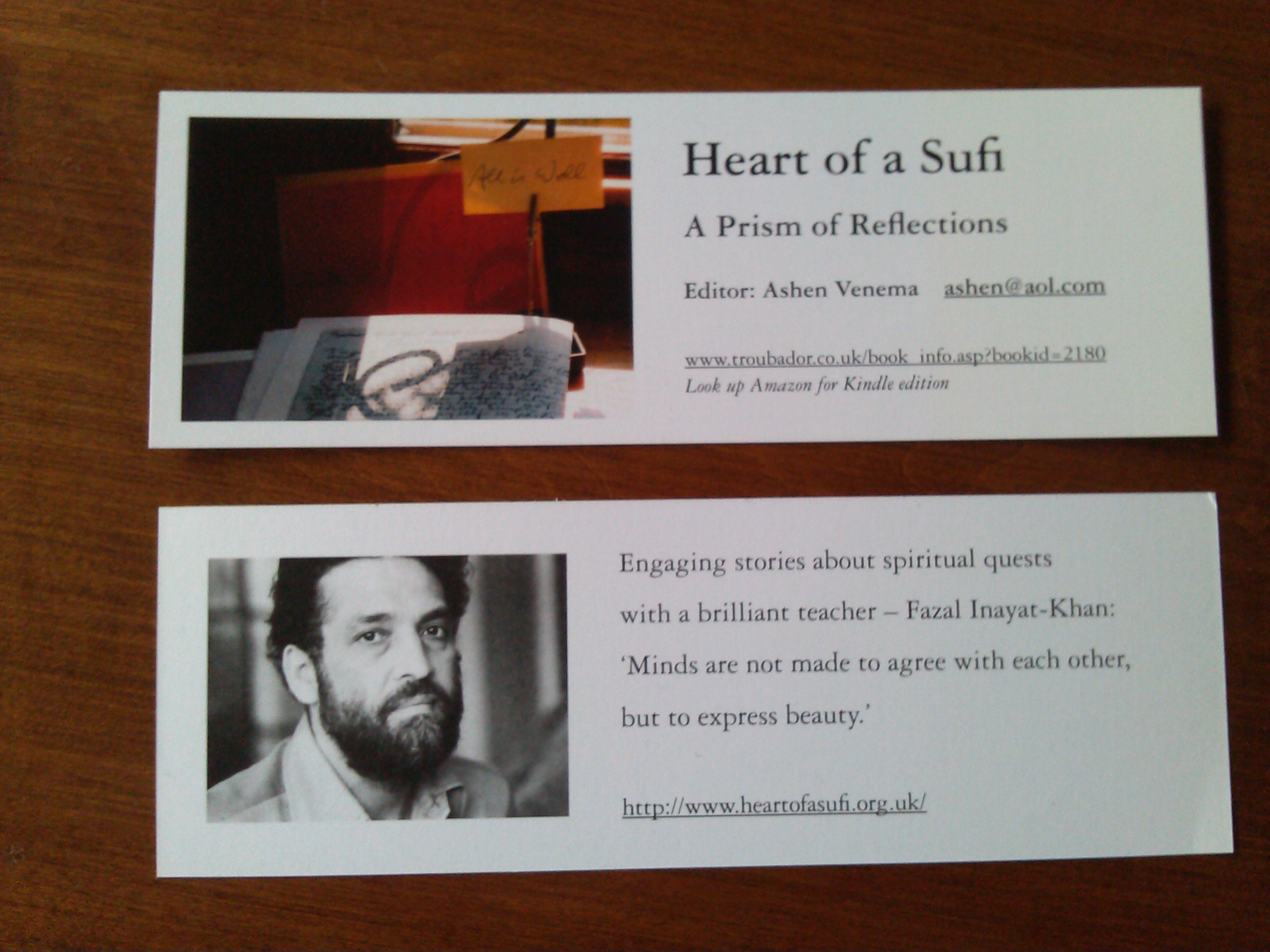
    img_20170102_141921I thought about James, recently, reading through Heart of a Sufi: A Prism of Reflections (Arch Ventures Press, 2010), about Fazal Inayat-Khan (1942-1990), also known as Frank Kevlin, a name Fazal invented in an effort to circumscribe his legacy as grandson to Pir-o-Murshid Hazrat Inayat Khan, who was instrumental in broadening awareness of what Fazal apparently preferred to call the “Sufi Way” around the world. The book is a high quality, sewn bound hardback, and includes black and white photographs, and informative appendix matter (contributor profiles, bibliography, glossary, website links). The primary content of the book consists of anecdotal, testimonial, and essay-like pieces contributed by people who knew Fazal as students or followers or were community members, particularly of Four Winds, a kind of commune located near Farnham, UK, and which was Fazal’s home for a time.

    The text is, then, an oral history. Twenty-one writers contribute experience with Fazal profiles primarily, it seems, from the 1970’s, a time when interest in communal life and alternate inquiries into how one might live flowered in many countries around the world. The book will be of interest to researchers working on oral histories, religious or spiritual movements, charismatic leaders and followers, or the period in and around the 1970s – as well, because Fazal was a trained psychotherapist, researchers interested in therapy fields as well as the functions of the mind and its potential spiritual energy or in foundations of learning and being and becoming.

    What I learned of Sufi from James amounts to about as much as I learned of guitar, which is to say that I am not a good listener. But the Prism of Reflections text is a good read for those interested in experiencing vicariously the era noted for gurus, spiritual quests, alternative life styles and approaches to religious and spiritual questions. The book is not an attempt to convert readers to any kind of Sufi practice. Its purpose seems to be primarily a vehicle to remember and give tribute to an influential teacher while describing his impact on the individual. Little attempt is made to venerate or hold Fazal up as a saint. And indeed, my own general skepticism of movements and teachers was catalyzed by some of the anecdotal evidence presented.

    For example, there is this conversation with Fazal related in one of Ashen Venema’s pieces:

    “After the Earthing event at Four Winds Fazal invited me to stay on, with a condition,
    ‘You must at all times do as I say.’
    I was speechless, and held his gaze for what seemed an awesome long time. He must be joking, I thought, he can’t be serious. I did not know then that Fazal’s teaching respected doubt, deeply, as the true measure of one’s faith. I struggled for a tactful answer. All of a sudden Fazal smiled and winked an eye. He didn’t have to say a word. I trusted the light of intelligence in his eyes” (49).

    Fair enough, but something a bit creepy lingers with that “at all times do as I say,” which he apparently said to others also. And the passage above might leave the reader, as many of the pieces in the rest of the book also might, with a cryptic experience. At the same time (and of course, as several contributors seem to suggest, the anecdotes may say as much or more about the writers than about Fazal), the memoir-style remembrances seem honest and balanced in their critical approach. Ashen goes on to say:

    “The Sufi family was and is an enigma, a spicy mix of characters with little in common. We could have come from different galaxies…Groups reveal to us our place in the human family, reflect the warring crowd within our individual psyche, where we struggle towards a dynamic balance and optimal functioning in a complex world. Groups quicken the process of psychological integration – and, ultimately, the freedom to be what we are already” (49-50).

    Later in the book, though, I came across this, a bit shocked and surprised:

    Principles relating to the customer

    • Serve our customer
    • Satisfy our customer
    • Service and maintain our customer’s products
    • Delight our customer” (128).

    In context, a section on the meaning and strategies of leadership, the principles are not at all jarring – I mention it here to help illustrate the wide spectrum of approaches the contributors took to remembering their experiences with their teacher. Fazal himself seems to have been somewhat isolated or even alienated by his own persona as potentially viewed and distorted by others. As a kind of celebrity, he seemed aware there would be students who would not necessarily benefit from a mentor they filled with their own projections. But in that sense too, the book acknowledges the difficulties inherent in the entire enterprise.

    There is great value in this kind of book, a collective memoir remembering a time, place, and person influential in helping shape the direction of individual lives and responsible for the continuity of group efforts that will no doubt be compromised by the vicissitudes of individual needs and desires as principles move through changing environments and meanings and time. The book may serve as an introduction to further studies, as its bibliography and glossary make clear. The book is learned and credible, and will be valuable to specialists and researchers of various topics, but again, its greatest value to the general reader is probably in the diary or memoir like diversity the individual contributors bring. The book is engaging precisely because it’s readable. These are very interesting people, people who have struggled with self and meaning, direction and efforts to contribute to something larger than their individual awareness might project. And many of the anecdotal pieces are down to earth descriptions of the man Fazal and his work and time. Taken as a whole, they create an oral history biography.

    And if you find, after reading the book, there does not appear to be a Sufi in you, you can always pick up the guitar.

    Heart of a Sufi – Fazal Inayat-Khan: A Prism of Reflections (2010), Arch Ventures Press, Edited by Rahima Milburn, Ashen Venema, and Zohra Sharp.

    img_20170102_142010

  • Body a la mode

    Hair is home
    host to vermin
    both lowlife
    and high fliers

    little lady bugs
    after aphids
    and crickets
    around the neck

    head is open
    for business
    enter up
    escalator nose

    bay lips open
    for winnow
    shopping
    the ears parking

    garages for
    diverse scads
    take elevator eyes
    to the penthouse

    sweet
    down now
    to the fruit and nuts
    the walnut shaped

    butt rarely sees
    up as down it sits
    a-squish in fat
    the thighs arise

    down to deal knees
    legs akimbo down
    to ankle gears
    pulleys the feet

    monkey wrenches
    between toes
    grease growing
    mushroom nails

    this being husk
    breath munching
    crunching
    masquerade

    and inside the body
    marching things
    really grow
    interesting .

  • Glidings

    (for Tim)

      capsule          bubbles                                     fall float                         sail                  glide
                                                                            heart engines purring                                                                                                             blood fuel Below all


    water

                                        sky full                         slip                  of bubbles
                                                                            all gliding with

    very

    little

    noise

    slow whoosh

    gliding
    across
    nighttime
    gliding
    during
    daytime
    coast
    with
    birds
    gliding
    to
    & fro
    for
    & from
    & squirrel
    gliding
    along
    fence top
    yard to yard
    cat
    watching
    gliding
    slowly
    up
    &
    down

    gliding

  • “All the World’s a Bill-Bard” at Berfrois

    Something new up at Berfrois. In which we argue for the power of the napkin poem! If yr sitting out with a cup, give it a read?img_20161112_130954

  • Anniversary

    when cold time frost slips
    cross moon & sun
    snivels buff’s hug mist

    yr fingers & toes fixed
    to warm grass high
    above buttered beach

    swells swirled since
    our first buss this
    dovetail tally recalls

    slips & falls
    shorts & talls
    sols wherewithal

    counterclockwise
    tetherball pole wrap
    round & round we

  • Ice Storm in the Pacific Northwest

    In “In the Heart of the Heart of the Country” (1968) William Gass wrote about snow in such a way that you feel the snow blowing in your face, creeping under your eyelids, sticking in your hair, and seeping through every stitch of your clothing, little flakes melting on the heat of your lips and your lips turning blue, as blue as glacier water full of crushed minerals.

    When winter hits locally, I often remember “In the Heart of the Heart of the Country,” and when we get an ice storm, I remember Robert Frost’s poem, “Fire and Ice”:

    Some say the world will end in fire,
    Some say in ice.
    From what I’ve tasted of desire
    I hold with those who favor fire.
    But if it had to perish twice,
    I think I know enough of hate
    To say that for destruction ice
    Is also great
    And would suffice.

    We got hit with an ice storm this weekend, three waves, the first wave a dry snow, then freezing rain, then more freezing rain. We are not in the heart of anything, here, though. We are on the edge of the continent, pushing west still, shoulders at the wheels, more often wet with day old ocean rain from the west rather than freezing winds from the east.

    Fire and ice are values; they are not virtues.

  • Notes on the Human Condition and Its Expression

    Earth is a human planet (for now – it wasn’t always one), home to the human condition, of which there is (as far as we know) only one. There may be other human heavenly bodies, but it seems unlikely, given the diversity of life and the size of the universe. Life elsewhere probably won’t appear like life here. Anyway, on Earth, humans enjoy symbiotic relationships with other forms of life, animal and plant. It’s a lively place, teeming and seething and awash with plasma and chlorophyll. Not all the symbiotic relationships are necessarily mutually beneficial. Things feed, often giving nothing back. Nothing new here.

    The human condition remains hidden under cakes of cosmetics. Born with no name, it hides from its own ignominy. It can’t show itself except through indirect expression. It cancels itself out, no remainder.

    Humans spend vital energy and expense denying themselves and others their human condition. Denying oneself the proper fit of one’s human condition seems to be its X factor. One opposes others their human condition in an effort to abjure any knowledge of it in oneself. “Then began he to curse and to swear, saying, I know not the man. And immediately the cock crew” (Matthew 26:74 KJV). That rebuttal is how metaphor is created – language at all, really. We never quite seem to know what something actually is, only what that something is like. What is it like to be human, and why do we go to such pains to avoid it?

    An electrician I brought in to help on a project, working along side him, pigeon-holed me as some sort of believer, when the subject of the human condition came up, and said he doesn’t believe in anything he can’t see or measure. Fair enough. Seems an odd line for an electrician to hold, though. I seem to be a magnet for these kinds of discussions.

    There is at least one absolute fact of the human condition: we are not alone. Try as we might, we can’t get rid ourselves of others. And, no matter how much we might try to get away from ourselves, we always wind up where we started.

    Look a little closer and you’ll see the human body a planet plays host to billions of myriad creatures, inside and out, enough bacteria in the big bang of a single sneeze to begin a new universe. And we swap spit. Begin the Beguine. The human condition is a merry-go-round dance.

    Scarcity – Musical Chairs. After losing his daughter, on the brink of suicide, Buckminster Fuller proves scarcity a fallacy solvable through technological evolution and equitable distribution (see “Operation Manual for Spaceship Earth”).

    Scare City, politics of fear, your other is out to get you. Better out them before they out you. Fuller offers examples of the difference between mind and brain. Mind is a characteristic of the human condition. Mind is universal; brain is local.

    Jesus was a perfect naked expression of the human condition: nakod, nudus, nagna: unadorned, vulnerable, reckless, and rash. The Church has kept itself in business for 2,000 years dressing him up, confusing virtue with penance and desire.

    “Take, eat; this is my body” (Matthew 14:26 KJV).

    The expression of the human condition is found in sacrifice and altruistic behavior, in non-competitive endurance. What is called character, as in ethos appropriate to its subject, by which is meant integrity, honor, or right values, is yet another dressing for the human condition, a dressing of privilege. Character wears a suit and tie; but it as often wears motley.

    Samuel Beckett expressed through text and drama the human condition in a bare form. And Beckett showed that a sense of humor is an important characteristic of the human condition, as he helped develop the tragicomedy, where literature becomes a striptease down to the human condition.

    During the Cuban Missile Crisis of 1962 I was a kid listening to the adults talking things over. My parents and their friends, mostly other parish members, were teenagers during World War Two, or a touch older and had served in the military or had watched others leave and knew some would not come back. They remembered listening to the war news evenings on the radio, in newsreels at the movie theater, weekend matinees. They experienced shortages, rations, and new factory jobs. They knew what atomic weapons were, heard when they dropped. They read about Hiroshima and Nagasaki in the newspaper. It was not reasonable to deny the possibility of their use again. Someone said we were lucky to be in Los Angeles, about as far away from Cuba as you could get in the US. Someone else said the spreading radiation could be worse, first like a sunburn that doesn’t show up until you’re back from the beach, then your skin is on fire, then more than skin, deep dark blistering blubber oozing juice and falling off the bones like a pig just out of the rock pit. It might be better to have the bomb land right on top of you. Out like a popped zit, a local teen quipped, for which he got a smack, but the adult with his pig went free. Being working class Catholics, they had all of course voted and prayed for Kennedy. One of them mentioned the US missiles in Italy and Turkey and a good old fashioned argument erupted that ended with beers and barbecued burgers and dogs and beans and hugs all around and the women and youngest kids inside praying the rosary while the men and older kids sat out with beers and smoked and talked about work for the week. I was an age where I could have stayed for the rosary or hung out with the men, but I was not invited to comment either place. I could wander off for an hour or two and no one would notice. A long seven years later I would reluctantly be wearing an Army uniform.

    A uniform is another disguise of the human condition. When two opposing soldiers wearing different uniforms meet, they still share the same human condition, but they wear different masks of it, show different expressions of it. The human condition then becomes the universal code by which we accept our commonality, or shared features and attributes, our shared similar virtues.

    Virtues are unlike values. Values are locally defined and ritualized. When a particular value is removed from the locality of its origin, it may cease to be of much use. (The poet Robert Creeley said, “Ritual removed from its place of origin loses meaning.” Values may also be fake or faked, as in “Good Country People,” or “Good Family Values,” platitudes or propaganda that when examined closely and all assumptions and presuppositions exposed are found to be hollow terms or labels of disguise.) Virtues are universal. Kindness, humility, love, forgiveness, patience, endurance – these are virtues. They transcend the local masks and express the human condition found worldwide. In virtues we recognize the human condition as a universal reality. It is on the basis of that recognition that rules of engagement and war are created and adhered to. It is on the basis of that recognition that torture is made universally criminal. It is on the basis of that recognition that cooperation, the same cooperation that is seen functioning on the altruistic cellular level (see E. O. Wilson, who has now suggested the gene is not characterized by selfishness, but by cooperation, thus questioning ideas based on survival of the strongest, the populist, or the nativist) is understood to be more important than competition.

    There is no guarantee the human condition will endure. It could morph into something new and different. It could be destroyed completely.

    There are incentives and rewards to living a life of values, membership in a group, for example, even if one only makes a pretense to sharing the values of the group, or misuses or reinterprets the values in a way that undermines their original purposes. There is no incentive to live a virtuous life.

    Tolerance is not a virtue. Tolerance may be a value, in as much as it’s better than intolerance, but to tolerate is not to accept. Tolerance anesthetizes, as intolerance attempts to persecute or destroy differences. Acceptance is the virtue, and is far more difficult than tolerance.

    It’s not enough to acknowledge the human condition in another. One must recognize the human condition of another as the same as one’s own human condition. No differences. We must continue to search for ever lower common denominators than are indicated in a comparison of values.

    The Golden Rule is subverted by self-loathing. How can one love another as one’s self if one does not love one’s self? Loving one’s self means accepting one’s human condition, and accepting one’s human condition means accepting that one shares that condition with everyone else, whether or not you feel you share the same values, beliefs, or goals as the other. Yet, paradoxically, it might be possible to hate one’s self while loving another? Enter, unrequited love.

    Is self-loathing simply a severe form of poor self image? Vices pander to the poor self imaged. Vices are masks, escapes from self loathing, medications. Virtues are the outward expression of the human condition. The virtuous accepts that self-loathing may also be a characteristic of the human condition in the sense that all masks show a human in hiding, a fugitive from self truth.

    Is there a need for virtuous living? No. And, as said, there is no guarantee that the human condition will endure. Maybe it will continue to evolve or morph into something that doesn’t at all recognize virtue, but we could scarcely then call it human as we now define humanity (humanity as in, “Ah, Bartleby! Ah, humanity!”).

    It’s difficult to agree upon values, what’s of value. It can be difficult adhering to one’s values, even as one embraces them as right. Anyone can be virtuous, at any time. Virtues are often worthless, no exchange, no stock value. The Church’s idea of indulgences makes a mockery of virtue, tries to capitalize on the essential worthlessness (in the existential sense) of the human condition.

    Virtue requires action. Virtue is a verb. Value does not require action. One easily plays one’s values close to the vest. Value is desire. What we want. Even when it’s not good for us. Values are never satisfied.

    Cruelty is a mask of self-loathing. If you would torture another, you are simply a sadist. Cruelty is a vice.

    Character as a value has local limits. Masks are local. If virtue is character, it must be universal.

    How to build a universal character?

    We may think we love the human condition, but it does not reciprocate. The human condition is the lipstick on the toilet paper. Value is the lipstick on the lips.

    Metaphor is often not helpful, but what is the lowest common denominator of the human condition? Are there virtues, selfless acts of sacrifice that ask for and indeed achieve practically nothing? Where do these virtues come from, and where are they going? How are they expressed, if at all?

    Some Bibliography

    Cosmopolitanism: Ethics in a World of Strangers, Kwame Anthony Appiah, 2006; 2007, Norton paperback. For Appiah, cosmopolitanism is the effort to learn to live together in a global society that recognizes and accepts differences while working on a shared basis of a universal sense of right and wrong that works toward the benefit of all. Appiah writes as a philosopher, which means he insists on logic, reasonableness, the unpacking of what we might do separated from why we might do it (because, as he points out, we might often agree to do the same thing but for different reasons). I am not a philosopher, and in my writing, I make no such distinctions. I’m afraid I’m a packer, not an unpacker, at heart, or by temperament. Likewise, Appiah is a scholar and academic, and follows the conventions of academic argument. As a rule, I do not follow any such conventions.

    A Small Treatise on the Great Virtues, Andre Comte-Sponville, 1996 (Petit Traite des Grandes Vertus); First Owl Books Edition 2002 (with the added subtitle, “the uses of philosophy in everyday life”). Comte-Sponville describes, defines, and discusses the following virtues in this order, a chapter devoted to each: Politeness, Fidelity, Prudence, Temperance, Courage, Justice, Generosity, Compassion, Mercy, Gratitude, Humility, Simplicity, Tolerance, Purity, Gentleness, Good Faith, Humor, Love. Readers might find it difficult distinguishing between values and virtues, or how being polite somehow might compare with being in love.

    E. O. Wilson: I’ve written several posts with references to Wilson. I was initially more interested in the questions of peer review, but I’ve since given up hope there – as far as peer review establishing or ensuring any kind of so-called scholarly credibility. Though I still recognize the importance of following conventions in order to participate in practical, fruitful argument, the throwing off of certain academic conventions opens a door to more free and creative pursuits. Anyway, here is a lively post on Wilson and altruistic behavior. The implications of his turnabout are huge, and, in turn, speak to the value and legitimacy of research, scholarly, and academic work.
  • A Sentimental Piece

    vacant lot, a wild flower
    where once a soldier
    fell, his last thought
    a rose in his
    girlfriend’s hair.