Tag: Ocean

  • Ocean Surfing Photos From the Late 1960’s

    I went outside to grab this morning’s paper and the air smelled and felt like the ocean, warm but a bit wet, a “marine layer,” the weather folks call it, and I was reminded of early June mornings in the South Bay, getting up to “go surfing,” and thought I’d pull some old photos, for an ocean surfing post.

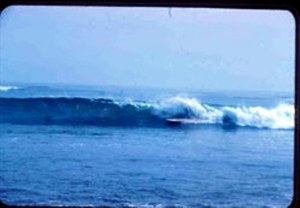
    We’d sometimes go down to the Redondo Beach pier, a horseshoe shaped pier. The waves were never very good there, but the view from the back of the waves gives a different perspective on the surfers, here one paddling out, the other dropping down.

    Also at the Redondo, horseshoe shaped pier, this photo was taken looking south from the north end of the horseshoe.

    The last two photos above were both taken looking south from the Manhattan Beach pier.

    We peeled the fiberglass off of our longboards, reshaped them into short boards, and re-glassed them in my Dad’s garage on Mariposa.

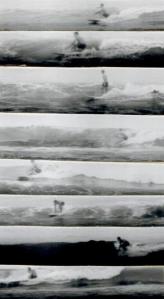
    This is me at El Porto in September of 1969, (riding the board seen on the floor of the garage in above photo, an old Jacobs), the month before reporting for Basic Combat Training at Fort Bliss, in El Paso. Surfing is bliss.

    Here I am kicking out at Leo Carrillo, but my board has a different idea. Now I’m going to kick out of the house and go for a walk in this marine air.

    For More on Surfing, See Related Posts, Below:

    The Sea Far Away

    Jerry Lewis at the Paradise

    Hemingway surfing and writing

    Small Wave Riders 2009 annual surf trip video

    John Cage, Cowboy Surf Shop, and Garage Jazz

    Albert Camus on the Economic Collapse

    Where weather and writing merge

  • The Sea Far Away

    I was trying to recall Ezra Pound’s line, “And men went down to the sea in ships.” Fine, wonderful line, except that’s not what he said. What Pound said, opening “Canto I,” I now recalled, looking it up, was, “And then went down to the ship.” And I was going to say, that if Pound had lived in the South Santa Monica Bay in the 1960’s, he might have said, “And boys went down to the ocean on surfboards.” But that doesn’t quite work now that I’ve corrected my recall. Pound’s sailors “Set keel to breakers, forth on the godly sea,” while the South Bay surfers of the 60’s, some watermen, some bleached a weak blond on a clean towel far up on the beach, where the waves couldn’t reach them, but still all caught up in the ancient tides that played on the radio and that licked at the western edge of Los Angeles, paddled out on surfboards and set skegs to waves.

    Pound does, in “Canto I,” mention a “sea-bord,” and “A man of no fortune,” and this might describe most surfers of the era (sea bored and poor). Still, Pound’s opening in a remote way does invoke the sport, the art, of surfing, for one catches waves not at the beginning of the wave’s life, but at the end of the swell, as it nears the beach: thus, “And then….” And then paddled out and turned around and caught waves back to the beach. Surf: Pound’s “…water mixed with white flour.”

    The waves always look smaller from the beach, and from the waves, sitting on the board, the beach looks, as Pound said, “…not as land looks on a map but as sea bord seen by men sailing” (“Canto LIX”).

    So what happens to the surfer sea bored? Just this, from Albert Camus’s essay “The Sea Close By”: “I grew up with the sea and poverty for me was sumptuous; then I lost the sea and found all luxuries gray and poverty unbearable. Since then, I have been waiting” (172).

    Related:

    Albert Camus on the Economic Collapse

  • On the ice with Thoreau

    Reading Walden this time around, and coming near the end of the literary sojourn, the Portland east winds blowing out of the Gorge, cracking their taut, dry cheeks while I burrowed into the  “Winter Animals” and “The Pond in Winter” chapters, I reflected on where nature goes in contemporary life, for we spend sweeping resources to turn our backs to her, to hide from her, to ignore her, to close our eyes, ears, noses to her, to avoid her sound and smell and touch, to lock her out. Thoreau went out to meet with her, and he spent quality time observing her habits at close range. Why should we not comb our own urban woods, gutters and sidewalk paths, yards and parks, breezeways and carports, bridges and sidings, bushes and beaches and fields, vacant lots, and streams of rain water running down the oily streets to see if there’s anything left of the nature Thoreau observed and chronicled in Walden? Thoreau asks rhetorical questions; why should not we?

    Some interest in nature is suggested by our obsession with the weather and natural disasters (many of which could be mitigated with the simplest of codes, for over 50% of the US population lives within 50 miles of a coastline, where most of the weather spends its wealth). But watching the Weather Channel or studying the sunny or cloudy day emoticons in the newspaper or on our cell phones falls short of Thoreau’s direct contact with the sun, clouds, rain, wind, ice. “But,” you say, donning jacket, scarf, hat, gloves, galoshes, and umbrella, though you’ve only a short walk from house to garage where the car is parked, “we spent a week camping out at the lake this past summer, and have the Facebook pics to show for it.”

    Thoreau spends time on the ice in winter, ice-fishing, taking short-cuts across the ponds, viewing the shores from a new vantage point. He seems to have no fear of the ice. There are over one hundred references to ice in the Walden text. Thoreau had a theory, which McKibben remarks on in one of his annotations, that if the world as we know it were to succumb to some modern weather disaster, the calamity would be ice. Yet Thoreau is remarkably resourceful on the ice:

    “Once, in the winter, many years ago, when I had been cutting holes through the ice in order to catch pickerel, as I stepped ashore I tossed my axe back on to the ice, but, as if some evil genius had directed it, it slid four or five rods directly into one of the holes, where the water was twenty-five feet deep. Out of curiosity, I lay down on the ice and looked through the hole, until I saw the axe a little on one side, standing on its head, with its helve erect and gently swaying to and fro with the pulse of the pond; and there it might have stood erect and swaying till in the course of time the handle rotted off, if I had not disturbed it. Making another hole directly over it with an ice chisel which I had, and cutting down the longest birch which I could find in the neighborhood with my knife, I made a slip-noose, which I attached to its end, and, letting it down carefully, passed it over the knob of the handle, and drew it by a line along the birch, and so pulled the axe out again” (“The Ponds” chapter).

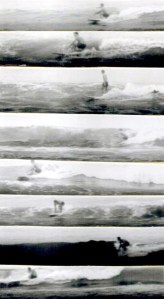
    Once, years ago now, never mind exactly when, I lived in a small house, for a little over a year, on Lake Oswego, a long but narrow lake fed by streams and the Tualatin River, south of Portland. I was there two winters, and both winters the lake froze over. During the first winter, I walked out onto the ice some distance and had my photo taken. It was a foolish thing to do, walking out on the ice. Unlike Thoreau, I didn’t know the thickness of the ice. The ice covered the water like a blanket with air pockets between the bottom of the ice and the surface of the unfrozen water. Thus the ice sheet moves up and down, cracks with its own weight, stretches and contracts, undulating like a monstrous, frozen jellyfish. I didn’t stay out on the ice very long. I walked out, had the photo snapped, and walked back to the boat dock. I was wearing a Navy flight jacket that I had traded a couple of years earlier for my Army field jacket. Neither would have done me much good had I fallen into the water. It’s taken me a long time to get used to the Northwest climate, but still, if I’m to go out on some water, I would prefer doing it on a surfboard, in warm, salty water, where nothing freezes. I like Thoreau, but I’m not following him out onto the ice again.
    Related:

    Thoreau, Henry David. Walden. 1854. Boston: Beacon Press, July 15, 2004 [Introduction and Annotations by Bill McKibben].

  • Jerry Lewis at the Paradise

    I was working in the film industry; I had a job as an usher at the Paradise theatre in the South Bay area of Los Angeles. The Paradise lobby swept up and curved away from the entrance and concession bar with deep, plush carpet. On the curved, floor-to-ceiling, wood-paneled wall hung commemorative Oscar plaques. In the single-screen hall, three sections of long-rowed seats angled down to a large screen, edged with maroon velvet curtains. With its high ceilings, faux boxes, and loge seats in the rear, the Paradise was a swank place.

    The Paradise still featured sneak previews, where most tickets were gifted to ensure a full house. The previewed films were not yet released, were still being edited. The previews helped build hype and advertising while giving the editors a live-audience reaction to think about before a final edit.

    One spectacular South Bay evening we were showing a new Jerry Lewis film. We rolled the red carpet out the door and across the broad sidewalk all the way to the curb, and Jerry Lewis emerged slim from a shiny black stretch limo, wearing flat-black tuxedo pants with enamel-black stripes down each leg, and a blinding white shirt under a candy-apple red, button-down sweater. His shiny, thin, black loafers matched the jet-black sheen of his short hair, spiked just above the forehead.

    After the standard brouhaha welcoming him and his entourage, Jerry was seated in the last seat in the last row in the middle section of the hall. The lights went down and the movie began to a quiet, full house, and ShaZAM!

    When the movie came on I was standing at attention, my flashlight in hand, at the end of a far aisle, and I rocked back on my feet when the first wave of sound hit me. Jerry had requested he be specially wired in his seat to control the volume, but something must have gone wrong. I hurried out the door for the lobby where I met the manager and two other ushers. It didn’t take long for patrons from the first few rows to come back complaining. They wanted the volume turned down. All we could offer was a complimentary ticket to a future show; Jerry Lewis was controlling the sound, and he wanted it loud.

    About half way through the movie, the first few rows having thinned out but the remaining audience seemingly satisfied, I stood in the back of the lobby against the Oscar wall, and Jerry came out to smoke a cigarette. He stood about twelve feet away from me. We were the only ones in the lobby at the moment. He smoked, relaxed, inscrutable. The sound of the movie occasionally seeped out of the hall into the usually quiet lobby. I watched him smoke. I had just returned from active duty; in fact, I was wearing my low-quarters, my name and military ID number sewn under the tongues. I was surfing my days away, waiting for the new semester to start at school, and ushering nights at the Paradise. I could have said something to Jerry. He was a nice guy. I could have asked him why so loud, but I knew the answer to that, and I left him to his smoke.

    I had been at the Paradise only a couple of weeks. The next day, Sunday, I arrived early to work the matinee. The manager gave me the job of scraping chewing gum off the bottom of the seats, before the doors opened. I stood in the back row, at the seat Jerry had sat in the night before. I looked across the long row. I looked down the formation of empty seats to the white screen. I walked out of the hall up to the usher dressing room, changed back into my street clothes, leaving my low-quarters behind, and walked back out into the solid gold South Bay weekend. I never went back to the Paradise, never recovered my low-quarters. I heard one of the other ushers was wearing them. A few years later the theatre was closed and converted into office space.

  • On the water writing

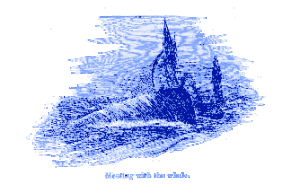
    Meeting with the whaleThere’s nothing better than being on the water. Another blog we’ve been following recently, Transparent Sea, is chronicling an open ocean paddle following the migration path of whales off the coast of Australia, and features some close-in photos and videos of whales, dolphins, and surfers.
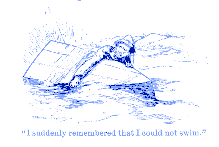
    I suddenly remembered I could not swimWe are reminded of Joshua Slocum’s classic, Sailing Alone Around the World. Slocum could not swim, yet he spent just over three years and 46,000 miles alone on the water. 
    Writing sometimes feels like being alone on the water, unable to swim.

  • Hemingway surfing and writing

    Timing is everything
    at Leo Carillo, 1969.

    We’ve been enjoying the El Porto Fridays blog. We can still feel the El Porto sand beneath our feet, the foam rushing over our board, the morning glass, the afternoon chop, the evening glass-off. We surfed there in the 60’s and 70’s, before heading out, like Huck Finns, for the territory, ahead of all the rest; well, ahead of some, behind others. The El Porto Fridays blog recently put up a post titled “5 Ways to Improve Your Surfing.” It had us thinking of Shaun Tomson’s Surfer’s Code, and of Hemingway and writing. 

    A sentence is like a wave, as Hemingway often illustrated; Hemingway didn’t surf, but he does have Jake Barnes in The Sun Also Rises body surfing, and this famous sentence from the short story “Cross Country Snow” illustrates what could be a surfer on a wave:

    “George was coming down in telemark position, kneeling; one leg forward and bent, the other trailing; his sticks hanging like some insect’s thin legs, kicking up puffs of snow as they touched the surface and finally the whole kneeling, trailing figure coming around in a beautiful right curve, crouching, the legs shot forward and back, the body leaning out against the swing, the sticks accenting the curve like points of light, all in a wild cloud of snow.”

  • Small Wave Riders 2009 annual surf trip video

    Joe Waves at El Porto circa 1969
    El Porto waves, circa 1969, riding a modified Jacobs.

    Gregg Noll, the first of the modern big wave surfers, never lost sight of the fun to be found in small waves. In the early-60s, still in the original Gregg Noll surfboard shop, in Hermosa, when asked if he found small waves boring after having surfed the giants, he replied not at all, he would always have fun in the South Bay slop. I know that because I was there, a local kid dreaming of a new board, and I asked him.

    Having fun in small surf is the sentiment that fuels Small Wave Riders. There are other reasons – as we get older, paddling out gets harder. And there is the pulling archetype of the surf trip (on the west coast, this means a long cruise on Highways 1 and 101, and Pacific Coast Highway, and Highland Ave., checking out the surf spots along the way); and community, always local, throwing off the work clothes (if necessary) for jeans, t shirt, and sandals – trunks and a surfboard (for “Jesus was a [surfer] when he walked upon the water,” sang Leonard Cohen, or might have sang, had he been a surfer; he sang “…sailor…only drowning men could see him”) – living out of the surf rig, a tent, the occasional old friend’s place up from the beach, eating out of bags, or at the best (discovered word of mouth) local dives, body sticky with sand, wax, and salt; and the blue green grey lure of the ocean, of men going down to the sea.

    Of course, over time, conditions change. Jesus now wears a wet suit, including booties, hands, and hood, and every spot is crowded, even the spots where the waves are so small they can hardly be called waves. The locals are even more protective of their spots, so the surfer on safari is sometimes well-advised to select a less crowded spot, even if it means yet smaller waves. But “just get in [the water]” is brother John Linker’s mantra. Once in, once the glass is broken, there’s no closer union with nature, physically and mentally. One doesn’t think on waves, not in the normal sense of thinking; once in, one is guided almost by pure instinct, and the Cartesian split is temporarily taped.

    So we were delighted to receive in the mail this past week the 2009 Small Wave Riders annual surf trip video, this year titled 5 Point 5. The film technology continues to improve, as does the technique. The sound track is blended with the waves and action, and the sequences of driving, stopping to check out a spot, paddling out, catching waves, then kicking back after the set, create a structure that feels natural, allowing for hightened viewer engagement. Some of the technique is reminiscent of the best of the old surf films, the ones we used to see in the Hermosa Beach High School auditorium, the independent, locally filmed surf movies, and there are also reminders of the great, original Endless Summer. Of course, these days, the summers get shorter, not longer, let alone endless, and the trip comes to an end, again in the old surf film manner, too soon, after only 35 minutes of small wave surfing. But it’s enough. Our appetite for a wave is soaking wet.

  • John Cage, Cowboy Surf Shop, and Garage Jazz

    John Cage was the first garage musician, freeing music at once from the academy, from high culture, from ubiquitous radios, from naturalism – from preconceived notions of what sounds should sound like. Cage valued sounds; he desired sounds, required sounds. Cage captured sounds he found in his environment and remixed them in his garage, creating a philosophy of music that encouraged listeners to experiment, restoring sound to primeval element. Cage’s music is not devoid of sentimentality, and heralds both warnings and callings – electronic blasts to the chest, bees dancing in the labyrinths of our ears.


    We are anxious to hear the sounds we make, our own voice, which we hear in unison, subverting our self-consciousness. The echo, reverb, was the first natural recording. Garage Band allows us to extend the range of our voice, format, and get loopy – all Cageian values. We’ve been listening for a long, long time; how much training do we require?


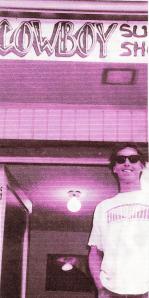
    Cowboy Surf ShopJohn Linker’s Cowboy Surf Shop employs his various interests – folk, alternative, literature, surfing, and playing guitar as something to do with your hands. In one piece, “Rock ‘n Roll Eden,” a Lou Reed cover, we hear a voice reading from Jack London (Jack’s ranch, in the Valley of the Moon, is not too far from John’s place). A diversion from teaching duties, John’s project is a demo, a rough draft, experimenting with loops, voice-overs, a variety of instruments (sans drums – bass picks up both rhythm and percussion), and improvisation on covers and originals.


    When in the Army in the late 60’s we used to hang around the motor pool after hours playing guitar. Spec. 4 Martin, who had worked at Fender, offered this criticism: “You never play the same thing the same way.” As we’ve discussed, Cage was not a jazz fan, but what we require now is garage jazz, inviting thought: what is garage; what is jazz.


  • Albert Camus on the Economic Collapse

    RefugioAn old friend from our South Santa Monica Bay days writes, “Did I hear that right? 5 day forecast for around here is in the upper 80’s.  Visibility for miles.  Air quality is wonderful. But, this is January.”

    In the mornings we went surfing, and in the afternoons we played whiffle ball in the yard or in the street. Maybe we walked to the five and dime for a pack of baseball cards, but if there were no good cards in the pack there was still the bubblegum, the smell like a perfume. Summers we camped on the beach at Refugio and for days wore nothing but our swim-trunks. 

    Camus Lyrical and Critical EssaysWe are reminded again of Camus’s “The Sea Close By”: “I grew up with the sea and poverty for me was sumptuous; then I lost the sea and found all luxuries gray and poverty unbearable” (p. 172). And this, from “Return to Tipasa”: “In the depths of winter, I finally learned that within me there lay an invincible summer” (p. 169).

    Camus, Albert. (1970). Lyrical and critical essays. Vintage Books: New York.

  • Theory of nothing, something, and everything in between

    Then we saw Wallace-Wells’s “Surfing the Universe,” in the July 21 issue, and we quickly skipped to this Annals of Science piece; for since seeing the Nobel Prize winning physicist Robert B. Laughlin lecture locally, our old curiosity to know if the physicists will ever solve their “Theory of Everything” has been expanding. 

    There’s apparently enough string theory going around that if the physicists studying it were Christo they could wrap the universe. We like Lisi’s new idea for a Theory of Everything because while it exposes string theory for the cat’s cradle it is, it also makes use of something called E8, at once suggesting an error on a guitar chart (he must mean E7, or E9 – what’s an E8 shaped like?), and our old drill sergeant at Fort Bliss (an E8), Fall 1969, who also toyed around with a theory of everything.

    We had our own theory of everything nearly completed, but it contained no math, actuarially speaking, though it was based on the number system we developed to illuminate the guitar fretboard. Like many of our great ideas, it was written on one of our Joe Mitchell note sheets, got left in a back pocket of a pair of jeans, and went out with the wash.

    Criticizing string theory in his book A Different Universe, Laughlin says “A measurement that cannot be done accurately, or that cannot be reproduced even if it is accurate, can never be divorced from politics and must therefore generate mythologies” (p. 215). In lecture, Laughlin was a card. Expecting a mega-PowerPoint, instead we got cartoons from an overhead. “Just look around you…Even this room is teeming with things we do not understand” (p. 218).

    Anyone lucky enough to have surfed, that is, surfed in the water, salt water, in real waves, may not understand physics, but certainly comprehends that, as Laughlin says, “there is much, much more yet to come” (p. 218).