Tag: John Cage

  • John Cage and Attitudes Toward Reading Today

    In John Cage’s A Year from Monday, a 1969 collection of his then New Lectures and Writings, we find a delightful, short piece titled “Seriously Comma,” and we are told the article was in answer to an inquiry regarding “attitudes toward Serial Music Today.” We find it difficult to pass on articles with the word “comma” in their title, seriously. In addition to our interest in commas, we are still concerned with the “reading crisis” topic The Coming of the Toads jumped on at the inception of the blog.

    “Seriously Comma” is an arrangement of 18 paragraphs separated by irregular spacing and layout and given further unity using Cage’s rhetorical mode of varying type font. Each paragraph might be read as a different voice in a contrapuntal arrangement – the piece might also be seen as the mosaic layout of a newspaper page. The second paragraph, quoted in its entirety (italics Cage’s):

    McLuhan insists on the newspaper front-page as the present existence type. Reading, we no longer read systematically (concluding each column, or even turning the page to conclude an article): we jump” (26).

    McLuhan’s work sums the effects of technology on the human sensorium – technology changes us. For McLuhan, the great example was the printing press. For Nicholas Carr, it’s the personal computer. Carr believes that internet skimming is changing our brain for the worse; the idea is getting ink, but it’s still a hypothesis. Do we read differently on-line? Yes, but as Cage on McLuhan illustrates, our jumping around somewhat skittishly while reading predates the personal computer. Perhaps the mosaic of the newspaper prepared us in some way for the mosaic of television and computer screens. What will happen next? The disappearance of newspapers and our adaptive brain evolving to a new way of  reading:

    “Invade areas where nothing’s definite (areas – micro and macro – adjacent the one we know in). It won’t sound like music – serial or electronic. It’ll sound like what we hear when we’re not hearing music, just hearing whatever wherever we happen to be. But to accomplish this our technological means must be constantly changing” (27).

    We are all musicians whenever we make noise; what are we whenever and however we read?

    “Dealing with language (while waiting for something else than syntax) as though it’s a sound-source that can be transformed into gibberish” (29).

    What is “computer literacy,” and how does it differ from traditional reading? In the late 30s and early 40s, the WPA produced posters encouraging, among other activities and ideas of benefit to local communities, reading, traditional reading, the book you’ve always meant to read. We agree with Carr that traditional reading slows things down; why not kick back and enjoy a slow Spring with a book? When we make noise we make music; when we read, we make time.
  • Where Listening Gives Rise to Silence and Fizzles

    There lived in our neighborhood some time ago a locally famous pianist who enjoyed great demand for piano lessons from parents for their children. The demand was such that a prospective student had to interview with the teacher. One of the interview “questions” involved listening to chords: the child identified a chord as “happy” or “sad.” Children unable to pass this interview question eliminated themselves from consideration. It’s been some time since I’ve talked to the pianist, but I’ve wondered from time to time what emotion a Bm7b5 (B minor 7 flat 5) might equate to, or an Eb7b9 (E flat 7 flat 9, as an inside chord, without the 5th, on the guitar).

    How one distinguishes sounds, as in the experiment discussed over at Language Log, might explain musical preferences. Listeners who prefer a country western song, such as Hank Williams’s “I’m So Lonesome I Could Cry” (and its many covers), over a short piece by John Cage, might not hear sounds the same way the Cage fan distinguishes sounds, for “A fool sees not the same tree that a wise man sees” (Blake, “Proverbs of Hell”) – as both Williams and Cage would probably agree.

    The Language Log listening experiment might also explain reading preferences, why some readers, for example, prefer Charles Dickens to Samuel Beckett (Dickens writes in minor keys, invoking pathos and bathos and every other kind of oath, Beckett in jovial major modes with flurries of flats falling like ash in downward spiraling scales).

    Emergence might be at work here, too (the entire piece can’t be predicted by any one of its chords), or simply that our ears sometimes grow tired or lazy, as do our tongues and our eyes. This is what Cage explored in Silence, and what Beckett meant by Fizzles.

  • Kierkegaard: A Good Self is Hard to Find

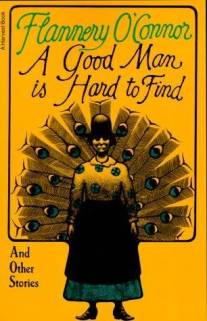
    A Good Man is Hard to FindWe enjoyed Gordon Marino’s recent piece in the Times, “Kierkegaard on the Couch,” about a distinction between despair and depression, the former, according to Marino, a kind of disrespect for one’s self, not accepting who one is, the latter a disease; the former our existential condition (for which Kafka said there is no cure), the latter treatable with medication and counseling.
    We were reminded of John Cage: “It is not irritating to be where one is. It is only irritating to think one would like to be somewhere else” (“Lecture on Nothing,” Silence, p. 119).

    Perhaps the opposite of Marino’s despair and depression distinction is found in joy and happiness. A certain kind of acceptance allows for joy, which is not quite the same as happiness. Joy, like grace, lives only in the moment; occurs regardless of where we are located; and appears like the epiphany, satori, the kick in the eye. Happiness is a kind of candy that wears off, leaving us depressed. Despair is the corollary of joy, depression the corollary of happiness.

    Joy Hopewell comes to mind, a Flannery O’Connor character (“Good Country People”) who changes her name from Joy to Hulga, such is her despair. A good self is hard to find.

  • Where jazz and literature get encaged

    The 2009 Believer music issue (July/August 09) arrived yesterday, and there’s a perceptive interview with jazz guitarist Pat Martino:

    “BLVR: What do you think jazz’s place in American culture is today?”

    “PM: The only thing I can be definitive with is an example. Take the students of jazz in our conservatories and universities. They’re studying harmony and theory, which is not jazz, that’s music. Number two, they’re studying and transcribing artists of the past – past cultures, or stages of our culture, and that is not the reality of today. So it [jazz] is not alive the way it used to be. And they’re studying something that is encaged, and they’re analyzing it to participate in something that no longer exists” (p. 73).

    I was reminded of Louis Menand’s recent piece in the New Yorker (June 8 & 15, 2009), on creative writing programs: “Academic creative-writing programs are, as McGurl puts it, examples of ‘the institutionalization of anti-institutionality.’ That’s why institutions love them. They are the outside contained on the inside” (p. 108).

    And John Cage: “A newspaperman wrote asking me to send’im my philosophy in a nutshell. Get out of whatever cage you happen to be in” (M, Writings ’67 – ’72, p. 212).

  • John Cage, Cowboy Surf Shop, and Garage Jazz

    John Cage was the first garage musician, freeing music at once from the academy, from high culture, from ubiquitous radios, from naturalism – from preconceived notions of what sounds should sound like. Cage valued sounds; he desired sounds, required sounds. Cage captured sounds he found in his environment and remixed them in his garage, creating a philosophy of music that encouraged listeners to experiment, restoring sound to primeval element. Cage’s music is not devoid of sentimentality, and heralds both warnings and callings – electronic blasts to the chest, bees dancing in the labyrinths of our ears.


    We are anxious to hear the sounds we make, our own voice, which we hear in unison, subverting our self-consciousness. The echo, reverb, was the first natural recording. Garage Band allows us to extend the range of our voice, format, and get loopy – all Cageian values. We’ve been listening for a long, long time; how much training do we require?


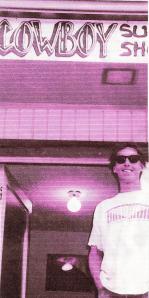
    Cowboy Surf ShopJohn Linker’s Cowboy Surf Shop employs his various interests – folk, alternative, literature, surfing, and playing guitar as something to do with your hands. In one piece, “Rock ‘n Roll Eden,” a Lou Reed cover, we hear a voice reading from Jack London (Jack’s ranch, in the Valley of the Moon, is not too far from John’s place). A diversion from teaching duties, John’s project is a demo, a rough draft, experimenting with loops, voice-overs, a variety of instruments (sans drums – bass picks up both rhythm and percussion), and improvisation on covers and originals.


    When in the Army in the late 60’s we used to hang around the motor pool after hours playing guitar. Spec. 4 Martin, who had worked at Fender, offered this criticism: “You never play the same thing the same way.” As we’ve discussed, Cage was not a jazz fan, but what we require now is garage jazz, inviting thought: what is garage; what is jazz.


  • Cage bop Monk lit

    John Cage, as we’ve mentioned, seemed to have little tolerance for jazz, suggesting that if musicians want to have a conversation they should use words, and we’ve always found this attitude surprising coming from an otherwise tolerant and peaceful composer – but who named one of his own books Silence, which contains, among many innovative works, our favorite, his “Lecture on Nothing.”

    “I have nothing to say, and I am saying it, and that is poetry,” Cage said, as he is often quoted, but incompletely, for the third column (measure) in that line is “as I need it.” Two lines up we find three empty measures. The fourth measure of that line starts the sentence “I have nothing to say.” The first measure of the next line is empty. The second measure reads “and I am saying it.” The third measure is empty. The fourth measure says “and that is.” The first measure of the next line contains “poetry,” the next measure is empty, the next contains “as I need it,” and the final measure contains the period to the sentence. You begin to see why we have always liked John Cage, and find ourselves coming back to him again and again, to read and to listen. 

    To round out the discussion, it’s worth mentioning, perhaps, that Silence also contains Cage’s “Lecture on Something,” suggesting a compare and contrast essay just itching to be written.

    For some reason we’ve always paired John Cage with Thelonius Monk, thinking, for one thing, maybe Monk did for jazz what Cage did for classical, which is to say, in short, put some fresh wax on the board, unafraid to paddle out solo. Then again, we’ve always thought much of Cage’s music closer to jazz than to classical, for he admitted random access to sounds, in notation and performance. What bothered him about words was probably the many connotations, too many to contain, to orchestrate, or that words distract from sound with meaning. For Cage, the tree falling in the forest with no one listening certainly makes noise; the question is, what sounds does it make, the sounds no one hears?

    Monk’s song titles provide clues to his intentions, “Rhythm-a-ning,” for example. Monk’s titles often convey what he has to say, his audience and purpose, if not his strategy. Monk had something to say, and said it, but, with the exception of the song titles, without words, and that is jazz, as he needed it.

    In response to a request for a statement on music, Cage wrote “…nothing is accomplished by writing a piece of music…” Or, Cage continued, “…by hearing…playing a piece of music} our ears are now in excellent condition.” What’s more, in the opening of this statement, he writes “instantaneous and unpredictable.” That seems to describe Monk, and isn’t that jazz, as we all need it?

  • Buckley and the hard work of writing

    William F. Buckley, Jr. now occupies, we hope, a seat in the bleachers to the right of Home Plate. We’ve been looking through his Buckley: The Right Word. We were not surprised to find him weighing in on the reading crisis. This, from 1980: “The good news is that there are people around who are trying to discover why it is that American youth, year after year, are having greater and greater difficulty in expressing themselves. There are a lot of wisecracks readily available (“they have nothing to say”), but one tires quickly of them, and then genuine worry sets in” (p. 131). And having nothing to say did not dissuade John Cage, who said, in his “Lecture on Nothing,” “I have nothing to say and I am saying it and that is poetry as I need it” (Silence, p. 109). Buckley finds fault with TV: “You can’t simultaneously spend four hours watching television and four hours reading good prose.” But he also acknowledges that any suspected blame does not seem to apply universally.

    If any one fault can be ascribed, perhaps the sheer physical difficulty of writing, and writing correctly, must be to blame. We are looking for cause and effect, but can not find even correlation. The effete and elite are each stricken equally, as the case of the Harvard student, passing placement exams but sitting in Expos unable to write a sentence, demonstrates. Buckley is then thrown off base by the Dick Cavett caveat, “Why does it matter?” Then comes this thunderbolt: Buckley relates that William Shawn, his editor at the New Yorker, once told him, “I am afraid, Mr. Buckley, that you do not really know the proper use of the comma.” Buckley’s response: “If St. Peter had declared me unfit to enter the Kingdom of God, I could not have felt more searingly the reproach…” (p. 306). Things are as bad as they ever were because nothing has made things any easier.

    Thinking about writing, and actually sitting down and doing the writing, are two different occupations. We can always start a book with a few chapters and claim a work in progress, even if we never pick it up again; but who benefits from this kind of deception? Buckley points to the hard work of writing: “Working on a novel, I like to write every day….On the other hand, don’t ever devote the entire day to doing just that….I’d like to see more novels not written by people who have all the time in the world to write them” (p. 285).

    But if writing is hard work, “But how would the reader know?” Buckley asks. The answer to that question Toulmin gives us, arguing that the work the writer does not put in, the reader must. But in spite of the hard work, Buckley assures us there’s nothing else he’d rather be doing. “Writing, if it’s done at all, has got to yield net satisfaction….I’m simply saying that writing is terribly hard work.” So he allows for distractions, change of pace and location, ancillary pursuits. He listened to music while writing: “Yes, I have the record player on most of the time.…I don’t play jazz when I write. I don’t know why but I just plain don’t. But I do when I paint” (pp. 290-291).

    We do listen to jazz when we write, almost exclusively, but usually instrumental, no vocals, which can be too distracting. But what’s the one significant takeaway we want to emphasize with regard to the hard practice of writing? What do we want from writing? What do we expect? We must write most days to develop answers to these and other questions about writing and reading. Posts may be warm up exercises to the real work.

    Buckley, W. F., Jr. (1996). Buckley: The right word (Harvest Book edition, 1998). New York: Harcourt Brace &  Company.

  • The weightlessness of existentialism

    Early yesterday, reading Nick Paumgarten on “The lives of elevators” (New Yorker, April 21), about a person stuck in one for forty-one hours, we were reminded of the weightlessness of reading and writing. The video, from the Kafkaesque security tape, is a work of art Warhol could have made; or Becket might have written a one-act play, but would have omitted the piano score, though the tempo is perfectly counterpointed to the Chaplinesque speed of the fast forwarded film. Of course, we also thought of John Cage: “It is not irritating to be where one is. It is only irritating to think one would like to be somewhere else” (“Lecture on Nothing,” Silence, p. 119).

    Later, at the Triple-A baseball game in a cold, near empty ballpark, a woman in the row in front of us turned around and asked if we had a pen. She seemed surprised when we said yes, and pulled the pen out of our jacket pocket, handing it out to her. She was a few seats away, down the row in front of us. There was no one else around. She was bundled up for the cold day of the game, in wool cap, and she had brought a full pack of incidentals to the game, to help pass the time, the way some people do at a ballgame, but no pen. She got up and walked over, smiling, and took the pen.

    The person stuck alone in the elevator is essentially weightless, can neither rise nor fall, cannot change seats. There is no exit. He pries open the doors to find a cement wall. He is a character in Sartre’s No Exit, sans the other people.  

    Take a piece of blank typing paper. Fold it in half, then in thirds. Place the folded paper in a pocket with a pen. You never know when you might get stuck – in a station at the metro, waiting anywhere – and it will not be nearly so irritating thinking you might like to be somewhere else. Pen and paper provide one with a play against the angst of any existential waiting game.

  • Jazzskin

    Words are sounds, first; then what do we do to them, to the sounds? Jung thought grief gave human voice to sound. This is the meaning of Norman O. Brown’s “The fall is into language” (Love’s Body, p. 256), though it seems equally plausible that joy, close friend to grief, might also be capable of producing a word or two. Dostoevsky contributes to the modern discussion in “Notes from Underground” with his often quoted “Suffering is the sole origin of consciousness.” If so, the first words uttered by conscious man must have been sounds of pain: Ouch! If you prefer cartoons, a caveman accidentally rolling the stone wheel across his big toe. Joyce spelled it:

    The fall (bababadalgharaghtakamminarronnkonnbronntonner-ronntuonnthunntrovarrhounawnskawntoohoohoordenenthurnuk!)

    (Finnegans Wake, p. 3).

    Norman O. Brown: “How to be silent. In a dialectical view: silence and speech, these two, are one. Apollonius of Tyana said silence also is a logos. And words do not spoil the silence for those who have ears to hear what is left unsaid” (p. 256). Listen to Ella Fitzgerald scat singing. Instruments reproduce the human voice, first (another reason Cage objected to jazz – and worked with sounds apart from voice). Louis Armstrong thought his trumpet an extension of his voice, and he sings as he plays. What we do to words is similar to what Cage thought we do to sounds in making music (anthropomorphizing sounds we hear in nature). Words give conscious order to sound, allowing for the reproduction of sounds with fidelity, creating self-consciousness through language.

    Here’s something recently dug out that might illustrate in a playful way:

    JAZZSKIN was published in the fall 1973, issue 3, of silent quicksand, a magazine published by students of El Camino College.

  • Jazzcage

    “Music as discourse (jazz) doesn’t work,” John Cage said, in his “DIARY: HOW TO IMPROVE THE WORLD (YOU WILL ONLY MAKE MATTERS WORSE) 1965,” the first text in his collection “A Year From Monday.” “If you’re going to have a discussion, have it and use words” (p. 12). David Revill, in “The Roaring Silence,” his biography of Cage, discusses “the puzzling attitude he [Cage] develops toward jazz” (p. 9). “He [Cage] says simply, ‘I love sounds, and I actually like them more than what we’ve done to them’ (p. 121 – Revill’s source notes don’t indicate where he got this Cage quote, and in a quick skim of my Cage books I’m unable to find it).

    I’ve always found Cage’s “…(jazz) doesn’t work” statement surprising, given how he integrates chance into his structures. Cage often sets up a rigorously defined structure only to let chance determine what comes next. For example, from his preface to “Diary:…” “I used twelve different type faces, letting chance operations determine which face would be used for which statement” (p. 3). Isn’t that jazz?

    I think Cage’s classical training explains his attitude toward jazz. Classical players don’t improvise. Composers improvise, as Bach probably did, but the classical musician has to play the thing as written. Jazz’s frequent use of popular songs as sources for improvisation probably also annoyed Cage, since he was more interested in sound than sentiment.

    Let’s substitute “words” for “sounds” in Cage’s statement that begins “I love sounds”: This gives us “I love words, and I actually like them more than what we’ve done to them.” And we might make the reverse substitution in the opening quote above, which would give us: “If you’re going to have a discussion, have it and use sounds.” Is it possible to enjoy words but not writing or reading? Cage appears to have preferred raw sounds to music that refines those sounds in an attempt to communicate something, even if that communication is an attempt to mimic nature.

    But we are nature, and the guitar sounds like a train coming down the line, and the drummer’s brushes sound like salt water receding over smooth stones. All sounds carry some meaning. Besides, Cage’s “Diary” follows with “(Dialogue is another matter.)” What? Another matter (discussion, music, discourse?) wherein jazz does work?

  • The way in is the far out

    John Cage opened the windows of the music room. He incorporated unintended as well as intended but unconventional sounds into music composition, thus acknowledging a modern electrocution of music that alters the sensorium. Music became an extension of our wired ears. The way in was the far out.

    Cage created performance lectures, utilizing a multi-media approach that combined sound, text, and oral lecture with non-linear arrangement and movement of ideas, words, sentences as musical phrases, and anecdotal asides (his short-short stories approximating the Zen koan). Bulleted lines, multiple columns, and a variety of font characteristics permeate the text versions. The lectures are collected in the books “Silence” (1961) and “A Year From Monday” (1967). Cage’s initial attempts were an effort to incorporate his musical ideas into different modes of argument, so that the listener could “experience what I had to say rather than just hear about it” (“Silence,” Foreword). The lectures are measured compositions. The composer provides time values, tempo markings, directions for rhythm and pitch, and textual arrangements serving as bars and measures. Chance and indeterminacy informed Cage’s composition process:

    “At Black Mountain College in 1952, I organized an event that involved the paintings of Bob Rauschenberg, the dancing of Merce Cunningham, films, slides, phonograph records, radios, the poetries of Charles Olson and M. C. Richards recited from the tops of ladders, and the pianism of David Tudor, together with my Juilliard lecture…The audience was seated in the center of all this activity” (“Silence,” Foreword).

    Not everyone in the audience may have enjoyed the attempt to rearrange their sensorium. Cage relates, of his “Lecture on Nothing,” “One of the structural divisions was the repetition, some fourteen times, of a single page in which occurred the refrain, ‘If anyone is sleepy let him go to sleep.’ Jeanne Reynal, I remember, stood up part way through, screamed, and then said, while I continued speaking, ‘John, I dearly love you, but I can’t bear another minute.’ She then walked out.”

    We may feel a similar response to some of today’s pervasive PowerPoint presentations. They are not written, or composed, but put together, as in “I put together a PowerPoint for today’s meeting.” The use of PowerPoint is itself a value assumption (warrant). Yet for organization and presentation of an argument for today’s reader (who has not the time, inclination, or patience for linear modes – a reader now beyond the Guttenberg Galaxy, outside the margins of McLuhan’s marginal man, a mosaic man), the persuasive possibilities of the PowerPoint slide show are hard to beat.

    For a consideration of the potential ill effects of PowerPoint, see Ian Parker, “Can a Software Package Edit Our Thoughts?” The New Yorker, May 28, 2001.