

A Notebook – Since 2007
 A duck hears a quack that sounds a bit out of whack and decides to hide in the reeds. The duck call recedes. Later, a duck decoy floats by, and our duck hears that queer cracker again, now from the far side of the pond. The prattle, it skiffs across the smooth water, sounds not propelled by a voice – and that’s the art of the duck call.
Museum art, discovered, sold, and resold, donated now so someone can get their name on a room, where “infinity goes up on trial” (Dylan, 1966, Blonde on Blonde, “Visions of Johanna“), hangs by the imprimatur (“let it be printed”) of money.
Why, when art is capable of producing such wealth and covetousness, does it still require public funding? Because anyone can make art and the average duck can’t tell the decoy from the real thing? Or is it because the decoy is the real thing?
Is the philanthropist involved in a clean form of money laundering? But this is neither the time nor place for a conspiracy theory. Do we breathe our art together, or solo? You can’t make a duck out of lead, at least not one that will float. That requires a pencil.
Does art require genius (En attendant Godot)? Every child has an attendant and attentive muse. Genius is the ability to listen with ears open, even when filled with wax, to see with eyes clear, even when they are closed. “You can look but don’t touch” is the beginning of art criticism. One day, the muse disappears, and the child no longer makes art. Instead, she buys it, or tries to. She applies for a grant.
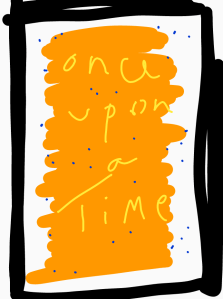 A friend who is a close reader, noting correctly my sudden obsession with my text-drawings done with the phone app, asked, “Having fun yet?” Once upon a time, art was fun, which is to say the making of art was fun. Writing was fun. The two together a blast!
Cooking is not the same thing as eating. Sewing a dress is not the same as wearing one. A colleague once said to me, “Everyone should write a book no one will read.” Maybe they do. How would we not know?
Meantime, my attendant must be on spring break, vacationing here. Can’t seem to get rid of her. I’m not sure if she’s another starving artist or just a decoy.
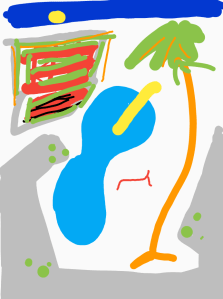
Note: with thanks to our regular reader from down under (who goes by “B”) for the inspiration behind the LA Home with Swimming Pool after Hockney mini-pic.
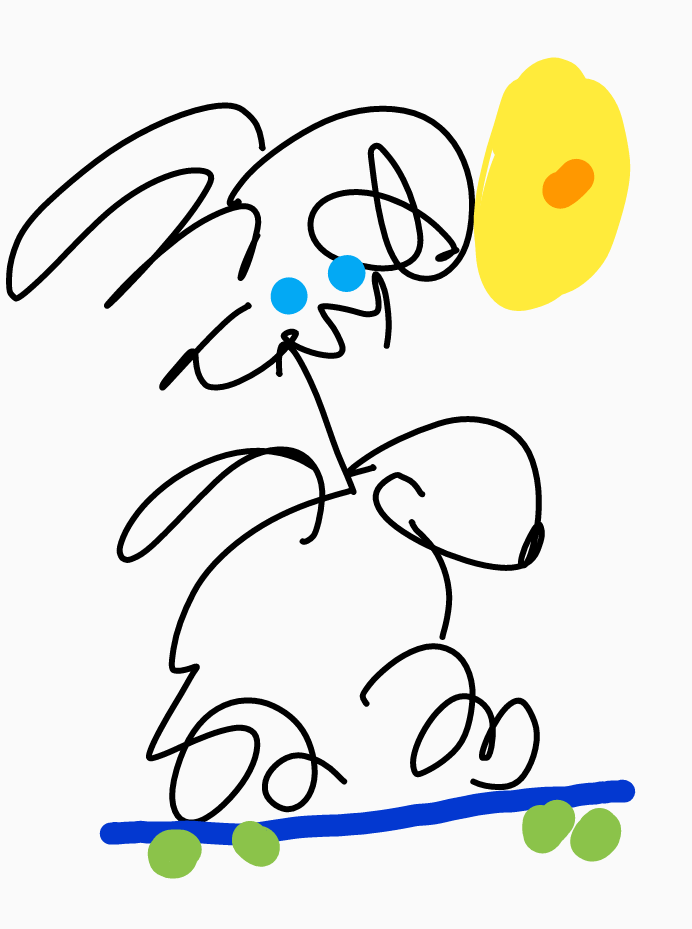
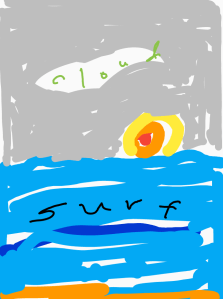
The old phone took quarters to make a call. I can doodle with fingers pictures on the new phone. I’ve been working on some Mini Poster Pics. Check out Comics page for large versions.


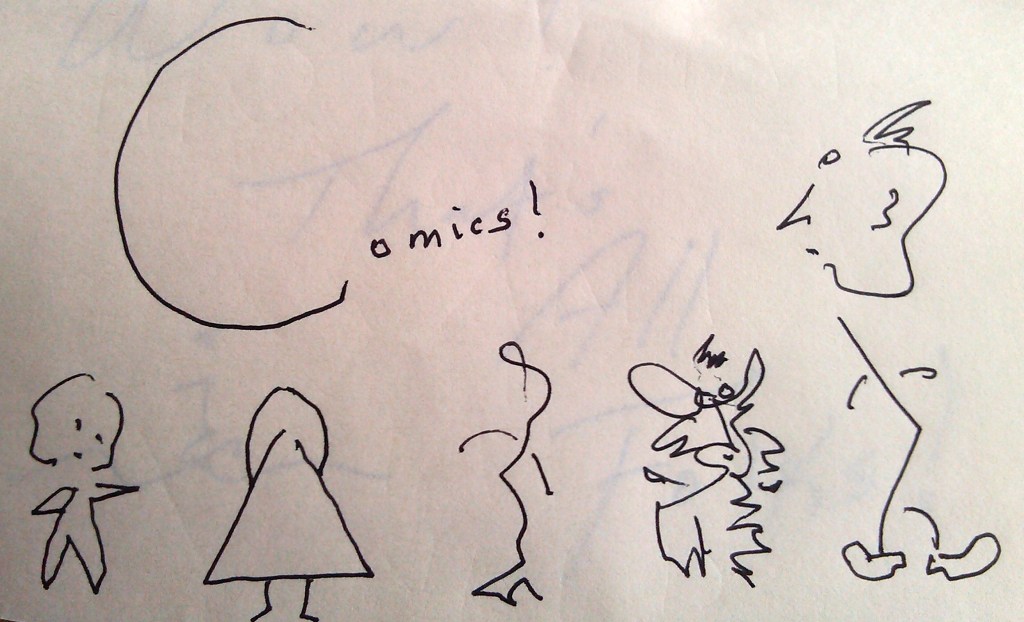
A new Scamble and Cramble episode has been posted to the Comics page! And, meantime, regular readers of The Coming of the Toads may notice a new format now in the works. Please browse around and let me know what you like or not of the new template.
From the sidewalk table sipping our espressos,
the vinegary smell from the torch smoke crossing
from the workers re-tarring the post acute rehab
hospital entry awning roof across Belmont, we saw
the first hippopotamus drop to her belly, blocking
the intersection, car horns jeering futilely, the hippo
happily like a humongous semicolon, skin winking
wet, waiting for the independent clause to follow;
the mother comma still far down Belmont, the paint
of the hippopotamuses a bubbly brown espresso,
now tan now black red umber shadows folding and
rolling in banana slug butter fat, the hippopotamus
before us yawned and hollered something, now
in the harsh spotlight of a police helicopter, and
the buzz from these espressos we expected
to last for tens of millions of years, by which
time the hippopotamuses and the whales
would tenant together the salt water open air
reservoirs, a sprinkling of reactionary
helicopters rusting in thick dusty green aloof.


To my odd ears, usquebaugh, from which whiskey derives, reminds me of the wedding party that year in Berkeley, and he…, and he couldn’t say…, or, he could not pronounce…, but that was nothing to the question of how he got the overstuffed hotel room chair through the bathroom door and up to the toilet, where he “addle liddle phifie Annie ugged the little craythur” (Joyce, FW), the toilet bowl, that is, speaking or repeating “usquebaugh” to us when we asked if he wasn’t good to go. Meanwhile, Beckett seemed always ready and able to pull a root fruit from one of his pockets, a turnip or a radish, and we went back into the sleeping space, where we had a lovely view of the hotel gardens and of the ocean in the distance. The night crashed like a wave in slow motion. In the morning there were a few stale beers and day old croissants for breakfast, and everything seemed fine, but we no longer hear from Usquebaugh, who over time seems to have grown uncomfortable with the dearth, in the belief, no doubt, that wealth is Thee all purpose cleaner, and it’s no doubt true that to get things really clean you must first grow so small.
I suppose I could give Beckett a call even now and we might go off for 9 holes of pique or a day of thought at the beach or river. He was, after all, a man of action, someone who made something. But what he made had to have a use. It wasn’t enough to be a man of action; you had to be a man of practical action. What would be the point of wedding dearth?
All of which may serve as an introduction to Whiskey Radish – in as much as I actually don’t know much about whiskey, how to speak Usquebaugh, or the comics artist Whiskey Radish. So I looked it up, as James Thurber, nearly blind and with no idea “You could look it up” would evolve into “You could Google it,” suggested. Thurber was a comic who wrote and made drawings. So that’s the angle and the segue I’m going with here, as these things go, if they go at all. Segue does not at all mean uninterrupted. It simply means follows, even if what follows does not follow. You follow? What does not follow is not necessarily non sequitur. What follows is only non sequitur if your expectation was somehow otherwise. What else could he have said sitting in the big chair pulled magically into the tiny bathroom and conveniently and suitably up to the commode over which his head dangled, whispering “usquebaugh”? In any case, we were unable to repeat the magic the next morning before checking out and had to leave the chair abandoned in the bathroom. I suspect they must have had to remove the bathroom door to get the chair back out into the hotel room. There’s a cartoon there, Beckett in the plush chair pulled up to the awful all full bowl, but I’ve no caption for it, no text. “This seat taken,” maybe.
Whiskey Radish makes drawings, comic style, but with the telling swipe of a Picasso line, pen brush and ink, which include handwritten text. Comics. The narratives are characterized by obscure and everyday references, personal or learned, street lingo punctuated with French phrase suggestion. The characters are sometimes identifiable but always original, as is the case with the banjo playing “Sam Cat,” a bartender’s assistant, the lines and text sometimes sparse, laconic, suggestive, but often detailed, loquacious.
Satire and romantic themes, unrequited lines, drawings, jobs, entertainments. The life of the artist thematically underscored. There’s a “whozwho” of Whiskey Radish characters on the Whiskey Radish website. The text includes what is left out.
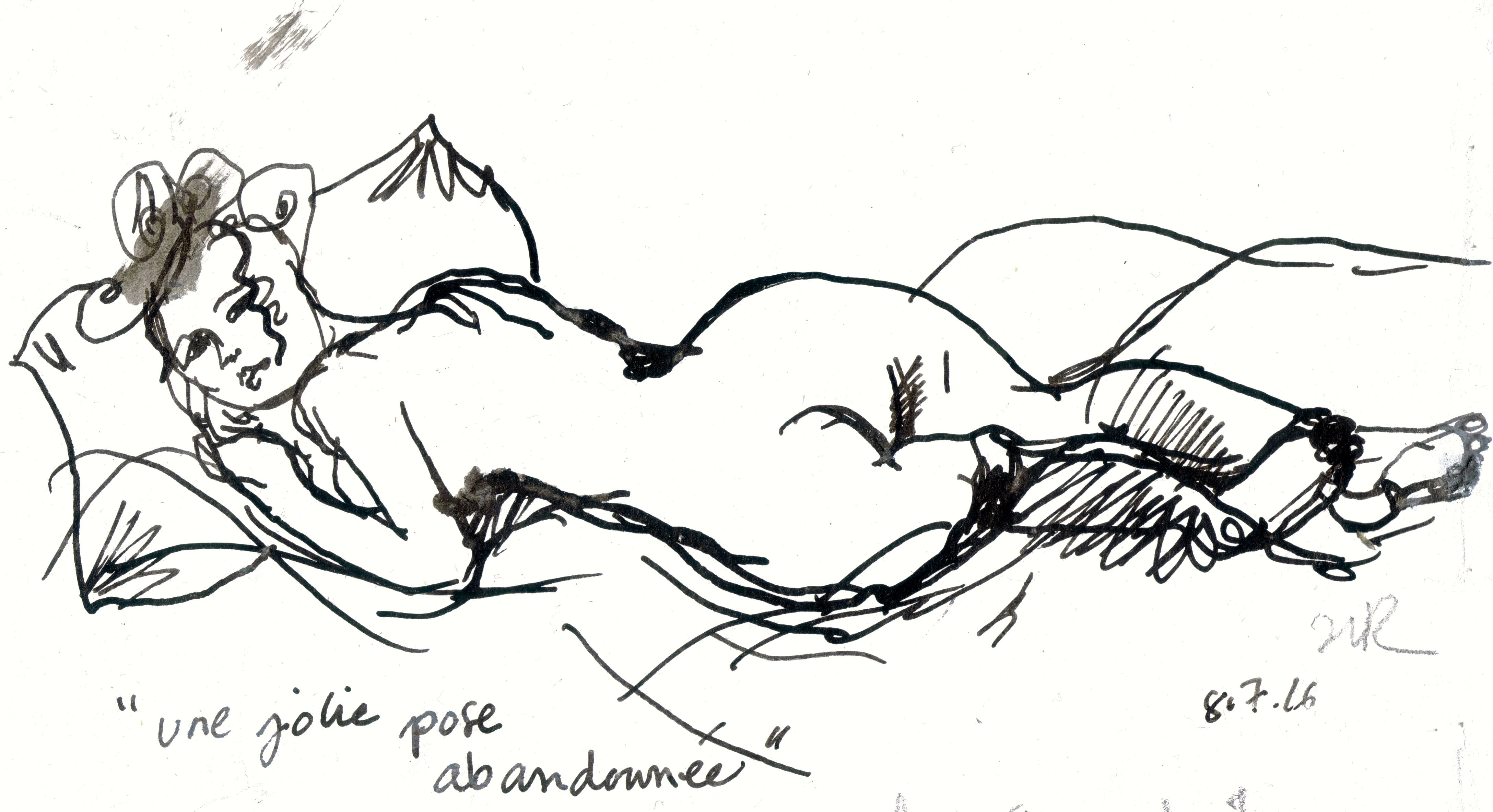
In the drawing enclosed, “une joile pose abandownee” (a pretty pose abandoned), we see, in black India ink over a thin acrylic base on rice paper, simple Picasso-like lines fulfill a statement that is an argument. There is a sleepiness in the eyes, a sadness, a triest, a torpor, a disappointment perhaps, or maybe that is the sense or touch or expression of abandonment, not of abandon, but of the abandonment that follows abandon, when one is not sure about one’s body, after all. And about the mouth, the lips, there is the indecisive shape of a pout that becomes a grimace that settles into a disregard, also after all. After all is said and done, whether we are finished or not, it’s over. Certain lines are crossed, crossed out, a kind of permanent erasure.
Technique is not style. Technique is something that has a beginning and an end, a procedure, a program, a convention. Technique can’t be abandoned. It can be unfinished, but that’s not the same as abandoning a work. Look at Kafka. Abandoned cartoons. Joseph K is Buster Keaton. Style is usage. Cartooning is vaudeville. You can only abandon style, because style can’t be finished. “A pretty pose abandoned” (the Whiskey Radish version) is graffiti over the 1897 “Baigneuse,” bather, by Jules Scalbert. It’s a study of a study. Do bathers pose? Is there a technique to bathing? Water paints. And the Whiskey Radish version is abandoned. Only abandonment can create style. Technique is inherited. The slow bath becomes the quick shower.
McLuhan explains: “The structural qualities of the print and woodcut obtain, also, in the cartoon, all of which share a participational and do-it-yourself character that provides a wide variety of media experiences today. The print is clue to the comic cartoon, just as the cartoon is clue to understanding the TV image” (McLuhan, 1964, “Understanding Media: the Extensions of Man,” Chapter 17, “Comics: Mad Vestibule to TV,” p. 151). Touch, McLuhan says, is the most involving of all the senses. And television, like the cartoon, is tactile; the cartoon requires audience participation. This is why we are drawn to drawings; we can participate. We must participate. We have to fill in what’s missing to get what was abandoned. We can listen to the radio while doing chores around the house, but if we turn on the television, we have to sit and watch and listen and participate, and the chores have to wait. That, for McLuhan, is the difference between hot and cool. We must get involved in a mosaic, the opposite experience from the detachment we might enjoy reading a book. “…the hot form excludes, and the cool one includes” (p. 37). Hot is technique; cool is style. The old newspaper cartoon pages were mosaics.
Considering the art and style of Whiskey Radish, we sense the abandon, the abandonment. The artist tries to bring something under control, only to give in to that control. The artist gives technique the deep-six. The cartoon disclaims and disavows, disses.
“Une joile pose abandownee” (abandonné?) is somewhere between cartoon and drawing. It’s Warhol technique; Andy was able to take a style and turn it into a technique easily reproduced. You walk away from the academic and the analysis and enter the real world, the world of cartoon and abandonment. Youth culture results from abandon and abandonment. One of the first oppressions to rebel against is the monotony of the anxiety of adultism, the balloon of the body now fully taut and now can only lose air and wither and wrinkle, lose static and fall to the floor where not even the cat will play with it anymore. The body is abandoned in cartooning. A new school of antic frantic fish frolicking in the warm water around the whale. Youth dreams are old dreams, just the same.
The copy abandoned, the idea of realism given up on, realism a losing argument, translation never finished, what’s abandoned is the drawing, a pretty drawing abandoned, that the viewer may be free.
Recently added to the Moleskine archive:


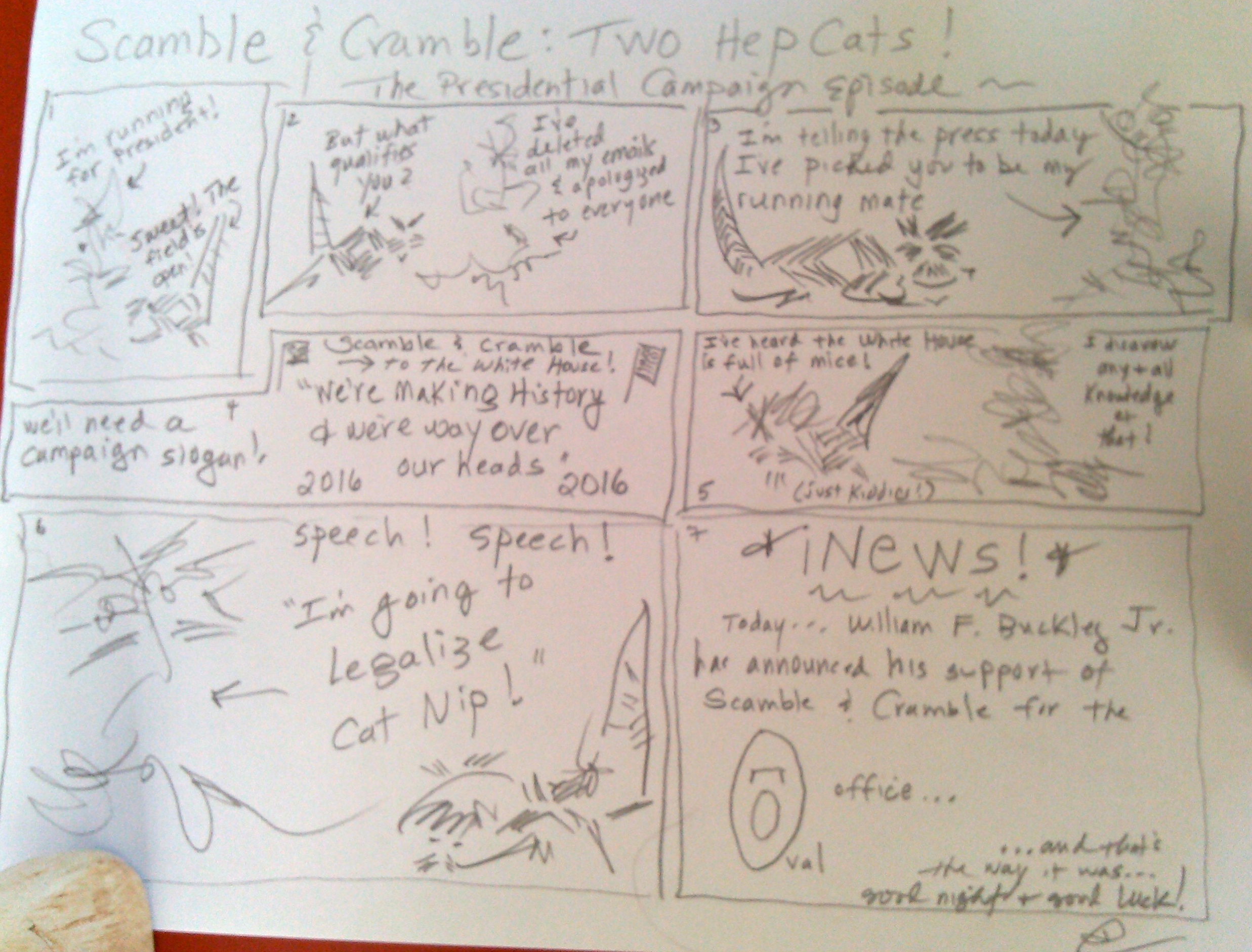
“I’m going to legalize catnip!”
Instructions: Read each row left to right, then, in each empty cell in the first column, insert a word that irks you. In the corresponding empty cell in the far right column, insert your irky word’s opposite. If you can’t think of a word that irks you, insert a word that feels good to your ears. (Note: You may also read the words by column, top to bottom, or bottom to top – individual reader experience may vary.)
| play | ear | piquancy | ||
| ear | wig | able | ||
| ear | ate | oblige | ||
| ear | riff | hive | ||
| ear | rev | rant | ||
| iron | browse | nose | ||
| ear | irk | sum | ||
| ir | clothed | ears | ||
| ear | iris | bow | ||
| ear | nose | spell | ||
| ire | oh | you | ||
| rear | reverse | ably | ||
| wear | plus | tear | ||
| spread | sheet | foot on | ||
| oval | ire | head | ||
| for | get | it | ||
| come | out | side |
In the cell to the right of the comment, indicate your level of satisfaction with The Coming of the Toads blog, using a 1 for “highly likely,” 2 for “depends,” 3 for “no opinion,” 4 for “not likely,” and 5 for “no way.” If the question suggests an “agree” or “disagree” answer, use 1 for “totally agree,” 2 for “agree somewhat,” 3 for “sometimes,” 4 for “I meditate often,” and 5 for “totally disagree.”
|
1 |
2 |
3 |
4 |
5 |
|
| I’ll probably stop reading your blog soon: | |||||
| I’d rather listen to the radio or watch TV: | |||||
| I prefer posts that are not poetry: | |||||
| I want to see more pictures: | |||||
| You should sponsor some giveaways: | |||||
| Have you thought of knitting for a hobby? | |||||
| I liked the recent bicycle post: | |||||
| I’m not sure what you mean by a post?: | |||||
| I’m currently reading “War and Peace”: | |||||
| I’m thinking of subscribing to a magazine: | |||||
| I’m thinking of buying a new car: | |||||
| I have enough clothes to suit my needs: | |||||
| I can never get a plumber when I need one: | |||||
| I got here by mistake: | |||||
| I was referred here by my plumber: | |||||
| My socio-economic demographic sucks: |
Thank you for visiting The Coming of the Toads and for participating in the survey.
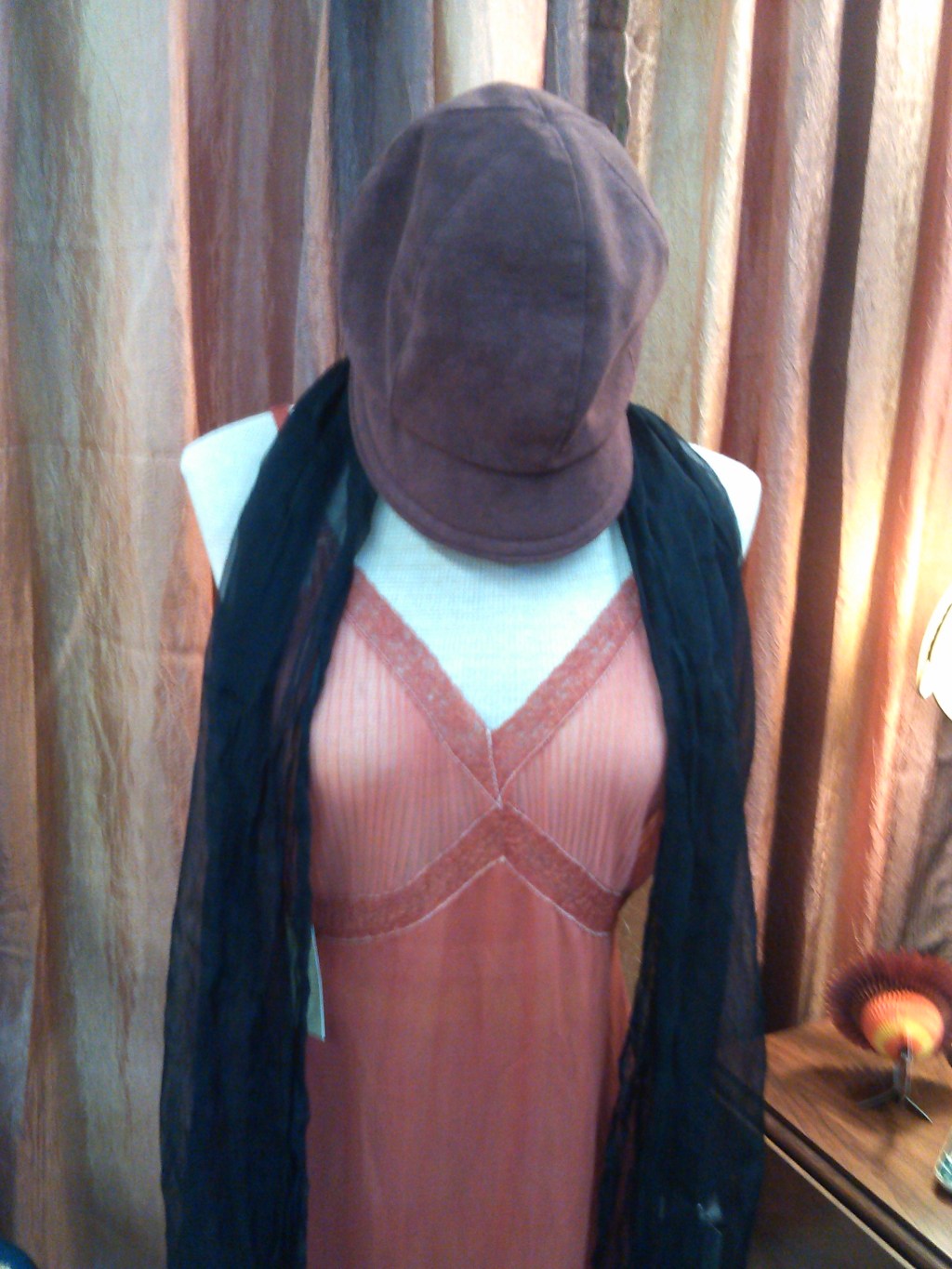
A few gratuitous pics for this post, because some readers have come to expect pics with words, and, believe it or not, appreciate a good selfie when they see one:


Readers can now look inside “Scamble and Cramble: Two Hep Cats and Other Tall Tales.”


 The Coming of the Toads