• The Business of Poetry

    I’m in a meeting about meetings.
    Someone is talking about needs:

    “…Clear purpose…
    …Keep to agenda…
    …Stick to schedule…
    …Out on time…
    …Take notes…
    …Dress code…”

    I note, doodle, jot down words,
    drop seeds of wild silly weeds
    into the creamy hirsute carpet;
    someday the seeds will sprout

    …into poems…

    the night janitor will sweep up.

    The priest talks of the need for prayer in despair.
    The scholar talks of the need to be read by peers.
    The senator talks of the need for dough and polls.
    The bag lady quietly appeals for a change of where.
    The therapist theorizes the need of rest from care.
    The bartender talks of the need for a road to hear.
    The mother yells just wait until your father comes
    home, until the evening comes when Dad disappears.

    Who knows the source of this need from long ago,
    the need for poems and to live like a fat soiled pig
    sloughing off in a muddle puddle wallow of words,
    but the meeting adjourns with predicable promises
    of more to come, of more to come, of more to come,
    and someone breaks an egg over the speaker’s head:
    a detailed SWOT Analysis called for pastry and pie,
    but the speaker is silent, not a word, about poetry.

  • The Art of the Bus Stop

    It was to be his last day, he dreamed, a phantasmagorical dream
    recurred, after a cup of coffee, in wakeful brain, a near belief in seizure.

    How would he spend his last day? He should limit his options,
    if chance proved him a fool tomorrow, build a hedge of porcupines.

    But if today’s feeling did not pass, his options were not so limited.
    He could fly anywhere, stay in a Six Star hotel in bikinied Marseilles,

    fly to romance Rome and get in line for a final Papal blessing,
    parachute into the Mojave desert, jump off Saddleback Mountain,

    surf the Banzai Pipeline – like in the old days, take the board out.
    Who would dare cut off an old man on a wild wave on his last day?

    He got his surfboard out of the deep basement, his lovely wife still sound asleep.
    He walked down to the bus stop. He waited with his surfboard on the poetic bench,

    beneath the ancient acacia tree. The bustling bus came but the discreet driver said no
    to his putting the untethered surfboard in the bike rack on the front of the bus.

    He went back to waiting at the busy bus stop, and this is how he passed
    his penultimate yesterday, talking to bussers about the art of surfing.

    Related Posts: Winter is icummen in, Lhude sing Line 15
    Reading Roland Barthes’s Writing Degree Zero on Line 15

  • Poetry Footprint

    Poetry High FiveAccording to the Global Footprint Network, the Ecological Footprint is “the metric that allows us to calculate human pressure on the planet and come up with facts, such as: If everyone lived the lifestyle of the average American we would need 5 planets.” There are several footprints currently being measured, carbon and water, for example, and we are encouraged to measure our own personal footprint and to reduce the size of our footprint, “to tread more lightly on the earth.”

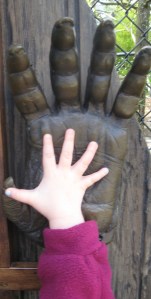
    Maybe poetry does not have a footprint, but a handprint. A print that shows who was here, and this is what they saw, what they heard, what they tasted, what they touched and felt, what they smelled. But also, what they and those close to them thought about this sensorium of experience, how they responded, how they changed, what they promised and what they betrayed, how they might have wronged and how they might have been forgiven. To do all of that, poetry needs a wide spectrum of possibilities. Some of these possibilities might lead listeners, readers, away from well worn paths, into uncharted waters, rough seas, or lulls, or blank spaces with no echo. Other possibilities might lead readers back into cities with crowded sidewalks, or into libraries full of musty, dusty books. Or into parks, or taverns, or beaches, or mountains and lakes and rivers, or nurseries or old folks’ homes, or orphanages or prisons, or churches or corporations, or onto ships or bicycles or cars or helicopters or surfboards. The point here is that any of these possibilities, for any individual listener, might wind up a dead end, but it can’t be wrong if it widens the spectrum, for the wider the spectrum, the greater the possibility of poetry.

    I sometimes wonder if human nature improves over time. In other words, are we better than our ancestors? We might like to think so. Technology and medicine, the comforts of modern housing and transportation, what we call advancements and improvements resulting in higher standards of living might lead us to think we are smarter, more accomplished, in a word, better than our ancestors. But what of our essential nature? Has that improved? Does it improve? Can it improve? I have doubts. I think we’re probably the same inside as we’ve always been. It’s the same old heart beating in the same old chest.

    In any case, what inspires this post is another skirmish posted in the poetry war, an internecine, academic argument. I’ll just point to David Biespiel’s response over at the Rumpus, and interested readers can follow the trail-links from there. Like most wars, it’s sometimes hard for an outsider to get what it’s all about, but like most fights, this one’s about territory and who’s to have the final word. But it’s also about values, what we value in poetry, and whose values ought to prevail. It might be important to remember that what we value is not necessarily what’s good for us. What we value is simply what we want.

    There is something about poetry to value, to want, that is relevant to the discussion. One of my favorite books of poems is “Paroles,” by Jacques Prevert.* Prevert lived in Paris during World War II, during the German occupation. Writing in 1964, Lawrence Ferlinghetti, in his translator’s note introduction, said, “I first came upon the poetry of Jacques Prevert written on a paper tablecloth in St. Brieuc in 1944…a poetry (his worst critics will tell you) which is perfectly suited to paper tablecloths, and existing always on as fine a line between sentiment and sentimentality as any that Charlie Chaplin ever teetered on.” That “perfectly suited to” is important, for it values a poem for its success in achieving its purpose. Even if we might think the purpose is bad, it can still be a good poem. This is a sentiment many critics find difficult to stomach, but it’s vital to the health of a wide spectrum of poetic possibilities.

    But there’s another reason I like Prevert, and that has to do with the idea of sitting out at a sidewalk cafe table writing a poem on a paper napkin, not even a paper tablecloth, a poem someone might read, or no one might read. Poetry was a way out of oppression for Prevert, and poetry remains a tool today for release from the natural malaise that comes from everyday life, even if that release is only temporary, and even if that malaise is from human pressure. The release comes in the act of writing the poem, not from the possibilities of someone else reading it or of having it published or some fantasy of poetic fame, but from the existential act that says, I am here, and this is what that means, for now. The act of poetry leaves a tiny Ecological Footprint. That sidewalk cafe napkin poem might be a good way to “tread more lightly on the earth,” even as it adds to the size of the poetry footprint.

    *Jacques Prevert’s “Paroles” is Number 9 in “The Pocket Poets Series,” first published in the City Lights Books edition in July 1958, in San Francisco. I have the Sixth Printing, February 1968.

    Related Post: Bukowski for President! David Biespiel and Poets for Democracy

  • Dictatorial Decree

    Already the sun slipsSun,
    filches off
    at a sneaking speed.

    The despot rising
    declares a natural
    state of emergency.

    The pompous papa
    prays on the instant
    for a sum of leniency.

    Alas, mere poet, see?
    The sun protracts
    your high-pitched misery.

    Tonight a summer
    full moon calls
    a ball of lunacy.

    The sun dictates the noon,
    casts down dress codes
    on the darling horology.

    The moon denudes the day.
    The night goes without
    a blanket of authority.

  • It’s “After Midnight” at Berfrois

    The Toads review, posted back in May, of “After Midnight” was reposted today on Berfrois. After the last few weeks of more unrest around the contemporary world – on the ground, in the air, on-line – Irmgard Keun’s short novel about the life of a young woman in Germany during the build up toward World War Two feels increasingly relevant. Whatever time it is locally, cruise on over to Berfrois and check out the review and more.

  • A Pith Zany

    Nook EveningAnd what he did last just
    before his personal power
    rose and surged
    then tweeted out
    was check his e-mail.

    “Heaven will be full of spam,”
    he decried, “because
    everyone wants to be there,
    while hell will be whiteout,
    an empty inbox.”

    “Or the other way around,”
    I replied.
    “Oh, that’s pithy,” he said.
    “And there’s nothing I dislike
    more than an epiphany poem.”

  • The Look of Love

    Climbing bolt eyes tightened so tight the threads
    strip, and the tongue, a dirty oiled belaying bolt,
    slips and slaps, and the whole edifice collapses,
    as if a plumber has grabbed the head by the ears
    and sucked on the nose with his plunger.
    
    The smith smites a bass anvil,
         hammering
              the hot steamed milk face
         forging
              the steel bridge nose,
         sculpting
              terrible white teeth,
         drawing and cooling
              the pendant tongue,
         punching
              eyes opaque blue,
         curling
              thick creamy hair
    around the handle of his hammer.
    
    This hyperbolic happy acid oozing 
    cold blue face bowl of plum pits,
    bonbon pate of goose liver. 
    “Don’t look at me!” cry the eye bolts expanding, 
    lips stressed taut, ears hung like life rings. 
    Far back on the tongue, a bitter spot to nap. 
    
    The old couple lives now in a window box. 
    The sash opens and a hand appears. 
    A palm with a long curved neck 
    pours water clear and concise. 
    
    An electrician comes to replace the eyes. 
    He breaks both sockets unscrewing the cold bulbs. 
    Memory starts to flicker, the call of a far-off bird. 
    In brackish blue eyes the tiller tongue feels spaces, 
    loosed from its mooring, and on the sail of the nose, 
    beating upwind for a kiss, ripples of sound,
    the soupy surf ringing in his ears, 
    snores an old surfer paddling about
    on a dinged, wax-worn, sun bleached board, 
    wanting to swim with you.
  • Watermarks from a Night Spring

    Embers of a partially burned ocean
    In a box in a dank basement molting notes
    A weathered surfer slowly descends the creaking

    Worn stairs, dark swells yawning
    Fish eyed and barnacle knuckled he climbs
    Finds and opens the box, peers in, smells the pages

    Runs salted fingers over the raised words
    Rusting paper clips, chiseled letters in Courier font
    Fading beached seagulls washing away in an incoming tide

    Wired spiraled journaled waves
    Bleaching across the page ink in water
    Blistering sun burnt tattoos on old shivered skin

    He can no longer read without bottled glasses
    He chuckles, the tide receding washing scouring
    White out rocks across words stuck buried in red tide pools

    Breathing with a snorkel
    The surfer leers over the smoldering sea
    Takes up the seaweed soiled waxed manuscript

    And paddles out of the basement
    Walks down to the beach and what remains
    Of the water and casts out the paper fish net

    Into a set of scaling waves
    Lit with a lustrous industrial moon
    The waves curling letters in blue neon.

    (Click any photo to view gallery)

  • facephenom

    facebrick

    facebrick facebuilt facebroke faceblind facedearth
    faceboss facetomb facepop facedough facetious
    facestitch facetouch facebotch facebach faceberth
    facestill facestone facequiet facepiece facemirth
    facebush faceface facephone facespill facer
    facecross facetoss facemoss facetaste facemill
    facevalve faceback facade faceplay faceout
    facetone facemoan faceme faceyou facepull
    faceposh facerush facemush facebrush facetilt
    facsimile factotum facecap facemask facetome
    facedrone facetill facetree faceroad facelift
    facesky facefront faceit facebuck faceroam
    facethis faucet facet facetrick faceroom
    faceless facemuse faceup facestop faceboom
  • Home Run for John’s Birthday

    I pitch my brother a tricky slow
    curve that floats warbling past the pink
    hibiscus and slides away under
    the Chinese elm, but he goes with the pitch.

    The yellow plastic bat darts
    like a startled fish, and he sends
    me back, back, to the wall –
    and the white, holey ball
    whiffles over the roof,
    landing in the olive tree.

    Happy Birthday, John!

  • Without you tonight

    A seeking breeze softly slips
    under the sleeping cherry tree
    a cursory note, “I am too busy.
    Too, too, toodle-loo,”
    smiles, hushes, and sounds off.
    A branch snaps, and a cat recalls the night
    when the owl, the nightingale,
    and the toad went out walking.

    The moon follows the trio into the tea garden, pulling
    behind the sounds of the rollicking ocean waves.
    In the garden, two women sit talking:

               “I wrench or hammer or pull or push
               To disassemble and repair
               To build in empty air
               The sound truth that is not
               Sound enough.”
     
               “I don’t believe the truth
               That there is no truth
               There are two truths
               The one you reject
               And the one you embrace.”

    Drowned out by the singing waves slopped with frothing beer,
    An old, lost surfer takes a hearty long piss on the briny rocks
    At the water’s rough edge and mutters a half assed poem
    To pass the night in song outside walking the dark beach
    While the women sit talking with the cat in the cove of the garden
    Under the cherry tree awakening and petals falling all
    In one great breath the ocean waves belly laughing full.

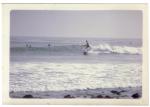
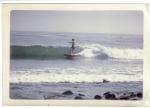
    Surfers