• Heart’s Apron Sestina

    Heart's ApronOozing down the sinuous sleeve the heart’s blood
    tempts the jackdaws to table to dine
    each bird a caddy for another’s purse
    whose ears exceed hearing and have eyes to eat
    who renounce not their heart’s guards
    but pronounce things with ease and clarity

    if left to their own corrections
    sop with erasure the heart’s brood
    I ago did watch one eye that pursed guard
    too hungry to alone dine
    for the ears on the word’s feast
    a three egg amulet protects the purse

    but there’s nothing in the purse
    the notion needs correction
    so we can sit down empty and eat
    something other than this soul’s doubloon
    good grief alone better to dine
    than suffer the guarded guards gardening

    the ones who taught the heart’s guards
    deluge ago to spend with lavish the purse
    so that today’s diners
    might eat correctly
    in a sacrifice bloodless
    at an ordinary eatery

    so with consciences clean let’s eat
    bring us the menus guards
    and napkins for these touchy emotions
    unbuckle the rope that holds the purse
    let it all hang out but with good manners
    for our purposeful dinner

    ago then we did dine
    on hearts on sleeves we did eat
    though correctly
    under the apron of the guards
    who held our purses
    and allowed aloud no drooling

    but this rectitudinal dining in and out
    fills with bile and drool of toasts and teas
    drop your guard forget the purse let’s flee

  • A Cat’s Christmas Carol

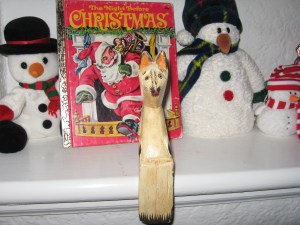
    "'Twas the night before Christmas, when all thro' the house, Not a creature was stirring, not even a mouse."
    “‘Twas the night before Christmas, when all thro’ the house, Not a creature was stirring, not even a mouse.”
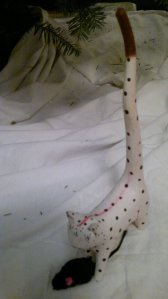
    That's because I'm standing on his tail, hee-hee.
    That’s because I’m standing on his tail, hee-hee.
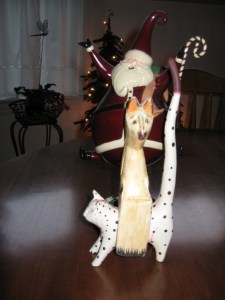
    Why can't you just sit on Santa's lap like everyone else?
    Why can’t you just sit on Santa’s lap like everyone else?
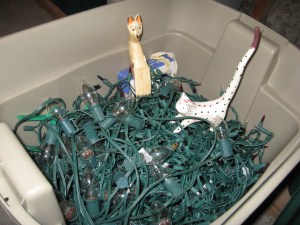
    What a mess! Who put the lights away last year?
    What a mess! Who put the lights away last year?
    Dig it! We got a Christmas card from Jimmy Carter!
    Dig it! We got a Christmas card from Jimmy Carter!
    Remember the year that cat in chains showed up? Claimed to be a cat from the past. What's the past? I asked.
    Remember the year that cat in chains showed up? Claimed to be a cat from the past. What’s the past? I asked.
    Won't Susan be surprised when she opens this one! The cat of Christmas present...hee-hee...
    Won’t Susan be surprised when she opens this one! The cat of Christmas present…hee-hee…
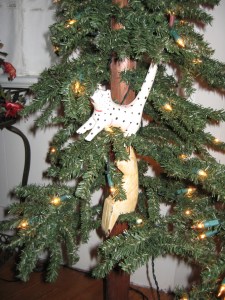
    Is this a good place for this one? Why do you have to hang on my head?
    Is this a good place for this one? Why do you have to hang on my head?
    "Happy Christmas to all, and to all a good night."
    “Happy Christmas to all, and to all a good night.”
  • Waltzing with a Loon to the Tune of a Whippoorwill

    Moondance 1Henry’s loon waltzed into the room laughing
    laughing laughing at the phony moon
    rising over the pond-like screen
    laughing at Henry, at me, and at you too
    who scorned the whippoorwilled
    who loon-waltzed our way across the fall season

    who tweeted twitted twisted and tallyhoed on
    but what stilled the waters the antithesis of laughter
    came the calm call of the whippoorwill
    calling up to the ballooning moon
    to Henry, Huck, Hank, and all of us who
    waltzing across a lightbox screen

    click click click the path of the reen
    and fail to see the turn of the season
    while flashes YouTube and you too
    laughing laughing laughing
    at the simple simple single moon
    who waltzes with the whippoorwill

    to the epizeuxises of the whippoorwill
    the yoke on me preening for the screening
    in a full no half no quarter no moon
    in the turning turning turning of the seasons
    as the lone loon laughs
    at Henry, Huck, Hank, me, and you too

    yes at you too you too you too
    whistles the only whippoorwill
    as the moon falls fades the laugh
    and across the pond fills the screen
    white going going gone the season
    of the wry loon waltzing with the moon

    with the dry improbably wry moon
    then on the far shore you too
    out of rhyme out of sync out of season
    running running running for the whippoorwill
    and across the pond comes a single scream
    that echoes epizootically laughing

    out of season the waltzing singing loon
    laughing woo hoo! woo hoo! woo hoo!
    the poor loon waltz in a pale fall screen

  • Cat Couple Vacation: A Photo Trip

    “Just once I would like to go somewhere for vacation,” I told him, “and not just sit around the house watching you with your whiskers in a book, your tail as still as a surfboard on the Oklahoma Panhandle.”
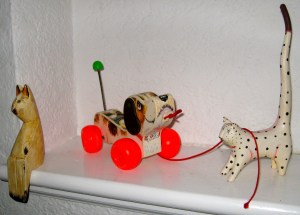
    At the Wild Animal Park. It’s a Dogoneus. It’s on the Endangered List. “You’re going to be on the endangered list, if you don’t start showing some enthusiasm for this trip,” I told him.
    At the Cat Dinosaur Museum. “We’re getting smaller and smaller,” he said. “Soon, we’ll be as small as mice. It’s called Existential Evolutionism.” “Is that why you’re always so bummed out?” I asked him.
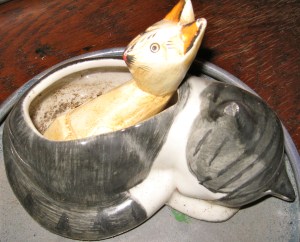
    Finally, he had some fun. Here he is on the Cat Teacup Ride.
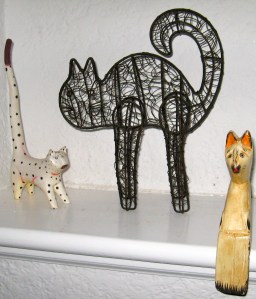
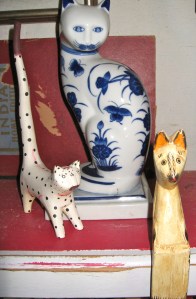
    In Japan. “No, it’s not The Beckoning Cat,” I told him. “She’s beckoning me,” he said, “to take her on Antiques Roadshow.” “I can’t take you anywhere,” I told him.
    At the Colossus of Cats. “It’s not size,” he said, “but the sharpness of claws.”
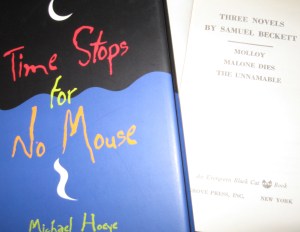
    Back home again. He’s doing some research on mice and re-reading all his Black Cat Books. Next year, he wants to visit all the great libraries of the world. I told him he can do that on his laptop. “I want to go dancing across the tierra of Los Angeles,” I told him. He looked at me like I might have cat scratch fever. “There is no earth in Los Angeles,” he said. “Yes, there is,” I said. “You just gotta dig it up.”
  • Why Read Poetry?

    Much of modern poetry is unintelligible or seems incoherent. That’s not modern poetry’s problem though. The problem with modern poetry is the absence of a general interest reader of poetry. Cautious readers avoid the crafted, arched bridges called poems precariously balanced over esoteric estuaries. But was there ever a general interest reader of poetry? Well, who filled the pit of Shakespeare’s Globe Theatre? Who did Walt Whitman write for? Why did Langston Hughes use the Blues? Who did Woody Guthrie sing to? Who listens to Bob Dylan?

    A word about craft, to those poets who would sit down to “craft” a poem: One may write a poem, compose a poem, draw a poem, paint a poem, photograph a poem, fingerprint a poem, press a poem, memorize a poem, sing a poem, post a poem, but one crafts a toilet bowl gasket seal, crafts a kitchen cabinet, crafts a chair to sit on to scribble the poem. Let poets work for a living and craft their poems in their sleep. And let them be well rested and sober when they begin to speak.

    Why would someone who does not read poetry suddenly start? Where would they begin? Any menu would look strange, even the crafted menu, maybe especially the crafted menu. Why would they taste anything on the table? It would look a strange feast: snake knuckles, chocolate covered roses. Most of the dishes the average reader wouldn’t even recognize as food. There’s little appetite for it, for poetry is strange. Yet here’s a poet craftily writing for an audience with a special hunger, Dylan Thomas, “In My Craft or Sullen Art,” writing for those “Who pay no praise or wages / Nor heed my craft or art.”

    I packed Rimbaud into my duffle bag a long time ago. “The first study for a man who wants to be a poet is the knowledge of himself, entire…But the soul has to be made monstrous,” Rimbaud wrote in the preface to his Illuminations, where quickly things get “unbearable! and the Queen, the Witch who lights her fire in the earthen pot will never tell us what she knows, and what we don’t know.” What did that mean? I didn’t know, but the “hare,” who “stopped in the clover and swaying flowerbells, and said a prayer to the rainbow, through the spider’s web,” I wanted to talk to, and the words curled up on the cold grate of reason and warmed one another, and soon started to glow and illuminate like candles of beeswax.

    Yesterday in conversation with a colleague I was asked why I read poetry.

    I am thankful for poetry. In the beginning was the word, and the word was posted to a tree, and around the tree gathered listeners and readers who began to talk among one another, even as the word was forgotten and fell to the ground and was buried in the falling leaves, and in the spring a young man out walking found the word now obscured from weather and compost and thought it said wood, or wode. This was the first reader of poetry, and Rimbaud’s Witch.

    Arthur Rimbaud. Illuminations and Other Prose Poems. Trans. Louise Varese. Revised Edition. A New Directions Paperbook, 1957, NDP56.

  • On Poetry

    A poem is a composition, an arrangement of parts. Or a rearrangement, or a disarrangement. Poets build things, edifices, structures, often claustrophobic, and the reader must throw open the windows to breathe. But just as often the poet tears structures down. Then the poet is a demolition worker swinging a sledgehammer, pulling on a pry bar, claw hammer hanging from the tool belt.

    The parts of a poem are most often words, but not only words, and sometimes no words. The spaces in between the words, the distances between lines, the s p a c e s between the letters, e v e n, are also parts, part of the composition. The reader must wear a hard hat, walking through the poem, the construction zone, and steel toe boots, and ear plugs.

    Or a poem may have no words, no alphabetical features, a nonliterate composition. Concrete Poetry contains many examples of poems composed without words. Nails are periods, screws commas. Some poems are welded together, others sewn, still others hot glued. Back in the 1960s, some poets used plumber’s caulk and boiled lead and chiseled the lines together like pipes, careful to make sure the pipes fell in the run.

    But a poem may not be seen, if it’s read aloud, if the poet sings. The reader may then want to wear snorkel gear. The poet is then a cotton swab. The poet wants to clean the wax from the reader’s ears. Poets are often unreasonable, and arguments break out like bar fights, the hard hat, the steel pot, now flung like a disc across the room.

    Then the poet returns with flowers, a bouquet of red roses. The roses are lovely, but beneath the glossy green leaves, all up and down the long stemmed roses, hide thorns like the claws of a raptor.

  • The Pope Tweets

    Now here’s a treat; the Pope’s to tweet. The news arrives not by tweet but via the promise of a more social-media engaged Vatican (see the Pope’s message “Truth, Proclamation and Authenticity of Life in the Digital Age,” June 5, 2011), but the tweeting news comes, also, at a moment of alleged intrigue, corruption, and scandal within the Papal Towers. Thomas Jones, editor of the London Review of Books Blog, in a review of a book exposing the Vatican’s seeming scheming culture, summarized that culture thus: “Even if you can’t follow all the tangled threads (and I certainly can’t), the overwhelming impression left by Nuzzi’s book, and the whole Vatileaks saga, is that the Vatican is seething with conspiracy, faction, infighting, self-interest, venality and back-stabbing. (When do they find time to pray?)” (p. 25). Not to mention, when will they find time to tweet?

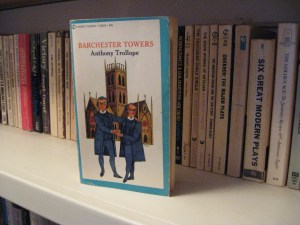
    Anthony Trollope’s Barchester Towers (1857) begins with a question: “In the latter days of July in the year 185––, a most important question was for ten days hourly asked in the cathedral city of Barchester, and answered every hour in various ways—Who was to be the new bishop?” What was the audience for such a question? Today’s Trollope might write: “What will be the Pope’s first tweet?” And the audience would consist of his Twitter followers, who would for the next month or more hourly tweet suggestions for what might be the Pope’s first tweet. Reuters reports the first Papal tweet is not expected for another month or so. I’m not the world’s fastest writer either, but a month to compose 140 characters? No wonder they’re still living in the Middle Ages.

    The Pope is not without his critics within the Church. The most notable perhaps is the Catholic priest Hans Kung, who continues to call for changes, though a tweeting Pope is probably not one of them. The Vatican has been trying to censor Kung for some time. Maybe Hans will get his own Twitter account. Martin Luther would have written some choice tweets.

    “It will, however, give you no trouble to write another article next week in which we, or some of us, shall be twitted with an unseemly apathy in matters of our vocation,” Trollope’s moderate-right hero of the High Church, Mr. Arabin, tells Eleanor.

    But tweets are not articles. Tweets are aphoristic, often sententious, conversational pith. But the Pope won’t be able to qualify his Twitter profile with any kind of disclaimer, even if the tweets are not his own.

    And how much less trouble to skip the article for a tweet. The verbose and prolific Trollope would fail the tweet. As he nears the end of his Barchester Towers novel, he worries about fit and about being twitted for his efforts:

    “And who can apportion out and dovetail his incidents, dialogues, characters, and descriptive morsels so as to fit them all exactly into 930 pages, without either compressing them unnaturally, or extending them artificially at the end of his labour? Do I not myself know that I am at this moment in want of a dozen pages, and that I am sick with cudgelling my brains to find them? And then, when everything is done, the kindest-hearted critic of them all invariably twits us with the incompetency and lameness of our conclusion. We have either become idle and neglected it, or tedious and overlaboured it. It is insipid or unnatural, overstrained or imbecile. It means nothing, or attempts too much. The last scene of all, as all last scenes we fear must be,

    Is second childishness, and mere oblivion,
    Sans teeth, sans eyes, sans taste, sans everything.”

  • Thoreau’s Bicycle

    Fall falls. Footfalls squish and squash through redorangeyellow leaves, their green energy sucked back into roots, an understandable hoarding for the winter.

    The casual bicyclist dismounts for the season, buries the bike in the basement, perhaps intending to walk through the winter.

    We have come to rely on the automobile to our detriment: for cars require a massive infrastructure, costly to build and maintain, that blights the landscape and harms the environment; cars are fuel-hogging inefficient, noisy and polluting, difficult to recycle; car use subtracts from walking opportunities. Even in parking lots we search for the space nearest the entrance, though that distance might be our only walk of the day.

    While Thoreau probably knew of the bicycle, he didn’t ride one. If Thoreau wanted or needed to get somewhere, he walked.

    In his essay simply titled “Walking,” Thoreau says he wants “to make an extreme statement.” What does an “extreme statement” sound like? “If you are ready to leave father and mother, and brother and sister, and wife and child and friends,” Thoreau says, “and never see them again; if you have paid your debts, and made your will, and settled all your affairs, and are a free man; then you are ready for a walk.” At that pace, few of us would ever be ready or able to go for a walk.

    Maybe it’s an argument of definition: what’s a walk? “But the walking of which I speak has nothing in it akin to taking exercise, as it is called…but is itself the enterprise and adventure of the day,” Thoreau says. He tells us, in Walden, he often walked four miles a day, and would walk eight miles to say hello to a tree (“Former Inhabitants” chapter, para. 17).

    “I am a good horse to travel but not from choice a roadster,” Thoreau says in “Walking.” I stopped walking when I got my first roadster, a 1956 Chevy. Cars are cool. Who isn’t intoxicated by the odor of a new car’s interior? Today’s cars, souped up with on-board, high-tech falderal, make my old ’56 Chevy seem a bicycle by comparison. To answer Thoreau’s extreme statement about going for a walk, to walk with Thoreau, we would add our cars to his list of things we must be ready to leave and never see again. It’s an argument of revolution.

    Related: Thoreau Posts

  • The Toads Transfigured at berfrois!

    The Toads post on the latest Rolling Stone Dylan interview, in which we blended Dylan’s discussion of transfiguration with Clarice Lispector’s in Aqua Viva, has been picked up and reposted at berfroisCheck it out!