• p-1: The Evil Hill on Mariposa

    n+1 vs The BelieverIf print does disappear, I will be only partially responsible. I’m doing my part to keep a few print publications healthy. But I can’t subscribe to everything. The question is always the same: what to read and how. A loyal subscriber to The Believer, alas, my subscription has lapsed, and just prior to the 2013 music issue, which turned out to be jazz inspired. Bummer.

    I’ve been comparing the cover changes over time of the New Yorker with the cover changes of the Rolling Stone. “Time is real,” Cornel West reminds us. But a few weeks ago, finding myself reading, with interest, no less, in the New Yorker, a “Tables for Two” eatery review of a restaurant I’ll never eat at, I decided I’d better augment the New Yorker and replace The Believer with something new. Meantime, I had discovered Kirill Medvedev, and noticed that n+1, which I follow, sporadically, on-line, was giving away the Medvedev “It’s No Good” book with a new subscription, so I went for it. And last week, the Fall 2013 n+1 print issue arrived, red dressed, calling itself the Evil Issue. Evil? Really? I felt the proverbial wince of buyer’s remorse.

    I sat down and opened my n+1. I glanced guardedly through the table of contents, not one for haunted houses, horror films, that sort of thing. Something here by Marco Roth on politics, on drones – ok, that’s evil. A drama piece titled “sixsixsix.” Why do folks think Satan evil? Consider Blake’s “The Marriage of Heaven and Hell”: “The reason Milton wrote in fetters when he wrote of Angels and God, and at Uberty [a lot] when of Devils and Hell, is because he was a true poet, and of the Devil’s party without knowing it.” Still perusing the evil issue’s table of contents and glancing through the articles to see what I might want to start with, I came to something from the Stanford Literary Lab, titled “Style at the Scale of the Sentence.” I haven’t finished it yet, but I’ve decided it’s at the heart of the evil issue for a reason. Then I saw this, which took me by surprise: Alice Gregory’s article titled “Mavericks: Life and death surfing,” and soon found myself into the evil issue in earnest.

    If the entire evil issue was instead titled “Mavericks” and filled with Alice’s writing about surfing I would be a happy reader. The only problem with the article is it’s only ten pages, which means back to the Literary Lab’s “Sentence” article too soon. Maybe I should have renewed The Believer, after all, seen if they’d send me the music issue I missed. On jazz! Jazz in the evening can turn an evil day good. Wondering about the etymology of the word evil, I found this in Wiktionary: “from Proto-Indo-European *upo, *up, *eup (“down, up, over”).” Ah ha! That’s a definition of surfing. One of the best pieces of journalistic writing on surfing I’ve ever read came in the New Yorker, back in 1992, written by William Finnegan, himself a surfer. “Surfing is not a spectator sport,” he says in the second of the two-week, long article. In the first week, Finnegan had said, describing the surf at Ocean Beach, off San Francisco, “The waves were big, ragged, relentless, with no visible channels for getting through the surf from the shore.” Conditions in the water, often fast changing, are difficult to read from the shore. Waves always seem bigger to the surfer in them than to the spectator watching from the beach or from a cliff high above the water. I read the long Finnegan piece twice before mailing my two copies with the articles to an old surfing buddy, not much of a reader, who later called me, totally stoked.

    Preparatory to surfing, back in the day, hey-hey, kids growing up in South Santa Monica Bay rode skateboards: literally, the wheels removed from old roller skates and nailed to the bottom of a two by four, crude vehicles compared to today’s boards. I lived on Mariposa, at the bottom of a long, steep hill, followed by a short straightaway, then an easy hill ending at my house on the corner. The houses on Mariposa backed up to railroad tracks (since removed). Between the railroad tracks and the back fences was a path the local kids called “Devil’s Path” or “Devil’s Pass,” a shortcut toward downtown. We regularly rode skateboards up and down the mild Mariposa hill, but to ride a board from the top of Mariposa was considered a daredevil feat.

    One day, my friend Pete Ponopsko, a few years older than me, took a skateboard to the top of upper Mariposa. He was going to ride down the big hill and would pick up enough momentum to carry him through the straightaway and down the lower hill all the way to the bottom. A small crowd of skateboard aficionados positioned themselves mid straightaway, where we could watch Pete whiz by on his way to the lower hill.

    One of the problems with early skateboard technology was shakiness. At fast speeds, the boards wobbled side to side. Another problem had to do with the metal, roller skate wheels. A pebble might catch under a wheel and brake it, stopping the board and throwing the rider forward. We never knew for sure what went wrong with Pete’s ride down the upper hill. Some said the board shimmied so severely he simply could not keep his balance. Others said he hit a rock and pearled. Still others said Pete chickened out and tried to jump off. Whatever the cause, the effects included a startling array of raspberry red scrapes and bruises along one side of Pete’s body, from his ankle to his ear. It was said Pete slid on the sidewalk a distance equal to the length of a 1956 Ford station wagon. It was an evil wipe out, and it was a long time before anyone tried to ride upper Mariposa again, but by then skateboards were wider and thinner and longer and fitted with smooth rubber wheels and stable wheel bearings, and Pete was already an old-timer.

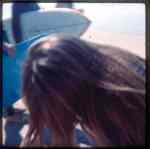
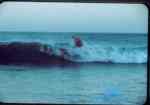
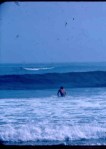
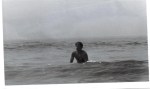
    Joe at the top of an evil wave. Well, an evil photo, anyway.
    Joe at the top of an evil wave. Well, an evil photo, anyway.

    Follow Up: n+1 has put the Alice Gregory Mavericks piece on-line, 9 Oct 13.

  • Susan Among the Zen Monks in the Gorge

    Upper Multnomah FallsOne summer, we drove into the Gorge to view the falls. There are several falls along the way. Multnomah Falls is the tallest, and is now a major tourist attraction, complete with gift shop, food carts, and a fancy restaurant where a few years ago Rachel Ray filmed a segment of a food show. Summer falls, and it’s hot in town and in the Gorge, but the mist from the falls is cool.

    There are two falls at Multnomah Falls, an upper and a lower. To get to the pool at the upper falls, you hike a switchback trail up to an old bridge. The pool below the upper falls is now off limits, but you can view the upper falls and the pool below from the bridge. We used to climb down the trail and wade into the pool, but you can’t do that any more. Wading into the pool, you could get soaking wet just from the mist from the falls. The falls don’t take the place of waves, the smell of salt-water breezes. In the Gorge, in the summer, if there’s no wind, the air seems thick and heavy, but if you take the old highway, you pass along cliffs of shade and green fern groves growing under the fir trees. And the falls are always a cool surprise.

    Lower Multnomah FallsAnyway, this last time we stopped at Multnomah Falls, Susan decided not to make the switchback hike to the top. On my way up, I passed a group of men coming down. Their heads were shaved. They wore robes and sandals. I didn’t think much of it; monks, I assumed. I nodded as we passed on the trail. When I got to the bridge, I spent some time looking at the upper falls and turned around and crossed the bridge to look down on the lower falls and below to the trailhead to try to spot Susan. And there she was, sitting on a stone bench, surrounded by the monks. I waved and waved some more and finally caught her attention, and she waved back, and all of the monks waved too. I took a picture of her in the middle of the monks, all waving. Then they all stopped waving and went back to talking with Susan. Later, Susan told me they were Zen monks. And this morning I’ve spent probably 30 minutes looking for that photo. Alas, it seems to have disappeared. I think in a past life Susan may have been a Zen monk who attained enlightenment.

  • Your Poem Will Start in 21 Seconds

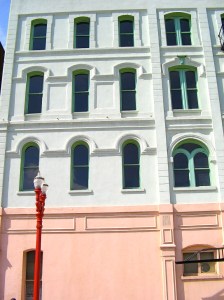
    Green and pink building with red lamp post.Your poem will start in 21 seconds.
    You can skip this ad in 5 seconds.
    Or now: click away. Or watch video:
    A two-tone building, seen from the street, light lime green with aqua-mint green trim over sunned-pink, with red double lamppost, a scotch of blue sky, a wedge of blue, a swizzle of blue. Just past noon shadows. Jet black ladder.
    Your poem will start in 21, 21 videos Your poem will start in 21 days Your poem will start in 21 years Your poem will start in 21 centuries Your poem will start, but it will not end: The rest of the poem is below the paywall, mercifully.

  • Hummingbird

    The Secret GardenAnna’s hum must be a drum
    Syllabifying wings she pauses
    Asks for a brush of water.

    Gusto the loin cat curls
    Garnished in the parsley
    Paws brown under yellow

    Orange marigold sprinkle.
    Curling green garlic stalks
    Stop hear the red head hum

    Oiled garden buzz
    Quicken the quiet morn humus
    Yeses of soft dry feathers.

    Break blossom drift
    Brood across rouse salsa
    Word warm worm release.

  • Two Ocean Surfing Poems at Berfrois – and a gallery of old ocean photos

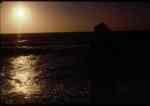
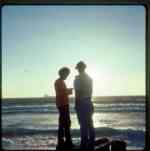
    “Ray, 1956” and “Watermarks from a Night Spring,” two poems with themes of the ocean, surfing, and working, were posted at Berfrois a couple of days ago, along with a few old surf photos.

    Paddle on over to Berfrois and check out the surf poems.

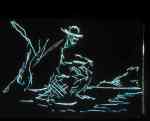
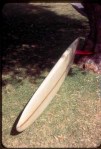
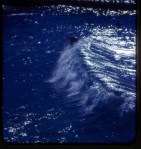
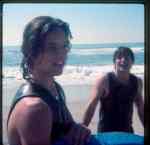
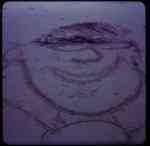
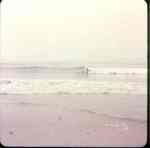
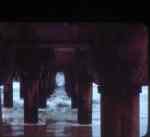
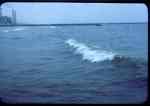
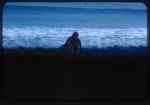
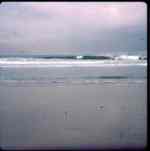
    And below find a gallery with more photos from the late 60’s thru mid 70’s. Most of these photos were taken with an Exakta 500 single-lens reflex camera (East German), with a 120 portrait lens, both purchased used and cheap to take surfing photos at local spots on Santa Monica Bay. Most are scanned from slides, Kodachrome or Ektachrome, and one is from a black and white print. The portrait lens was an affordable workaround at the time used as a kind of telephoto, and it worked ok. The camera was abused though, tossed in the sand, and over time the shutter began to stick. The photos starting coming out black. Some viewers may feel these the best photos. See etched drawing on one of the black slides. These are not “big” waves, and the surfers are locals, but the ocean is huge and alive and old and every morning new. Click any photo to see the gallery. And don’t forget to check out the poems.

    Related: Watermarks from a Night Spring & Ray, 1956

  • Memories and Hallucinations, Real Nostalgia: Bill Bryson’s “The Life and Times of The Thunderbolt Kid”

    Electric WaterfallThe notion things change fast doubles in intensity roughly every two days. It takes a couple of days for most changes to sink in. “Who moved the cat dish?” I ask, combing out dry crumbs from between my toes. “Oh, I changed that the other day,” Susan says. Moore’s law observed amplifying speeds doubling every two years. Too bad the Market hasn’t managed as well. If we understand the laws influencing changes, we’re able to merge smoothly into the new wave. Joe’s law says internal speeds slow inversely to external speeds. As the speed of life increases, what we’re feeling inside slows to a crawl. I can feel the cornstarch thickening in my spinning stomach. The waves keep coming. We can roll under, ride up and over, dive through, or turn around and catch one. We get out of the water and consider our memoir, what just happened, what just changed. The waves look different from the beach, not what we remember at all. We get our breath back. We consider the last wipeout.

    What is change? Do things actually change, or do we simply wake up one morning and remember things differently? Oliver Sacks, in “Speak, Memory” (New York Review of Books), his title borrowed from Nabokov’s memoir, said, “There is no easy way of distinguishing a genuine memory or inspiration, felt as such, from those that have been borrowed or suggested.” Our experiences – real, imagined, vicarious, read, heard – become stories we retell. “Memory is dialogic,” Sacks says (made from communication with others), “and arises not only from direct experience but from the intercourse of many minds.” I’ve only read a portion of Sacks’s latest book, “Hallucinations,” an excerpt, “Altered States: Self-experiments in chemistry,” in the 27 Aug 2012 New Yorker. How does Sacks remember anything? Stories like Sacks’s always remind me of a Salvador Dali interview. When asked if he took drugs to produce his surreal art, Dali responded: “Why should I take the drug? I am the drug.” But Sacks obviously has a good memory, or memories. What’s a good memory?

    Speaking of hallucinations and memories, I’ve just finished a Bill Bryson book, recommended by Susan, “The Life and Times of the Thunderbolt Kid: A Memoir” (Random House, 2006). Bryson was born in 1951, and the book is about him growing up in Des Moines, Iowa, in the 1950’s. We see his memory at work, his memory assisted by a bibliography of books about the world he was born into. That world is given particular focus through his witty anecdotes of home, neighborhood, school, and town, personal reflections mixed in with the historical, researched view. It’s an easy to read, enjoyable book, almost subversive the way he works into the telling what might otherwise be a dry history book. We learn, or are reminded, of much of 1950’s culture, politics, family and societal values. Most of the telling, while written for an adult audience, sounds like it’s coming from a kid’s attitude. The kid reports what’s happening to him, but he doesn’t always understand why it’s happening – several levels of irony at work. Susan set me up. “Read this page,” she said, handing me the book one day, “out loud.” I did, and when I got to the bottom I laughed out loud. I didn’t see the joke coming. Bryson figures things out, like the rest of us, a kid on the go. It helps to remember some things. Other things, it helps to forget. “Grape was the one flavor that could actually make you hallucinate; I once saw to the edge of the universe while drinking grape Nehi” (278) Bryson says, blending Dali with Sacks.

    Bryson is a prolific writer with an encyclopedic style. It’s sometimes hard to keep track of all the details, facts, numbers, all startling, though you might have been there, too. The chapter on the Bomb brought back memories of the classic classroom aid raid drills where kids practiced scrunching under their school desks in preparation for atomic attack. No wonder the generation grew cynical. Really, these desks were going to protect us? From what? Not from our memories. Here’s an example of how Bryson blends the personal with the researched: “I watched a lot of television in those days. We all did. By 1955, the average American child had watched five thousand hours of television, up from zero hours five years earlier” (279). And then he lists his favorite shows, a bunch of them. His favorite show was the “George Burns and Gracie Allen Show,” which pretty much spanned the 50’s. The key word back there is average, which Bryson was not, but no one is average. Individuals are too unique for any kind of averaging that makes sense (“People are Strange,” sang The Doors, a decade later). For one thing, it doesn’t sound like Bryson watched much TV with his family, but alone, in his bedroom, after he had collected enough cash on a paper route to buy his own TV. Most families I knew had but one television set, and it occupied the living room, an electronic shrine. In our house, it was a shrine, a statue of Mary on top standing on a doily and leaning against the antennae – its tips wrapped in tin foil to improve reception. For a time, it’s where we prayed the rosary together, for which the TV had to be off, though. But the concept of average is a Madison Avenue marketing ploy, and in school, average was a way of keeping kids in line. Anyway, remember the end of the broadcast day, the eerie signal that accompanied the black and white lined diagram on a field of gray, the tubes glowing red-orange like stationary fireflies? Or did I hallucinate that? Then came the teen years and kids grew subversive by not watching TV, while their parents watched the war every night around 6, just before prime time.

    The notion that decades of years fix boundaries of anything is silly, but as we leave Bryson’s book on the 1950’s, we are reminded that everything the decade is remembered for is all gone. There is nothing left of the 1950’s. Everything has changed, and while the 1950’s certainly rang up a toll of bad stuff, all dutifully set down by Bryson, the fact that everything changed is not necessarily a good thing. Gone is the closeness, the walks downtown to the grand theatres, the churchyard dinners, the thousands of family owned farms, the tiny farmhouses under trees alongside two lane roads that passed through small towns. Bryson’s view of the 1950’s is a view of a kid growing up in the 50’s. His preference for something like the “Burns and Allen Show” points to something important: George and Gracie were not products of the 1950’s. They came from a different era, their TV show an example of McLuhan’s theory that every new technology takes its content from the content of a previous form: picaresque to vaudeville to radio to TV. It might have looked new, but it was already old. But today things move so fast that we can hardly calculate those changes. Certainly it doesn’t any longer take a decade. Already everything from two days ago is changed, if not two hours ago, if not from the beginning of this post. Dang! I just put my foot down into the kitty litter box. I would like to say I’m going for a swim, but someone moved the ocean.

  • It’s No Good; It’s All Good – at Berfrois

    The Toads review of Kirill Medvedev’s book, “It’s No Good,” has been reposted at Berfrois. Slide on over and check out the situation at Berfrois.

  • Kirill Medvedev: “It’s No Good”

    Kirill Medvedev’s poems are easy to get into. He explains situations, tells stories about people. You don’t mind listening and want to hear more. He’s contemplative and calm and reasonable, even when he’s making a wakeup call, dissing and dressing down, asking why things can’t be rearranged. The vocabulary isn’t hard. The figurative language is sparse. “I don’t like metaphors,” he says (74). The poems are slim, fat free, figureless. In some lines, he’s almost like a stand-up comic, in his delivery, his next move always a surprise. But the poems challenge in other ways. If you’re not laughing, you might be his subject, and the venue seems either oppressive or empty tonight. Medvedev’s concerns are the Man (government, politics, power), Work and Money (economics, business, family), and Free Time (culture – what we do when we get off work – trust, honesty, values). He puts those concerns into his poems, essays, and special pieces he calls “actions.”

    It’s No Good: poems / essays / actions” includes selections of Kirill Medvedev’s writing from 2000 through 2012. Published in December 2012 by Ugly Duckling Presse, you can get a copy as a giveaway incentive with a new print subscription to n+1. While Medvedev, like Faulkner’s Isaac, has renounced his copyright, the English translations from the Russian original are copyrighted by Keith Gessen, who provides an introduction, and several other translators. “It’s No Good” is an argument. What’s no good? The title is from Medvedev’s first book of poems. Gessen explains the Russian title, “Vsyo plokho,” can be translated into “Everything’s Bad.” Medvedev is talking about the predicament of a nascent generation, and poetry becomes the window through which everything can be thrown.

    Poetry, for Medvedev, is “an authentic way of seeing, the degree of its expressiveness the only criterion by which you can determine its quality” (125). This would seem to be a good, and it is: “I am, of course, exaggerating,” he says. “I’m forcing reality to fit under my favorite rubric of ‘it’s no good.’ It’s not entirely true; some things are good; there are oases” (124). The problem, why everything might be bad, is that our contemporary predicament includes more than poetry. But to know what poetry is and what you are trying to make with it is not a bad predicament. It’s a good start to know

    “…your own worth)
    …to determine
    THE CAPACITY
    to see and accept yourself
    as you are” (74-75).

    And then what? “We need to do away with this false notion of ‘poetry as private activity’” (136).

    Charles Bukowski is precursor to Medvedev’s poetic attitude. Medvedev translated Bukowski from English to Russian, but he knows he’s not Bukowski, nor does he want to be. Bukowski is rude and raw, cusses in his poems, drinks to excess, and is apolitical and not socially engaged. He’s an outsider, sits alone at the end of the bar, but when he talks, he’s clear. What Medvedev has in common with Bukowski is an absence of compromise, honesty (which means speaking clearly of your predicament, your situation, in a contemporary voice), and a disdain for the various fine clothes and perfumes that poems are sometimes made to wear:

    “everything is
    nothing, everything is
    nothing, just the way it
    started, I kiss statues
    and the flies circle singing
    rot, rot, rot” (Bukowski, from “Song of the Flies“).

    Bukowski, a son of Los Angeles, grew up in good weather, but the Great Depression hit from without and from within. He grew up in a “house of horrors” (see “Ham on Rye“).

    “From my mother’s sleep I fell into the State” (see Randall Jarrell, “The Death of the Ball Turret Gunner“). Yes, from mom’s syrupy womb, we all slip and fall into our father’s house, a country governed by an attitude, and if your father happens to be temperamental, poetry may be one of the few options available to escape his pincer plier grasp. “I’m a child of the Russian intelligentsia, I’m a person of culture” (122) Medvedev says (his italics), another difference between him and Bukowski, I thought, until I got to his definition of culture. Culture, for Medvedev, is connecting to the predicament of the weary. He speaks a kind of “Weary Blues,” as Langston Hughes wrote. The Soviet Union has collapsed, but there are problems with the renaissance. In the Dylan song “It’s All Good” (“Together Through Life” 2009), the phrase is used sarcastically. The phrase is a political speech, an aphoristic tip of the hat to the power of positive thinking folks, an advertisement for soap or cigarettes, Faulkner’s lament that the US has found no other place for the artist than to use his celebrity to sell something. The phrase it’s all good suggests art must remain a positive thing, to clean up everything bad. Art must not contribute to the bad. Medvedev’s title “It’s No Good” is an opposing viewpoint to the hollow socio-political phrase “It’s All Good”; or is it:

    “so everything’s all right.
    although, maybe the fact that
    everything’s all right is the problem?
    no, that’s not a problem.

    or maybe it’s that when everything’s all right,
    that just doesn’t sit well with me?
    no, it sits well.

    (then what the hell?)” (note: ellipsis in penultimate line is part of the poem, 213).

    What’s a good poem in Medvedev’s view? You don’t hear Medvedev talking about craft. A good poem must be new (if what you’re into is craft, your poem is old at conception), and a good new poem must contemplate a new audience, one that didn’t exist prior to the poem. The poem draws a crowd (184). This may sound like a fad or pop art call-out, but it’s a great challenge to “light out for the territory ahead of all the rest,” as Huck said, to avoid the old ways of getting civilized. This is the reason Medvedev turned away from the traditional forms of writing, publishing, and hobnobbing in the literary world. Most of “It’s No Good” was published originally on his website following his renunciation of his copyright. He explains why he started a blog. And “It’s No Good” ends with selected poems originally published by Medvedev on his Facebook page. Imagine John Ashbery or Billy Collins starting to self-publish their poems on a Facebook page. Imagine the look on their literary agents’ faces. These guys have agents, but it should be noted that very few poets have agents, because there’s no money in poetry: a poet could craft a manned spaceship to Mars in a poem, solve the riddle of dark matter in a metaphor, steal the Pope’s hat in a trope – there would still be no money in his poetry. So why shouldn’t Ashbery and Collins earn a bit of dough with their poems? It’s all good.

    It’s not that Medvedev did not have status as a poet. He studied at the Moscow “Lit. Institute,” was published as a poet, journalist, and critic, is a translator, gave readings, but apparently, with regard to those things, “it’s no good.” Contemporary poets like Medvedev take risks, and there’s a certain kind of toughness required. Poetry is no good; it’s all good. Throughout “It’s No Good,” Medvedev talks about past Russian writers, imprisonments during the Soviet era, all sorts of harassment, the risks of failure and loss, and particularly the political engagement that often results in exile, censorship, or worse (Pablo Neruda, the Chilean poet, comes to mind; and in the US, the McCarthy years of blacklisting and the numbing that came from the naming of names), and Medvedev speaks clearly, eloquently, and with great empathy for oppressed individuals and peoples. And throughout all of this he emphasizes a perhaps obvious but powerful point: you don’t have to be a politician to participate in politics. This is why the anthologized poem is effete and a waste of Medvedev’s time and energy (198). One of Medvedev’s poems, titled “How’s This for a Poem?,” is made from the text of a press interview with a crane operator given after he was fired from his job for trying to help organize workers. Medvedev gets out the caps in the last stanza:

    “BUT IT’S ALRIGHT life goes on
    and as for me, given all the free time
    Surgutneftegaz has accidentally presented me with,
    I INTEND TO USE IT EVERY SINGLE DAY
    TO FIGHT FOR PEOPLE’S RIGHTS – THEIR HUMAN
    RIGHTS” (note: caps are part of the poem, 220).

    “It’s No Good” doesn’t so much end as stop. Because it’s now today, and we are free once again to move about. Or are we? In the last section of the last poem a young widowed mother soothes her child to sleep in a working class nativity scene. She wants her child to grow strong to continue the fight. The fight for what? We’ve been through two decades of “It’s No Good,” witnessed, of course vicariously, the exploitations and losses, the external chaos that seems to galvanize the internal despair, wars and fights, and the competing interests of groups and individuals. That’s all a reader can do, witness vicariously, but a writer like Medvedev is both a reader and a person of action, a true poet, which for him means to influence change. But what if the child wants to “light out for the territory”? Can that right be subsumed too? But there is no territory that is not somehow enabled by connections, Medvedev would say. How should we act, behave, in a fatherless state – this is now Medvedev’s concern. Father Bear has finally wandered off for good, isn’t coming home anymore. We are free to move about, must move about.

    And once up and moving about, then what? “No work of art is a thing in itself, as bourgeois thought claims,” Medvedev says. He carefully considers the values of pure art, straightforward utterance, the new sincerity (or the new emotionalism, which sounds like the breakout of memoir here in the US), and dismisses them all as avoidances, enablements, co-optations. Nor is art “a divine reflection, as religious thought claims, but evidence of all of society’s defects, including the relations of the dominant and dominated. The task of innovative art is to insist on the uniqueness of the individual while revealing the genuine relations between people, the true connections in society, and, as a result, to forge a new reality” (199-203, 237).

    Joyce comes to mind, who at the end of “A Portrait of the Artist as a Young Man” has decided to leave his country and home and family:

    “—Look here, Cranly, he said. You have asked me what I would do and what I would not do. I will tell you what I will do and what I will not do. I will not serve that in which I no longer believe, whether it call itself my home, my fatherland, or my church: and I will try to express myself in some mode of life or art as freely as I can and as wholly as I can, using for my defence the only arms I allow myself to use—silence, exile, and cunning….

    Mother is putting my new secondhand clothes in order. She prays now, she says, that I may learn in my own life and away from home and friends what the heart is and what it feels. Amen. So be it. Welcome, O life, I go to encounter for the millionth time the reality of experience and to forge in the smithy of my soul the uncreated conscience of my race.”

    Joyce was on the run from two masters, the Church and imperial Britain (“Ulysses“), but while Joyce would have, in Medvedev’s view, influenced literature, he would not have influenced politics. He would not have made a difference in his reader’s lives. And what difference he did make might now seem a disaster given how buried and anthologized he’s become in the academy, how many lives have been lost to peer review, a country with a stingy father and stiff immigration laws. Again from the final poem in “It’s No Good”:

    “…for the moment
    the progressive labor activists have a higher political consciousness
    than the intellectuals,
    than the professors,
    it’s just too bad there are so few of them” (271-272).

    “It’s No Good” is full of history, past and present, stories and anecdotes, commentary, reports of daily events. It’s significantly more than a book of poems, more than mere literature. It’s a book to be read and re-read, a book that encourages reflection on one’s place and activity in the web. Gessen’s introduction and the many footnotes throughout are helpful, and there are many paths pointed out for further reading.

    Kirill Medvedev, “It’s No Good.” (2012). Edited and introduced by Keith Gessen. Translated from the Russian by Keith Gessen with Mark Krotov, Cory Merrill, and Bela Shayevich. n+1 / Ugly Duckling Presse, Eastern European Poets Series #30. ISBN 978-1-933254-94-4.

    30 Jul 2013: Interview with Kirill Medvedev at Boston Review
    30 Sep 2013: “Kirill Medvedev’s Personable Provocations” at The New Yorker Blog

  • Verlyn Klinkenborg: “Several short sentences about writing”

    In the beginning was the word, and the word was a sentence.
    And the sentence was an assignment.
    And the assignment broiled in the brain,
    that alchemical brewpub of doubt.
    A devil came near, cooing, “Plagiarize, my dear;
    allow me to serve the sentence for you.”
    A good angel appeared: “Depart, ye fiends of papers for free.
    Ditch, web dwellers of rehearsed research.
    Begone, you bad teachers of bad writing.
    Students can do this on their own.”
    And singing Blake’s proverb, from
    The Marriage of Heaven and Hell,
    “No bird soars too high if he soars
    with his own wings,” the angel dropped a book
    into the waiting writer’s lap, and flew away.

    What book did this fresh, good angel drop, which might bargain anew all the how-tos with writing students and their teachers both in and out of academia? Verlyn Klinkenborg’s Several short sentences about writing (Vintage, April 2013). Klinkenborg challenges schooled approaches consisting of “received wisdom about how writing works” (Prologue). Klinkenborg turns the traditional writing teacher on his head and shakes the bulges out of his pockets. All sorts of found, useless stuff drops out, lightening the student’s load. Klinkenborg speaks to the writing “piece,” considers genre arbitrary and binding. He eschews genres and schools and rules. But not grammar and syntax. Loves the fragment, not the run-on. His style is controlled by “implication.” Implication is a good sentence’s great secret, its ability to suggest thought. His sentences often illustrate their own attributes. The book as a whole is a study and a reflection on that study of the sentence. The book’s prose is cut into lines that emphasize what’s necessary to read a sentence for its syntax and rhythm and space. Some may see this as mere trickery, and maybe the book is a slow, idiosyncratic, quiet rant. His discussion of “rhetorical tics,” the bane of Freshman Composition that remains through graduate school and beyond like an old scar, is funny and sad (118). If you’ve ever completed any assignments on your own, you might recognize yourself in his descriptions of a web of false writing. I did. But I also saw many hunches I’ve had over time validated: writing is learned while writing and in no other way; a good writer is a good reader, a good proofreader, but also a good general interest reader, which means not having to have something that “interests me” before being able to read it, because good writing creates its own interest; teachers have done so much damage to students that many students would rather risk plagiarism than think and write on their own.

    There are contradictions, difficult to resolve. Klinkenborg says, on page 57, “You don’t need to be an expert in grammar and syntax to write well.” I agree. The apparent contradiction is that he then spends the next sizable section of the book on what we should know about grammar. “You do need to know the difference between transitive and intransitive verbs,” he says, but he doesn’t say why, nor does he try to explain that difference (though the answer might be found in an implication I missed). If we don’t need to know grammar, why spend time on it? This is an important question. And of course we do know grammar. We learned grammar when we learned to speak. But we may not know how to talk about grammar or to read for grammar or syntax. And some knowledge of parts of speech and what we think of as grammatical terms might be important to certain kinds of reading. He wants us to find words in a dictionary and to notice etymology and parts of speech. This is sound. But some of his precepts seem vague, even New-Agey. Explaining implication, he says it’s “The ability to speak to the reader in silence” (13). Well, John Cage did speak to the reader in silence. And Klinkenborg’s many references to the way we were taught to write in school are at risk of becoming a kind of straw man argument. Has no one tried to dig through the dried up crap of fabricated rules before? But the straw man here, if there is one, might be personified as an industry of text books, so the challenge is worth the charge. Klinkenborg may not be an archangel delivering a sacred text, but his book clears the air for a spell.

    A colleague suggested the Klinkenborg book, and I’m glad to have read it and to recommend it for general interest readers, writing teachers at any level, and students at any level, anyone, in short, in or out of school, interested in reading or writing. Yes, Klinkenborg wants to talk to the whole writing world about sentences. He wants to non-specialize the traditional approaches to thinking about writing, remove bogus rules from circulation, instill faith and trust in aspiring readers and writers.

    Several short sentences about writing is divided into four major sections and many subsections. The book (204 pages) does not wear its skeleton on the outside. The main sections are as follows: 1 – a short prologue; 2 – the central text (146 pages), the sentences arranged in cut lines, like verse (opposite of what we’ve come to expect from prose); 3 –  “Some Prose and Some Questions,” eleven short prose excerpts by established writers, followed by a section inviting analysis of the pieces through reflection suggested by specific questions Klinkenborg provides; and 4 – Some Practical Problems, 33 pages of short sentences from student writing, with short comments by Klinkenborg. It’s not a text book, but it could be used as a text. But that would require, perhaps, changing the mindset of an instructor, or even of an entire English department, or at least calling upon instructors to reconsider traditional “received wisdom about how writing works,” or how the teaching and learning of writing might work.

    Here’s an example of a wonderful Klinkenborg sentence fragment: “The faint vertigo caused by an ambiguity you can’t quite detect” (55). This is quoted unfairly out of context (is there any other way to quote?), but who is “you” here? What kind of reading experience must one have to get dizzy reading a poor sentence? And here’s an example of the way he challenges the august teaching community: “…The assumption that logic persuades the reader instead of the clarity of what you’re saying” (117).

    By implication, at least, Klinkenborg’s sentences touch on many of the topics usually covered in composition classes: research, authority, argument, outlining, chronology and sequence, style, ambiguity, rules, rubrics, writing models, imitation, rhythm, revision, editing, meaning, figurative language, transitions, reading, reader, clarity. The sentences wit and cut new paths through this overgrown field.

    If you are into marginalia, this Klinkenborg book is a lepidopterist’s field day. I found myself chasing sentences around the book as if they were butterflies. My copy is a mess of notes. I was inspired to try my hand at an original sentence. Here goes nothing: Thoughts without sentences are like flowers that never bloom, each tightly wrapped petal a word waiting to become part of a sentence to be smelled, to be read or heard in a single breath. Klinkenborg would say it’s too long, ambiguous, cliched, doesn’t breathe. And it doesn’t make sense. Do we hear through breathing? Sounds like something a Woody Allen character might say, the audience erupting in laughter, the irony on you. “The most subversive thing you can do is to write clearly and directly…” (132). Easy for him to say.

    Related Posts:
    As You Like It: Rules for Writing
    Ticker Tape Sentence
    A Year From the Use and Misuse of English Grammar

  • The Business of Poetry

    I’m in a meeting about meetings.
    Someone is talking about needs:

    “…Clear purpose…
    …Keep to agenda…
    …Stick to schedule…
    …Out on time…
    …Take notes…
    …Dress code…”

    I note, doodle, jot down words,
    drop seeds of wild silly weeds
    into the creamy hirsute carpet;
    someday the seeds will sprout

    …into poems…

    the night janitor will sweep up.

    The priest talks of the need for prayer in despair.
    The scholar talks of the need to be read by peers.
    The senator talks of the need for dough and polls.
    The bag lady quietly appeals for a change of where.
    The therapist theorizes the need of rest from care.
    The bartender talks of the need for a road to hear.
    The mother yells just wait until your father comes
    home, until the evening comes when Dad disappears.

    Who knows the source of this need from long ago,
    the need for poems and to live like a fat soiled pig
    sloughing off in a muddle puddle wallow of words,
    but the meeting adjourns with predicable promises
    of more to come, of more to come, of more to come,
    and someone breaks an egg over the speaker’s head:
    a detailed SWOT Analysis called for pastry and pie,
    but the speaker is silent, not a word, about poetry.