Tag: Writing

  • Summer Notes: 7 – Shoeless

    Summer Notes: 7 – Shoeless

    Discalced order of children
    running aground barefoot,
    the beach sand so hot we
    flip flopped like fish out of
    the water close at hand.

    When you did not know
    what a thing was,
    you gave it a name,
    then you knew it.

    Flip-flops went everywhere,
    named for their sound,
    rubber sole held to the front
    of the foot with a cross strap
    and thong between hallux
    (big toe, thumb of the foot)
    and pointer toe (the dowsing
    rod used to test the ocean
    water temperature), causing
    the heel (no ankle strap) to stay
    put (flopped)
    then flip up (flip),
    slapping the bottom
    of the heel,
    also went
    by other names.

    My father called those shoes
    “come-alongs,” the body
    perhaps a pulled
    object. Imagine thinking
    of the body as winch
    and ratchet for pulling
    and hoisting, but that
    was his world.
    They were also named
    “go aheads,” polite,
    easy-going, relaxed shoes.

    Thongs, shower shoes,
    simple sandals, flip-flops,
    like so many other things
    we used to use (and do),
    and may still use (and do),
    are not good for you.

    Better, it turns out,
    to go barefoot, risking
    the stubbed toe, the bee
    sting, the rusted nail,
    the beach tar, the hot
    sand, loving the cool
    green grass, the ice
    plant you could pick
    and squeeze the jelly
    juice over your callouses.


  • Summer Notes: 6 – Vinyl Eve

    Summer Notes: 6 – Vinyl Eve

    Ray on
    Polly & Ester over
    Shell lack, the beach so far
    It’s a Beautiful Day
    for the Blues.

    His story film earlier
    Text I’ll yarn
    Den I’m hep
    Woe vane
    All dyed felting.

    More hair
    Flee C
    Mad as a more curious
    hatter,
    a chord eon.

  • Summer Notes: 5 – A Blues

    Summer Notes: 5 – A Blues

    In the morning, when the sun comes up
    In the morning, when the sun comes up
    In the morning, when the sun comes up
    Give thanks for this cup of coffee.

    In the evening, when the sun goes down
    In the evening, when the sun goes down
    In the evening, when the sun goes down
    Ballyhoo this cold glass of beer.

    At midnight, when the moon comes out
    At midnight, when the moon comes out
    At midnight, when the moon comes out
    Laud, laud the light.

  • Summer Notes: 4 – Water

    Summer Notes: 4 – Water

    These awkward weedy notes of summer, they steal
    water from the subtle artful crafty ones, the ones
    crammed with food and hose drenched, and yes,
    fruit-bearing they’ll be, and well spent.

    The mollycoddle promises a bumper crop this year,
    but what will be done with it all?

    They can can the coddle, bottle the molly,
    boil the gruel for ballet to improve posture,
    post this and that here and there without
    regard for the rules of a bygone garden.

    The cooing of pigeons so quiet,
    the stained glass raw golds
    color the little nook with amber light.

    No words in nature to suffer these weeds,
    still birds align in lines that make sense,
    the washerwoman counting syllables
    come morning the clothes inside out.

    And the slug slowing has something to say,
    heading under the clinker cool brick.

    These appellations June dropped,
    in the day squirrels gnaw them,
    at night possums come and grab,
    and raccoons, and very early
    in the morning, just before sunup
    now, the coyotes looking for cats up.

    Give us the weeds our daily words,
    and forgive us our arrears,
    for we are hard on hearing,
    and we don’t really need
    words, anyway.

    We might want words, why,
    I’m not sure, but we need
    water, weeds and all, and you,
    you have all the words,
    more than you need.

  • Summer Notes: 3 – The Morning Nap

    Summer Notes: 3 – The Morning Nap

    Catnap back to wind-sun rush
    kick in the eye fire-worked over
    street cools quiet hush

    Grace comes with natural light
    patches of prayer breezes
    in the hither and thither
    of dry leaves palms up
    elbows open
    frazzled knees

    and a calico cat in green
    sky white bells crawls
    over out
    door cot jumps
    through square
    of rusted wire fence

    Summer dawns
    mind full of weeds
    with long roots and
    the body takes pleasure
    in walking the mind
    nowhere


  • Summer Notes: 2 – Fireworks

    Summer Notes: 2 – Fireworks

    “Raise high” red & orange sun umbrellas
    blow out the blue balloon ballroom
    ceiling for the doff dance

    “Pick up order here!
    …olives, pepperochini!
    pale ale from Hop House!”

    Ten knuckle blues
    cats breaking the rules
    notes bent brittle thin cast iron

    fat slides & tempting trombones Pop
    go the contradictions contraindications
    spinning bombos bouncing in the street.

  • Summer Notes: 1 – Baseball

    Summer Notes: 1 – Baseball

    Run now down the dreary drowning droning
    cheers of summer under yellow umbrellas
    American baseball under rain
    A last blue light in the little lilac
    and raspberries wandering and falling
    spray of pop flies
    Sun slips between clouds squeeze play
    cat sitting on cedar deck
    gives backward glance
    White stone paper cup empty beer
    jangle of green grass fills
    sun and cat and clouds
    Fans all napping
    sun crosses bird feathers
    field and stands empty nest.

  • Postage at Queen Mob’s Tea House

    Postage at Queen Mob’s Tea House

    A new short “misfit” piece is up today at Queen Mob’s Tea House. Check it out?

  • Earworms Again

    Earworms Again

    I hear tiny sounds roar like catapults through chasms. I hear dust flakes turning as they fall through the air in my room and hit the floor with a bang and spin and crash into one another like bumper cars until they each finally settle into some tiny cavern in the cracking oak floor, while another dust storm, activated by the sneeze of a moth near the ceiling, already spins out of control, howling across the room’s stormy air.

    I didn’t always hear things so closely. I was a fairly inattentive listener. That is to say, I was not constantly berated for being a poor listener. When the fickle finally realize what they just said, they’re happy you weren’t listening.

    I wasn’t born with the huge ears now hanging from my now bald head, ears that sprout sprouts and fungi.

    Did she say I was bald? I am not bald. My hair is as robust as the oak leaf, and as glossy green. I’m not sure what has turned it so green. My hair used to be yellow. Too much blue mixed in over the years.

    Words hover at my ears like siege engines threatening the gates of paradise. She brings words to me. A single no in one ear splits my skull. A melodious perfumed yes rises and fills my head like a muddy wave. My asymmetrical hearing has me looking this way and that at the walls and the corners, wondering where these words are coming from.

    Even as I write these words with a pencil in a notebook, I must wear earmuffs. Music? Surely you are up to some vile jest with that word. They will be here soon. We should prepare some snacks, cheese and bread, set out a couple of wines. Is there any of that red left from last night? It was a light and pleasant red. By the swallow you already forgot. Not like this morning’s coffee. What a dreadful burden coffee has become, so thick, sulfur. And what it does to the whole system, like eating a plate of butterflies with a spoon.

    So, I’ve been at it again, this writing business. Well, not a proper business, of course (I hasten to add for the severe critics ready to jump their seat), this, in any case, not a profitable business. But what is profit? And what profits a man? Unless one considers the profits of emissions never (insert whatever adverb you’d like) to return.

    If one could only write the final emit. Hit the send button one last time and be done with it. Send. How easy is that? Not like the return bar. Grab, pull, slide, and “ding!” That pecking order. Still, then there was at least the bottom of a page, and the roller, and the wad up, and the ball game with the trash can. How absurd now though these bottomless pages. Go on forever, you let them.

    Delete not the same as emit. Delete and it was never there. Emit and there’s the refuse. Signs. Like reading tea leaves. She used to read my tea leaves. Trace my palm. Didn’t care where I came from, where I might be going. We went for walks, happily empty. Do you remember we used to run around barefoot?

    No sound was too loud in those days. The world was acoustic, the breeze, the trees, the small waves asking for some beach to rest and relax.

  • Some Readings

    Some Readings

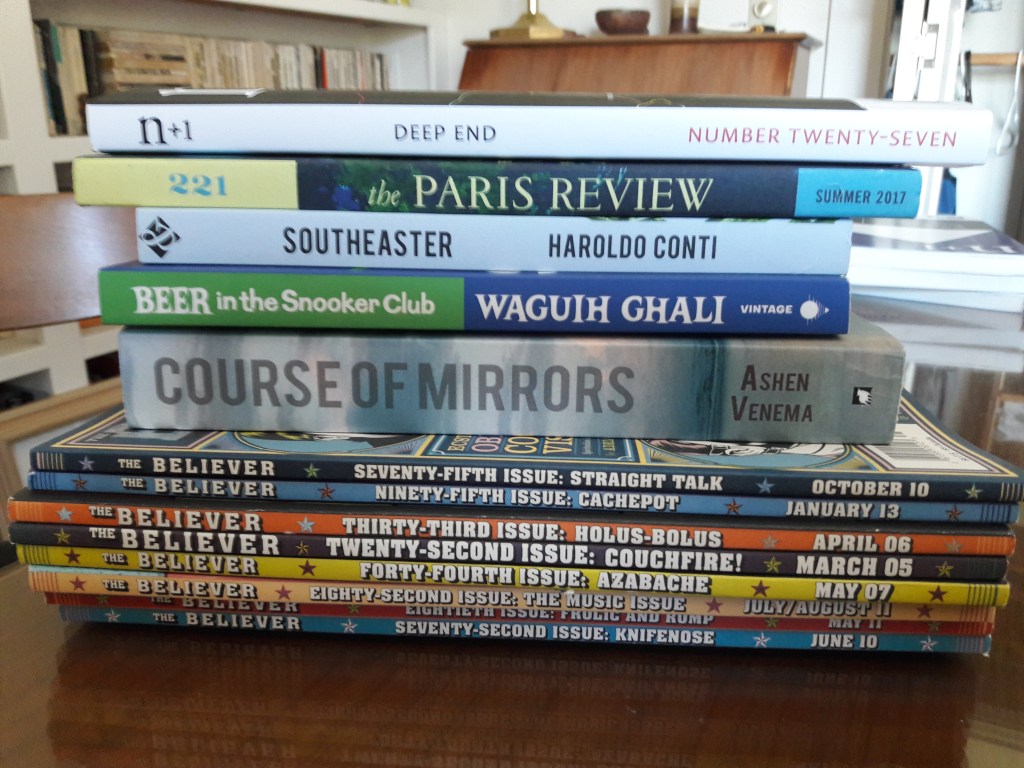
    Course of Mirrors (Ashen Venema); Beer in the Snooker Club (Waguih Ghali); Southeaster (Haroldo Conti); Envoy and Ward’s Fool (Caleb Crain)

    I was cured a couple of years ago of making unsolicited reading recommendations. Having pushed a couple of suggestions into the hands of a suspecting neighbor, who initially faked appreciation but later made me realize he despised being told what to read, I decided to relax into my own reading and leave well enough alone when it came to the reading or non-reading of others.

    I remind myself there are books I once loved and re-loved I’ve since dropped into the free library share box on the corner, always full of suggestions of what we might read. Likewise, there are books I once started reading but could not “get into,” as the old reading saying goes, but on a later look did fall incomprehensibly in love with, which is to say reading is not always placed before, but sometimes after. Before or after what? Something draws us to a text – what? why?

    In any case, I’ve decided to talk a bit of some recent readings. A book review, mind you, is not the same as a book recommendation, nor is it the same as a kind of what “I’vebeenreadinglately.” Nick Hornby used to write a monthly column for the Believer magazine called “Stuff I’ve Been Reading.” At the top of each column he listed “books read,” followed by “books bought” [during the month], discussion following that may or may not cover all the books read in any kind of traditional review. It was a personal reading column. I enjoyed it, and always went to it first, to see what was there, even if I but rarely followed up with reading the books myself. The lists may or may not have matched, usually did not match exactly. Also in the Believer, Greil Marcus contributed a monthly column called “Real Life Rock Top Ten,” a personal Billboard of his monthly music experience, a perfect column, a ten paragraph countdown full of Greil’s unique style where Edmund Wilson takes over “At the Movies,” talking about popular music not as sub-culture but as the culture, which means it can be read into, in to, too. I don’t know if Hornby and Marcus are still writing for the Believer, my subscription of a few years having been let lapse. It now appears the old Believer, out of San Francisco, is giving way to a new life at Black Mountain Institute at UNLV.

    My reading experience with Ashen Venema’s “Course of Mirrors,” a book of contemporary mythical fantasy, a coming of age story, a memoir disguised in allegory, was enjoyable. Sometimes, a reader must let go and simply read what’s there and stop underlining and marking up the text with marginal notes as if he too were going to write something brilliant in the Believer. That is called reading for enjoyment. I remember reading somewhere Harold Bloom saying he never underlined or marked up a book, he remembered everything, he “internalized” the text as he read it. I have to read up and down, back and forth, settle in and settle up, spend time in the dictionary, if not in the loo.

    Maybe readers enjoy books most they discover on their own. Lists, which can be useful, lead to argument. Rely on the list in that link, for example, and you’ll miss Henry Miller and Jack Kerouac. There are lists and anti-lists, counter canons, counter intuitive lists. Good reading is often subversive to one’s own assumptions and preconceptions.

    Youssef Rakha recently mentioned (in a tweet or at The Sultan’s Seal – I can’t find the reference now) “Beer in the Snooker Club,” which I bought and read. It’s a coming of age story of a mid-century Egyptian who is impoverished by the privilege he’s born into. It’s about identity, alienation, love, and the economic and intellectual frustration of compromise amid what Thoreau called in a different time and place the “quiet desperation” of the lives most men lead. It’s both heavy and light. The setting is Egypt and England around the time of the Suez Crisis. The first person narration is witty and sharp, literary and sarcastic, self-aware and penetrating. The characters are real, the events depicted clearly and with a detached empathy that brings world events close to home and headlines into one’s mailbox. The narration employs styles that mimic without becoming parody – the Hemingway set piece, for example. You see it coming, realize you’re there, but in case you missed it, are given his name. It’s a great book. I’m glad to have read it, and I’m going to turn around and read it again.

    “Southeaster” I first heard about at the Boston Review, where Jessica Sequeira gave a thorough discussion of the book, its setting, author, and times, and with a focus on the translator, Jon Lindsay Miles, including an interview. I might be one of the North American readers Jessica refers to, though I read “Southeaster” not as exotic literature, although I did think of “The Old Man and the Sea” in more than one place, but also I thought of Steinbeck, but I read “Southeaster” as an old surfer might, aficionado of water flow, enjoying the very similar way of being on the water, though not, given the crowds these days, as solitary an experience as Haroldo Conti’s river. This book sat in a stack for over a year before I finally gave it a proper reading.

    The summer issue of “The Paris Review’ arrived, with a story by Caleb Crain, “Envoy,” just a few pages, but an extraordinary narration by a first person who lies twice about his age and almost misses the epiphany of a flattery. The appearance of “Envoy” reminded me I had yet to properly finish Caleb’s story, “Ward’s Fool,” in the Winter 2017, n+1. “Ward’s Fool,” set in some non-specific future, appears to be a kind of phrase writer’s bureaucratese, until another epiphany slowly dawns across another river.

    I enjoyed a beer yesterday late afternoon with a few colleagues from my past. Not fiction readers by vocation or avocation, they were nevertheless aware of my “Penina’s Letters,” and had even read the Amazon reviews, and had perhaps glanced through the “look inside” Amazon feature. I was not offended, but happy they had showed any kind of interest, shared any kind of mention. I thought of audience and occasion and the discipline of respecting both. Marketing can at times rival literature for its subversive practices. The marketing of literature might be doubly subversive.

  • Ashen Venema’s Course of Mirrors: An Odyssey

    As we begin our trip with Ana, leaving her teens and moving from a self-renounced medieval privilege to her own renaissance, we get the feeling she has no interest in becoming the subject of some troubadour’s love song or any knight’s lady waiting in a fortified manor house for her man to come home with the meat and mead. She’s interested in neither shame nor honor. The holy grail of “Course of Mirrors: An Odyssey” is a story of one’s own. This is not your mom’s fairy tale.

    A medieval mystery play, a miracle play, directed by an evil Preacher, brings Ana a quick and unwanted celebrity. But the Preacher is a vaudevillian, the sacrifice, like the Catholic mass, intended to be bloodless. Fine, Ana wonders, but what was his plan for her if she was not to die? And something about the Preacher, his looks, his bearing, his power to pander, attracts Ana. We don’t always want what’s good for us.

    We are on a rogue adventure in a picaresque tale where disguise and subterfuge are necessary and ordinary. Ana dresses as a boy, learns to live off herbs and small animals from her mentor Rheine, and, in the course of their travels and travails, embraces a realism rooted in the fairy tale. For example, now hiding from her mother now searching for her girl disguised as a boy, in the hold of a boat where,

    “Far too many horses, mules, sheep, goats, fowl and pets were cramped together with hardly any ventilation. The sickening stench of urine and droppings eventually defeated me. At daybreak I retched and escaped onto the first deck. Bent with pain, I was violently sick over the railing, onto the oars below.” Also realistic is the humor; Rheine says, “I’d an inkling your night would be disagreeable.”

    The miracle play motif is picked up by a traveling theater troupe: “Rheine had squeezed my hand on occasions. The irreverence brought to the miracle made us simultaneously cry and laugh with the audience. Humour softened my bitter memory. I told myself that the saint business was a mob dream.”

    But we are as quickly brought from a saving humor to a murderous reality: “People and animals thrashed in the water or floated lifeless in the wake of the burning…The men pulled three bodies into their boat and attacked the rest with oars. They pushed the living underwater to their deaths.”

    In the space of a few episodes, then, we are caught in our runaway’s fallopian fall from innocence to experience, pushed by a stubborn insistence on an existential rebirthing, from parental expectations to a daughter’s commitment to freedom. The contemporary allegory may have its roots in the counter culture movement of the 1960’s, when costume and disguise, stage renaissance fair updated with hallucinogenic lighting, pretend sacrifice, and children on the run from the neurotic, war damaged psyches of their parents figured out new ways to live and tell the old stories.

    In any case, the future is never far behind, where our decisions have consequences. This is time travel, in the form of foil character Cara’s journal: “A handful of us are perched on the flat roof of a skyscraper; I can’t see the faces of the people with me, they are strangers. The tower sways like a ship tossed about in an ocean, climbing a rising wave, only to plummet. The tower tilts. I slide and cling to the leaded rim of the flat roof. There is a sudden lurch.” Cara’s time altered mirrored narrative within a narrative both clarifies and complicates Ana’s predicament as the plot unfolds like a house of falling playing cards. The story’s movement is metallic, its setting competing communes, its joy food and drink, its darkness plague and plundering and penury, beggary and politics. Its themes include independence, movement and flow, archetypal psychological imprints: the quest, journey, river, the map; loveless marriage and surrogate parental forces and mystery births; instinct and intuition, magic, alternates – including love and sex and the confusions one brings to the other.

    The writing style moves with the themes. Some of the descriptions are like Hieronymus Bosch paintings, people burning in fires, drowning, children screaming, animals too, faces hiding in the brush. As our heroine prepares for her first kiss, though, the writing changes to the lavender prose of a teen romance novel. An entire chapter is given to what becomes the disappointing epiphany, where the “peeling” of one’s clothes reveals a plush orange that screams when split. She gets used to it, but then the prose turns to the stark realism of relationships: “Naivety is a curse. Crushed like a rose and tossed into the pale remains of a fire, I was of no use, not even as fuel for kindling. I should have asked the river to take me when it offered to.”

    There is an economy to the writing that is expedient, efficient. A history of a people and a land must be told, but so must a personal diary be explained. The narration moves from first person to third person without any introduction or worry. The switch is simply necessary to keep the story moving. And our first person has other ways of knowing, of omniscience. Sentience appears as a kind of hallucinogen usually hidden within things. Perception pulls life force from stone, going forth as well as taking in.

    How serious is all this? First, it’s great fun. And shouldn’t writing, particularly the writing of a novel, bring pleasure to both the writer and the reader? The risk is a flatness, two dimensional characterizations, an animated film, the artistry of which undercuts its own reality. Myth when expanded usually fills with irony. Second, there are borrowings of form from myth and fairy tale that legitimize the atmosphere of magic and fantasy. But it takes a great leap of imagination to enter an invented world open eyed, to pretend even after all pretense has been lost. But this is the writer’s explanation of things, of life, of a life, anyway, this book. In some purviews, every thing must be explained. So the mechanical pencil might come to explain safe sex.

    Of course sex is not to be mistaken for love, or the prostitute would be out of business, but does the withholding of sex from one’s willing marriage partner signify un-love? Ana is consumed by the adults in her life, ignored or suffocated, and suffers from the only child curse, which requires the fantasy playmate so she’s somebody to talk to. From the pretend playmate the child learns mimicry. The playmate passes on the talisman. There is a kind of shorthand to the method that results, again, in a two dimensional telling, even though the attempt is a mimesis of the whole. When does the whole break into parts of sentimentalism, and from there to irony? “My poetry, he [Lionel] said, is devoted to the feminine spirit.” Ana responds, a severe critic: “They were bad poems, overly sentimental.” And this only a few pages from sharing Cara’s poem the reader may find sentimental in its longing to find some meaning in the “void.” Later, Professor Ruskin will fill in the blanks. We must remind ourselves the sacrifice was staged. But even a staged sacrifice has consequences. That’s where the repetition comes from. “It breaks my heart that the feud of brothers should repeat itself into another generation. It’s like a curse.” No, it’s not “like a curse”; it is a curse. The curse is metaphor, allegory – but even the language of the physicists can’t adequately explain what we either see or don’t see. All of creation is just that – an artist’s rendition, a depiction, a deduction.

    But the epiphany does come, or comes down, and “she will compose her own song.” A song of one’s own. A myth of one’s own. “I could no longer strangle my voice.” She composes her own poem:

    “I’ll kick your ghost
    out of here – I’ll make no more
    bargains with your fear…”

    But have we instead cut a deal with our therapy? The troupe now performs a parody of the miracle, as if we need reminding it wasn’t a real miracle to begin with. “In the shadow of each mask lies desire.” Desire for what? Power? Or to be used by some mad man’s “mad ambitions?” And what’s the ambition, the obsession, all about? We’re back to teen romance, now darkened with a certain amount of experience: “Unsure whether to laugh or cry, I cancelled my response, flattening my lover’s pleasure.” As if he cares, which might be part of the attraction. By the time we get to Batin’s place, we’re ready for the details of the dark side. We come across “Cults of Ecstasy” and the “pit” of “correction.” Are these bridges to the real world?

    We continue to meet new characters, travel, encounter new adventures. The book is divided into 29 numbered chapters, each divided into smaller, titled sections. There is a prologue and a short epilogue, and useful lists of characters, and a map and a list of places. The lists contain short descriptions of character and place. Time moves back and forth, like eddies in a river. We fall deeper into the encyclopedic epic. We are not out of trouble yet, as the short section “Cockroaches in the hellhole” makes clear. Ana is saved from a “sickening concoction of smells – rancid fat, stale urine, sweat and rum,” and “broken teeth.” Little Snake is a welcomed if late well-developed character. Cassia appears. We discover what “dissolves a curse,” and what it’s like to make love “truly naked.”

    What gives shape to a life drifts off with words. We close the book, glance up, and there we are, again, leaving, looking for something new. Myth is individual experience repeated, over and over again, until it becomes universal and a story everyone understands. Myth is not false news. It’s a way of telling a story.

    Course of Mirrors: An Odyssey, by Ashen Venema; 2017, Matador, 377 pages.