All work is work in progress. Never finished. Brought to a close. Ready for fashion. Finis. Ready to beginnan. Again. How to? Cover up. Conceal the old. Bury. Build over. Incomplete. Partial, patchy: imperfect.
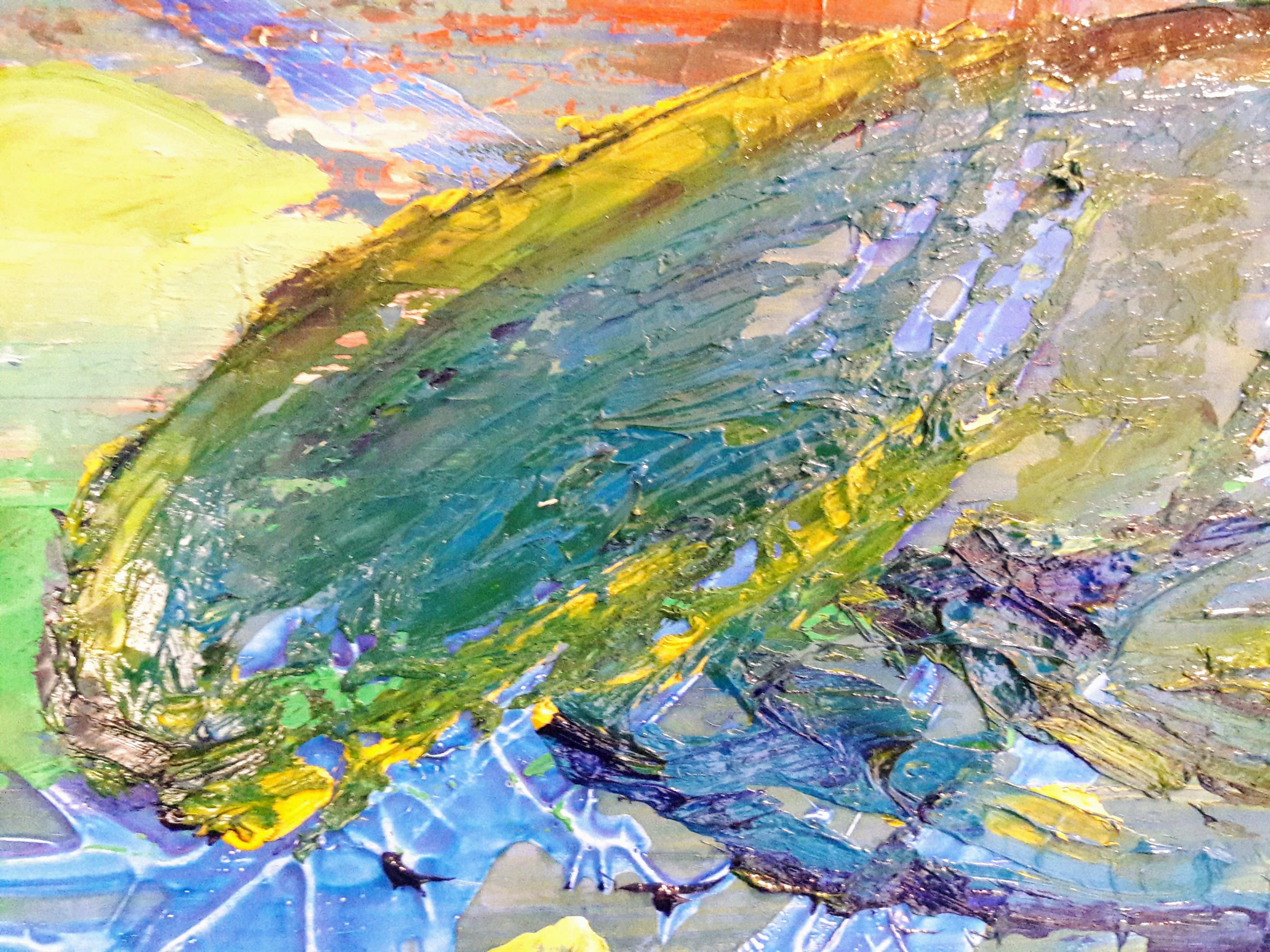
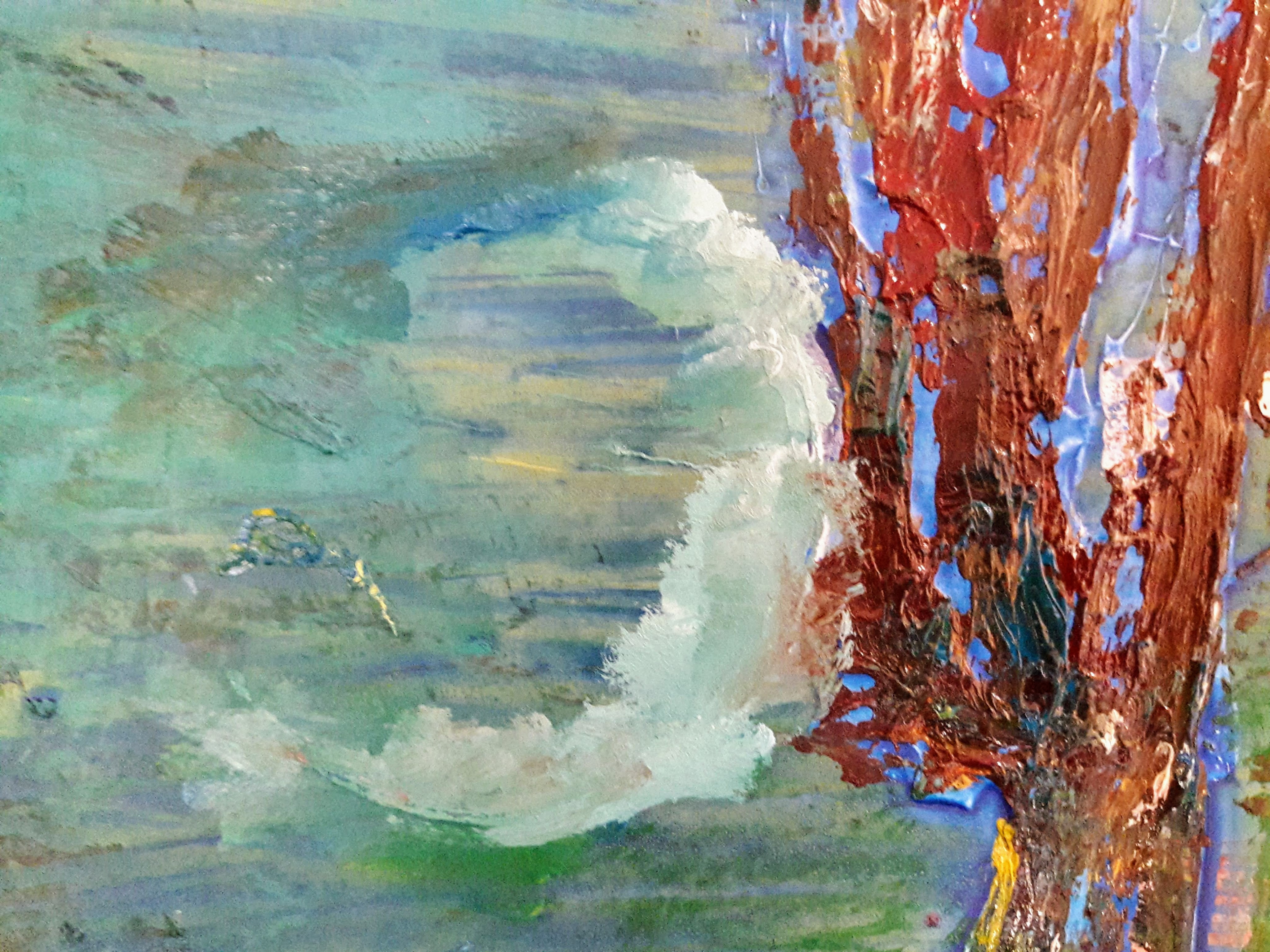
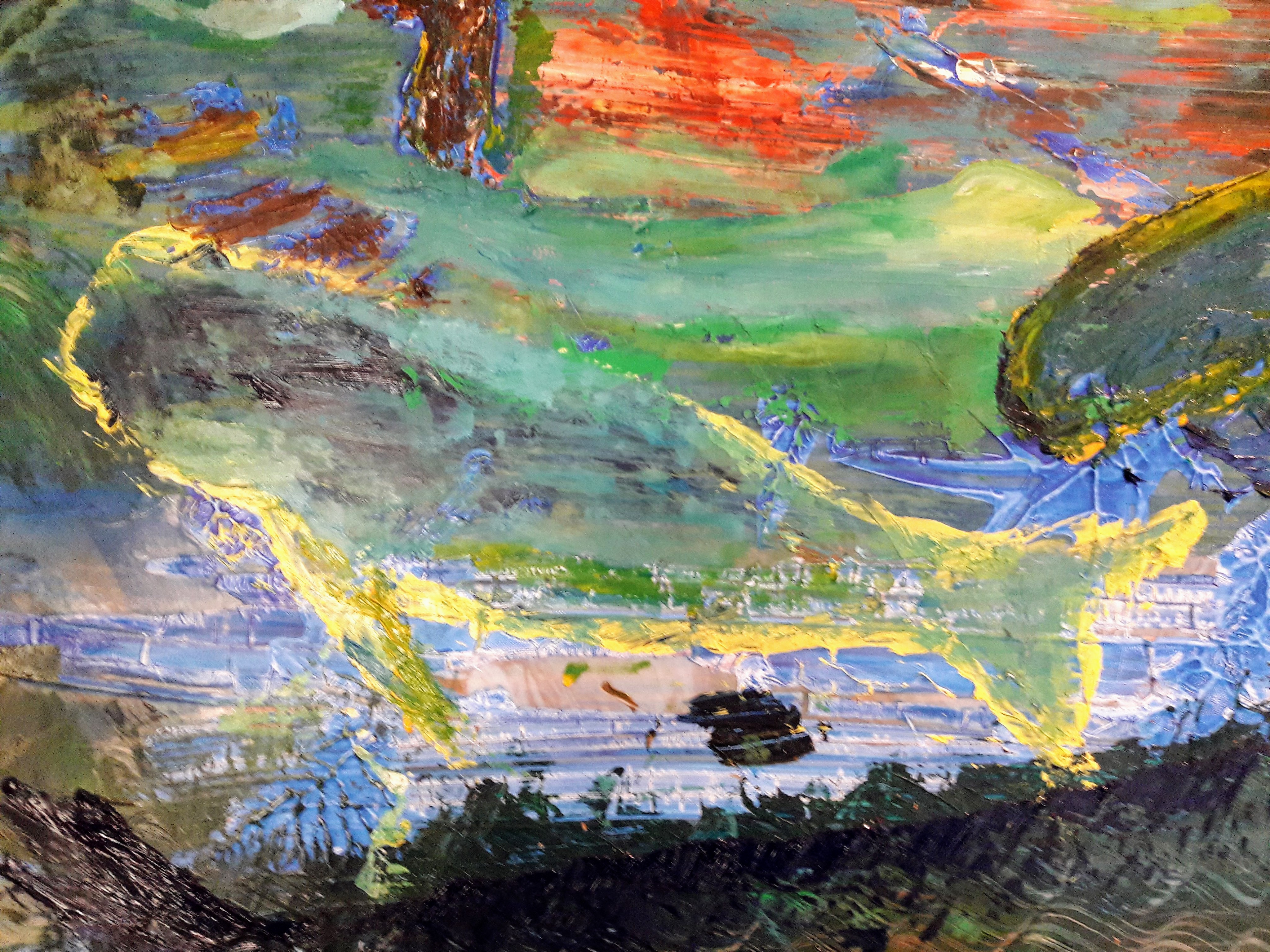
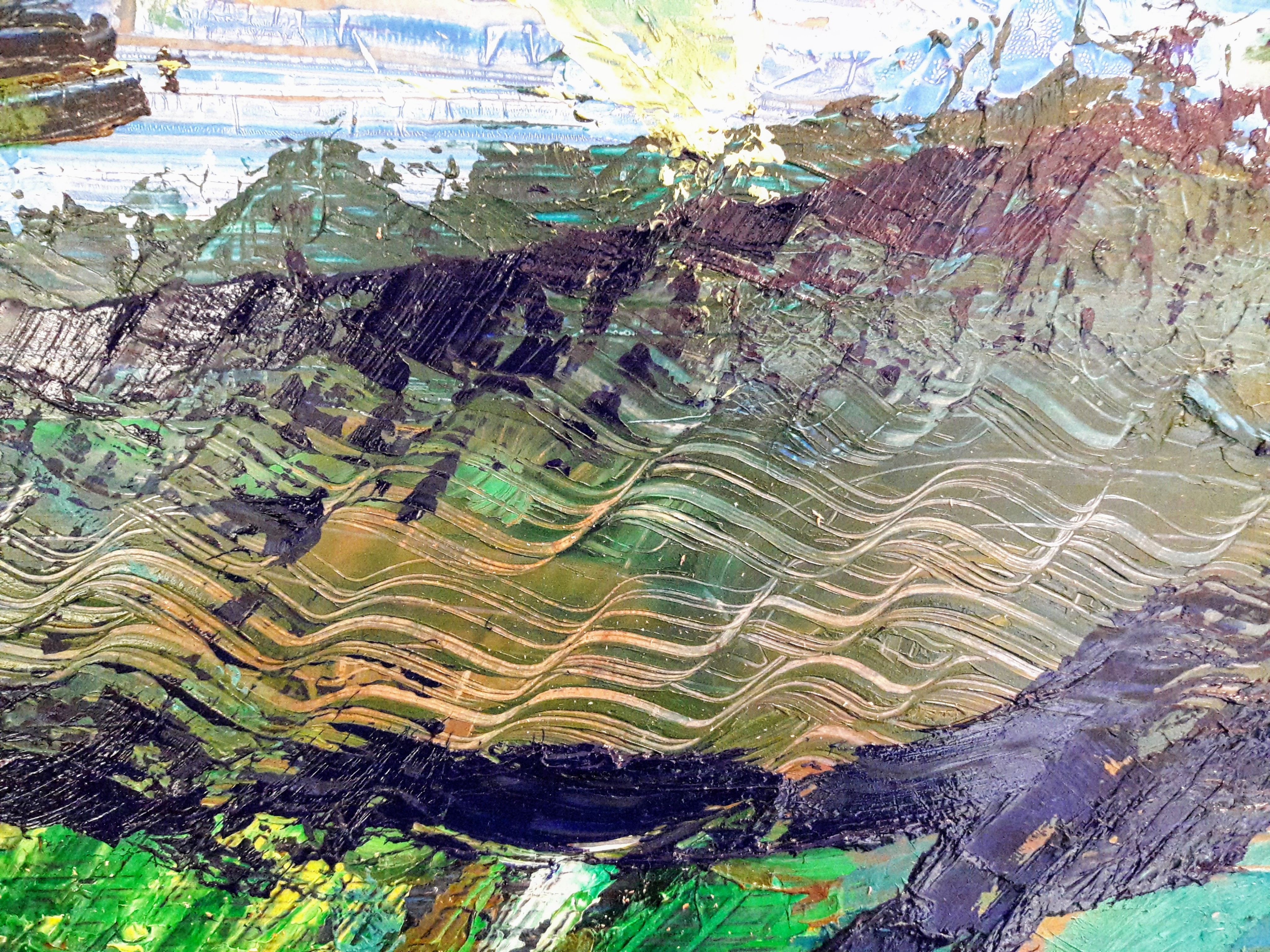
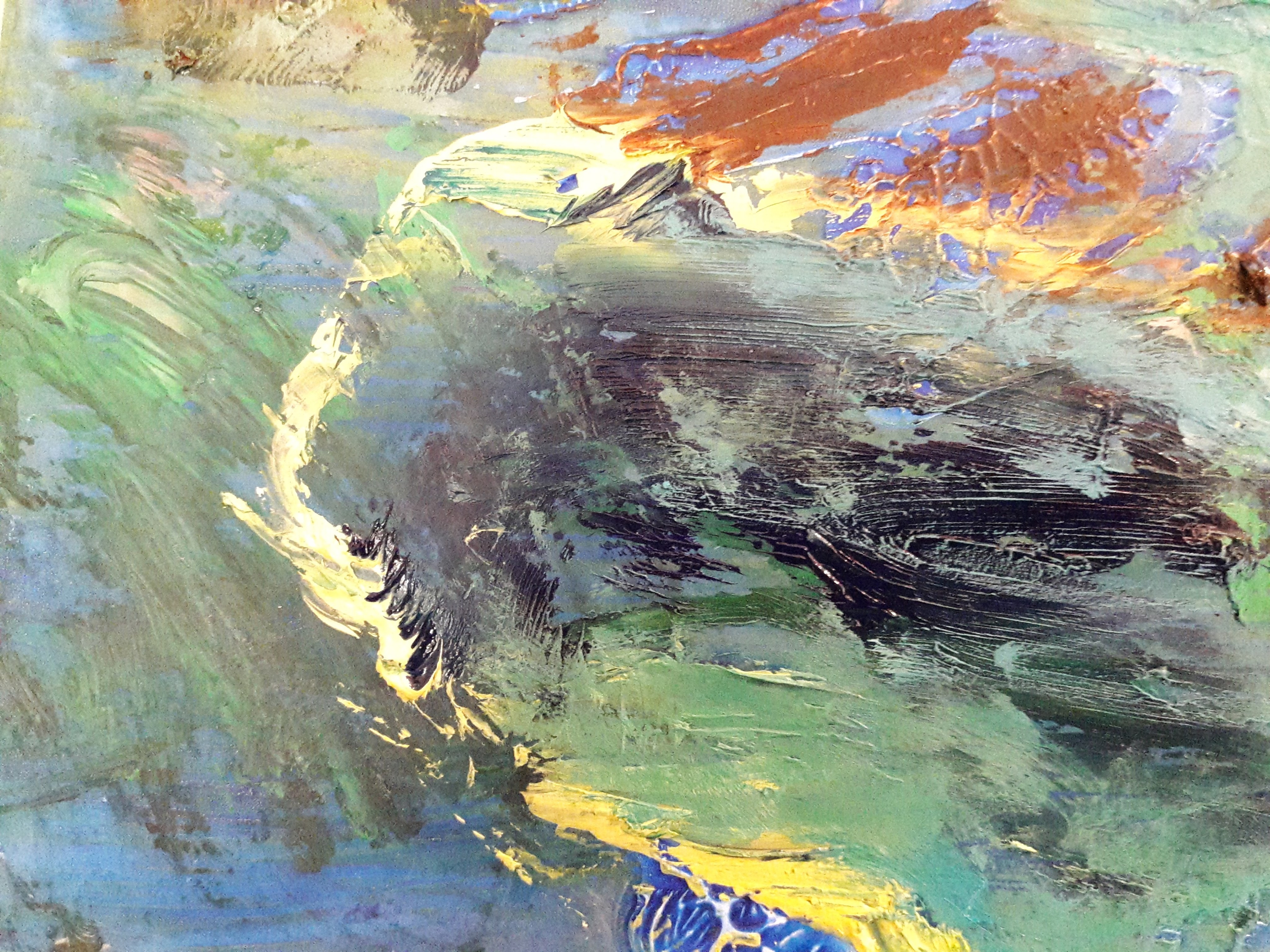
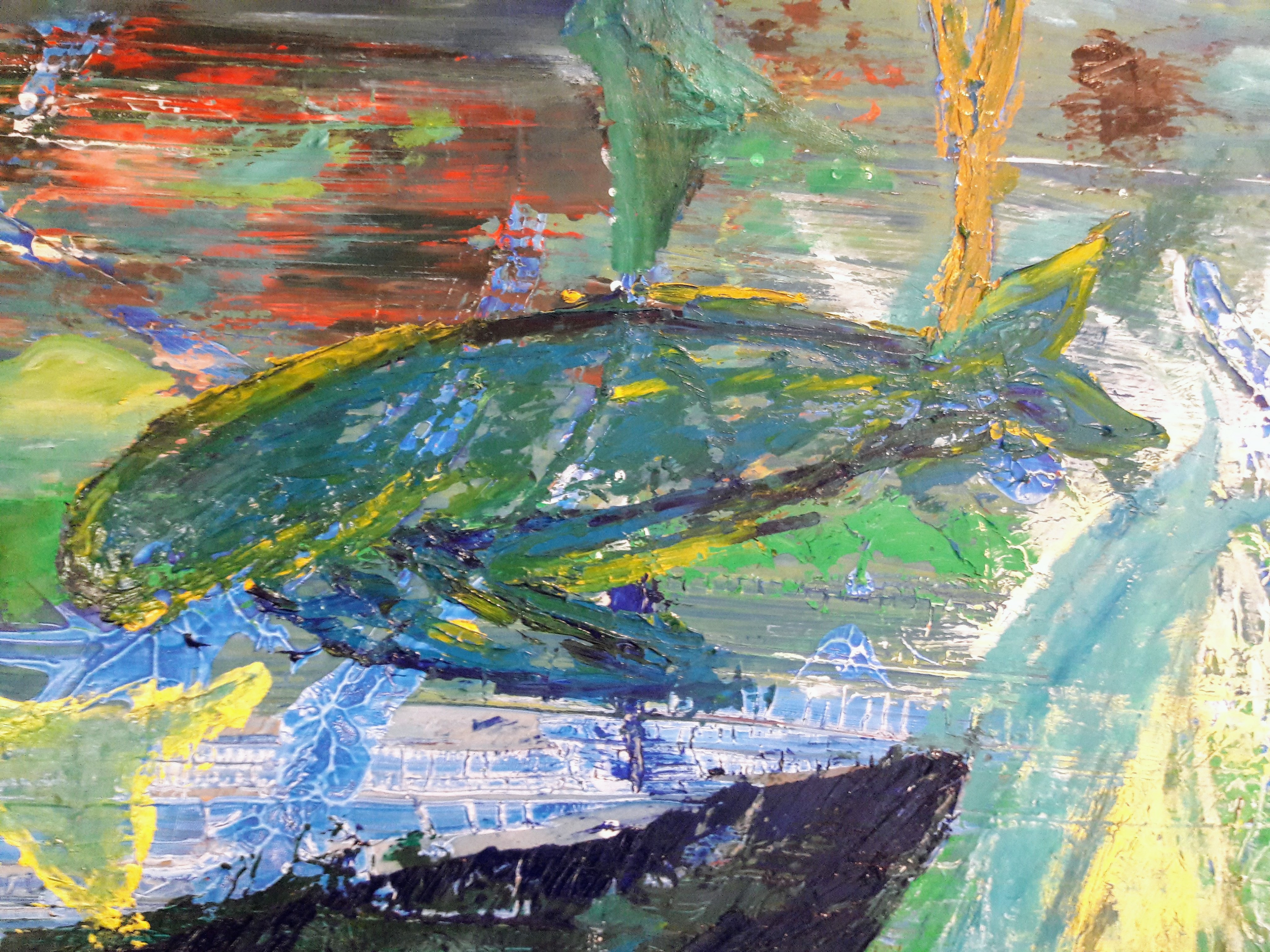
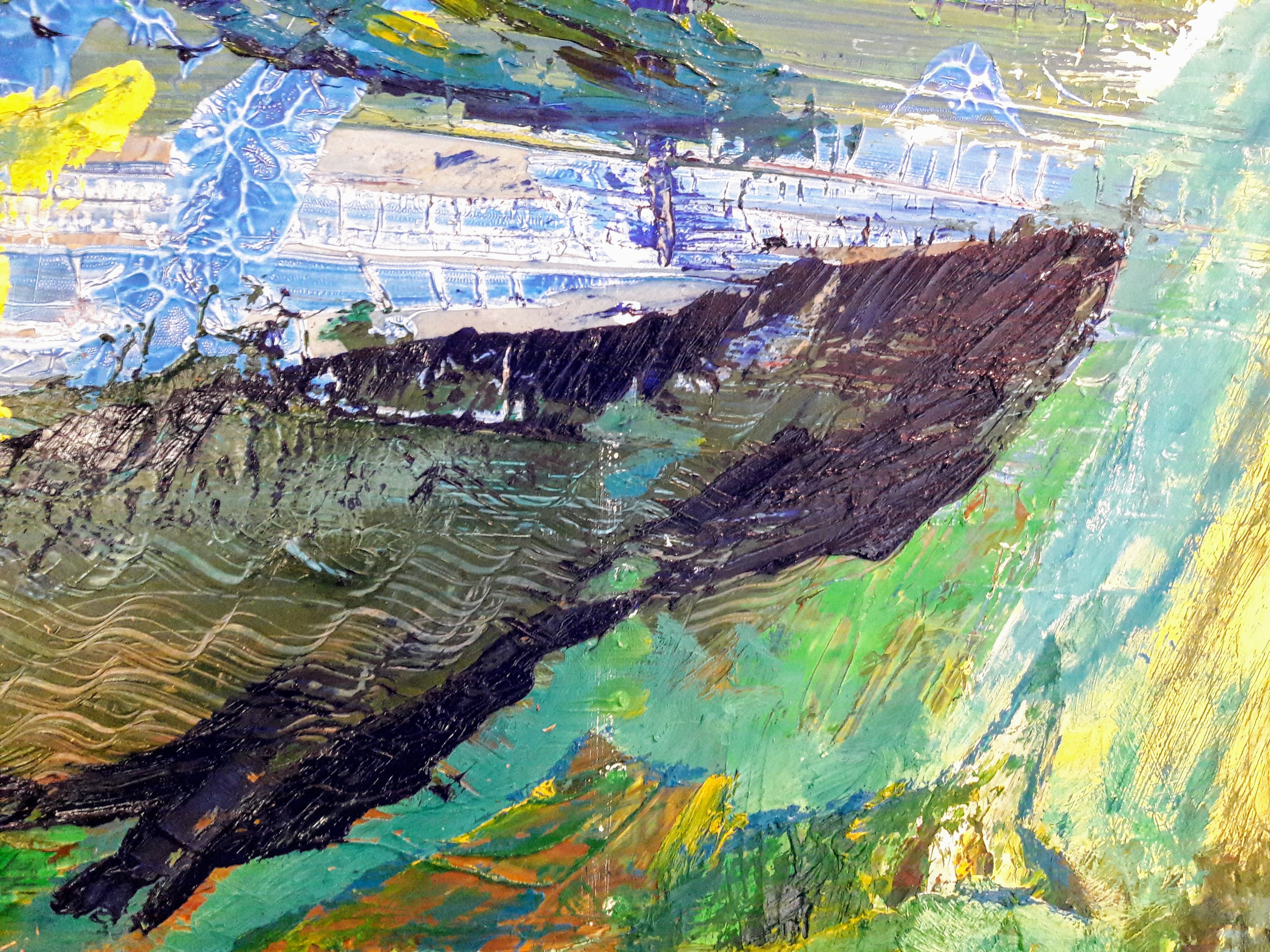
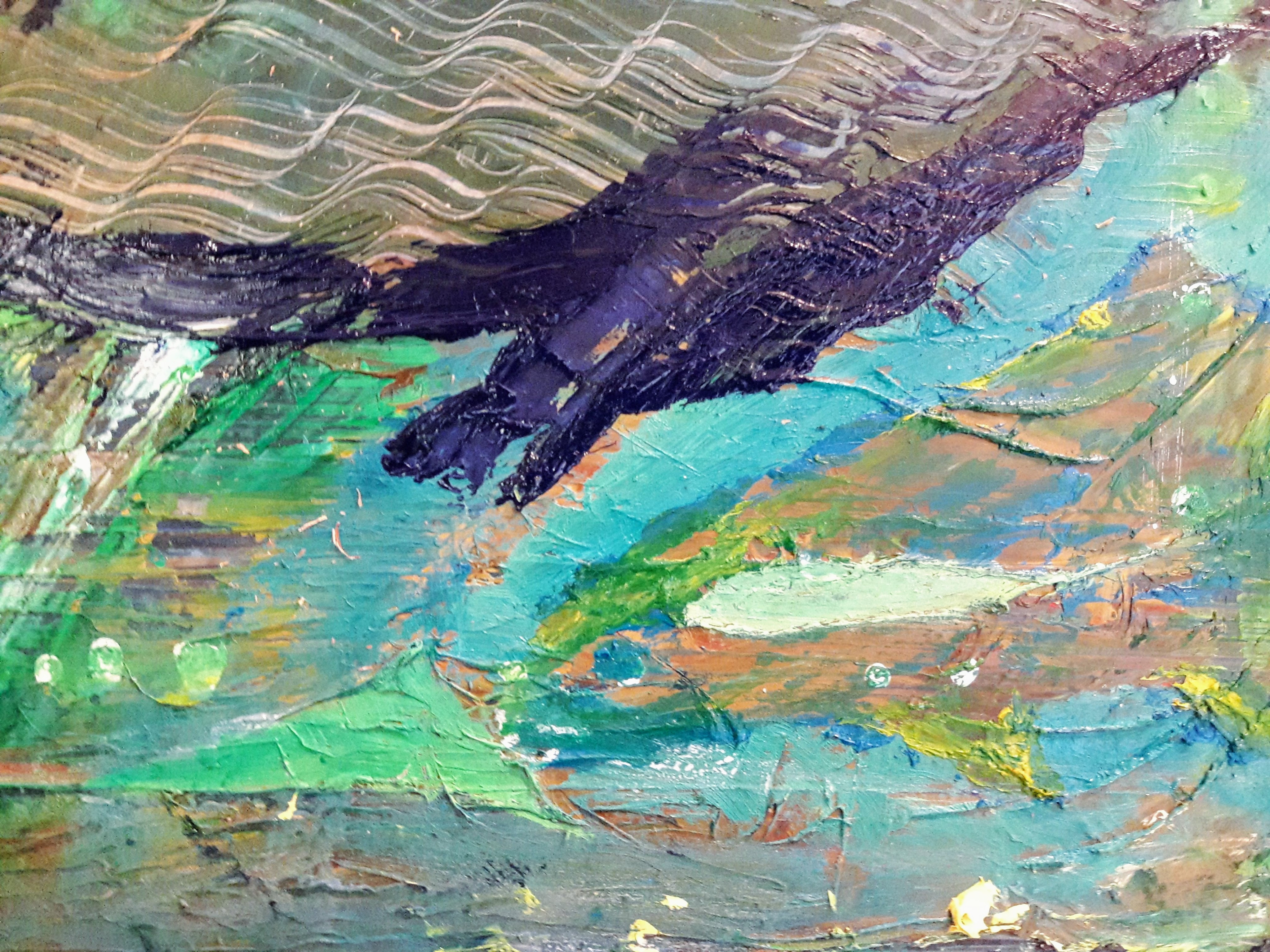
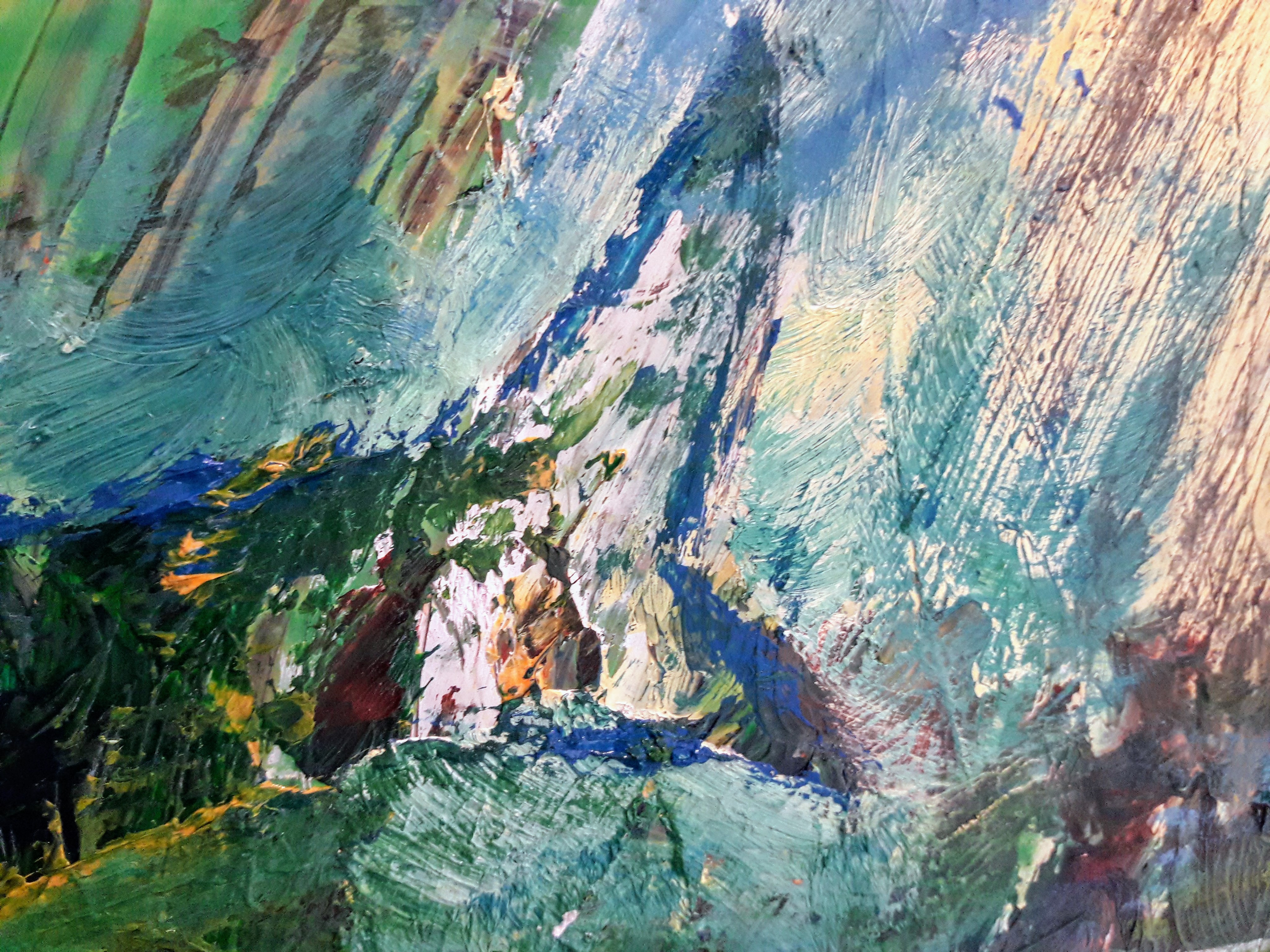
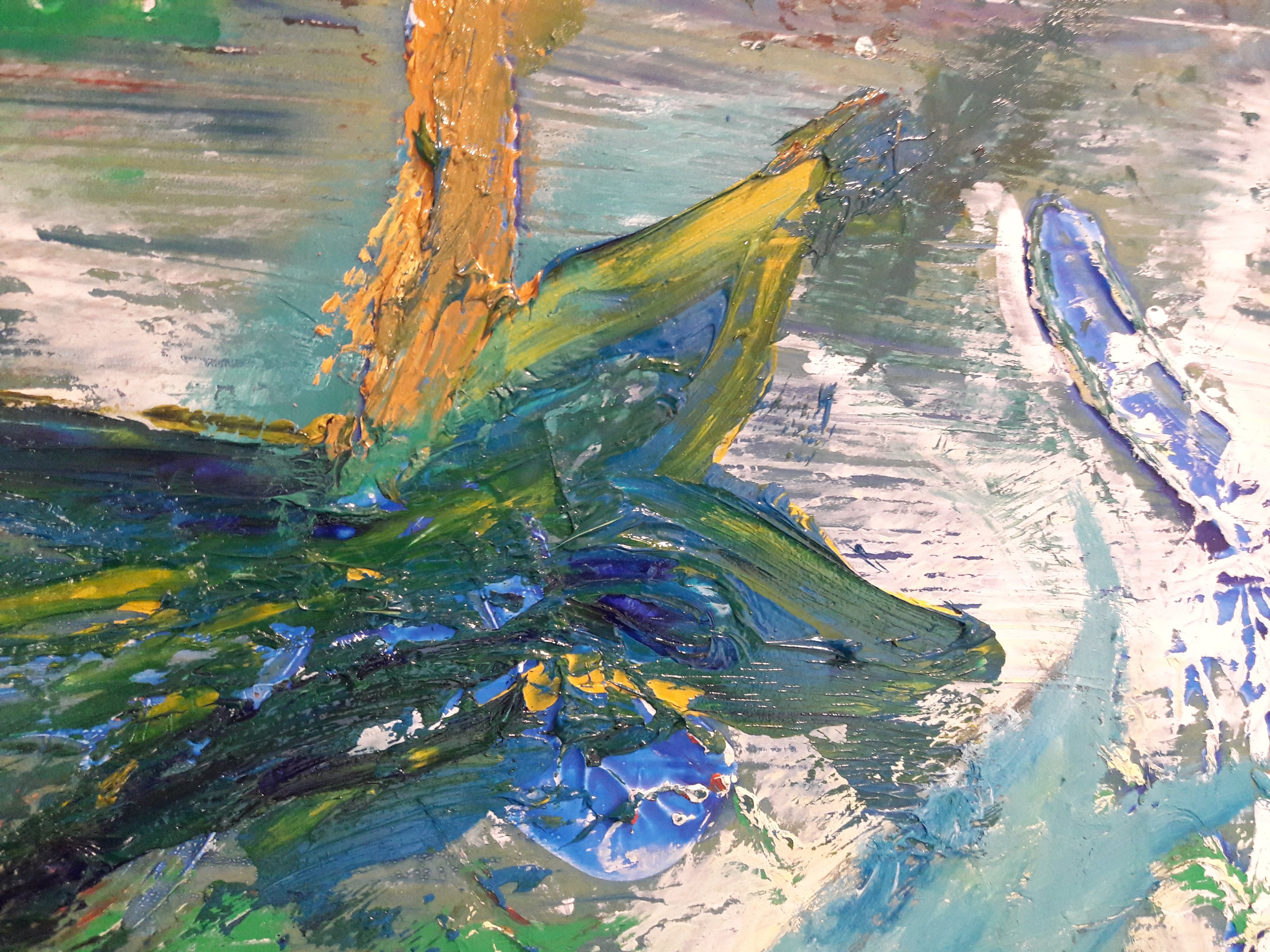
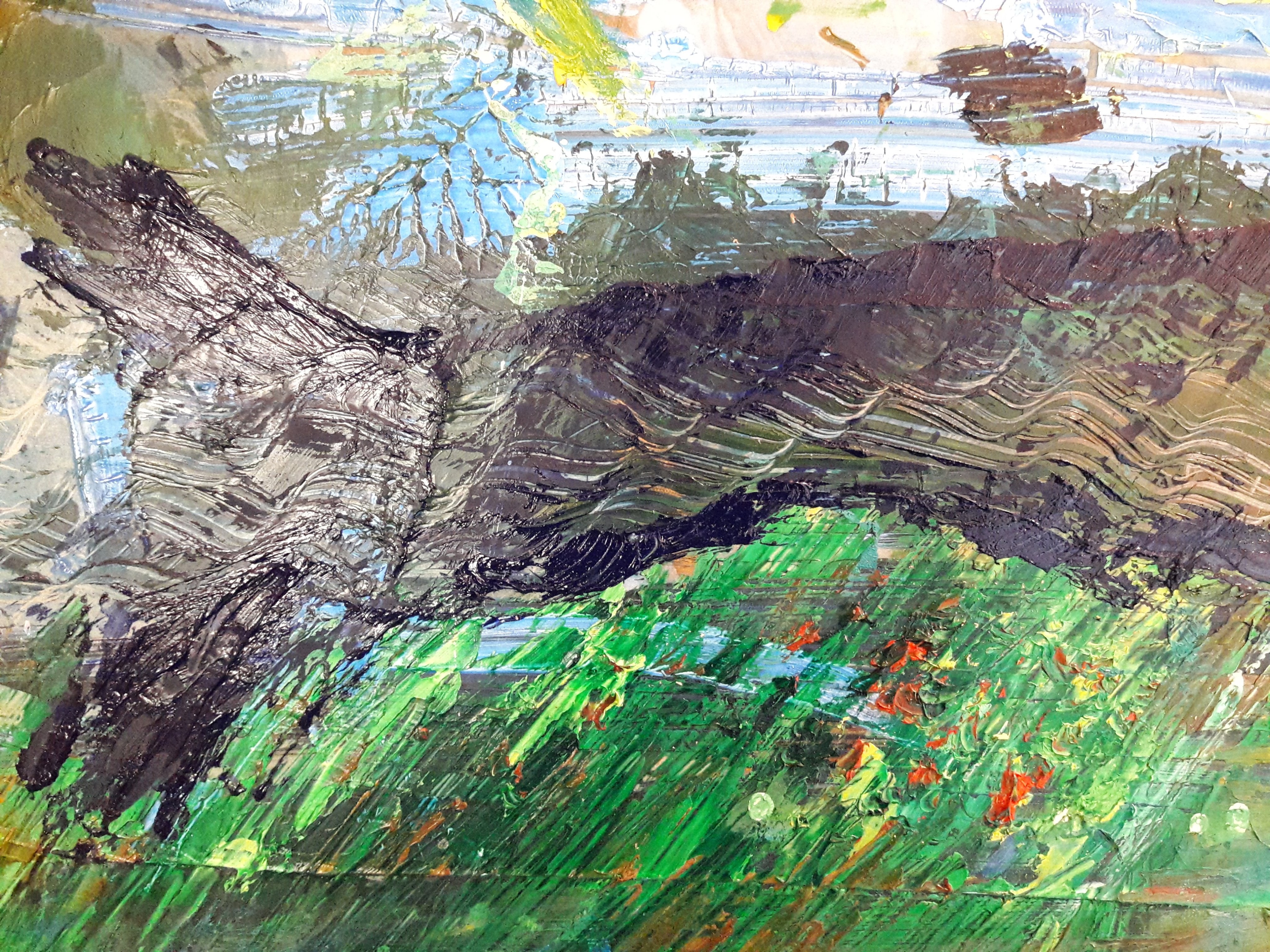
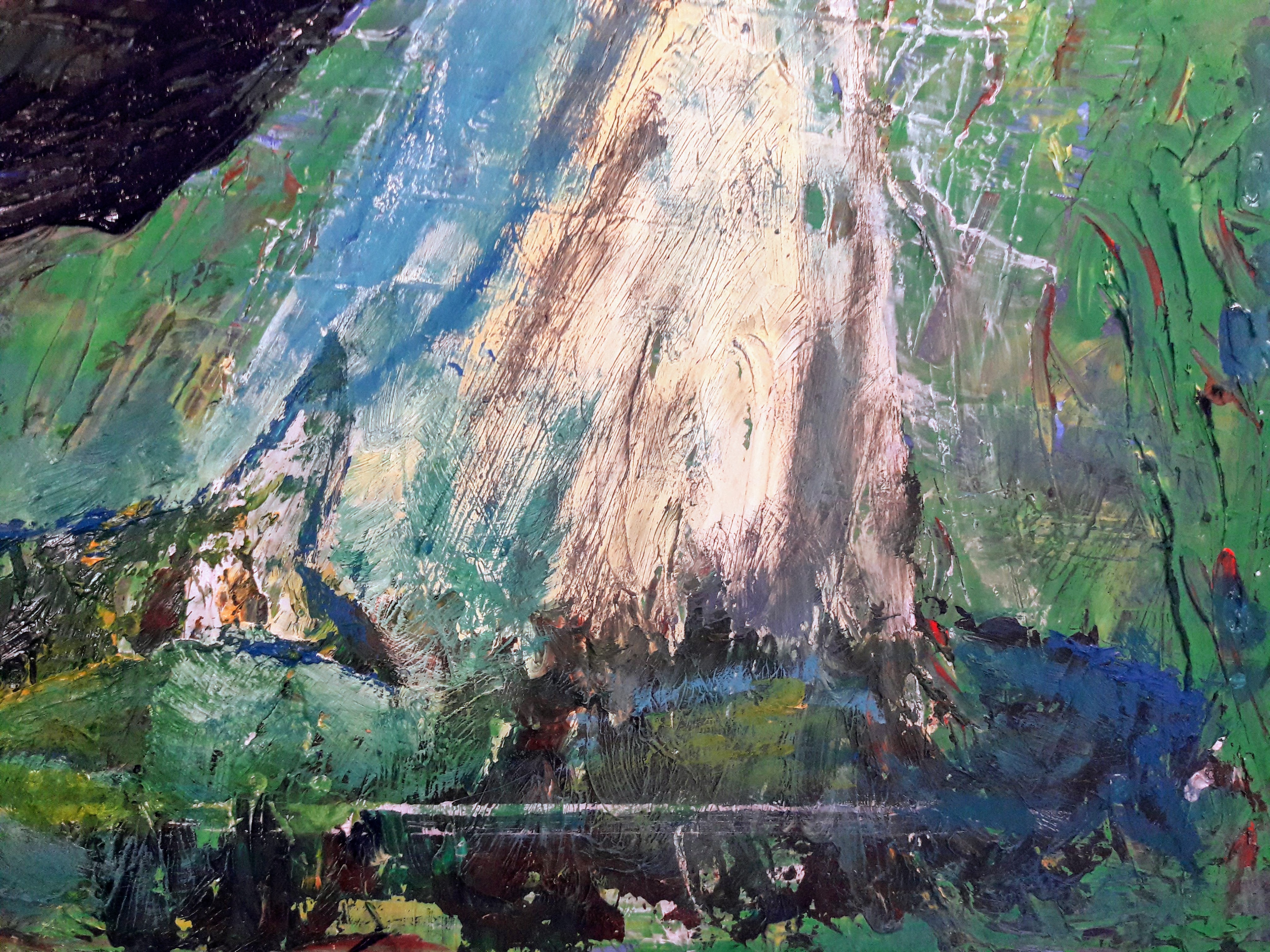
A Notebook – Since 2007
All work is work in progress. Never finished. Brought to a close. Ready for fashion. Finis. Ready to beginnan. Again. How to? Cover up. Conceal the old. Bury. Build over. Incomplete. Partial, patchy: imperfect.
Water based oils on canvas: 40″ x 30″ x 1&3/4″.
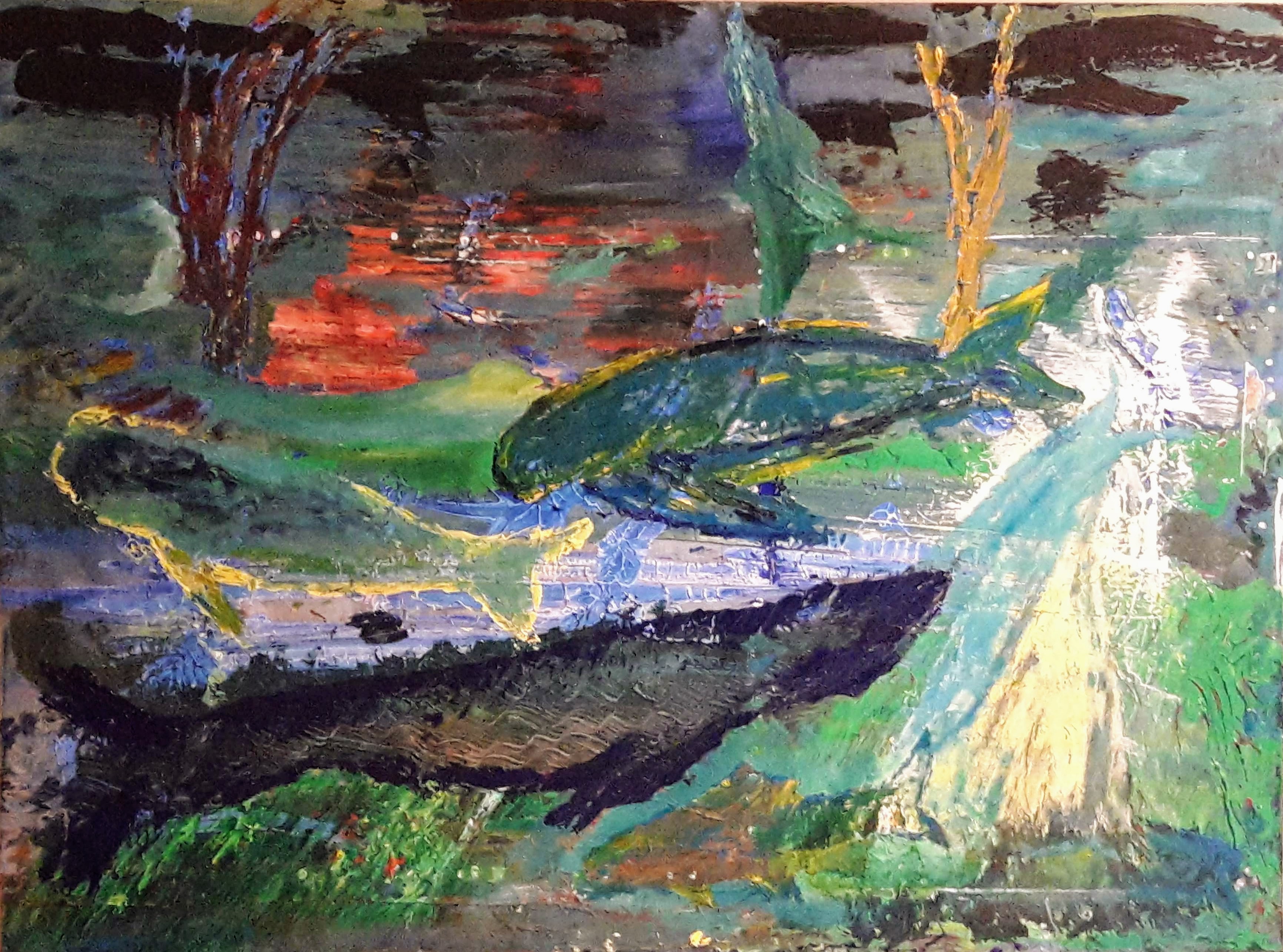
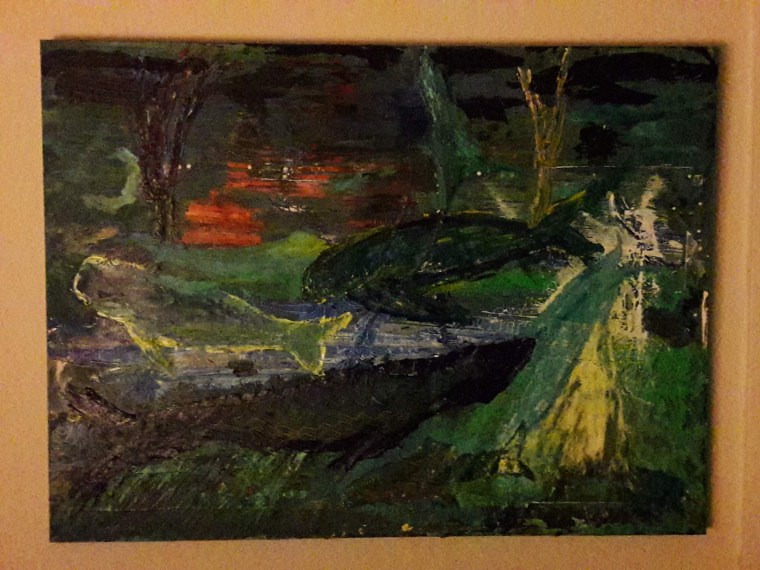
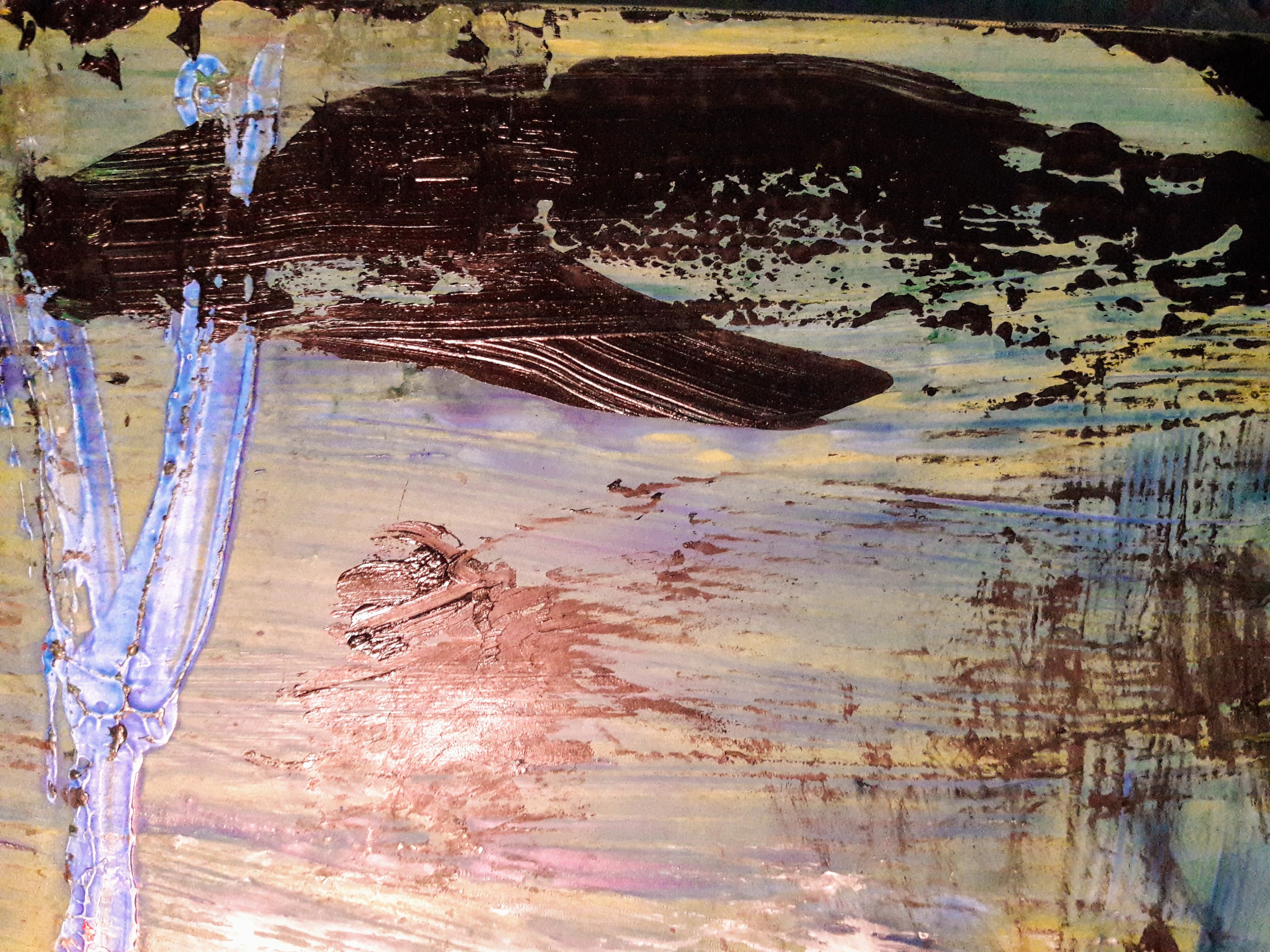
“You are the light
of the world.
A city
set upon a hill
cannot be hidden” (Matthew 5:14).
Not to mention something you’ve put up online. What’s posted online can’t be deleted or hidden. That is the poet’s dilemma, who craves publication but still has changes, or will have. But that is only a matter or problem of print. Oral poetry, or song, allows, invites, indeed wants variations. Covers. Over time, cities get covered up. The earth rises, and falls.
I assumed the Queen Mob’s Teahouse poetry editor position back in April, taking over from Erik Kennedy, Queen Mob’s second poetry editor, from May, 2015, who followed Laura A. Warman. The gig is volunteer work, of course, as befits any true poetic enterprise.
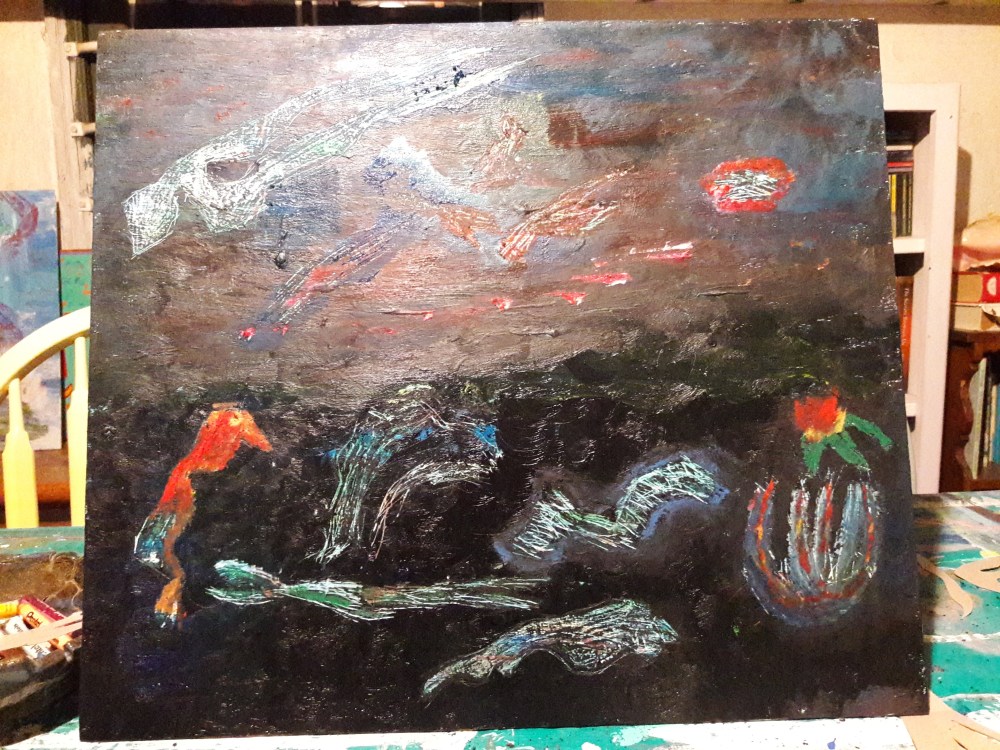
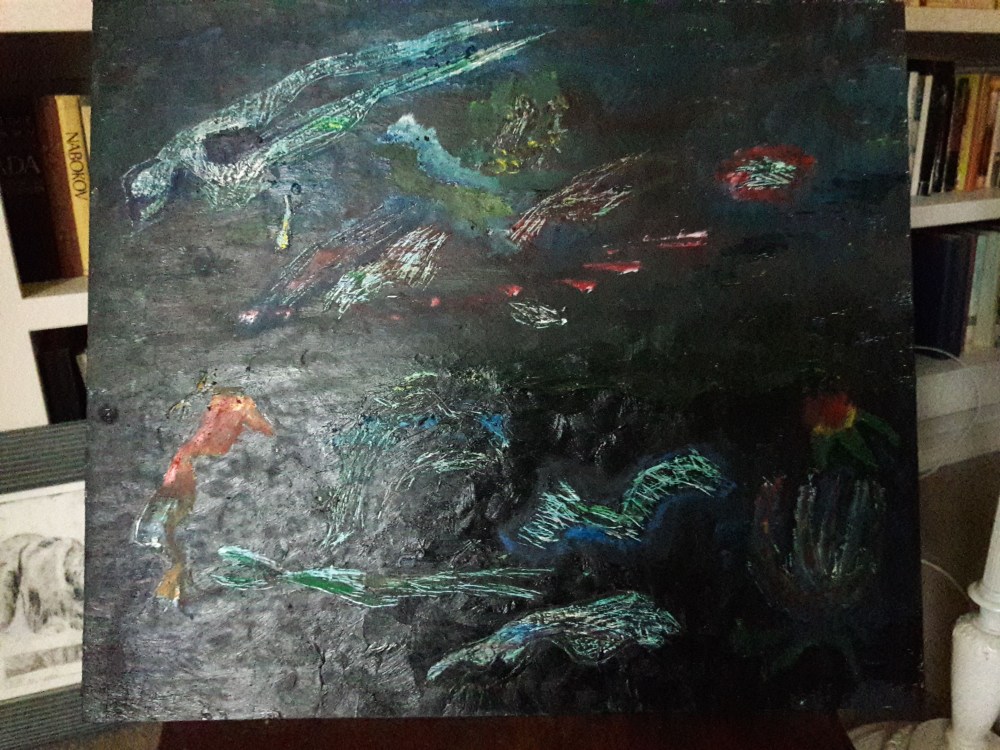
I first put up, on April 19, three poems by Jax NTP. It was then the idea came to me to use my own paintings as the header images over the poet’s work. I was struck by Jax NTP’s atmospheric, impressionistic poetry. The poems are packed with energetic images changing with the speed of “Highway 61 Revisited”:
“there’s a giant temple on hazard and new hope street
from “how to pivot when you’re paralyzed,” by Jax NTP
blue reptile and green mazing skeletons, keepers of time
how long can you sit there with the pain before you try to fix it?”
And I had just finished a painting, the impressions of which, the symbols within, the colors, the shapes, I thought might complement Jax NTP’s poetry. I don’t mean to suggest any of the paintings necessarily align with the poetry in any literal way. In any case, I continued to look for images within my collection of painting pic selfies for complementary impressions.
Reading and reflecting on Jessica Sequeira’s poems, and later looking for a painting to go with the posting on QMT, I again felt the suggestion with impressions that seems the essence of poetry, particularly of poetical delight:
“The heavens have promised rain for so many days.
from “Eastern Variations, style of Ikkyū Sōjun,” by Jessica Sequeira
I think of waiting for torrents from the white sky.
But it might be a long time. Or this could be a dream.
Taking your hand, I guide it below, to my cloud.”
I selected for Jessica’s poems a painting from last year, “City on a Hill,” a large painting that had taken some time to complete. Again, the setting of the poems and the painting seemed harmonious:
“lakes shine like mirrors
reflecting tall mountainsrainfalls are unpredictable
innocent changes in the divine moodbirds sing into great holy spaces
the wind whistles its replyicy glaciers plunge towards sky
from “My South,” by Jessica Sequeira
green valleys dive into earth”
I had taken numerous pics of “City on a Hill” when a work in progress in the basement studio:
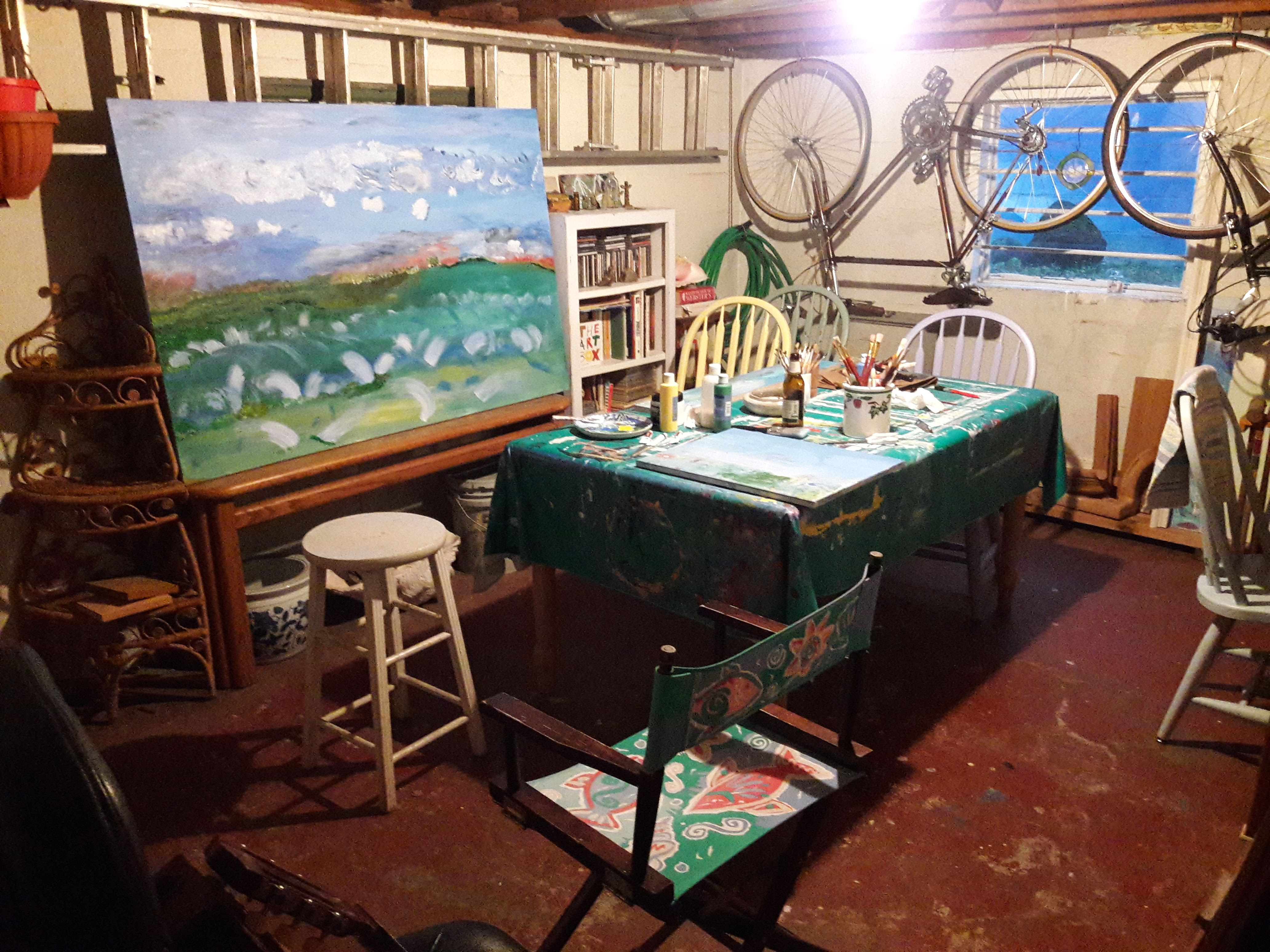
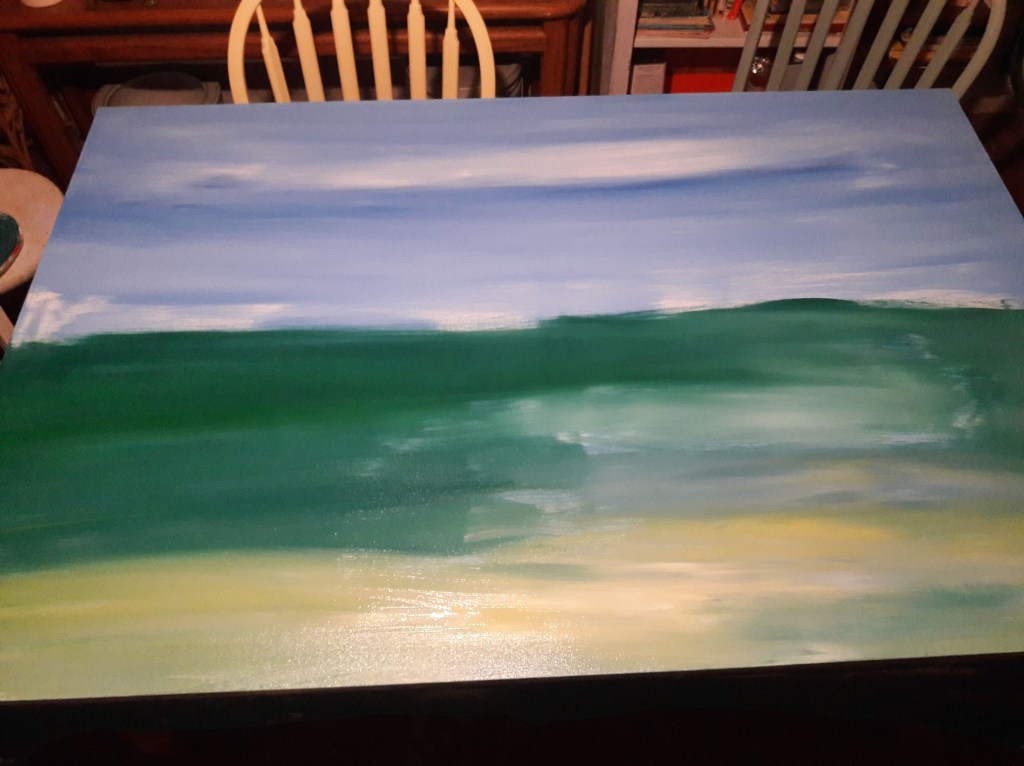
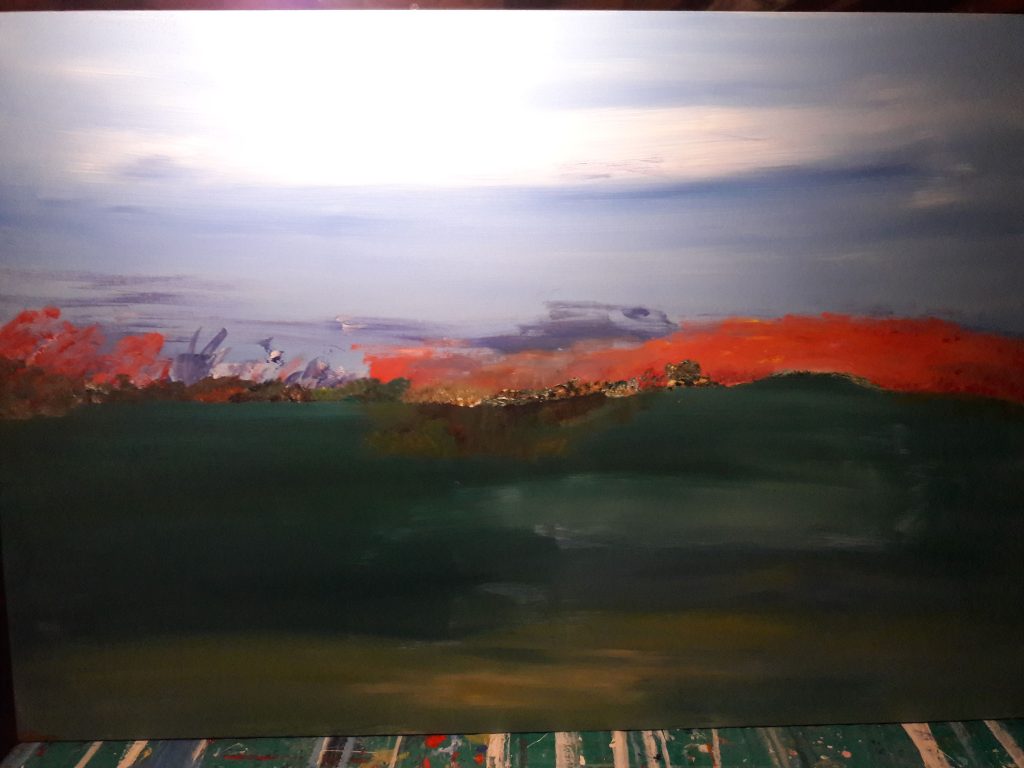
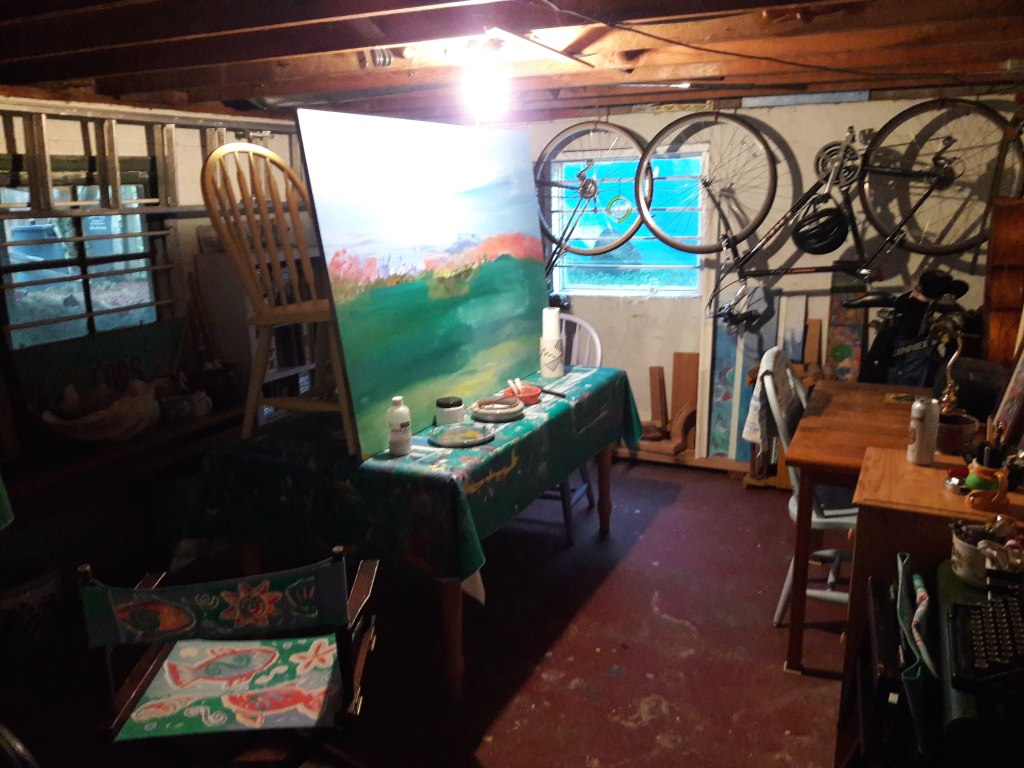
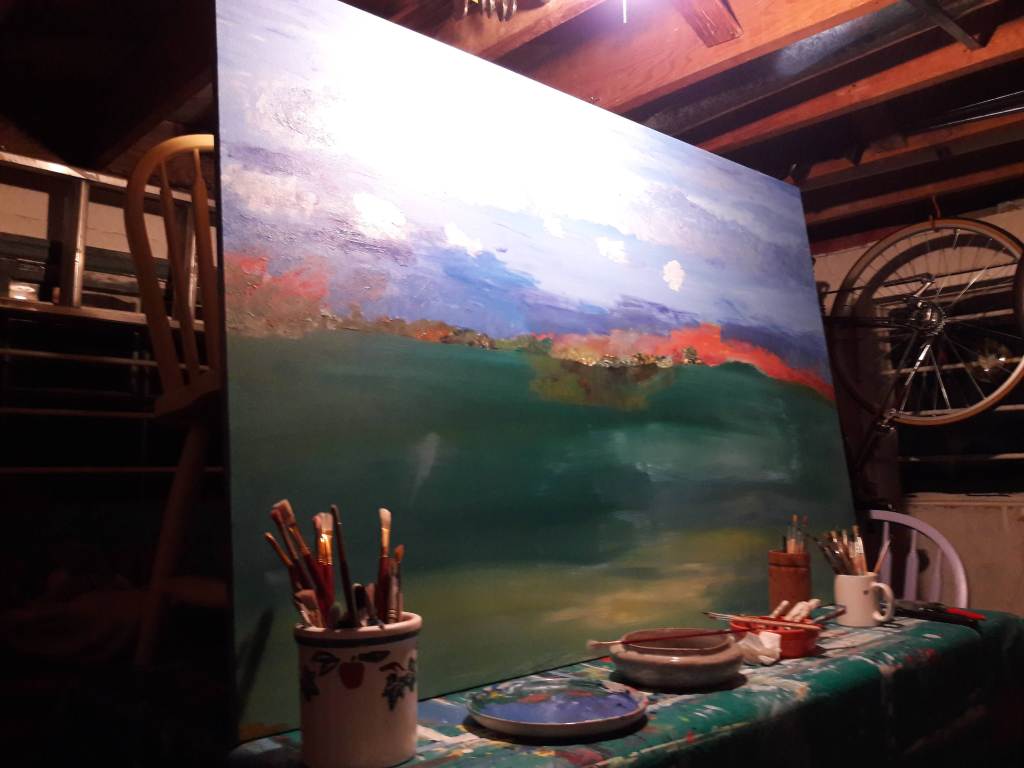
And I used an early draft of “City on a Hill” to go with Ashen Venema’s poetry:
I sit still, watch him thin the oil
from “My Painter,” by Ashen Venema
and restore his long gone love
on canvas, standing in
as the young skin
by the window, sunlit among
lilies, fresh cut, and Persian rugs
casually flung across seats.
Well, the setting of Ashen’s “My Painter,” “sunlit among / lilies,” doesn’t quite align with the basement studio, though things are there too “casually flung.”
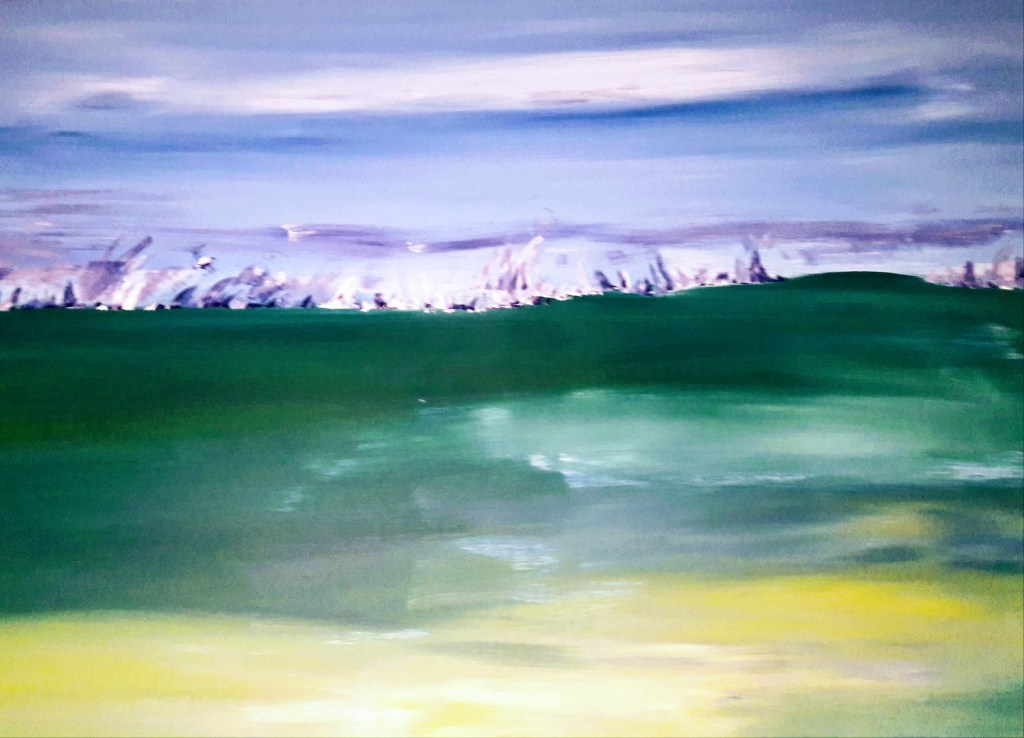
All my paintings I eventually give away, to family, friends, colleagues, who show an interest and enthusiasm. “City on a Hill” is hanging in my daughter’s den, looking out upon the backyard. The light in the room is perfect. I just want or hope the paintings have a life outside my basement, where, as Ashen puts it in “My Painter”:
“A blaze of light rims his white hair
from under his thick swirl of brows
black humour hides, and surprise”
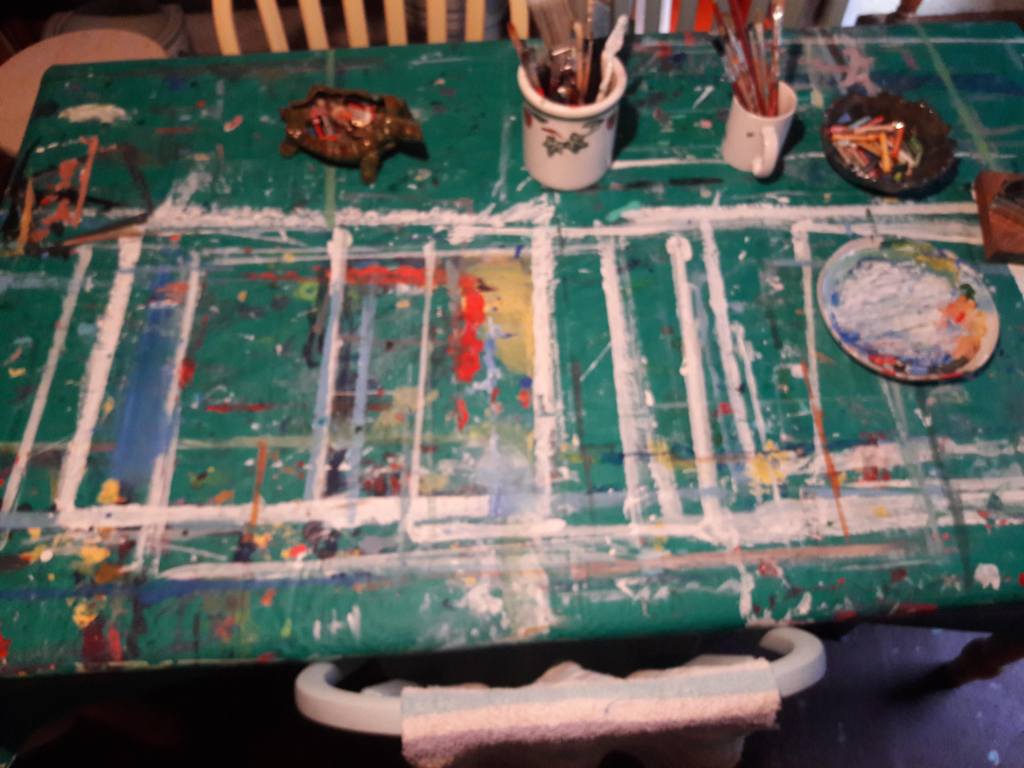
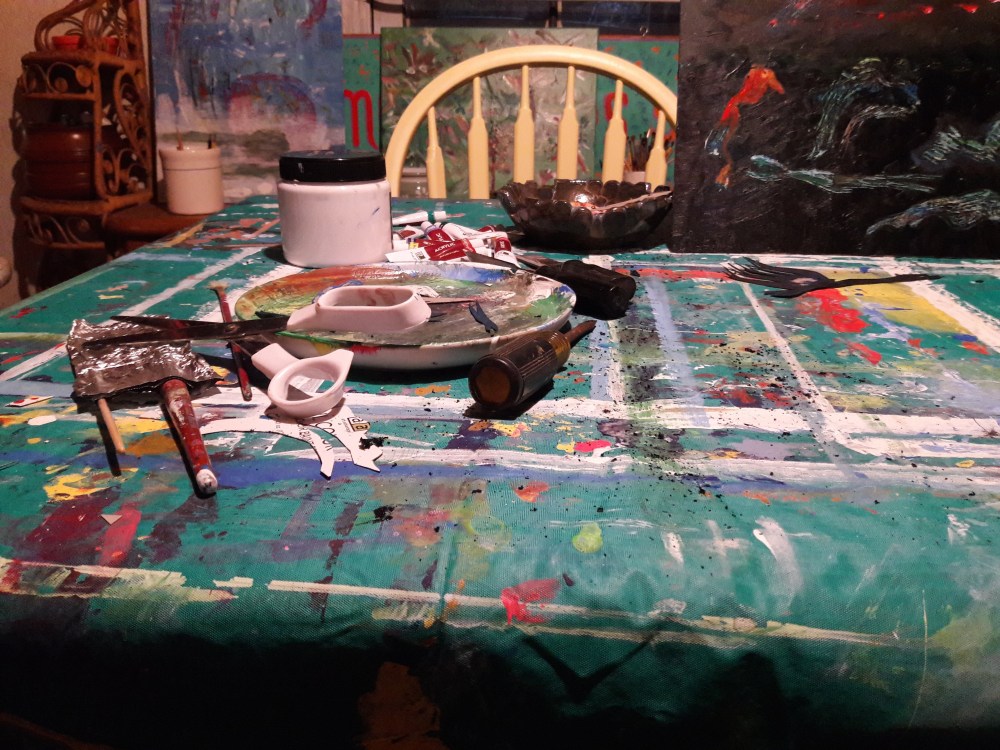
After all the work on a painting, which isn’t really work, of course, but play, like the work of much poetry, we just might find a true work of art in what we’ve mostly ignored, in the mess we left behind. That tablecloth, for example, now that’s a work of art!
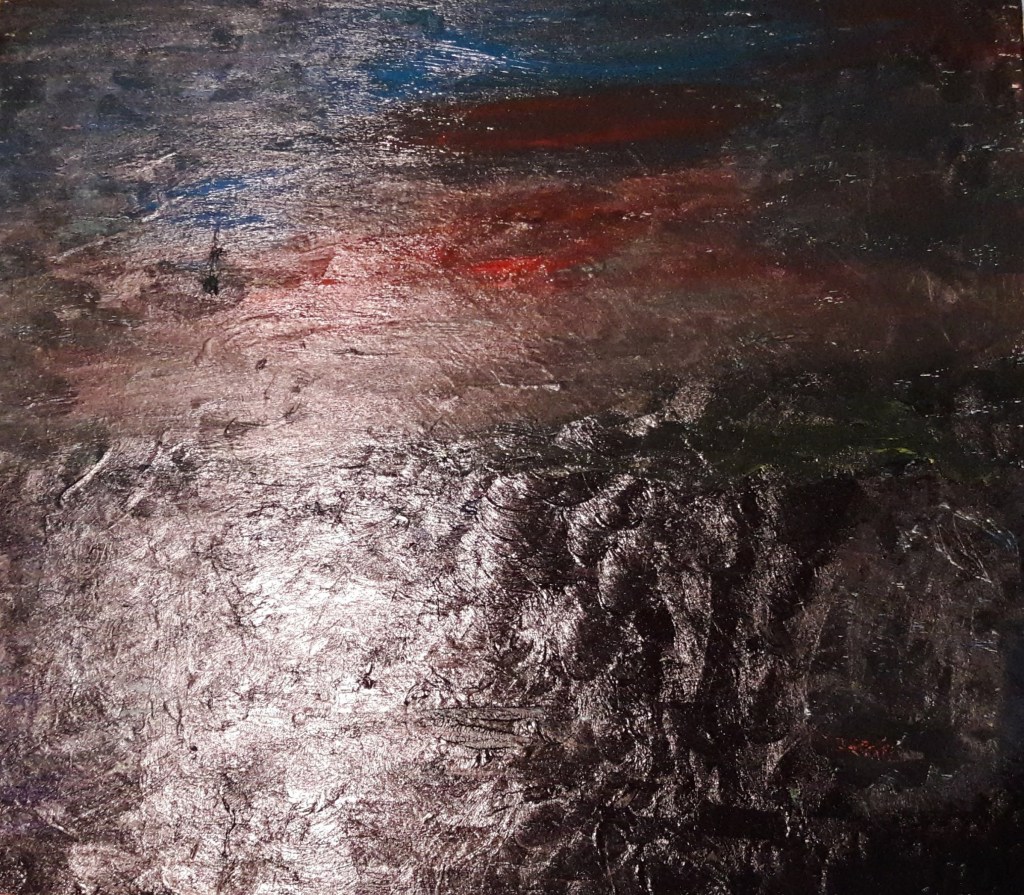
Geomicrobiologists now claim life underground exceeds in size, diversity, and span life above ground. What is life? It might be easier to simply say Earth is alive, all of it, including the rocks. And does extraterrestrial life exist? Well, we exist, we think. It now appears planets are living beings. Universe is alive. And that’s not counting the ghosts.
According to scientist Karen Lloyd, quoted in The Guardian: “The strangest thing for me is that some organisms can exist for millennia. They are metabolically active but in stasis, with less energy than we thought possible of supporting life.” That describes a teacher I had in high school.
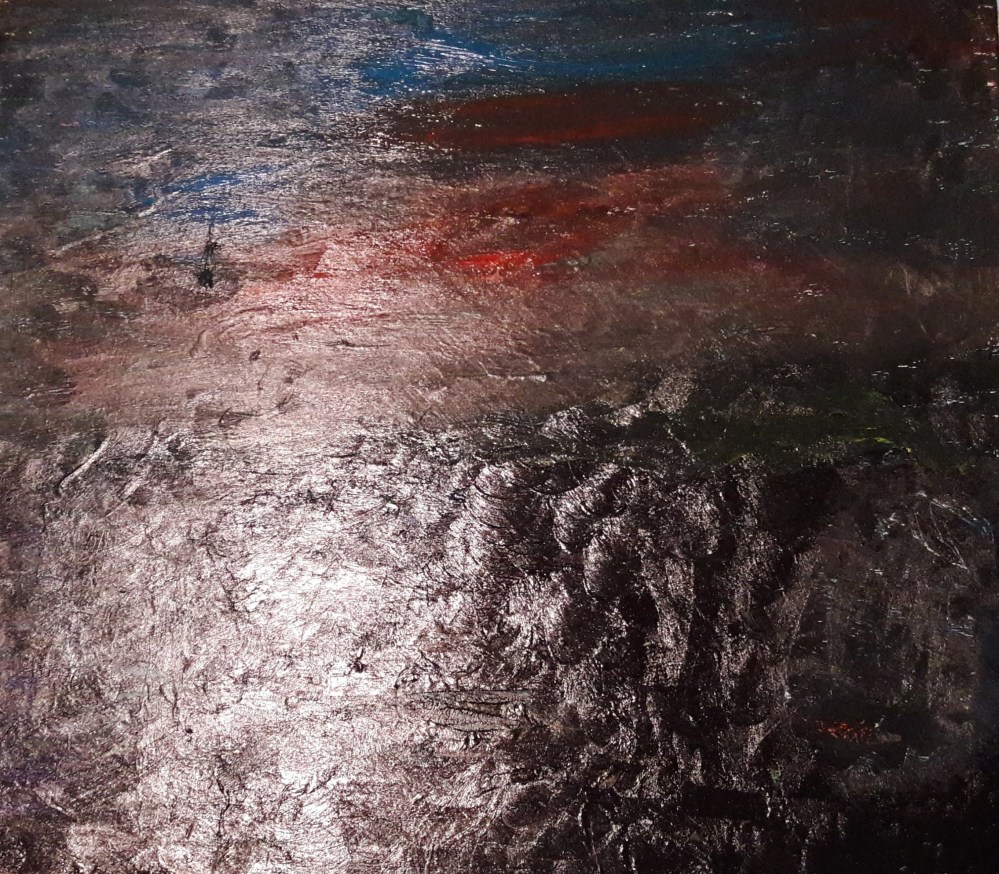
Meanwhile, in the basement studio, located at the intersection of above and below ground, I’ve continued to work on cutout paintings. The photos below detail the evolution of a recent graffito work:
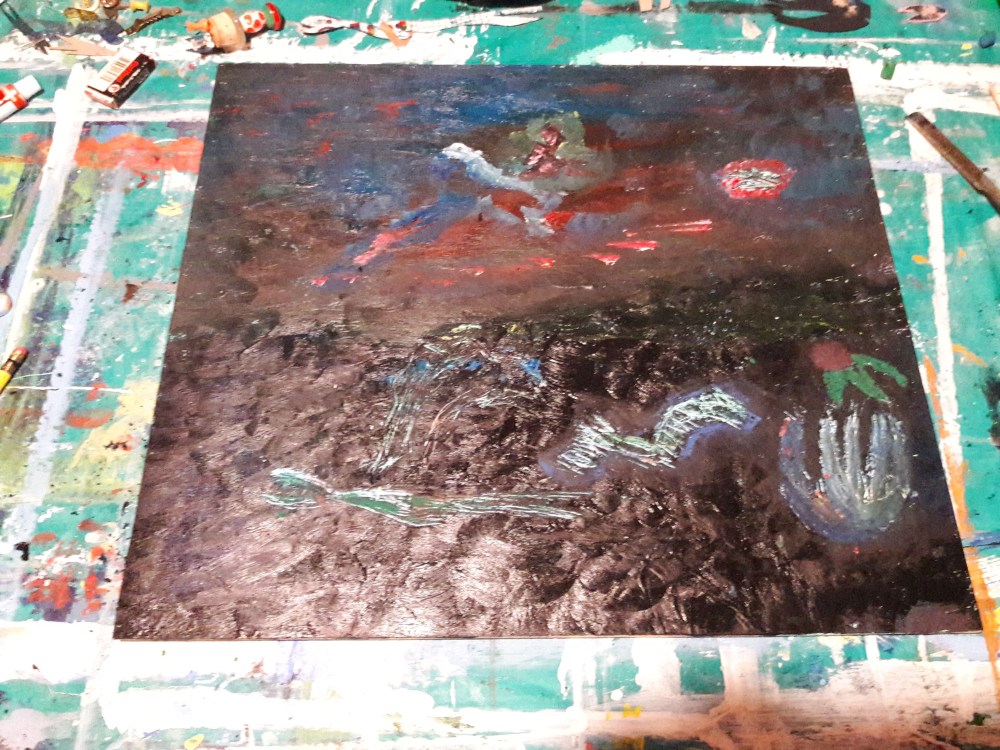
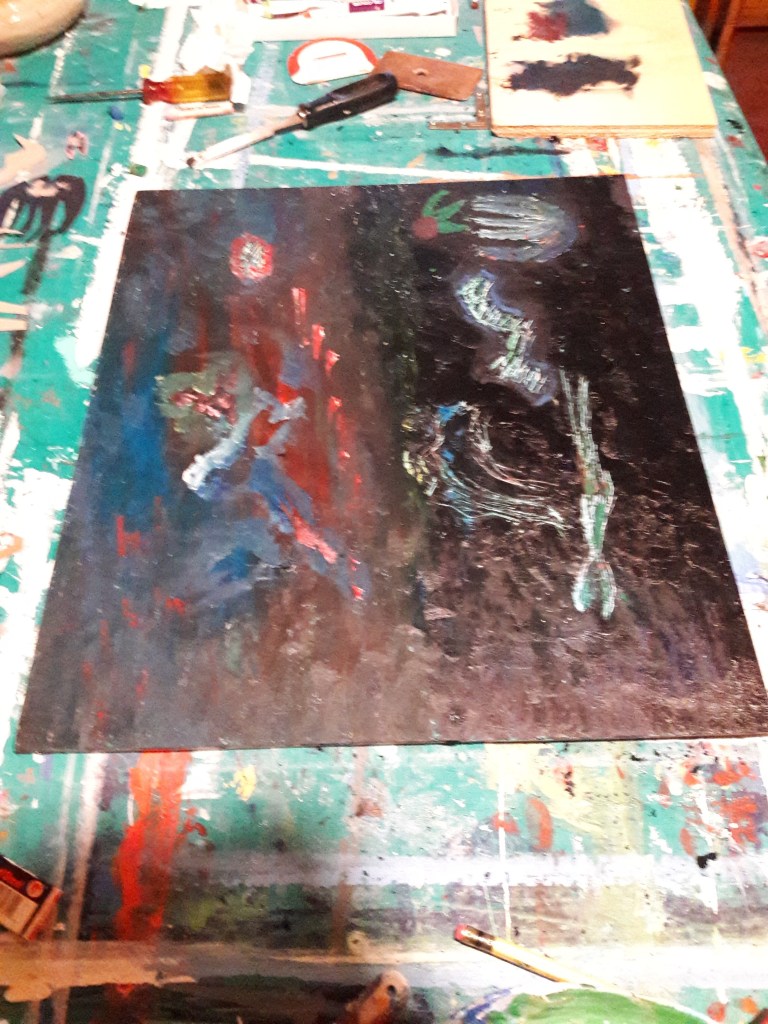
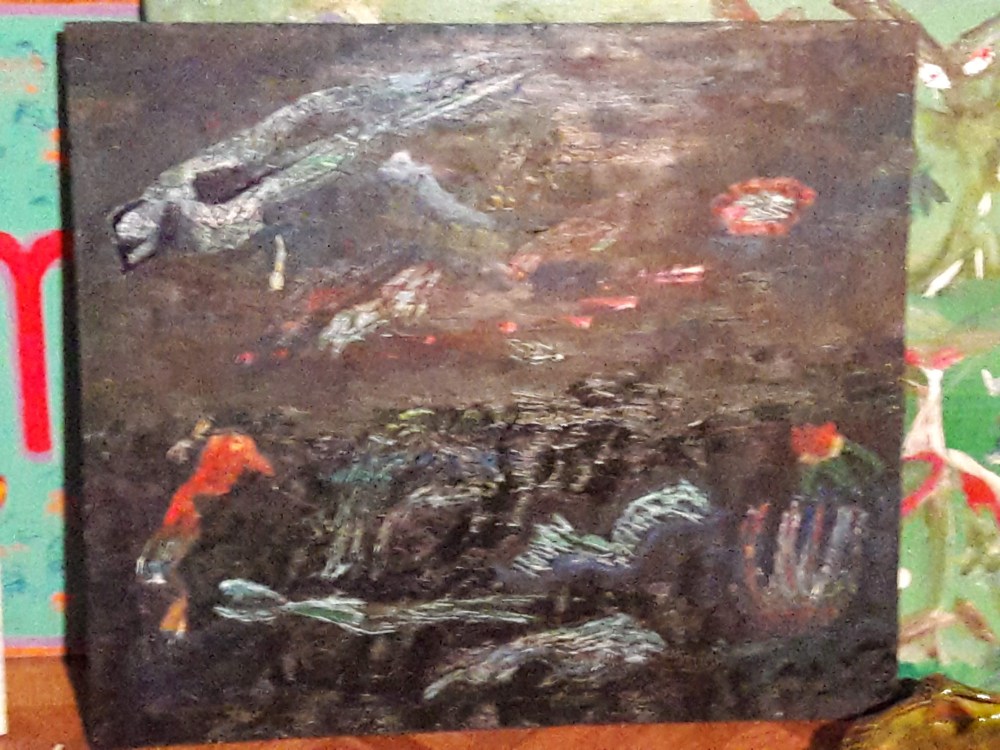
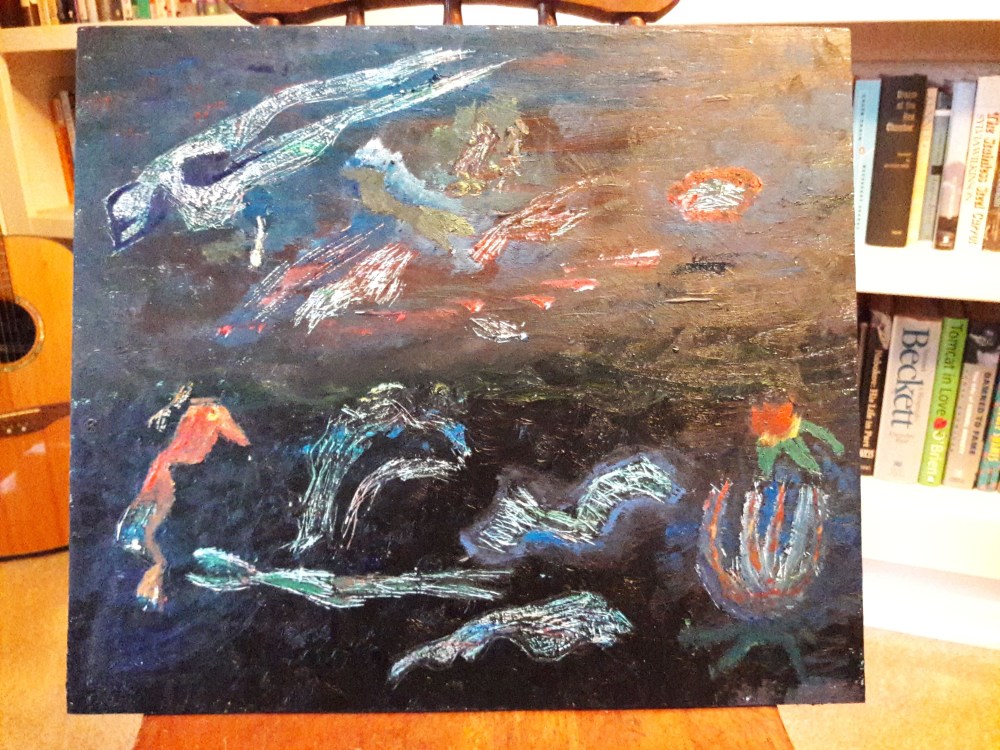
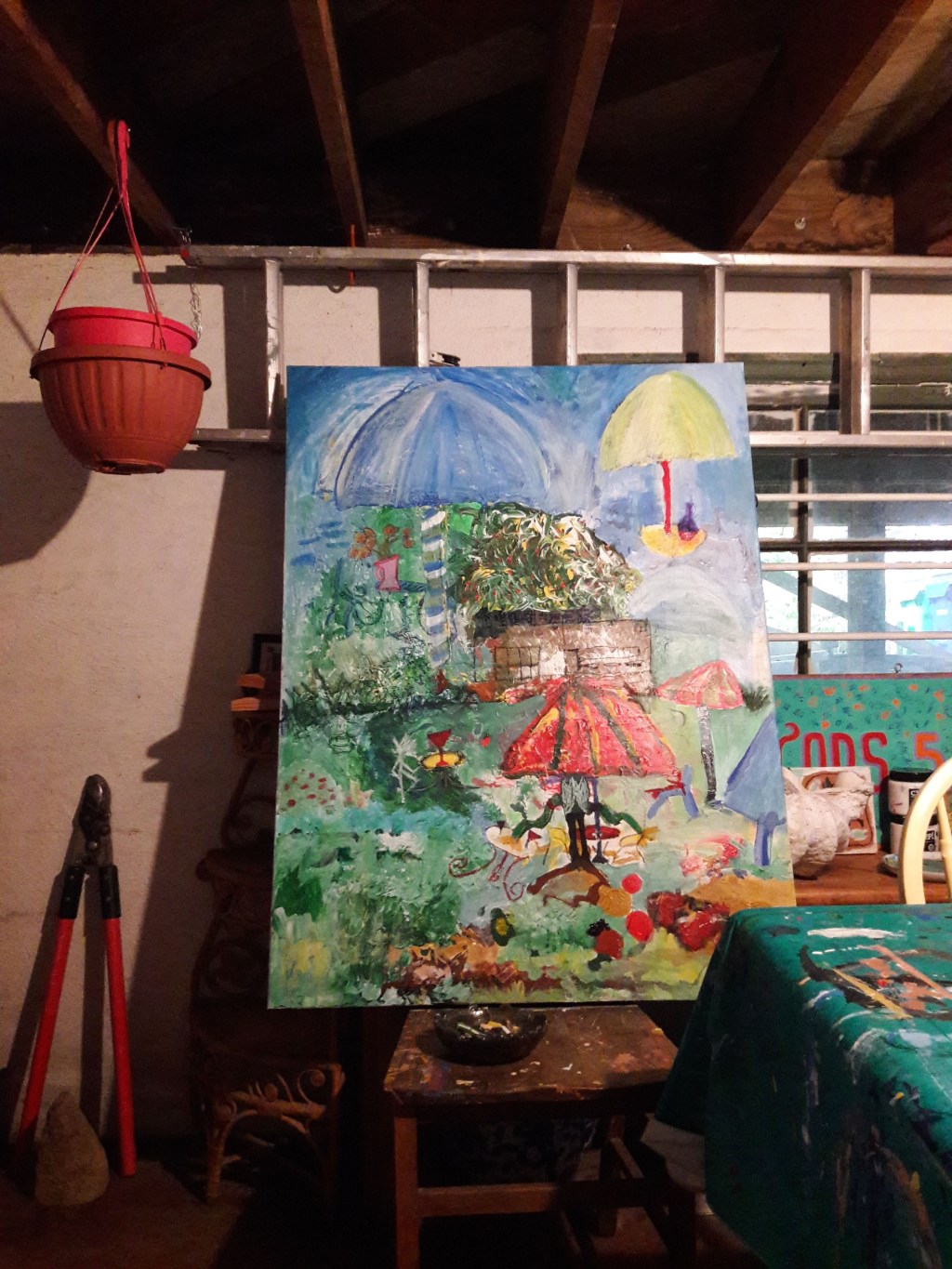
Portlanders love to sit out. At sidewalk cafes, outside pubs, in their yards or drives. On porches, decks, balconies. In parks. On special occasions, neighbors will close their street to cars so they can sit out in the middle of the block at improvised tables in whatever chairs seem to turn up. The atmosphere of a street closed to cars turns surreal in these times. Maybe because it rains six months out of the year, Portlanders don’t take the perfect evening for a sit out for granted, but they’ll even sit out in the rain, huddled beneath coats and blankets around a fire pit or under overhead standing outdoor electric heaters.
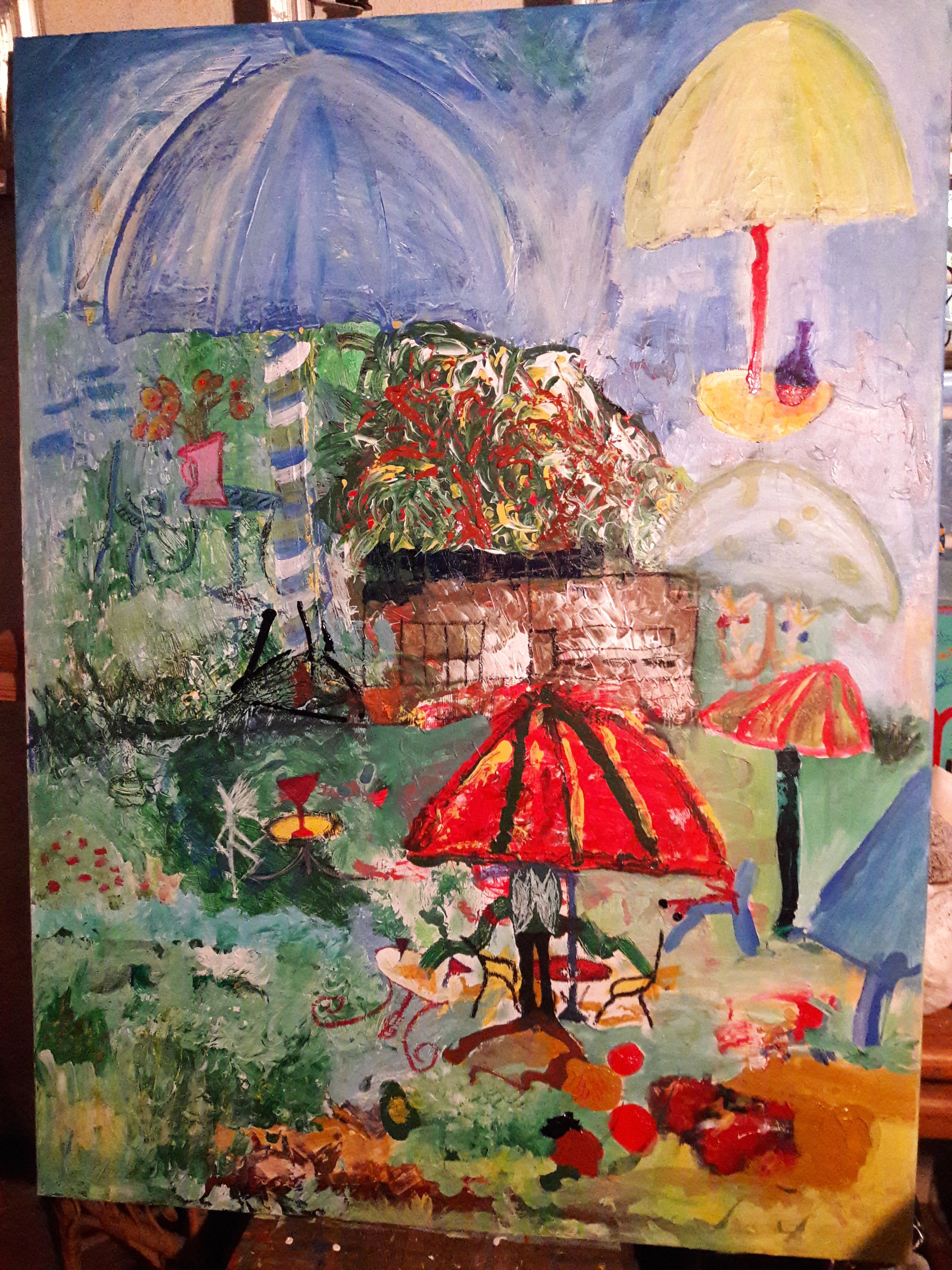
The current painting in progress is tentatively titled, “Sitting Out.” It’s 3 feet by 5 feet, stretched canvas. I’ve used acrylics, oils, and oil pastels, applied with brush, palette knife, or directly out of the tube. The grandgirls have been involved in this painting as well. Chloe is responsible for the bottom left, raspberries at the top of a green hill, ZZ for the sky and bottom right umbrella and blue chair seated with a red figure. Layer upon layer. Things get covered up. Sometimes it’s a mistake to cover something over, but you keep working. A canvas of this size is not inexpensive, but we got this one used at a garage sale for $5. We painted over the old painting, but ZZ wanted to keep some existing red roses in the bottom right hand corner, so we tried to preserve those.


Our studio, such as it is, is located in the basement:


The grandgirls are back in school now, and I’m working on the sit out painting in the basement alone. Last night I added the black umbrella outline with the broken stretchers pointing upward in the middle left. Had the girls been there, they would have booed this change. I need to figure out a way to cover it up without ruining the horizon line below it, which tops Chloe’s field.
Below are two pics of Portlanders sitting out on the sidewalk and in the street corral of a corner restaurant:


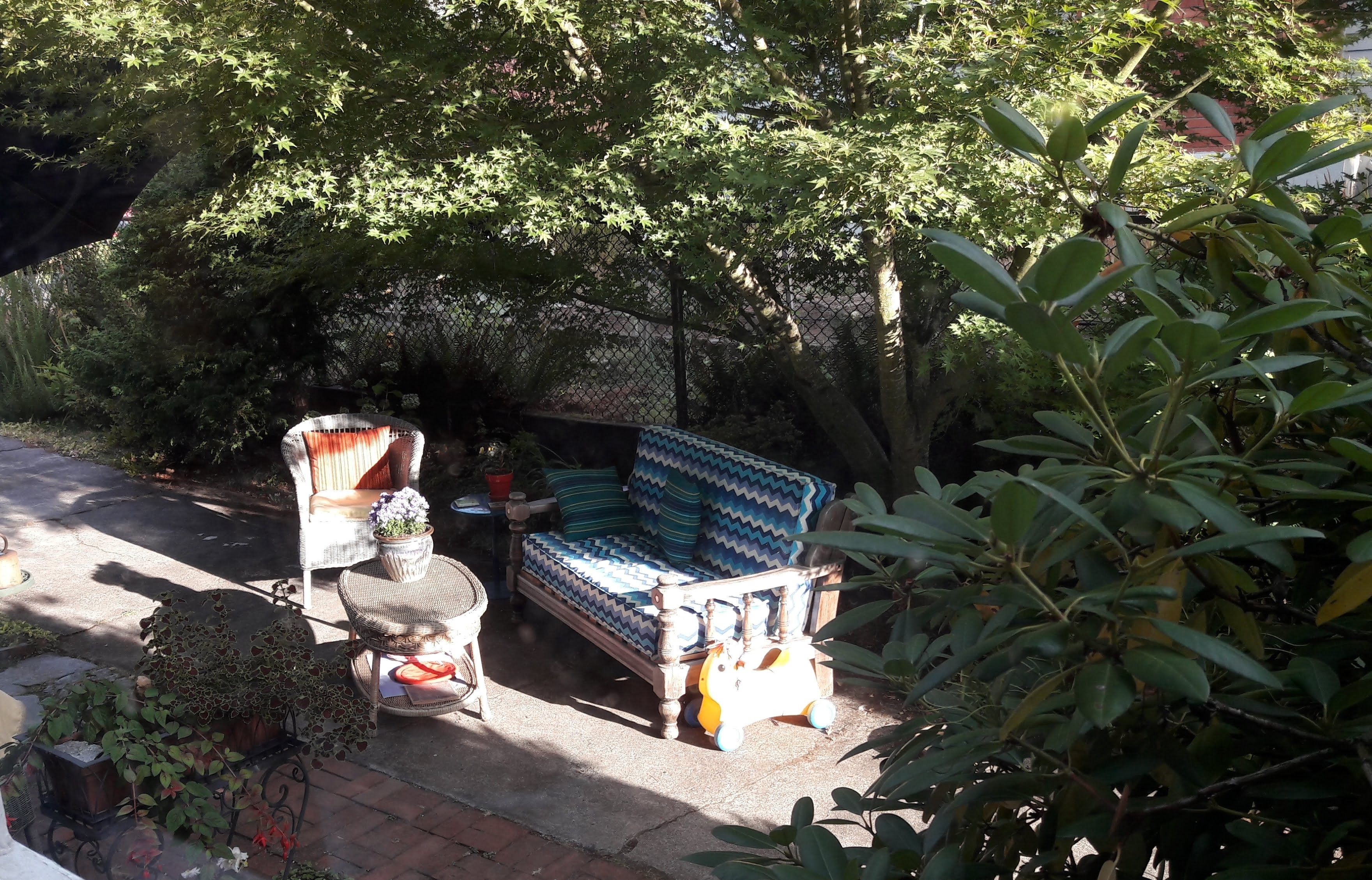
And we’ll close with this pic of a sit out zone in an unused portion of a driveway, Ollie waiting patiently to be taken for a ride:
On the table a yellow
bowl
green apple
red pear
fuzzy pink peach
blue-green ba
nana
All
as verbless as
the bibelots all
in nice rows of yore
Nana’s touchless
glassed shelf.
One advantage of painting over writing, there needn’t be words. Where is there writing without words? I want to read that.



 Sentence lines to right, rounds first, and pauses,
runs on, and Comma throws short relay to Dash –
who looks Sentence back to first, running the ball
into the infield, Sense feels his way to the mound,
one on, nobody out, in the bottom half of the first.
| “Stone | put | upon | stone | |||||
| and | chamber | beside | chamber” | |||||
| D’Arcy | Thompson | |||||||
| “Mud put | ||||||||
| upon mud, | ||||||||
| lifted | ||||||||
| to make | room,” | |||||||
| Robert | Creeley | |||||||
| word | hod | |||||||
| put | ||||||||
| upon | house | |||||||
| word | ||||||||
| shell | ||||||||
| soma | stone | |||||||
| put | ||||||||
| upon | ||||||||
| stone | ||||||||
| put | log | upon | log | cube | upon | cube | ||
| pier | upon | pier | unit | upon | unit | |||
| post | up | & | unus | put | upon | unus | ||
| road | upon | road | ||||||
| page | upon | page | ||||||
| wood | in | face | upon | face | ||||
| paint | put | upon | paint | wall | put | upon | wall | |
| one | part | upon | part | upon | ||||
| slab | on | slab | load | put | upon | load | ||
| hod | word | onus | upon | onus | ||||
| line | put | upon | line | word | upon | stone | ||
| bowl | put | mud | in | |||||
| hand | put | upon | hand | a | pan | upon | a | |
| tone | drum | stone | upon | |||||
| note | upon | note | a | lifted | scuttle | |||
| note | upon | row | in | a | ||||
| sign | sing | stone | mud | call | ||||
| name | put | upon | cut | word | in | |||
| rune | put | upon | stone | bone | lifted | |||
| end | upon | end | a | tune | in | |||
CODA: wind upon wind wave upon wave cloud upon cloud grass upon grass leaf upon leaf sail upon sail hill upon hill cove around cove cliff upon cliff square upon square camp upon camp town upon town city upon city state upon state…wind upon wind wave upon wave cloud upon cloud cove around cove
 The Rothko installation yesterday at the Portland Art Museum felt claustrophobic. The fabric covered faux walls created a maze of high vertical columns separated by narrow horizontal spaces, forcing the large Rothko paintings, which I’d been curious to see close up and in person, too close to one another, like pictures taped to the wall in a grade school classroom art show, parents and friends crowding in to see.
These large Rothko pieces, the ones he painted toward the end, are best viewed from a distance in proportion to the size of the piece, but everyone wanted to see them both up close and far away, myself included. I was surprised to find the paint so thinly applied on most of the large pieces. In some, I could see the weft of the canvas. Of course, I was standing too close, bringing both my amateur eye and my reading classes to the subject. One result of everyone wanting to be at once near and far, combined with the cloistered installation, was that viewers kept crisscrossing in one another’s view. But the crowded effect also created the feel of being part of an audience, which I appreciated.
Why does the museum have the feel of a church, viewers whispering as if performing the Stations of the Cross, usher-guards at every corner like nuns ready to pinch the ear of the tinkerer? Of course, my sensing a reverent whisper could have been the result of my asymmetrical hearing condition, which creates a peculiar point of view not shared by the whole audience. This distorted point of view is important, though, for doesn’t everyone suffer some asymmetrical perspective, the result of imperfect tuning, a slant eye, a limp? The Portland Art Museum has a generous age 55 senior ticket limit, and I had snuck in at the senior rate in spite of my youthful looks, the ticket-seller discretely not asking to see my ID. Once in the show though, my senior frailties began to make up for the reduced ticket price.
From a distance, immediately my favorite Rothko was a green over blue rectangle about 10 feet high and 14 feet wide (the museum info-cards inexplicitly did not show dimensions, just date and title – though most of the later Rothko pieces are simply numbered or “untitled”). From a distance, this blue-green was filled with luminous, almost phosphorescent, watery colors like we find in Monet’s water lilies, yet when viewed close up, I saw brown splotches in the green, dull beige drops on the blue, the color of ordinary dirt. I was also surprised at the way the rectangular boxes of color swirled and clouded at the edges, like a broken ocean wave, like surf. But as I browsed around, I soon realized that every combination of colors was represented, reds and blues, oranges and yellows, purples and greens, and I liked them all, and did not need a favorite.
The Rothko exhibit is chronologically arranged, and I had entered from the end. Still, the sense of development, of an expressive evolution, from recognizable shapes to abstract color fields over the course of the artist’s life was easily realized and a pleasure to see. I particularly enjoyed the early pieces, unknown to me, women on a beach, people in a subway, one small piece of several large women, the circle of women reminding me of Matisse, the female form beautiful in a near-realistic rendition of shapely fat. I looked in these early Rothko pieces for some sign of things to come. A middle piece contained just vestiges of shapes. I dared to guess at the shapes, but I’m not sure this is allowed. Rothko’s end period is laced with shadow, grays and blacks, purple stripped of its nobility. I thought of Beckett and his late characters, seniors all and barely still citizens of some bizarre place, blind and hobbling, but still trying to express what they see or feel, nothing, and what nothing looks and feels like, and what nothing tastes like, and smells like, and sounds like.
Practically ruining the entire installation, and inviting dilettante comment, into which I happily step, the museum posted a quote above the entry pavilion, something to the effect of the subject of modern painting being the painting itself. This is the reductio ad absurdum of modernist criticism, and is often applied to poetry, music, whatever. If nothing else, the Rothko paintings are about money, which suggests some attempt to persuade someone of something. This is one peculiar experience of the museum, where art gets institutionalized, its importance inflated to the size of zeppelins floating aimlessly above the heads of the crowd.


 The Coming of the Toads