Tag: Ocean

  • p-1: The Evil Hill on Mariposa

    n+1 vs The BelieverIf print does disappear, I will be only partially responsible. I’m doing my part to keep a few print publications healthy. But I can’t subscribe to everything. The question is always the same: what to read and how. A loyal subscriber to The Believer, alas, my subscription has lapsed, and just prior to the 2013 music issue, which turned out to be jazz inspired. Bummer.

    I’ve been comparing the cover changes over time of the New Yorker with the cover changes of the Rolling Stone. “Time is real,” Cornel West reminds us. But a few weeks ago, finding myself reading, with interest, no less, in the New Yorker, a “Tables for Two” eatery review of a restaurant I’ll never eat at, I decided I’d better augment the New Yorker and replace The Believer with something new. Meantime, I had discovered Kirill Medvedev, and noticed that n+1, which I follow, sporadically, on-line, was giving away the Medvedev “It’s No Good” book with a new subscription, so I went for it. And last week, the Fall 2013 n+1 print issue arrived, red dressed, calling itself the Evil Issue. Evil? Really? I felt the proverbial wince of buyer’s remorse.

    I sat down and opened my n+1. I glanced guardedly through the table of contents, not one for haunted houses, horror films, that sort of thing. Something here by Marco Roth on politics, on drones – ok, that’s evil. A drama piece titled “sixsixsix.” Why do folks think Satan evil? Consider Blake’s “The Marriage of Heaven and Hell”: “The reason Milton wrote in fetters when he wrote of Angels and God, and at Uberty [a lot] when of Devils and Hell, is because he was a true poet, and of the Devil’s party without knowing it.” Still perusing the evil issue’s table of contents and glancing through the articles to see what I might want to start with, I came to something from the Stanford Literary Lab, titled “Style at the Scale of the Sentence.” I haven’t finished it yet, but I’ve decided it’s at the heart of the evil issue for a reason. Then I saw this, which took me by surprise: Alice Gregory’s article titled “Mavericks: Life and death surfing,” and soon found myself into the evil issue in earnest.

    If the entire evil issue was instead titled “Mavericks” and filled with Alice’s writing about surfing I would be a happy reader. The only problem with the article is it’s only ten pages, which means back to the Literary Lab’s “Sentence” article too soon. Maybe I should have renewed The Believer, after all, seen if they’d send me the music issue I missed. On jazz! Jazz in the evening can turn an evil day good. Wondering about the etymology of the word evil, I found this in Wiktionary: “from Proto-Indo-European *upo, *up, *eup (“down, up, over”).” Ah ha! That’s a definition of surfing. One of the best pieces of journalistic writing on surfing I’ve ever read came in the New Yorker, back in 1992, written by William Finnegan, himself a surfer. “Surfing is not a spectator sport,” he says in the second of the two-week, long article. In the first week, Finnegan had said, describing the surf at Ocean Beach, off San Francisco, “The waves were big, ragged, relentless, with no visible channels for getting through the surf from the shore.” Conditions in the water, often fast changing, are difficult to read from the shore. Waves always seem bigger to the surfer in them than to the spectator watching from the beach or from a cliff high above the water. I read the long Finnegan piece twice before mailing my two copies with the articles to an old surfing buddy, not much of a reader, who later called me, totally stoked.

    Preparatory to surfing, back in the day, hey-hey, kids growing up in South Santa Monica Bay rode skateboards: literally, the wheels removed from old roller skates and nailed to the bottom of a two by four, crude vehicles compared to today’s boards. I lived on Mariposa, at the bottom of a long, steep hill, followed by a short straightaway, then an easy hill ending at my house on the corner. The houses on Mariposa backed up to railroad tracks (since removed). Between the railroad tracks and the back fences was a path the local kids called “Devil’s Path” or “Devil’s Pass,” a shortcut toward downtown. We regularly rode skateboards up and down the mild Mariposa hill, but to ride a board from the top of Mariposa was considered a daredevil feat.

    One day, my friend Pete Ponopsko, a few years older than me, took a skateboard to the top of upper Mariposa. He was going to ride down the big hill and would pick up enough momentum to carry him through the straightaway and down the lower hill all the way to the bottom. A small crowd of skateboard aficionados positioned themselves mid straightaway, where we could watch Pete whiz by on his way to the lower hill.

    One of the problems with early skateboard technology was shakiness. At fast speeds, the boards wobbled side to side. Another problem had to do with the metal, roller skate wheels. A pebble might catch under a wheel and brake it, stopping the board and throwing the rider forward. We never knew for sure what went wrong with Pete’s ride down the upper hill. Some said the board shimmied so severely he simply could not keep his balance. Others said he hit a rock and pearled. Still others said Pete chickened out and tried to jump off. Whatever the cause, the effects included a startling array of raspberry red scrapes and bruises along one side of Pete’s body, from his ankle to his ear. It was said Pete slid on the sidewalk a distance equal to the length of a 1956 Ford station wagon. It was an evil wipe out, and it was a long time before anyone tried to ride upper Mariposa again, but by then skateboards were wider and thinner and longer and fitted with smooth rubber wheels and stable wheel bearings, and Pete was already an old-timer.

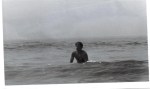
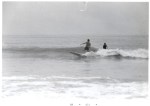
    Joe at the top of an evil wave. Well, an evil photo, anyway.
    Joe at the top of an evil wave. Well, an evil photo, anyway.

    Follow Up: n+1 has put the Alice Gregory Mavericks piece on-line, 9 Oct 13.
  • Two Ocean Surfing Poems at Berfrois – and a gallery of old ocean photos

    “Ray, 1956” and “Watermarks from a Night Spring,” two poems with themes of the ocean, surfing, and working, were posted at Berfrois a couple of days ago, along with a few old surf photos.

    Paddle on over to Berfrois and check out the surf poems.

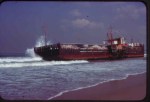
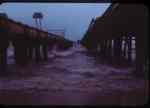
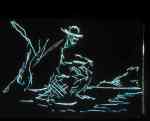
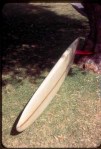
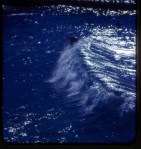
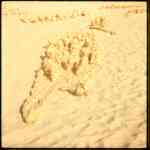
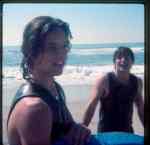
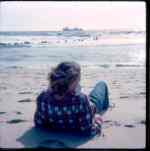
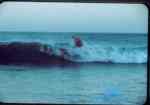
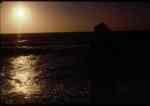
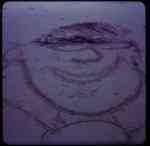
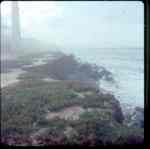
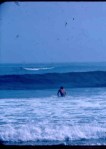
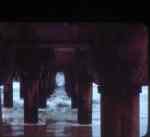
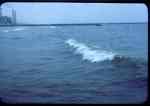
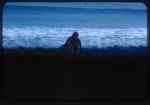
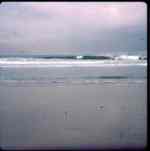
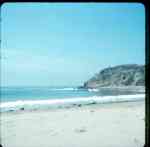
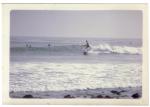
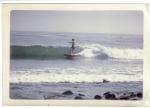
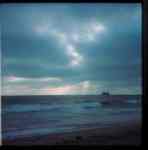
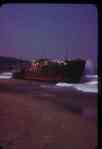
    And below find a gallery with more photos from the late 60’s thru mid 70’s. Most of these photos were taken with an Exakta 500 single-lens reflex camera (East German), with a 120 portrait lens, both purchased used and cheap to take surfing photos at local spots on Santa Monica Bay. Most are scanned from slides, Kodachrome or Ektachrome, and one is from a black and white print. The portrait lens was an affordable workaround at the time used as a kind of telephoto, and it worked ok. The camera was abused though, tossed in the sand, and over time the shutter began to stick. The photos starting coming out black. Some viewers may feel these the best photos. See etched drawing on one of the black slides. These are not “big” waves, and the surfers are locals, but the ocean is huge and alive and old and every morning new. Click any photo to see the gallery. And don’t forget to check out the poems.

    Related: Watermarks from a Night Spring & Ray, 1956

  • The Art of the Bus Stop

    It was to be his last day, he dreamed, a phantasmagorical dream
    recurred, after a cup of coffee, in wakeful brain, a near belief in seizure.

    How would he spend his last day? He should limit his options,
    if chance proved him a fool tomorrow, build a hedge of porcupines.

    But if today’s feeling did not pass, his options were not so limited.
    He could fly anywhere, stay in a Six Star hotel in bikinied Marseilles,

    fly to romance Rome and get in line for a final Papal blessing,
    parachute into the Mojave desert, jump off Saddleback Mountain,

    surf the Banzai Pipeline – like in the old days, take the board out.
    Who would dare cut off an old man on a wild wave on his last day?

    He got his surfboard out of the deep basement, his lovely wife still sound asleep.
    He walked down to the bus stop. He waited with his surfboard on the poetic bench,

    beneath the ancient acacia tree. The bustling bus came but the discreet driver said no
    to his putting the untethered surfboard in the bike rack on the front of the bus.

    He went back to waiting at the busy bus stop, and this is how he passed
    his penultimate yesterday, talking to bussers about the art of surfing.

    Related Posts: Winter is icummen in, Lhude sing Line 15
    Reading Roland Barthes’s Writing Degree Zero on Line 15

  • The Look of Love

    Climbing bolt eyes tightened so tight the threads
    strip, and the tongue, a dirty oiled belaying bolt,
    slips and slaps, and the whole edifice collapses,
    as if a plumber has grabbed the head by the ears
    and sucked on the nose with his plunger.
    
    The smith smites a bass anvil,
         hammering
              the hot steamed milk face
         forging
              the steel bridge nose,
         sculpting
              terrible white teeth,
         drawing and cooling
              the pendant tongue,
         punching
              eyes opaque blue,
         curling
              thick creamy hair
    around the handle of his hammer.
    
    This hyperbolic happy acid oozing 
    cold blue face bowl of plum pits,
    bonbon pate of goose liver. 
    “Don’t look at me!” cry the eye bolts expanding, 
    lips stressed taut, ears hung like life rings. 
    Far back on the tongue, a bitter spot to nap. 
    
    The old couple lives now in a window box. 
    The sash opens and a hand appears. 
    A palm with a long curved neck 
    pours water clear and concise. 
    
    An electrician comes to replace the eyes. 
    He breaks both sockets unscrewing the cold bulbs. 
    Memory starts to flicker, the call of a far-off bird. 
    In brackish blue eyes the tiller tongue feels spaces, 
    loosed from its mooring, and on the sail of the nose, 
    beating upwind for a kiss, ripples of sound,
    the soupy surf ringing in his ears, 
    snores an old surfer paddling about
    on a dinged, wax-worn, sun bleached board, 
    wanting to swim with you.
  • Watermarks from a Night Spring

    Embers of a partially burned ocean
    In a box in a dank basement molting notes
    A weathered surfer slowly descends the creaking

    Worn stairs, dark swells yawning
    Fish eyed and barnacle knuckled he climbs
    Finds and opens the box, peers in, smells the pages

    Runs salted fingers over the raised words
    Rusting paper clips, chiseled letters in Courier font
    Fading beached seagulls washing away in an incoming tide

    Wired spiraled journaled waves
    Bleaching across the page ink in water
    Blistering sun burnt tattoos on old shivered skin

    He can no longer read without bottled glasses
    He chuckles, the tide receding washing scouring
    White out rocks across words stuck buried in red tide pools

    Breathing with a snorkel
    The surfer leers over the smoldering sea
    Takes up the seaweed soiled waxed manuscript

    And paddles out of the basement
    Walks down to the beach and what remains
    Of the water and casts out the paper fish net

    Into a set of scaling waves
    Lit with a lustrous industrial moon
    The waves curling letters in blue neon.

    (Click any photo to view gallery)

  • Without you tonight

    A seeking breeze softly slips
    under the sleeping cherry tree
    a cursory note, “I am too busy.
    Too, too, toodle-loo,”
    smiles, hushes, and sounds off.
    A branch snaps, and a cat recalls the night
    when the owl, the nightingale,
    and the toad went out walking.

    The moon follows the trio into the tea garden, pulling
    behind the sounds of the rollicking ocean waves.
    In the garden, two women sit talking:

               “I wrench or hammer or pull or push
               To disassemble and repair
               To build in empty air
               The sound truth that is not
               Sound enough.”
     
               “I don’t believe the truth
               That there is no truth
               There are two truths
               The one you reject
               And the one you embrace.”

    Drowned out by the singing waves slopped with frothing beer,
    An old, lost surfer takes a hearty long piss on the briny rocks
    At the water’s rough edge and mutters a half assed poem
    To pass the night in song outside walking the dark beach
    While the women sit talking with the cat in the cove of the garden
    Under the cherry tree awakening and petals falling all
    In one great breath the ocean waves belly laughing full.

    Surfers

  • Ray, 1956

    He feared drowning. He fell asleep on the bus,
    sleeping past his stop, and on down to Redondo Beach,
    the waves breaking, hard on hearing.

    He slept past the beach break at El Porto,
    his head bouncing against the beach-side window,
    his tools jiggling in his toolbox at his feet,
    past the Manhattan Beach Pier,
    the Hermosa Biltmore Hotel,
    the Hermosa pier, on down to Redondo.

    The bus driver would have to speak up.
    The evening water was glassing off,
    the Strand bars filling with surfers,
    their cream yellow and orange and blue surfboards standing
    against cars, walls, wet, dirty sand waxed.

    He dreamed of fish, bottled beer, oysters.
    He dreamed of broiled eel,
    of yellowtail garnished with scallops,
    dreams he did not understand.

    A giant squid rose from a thick gelled water
    and reached up for him, and he quick stroked
    in his sleep on the bus to dog paddle away,
    back to Shively, the house near the railroad tracks,
    where he’d built out the basement room in knotty pine.

    He awoke on the bus in Redondo Beach,
    at the end of the line, foggy out now,
    the sound of the surf muffled
    in his ears. Flying fish eggs
    surrounded his tired and dozed head,
    his hair closely cropped,
    his clothes dirty from the day’s work.
    He’d returned the car, a ’56 Plymouth,
    and salt filled his ears.

  • Rows sans end

    El Porto, 1969A sentence, this one, for example (though another might do), the one you are now reading, backlit, for some purpose, presumably (your body like a house in disrepair, suit fraying, limbs sagging, glasses missing one temple, pads bent, joints crooked, hair crinkled dry moss, green going grey, a bird’s nest), late summer as the sentence gets started, lolling, dozing, without antecedent, no foreshadowing, no shadows at all, no dashes, noon, then, the beach clear, the water shipless and shapeless, but shiftless still, then suddenly awakening and rising, like a quick second wind, and just as quickly a third wind, the afternoon slop now upon the coast, the water rougher than it looked from the beach, sudden, swell upon swell following the sleepy noon lull, and you are not ready for this, each new wave an and, followed by another and, and another and, until, caught now in a riptide, a rebuttal that has the stylish lifeguards proofreading for drowning readers, and when they find one, they click on the swimmer and go, click and go, click and go, sweeping the sentence down to the water clear of this sort of thing, fragments, wave fragments, ripples from where they sit high in their tower

    A row is a row is a row is a row,
    a row a row a row a row.
    A paddle is a paddle is a paddle is a paddle,
    and we are out past the break,
    out to sea,
    so to speak
    is to speak is to speak is to speak.
    
    No matter      what we do (rules)      where we go (directions)
    there are margins,                                            edgeswe come up against.
                            The world is flat
    after all,
                      the flat earth squaring us in,
    switchbacks,               zigzags              away from intuition. 
    For the world wants style:
                      8 & ½ x 11, 3 hole punched,
    the thin red vertical line creating a margin,    a double edge.

    “Sometimes a thing is hard because you are doing it wrong” (Don DeLillo, “Point Omega, p. 27).

  • “Penina’s Letters” at The Boulevard

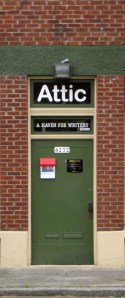
    A short excerpt from Chapter Two, “The Truth of Things,” from Penina’s Letters, a novel in progress, is now up at The Boulevard, a publication of the Hawthorne Fellows at the Attic Institute: A Haven for Writers.

    Click here to read “The Truth of Things.”

    I’m a Hawthorne Fellow at the Attic Institute for the period April though August, working on a novel, Penina’s Letters. For information on the Hawthorne Fellows, click on the Attic door below. They are accepting applications now for the next Fellows period, Oct. through Feb., 2012-13.
    Related Post: “Penina’s Letters”: Hawthorne Fellows at The Attic Institute

  • Surf Noir: “The Tribes of Palos Verdes”

    I knew about “The Tribes of Palos Verdes” (St. Martin’s Press, 1997) when it first came out, and I was interested in reading it for what appeared to be its local surf setting. We used to go snorkel diving in the coves around Palos Verdes, the small peninsula that gives Los Angeles’s Santa Monica Bay its southern boundary, in the late 50’s and early 60s. We drove down through the beach cities to Palos Verdes from El Segundo. We did not wear wet suits, and I don’t remember many houses on the cliffs, or any problems with locals (key themes for Medina, the teenaged, first person narrator of “Tribes”). The coves consisted of rocky bottoms and kelp beds. Later, we surfed Haggerty’s and The Cove a few times. But if you live close to a beach, you tend to stay local, and El Porto was our local beach, so over the years, we didn’t get down to Palos Verdes very often. And I didn’t get around to reading “Tribes” until just recently.
    It seems two basic views of surfing, of surf culture, dominate popular depictions. One is bright and sunny, and emphasizes a water sport, a recreational activity. The other is dark and dangerous, and emphasizes behaviors that may not have anything to do with wave riding. The argument is a fallacious dichotomy, and I don’t subscribe to either view, but it might be useful in describing writing with background themes of surfing. At the Catholic high school I attended, in Playa del Rey, surfers were viewed with a certain suspicion, for the sport (if it was even begrudgingly called a sport at the time) was an off-campus, un-sanctioned activity. This view was further tainted by corny media representation in films and music, but why couldn’t the teachers see through that? A kid couldn’t just have fun with a surfboard in the water. He had to be part of a growing sub-culture which at best wasted its time hanging out at the beach and at worst was infused with anti-social sentiment characterized by rebellious attitudes illustrated by long hair, non-participation in team sports, resin-sniffing.

    Yet most of the surfers I knew were in better physical shape than the football players with their damaged knees and light concussions. And surfing has gone on to occupy a singular place in today’s sporting world, combining health, spirit, and organic virtues. Surfing cannot get caged in an arena. Yet, in any case, perhaps, at least in “Tribes,” we hear the teen spirit asking, how do we know what’s good for us if we don’t taste some bad every now and then? Perhaps this explains the taste for noir. Thus D. H. Lawrence looks at Browning’s “God’s in His heaven—All’s right with the world!,” and comes up with (from his poem titled “Nemesis” – from “Pansies,” 1929):

    “The Nemesis that awaits our civilsation
    is social insanity
    which in the end is always homicidal.
    Sanity means the wholeness of the consciousness.
    And our society is only part conscious, like an idiot.

    If we do not rapidly open all the doors of consciousness
    and freshen the putrid little space in which we are cribbed
    the sky-blue walls of our unventilated heaven
    will be bright red with blood.”

    Anyway, as a result of a recent, random conversation that mentioned “Tribes,” I finally did get a copy (at Powell’s, 1st edition hardback, signed by the author, – what a find! – if you like that sort of thing), and read with pleasure Joy Nicholson’s book. And the sky blue walls of Medina’s Palos Verdes are unventilated, much of the surfing takes place at night, and the sport is infused with a noir spirit. I was reminded of Kem Nunn’s surf-themed books, “Tijuana Straits” (Scribner, 2004) for example, which I did read when it first came out. The reader is asked, in both books, to suspend judgement with regard to certain aspects of surfing and local conditions. It’s unclear how, for example, surfers in Joy’s book could possibly be seen from the front window of her house; likewise, the last wave Nunn’s surfer-hero rides, across the U. S. and Mexico boundary, peaks with poetic license. In both books, surfing is as much figurative as literal.

    Back to D. H. Lawrence, where we find we should

    “Be still!

    The only thing to be done, now,
    now that the waves of our undoing have begun to strike
    on us,
    is to contain ourselves.

    To keep still, and let the wreckage of ourselves go,
    let everything go, as the wave smashes us,
    yet keep still, and hold
    the tiny grain of something that no wave can wash away,
    not even the most massive wave of destiny.

    Among all the smashed debris of myself
    keep quiet, and wait.
    For the word is Resurrection.
    And even the sea of seas will have to give up its dead.”

    Joy’s book is a dark depiction of teen life in a toxic family and local social environment driven by stereotyped trappings of upper-middle class wealth. The values described are popularly depicted, but the teen perception is sharp in its single, unflinching vision. The toxicity, toward the end of the book, grows to mythic proportions as a famous red tide is stretched to figurative means, and the book speeds toward a final, conclusive wipe out. “Tribes” is divided into seven, un-numbered chapters consisting of 218 short, un-numbered sections, separated by sets of wave looking tildes (~ ~ ~): Waves (81 sections); Rocks (41); Motion (22); Tide (13); Fire (44); Salt (6); Stars (11). Surfing is largely a figurative theme throughout, and the language is remarkably clear of metaphor. The dialog is crisp and the narrator’s voice sarcastic in what would seem true to her age and setting.