Tag: Music

  • She Shakes Me Out

    She Shakes Me Out

    She shakes me out, she jiggles me down
    starts me dancing like a rodeo clown.
    Twist to the left, twist to the right
    never do we get too way up tight.

    She stays so near, she goes so far
    she ain’t no Facebook or Internet star.
    She’s seen over here, she’s been over there
    all night and day, everywhere.

    Turn it up loud, turn it down soft
    turn it all the way off.
    She never says yes, she never says no
    she knows when to say let it all go.

    She don’t wear silver, she don’t wear gold
    she’s never been bought, she’s never been sold.
    She rides me high, she rides me low
    she rides me fast, and she rides me slow.

    Turn me loose, I have no choice
    she rides me like a pet mongoose.
    She be hep, she be cool
    she never ever don’t be cruel.

    She sings the old songs, fingerpicks a guitar
    she don’t care if all the words go wrong.
    She walks the streets, visits the sick
    she don’t mind being in the thick of it.

    She knows how to live, knows how to die
    she looks me straight in the eye.
    Color me blue, color me green
    she’s the best thing I’ve ever seen.

    She heats my beans, toasts my buns
    and I hardly ever get the runs.
    She shoots pool, shoots the shit
    she ignores all the rules of it.

    She hits a home run, lays down a bunt
    she lays it all on the line.
    She knows how to fly, knows how to fall
    knows how to climb this here wall.

    She knows how to pray, knows how to sin
    she always knows the shape I’m in.
    She knows how to work, knows how to play
    knows to go home at the end of the day.

    She knows how to give, knows how to take
    she knows how to ask if there is some mistake.
    She knows how to swim, knows how to sleep
    she knows how to make that midnight creep.

    She knows how to laugh, knows how to cry
    not every guy in a suit is a spy.
    She likes a tete-a-tete with a cat or two
    down by the water.

    She likes it slow, takes it easy
    drinks a bourbon in the salsa garden.
    The sun makes her happy, but rain makes her glad
    Her blue eyes seldom cry.

    She forgives, she forgets
    she’s got rooms to let.
    I do her dishes, scrub her pots
    change the diapers, that’s my lot.

    The bells of Saint Mary’s, down by the sea
    the waves they did cry.
    The day she got married, on the radio
    angels they did fly.

    She took a walk, on the mild side
    she went to bed, and fell asleep.
    She shakes me out, jiggles me down
    I get up in the morning like a working clown.

    “She Shakes Me Out” is a song I wrote and performed on my show “Live at 5 from the JoeZone” on Instagram on Monday, May 18 (now deleted). I used the chord progression:

    Bb7  Bb9  Bb7b9  Bb9 
    Eb9  Eb7b9  Eb7  Eb7b9 
    Bb7  Bb9  Bb7b9  Bb9 
    F9   Eb9   Bb7   F9

    Tune in to Live at 5 from the JoeZone most nights (PST), a pandemic quarantine social distancing live video hour (or less) of music, talk, stories, and such to help pass the time and ease the mind.


  • Two Riders Were Approaching

    Two Riders Were Approaching

    Two riders were approaching
    on hogs and wearing leather.
    “Let’s stop here,” said one to the other,
    “for a cool drinking beer.”

    They passed the time on songs
    that ofttimes rhymed.
    On the trail or in the big city.
    They parked the hogs in the gutter.

    At the bar the one he uttered,
    “What’s that you got in the vat?”
    “Saltwort Ale,” the barkeep did tell,
    combing his beard with a hand.

    “Two lights for us, my friend,
    the day grows warm and thin,
    the dust is finding its corners,
    the dogs want shade and water.”

    “No light here,” the barkeep says,
    “and we don’t serve no rhymesters.”
    “But we are the two riders,
    two riders who were approaching.”

    “This here’s a craft brew pub,
    not some seedy tavern.
    Take your hogs and dogs across the tracks,
    go see John Wesley’s mother.”

    The two riders went back to riding.
    On the trail where we last heard their cry,
    they were still approaching.
    Two riders were approaching.

    “Yippi-yi-yo,
    yippie-ki-yay,
    we’re gonna go
    our own way.”

    Yippi-yi-yo,
    yippie-ki-yay,
    we’re gonna go
    our own way.”

    “Two Riders Were Approaching” is a song I wrote and performed on my show “Live at 5 from the JoeZone” on Instagram on Saturday, May 9. I used the chord progression Am Dm E7 Am. I changed a few words and lines here, and I discarded here a few of the lines sung live, as follows:

    “…where the hodads hang their hats”;
    “The hogs are hot and tired”;
    “I don’t care if you’re the four horses of the apocalypse.”

    If I ever play “Two Riders” again, I’ll probably change it some more.
    Meantime, tune in to Live at 5 from the JoeZone Saturday nights (PST), a pandemic quarantine social distancing live video hour (or less) of music, talk, stories, and such to help pass the time and ease the mind.

    I wrote this song, as I explained on “Live at 5,” to celebrate the latest Bob Dylan recordings, his first with all original songs in eight years. The title of my song, “Two Riders Were Approaching,” is the penultimate line in the Dylan song “All Along the Watchtower.” As I asked my audience, “Have you ever wondered what happened to those two riders?”

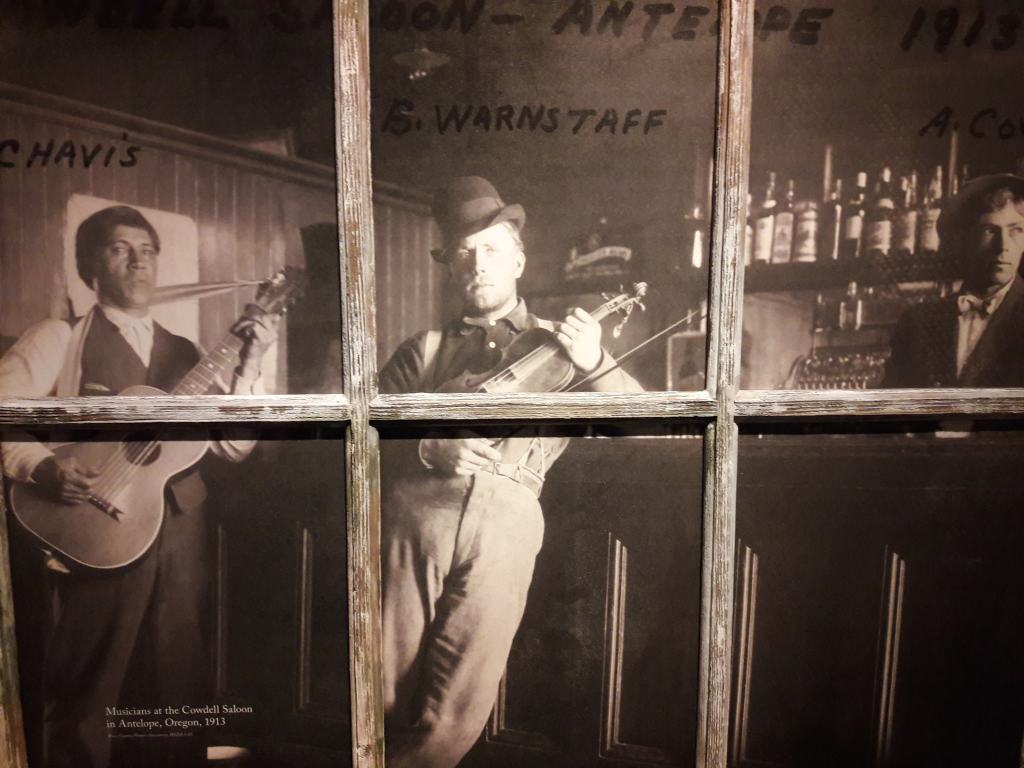
    Photo: Pic I took of a photo at the Oregon Historical Society “Barley, Barrels, Bottles, and Brews” exhibit in 2019: two musicians and a bartender at the Cowdell Saloon in Antelope, Oregon, 1913.


  • Motti, Lazzaro, and Django

    Motti, Lazzaro, and Django

    The Awakening of Motti Wolkenbruch (Swiss, 2018) is a coming of age story, Motti’s single marital status of existential concern to his mother, who tries to set him up with any number of, for Motti, unsuitable but available girls whose mothers are equally concerned about the marriage status of their daughters. But Motti has his own ideas about attractions and family values, even as his young and tender heart is yanked from his body by the carefree girl he falls off a cliff for, and a parental sponsored trip to Israel banking on his finding a girl the family can approve of only makes matters worse. Expect much laughter, and crying, out loud, with actors speaking German, Yiddish, and Hebrew. The Awakening of Motti Wolkenbruch is about the surprise of life.

    Happy as Lazzaro (Italian, 2018) is another coming of age story. Lazzaro does, literally, fall off a cliff, but not for love, and his heart remains surreally whole, inviolate, even as his body is bruised and abused. He’s a static character, the same at the end as at the beginning, even as life around him changes dramatically. The dwelling settings, country and city, are brutal but beautiful. The lives of the sharecroppers, under imprisonment and later emancipated but just as poor, still captives of poverty, illustrate that poverty is protean, affecting both the poor and the wealthy.

    Django (French, 2017). A dramatization of the life of the guitarist Django Reinhardt and his family during World War II. The Nazis persecuted the Gypsies, many of whom tried to flee to relatively safe zones, joined the resistance, or were caught, killed on the spot, or transported via train to the Nazi concentration camps. The film focuses on Django’s one attempt to escape France, and while he did try to escape to Switzerland, according to the book Django: The Life and Music of a Gypsy Legend (2004, Michael Dregni, Oxford University Press), Django spent most of the war in Paris, where he was allowed to continue playing his music because by then he and his music had become so popular. But he had to play for the occupiers as well as for the locals, his safe treatment thus coming at the cost of a kind of debt bondage. From the book:

    “Hitler bore a deep hatred for Gypsies…From 1933, German Gypsies were doomed. The Nazis barred Romanies from cities, shuttling them into settlement camps. Nazi doctors began sterilizing Romanies as early as 1933. And German Gypsies were required to wear a brown triangle sewn on their chest marked with the letter “Z” for zigemer, German for “Gypsy” – a precursor of the yellow Stars of David pinned to Jews (168)….Yet in Paris, Django was flourishing. Never did he have so much work or live in such sumptuous surroundings. Just as the Germans permitted jazz in Paris, they allowed Romany musicians to continue to play – and paid to come hear them every night” (169).

    Still, Django worried for his family and for his own life, and if some considered him a hero, others thought of him as a conspirator: “Being in the spotlight saved him from the fate awaiting other Gypsies, but Django began to sweat under the glare” (182). Django takes off with his pregnant wife and his mother. They get caught and are imprisoned, but then, in the absurd way these things seem to happen, Dregni says, “A miracle arrived in the unlikely form of the German kommandant. He was a jazz fan, and when he came to question his new prisoner, he was astonished. ‘My good Reinhardt,’ he said, ‘whatever are you doing in this fix?’ Django promised not to try to escape again, and was freed” (184).

    Django the film is must see for anyone interested in Gypsy jazz. But it’s also just a classic film – the acting, the setting, the timing, the war, the family and country drama and suspense. It features much magnificent music, including the organ “Mass” piece Django created. Django the book by Dregni should also be read. Django never learned to read or write, save at a most rudimentary level, and that late in his life (he died age 43). The book reveals a deep history of jazz music in Europe, particularly Paris, including stories of the many Black American musicians who traveled through Europe, most stopping in Paris, many playing with Django, following both World Wars. It covers the business of music and recording and performance management, popular success and failure, the changing style of jazz as musicians work to assimilate new music experienced from new exposures.

  • Born to Read

    Born to Read

    Born to read. How boring is that? You could have been:

    Born to Be Wild
    Born to Be Bad
    Born to Lose
    Born in a Trunk
    Born Again
    Born Before the Wind
    Born to Run

    Rock and roll is the universal elixir the alchemists sought. Most US kids know the formula, share autobiographical characteristics, the cultural DNA of the mid twentieth century: the disappointed father who in the economic growth following World War II can’t seem to turn anything into gold; his solitude, his drinking, his passive or active aggressive tendencies; his criticism of life in general, of his home and family in particular; his anger, controlled or not, his anger; his hatred of the jobs and loans and duns they’re able to squeak by with. His depressions. His relationship with his company store. The sixteen tons he loads at work, and the sixteen tons he brings home every day. His wife, your mother, if they stay together, and if they don’t. His loner kid who wants a guitar. The only sports the kid is into are surfing or the pool hall or guitar. The chaos of alienation, isolation, and depression stirs the dull dust of discontent.

    Many of the working class guys I grew up with could tell this story, have told this story, do tell this story. Up to the point where they don’t turn into gold. Then the story breaks, and they’re forced to contend with a present silence. Where did the existential choice to turn to rock and roll fail them? Bruce Springsteen was born to rock and roll. His autobiography, “Born to Run” ( 2016), tells the story most guys could tell, until, of course, he turns to gold. But whether we turned to gold, silver, bronze, or lead, the story will sound familiar to those born around 1950, in the heart of rock and roll, in a US small town.

    Small towns can be deceiving. Freehold, New Jersey, for example, is only a couple of hours drive to Brooklyn. What defines a small town though isn’t necessarily its proximity to the big city, but the local high school, where family values are tested in a melting pot and loners come of age, and the local churches, which, while professing belief in the same big bang book, remain at odds over how to read it. A local factory or refinery will help define a small town, or a mill, or a nearby ocean beach. A rail or main street might separate two sides of the town, and the one high school maintains the same resulting socioeconomic distinctions. The promise of high school is the get out of Dodge free card. But then there’s a draft, and the cycle repeats.

    The voice of “Born to Run” seems to have been edited the way a song might be mixed and remixed, filtered and sifted, until it’s as close to the pure gold style of a bestseller it’s gonna get. It’s clear and articulate, unfettered by literary or personal idiosyncrasies, professionally orchestrated and well organized. Which is to say, it sounds written, not spoken, something seemingly at odds with the roots of rock and roll. But the book itself is not rock and roll, nor was it intended to be. It’s about a working man who as a kid makes an existential decision to turn himself into a musician, a songwriter, an artist. And then turn the musician into gold. And then to sum it all up, to talk about the alchemy of his life.

    I especially liked the way the changing relationship with his father unfolds in non-contiguous chapters as Bruce and his father age, learn, change, yet remain the same, yet change again. Just so, the book balances a lot of balls in the air simultaneously, moving in turns from family to songs to concerts to the business of popular music and back to family again. Readers won’t doubt the veracity of the story, no matter how exaggerated or played down its various parts might be, for they will have lived much of it themselves.

    But rock and roll is a circus, and the circus can’t stay in any one small town. It must move on. And when it leaves town, it’ll take one or two loners with it, every time. The circus is a road show, a tour. And the circus is always looking for a new act, something to refresh its atmosphere and surprise its audiences. A new song. The same song, but a new song. Or, a new song that creates a similar feeling the old song made. That’s part of the alchemy. Does it really need all the spectacle? How big does the circus need to get? How many rings before you lose track of the center. What happens when the quintessential, archetypal circus outgrows the small town?

    Springsteen seems a kid who runs not for the sake of running, but because he can’t keep still. His book is not tabloid. It’s respectful, aims for honesty and transparency while steering clear of details that might only smear the message in further misunderstandings or too quickly satisfy the reader who comes on with preconceived notions and unquestioned assumptions. Springsteen admits to the frailties and insecurities that plague most of us, the depressions and anxieties that drop by out of nowhere to say their hellos and pay their respects every now and then, and the doubts about what we might be doing or how we are doing it at any given moment, including in the spotlight. If he sounds egotistical, narcissistic, self-centered, lonely, at times, it’s because he is, which he freely admits and tries to explain, but he’s also funny and full of fun, balanced, humble when he knows he needs to be. He seeks help when he realizes he can’t go it alone, or his understanding of what’s happening to him is incomplete. He’s critical of things he loves, the people and places and circumstances that help make him who he is; which is to say, he’s not cynical. He’s realistic. His book provides lesson after lesson of songwriting, concert making, of being a son and husband and father and businessman and citizen – lessons about working, about blue collar commitment to tools, about respect for others as well as how to build your own stage.

    There’s a scene late in the book where Springsteen takes his then teenage son to see a new, young band the kid’s been following. Backstage after the show, the bass player shows father and son a tattoo he has of the father on his arm. His son is gobsmacked, but later finds it funny, while Bruce realizes the tattoo says much more about the bass player than it does about him. That’s not him in the tattoo; it’s an image. An image of what? For that, you’ll have to read “Born to Run.”

    Entertainment is circus. Circus is defined by its boundaries, the circle, the entrance, enchantment in a spotlight (a smaller circle), the victorious exit amid applause. Though real life is also circular, boundaries are more fluid, and spectators get mixed up with the clowns and acrobats and the freaks. What goes around might come around, or not, might come around and slap you upside the head or whiff on by. Performers come and go, tents get moved, the circus goes on. Send in the clowns.

    “Born to Run” is about identity, finding one’s own, wanting it to be authentic and hoping to stay true to it, and what it takes over time to fuel that identity, its costs, and what it takes to forge an identity in a cold deck stacked against it. But you can’t just choose any identity. The existential question that involves defining the meaning of your own life can’t ignore whatever privileges or handicaps you are born into, regardless of how relatively light or heavy those appear to be. And one’s identity changes over the years. People change, even if the proximate cause of change is a world that won’t stay still. Being born to run turns out to be an advantage in a society that moves about like a circus. And the work is never over, the existential self-identity crisis. It’s a life long work. And one struggles against the identities others may try to insist upon, impose, brand: failure and loser; hero and savior; outcast and outlier; man of the hour or woman of the year; runner up or has been; employee of the month or slacker.

    But to say one is born to anything, however seemingly noble or rotten, is to concede, to acquiesce to chance, to renounce the birthright of being human, which is to choose. It’s not enough to be born once. One must be born again. But it’s not enough to be born again once, either. One must be born again every day. That’s the cycle. Every day there is a choice to be made. It’s no good saying, as some do, simply, I am what I am. One is born to nothing. Birth is hard work. But it’s the only thing we really have to do, to give birth to ourselves. Born to choose.
  • The Cat Music Critic

    The Cat Music CriticI’ve noticed when I pick up the guitar and the cat Zoe is hanging out, she’ll scurry off to a quieter corner. Cats have excellent ears.
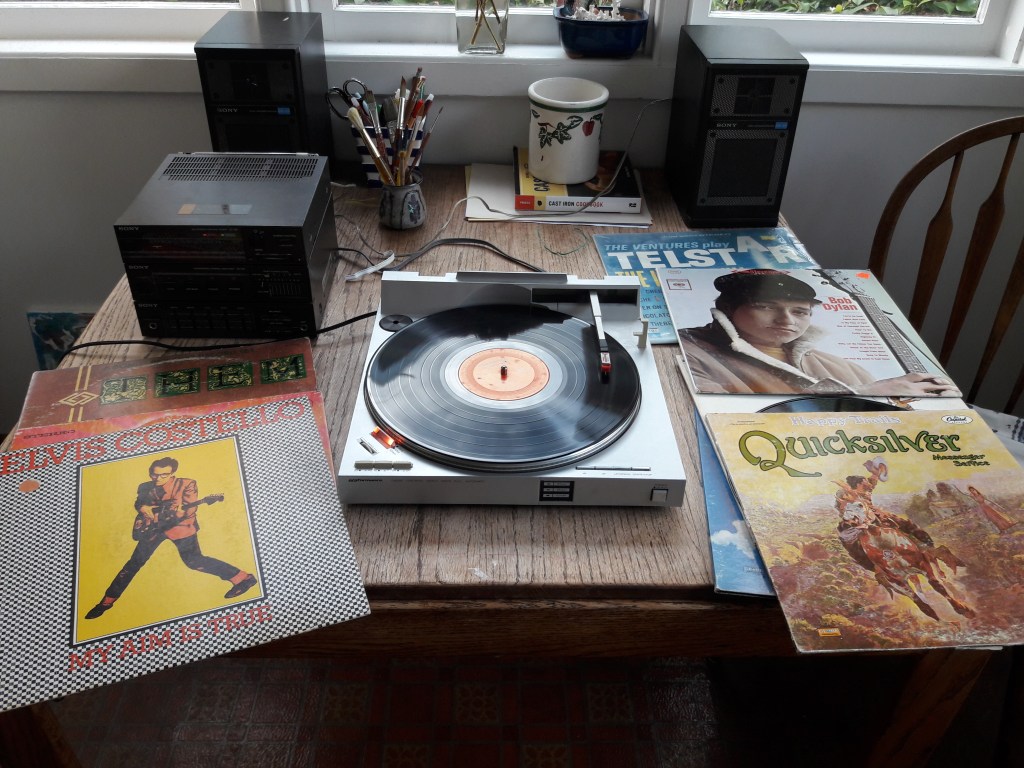
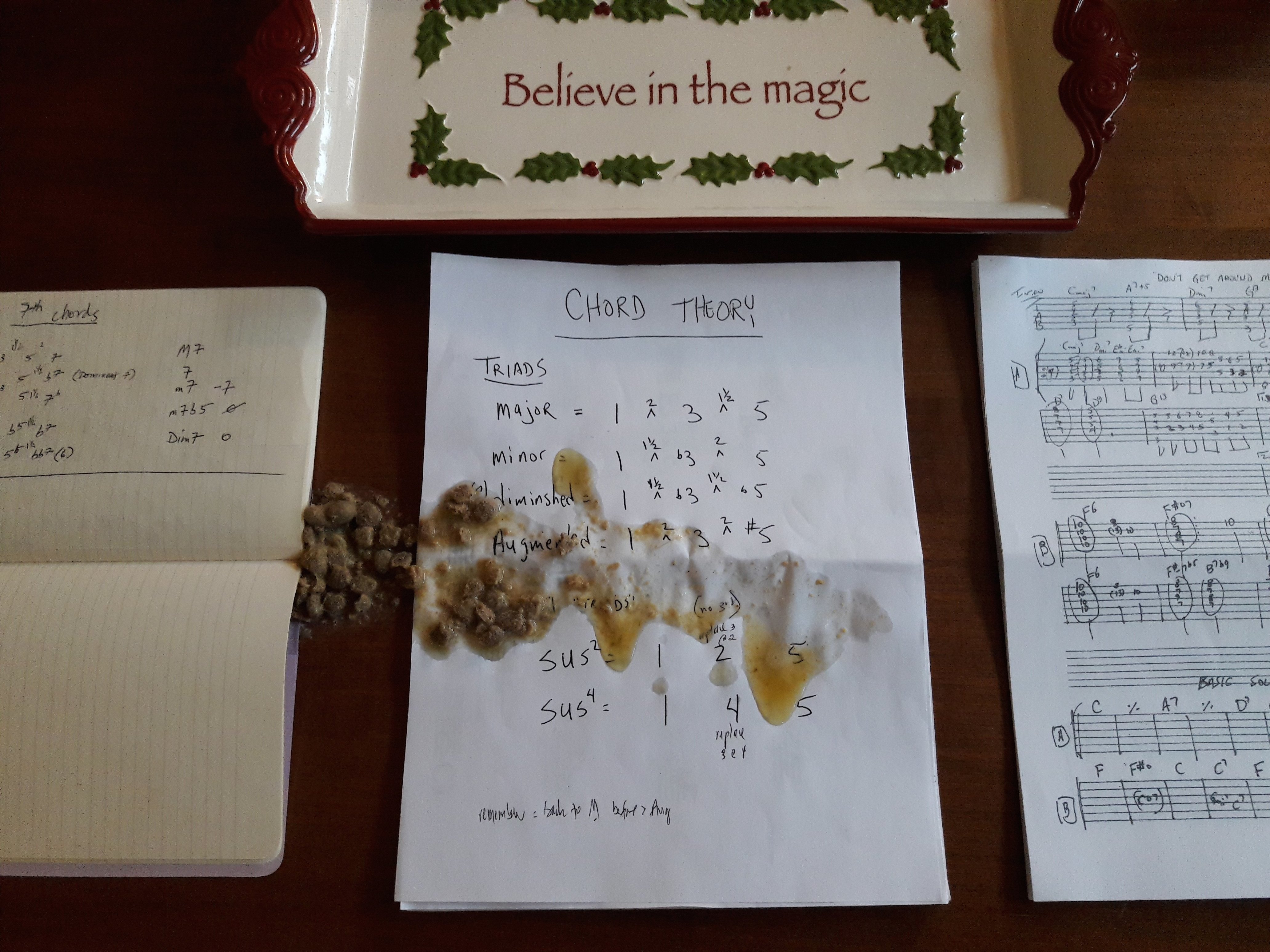
    Yesterday, home from the afternoon music theory class I’ve been taking, I organized my notes and handouts, reviewing each page. I left the pages in neat piles on the dining room table.

    This morning, I go to resume my music musing, and what do I find but the cat music critic’s overnight review – Zoe had barfed over my notes.

    Cats are excellent communicators. I’m glad she doesn’t tweet.

  • One Page Guitar Scales and Chords

    One Page Guitar Scales and Chords

    There are of course already a near infinite number of guitar fretboard studies available, and scads of 5,000 Guitar Chords and Scale books. What’s unique about this spreadsheet I put together is that it’s a one page reference. It helps if you first memorize the fretboard notes, but from there the “number system,” probably a simplification of the “Nashville system,” provides an efficient map for chord and scale fingering possibilities. I also wanted to learn how to attach a .pdf file to the blog. Click link below and check it out.

    One Page Guitar Scales and Chords


  • Triad Inversion Study for Guitar

    Place root note of chord on selected fret and use the number system to play triads moveable along the fretboard as indicated. Raise 5 to augment. Flat 3 for minor. Flat 3 and 5 to diminish.

    string
    1st R 3 5
    2nd 5 R 3
    3rd 3 5 R
    2nd R 3 5
    3rd 5 R 3
    4th 3 5 R
    3rd R 3 5
    4th 5 R 3
    5th 3 5 R
    4th R  3 5
    5th 5  R 3
    6th 3  5 R
  • Summer Notes: 6 – Vinyl Eve

    Summer Notes: 6 – Vinyl Eve

    Ray on
    Polly & Ester over
    Shell lack, the beach so far
    It’s a Beautiful Day
    for the Blues.

    His story film earlier
    Text I’ll yarn
    Den I’m hep
    Woe vane
    All dyed felting.

    More hair
    Flee C
    Mad as a more curious
    hatter,
    a chord eon.

  • Summer Notes: 5 – A Blues

    Summer Notes: 5 – A Blues

    In the morning, when the sun comes up
    In the morning, when the sun comes up
    In the morning, when the sun comes up
    Give thanks for this cup of coffee.

    In the evening, when the sun goes down
    In the evening, when the sun goes down
    In the evening, when the sun goes down
    Ballyhoo this cold glass of beer.

    At midnight, when the moon comes out
    At midnight, when the moon comes out
    At midnight, when the moon comes out
    Laud, laud the light.

  • We Are Sorry For The Delay

    We Are Sorry For The Delay

    I had answered my ringing house phone to a recording. I put the phone on speaker, set it down on the counter, and waited for the caller to come on live. The recording continued, as if with indefinite intent. I opened Garage Band on my laptop and recorded the message, later adding the other tracks with instruments and vocals.