Tag: Mechanics

  • This and That

    This and That had a quick chat.
    You go this way and I’ll go that,
    balanced on the brim of a hat.

    Said That, I which wish to set
    up this neither forget nor forgive
    any trespass near or far.

    As far as that goes, replied This,
    I’ll look forward to that there
    reminder, and with That,

    into the hat fell This,
    and next,
    out came That.

    Thus This fell forward nearby,
    while That fell far and away 
    back, and this chat was that.

  • Penina’s Paginations

    Penina’s Paginations

    For some, grammar might be understood as an attempt to control language, or to control a speaker. But the only way to establish complete control over a language is to kill it, which is probably or nearly impossible, because language possesses, like the planarian, the ability to reform or regenerate from a tiny piece of itself. I point to an object, and that is how grammar works. The object could be the sugar bowl on the kitchen table, the moon, or a running man. I link to it for the purpose of linking you to it also. But first, I have to get your attention. Of course, I can always point to myself, or point to an object by myself, like talking to myself, which might be one origin of poetry. When the objects we point to disappear, or others claim to be unable to see them, we come to the first existential crisis of language, where we find ourselves in grammar school, the subjects of rote repetition in an effort to create memory. In grammar school, we learn to wear a uniform.

    We learn to number our clothes. The hat, number 1. Or maybe we start with the shoes, the socks being a subset. First we put on the right sock, then the left, then the right shoe, then the left shoe. Never mind it’s a sunny day and we were thinking what fun it would be to go barefoot. To go barefoot, in grammar school, is one of the first examples of being ungrammatical. We are assigned a seat, a number in a numbered row, alphabetized and numbered in the numbers book. Having a number is essential when everyone looks alike.

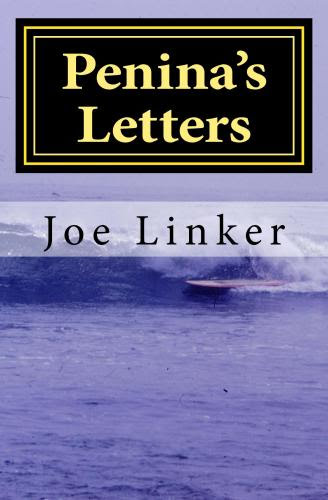
    So it was with a tremulous motion I finally approached my MS Word file containing my first published novel, “Penina’s Letters,” to correct a few unintended consequences. The first printing had contained an unacceptable number of typos, and the front matter setup has always felt a bit clumsy to me. The chapter listing page, for example, showed the chapter titles but no page numbers. And the ISBN didn’t show on the copyright page. But why the tremolo? Why not just go in and make the changes? I did manage one corrected copy upload, after the first printing back in 2016, ridding the book of most of the obvious errors, mistakes which, it pains me to admit, I had failed to spy with my little proofreading eye. But a few issues remained, as additional readings revealed, but the thought of entering the MS Word file again and resubmitting for revision to CreateSpace for approval with the hope of not making matters worse was all more than I felt up to. Besides, I now had other projects underway that required my attention.

    Then, a week or so ago, I was notified that CreateSpace was closing its doors and all texts migrating to Kindle Direct Publishing (KDP). So I took the opportunity to become acquainted with KDP by reworking the front matter of “Penina’s Letters” and fixing a trio of what I recognized as outstanding mistakes.

    My first submission of a redo file for KDP’s approval was rejected – something to do with pagination errors. Mercifully, the rejection came within the 24 hours promised, and I went back to work on the Word.doc before motivation waned, resubmitted again, got approval, ordered a proof copy, and voila! No page numbers at all.

    Suffice to say, after all that preamble and bramble, that for the past several days I’ve been immersed in a kind of MS Word pagination purgatory. Changes to a text often cancel out other changes, or sit on top of them, burying them below – but that suggests there is a top and a bottom to the thing, and of course there is not.

    I got page one to say 1 but could not get the other pages to follow suit. I got every page to say 1. And so on, nothing acceptable. I began to think, rationalizing and trying to come up with some creative solution, why bother paginating at all anyway? Does the common reader really need page numbers? And isn’t a page number a kind of mar on an otherwise illuminated manuscript page? I got page numbers to show, but not in the footer where they belong. I toyed with “different front page,” “link to previous,” “create section break,” erase all and begin again. Deeper and deeper into an MS Word morass I sank. I entered “document,” “paragraph,” the journeyman’s “tools.” Suddenly blank pages and huge gaps in the text began to appear throughout the manuscript. I fixed and corrected and proofed. At one point, I had a file with pagination complete that seemed correctly formatted. I resubmitted yet again to KDP, and the proof file came back still with no page numbers.

    I took a break from the project. I remember McLuhan saying something about pagination beginning with the printing press. The fall is into the printing press. Is there a page 1 to the Internet? In a mosaic, one may enter and exit anywhere. Page numbers are useless. There are no pages. There is the infinite scroll – over, under, sideways, down.

    “Backwards forwards square and round.
    When will it end, when will it end,
    When will it end, when will it end,”

    the Yardbirds sang.

    “We don’t need no stinking page numbers,” I can hear Puck Malone of “Penina’s Letters” saying. But in the end I managed somehow to successfully place page numbers on the outside edge in the footer of even numbered pages, in sequence, every other page. I seemed to recall seeing books numbered only on every other page. I looked through some books. Saul Bellow’s “The Actual” places page numbers only on the odd numbered pages, right edge of page, in the margin, spelled out, in italics: page one. Enough.

    Interested readers may utilize the “look inside” feature at Amazon to get an idea of how the new printing of “Penina’s Letters” came out.


  • Cyberpunk

    Round ears curl silver coils of sounds,
    across nose stands glass bridge in worm-fog,
    always under construction.

    Every sense a degree, and digression, and distraction.

    This is technology:
    rubber sneakers, cotton threads,
    titanium screw implants capped
    with fool’s gold.

    Then that hardened heart
    lumbering loose without nails
    full of sloth a snail’s shake
    ebbs & flows fickling & flicking
    comes & goes riding the tides
    like a pickle on smooth ocean
    swells rising then falling
    oily muscle lifting and dropping
    off to sleep, surly salty
    heart pickled in hope chest,
    just like a human heart.

  • Notes on Jessica Sequeira’s “A Furious Oyster”

    20180916_100653I was reading Jessica Sequeira’s debut novel, “A Furious Oyster” (Dostoyevsky Wannabe, 2018), when the 30 August London Review of Books arrived in the day’s mail. A book review should reveal something unexpected, but to do that the book under consideration must be heard in a whisper.

    I turned to the review of Zadie Smith’s latest collection of essays; the LRB reviewer, Thomas Chatterton Williams, quotes from Zadie’s foreword:

    “‘I have no real qualifications to write as I do. Not a philosopher or sociologist, not a real professor of literature or film, not a political scientist, professional music critic or trained journalist … My evidence – such as it is – is almost always intimate. I feel this – do you? I’m struck by this thought – are you?’”

    Later in the review, we might recall that quote and think Zadie is telling us something more, but on the slant, that where she comes from, who she is, who her parents were, the various markings often used for identity, also don’t necessarily serve as “real qualifications”:

    “‘Who am I to speak of this painting? I am a laywoman, a casual appreciator of painting, a dilettante novelist, a non-expert – not to mention a woman of lower birth than the personage here depicted … I am still the type of person who will tend, if I am in a public gallery, to whisper as I stand in front of the art.’”

    That ‘whisper’ is often precisely both unexpected and unheard. The whisper follows no code of style. The whisper comes after the existence of the writer, and describes her essence, her choices, her existential leanings, what she has decided to follow. The whisper is the writer’s breath. The whisper might also be how something is said, and is often paradoxical. The whisper breaks the piece, ruins the lecture, calls from the pit, stops the show. The whisper might be a prayer of praise or a heckle in time with popular opinions.

    There’s something else, too, about the whisper; it’s what most of us do who have no real qualifications. And out of all those whispers (the all but silent blogs, the self-published and distributed broadside, the furious but funny poem in the on-line lit-wall), which ones should we home in on? And why would someone whisper when already no one’s listening?

    Sometimes, of course, the whisper “goes viral,” bounces and echoes off walls, scampers up trees, drifts through subway tunnels. But who or what is the host for that sometimes poison, at times the scent of lavender? And it’s well known, though often not accepted, the virus does not respond to antibiotics, the stubborn use of which weakens the resistance.

    All noise dissipates into whisper, so it should not surprise us that John Cage’s 4’ 33’’ goes briefly viral upon each new discovery. We realize even the Big Bang was a silent singularity. Not only might the world end not with a bang but a whisper, as Eliot almost said in “The Hollow Men,” but the world probably began with a whisper.

    A whisper is not a whimper. A whimper is what comes out of a giant mouth at the end of a rant. A whisper is a careful timing of breath, a largo escape, patient. The whisper goes easy and around.

    “Although that isn’t quite right either: how to describe something like the voice of a person just out of sight?” (A Furious Oyster, 92).

    Hilda Mundy’s voice was far out of sight when Jessica Sequeira brought it back: “I don’t want them to punish me with comments” (Mundy, Pyrotechnics, trans. Sequeira, We Heard You Like Books, 2017, 17). “Them,” the “three-dozen readers laughing at the pages of my failure” (17).

    The whisper never fails: “I began to hear people whispering things to help me, advice. I don’t know whether those voices were really there or not, but they brought me serenity. They helped talk me through my situation, suggesting new paths, pointing out what I needed to do” (A Furious Oyster, 92).

    “I have great respect, in contrast, for the metaphor. This is that” (118). So when we are told Pablo Neruda has ridden a wave of energy from an earthquake or the ocean or some great storm to enter the realm of the living, we believe. “This is my body.” This voice, this word. The metaphor transfigures.

    Sequeira’s “A Furious Oyster” is diary, memoir, investigation, document, thesis, mystery, love story. Let’s “be clear,” there are “other realities” (55). The reality of the metaphor, for example. “Strong wills work even in the shadows of the afterlife” (Mundy, Pyrotechnics, 29). Does every word contain its erotic origin? “How pleasant and suggestive a couple in love is!” (Mundy, 34). “Would I want to live forever in this particular moment, this precise patch of time?…Her kisses alternate, soft and hard. I wrap my arms around her, but already her shoulders feel less firm; our time is nearly up. We must go back now, I know, I know. I know, and how I wish I did not” (A Furious Oyster, 38).

    “A Furious Oyster” is a story of two famous poets in Chile, Pablo Neruda and Pablo de Rokha, literary adversaries, it seems, but both driven by the sufferings and loves of the people of a place, a land, a geography, a structure, to reach out, to reach. The geography of Sequeira’s book reveals her interests in shapes: “Sometimes at night, I dreamed of these theoretical shapes – the rhombuses, the ovals, the diamonds, the ellipses of sub-arguments within the prose. I kept only one notebook, and the diary of my personal life merged smoothly into the most abstract of notes on these Chilean poets, here and gone before my time” (55). “A Furious Oyster” is also the story of a writer researching, composing, working, in a relationship, watching, listening. And it’s the story of a place, Santiago de Chile.

    Sequeira possesses that most unique of minds, the one able ambidextrously to move easily from the hard academic to the soft poet (or is it the soft academic to the hard poet?) within the same shape. The flow of “A Furious Oyster,” its style, is redolent of the Duras of the “Four Novels,” or Lispector’s way of creating mystery while unveiling surprises. I also thought of the modernism of Djuna Barnes and Anais Nin. Jessica Sequeira is a translator, a scholar, a writer. She both understands and comprehends literature. For those of us who can only comprehend, but feel we are indeed also “struck with this thought,” we can only whisper in her shadow that you really should read “A Furious Oyster.”

  • Pig Roast

    In backyard rock lined pit dug underground for roasting of pig.

    This yr pig day a hot one. The pig on a spit put into the pit by two strongest men, kneeling over the mouth, where a wood fire burning overnight has heated the rocks molten. The prepared pig at rest in the hot rocks, a sheet metal lid pulled over the hole. The pig cooks in the ground all this long hot day.

    Waiting while pig cooks, drinking beer, young men throwing horse shoes, kids playing capture the flag in the closed street, salads prepped inside in the kitchen (where a ceiling fan famously spins), watermelon slices and water balloon toss in the front yard.

    The pig pulls out early evening, after the old folks nap in the shade of the dusty eucalyptus.

    The planet spins, spit pointed this pole toward the sun, one hot stone roasting a pretty blue pig, green apples popped in its mouth.

    General agreement this yrs pig tastiest on record.

    “This heat keeps up, soon be fixing swine in the shade of the sun,” Mr. Picbred says, mouth swill of pig, popping a fresh beer, sitting in front porch rocker, plate on lap, feet up, breathing from his belly, watching our sun go down.

    global warming

  • Mending Walk

         on and on the walk       the low wall climbing       of something not

    the walk and come       bestrewn the hill       a wall of lifted stone

    and come to a low          or down the hill       a noisy neighbor

    to a low wall built       ascending or descending       harmonica

    wall built of loose       so much depends      on blazing a path

    of loose stones       deep ends       to hegemony

    some fallen       on perspective       from lines

    fallen strewn       which comes        from punctuation

    strewn dry weeds       seasoned start       to and fro

    on this side       of a mending       walk     meandering

    maunder and you reader on the other side other side

    of this wall wall wall wall wall wall wall wall wall wall wall wall wall wall wall |||
    wall wall wall wall wall wall wall wall wall walllllwall wall wall wall wall wall |||
    waaaaaalllllllalalalawallalalalawallalalawalllalalawall wall wall wall wall wall |||
    wallawallawallawallawallawallawallawallawallalwall wall wall wall wall wall |||
    of this wall wall wall wall wall wall wall wall wallwall wall wall wall wall wall |||


  • Some Comics Explained

    Some Comics Explained

    Words were never so simple as we were taught to believe. Tricksters of the trade make things look like all the chess moves were preordained. And if we are reading second hand, through the prism of translation, so much the better for our lack of understanding!

    and I quote
    “You said, ‘”and I quote…’”

    Words are not to understand, but to experience, to share, the ordinary daily world we work so hard at from being cornered.

    smiles
    The face prepared to meet the faces.

    Do we understand the invisible string of musical notes? What do they mean? Already heard and gone, and where did they go, these industrial sounds?

    apartment house
    Tenement

    Words work within their industry, economy, structures.

    performance
    Performance

    Dust particles, falling, drifting, piling up, the tongue the only rule, the teeth, lips, mouth.

    moon sea creature
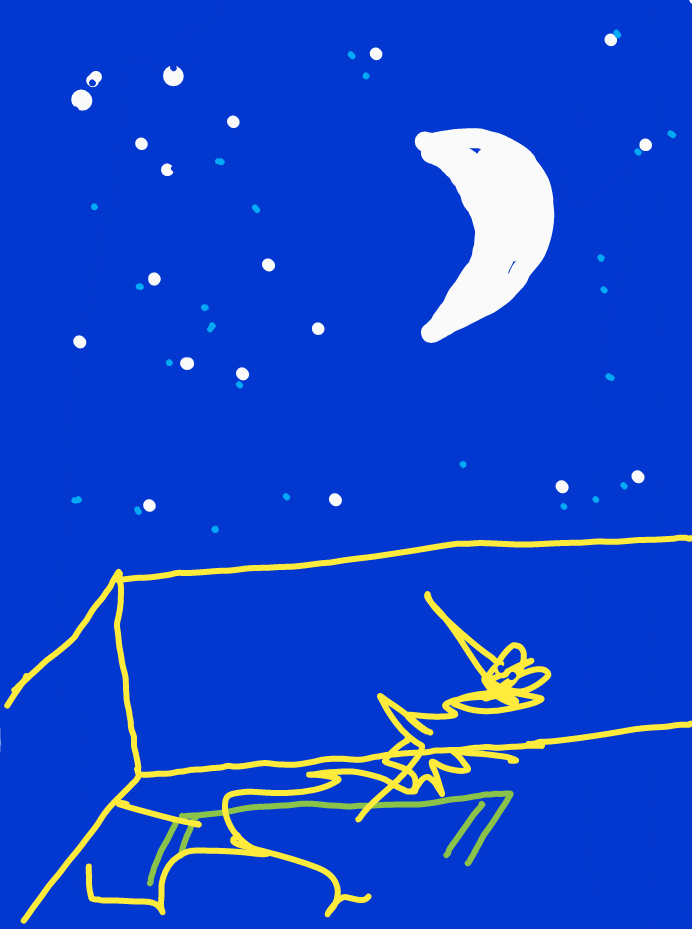
    The moon looked like a banana.

    The poem is an old thing, some kind of tool, maybe, an implement, but what was it used for?

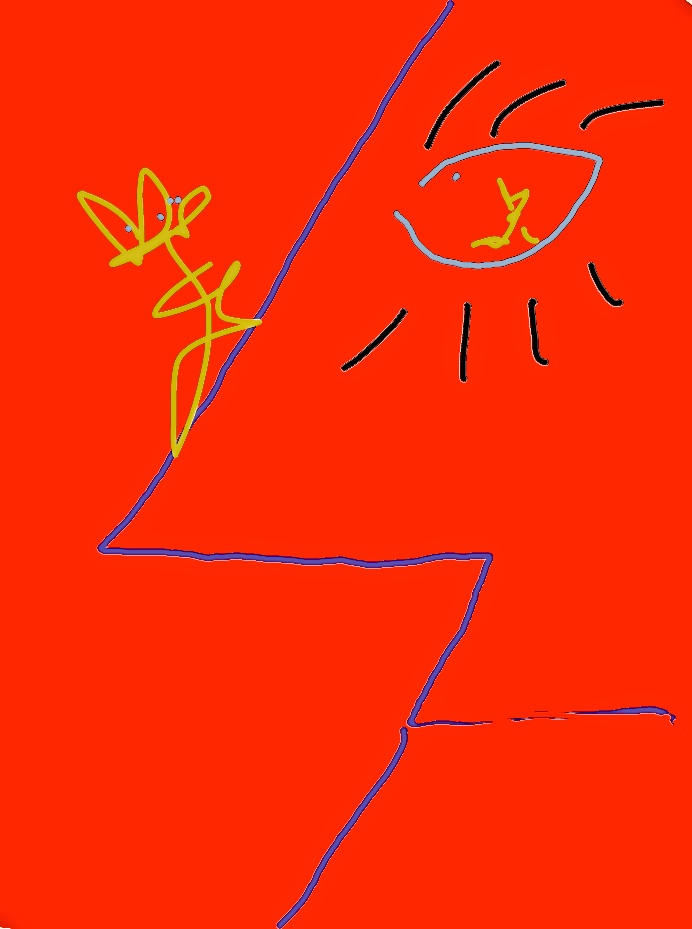
    eye floater
    Eye floater.

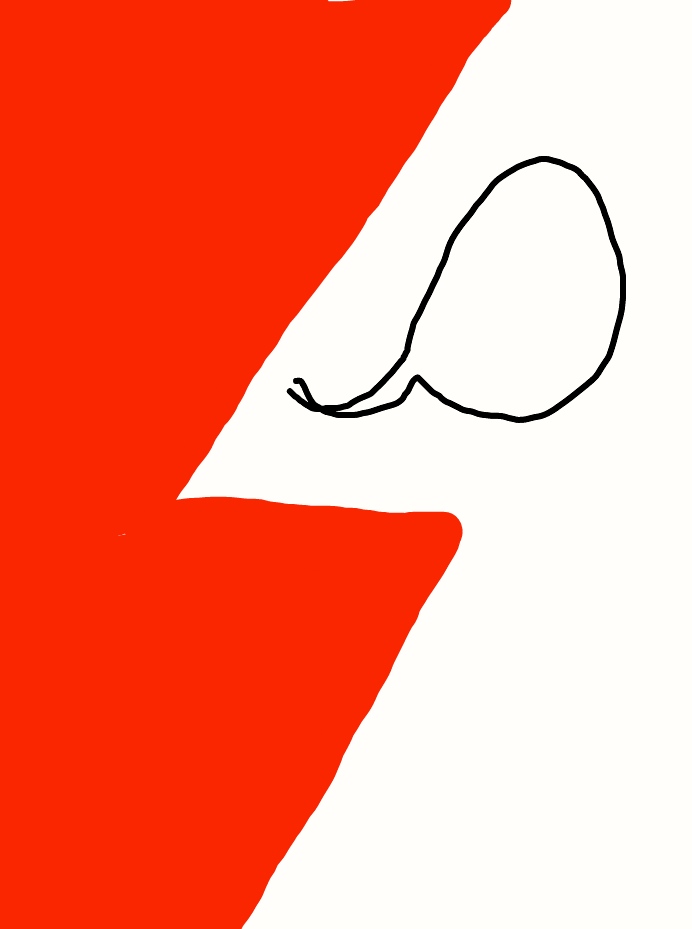
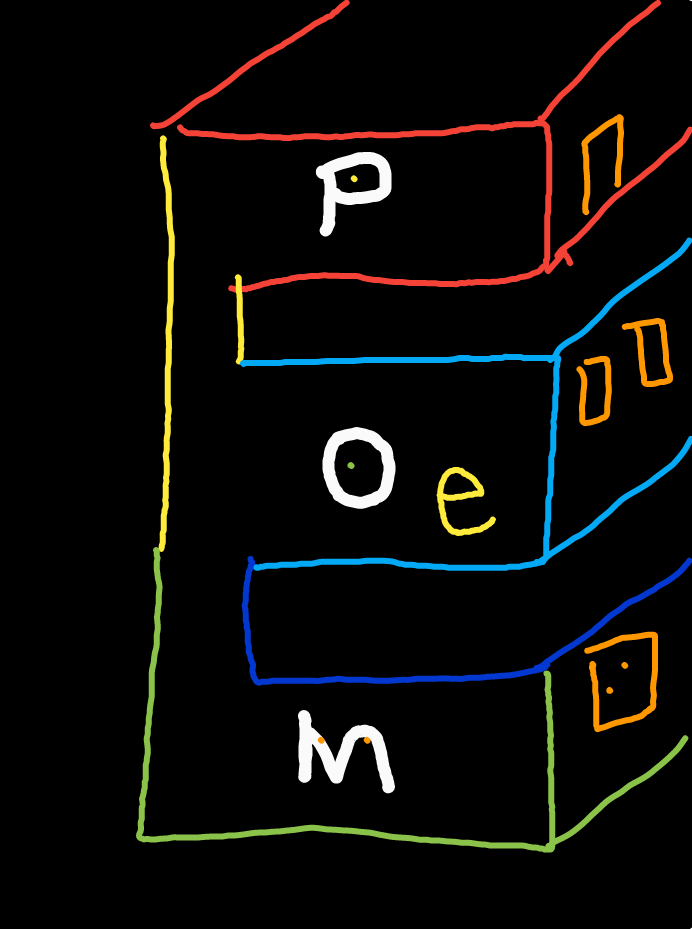
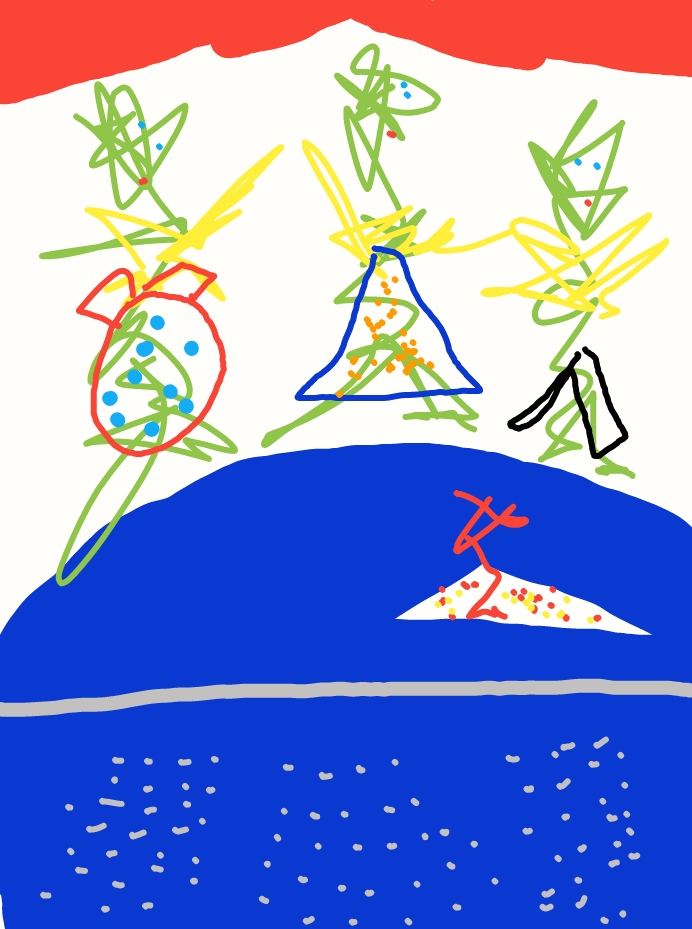
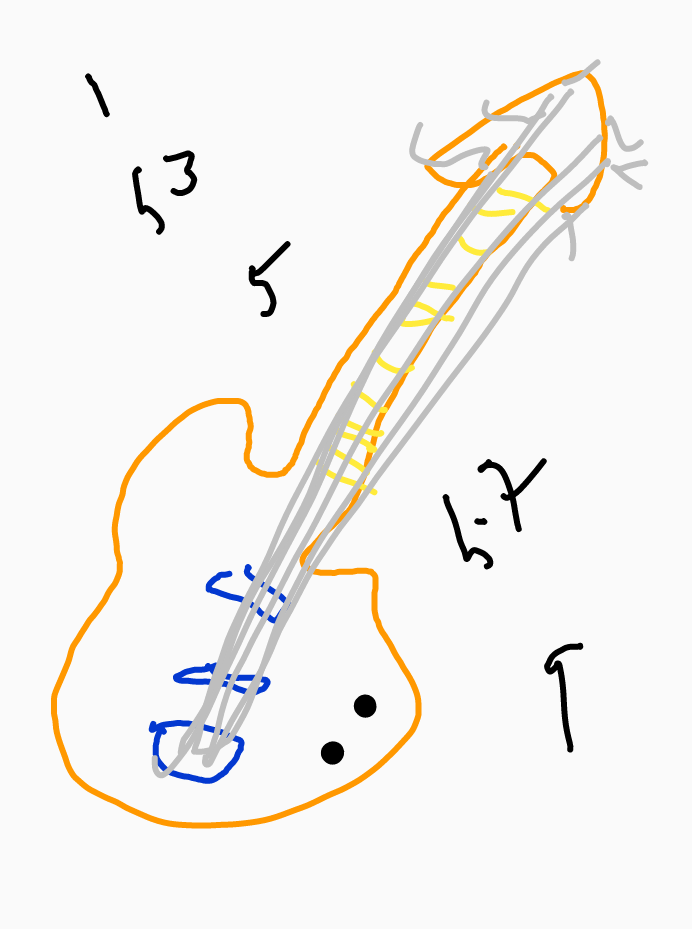
    He started off so serious, as if he were out to save something, someone. But first he had to persuade there was some danger. These comics, by the way, these unsophisticated, small-scale drawings, are made with fingers on the simplest of phone apps, with just a few basic colors, and no tricks.

    But mostly at night, in the middle of the night, when sleeplessness becomes comical.

  • Notes on “Pure and Faultless Elation Emerging From Hiding”

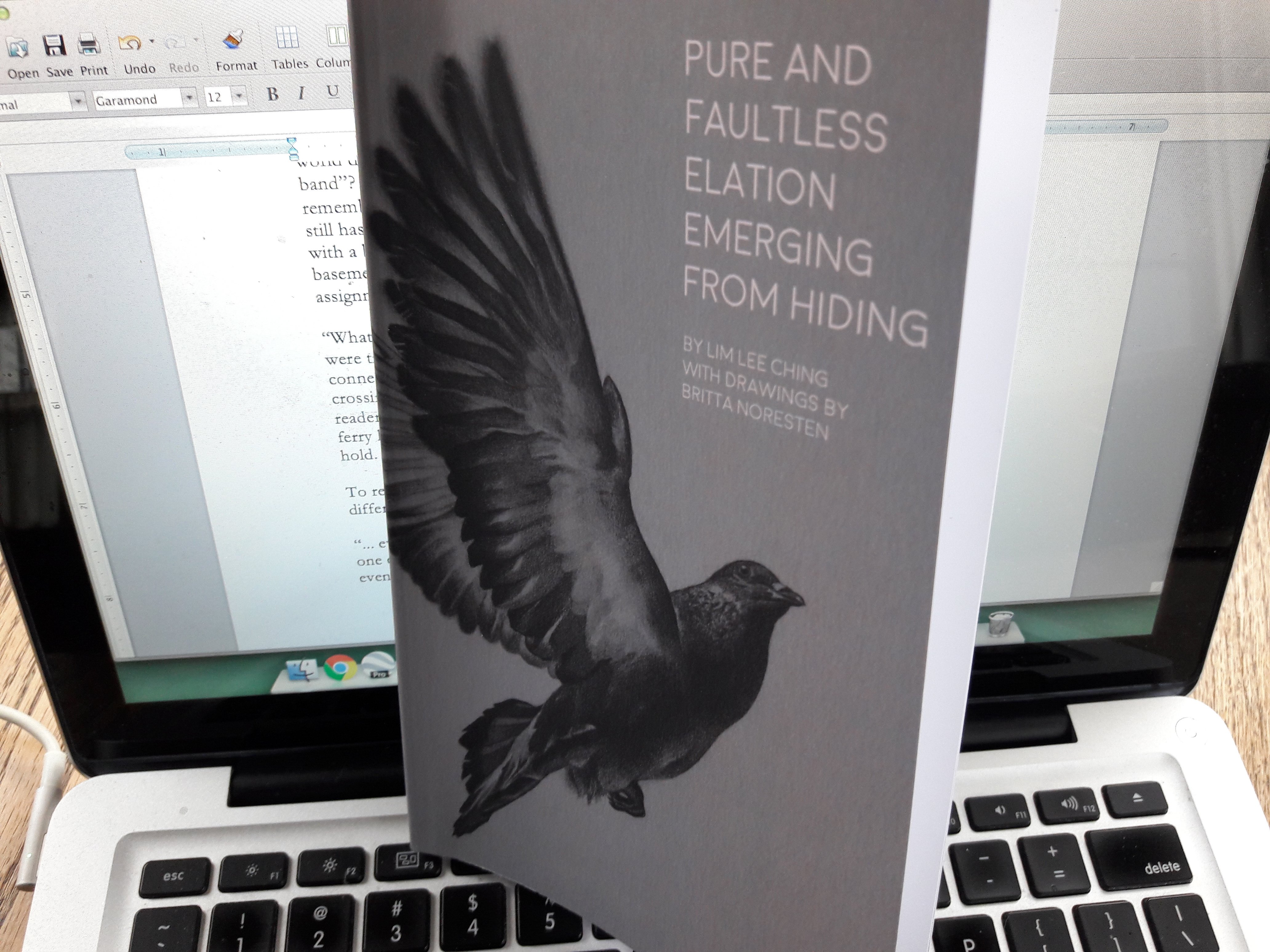
    Pure and Faultless Elation Emerging From HidingPure and Faultless Elation Emerging From Hiding, by Lim Lee Ching, with Drawings by Britta Noresten. Introduction by Neil Murphy and Afterword by Jeremy Fernando. Poems Sequenced by Mary Ann Lim. Layout by Yanyun Chen. Paperback edition first published 2017 by Delere Press, Singapore.


    In a December, 2014 interview with Sara Lau for Obscured, Jeremy Fernando talks about his vision for Delere Press: “We didn’t see the need to have a prescribed look for all our books – we recognize that we are a small boutique press, and we are probably going to remain that way in the foreseeable future. In the end, all we want to do is to create and publish something that shows the artists and the writers’ work in the most beautiful way possible.” “Pure and Faultless Elation Emerging From Hiding” is my second experience reading with notes intended for the Toads in response to a Delere Press work. Of particular note is the press’s intent “to provide a home for text and images that may not have a home otherwise, no matter what its geographical origins.” That the press attempts to do so with hard copy, illustrated texts, choreographed by literary troupe in our digital age is remarkable.

    “Pure and Faultless Elation Emerging From Hiding,” is a collaborative effort to book a collection of poems by a particular writer that becomes more than a sum of its parts. We have, maybe, become too familiar with books of hidden poetry. They line the shelves like butterflies pinned under glass. A poem does not begin like a fallen leaf pressed between pages of a book for bibliographical preservation. A poem begins as a particle, a photon, a piece of light that lands in the reader’s hands, a single note that enters the ears with a breeze, something that bugs the skin with an itch, as in, “something just bit me!” A book cannot preserve that piece of light except in fossilized memory. We may never hear that note again; it has joined the sound ocean waves make. The bug has lit, and we are left the proof of a small rash of the bed bug or lice visit. We jump into a bath of prose to escape the itching.

    When I say “to book,” I mean that pinned collection of specimens organized for study. To book is to create a model to look. The helpless reader must imagine the specimen fluttering in a heat of flowers. A poem may try to evade its predators (its digital critics) by hiding in the book:

    “Even as it might be chuckling, perhaps always
    laughing

                                                le rire du poeme

    A laughter from elsewhere,
    one that we perhaps cannot yet hear.
    Much like the silence of the sirens. Always perhaps
    already there,
    awaiting us.”

    That is from Jeremy Fernando’s “Et tu…A Prayer for Lim Lee Ching,” an afterword to “Pure and Faultless Elation Emerging from Hiding.” Other parts of Lim Lee Ching’s book of poetry include an introduction by Neil Murphy (“Lim Lee Ching: Bounded by Beauty”) and eight drawings of birds, spread throughout the book, by Britta Noresten. We are told the poems were sequenced by Mary Ann Lim and the layout composed by Yanyun Chen. All of those collaborators are called “contributors,” and they are given end-space so they too might become familiar to the reader. What becomes larger than the sum of the parts is that collaborative effort that creates emergence. What emerges is poetry from hiding, raising elation, poetry unshackled, flown like paper birds from the garret into a community, a society. Poetry is a question of community more important than mere self-expression.

    “The path is not tongue-tied,” Lim Lee Ching says. The path is there and people will walk it. The invitation, the invocation, is clear. But who are these people, these walkers (readers) of the path? “That perhaps is not so much the question, but quite certainly a question,” Fernando says, and “Keeping in mind Paul Celan’s beautiful, haunting, reminder that la poesie ne s’impose plus, elle s’expose. One might even say it opens itself” (93). Opens itself to itself, it’s self-same intuitions, which are its conventions, if you need “criteria” to read by, if mere light proves insufficient. We are on a path.

    When I first read “Quick Guide” (48), I thought I was to pick words from the text box on page 48 and insert them into one of the blank lines in the text on pages 49 through 51. I thought the path had come upon a Mad Lib.

    “Sometimes a show can be too new for its own good” (49), I suggested to myself, my choices being “first blue dark ripe new fast.” “Mad” is a choice farther down the list, and “sad,” and “bad,” if you want to rhyme. But now I’m not so sure. All the words in the text box are one syllable. There are 78 words in the text box, and there are 60 blank spaces in the text on pages 49 through 51. This is analysis. Am I analyzing a joke here? Is this humor? Of course it is! Let’s get the reader really involved!

    “It quickly becomes clear that part of the idea is to use humour to send up some of the ____________ attitudes still dominant in the art world. So, the pleasures of discipline are extolled, the players get their turn and pretentiousness gets a ____________ kicking” (50).

    Poetry comes without directions, or it should. Critics may provide some directions, using a kind of rear view mirror to describe the path now behind them. The critic’s notes may prove useful maps; then again, the reader may feel just as lost.

    The Poems:

    Beginning with “Ode to Everman” [sic], we hear repetition and a counting (accounting of things): cadence, marching, peace and piece, music piece, measured. Every man [who has ever marched, marching in a line, in a poem, to a tune, attuned]. Circumstance, the silence of Beckett (a ringing in the ears). Military “boom time,” “armed,” “beating” (12:13).

    Warren Beatty? How’s that for a surprise? Repetitions (‘One at a time”), words connected by sound: “cravat advocate” (14).

    “Unloading pomposity one at a time” (14), and again “…your / Penchant for pomposity” (22). Where “Iowa” is monosyllabic: “Impossibility of authenticity” (22).

    Numbers as poetic concern, things counted, measured, “Halved too far” (15).

    “Cull” illustrates the poet’s task. The poet fishes, on a perch, for a perch. But who are the “armed men”? Look how quickly we can move from river to city:

    “Waiting and baiting on the narrowing perch,
    The centre holds them still.
    A trunk, a branch – of streets and lanes,
    Of skinny legs and weathered shoulders” (17).

    Suggesting weathered soldiers, readers. Again, a military, a line: “Of fight, of fright, / And frenzied feeding against stained walls” (17). Desire is impotent. Who will teach that?

    Then we turn the page to a drawing of a bird, not quite but almost black and white, but more, the feeling of a bird in flight, perhaps in the night, or a fog, or over a grey sea. We resist the impulse to anthropomorphize. But it’s clinging to a small branch. Building a nest? Very few birds fly solo. What a world this must be, to a bird. In any case, to cull is to pick, peck, at words.

    “Only the facts remain” of Ryan White, who picked up a “Contagion.” Only our germs remain. You build yourself a bomb shelter against the fallout, but you are yourself a germ, a bug, rising, falling. So much fear. “Only the facts remain” (20). Facts survive. If we’ve lived for any length of time in a refugee camp, we have germs. If we’ve lived any length of time in a bungalow in Des Moines, we have the same germs. We are emergent, emerging – emergence, as writer merges with reader, something more. Is that pompous? Is poetry a contagion? After the poem, what remains?

    “Bookmarks” is a longer poem, of which there are several in the book, prose blocks, not non-lyrical, but not lyrics. But not prose, and not blocks, scrolls. We keep to the first word of each line capitalized, giving the line that authority accustomed poetry, but the lines are not necessarily sentences, not in the usual sense:

    “Only the words remain to be spoken, the writing to be sung
    Of happinesses witnessed and tongues tied
    In full contemplation of the idea of ideas” (24).

    Who inhabits the space of an idea? “…not…king, colonel or clown, / Nor the realm of whisperers seeking to please” (24).

    An idea (ideology is not ideas, Trilling said: Ideas malleable, suitable for poetry; ideology fixed). Idea of order in things (Key West shells, beaches, cocktails, dandy diamond Wallace Stevens). “Not ideas about the thing, but the thing itself,” Stevens said. No idea except in things (Williams, Paterson, Book I):

    “—Say it, no ideas but in things—
    nothing but the blank faces of the houses
    and cylindrical trees
    bent, forked by preconception and accident—
    split, furrowed, creased, mottled, stained—
    secret—into the body of the light!”

    I’m in “Bookmarks,” and I’m reminded of Blake (where I left plenty of bookmarks), “Proverbs of Hell.” “Adagia”? Erasmus’s collection of proverbs. In any case, Lim Lee Ching says:

    “The source of ignorance may well be reluctant pursuit.”

    “The cult of stability and singular meaning
    Diminishes ascendant beauty, delight and breath-hope.”


    “Persistent therefores are fallacious,
    They bind while unleashing the gateward push” (25).

    Prayer, cadence, repetition. Whose tongue is tied praying, writing, reading poems? The scat of the song ruins the stutter, but the poet’s many tools are not obtrusive:

    “Whispery songs of woven trances,
    Of ancient wisemen oozing” (27).

    Cadence as old steps (“the fragrance of remembrance”) might lead to disappointment, even depression: “Accord each a place in abjection” (27).

    But isn’t time directionless? What does it matter if we are moving forward (in desire, in anxiety) or backward (in memory, in loss). For-word. Back-word. The poet spends time in a backworld, where the citizens speak backward.

    “Penance is the province of princes, not poor men” (28), which brings us to T. S. Eliot:

    “Here lies the awakening
    Of the dispensation of an age,
    Dismissing the certainty as one in many
    [where]
    The faces put on meet the faces within” (29).

    Ideology is a “contagion.” Is poetry the antidote?

    And again birds, before a song breaks the spell of the litany. Something lonely about the bird drawings. The birds are not in nature, or even in the city, but alone, each its own poem, each drawing its own poem, saying the same thing, but in different expressions. Where do we see these birds? In sky that is like a sea: grey-green; blue-grey; slate; cliff chalk white.

    “Song” (34): Blake of the Songs – song, rhyme, cadence, hope, safe, heart, metaphor for what? Can the reader, too, be one of the “players of the heart”? (35).

    “faithful” (37), religious or spiritual, sound but abstract images, nothing of the kitchen full of dirty dishes or the toilet in the bathroom in need of cleaning. Not Bukowski here. And I’m still hearing Blake of the Songs. Which is lovely, lyrical, song. I try to remain a faithful reader.

    We’ve had our song, now the “Road Rises” as the reader falls. Mix of pop culture with “village.” The “tenderizing songs” of Elvis. And “Plastic Jesus” – the perfect image on the dashboard desires deconstruction, a theory to explain its presence, or disappearance.

    Then again I’m reminded of Frank O’Hara, Kenneth Koch, but not Stevie Smith or Marianne Moore. Not a statistician. Enjoys punctuation that helps, not simply follows some rule. Writing as accretion, addition. I find something interesting, a two word form, in “Shallowbreath”: “ribboned arches…winded depths…cobbled many…meddled few…celebrated warmth…allayed smokememory…displaced upon…hounded the highroad… …warmed eyes.” We could be in London or Singapore or Dublin. Joycean, that “smokememory.”

    A short, lyrical, litany ends, “And then there is you.” Do birds prepare for flight? Always at the ready, never slack, like cats, never napping in clear sight. Are birds keen to fly? “On the station platform prayer beads change hands” (57). Partnerships.

    “A Gazal” (58). What gets rhymed, and why, and what gets repeated, and why? For song, for the sake of song in which we have something to keen. Poetry gives form to the broken. What is unbound cannot be broken again.

    The poems seem to call on a kind of philosophical muse, hard thought. Yet that thought’s softness comes through in poetic style, the form and shapes, the lines, the breath, the flows repeated and measured. The writing seems logical, in the same way that Kafka may appear logical, or Borges, without dismissing the nonlogical. The first person is not paramount. Others are. And when I appears, it’s Meng Jiang (61). If we continue to break what is broken what do we become? Minerals? Salts?

    Little poems of “love and faith” (65). What more can a reader ask for? The reader comprehends the poetry without necessarily every line understanding it.

    Nijinsky appears (66). The last time I saw Nijinsky in a poem was at El Camino, around 1969. Stephen Jama passed out a poem he had written, typewriter print on colored paper. Some students got a green sheet, others a yellow, others blue or grey. Never white. “And the world dies, Adonis on its lips,” I think I recall, at the top. And Nijinsky was “dancing a band”? No, dancing I forget what. And there was a “tousled laugh.” I wish I could remember that poem. It’s lost now. I don’t think it ever made it into a book. I wonder who still has their copy. I kept mine for years, then one day without reason tossed them all, along with a box of my own stuff. I was knee deep in the red dust by then, cleaning out the basement, lost in the dust. Maybe it’s poems “belong only to the night” (67). Jama’s assignment was for us to read the poem and then to write a response. Birds in flight.

    “What I have written, I have written,” Jeremy Fernando says in his afterword. Would that were true of what I have written. But what I have read, I have read. Fernando attempts to connect writer to reader: where does poetry, that space of water we seem to want to cross, a crossing, from the shore of sleep to the loading docks of day – poetry the ferry full of readers unbound from one shore, paddling for the opposite – what path leads down to the ferry launch? When the poem laughs, is it the reader laughed at? That is a cynical view many hold.

    To read is to experience. Any attempt to make some other sense of that experience is a different matter:

    “… every try, any trying, perhaps even trial, is not just haunted by misreadings, over-writings, one cannot even underwrite it with the certainty that reading has taken place, that one has even read” (77).
  • Diary: How to Improve the Text (You Will Only Make Matters Worse)

    textsDiary: How to

    Improve the Text (You Will

    Only Make Matters Worse)


    John Cage titled his diary, “Diary: How to

    Improve the World (You Will

    Only Make Matters Worse)” (1965),

    suggesting a zen koan where every move

    in one direction is a move in another direction.

    Cage was not too into the game of chess,

    that was Nabokov. Were they neither control

    freaks? One looked down on the ground

    for mushrooms, the other up in the air for butterflies.


    Listen to the music mushrooms make:

    shiitake, for example.


    “Nothing to be done,” Beckett said, and he said

    it more than once: “Nothing to be done.”

    Again and again, recycling the words,


    imagining a future without retail,

    which entailed imagination, the tale

    of dead malls, hollowed out shells,

    shelter for the homeless.


    (artificial intelligence:

    “all watched over by machines

    of amazing grace,” Richard Brautigan said.)


    What if anything is artificial? Artifice, father, creator:

    The true ecologist loves garbage, Slavoj Zizek said,

    and, we must become more artificial,

    if we are to comprehend the universe,

    a grasping together. GASP! (Taylor, Examined Life).


    Every thing is recyclable, even no thing (as Beckett showed),

    all things crawling with recycling bugs chewing,

    the textual droppings of these bugs crawling across the page

    two streams of ants, one going, the other coming:

    ant ant ant ant ant ant ant ant ant ant ant

    tna tna tna tna tna tna tna tna tna tna tna.

    The ants smell textual clues.


    The job of being

    human

    altruism and community, signage,

    the shape of mouths, lip tools,

    tongue, teeth, mouth to ear, surplus

    age, a pantry of letters, a kitchen of words

    a living room of text, a bed of books,

    a shelter of stories.


    It probably never was the best of times

    and self-pity to call any time the worst of times.

    The people bored march on nothing.

    Blog is dead, someone said, sweeping up,

    blogging, only dead if you thought

    that; otherwise, it was still

    “lots of fun for everyone!”


    Retail is dead, the tinker said,

    stirring her pots and pans;

    on the other side of the street,

    a drone drops a text.


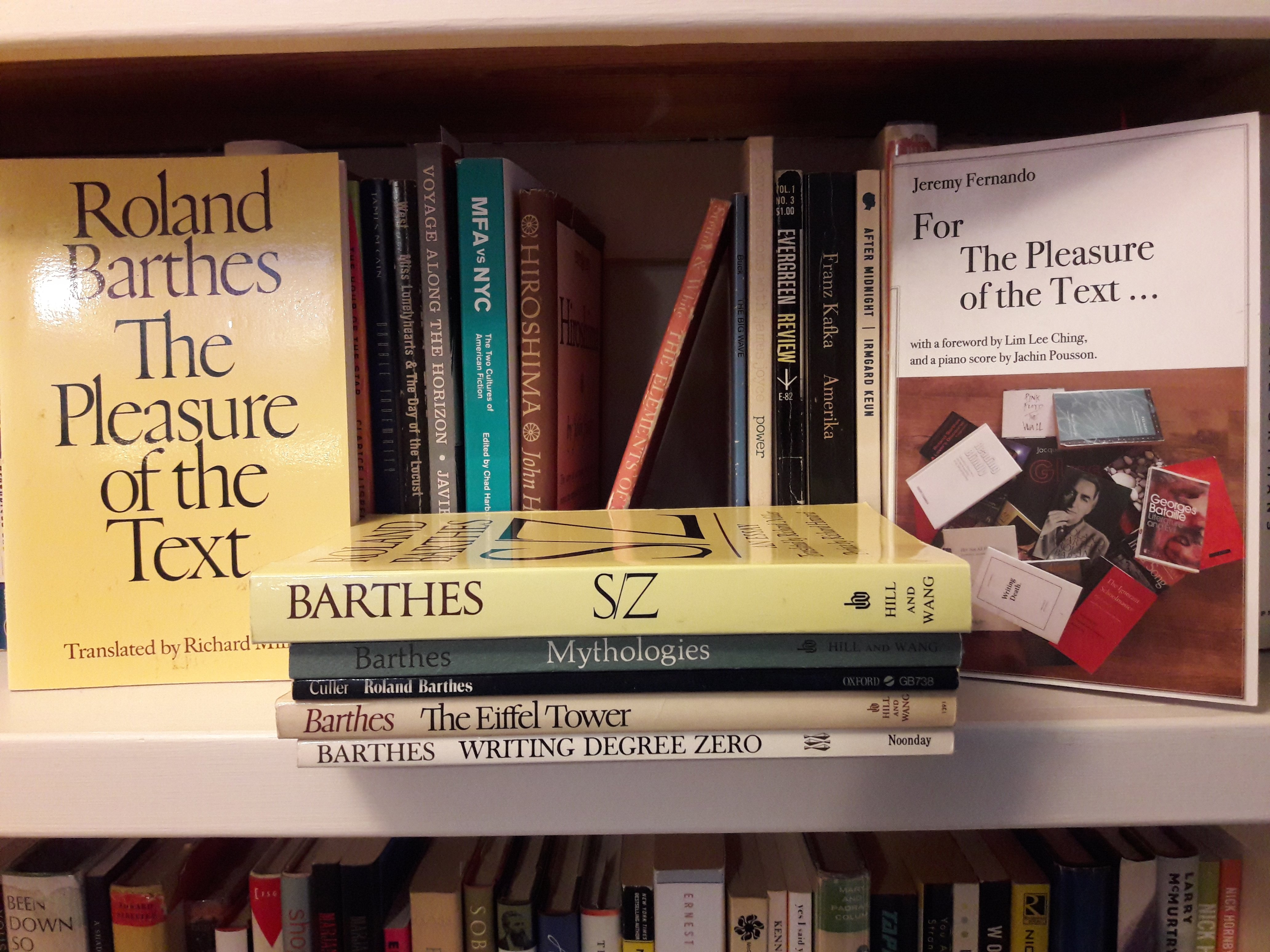
    In “For

    The Pleasure

    of the Text…,” Jeremy Fernando explains how

    text comes into being when reading, comes and goes, his book

    full of marginalia mushrooms, the writer a saprophyte,

    pages flipping to and fro like butterflies, and as hard to find,

    the text always disappearing, pages not mumbered [sic],

    but we know where to look

    for mushrooms and the colors butterflies prefer.


    When speaking of the universe, keep in mind nothing is factual; everything is argument – claim and rebuttal, recycling. When speaking of the text, keep in mind everything potentially purposeful, so yes, the most effective writer knows not what will be read, can’t be sure of what’s being written. That is one pleasure of the text, the not knowing, uncertainty, ambiguity – the taking and eating of a strange mushroom, an invasion, a landing, of alien butterflies. Beckett said we can’t listen to a conversation for more than five minutes without noting inherent chaos. Yet some writers abhor ambiguity and seem to think they write with clarity. What is clear is that nothing is clear, in spite of grammar.


    Understanding the text, or attempts to understand one’s own comprehension of the text, are subservient

    to experiencing the text. One can only begin to experience the text by giving in to it, which is to say,

    consuming it, mouthing the words, eating the text, licking the letters, smelling the ink’s decay.

    The text is a meal which like the mushroom can be distasteful, cause belches or gas, even be poisonous.

    One might prepare for a heartburn of the text, but that heartburn is part of experiencing the text. The

    metaphor grows stale, corny. Halt. Stop. Let us retire for a break in the text to some hops.

    The text plays itself out.

    text
    g UL p
    ale

    The reader returns to the text, changed, reader and text, both changed, a bit tipsy, textual vibrations: screen shots of textual cuts, rips, woven riffs, quotes like on a guitar, but cited for the newly planted who need authority to get established, but why would one want authority over/under/sideways/down another? textual authority to pass testual [sic] authority, getting testy this, this authority, King Ibid on his throne in the kingdom of Where Did You Get This Weave? There can be no misreading, only the experience of reading: vicarious. Author as vicar, vice advice, a writing vise.

    a grammar of the other

    another

    other

    mother

    moth (lex) toward the light

    mouth (law) toward the dark

    declension

    every text an attempt to improve

    which worsens

    writing as self-medicating

    for which there is no cure

    curator

    mother

    a text that cures

    Watt Ales


    what is the meaning of an unpaginated (upainted) text?

    citations as reproductions, pics of texts

    folder paper, where the lines are the bedrock

    of grammar, the grammar of the text –

    the reader creates the ungrammatical (including typos)

    as the police create crime (cite N+1)

    calls into question any misreading

    “justesse of any sentence” (JF, PT)

    ripping through the text, pulling quotes out

    disrupting the horizons of folder paper lines

    horizontal disappearings

    a following silence until a new text swells

    the crowd disperses, the text shelved.


    In the middle of the text we find a pic

    of “Anatomie” (Ibid: 180), and this

    quoted:

    “To write the body,
    Neither the skin, nor the muscles, nor the bones,
    nor the nerves, but the rest: an awkward, fibrous,
    shaggy, raveled thing, a clown’s coat”

    so we get at once
    Love’s Body (Norman O. Brown)
    Beckett’s clown
    & Bob Dylan.


    Next comes the pun: body > corpus

    and “authenticity” – the authority

    of the corpse, already with us,

    and the illuminated manuscript,

    backlit screen.


    And don’t miss the three asterisks.


    A typo it appears? (Elfriede Jelinekl) in the text, part of the text; typos are like black holes. They suck in the light. Some readers delight in seeing them (schadenfreude), but perhaps the typo corrects one’s vision. Certainly they test it. Typos are purposeful. Theory of accidents.


    Musical interlude, listen, an invisible text. Music as language must be translated. “Happy New Ears,” Cage said.


    …now to dreaming:

    the experience of reading. experience is not

    necessarily evil, a song of experience is not

    a song of evil – nor is a song of innocence

    necessarily a song of good. depends on text.


    No more links, likes, or comments;

    and if you don’t like this post at the Toads,

    take it up with JF’s RB, or RB’s JF.


    The bits about death, or Death? One prefers breath, or Breath! One might here sight [sic] Walt Whitman or Charles Olson, but there follows a sketch (portrait), not traced, there are rules, after all – yes, but whose rules?

    The rules of the text:

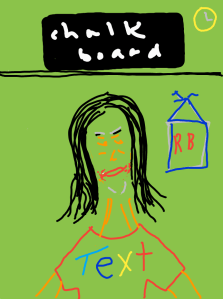
    JF and RB by JL

    ~~~

    the text tails off

    them’s that’s got it

    Vonnegut footnote

    inventions (externalizations)… to be continued, continue to be

    References

    Fernando, Jeremy. (2015). For The Pleasure of the Text… {etc.}

    references


  • One Page Guitar Scales and Chords

    One Page Guitar Scales and Chords

    There are of course already a near infinite number of guitar fretboard studies available, and scads of 5,000 Guitar Chords and Scale books. What’s unique about this spreadsheet I put together is that it’s a one page reference. It helps if you first memorize the fretboard notes, but from there the “number system,” probably a simplification of the “Nashville system,” provides an efficient map for chord and scale fingering possibilities. I also wanted to learn how to attach a .pdf file to the blog. Click link below and check it out.

    One Page Guitar Scales and Chords