Tag: McLuhan

  • Nicholson Baker, Nicholas Carr, and Googling Clothespins

    Nicholas Carr might argue I got stupider this week, and I admit that I did spend more time than usual on Google. Carr’s influential Atlantic article, “Is Google Making Us Stupid?” (July, 2008), has been picked up by the English teaching gaggle to promote reading. I’m going to save that argument for another time and place. One of the first to use Carr’s article, I did not use it to promote reading, but to discuss the elements of argument; for now, I want to explain why I spent more time than usual on Google this week, and show what I found. The first is easy to explain; I discovered Google Patents. The second is easy to show – clothespins. Here’s what happened.

    I came across one of my old Joseph Mitchell tri-folded reporter note sheets and realized I had never followed up on a note I had made to research a section in Nicholson Baker’s The Anthologist, a novel about a procrastinating poet, whose ruminations, while stalling to write an introduction to a new poetry anthology he’s put together and found a publisher for, produce, in the end, the introduction itself. My note was to research something I found interesting on page 116 of Baker’s novel. Baker’s poet, Paul Chowder, staggers into a discussion of clothespins, and makes this claim: “There was a factory in Vanceborough, Maine, that made eight hundred clothespins a minute in 1883.”

    I boarded Google but failed to find the factory. Growing stupider by the minute, I looked up clothespins in Wiki, where a claim is made that the Shakers invented the clothespin, but they didn’t patent their inventions. Patented or not, it would seem that the clothespin, technologically an extension (as McLuhan might explain) of the human finger and thumb clamp, must surely predate the Shakers.

    The paperclip might be an evolutionary relative of the clothespin, as shown by my research in Google patents. To the left, is a drawing of a patent by A. W. Burch, dated July 2, 1907. The pin is made of wire, and appears to have been inspired by the paperclip.

    Many patents seek to improve upon ideas already patented and manufactured; for example, Roy V. Shackelford, of Long Beach, California, was granted a patent in 1939 for a clothespin that “attached to a line in such a manner that the clothes which are fastened in the pin never come in actual contact with the clothes line.”

    Sarah J. Miley, in 1898, wrote a patent that discouraged traditional one piece bifurcated wood clothespins from splitting in half, through the addition of a metal  “stay plate” in the handle end (drawing left).

    It might have been a stupid week, but I will never look at a clothespin the same again, nor a paperclip, for that matter, nor the possibilities for the extensions of the human for inventions that we call technology.

    As for Nicholson Baker’s factory, how many clothespins do we need? The answer to that might be found in A. R. Stewart’s invention (drawing below), patented in 1874. It’s not a clothespin; it’s a machine to make clothespins. The Shakers didn’t need to patent their clothespin because they had no intention of mass producing and marketing it; if they needed another clothespin, they would simply make a new one. Manufacturing, like specialization, leads to extinctions.

    Stewart’s patent application, titled “Improvement in Machines for Making Clothes-pins,” does not mention the number of clothespins the machine is capable of producing per minute, but instead describes a machine “capable of forming a perfect clothes-pin at each downward movement of the saw and cutters, and, as the finished pins are removed by the same upon their upward stroke, no other attention is necessary except to supply the blanks to the hopper.” The improvement seems to be found not in the quantity of clothespins produced, but in the saving of labor required to produce them. I thought of Melville’s Bartleby: Ah technology! Ah, humanity!

  • Where readers eSurface but authors lose control

    One advantage of the eBook is lightness. And library books “just disappear” from the little light box on the due date – so no overdue notices, an article in this week’s Christian Science Monitor (print edition) illustrates (we’ve noticed our print books disappearing occasionally, reminding us of bumbling Polonius’s advice, “Neither a borrower nor a lender be”).

    We read a gloomy hope, for at least reading is in the headlines: gloomy in that “deep reading” is failing; hopeful in that readers appear to be surfacing. Some consider that’s a problem. The CSM article references Marianne Wolf, whom we first glimpsed in Carr’s “Is Google Making Us Stupid,” still concerned about the loss of “deep reading.” But “deep reading” may simply be floating, detachment: “The alphabet and print technology fostered and encouraged a fragmenting process, a process of specialism and of detachment,” McLuhan said.

    Carr, Wolf, and others are concerned that electronic reading is changing brain circuitry. Of course it is: “All media are extensions of some human faculty – psychic or physical…Media, by altering the environment, evoke in us unique ratios of sense perceptions. The extension of any one sense alters the way we think and act – the way we perceive the world. When these ratios change, men change,” McLuhan argues: “Electronic circuitry is an extension of the central nervous system.” If that’s so, then what? The end of books?

    The eBook returns us to the middle ages, before copyright, before individual authors, before fixed points of view. The problem for some is now authorship and ownership: “Medieval scholars were indifferent to the precise identity of the ‘books’ they studied. In turn, they rarely signed even what was clearly their own…Many small texts were transmitted into volumes of miscellaneous content, very much like ‘jottings’ in a scrapbook, and, in this transmission, authorship was often lost” (McLuhan). Sounds like blogging.

    “We’re not going to change the code,” Reid Lyon says. No, we’re not, but perhaps readers will, or non-readers – perhaps the code is changing (under our very ears), for, as McLuhan argues, it’s impossible to be illiterate in a non-literate culture. We may be coming close to “the end of the line.”

    McLuhan, M. (1967). The Medium is the Massage. Bantam Books.

  • This Is Your Brain On Books

    Over at the Frontal Cortex, Jonah Lehrer has posted his review of a new book about the effects of the brain on reading: Stanislas Dehaene’s Reading in the Brain. Lehrer says that the “moral of Dehaene’s book is that our cultural forms reflect the biological form of the brain; the details of language are largely a biological accident.” We’ve not read Dehaene’s book yet, but Lehrer’s summary seems to suggest a symbiotic relationship between the brain and the brain’s environment.

    To understand the effects of reading on the brain, one must go to non-literate cultures, and study, as Marshall McLuhan researched, the changes that occur in both the brain and the culture as reading is learned. “The most obvious character of print is repetition,” McLuhan said, “just as the obvious effect of repetition is hypnosis or obsession” (p. 47). It’s impossible to be illiterate in a non-literate culture, and non-literacy has its advantages.

    When we read, we are hypnotized, the eye becomes master of the sensorium, the remaining four senses impressed into eye-service. The hypnosis blinks when the eye sees an unfamiliar word, and the tongue and ear have to help out: “we’re forced to decipher the sound of the word before we can make a guess about its definition, which requires a second or two of conscious effort” (Lehrer). This means that the new reader must mouth his words as he reads (since all the words are unfamiliar to the new reader); he must hear them first. This is why, according to McLuhan, “the medieval monks’ reading carrel was indeed a singing booth” (p. 115). They had not yet learned to read silently. They had to say the word and hear it; the words entered the brain through their ears, not through their eyes. (This supports using a phonics method to teach reading.)

    Lehrer says that Dehaene “also speculates that, while ‘learning to read induces massive cognitive gains,’ it also comes with a hidden mental cost: because so much of our visual cortex is now devoted to literacy, we’re less able to ‘read’ the details of natural world.” Again, this ground was covered by McLuhan in The Guttenberg Galaxy: The Making of Typographic Man.

    “Literacy,” McLuhan argued, “affects the physiology as well as the psychic life” (p. 45). McLuhan said that “every technology contrived and ‘outered’ by man has the power to numb human awareness during the period of its first interiorization” (p. 187). And this is the ground that Nicholas Carr has been sifting though with regard to the effects of the internet on reading and on the brain.

    It’s curious to hear Lehrer, not quite a neuroscientist (which is one reason we like him; he’s a non-specialist), say that “the brain is much more than the seat of the soul…,” curious in that he resorts to both metaphor and the metaphysical in a single phrase. “The seat of the soul”: surely that’s your brain on books.

    June 6, 2010 Update: Jonah Lehrer takes some of the wind out of Nicholas Carr’s neuro-sails in a Times review of Carr’s book The Shallows and in a follow up post on his blog.

  • APA Caution: Metaphor Crossing

    We don’t find E. B. White adhering to APA guidelines. It’s more palatable monkeying with rats if one denies them human characteristics.

    One rule that hasn’t changed in the new 6th edition APA manual concerns a warning against the use of metaphor, specifically anthropomorphic connotations (p. 69). One may not use metaphor; the question is, can one not.

    Camus avoided metaphor in The Stranger, creating an anti-man. For McLuhan, technology is metaphor, extensions of the senses. For Norman O. Brown, in Love’s Body, language is metaphor; to avoid metaphor is to avoid language: “Metaphor is mistake or impropriety; a faux pas, or slip of the tongue; a little madness; petit mal; a little seizure or inspiration” (p. 244). It’s easy to see why the APA wants to avoid it. On the other hand, “Freedom is poetry, taking liberties with words, breaking the rules of normal speech, violating common sense” (p. 244), in short, jazz. But metaphor is ambiguous, and that’s what we must avoid: “Psychoanalysis, symbolic consciousness, leads from disguised to patent nonsense – Wittgenstein, surrealism, Finnegans Wake” (p. 245). In “VII” of Love’s Body, titled “Head,” Brown lights out for the territory, ahead of all the rest: “Psychoanalysis shows the sexual organization of the body physical to be a political organization; the body is a body politic…a political arrangement arrived at after stormy upheavals in the house of Oedipus…a well-organized tyranny” (pp. 126-127). And if one wants to avoid sex, of course, one may go in for the corporate body, where the head sits at the top, and gets dibs on the first parking space.

    Metaphor begins with sound, and poetry begins with being tricked by sound: “…cuckoo(‘s)fool, maid(en, mate, the Wryneck, which arrives at or about the same time as the cuckoo” (OED, mate).

    So, in the 6th edition of the APA manual, we find this: “Correct: Pairs of rats (cage mates) were allowed to forage together. Incorrect: Rat couples (cage mates) were allowed to forage together” (p. 69). But, first, pair is no better than couple. Since the 13th Century, at least, the OED gives us, pair has been used to describe a married couple; indeed, the denotative meaning of pair is couple. Second, the offensive word in the passage (taking the APA view of metaphor as something to be avoided), is not pairs or couples, but mates, for a mate is one of a pair, a partner in marriage, a lover. The denotative meaning of mate, from the OED, is “A companion, fellow, comrade, friend; a fellow worker or business partner,” and only an E. B. White can handle a rat as all of these.

    The poor rats, coupled in their cage, denied by the APA their very coupling, for, again, as the OED gives us, couple means “That which unites two. 1. a. A brace or leash for holding two hounds together.” Alone, together; together, but separate: like humans, a condition that can only exist in some cage, in cagey logic.

    And what of cage? From the OED: “I. Generally and non-technically. 1. A box or place of confinement for birds and other animals (or, in barbarous times, for human beings), made wholly or partly of wire, or with bars of metal or wood, so as to admit air and light, while preventing the creature’s escape.”

    Note “in barbarous times” suggests time past, but no longer: we wish, for language is our cage, a pair of gloves with a missing mate, a decoupling of experience.

    If we want to avoid metaphor in the APA example given on page 69, we suggest: Rats were allowed to forage together, in cages, separated two by two. Lovely, isn’t it? Then again, were the rats allowed out of their cages to forage? Can one forage in a cage? Perhaps rats can, but still, an even greater problem than pair, couple, or cage is found with the word forage, for a forager is a messenger, though one may forage for oneself. Do rats “plunder, pillage, ravage” (OED, for forage)? No, only humans forage, as we have done here, within the cage of our blog.

  • Rolling Stone’s 50 Reasons to Watch TV

    The cover story of the September 17 issue of Rolling Stone gives us the best reasons to watch television. It’s all about content, of course – not a word about form.

    Marshall McLuhan, in Understanding Media, gives us the real best reasons for watching TV.

    “With TV, the viewer is the screen,” McLuhan says (p. 272), and he foreshadows the same arguments that currently occupy Nicholas Carr and others. “The introspective life of long, long thoughts and distant goals…cannot coexist with the mosaic form of the TV image that commands immediate participation in depth and admits of no delays” (McLuhan, p. 283).

    Carr recently blamed the end of book culture on internet habits. McLuhan was writing before the invention of the personal computer, but Carr’s focus still repeats McLuhan’s claim: “The phenomenon of the paperback, the book in ‘cool’ version, can head this list of TV mandates, because the transformation of book culture into something else is manifested at that point” (McLuhan, p. 283). But then Carr goes off track. Carr thinks print culture is about deep thinking, but it’s about living on the railroad, and has little to do with all of Carr’s deep sea metaphors, as McLuhan explains: “The American since TV has lost his inhibitions and his innocence about depth culture” (p. 283).

    McLuhan illustrates that it’s impossible to be illiterate in a non-literate culture. It’s not yet clear what this might mean placed into the socially ubiquitous phenomenon of PC literacy. E. L. Mayo gives us a clue perhaps with his political (and perhaps the best yet) reason for watching TV in his short poem “The Coming of the Toads,” where TV, while perhaps the ugliest medium a book cultured person can fathom, flattens social stratification.

  • Bio-Lego-Land: Building a Better Body thru Metaphor

    In the September 28, 2009 issue of The New Yorker, we meet synthetic bio-Lego-boys Drew Endy and Rob Carlson: “Some of my best work has come together in my mind’s eye accompanied by what I swear was an audible click, ” Carlson tells New Yorker’s Michael Specter, who says Endy has never forgotten “…the secret of Legos – they work because you can take any single part and attach it to any other – in 2005 Endy and colleagues…started BioBricks Foundation…to register and develop standard parts for assembling DNA” (61).

    What if Norman O. Brown had grown up playing with Legos? Would he have named Love’s Body, Lego’s Body? In Chapter XV, “Freedom,” Brown says that “Metaphor is mistake or impropriety…a little madness…a little seizure or inspiration” (244). 

    “The glory of God is to conceal a thing, but the glory of the king is to find it out…,” Brown quotes Bacon in McLuhan (Gutenberg Galaxy, 190).

    “Feet off the ground. Freedom is instability; the destruction of attachments; the ropes, the fixtures, fixations, that tie us down” (Brown, 260). 

    William Blake, in The Marriage of Heaven and Hell, drew the modern man: “The head Sublime, the heart Pathos, the genitals Beauty, the hands & feet Proportion.” Let’s hope the synthetic biologists mix their metaphors mercifully, for “A fool sees not the same tree that a wise man sees,” Blake said; nor the same Lego, for that matter.

    More on the genome of metaphor.

  • From bookface to facebook

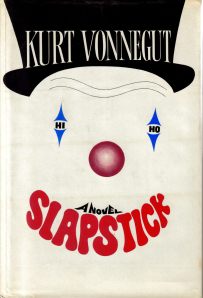
    SlapstickWhy facebook? Why not faceweb? The web is not a book. Then again, what is a book? What is a web? The web is like an illuminated manuscript.
     

    We used to call prolific readers bookworms, their faces buried in books. Bookworm is a misnomer; worms are quite social, as my compost pile reveals. But the bookworm does prefer the warmth of an open, airy book, lives within the book. The bookworm feeds on the book, a moist book, an organic book, destroying the book in the process of reading it, a deconstructionist.


    facebook…facebook, face + book, already a metaphor, specialized. Books are sequential, linear; facebook is mosaic, multidirectional: The face as book, borrowing book as ethos for the face that is prepared, so a face with credibility, reliability, with a fixed point of view. Really? Eye contact; I contact, enter-face. “Manuscript culture is conversational if only because the writer and his audience are physically related by the form of publication as performance” (McLuhan, [The Gutenberg Galaxy], 1962, p. 105). Webworm.
  • From the Gutenberg to a Gatesian Galaxy

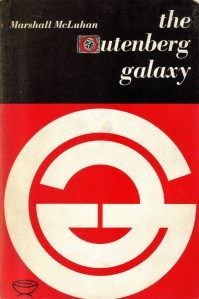
    the Gutenberg galaxyMadison Avenue was first to show interest in McLuhan’s ideas. What were those ideas? He did not argue an aesthetic, as Nicholas Carr seems to want. McLuhan would certainly miss books, if change came to that. Every new technology alters the sensorium. Is Google making us stupid? Who’s us? What is stupid? Google’s effects are more political than aesthetical: Blessed are the dull for they shall watch television; blessed are the sharp, for they also shall watch television. Blessed are the stupid, for they shall google.
    And what of the internet? McLuhan would argue that the internet has not yet invented its content. Every new technology fills with the content of the old; Google’s book project is the reductio ad absurdum of this McLuhan tenet. If the printing press resulted in nationalism, marginal man, individualism, privacy, what will the effects of the internet be? Certainly to reinforce the concept of individualism, but without the privacy (facebook, blogging) – truly a global village, a political effect.

    When we think, we are already googling. Every technology is an extension of our senses or body, as McLuhan said and showed, and he would have argued that the internet is an extension of our central nervous system. Sitting at the internet, we are watching the reflection of our central nervous system at work. What do we think of that, and how does that make us stupid?

  • Eca de Queiros and a Metaphysical Googlelarity

    McLuhan, The Medium is the Massage: An Inventory of EffectsWe know technology changes us, rearranges the sensorium; the printing press, for example, gave the eye dominance over the ear, as McCluhan explained. But is technological change bad for us? What do we value? What do we want? We survive by our abilities to adapt; change is irrelevant. The question shouldn’t be “Is Google Making Us Stupid?” but, is Google making us happy?

    In Eca de Queiros’s The City and the Mountains (1895, new Margaret Jull Costa translation from New Directions, 2008) civilization is defined and confined by its “machines and instruments” (p. 50): “Defeated, my Prince slouched into his study and did the rounds of all those machines intended to complete or facilitate Life – the Telegraph, the Telephone, the Phonograph, the Radiometer, the Graphophone, the Microphone, the Writing Machine, the Adding Machine, the Electric Press, the Magnetic Press, all his tools and tubes and wires…” (p. 120).

    There’s even a link, 1895 version: “Then, desperately, he linked No. 202 up with the telegraphic wires of The Times, so that his study, like a heart, would pulsate with the whole Social Life of Europe” (p. 114-115).

    But the ruling class isn’t happy, and getting on their machines does nothing to improve their foolishness: “Like some icy, melancholy sun, the Electricity blazed down on the silence and on the pensive immobility of all those backs and all those décolletages. From each attentive ear, cupped by a hand, hung a black wire, like a piece of intestine…superior, civilized beings devoutly and silently drinking in the obscenities Gilberte was bleating down the line at them from beneath the soil of Paris, through wires buried in the gutters, close by the sewers…” (p. 62-63). They are all logged on, severally, to the “Theaterphone.”

    The problem is the city, civilization, machines that lack the ability to bestow grace: “But the City has its most deleterious effects on Man’s Intelligence, which it either imprisons in banality or drives into wild extravagance” (p. 93). The city lights do not illuminate most of its inhabitants: “If the illusion of the City could at the very least make all the people who maintained it happy, but it patently fails!” (p. 94). And so they leave for the mountains of the title, taking only a small part of the “super-civilized Prince’s sumptuous collection” with them.

    Were it 2009, would they be taking their laptops, which, like Stevens’s jar in “Anecdote of the Jar,” would likely jar the nature of the mountains and their own alike, like nothing else in Portugal? We find out in the second half of The City and the Mountains.

  • Strangers to the future

    When Nicholas Carr tries to walk a straight line in the web, he’s a different kind of stranger in a strange land. Google’s goal is not to make us smart, but rich, a goal it has surpassed. What passes for smart in the land of Carr is linear and vertical, long and deep, but what is it? Here’s a clue: deep dives like War and Peace can’t be comfortably experienced on the web, where readers value clarity, conciseness, and the ability to jump around with the speed of a photon.

    Carr complains about blogging and bloggers, but his real lament may be for the adulteration of the professional writer’s medium, for the paid writer is accustomed to being compensated a spot in the box, but now has to sit in the general admission seats behind the center field fence with the blue-collar fans.

    McLuhan said each new medium fills with the content of the old (e.g. vaudeville > radio > TV), before it develops its own content, and that every technology is an extension of the senses. He thought electronic media an extension of our central nervous system; no wonder we feel wired and jittery sitting at the computer surfing the web. And we prefer our posts short, with a picture or two; for what’s a book without pictures and conversations? Go ask Alice.

    Blogs are not usually filled with essays. When they are they surely get skimmed by surfer-readers, one of Carr’s complaints; but isn’t that the way we read newspapers (mosaics) and most periodicals (mosaic-hybrid-newspapers)?

    Carr claims that internet reading distracts us from linear and deep thinking, thus making us dumb. Linearity and “deep-reading,” the ability to read in a straight line for a long time, holding one’s intellectual breath long enough to absorb the view deep down, are capabilities Carr values, but he can’t prove that without them we grow stupid. Moreover, he’s filling the new medium with old content, which can only last temporarily, according to McLuhan. 

    McLuhan, paraphrasing David Hume, said in Understanding Media: The Extensions of Man, “…there is no principle of causality in a mere sequence. That one thing follows another accounts for nothing. Nothing follows from following, except change. So the greatest of all reversals occurred with electricity, that ended sequence by making things instant” (p. 27). In choosing War and Peace to reason his claim, Carr signifies his value, for why didn’t he choose Finnegans Wake? “In other words, cubism, by giving the inside and outside, the top, bottom, back, and front and the rest, in two dimensions, drops the illusion of perspective in favor of instant sensory awareness of the whole. Cubism, by seizing on instant total awareness, suddenly announced that the medium is the message. Is it not evident that the moment that sequence yields to the simultaneous, one is in the world of the structure and of configuration? Is that not what has happened in physics as in painting, poetry, and in communication? Specialized segments of attention have shifted to total field, and we can now say, ‘The medium is the message’ quite naturally” (p. 28).

    It’s not clear that Carr wants people to think as much as he wants them to think like him, not what he thinks, necessarily, but the way he thinks. The issue in controversy asks if the internet is changing the way we think (of course it is), and then asks a question related to the quality of thinking, but a different way of thinking is not automatically a worse way of thinking. The brain adapting yet again is not proven a bad change. Carr’s argument, that internet reading is making us stupid, suggests we were smart, but there’s unfortunately inadequate evidence to support that claim also. In any event, by the time we can determine if the change was for the better or worse, it’s likely that the written word as we now enjoy it will be a relic or fossil of some earlier culture. We are all strangers to the future.

  • What will happen to books?

    If everyone stops reading, what will happen to all of the books? Two suggestions come to mind, one from “The Time Machine,” by H. G. Wells (1895), the other from Ray Bradbury’s “Fahrenheit 451” (1953).  

    In the Palace of Green Porcelain, the Time Traveller wanders “… out of that gallery and into another and still larger one, which at the first glance reminded me of a military chapel hung with tattered flags. The brown and charred rags that hung from the sides of it, I presently recognized as the decaying vestiges of books. They had long since dropped to pieces, and every semblance of print had left them. But here and there were warped boards and cracked metallic clasps that told the tale well enough” (chap. 8, p. 103).   

    The first “Time Machine” movie (1960) contains two scenes worth mentioning that are not in the book. The talking rings scene was suggested by record albums, but, in a current reading, the rings are predictive of CD’s; the other scene is the crumbling book in the Time Traveller’s hands, and his sweeping of the books on a shelf into dust as his Eloi companion, Weena, looks on, with no comprehension. The Time Traveller returns home, tells his story, then returns to the future – in the movie, with three books (which books, we don’t know), but in the book, he’s seen preparing to leave, “a small camera under one arm and a knapsack under the other” (chap. 12, p. 137), but what’s in the knapsack, we don’t know.   

    Ray Bradbury, in “Fahrenheit 451,” imagined a different, but similarly bleak, future for books, one in which books are illegal, and if found, are burned by special firemen – for everything else in this future society is fireproof. But at the end of the book, the fireman Montag, now a fugitive on the run, having betrayed with books and deserted the force, discovers a band of outlaws living outside the city: “We’re book burners, too. We read the books and burnt them, afraid they’d be found. Microfilming didn’t pay off; we were always traveling, we didn’t want to bury the film and come back later. Always the chance of discovery. Better to keep it in the old heads, where no one can see it or suspect it.”  

    McLuhan, “The Medium is the Massage:” “’Authorship’ – in the sense we know it today, individual intellectual effort related to the book as an economic commodity – was practically unknown before the advent of print technology… the invention of printing did away with anonymity, fostering ideas of literary fame and the habit of considering intellectual effort as private property. Mechanical multiples of the same text created a public – a reading public… the idea of copywrite…was born…As new technologies come into play, people are less and less convinced of the importance of self-expression” (pp. 122-123).