…from an old notebook, around 1988:

A Notebook – Since 2007

I once spent a lot of time going to a lot of meetings where I took a lot of notes but also doodled a lot. Sometimes my neighbors showed an interest in my doodles, but not often. Over time I developed a disregard for the term a lot. A lot is used a lot as support for an argument, but a lot of the time a lot is too imprecise to properly fund a decision. Nevertheless, a lot of people got away with using the term a lot a lot.
Apart from its imprecision, a lot is unpalatable. A lot lifts off the tongue but cuts itself short, unlike alas, aloof, or aloft, which all seem more complete and satisfying. A lot carries no drift.
A lot of people think a lot is one word: alot. What’s a word? Speech flows, a syllable stream, often alotadoo about nothing. Punctuation helps, but punctuation is a kind of stop animation. A lot of the time, punctuation can only approximate the real speed of speech. Writing is divorced from speech. We are taught from a young age to separate our tongues from our eyes, the quicker to read. Poems often use stop animation technique to slow readers down, to get the reader to mouth the words, to taste the words, chew them. Words become salt water taffy in the poet’s mouth. A lot of poets suffer bad teeth, yet poetry is not fast food. A lot of poets are poor.
A lot tells an amount, but how much is it? Lots and lots. Compared to what? A lot of the time a lot is used with the time: a lot of the time. There seems to be some connection between a lot and time. A lot of the time the meaning of a lot is understood from context. It rains a lot in Portland, but still, there are a lot of different kinds of rain. A lot of the time, I think it’s raining, but it’s not wet outside. Those are good days to get a lot of yard work done.
What’s the opposite of a lot? Is there an antonym for alot? Alittle. In “Silence,” John Cage’s book that I come back to a lot, there’s a little story about a couple who live in Alaska. Someone asks them if it was very cold last winter. Not too cold, they respond, only a couple of days, they explain, did they have to stay in bed all day to keep warm.
Then again, a lot of the time, memories go awry, amiss, askew. While I read a lot in “Silence,” I had not recently read the little story about how cold the winter was, so I thought I’d better look it up. I glanced through “Silence” a few times, but I couldn’t find it. I then thought it might be in John Cage’s book “A Year From Monday,” and it is, on page 138, but there’s no mention of Alaska, and there’s no couple, just “a woman who lived in the country,” and there were more than a couple of days, “three or four days,” she says, but she does say “we had to stay in bed all day to keep warm,” so maybe that’s where I got the idea there was a couple. It’s a very short story: 44 words total.
Not a lot, but sometimes (maybe that’s the antonym) a lot is allot, as in allotment. I’ve reached the number of words allotted for this post. Not a lot.
“Overrated and abused, underrated and reused, hyperbolized and underused, understated and overstated, restated and retracted, excused and double-downed, drowned and rusticated, nailed to a wall and drawn on a scroll, ignored and explored, welcomed and turned away, painted and scrawled, yelled and whispered, tattooed and erased, written down and written up, spelled out in the bottom of a tea cup.”
The above quote is from the comment stream to a previous post: “Bob Dylan & Clarice Lispector: Bewildering, Transfigured & Redeemed.”
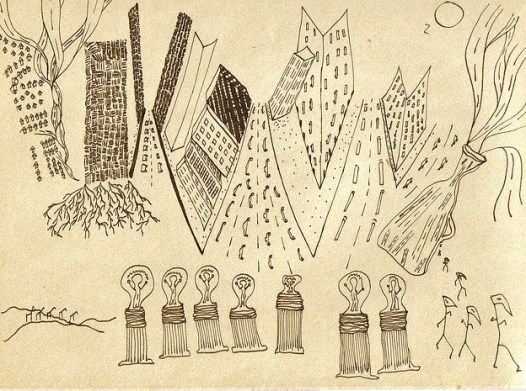
The drawing above I made years ago, the paper now yellowing. I wanted to title the drawing “Leaving the City,” or something like that, “City Life,” but the drawing might somehow be appropriately titled “Words,” for the city is constantly in commute, the exchange made with words; our world is filled with words, sounds rising, mixing in the froths and foams – the city yeasts of ambition and commerce, change and exchange, the city a sea of words that act like yeasts, fermenting. Inside each car a radio no doubt adds to the mix, each car an oven full of baking words.
At night, a bread of crusted quiet rises, the din below softening, words breaking apart and falling like shreds of unintelligible graffiti, night words. From a distance, animals contemplate the city scene.
Walking with another in the country, on a path, words spoken have a pronounced different quality than words spoken walking on a sidewalk on a busy city day.
The characters in the foreground of the drawing might be workers in an urban call center. The fellows in the bottom right might be stumbling or sneaking home from a local pub.
“Words are overrated,” the commenter had said to the Dylan & Lispector post. No doubt, I thought, but more, and replied with the comment quoted above, to which the commenter then replied, “Ja, just so.” And, there you have it. Talk on.
Is doodling an art form? The true doodle only appears when the doodler is preoccupied, listening to a lecture, sitting in a staff meeting, caged, drawing absent-mindedly. While the doodler is distracted, the doodles escape. But, as John Cage said, music occurs whether we intend it or not, and when we turn our attention to that music we do not intend, it is a pleasure. And Basho said, whatever we may be doing at any given moment, it has a bearing on our everlasting life (physicists are in the process of proving this as we doodle on, on the doodle). Here are some doodles for your mid-week doodle viewing pleasure:


Some might argue this last piece may not qualify as a doodle. “This guy’s trying to do art, and failing.” But yeah, it’s a doodle. The critics said to Picasso, of his painting titled “Woman Sitting in a Chair”: “We don’t get it: no woman, no chair.” Picasso replied that it is a painting of what it feels like to be a woman sitting in a chair. That last doodle appears to be a drawing of what it feels like to doodle, to watch the doodles escaping.
John Cage, Basho, Picasso, Delmore Schwartz…now here’s some doodling post. Some might argue that blogging is like doodling. In doodles begin responsibilities.
 The Coming of the Toads