Tag: Discuss

  • SMP: Sine Mascula Prole – Preparatory to Bloomsday

    James Joyce’s “Ulysses” begins with a large S that takes up most of the first page and begins the first sentence: “Stately, plump….” The book is divided into 18 chapters, or episodes, as Stuart Gilbert called them, though Joyce did not number or title the chapters. A new chapter is signaled with the start of a new page, its first line all caps. Each chapter is characterized by its own, unique writing style (the changing styles are obvious, and one doesn’t need an annotated work to note or enjoy the differences). The 18 chapters are divided into three parts, marked by separate pages with a large Roman numeral at the top: I, II, and III. Part I contains the first three chapters and part III the last three chapters, part II, then, the middle 12 chapters. Each part is signaled with a full page devoted to a large letter that takes up the entire page:

    S M P

    Why S M P? One suggestion is that the letters stand for the three main characters: Stephen, Molly, and Bloom (P for Bloom, for his nickname: “Poldy”). But P might also point to Penelope, for Molly’s soliloquy, the last chapter (Penelope was the wife of Ulysses). Certainly the first three chapters concern Stephen (the M sentence introduces “Mr Leopold Bloom…,” and the P sentence begins, “Preparatory to anything else Mr. Bloom…”). Scholarly, annotated discussions have suggested sentence, middle, predicate, Aristotle’s syllogism. Whatever.

    Frank Budgen, in his book “James Joyce and the Making of Ulysses,” explains that Joyce liked the character Ulysses for his “complete, all round character.” Ulysses was a father, a son, a husband, a soldier (but, Joyce adds, speaking to Budgen: “Don’t forget that he was a war dodger who tried to evade military service by simulating madness.”). Joyce also says that Ulysses was “the first gentleman in Europe,” and “an inventor too.” Joyce says to Budgen of Ulysses, “But he is a complete man as well – a good man. At any rate, that is what I intend that he shall be.”

    I remember at CSUDH working with my Joycean mentor Mike Mahon, and I had simply looked up SMP in some dictionary, and found that it was an acronym for the Latin phrase “sine mascula prole,” without male issue. While Bloom is a father, his son, Rudy, has died (Bloom also has a daughter, Milly), and there’s a suggestion that Rudy’s death is the cause for the distance created between Molly and Bloom, and thus Bloom, in addition to being a father, son, and husband, is made by Molly to be a cuckold. Thus indeed he is Joyce’s “complete man,” and “without male issue” may take on yet another connotation.

    It’s unlikely Joyce had any of the following in mind with regard to SMP, but since what Joyce had in mind is often beside the point, we might also enjoy considering:

    Strategic Management Plan
    Sex, Money, Power
    Simple Minded People
    See Me Please
    Smoke More Pot
    Standard Maintenance Procedure
    Sub Motor Pool

    Related: An Invitation to Celebrate Bloomsday with Frank Delaney

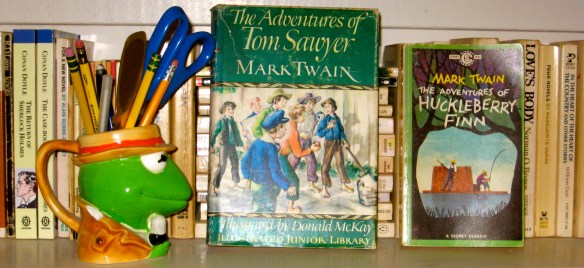
  • “…light out for the territory…” at berfrois!

    “…and so there ain’t nothing more to write about, and I am rotten glad of it, because if I’d ‘a’ knowed what a trouble it was to make a book I wouldn’t ‘a’ tackled it, and ain’t a-going to no more. But I reckon I got to light out for the territory ahead of the rest, because Aunt Sally she’s going to adopt me and sivilize me, and I can’t stand it. I been there before” (Huckleberry Finn, last sentences).

    Check out the Toads post at berfrois: “…what happens to Huck when he winds up in a research paper writing class? Tom skates through while Huck suffers the fantods.”

  • Bless me critic, for I have read…

    So-called Easy Reads should not be confused with Easy Writes. There are no easy writes. “Writing is hard, even for authors who do it all the time,” Roger Angell reminds us in the “Foreword” to the fourth edition of “The Elements of Style,” the lately lambasted as prescriptivist poppycock handbook that nonetheless many still enjoy – but at least this Angell point seems unassailable.

    Arthur Krystal’s “Critic at Large” piece in the May 28, 2012 New Yorker (81-84), titled “Easy Writers,” revisits the highbrow impulse to visit the literary gutter. He doesn’t mention “The Elements of Style,” but he might have. The literary gutter is where one finds one’s genre or formula works, potboilers, dime store paperbacks, Classics Illustrated, though Krystal seems to stop short of the romance novels, so even the critic at large granting absolution for partaking in “guilty [reading] pleasures” might still be seen separating the venial from mortal reading sin.

    Krystal’s piece is behind the New Yorker paywall, so get it at the library or get a subscription. Krystal writes some choice lines: “Modernism, of course, confirmed the idea of the commercial novel as a guilty pleasure by making the literary novel tough sledding.” White, of course, would have struck Krystal’s “of course” as needless words. And there’s the rub to the whole nexus: Krystal’s audience. Who’s he saying “of course” to? He says, “…intelligence could be a hindrance to writing fiction; otherwise, every intelligent critic would be capable of writing a readable novel,” thus like a boxer at a punching bag left rights with stinging insult both writer and critic at once.

    Ibsen said of Zola that Zola went to the sewer to take a bath in it, while Ibsen waded in wanting to clean it. Just so, the general interest reader goes to the literary gutter to play in the mud, not to tidy things up. Feeling guilty for some readers is no doubt part of the pleasure. “Apparently,” Krystal says, “we’re still judged by the books we read, and perhaps we should be.” And who’s the judge? Krystal shares critic Harold Bloom’s testimony against Stephen King, upon King’s winning a medal from the National Book Foundation: “The fact that the…judges [Bloom said] ‘could believe that there is any literary value there or any aesthetic accomplishment or signs of an inventive human intelligence is simply a testimony to their own idiocy.’” Maybe, but does that absolve Bloom of being in denial? Bloom has written a shelf load of critical works and one novel, which he has disinherited.

    There are no reading sins, but if one needs to confess something, it might be for not reading anything at all.

  • Cheese Grilled with Sliced Banana Sandwich; or, A History of the World in 6 Innings

    Tom Standage’s “A History of the World in 6 Glasses” begins with beer. Beer “was not invented but discovered.” It’s not clear who found the first can, but according to Standage the ice age was a cold memory, and down in the Fertile Crescent they were building up a spring training thirst. “Hey, take a sip of this…Well, what do you think?” “Not bad; pour me a glass.” Earliest beer, Standage tells us, was not lite, and probably required a straw to get through the head of unfiltered crust of stuff floating on top, something like a bowl of oatmeal forgotten on your counter the week you flew up to Portland for the annual brew fest.

    I’ve been thinking of writing a history of my world (not to be confused with the world) in 6 somethings. How about, “A History of my World in 6 Sandwiches”? The first would have to be my cheese grilled. When I was a kid I learned to make a cheese grilled with sliced bananas. Served on a paper plate with a few potato chips next to a glass of milk with a Dodger game on the radio – this is the stuff history is made of.

    I mentioned my cheese grilled to some visitors from Arcadia last week, and they and Susan ganged up on me with a correction: grilled cheese, not cheese grilled. “You can also make a cheese grilled with sliced bananas into a tuna melt,” I said, ignoring the prescriptivists. I’m just describing a sandwich here, not wanting to provoke a language war. Use organic tuna, if you can get hold of a can.

    I would probably follow my cheese grilled with my southwester burger, made with sliced jalapeno and bell pepper and stuffed with Monterey Pepper Jack cheese. First, douse the burger in olive oil and Worcestershire sauce and beer. Serve on a white ceramic plate with a poured glass of ale or lager of choice – no prescription needed, but you should let it breathe.

    Post called on account of rain, but we got about 6 innings in, so no need to replay it. Still, I wonder what the usage panel would have to say about grilled cheese versus cheese grilled. Care to weigh in? What’s your prescription?

  • Mosaic Writing

    McLuhan suggested we pay a price for literacy. There’s a difference between illiteracy and non-literacy. An illiterate person can neither read nor write written texts in his native language, while a non-literate person’s language has no written text, no alphabet.

    It’s moving from non-literacy to literacy where a price is paid: “The visual makes for the explicit,” McLuhan said, “the uniform, and the sequential in painting, in poetry, in logic, history. The non-literate modes are implicit, simultaneous, and discontinuous, whether in the primitive past or the electronic present, which Joyce called ‘eins within a space’” (GG, 73).

    Thus the “World Wide Web” may be promoting a kind of non-literacy, where the mosaic form of presentation dominates the chronological, the linear, the literate, where the literate means a fixed point of view: “This visualizing of chronological sequences is unknown to oral societies, as it is now irrelevant in the electric age of information movement” (GG, 72).
    Yet, McLuhan reminds us that “only a fraction of the history of literacy has been typographic” (GG, 93).

    So, what’s the price? For one thing, McLuhan said, “the divorce of poetry and music was first reflected by the printed page” (GG, 240).

    And all the effort we’ve put into learning to read left to right, up to down, front to back – when presented with a mosaic, we don’t know where to begin reading. We may not know how to read mosaic writing. The Internet is a mosaic. And as we learn to read on the Internet, we may be losing our preference for, and the skills required to read, sequential writing.

    Some excellent examples of Mosaic Writing include:
    “Silence” and “A Year from Monday,” by John Cage
    “Finnegans Wake,” by James Joyce
    “Love’s Body,” by Norman O. Brown
    “The Guttenberg Galaxy,” by Marshall McLuhan

  • A Year From The Use and Misuse of English Grammar

    We learn grammar when we learn to speak, we know grammar, we pause where we want, when we want, pulling words like fish from our Pond of Vocabulary and stringing them on the line, one after another, one to a hook, using commas instead of periods when we don’t want to be interrupted, YELLing when someone is so rude as to keep on talking when we are trying to interrupt – we fall silent, dashed, a period of rigour-tunge follows (our tongues rigged with rules), then we bounce awake, trim our sails, for we’re surrounded in the Bay of Prescription, the murky waters of communication, with boats of advice all bopping this way and that (there goes the “Do This,” firing across the bow of the “Don’t Do That”), the pond stormy on a storm swept night if there ever was one.

    In Wendell Johnson’s “You Can’t Write Writing,” (The Use and Misuse of Language, 1962, S. I. Hayakawa, ed.), we learn that bad grammar, baby, ain’t our problem: “The late Clarence Darrow, while speaking one day to a group of professors of English and others of kindred inclination, either raised or dismissed the basic problem with which his listeners were concerned by asking, ‘Even if you do learn to speak correct English, who are you going to talk it to?’ Mr. Darrow was contending…the effective use of the English language is more important than the ‘correct’ use of it, and that if you can speak English ‘correctly,’ but not effectively, it does not matter very much ‘who you talk it to’” (101).

    This has implications for those who would aspire to teach writing, and Johnson continues, “The teacher of English appears to attempt to place the emphasis upon writing, rather than upon writing-about-something-for-someone. From this it follows quite inevitably that the student of English fails in large measure to learn the nature of the significance of clarity or precision and of organization in the written representation of facts” (103).

    Grammar is the least of our worries, argues Johnson: “So long as the student’s primary anxieties are made to revolve around the task of learning to spell, punctuate, and observe the rules of syntax, he is not likely to become keenly conscious of the fact that when he writes he is, above all, communicating…his first obligation to his reader is not to be grammatically fashionable but to be clear and coherent” (103).

    Hayakawa, in his introduction, has already explained his interest with regard to how people talk: “We are not worrying about the elegance of their pronunciation or the correctness of their grammar. Basically we are concerned with the adequacy of their language as a ‘map’ of the ‘territory’ of experience being talked about” (vii). And, ultimately, for the reader interested in more than mere prescriptions on how to write, emphasis is placed “not only on what the speakers said, but even more importantly on their attitudes towards their own utterances” (vii).

    Hayakawa sums up his concerns as follows: “What general semanticists mean by ‘language habits’ is the entire complex of (1) how we talk – whether our language is specific or general, descriptive or inferential or judgmental; and (2) our attitudes toward our own remarks – whether dogmatic or open-minded, rigid or flexible” (vii).

    Whenever I hear some self-appointed cop of language (or worse, someone with the badge of a degree), attempting to arrest a speaker’s tongue, putting it in the handcuffs of some prescriptive rule, I think about Hayakawa’s The Use and Misuse of Language.

    But, unforlorn, I’m inclined toward and recline with an infuzen of John Cage, who sums the problem up nicely in his A Year From Monday (1969), which begins with “DIARY: HOW TO IMPROVE THE WORLD (YOU WILL ONLY MAKE MATTERS WORSE) 1965

            I.               Continue; I’ll discover where you

                                sweat  (Kierkegaard).            We are getting

    rid of ownership, substituting use.

    Beginning with ideas.            Which ones can we

    take?            Which ones can we give?

    Disappearance of power politics.            Non-

    measurement.”

    Related:

    “You Can’t Write Writing”
    Baseball and the Parts of Speech
    Stanley Fish, Full of Ethos
    Kicking E. B. White When He’s Down
    The Bare Bodkin of the English Major
    How to Teach College Writing to Nonreaders

  • How to Teach College Writing to Nonreaders

    How should introductory college writing be taught to today’s nonreaders? E. B. White said to “make the paragraph the unit of composition.” But the paragraph is made of sentences, so why not start with the sentence? Francis Christensen did, and his original Notes Toward A New Rhetoric: 6 Essays for Teachers (1967), is today available as Notes Toward A New Rhetoric: 9 Essays for Teachers (3rd Ed., 2007).  A preview of his “A Generative Rhetoric of the Sentence” can be viewed here.

    “The teacher of writing must be a judge of what is good and bad in writing,” Christensen said, but “from what sources do they say ‘Do this’ or Don’t do that?’”

    Christensen used a descriptive rather than a prescriptive approach based on his “…close inductive study of contemporary American prose.” In part, his work was a response to the “many English teachers [who] abide by the prescriptions of the textbooks they were brought up on. This preference is one that I cannot understand,” he said, “since it means taking the word of the amateurs who hack out textbooks that talk about language (fools like me) as against the practice of professionals who live by their skill in using language.”

    Christensen’s inductive study resulted in his new method because he realized that, for example, there existed “…no textbook whose treatment of grammar and syntax could cope with more than a small fraction of its [Ralph Ellison’s Invisible Man] sentences, but I would venture the claim that there is not a sentence whose syntactic secrets could not be opened by the key fashioned in the first two essays [of his Notes Toward…].”

    Christiansen’s descriptive method recognized that grammar knowledge does not necessarily result in good writing. But Christiansen’s descriptive method does not ignore grammar. He said, “…the rhetorical analysis rests squarely on grammar,” but that “it should surprise no one that no experiments…show any correlation between knowledge of grammar and the ability to write. One should not expect a correlation where no relation has been established and made the ground for instruction.”

    But neither should that be used, he goes on, to argue “that the only way to learn to write is to read literature [because] what is true over a lifetime is not true of the fifteen weeks of a semester. In practice, this position throws the burden of learning to write on the student. It expects him to divine the elements of style that make literature what it is and apply the relevant ones to writing expository essays about literature – a divination of which the teachers themselves are incapable. If reading literature were the royal road that this argument takes it to be, English teachers would be our best writers and PMLA would year by year take all the prizes for nonfiction.”

    But why shouldn’t students be made to take on “the burden of learning to write”? And why does Christensen make the assumption that English teachers are so well-read? They have that reputation, but how much reading, in the midst of a full load and stacks of student papers to get through, are they able to get done “over a lifetime”? Consider, for example, this typical Christensen observation, made from his inductive study: “…our faith in the subordinate clause and the complex sentence is misplaced…we should concentrate instead on the sentence modifiers, or free modifiers.” But how do we know that without making the same inductive study he made? Indeed, Notes Toward a New Rhetoric, in sum, while not at all ignoring grammar, recommends taking the inductive study into the classroom, reading literature to teach writing.

    “Oh, teachers, are my lessons done? I cannot do another one.
    They laughed and laughed, and said, ‘Well child,
    Are your lessons done?
    Are your lessons done?
    Are your lessons done?’”

    …from “Teachers,” by Leonard Cohen, 1967.

    Related:

    Baseball and the Parts of Speech
    Stanley Fish, Full of Ethos
    Kicking E. B. White When He’s Down
    The Bare Bodkin of the English Major

    Notes toward a New Rhetoric
    Francis Christensen
    College English
    Vol. 25, No. 1 (Oct., 1963), pp. 7-18
    Published by: National Council of Teachers of English
    Article Stable URL: http://www.jstor.org/stable/373827

  • Update on the Universe; or, Where we “canst not tell whence it cometh, and whither it goeth”

    Box seat holders at the Toads know that periodically we like to drop in on the physicists to see how the universe is progressing. Though it may be some 14 billion years old, fans will be happy to know that the universe is still in its early innings. Time for a hot dog and a bottle of that dark matter earthlings call beer.

    But why can’t we enjoy the universe without the polemic diatribes of the scientists who must wear their atheist merit badges on their sleeves? In the most recent example, Lawrence Krauss’s A Universe from Nothing: Why There Is Something Rather than Nothing, Richard Dawkins comes out of the bullpen to write the afterword, and we find ourselves trying to stay afloat in some deep, dark matter, but it’s not beer.

    “Over the course of the history of our galaxy,” Krauss writes, “about 200 million stars have exploded. These myriad stars sacrificed themselves, if you wish, so that one day you could be born. I suppose that qualifies them as much as anything else for the role of saviors.” But is Jesus about being born, or about the existential possibility of being reborn?* To get this, one must imagine a universe without shame. It doesn’t matter where you come from, who your parents were, the color of your collar. The universe does not come into play. Krauss has hit a foul ball.

    Why the scientists can’t stick to scientific writing is one of the mysteries of the universe that neither Krauss nor Dawkins unravel. Consider, for example, Dawkins’s afterward. After a couple hundred pages of Krauss blowing winds and cracking cheeks in which he attempts to explain that King Lear was wrong when he said “nothing will come of nothing,” we find that indeed nothing has come of nothing, but that it may amount to the same thing as something coming from nothing, or the other way around. In any case, as early as 14 billion years ago, which is to say, in his preface, Krauss has already admitted, “we simply don’t know” and probably never will. As it turns out, the universe is really about funding.

    We’ve never doubted, here at the Toads, that something can come from nothing (witness the 1969 Mets); neither have we doubted the reverse, that nothing can come from something. We’re going back to casting out 9’s, dividing the universe into 9 inning segments.

    “We may not understand quantum theory,” Dawkins writes in his afterward, but then says, parenthetically and inexplicably religiously, “[heaven knows, I don’t] but a theory that predicts the world to ten decimal places cannot in any straightforward sense be wrong. Theology not only lacks decimal places: it lacks even the smallest hint of connection with the real world.” Yes, but why “heaven knows”? Is Dawkins kidding here? Or is this a slip of the atheist pen? And what about those ten decimal places? In a universe as old and big as Krauss has described, ten decimal places hardly seems significant at all. The assumptions of the argument lose their scientific credibility the moment its purpose is revealed to be conversion: it’s an argument of conversion, and it’s trying and tiring.

    Note: For information about the universe, the Toads still recommends Robert B. Laughlin’s A Different Universe.

    *“Marvel not that I said unto thee, Ye must be born again. The wind bloweth where it listeth, and thou hearest the sound thereof, but canst not tell whence it cometh, and whither it goeth: so is every one that is born of the Spirit” (John 3:7-8, KJV).

    Related:

    David Albert’s New York Times book review of Krauss’s A Universe from Nothing.

    Sea Monsters in A. C. Grayling’s Secular Bible; or, Humanity’s Greatest Endeavor

    Progress Report: Our Disappearing World

  • A Portrait of the Plumber as a Poor Speller; or, Wrong Word

    When my father first asked me if I wanted to follow him into the plumbing trade, I’d already been helping him on jobs for several years. I knew the names of the tools, could boil lead and poor it into the rope packed pipe joints, run the threading machine, drill holes, dig ditches with the right fall.

    But, no, I thought I’d go to school, I told him, and I knew he was disappointed. He could read blueprints, but he put no stock in books. I made my decision to stay in school because I did like books and reading and writers and the whole idea of becoming a writer, as out of focus as that picture might have been, but had I made the decision based on my ability to spell, I might have listened to my dad and become a plumber. Perhaps it’s not too late.

    My friend Dan (we were first year teachers at the same school in Venice a long time ago), who just recently started blogging, over at itkindofgotawayfromyou, and reading this blog, surprised me with an email this morning, first wishing us a happy Easter, then pointing out a spelling error in my last post. I couldn’t dismiss the error as a typo. I’d made it three times in the same post. Nor could I blame it on spell-check. It was one of those words that fools spell-check, as it had fooled me. This isn’t the first time Dan has had to help pick me up after a misspelling fall. During that first year of teaching, I had asked Dan to read something I had written. He did, and when he gave it back, he said I’d typed “your” where I wanted “you’re,” though an error like that often might be a typo; still, the proofreading eye needs to spot the error, and not see what it expects to see. Some words need to be unpacked before we hang them to dry on the outside clothesline.

    We all have a particular picture of ourselves, but seldom, perhaps, the same picture others have of us. I’ve always pictured Dan as a good speller, and it’s nice to know he hasn’t lost his eye for orthography, though I’m not sure spelling is a question of the eye. But the picture that portrays English majors by definition as good spellers is myth. And reading Dan’s email, I reminded myself, for some consolation, that there’s credible evidence showing some of our best writers were poor spellers. Standard examples include F. Scott Fitzgerald, who could never remember how to spell his friend and Nobel Prize winning writer Hemingway’s name (one m or two?), while Hemingway wasn’t a much better speller, and Faulkner was also a poor speller. Joyce, on the other hand, a good speller, enjoyed creating new words and puns by deliberately misspelling words. Theories of why some can spell and others can’t suggest the brain’s to blame.

    It wasn’t long ago my friend Judy invited me to join a spelling bee with her. What treachery was this, I wondered. I knew she was an orthographic genius, and just wanted me along as a foil character. Still, I’m not really such a poor speller, probably just average, is all. I usually get it right, but sometimes lack confidence, and look it up, but find I was right all along. So I went with Judy to the spelling bee, thinking I might get lucky with a few relatively easy ones. No luck. I misspelled on my third word, while Judy won the bee.

    My father could not have cared less if I was a good or a poor speller, if I one spelling bees are lost them. He was, on the other hand, somewhat conserned that I became a poor plumber.

    Coda: Readers noticing some spelling errors in that last paragraph might be interested in Joseph Williams’s “The Phenomenology of Error.” It’s not about finding spelling errors, but it is about why some of us see writing errors others don’t, and why others are inclined to see errors we don’t. It’s about writing; spelling is about something else. Moreover, one might argue there’s only one misspelled word in my penultimate paragraph, the other two mistakes being simply wrong words, which, as it turns out, is the error Dan pointed out in my last post, a wrong word in the context, not a misspelled one.

    Related:

    E. B. White and the plumber

  • Writing Inventions

    Writing strategy textbooks often move us quickly through the rhetorical modes before introducing argument, where we are invited to pick a topic of interest, something we’re passionate about, but then are asked to write a research paper, as opposed to a personal essay, presumably to distinguish between mere opinion and rigorous discourse, where claims are backed by reasoned evidence and assumptions are explained. Hot topic items are sometimes suggested: abortion, immigration, addiction, gun control, health care, same sex marriage, legalizing marijuana. Following a research paper rubric, we search for articles for and against our stance. Thus the project begins in dichotomy, seemingly necessary to building an arguable thesis. But we usually go into the research topic with preconceived convictions and deep-rooted assumptions, and we don’t learn much about the topic, writing, or ourselves in the assignment process. It’s an exercise in frustration and futility, for the canon of hot topics has been worked over like road kill squirrel picked clean by hungry birds. And writing instructors, hungry for something new to read and talk about, but finding the trite and stale canned paper, can only respond to the mechanics of the research paper rubrics, issuing tickets for standard English violations, citations for lousy references, deductions for technicalities – as they scan the paper highway for plagiarism. Instructive readers will at least be able to comment on how effectively we have blended references into our discussion, but the standard research paper is doomed from the start to what has become an up or down vote, the proofs multiple choices from an existing canon, the conclusion an echo of something that’s already been said. The result is too often a laboriously boring displeasure for writer and reader.

    We are in no position to tell others what they want, or even what they should want, while we all may value things that are not necessarily good for us. We need to invent, but to invent a solution, we must first see a problem. If we don’t see problems, we are not thinking. We are numb to our environment, unable to find the source of our limits. We must invent if we expect to think. But how can we uncover problems if we don’t know what we want? If we don’t know what we want, we’re unaware of specific antagonists creating obstacles. But how do we know what we want?

    We lament that we are growing into a culture of non-readers, for reading is the [supposed] old way of learning what we want, but while The Adventures of Huckleberry Finn is a great novel, did Huck ever read one? Tom Sawyer, Huck’s good buddy, is the middle class boy who covets pirate book fantasies, the expert who has done his research. But Huck’s genius is that he thinks for himself. He’s able to think for himself because he knows what he wants, and because he knows what he wants, he correctly identifies his antagonists, and because he knows what’s in his way, he’s able to invent solutions. But what happens to Huck when he winds up in a research paper writing class? Tom skates through while Huck suffers the fantods.

    Why is research so important to academic progress and success? One answer is specialization, but specialization leads, as Fuller explained, to extinction. And academics are becoming extinct, the ones who teach writing, anyway, as their peers in competing disciplines begin to teach their own writing processes, better suited to their own needs, better suited to specialization and funding requirements. In English class, the topic seems almost not to matter anymore. The topic of the English class used to be literature, the essay, language. But the contemporary English class seems to have no topic of its own, thus the importance of picking one, passionately freewheeling. Consider the following, from a recent Chronicle article, suggesting the research paper should be abandoned:

    “‘After all, students exhibit the same kinds of mistakes at the end of their first-year composition courses as they do at the beginning, regardless of the type of institution or whether the course is taught by a full-time faculty member or an adjunct,’ Ms. Jamieson said. ‘Part of the problem, she added, is the expectation that faculty members trained in composition have expertise in the subject being researched, whether it is abortion, the death penalty, or gun control [and there you have it, the canon’s greatest hits]: Unless it’s in your field, you don’t know what a good source is and what isn’t’” (“Freshman Composition is Not Teaching Key Skills in Analysis, Researchers Argue,” Chronicle of Higher Education, March 21, 2012). (Also see: “Skimming the Surface”; The Citation Project.)

    But the problem as described seems to relate to topic, which we assume is specialized, for why can’t an experienced, general interest reader tell a good reference from a bad one, particularly in a “Freshman Composition” class? In any case, we don’t always start our writing with a topic. We begin with reading and taking notes as we read. As our notes begin to develop into thoughts, reflective, evaluative comments on what we are reading, our topic emerges. The research paper writing assignment, as it’s usually rubriced (red chalked – it’s where the English teachers got the idea to correct using red ink), teaches a way of writing that few writers actually use. It’s not the way we write. We don’t begin with topics. We begin with reading, and we discover what we want to say as we attempt to join the discussion, the conversation of a particular community, and we know who’s working in the community, and what they’ve said. We know where to find them, and how they talk. We don’t need to apply the credibility and reliability tests. That’s done through the process of peer review – so the myth goes.

    Does specialization in the academy prohibit a common reader response, disallow generalized thinking? But not even English teachers can read everything, and perhaps it’s because they haven’t read everything that they might be quick to dismiss Wiki, blogs, et al., and insist, instead, on scholarly journal references, never mind the nonsense that also goes on in that arena (I’m reminded of “The Music Man”: “Just a minute, Professor [Hill], we want to see your credentials!”). Lack of experiential reading might also be why some insist on writing or grammar “Handbooks,” prescriptive and expensive tomes that become their own justification.

    Claims are supposed to be debatable, to invite argument. Argument is a good. But specialization and the consequences of funding seem to be putting unusual pressure on the hallowed process of academic discourse and peer review. Three recent examples illustrate: “Lies, Damned Lies, and Medical Science,” from the November, 2010 Atlantic, exposes fraud in the medical journal peer review process, and funding appears to be a significant source of the problem; “Kin and Kind: A fight about the genetics of altruism,” from the March 5th New Yorker, describes another debate, this one focussed on E. O. Wilson’s recent reversal of his prior stance on the explanations of altruistic behavior, a change of mind which has earned him the scorn of his peers – and, again, funding would seem to underlie much of the critical response; and “Angry Words,” from the March 20th Chronicle, summarizes the ongoing brouhaha in language study, and Geoffrey Pullum followed up, also in the  Chronicle, with “The Rise and Fall of a Venomous Dispute” – the title alone might sound surprising to the general interest reader of academic research papers. The three examples taken together don’t inspire much confidence in the processes at work, yet the comment discussion following Pullum’s short article is instructive in a number of ways. It appears that specialists and scholars engage in writing inventions of all kinds and don’t appear to have the market on credibility and reliability cornered. But it’s enlightening and heartening, and, perhaps, entertaining, to see that they are human and given to the human foibles inherent in argument and opinion, in the fight for truth, justice, and the Academic way.

    Related:

    Trilling’s “The Meaning of a Literary Idea”; or, the Essay as Argument: Why The Research Paper Should be Abolished

    Opening the Patient in Open Access Week; or, the Great Research Hoax

  • Problems, Inventions, and Implications

    Inventions are usually a response to a problem. A problem is something that limits or impairs access to needs, wants, or values. An invention solves the problem, granting or improving access. An invention might be a machine, an idea, or a new value. Inventions alter our environment and often present side effects, good or bad, that may or may not have anything to do with the original problem, and may or may not have been anticipated. Inventions can create new problems, and changes in our environment can change us, often in unexpected ways, change our response to our environment, change us externally or internally, physically, mentally, or emotionally, change our behavior and the way we think of ourselves. Inventions can change culture and change the direction of societal development. Sometimes, as in the case of synthetic biology, an invention takes on “A Life of Its Own” (Michael Specter, New Yorker, 28 September 2009). This “life of its own” we might call implications. Invention shares with experiment, discovery, and creation what it means to be human.

    As machines, inventions have a shelf life, for they are subject to entropy, wear and tear, as well as obsolescence created by changes in the environment or by other inventions. It was Socrates, in Plato’s Republic, talking about the creation of the State (which begins as an idea), who said, “…the true creator is necessity, who is the mother of our invention” (Jowett, V-128, Book II, p. 60). What happens to the old machines when we no longer perceive the necessity? And if inventions are a response to a problem, what problem did the automobile solve?

    Imagine life today without the automobile – not that you simply give up your car, but that the automobile was never invented.

    According to Google Patents, the oldest patent using the word Automobile was filed in 1809, but not issued until 1902. The patent, by J. Ledwinka, “subject of the Emperor of Austria-Hungary,” but, “residing in Chicago,” was a design allowing for the independent functioning of the four wheels of the carriage. The patent improves the efficiency of the automobile, making it easier to operate. The terms Motor-car and Auto-car will fetch other, equally old patents from Google Patents.

    The word “automobile” suggests a self-moving vehicle. A US patent for L. Bollee, of France, providing improvements for a “self-propelling vehicle,” was filed in 1896 and issued in 1898. This patent involves improvements to “…five principal parts: first, the motor; second, the frame; third, the transmission gear; fourth, the brake; and, fifth, the mechanism for engaging and disengaging the motor, for changing the speed of the vehicle, and for actuating the brake.” There’s no mention of a radio or radar detector.

    Many of the patents surrounding automobiles suggest that most patents are inventions of improvement. The automobile itself, as an invention, isn’t a new machine as much as an improvement on older machines. The idea of a wheeled vehicle is very old, and may be said to leverage the underlying general principle of the circle, its latent energy (as Fuller’s piano top life preserver illustrates the underlying general principle of flotation, and his magic log illustrates the underlying general principle of the fulcrum, or leverage). Humanity’s first observations of round things rolling, seemingly of their own volition, perhaps needing a kick to get things going, seems to have set off a chain of inventions in what we now call a “snowball effect.” Society seems to be a tower of inventions, not all necessarily designed to improve our humanity.

    Imagine life today without the automobile – not that you simply give up your car, but that the automobile was never invented. This is increasingly difficult to do because we may have lost sight of the original problem the automobile was designed to solve, and the automobile has itself created new problems for which it is the invention that appears to be the solution. This is why Fuller said, “You never change things by fighting the existing reality. To change something, build a new model that makes the existing model obsolete.”

    Related:

    All Stung Over By Links of Googled Grace

    Earth-Glass Half Empty or Fuller?: Operating Manual for Spaceship Earth

    Progress Report: Our Disappearing World