I talk to myself, but I’ve not much to say. I talk to myself, just like to say hey. I talk to myself, and oh by the way, I put in a good word for you.
When I’m on the road behind the wheel, I talk to myself and away I peel. When I’m standing in line at the DMV I talk to myself like you wouldn’t believe.
I talk to myself, but I’ve not much to say. I talk to myself, just like to say hey. I talk to myself, and oh by the way, I put in a good word for you.
All around town as I walk down the street I talk to myself while I meet and greet. After midnight and I’m awake in bed I talk to myself in the back of my head.
I talk to myself, but I’ve not much to say. I talk to myself, just like to say hey. I talk to myself, and oh by the way, I put in a good word for you.
Punctuate, yourself. A few points on punctuation. Punctuate yourself! Can we pull over, please? I have to go punctuate. But there’s nowhere to stop! I’m going to runon.
Imagine you’ve just finished a possibly remarkable poem (into which you’ve poured the decanted, pure liquid of your heart and soul, not to mention other vital organs), if a poem can be said to ever be finished (be it ever so humble), in any kind of existential sense (which we know it can not – can never end), and the first, perhaps the only, criticism that is offered remarks on the lack of commas or periods – a comment on the punctuation used, or not used, in your poem, ignoring the fact that an apparent absence of punctuation is, still, a kind of punctuation. But in fact, your poem is called (critics love name calling) a run-on sentence. Or, in any case, that’s the only comment you get, that there’s a run-on indeed there is so you have no or little defense.
But punctuation is pertinent to poetry, and poets should take due care to punctuate their poems. What is punctuation? We often, maybe, think of punctuation as a tool used to separate. To insert. To come between. A wedge in thought and time, or speech. We insert a punctuation mark. We dot. We apostrophize. The punctuationist seeks to achieve stasis – no more morphological change, by which we mean the study of shape. Punctuation, then, suggests change. To mispunctuate is to risk sudden change in selection and variation – in other words, to introduce ambiguity (mutation).
Adorno wrote a short essay on punctuation, on punctuation marks, to be specific – as if punctuation consists of a kind of graffiti sprayed across one’s text.
Note how Adorno moves from anthropomorphic comparison to explaining writing as driving a car. And then apparently turns on the car radio, and there too, in the canned music, finds punctuation. He thus shows the difficulty of even talking about punctuation as it might exist in its own right.
We find punctuation endlessly interesting, and appreciate the attempts of our readers to find clarity and avoid ambiguity in our writing. Unfortunately, achieving clarity and avoiding ambiguity are often not the primary aims of poetry. What is clear is often opaque. What is meant is often not what is meant at all. This is not to suggest that poetry is a game of hide and seek (though that does often seem to be the point of the universe). Poetry may indeed be viewed as a kind of punctuation – where we insert in our day or night a comma or period of rest and pause, of relaxation, where, or within which, we may reflect and attempt to come to terms with our predicament.
Indeed, we might even say that poetry is punctuation. And punctuation is poetry, even if mispunctuated.
In well worn industrial area east across polluted river from swept clean downtown weeds grow thru cement cracks asphalt vacant lot near railroad tracks.
At night sluggish possums racoon families single file walk down to dark river using alleys streets docks.
No skyscrapers offer moon shade possums backlit racoons shadow one another past metal works pipe fitting supply wood and metal fabrication produce row truck farm stalls construction hard ware welding taverns cafe guitar & drums body & fender shop storage facility social services wholesale warehousing but nary inside space or place for homeless asleep in streets possums and racoons slip by sleeping bags tents nose through trash heaps past tied tarps bent shopping carts broken bicycles war zone skoolies wrecked recreational vehicles rusting freight and delivery loading docks tile reclamation screw machine tool shops elaborate food carts.
At river racoons play opossums bluff and clean and groom eating rat remains rich cultural throwaways.
VI In heaven in silence sit vast statues of stone on earth there is no quiet stone clouds break open what does the thunder say? Don’t sit under the apple tree fall is the mother of beauty with anyone else but she. She doesn’t like her picture taken nor to be in a poem does not care she is beauty but takes time with her hair avoids rules not her own. Heaven falls from the sky no heaven no earth below.
VII Words are not a product of heaven but of earth. Sunday morning returns with a cup of French Roast under a grapevine wreath looped herbs and flowers. The coffee smells of earth the first gentle rain stirs petrichor into the air the dry grass two crows the cat on the dirt path. In heaven no senses no tenses no need no rain no sun no mud no crud. All sense is earthbound.
VIII Sunday morning slows autumn leaves falling where she lives and walks in fine form and talks of the lovely noisy nights and dirty days of clean kitchens and open stays all means understood and confused all reason clear and absurd peaceful and happy stones that turn to stories and poems. How many choices in one heaven on one earth?
IV She is content with the calico cat poosha the boy pilot who crashed his plane in takeoff suckled home the Stones on the transistor mother smothered with a cover of beauty. For content she talks about crows the two in the street eating squish squirrel but the murder on leaves the warm asphalt melting summer sun heat where does heaven hide and why at night come monsters from paradise looking for a name. She will not join a community whose purpose is to persecute another heaven a different earth.
V Satisfied she collects the stories of the stones beauty calcified in underground electromagnetic waves on a static spirit oldie station where sleeping birds again awake to the murder of the sun or return not and even the earth’s rot will not endure and old trips up the coast memorized in slide shows by campfires that death may be related to beauty the birth of moods passion splurge now dead urges flown to beauty’s abode.
III Oh my Zeus a girl Suze by Jove! No god got involved the parents the ruin of beauty and paradise a coffee shop she a cupbearer waitress to the young men new to the surfboard of wet thought. The waves roil with oily sludge the kids play run from the blob of the reclamation plant lazy jets from lax prodding probing the puffy foggy overcast clouds. Bucketed fish guts and heads on the pier odors the paradise she comes to know and to love evening gold and morning blue.
II Why should she give it up to him? What is love if he can come only in noisy fantasy and nightmare? Her dolphins play in their waves charismatic and whole while he came to end all frolic and family for some abstract community of musty prayer and the comfort of wet sackcloth and cold ashes. He who lived within herself washed up on a desert beach her desserts shells for a shelf her soul he saved in a bottle labeled I am not to drink in letters from a foreign field.
I Malaises of the nightgown and wait for the coffee in the well worn bed and the matted habit of a real cat up in her window seat dome room coalesce to repeat the profane reminder of ritual dismission. She dreams not and moves awake with the eye of the storm encircled by each newfangled catastrophe as wealth darkens among Malibu lights across Santa Monica Bay. Against a rude screen true bugs intrude like the kitchen roaches scattering from the sudden light. The day is like El Porto happy with friends and popular songs until the coming of the cat poop cup up the stairs all the way from the sway of bread and beer.
II Why should she give it up to him? What is love if he can come only in noisy fantasy and nightmare? Her dolphins play in their waves charismatic and whole while he came to end all frolic and family for some abstract community of musty prayer and the comfort of wet sackcloth and cold ashes. He who lived within herself washed up on a desert beach her desserts shells for a shelf her soul he saved in a bottle labeled I am not to drink in letters from a foreign field.
I Malaises of the nightgown and wait for the coffee in the well worn bed and the matted habit of a real cat up in her window seat dome room coalesce to repeat the profane reminder of ritual dismission. She dreams not and moves awake with the eye of the storm encircled by each newfangled catastrophe as wealth darkens among Malibu lights across Santa Monica Bay. Against a rude screen true bugs intrude like the kitchen roaches scattering from the sudden light. The day is like El Porto happy with friends and popular songs until the coming of the cat poop cup up the stairs all the way from the sway of bread and beer.
Malaises of the nightgown and wait for the coffee in the well worn bed and the matted habit of a real cat up in her window seat dome room coalesce to repeat the profane reminder of ritual dismission. She dreams not and moves awake with the eye of the storm encircled by each newfangled catastrophe as wealth darkens among Malibu lights across Santa Monica Bay. Against a rude screen true bugs intrude like the kitchen roaches scattering from the sudden light. The day is like El Porto happy with friends and popular songs until the coming of the cat poop cup up the stairs all the way from the sway of bread and beer.
Where Joyce tried writing everything in, Beckett tried leaving everything out. For Joyce, writing was a process of addition; for Beckett, one of subtraction. In Waiting for Godot, the phrase “Nothing to be done” becomes a kind of mantra. But it’s just an opinion, as Vlad says, even as he considers giving in to it:
Estragon (giving up on his boot)

- Nothing to be done.

Vladimir

- I'm beginning to come round to that opinion. All my life I've tried to put it from me, saying, Vladimir, be reasonable, you haven't yet tried everything.
“Waiting for Godot,” Samuel Beckett, 1953
Beckett’s characters often seem to have nothing to do. Most modern distractions are taken out, life’s experience parboiled to essentials. There are not many spices on Beckett’s kitchen shelf. Estragon and Vladimir don’t have cell phones. No books, no television, no newspaper. The game is not on. The team is not in town. The ballpark is empty. The surf is flat. While they consider what to do when there is nothing to be done, they can’t sit still. They talk. They have one another.
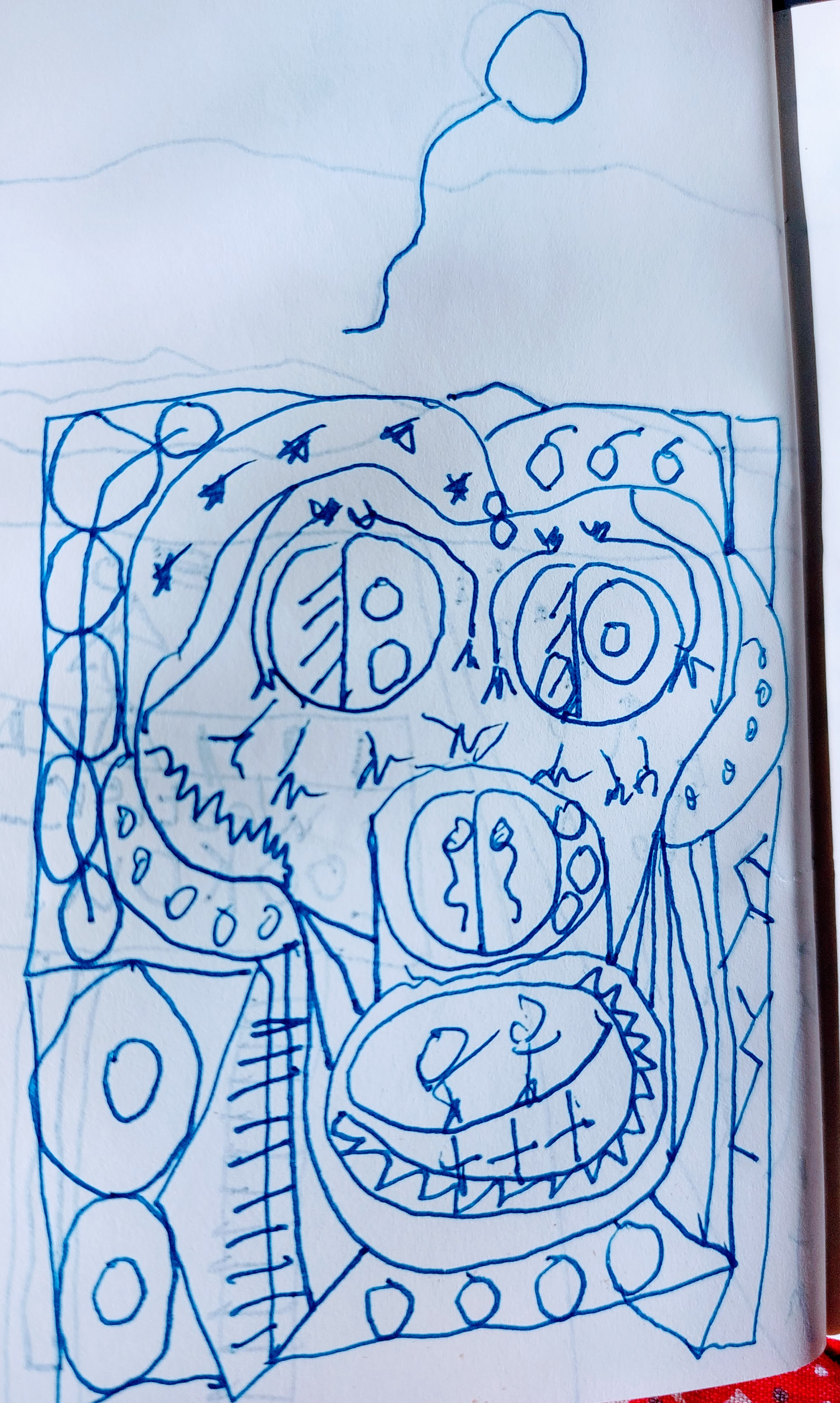
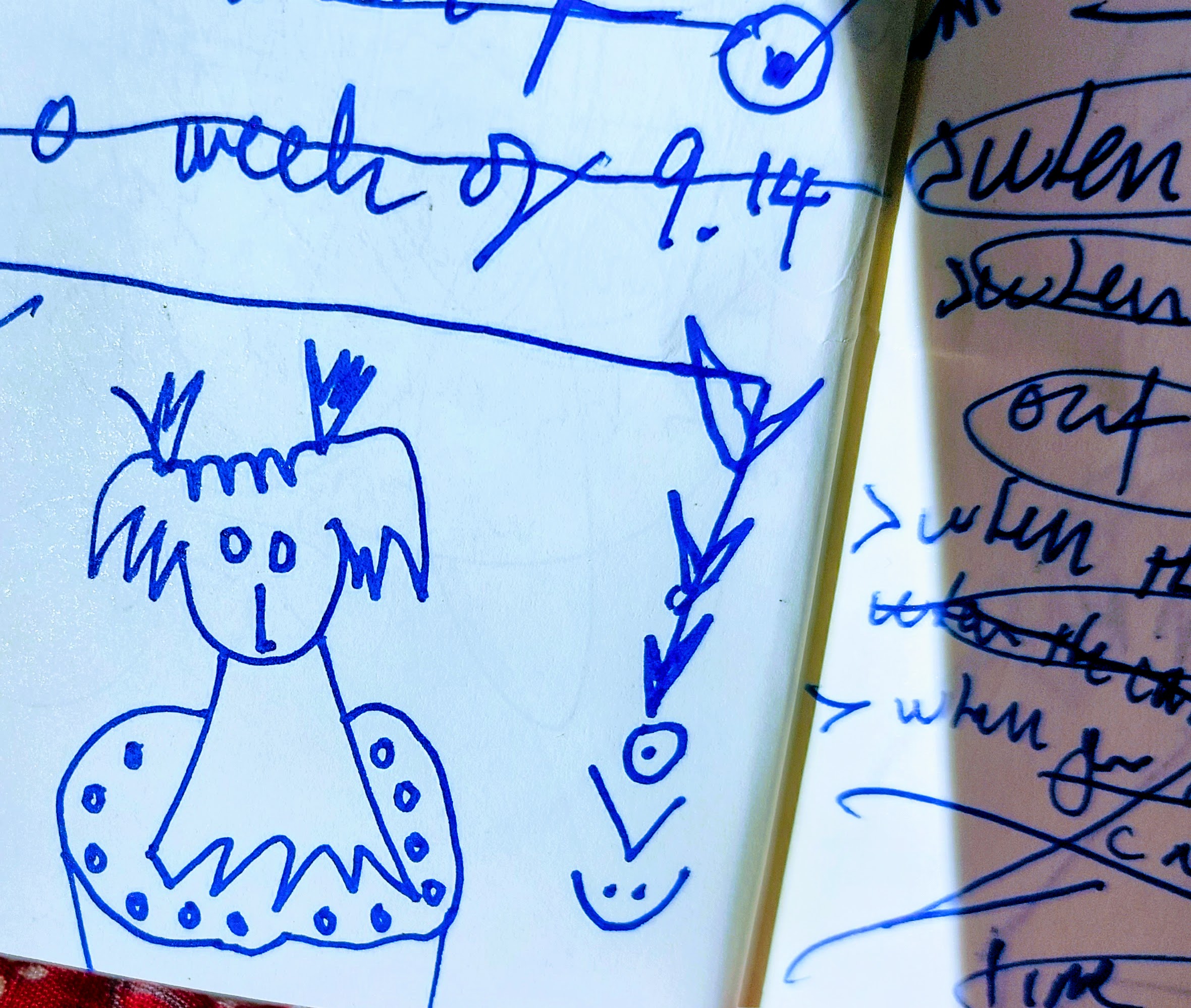
If they had pen and notebook, maybe they’d doodle:
Midnight likes to hang out all night long with a puss in boots on every block flight finally comes home climbs the fire escape out back: good morning, Midnight.
There’s a noisy argument over in Flat 3 Midnight’s up reading “The Life and Adventures of a Cat” (1760) about some tomfool caterwauling tom-tom tomcat.
Now in the Cat, there appears the utmoſt auſterity, with the greateſt levity. ‘ A rake and a ſenator are moſt wonderfully com pounded. Who can analize theſe differing ingredients, fo demure a puritan on ſudden, verted into the moſt abfolute de bauche ? One time ſitting for four or five hours in the attitude of ſo lemnity, and then on a ſudden break out into the moſt diffolute feſtivity . Theſe qualities, ſo diffonant, ſo ve ry oppoſite to each other, muſt in dicate ſomething ſuperior in the animal, whoſe hiſtory wewe are at preſent writing, and we think we have proved this ſuperiority of the Cat.
THE LIFE AND ADVENTURES OF A CAT. LONDON: Printed for WILLOUGHBY MYNORS, in Middle- Row, Holborn. M DCC LX.
Just so, we find ourself at odds with our other selves at times as docile as the doe in the meadow the morning dews and sunup
rough-hews the tousled covers the well worn silver curls one dare not come near at this late hour the abode dark and quiet.
Then again after a rest resumes the sounds that do attract the rooster in the cat to come closer claws retracted mewing.
Thus we speak of night and day and the contraries of our natures the desire to lose ourselves we so deliciously have cultivated.
 The Coming of the Toads