Category: Writing

  • “silent quicksand”

    silent quicksand was a poetry and art magazine at El Camino College in the early 70s. I don’t know how many issues came out before folks moved on and it folded, but I don’t think many. I have copies of issues # 2 and # 3. I had three poems appear in the Fall 1973 issue (# 3). When I told my old high school friend Tim at the time about it, he said there was no quicker way to obscurity than appearing in a college literary magazine. That was of course before blogging came along. In any case, I thought it was cool then, and I still do, that two of my poems shared a page with Stephen Jama, one of the ECC English instructors, who became for a time a friend and mentor.

    Four poems from Silent Quicksand # 3

    Below is an image of issue # 3 and below that an image of issue # 2:

    silent quicksand # 3

    silent quicksand # 2

    I was reading, at the time, the Beat poets, Corso, Ferlinghetti, Philip Lamantia, and of course Ginsberg, and King of the Road Kerouac, and Gary Snyder, and I remember reading Diane Di Prima, and I read Henry Miller and Anais Nin and all along John Cage, and Whitman and William Carlos Williams, and, having started with folk music, I was now getting deeper into jazz, and I read “Blues People,” by LeRoi Jones (Amiri Baraka). Still other influences included the Rexroth translations, Hugh Kenner’s “The Pound Era,” Donald Hall’s “Contemporary American Poetry,” McLuhan and Norman O. Brown, and de Beauvoir and Sartre, and Camus. In seminars we still read Dos Passos, Hemingway, Faulkner, Fitzgerald, and Joyce and Beckett.

    One night, I went with Jama up into Santa Monica to see a live production of Beckett’s “Endgame” at a small theatre, and another time we saw Beckett’s “Krapp’s Last Tape” at a small troupe theatre in Hermosa Beach. I saw the humor in Beckett. I had a sense of humor about it all, the literary quicksand. That was all before my foray into what Han Shan called the red dust. It’s not easy keeping one’s sense of humor where the quicksand is so quiet and deep, but I had my sense of humor there, too, and I hope I still do:

    amuse and abuse

  • “jazzskin”

    “jazzskin” is an old, handmade chapbook (1973, 17 pages – click on photos):

    "soakin up the bath" & "Lester Young founded the"

    jazzskin info. page

    The “poetry occurs” idea is a riff off John Cage, whose book “Silence” (1961) begins with “The Future of Music: Credo”: “Wherever we are,” Cage says, “what we hear is mostly noise. When we ignore it, it disturbs us. When we listen to it, we find it fascinating.” In his essay “Experimental Music,” Cage underscores the idea that noise is everywhere and attempts to control it create other hazards, but, he says, “One need not fear about the future of music. But this fearlessness only follows if, at the parting of the ways, where it is realized that sounds occur whether intended or not, one turns in the direction of those he does not intend.” When I was working on “jazzskin,” I felt, as I do now, the same about poetry that Cage felt about music. But Cage was not a jazz fan. He apparently thought jazz was about having a conversation, for which he preferred words.

    "duet for snow balls and light bulbs"

    jazzskin cover

    Lester Young founded the

    Related: Jazzskin, a post, and “JAZZSKIN” a poem (follow link or see “About” page).

  • Point of View

    …from an old notebook, around 1988:

    Point of View

  • Berfrois Tuesday: Satisfactōrum

    Out of TimeOur review of our recent Stones experience, “Satisfactus: ‘Charlie is My Darling,’” has been picked up by Berfrois.

    Ruby on over there this fine Tuesday and check it out, but still I’m gonna miss you. Get hep, at Berfrois.

  • A Lot Ado About Nothing

    The Myth of Syllabus

    I once spent a lot of time going to a lot of meetings where I took a lot of notes but also doodled a lot. Sometimes my neighbors showed an interest in my doodles, but not often. Over time I developed a disregard for the term a lot. A lot is used a lot as support for an argument, but a lot of the time a lot is too imprecise to properly fund a decision. Nevertheless, a lot of people got away with using the term a lot a lot.

    Apart from its imprecision, a lot is unpalatable. A lot lifts off the tongue but cuts itself short, unlike alas, aloof, or aloft, which all seem more complete and satisfying. A lot carries no drift.

    A lot of people think a lot is one word: alot. What’s a word? Speech flows, a syllable stream, often alotadoo about nothing. Punctuation helps, but punctuation is a kind of stop animation. A lot of the time, punctuation can only approximate the real speed of speech. Writing is divorced from speech. We are taught from a young age to separate our tongues from our eyes, the quicker to read. Poems often use stop animation technique to slow readers down, to get the reader to mouth the words, to taste the words, chew them. Words become salt water taffy in the poet’s mouth. A lot of poets suffer bad teeth, yet poetry is not fast food. A lot of poets are poor.

    A lot tells an amount, but how much is it? Lots and lots. Compared to what? A lot of the time a lot is used with the time: a lot of the time. There seems to be some connection between a lot and time. A lot of the time the meaning of a lot is understood from context. It rains a lot in Portland, but still, there are a lot of different kinds of rain. A lot of the time, I think it’s raining, but it’s not wet outside. Those are good days to get a lot of yard work done.

    What’s the opposite of a lot? Is there an antonym for alot? Alittle. In “Silence,” John Cage’s book that I come back to a lot, there’s a little story about a couple who live in Alaska. Someone asks them if it was very cold last winter. Not too cold, they respond, only a couple of days, they explain, did they have to stay in bed all day to keep warm.

    Then again, a lot of the time, memories go awry, amiss, askew. While I read a lot in “Silence,” I had not recently read the little story about how cold the winter was, so I thought I’d better look it up. I glanced through “Silence” a few times, but I couldn’t find it. I then thought it might be in John Cage’s book “A Year From Monday,” and it is, on page 138, but there’s no mention of Alaska, and there’s no couple, just “a woman who lived in the country,” and there were more than a couple of days, “three or four days,” she says, but she does say “we had to stay in bed all day to keep warm,” so maybe that’s where I got the idea there was a couple. It’s a very short story: 44 words total.

    Not a lot, but sometimes (maybe that’s the antonym) a lot is allot, as in allotment. I’ve reached the number of words allotted for this post. Not a lot.

  • “Mkgnao! Mrkgnao! Mrkrgnao! Gurrhr!”

    - I’m starting a new cat blog! - What’s it called? - "Mkgnao! Mrkgnao! Mrkrgnao! Gurrhr!" - You’ll need a good copy editor.
    – I’m starting a new cat blog!
    – What’s it called?
    – “Mkgnao! Mrkgnao! Mrkrgnao! Gurrhr!”
    – You’ll need a good copy editor.
    - My blog is going to be about the cultural life of cats, very literary, you know, but not stuck up, kind of down home, back to the roots, folksy, backyardsy, and music, lots of musical licks and likes. - Oh. - Check out my first post! It’s a photo post! The text will read, “Dude! Check out the size of these speakers!” It’s to make older readers, you know, from the 60’s and 70’s, feel welcome.
    – My blog is going to be about the cultural life of cats, very literary, you know, but not stuck up, kind of down home, back to the roots, folksy, backyardsy, and music, lots of musical licks and likes.
    – Oh.
    – Check out my first post! It’s a photo post! The text will read, “Dude! Check out the size of these speakers!” It’s to make older readers, you know, from the 60’s and 70’s, feel welcome.
    - You never know where an idea for a good post might come from.
    – You never know where an idea for a good post might come from.
    - I happen to know a very competent copy editor, a copy chief, in fact, a ruthless prescriptionist.- Toothless? Did you say something about a toothless copy editor? Great echo in here!
    – I happen to know a very competent copy editor, a copy chief, in fact, a ruthless prescriptionist.
    – Toothless? Did you say something about a toothless copy editor? Great echo in here!

    …from the 4th chapter of Joyce’s “Ulysses,” as Bloom prepares breakfast, his cat lingering by:

    Another slice of bread and butter: three, four: right. She didn’t like
    her plate full. Right. He turned from the tray, lifted the kettle off
    the hob and set it sideways on the fire. It sat there, dull and squat,
    its spout stuck out. Cup of tea soon. Good. Mouth dry. The cat walked
    stiffly round a leg of the table with tail on high.

    –Mkgnao!

    –O, there you are, Mr Bloom said, turning from the fire.

    The cat mewed in answer and stalked again stiffly round a leg of the
    table, mewing. Just how she stalks over my writingtable. Prr. Scratch my
    head. Prr.

    Mr Bloom watched curiously, kindly the lithe black form. Clean to see:
    the gloss of her sleek hide, the white button under the butt of her
    tail, the green flashing eyes. He bent down to her, his hands on his
    knees.

    –Milk for the pussens, he said.

    –Mrkgnao! the cat cried.

    They call them stupid. They understand what we say better than we
    understand them. She understands all she wants to. Vindictive too.
    Cruel. Her nature. Curious mice never squeal. Seem to like it. Wonder
    what I look like to her. Height of a tower? No, she can jump me.

    –Afraid of the chickens she is, he said mockingly. Afraid of the
    chookchooks. I never saw such a stupid pussens as the pussens.

    Cruel. Her nature. Curious mice never squeal. Seem to like it.

    –Mrkrgnao! the cat said loudly.

    She blinked up out of her avid shameclosing eyes, mewing plaintively
    and long, showing him her milkwhite teeth. He watched the dark eyeslits
    narrowing with greed till her eyes were green stones. Then he went to
    the dresser, took the jug Hanlon’s milkman had just filled for him,
    poured warmbubbled milk on a saucer and set it slowly on the floor.

    –Gurrhr! she cried, running to lap.

  • Samuel Beckett’s “Molloy” p. 161

      1. I
    
      2. I
    
      3. I
                                                     I
                       I
    my
           us      I          I    
    I      I     
                                 I              my
           I                          my                  me
                                        my                me
                        I                               I
                                  I
    
                   I
                                       I
                                              me
                 my                          
                                                  my
                          I 
                 my
    me                                 me
               I
       I                           my      my
    
       myself
                                                    I
                                           I
          I                                          my
                  me         my
    
                                                              I
                      I
    
         I
                                         I
                                                             my
                                             me
       me
       me

    The above, expunged page is from Three Novels by Samuel Beckett: Molly, Malone Dies, The Unnamable (First Evergreen Black Cat Edition, 1965, Seventh Printing). Page 161 was selected not quite at random (I liked that it begins with the numbers), though any page might work, to illustrate, in concrete poetry style, the proliferation of personal pronouns throughout Beckett’s text. The excised page, each pronoun appearing in its place from the original page, the surrounding words cut, makes for an effective and lovely concrete poem expressing one of Beckett’s themes, the individual immersed in white space, floating. Although an equally provocative reading might suggest that each pronoun is a separate individual, each reaching out for another. Try reading the concrete poem aloud, pausing between words just for the time it takes for your eye to locate the next one.
    Three Novels by Samuel Beckett

    page 161

  • Satisfactus: “Charlie is My Darling”

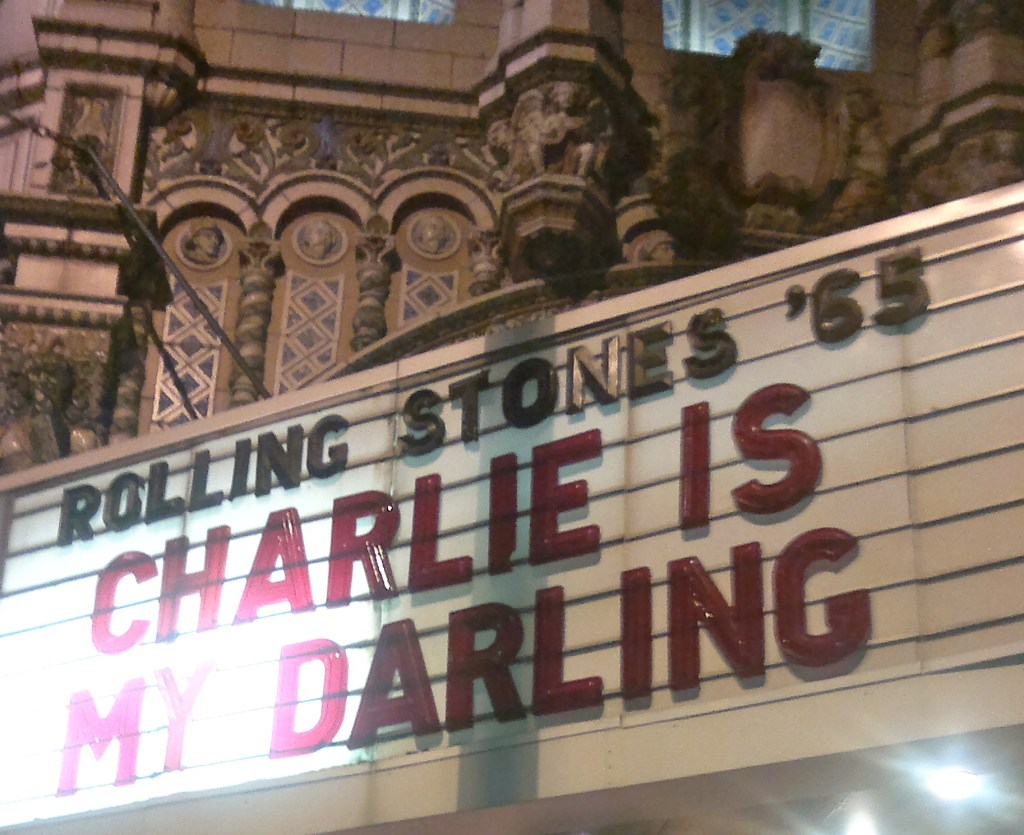
    Charlie Is My Darling at The HollywoodThe new, old Rolling Stones film, “Charlie Is My Darling,” played at Portland’s Hollywood Theatre this past weekend, and we joined a mellow crowd of folks carrying beers and popcorn into the main auditorium, most of us probably able to claim that we had been raised on the Stones.

    The Rolling Stones of 1965 were born before the outcome of World War II was certain. Mick was born the week of Operation Gomorra, the Allied bombing of Hamburg, Germany, the firestorm that literally sucked all the oxygen from the air, killing 40,000, injuring another 40,000. Keith was born that December, the week Eisenhower was named the Supreme Allied Commander in Europe.

    Time was on their side, and ours too, as we settled into the revamped seats to view the revamped film. But time for what? One thing that seems to have died in the war was the notion of patrimony, if only temporarily and sporadically, that one might be born with guarantees, warranties. In its place would come a new wave of egalitarianism. It bartered with time, but still, what to do with it? Over in France, the question was considered existential, but for the Stones of “Charlie Is My Darling,” touring Ireland in September of 1965, the question hardly seems to have created a crisis.

    “I am not a musician,” Charlie Watts, the drummer, and Bill Wyman, the bassist, both insist. But that’s a simple argument of definition, for what is a musician? They certainly were not musicians in the sense of the classical pieces tied to their seats in a symphony orchestra. But “I just play music” is the rejoinder of the actor, the musician who takes the stage in front of an audience wanting to feel real time, feel alive and in motion. Thus Mick says he’s acting. Music becomes an act, and part of the act is the audience. There’s a scene in the film when a small crowd takes the stage, and an Irish boy grabs Mick’s microphone stand and takes the helm. But he’s not acting, or is he? It’s today a funny scene, full of dramatic irony, for we know what they don’t. It seems almost staged, improvised, but expected, at the same time. What does the audience want, the Stones are asked. To get close, to touch, to be part of the moment. To be in time with the band.

    Time is tight, sometimes, but as time goes by, we don’t always feel so constricted, but nor do we feel time “creeping in [its] petty pace,” taking its leisurely time, but still we feel we’ve time “to wonder, “Do I dare?” and, “Do I dare?,” and time to wonder if blogging isn’t such a waste of time, but time can be impatient with us, or we with time, like the bartender in Eliot’s “The Waste Land,” who simply wants to go home, and calls out repeatedly: “HURRY UP PLEASE ITS TIME.”
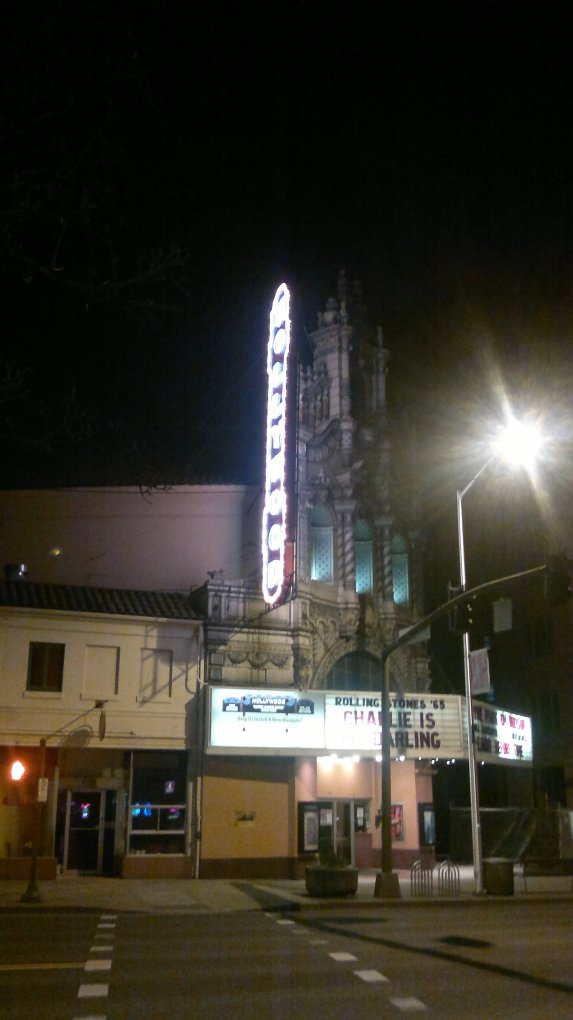
    The HollywoodTime is real. What to do? Rock around the clock.

    The film release comes in time for the Stones 50th anniversary year. It would be fine if their 50th anniversary tour gigs were as simple as the ones in “Charlie Is My Darling,” the stages low and thin, the instruments and amplification unhyped, the audience small and close, the band members close to one another, no catwalk for Mick’s jagged moves, playing venues like The Hollywood Theatre.

    Alas, too much time has passed, and with it, too much innocence.

    In the film, though 1965 does not seem like some ancient time, one is startled to see how young the Stones look and how old things seem. They travel by train, and the camera captures some splendid Irish countryside. When they do fly, it’s in a prop plane. The audiences are young, of course, but casual and quick interviews with bystanders show they were well-known, if not popular with everyone. There’s a fun and impressive scene where sequestered in a small hotel room with a piano Mick and Keith imitate Elvis and Fats Domino. Charlie pounds a bit on the piano, too. They had all gone to school on this stuff. And there’s another instructive scene where Mick and Keith are shown making up a song, the others following the process, getting it as they go – yeah, not musicians, though; they just make up songs. Mick downplays the lyrics and intellectualizing any of it. Maybe, but this too is all part of the act. What is their audience not satisfied with, Mick’s asked. Being controlled by the older generation, he says. And why do they feel that way? Because they’re dissatisfied with it.

    CharlieThe thin stages, the notable riffs, Mick’s antic catlike, moody body language, the minimal amplification and Charlie’s simple drum kit, were all easily enough to activate and satisfy the audience’s rock and roll impulse, both in the film and in the Hollywood Theatre. This could be the last time. Every time, any time.

    What to do, and why not a few songs, an hour upon the stage, or in front of the stage, or, years gone by, in an old movie theatre? Susan sat next to me, I could hear her softly singing, and I could feel her chair rocking.

  • Hey, where did that Tweet go? Never-mind, check this out: Cat Twitter and Blog Beautiful

    Is there any expression more ephemeral than the tweet? Tweets are like mosquitoes, they bite and you have to scratch, and they fly about in swarms. Of course, you don’t have to go out into the twittering evening. There are many species of tweets but all have a short life cycle. Tweets are tiny. Large tweets are called blogs.

    Of the many species of tweets, the wry with a twist is perhaps one of the most coveted. The topic hardly matters, but the more mundane the subject often the better to surprise with the wry. It’s as if to say, I could go on about this, but your attention warrants only my slightest swat. But when these fail, the tweets about brushing one’s teeth with a tube of diaper rash ointment because you couldn’t find your reading glasses, for example, or the photo of the morning bagel with cream cheese, and you were sure the baker was trying to send you some covert message, the wry is treated like a bad pun, noses in the air.

    I have nothing to tweet, and I am tweeting it, and that is Twitter, as I need it, to do damage to John Cage‘s “Lecture on Nothing,” but it does seem appropriate to some twitterers. If one truly has nothing to say, who will listen? But if we begin with the admission, perhaps something of interest will follow. For having nothing to say, and saying it, is having something to say, after all.

    Speaking of follow, Twitter’s format permits a kind of democratized social media, where one can follow without fear of being followed or be followed without fear of having to follow back. Is this freedom? One can lock one’s tweets, as Emily Dickinson did. But the mass of Twitterers follow more than are followed. There’s a crossover point, somewhere, a kind of demarcation separating the pro twitterer from the amateur, the popular from the wallflower, but which can occur at any level.

    But what’s got us all atwitter this morning? Just this, an article followed from a tweet, “Librarians of the Twitterverse,” by James Gleick, in a post at the NYR Blog. To whit: probably (at this point) over 200 billion tweets have been imported into the Library of Congress, where the hope is to create a file that can trackback every mosquito in the swarm, and their every bite, an everyone’s Diary of Samuel Pepys.

    But where to begin, now, if not then, letting the future worry about them and then. What do we look for in a tweet, in a blog post? Most of what we see is a kind of cat twitter. But that’s ok. Like Buckminster Fuller said, or might have said, if he knew about Twitter, 1,000 people should tweet, and one will come up with a tweet good enough to retweet, but you never know which one.

    So, who to follow, whose tweets or whose blog posts. Here at the Toads we’re always on the lookout for something clear and concise, purposeful and meaningful and reflective, though we also enjoy the quixotic and the chaotic, the wry with the sad, the happy with the bubbly. It’s seldom so much what’s being said, but it’s always about how it’s being said. I’m always adding and subtracting from my blog feed subscriptions, somewhat capriciously, a fickle reader, yet there are a number of blogs I follow regularly, and when I see there’s been an update, a new post, I go directly to it. What is it about these blogs that keeps me going back to them?

    This morning I want to pass along a blog I discovered recently that surpasses the average for its lucid and honest prose and lovely style. It’s called “Small Fires.” I hope you check it out. Reading the posts, I get the feeling here is a writer, someone who seems at ease with words, though not always with the subject, for some subjects are not easy, but whose ease puts the reader at ease. How does she do this? I don’t know.

    But to close on the quixotic and the chaotic, another cat cartoon:

    Cat Twitter
    – I joined Twitter! Check it out, my first Tweet!
    “Sitting under apple tree looking though wintery bare branches waiting for birds tweeters jay flickers titmice owl or the occasional squirrel” – exactly 140 characters including spaces.
    – I notice you are not partial to punctuation.
    – I already have 5,000 Twitter followers! And a bunch of Retweets!
    – All birds, you say? Might want to rethink giving away your location.
    – Cats of the future will read my tweets at the Library of Congress!
    – I don’t doubt it for a tweet-second.
  • Carpe diem the light flight of the Frisbee!

    GaviotaPoems are often compost piles mixed with eggshells broken by past poets, full of word scraps and shards decomposing. Themes leach toward the surface, riding on the juicy skin of earthworms, rising toward the light and warmth of now.

    Speaking of now, one such theme is carpe diem, seize the day, or, as Janis Joplin sang, “Get it while you can.” Carpe diem is an argument, an attempt to persuade. Who’s the speaker? Who’s listening? What’s the occasion? What are they talking about? Or is only one talking, the other listening?

    Sometimes, abandoned or unintended compost piles volunteer new versions of old, rotted plants, often now cross-fertilizing into new varieties of carrot, turnip, garlic, potato, pepper, pea, bean, tomato, melon, radish, corn; or you might get portmanteau words, or a cornpone cornpoem, or at least a cornponepost. Of course, you might want to dig it all back in and let it stew for another year.

    But here is a poem-mix from the Toads poetry reading compost pile. The idea is to dig through the layers, reading as a dig, the poem an earth oven. Careful, some poems smolder for a long time – some are still smoldering, hundreds of years old:

    To the Virgins, to Make Much of Time” (1647), Robert Herrick: the poet argues a proposal – don’t go coy, for one who goes coy risks going solo. Surely there’s a rebuttal to this argument, or the argument is a rebuttal, for going solo is better than going sour?

    To His Coy Mistress” (1650), Andrew Marvell: There are some worms in this one, but embedded in a kind of taphephobic image, and what about those “amorous birds of prey”? Is the poem an appeal to love or to fear? The poet seems to be on the run from something that does not sound too fun.

    Dover Beach” (1867), Mathew Arnold. A couple of hundred years closer to the top, but the poet is still talking to his girl, but coyness doesn’t sound like the problem, but fear has gripped the moment. Lovely evening, but our poet can’t seem to embrace the now; he’s built his compost pile over a cemetery, and that low tide has really got him spooked. Is this any way to talk to a woman? Notice how quiet her response; she doesn’t make a move.

    The Dover Bitch” (1967), Anthony Hecht. Something has happened over the last 100 years, something to the poet, and to the woman, and to the tone. The Sea of Faith is now bone dry. But no one is kept waiting around anymore. The viewpoint has swiveled. Same room, same scene, same poetry garden, but someone has shoveled a lot more irony into the compost pile.

    Dover Butch” (2006), David Biespiel. Another 40 years passes by, and coyness may no longer seem much of a crime, for the rate of exchange has changed, and the viewpoint has swiveled even more. We’re still up on the cliff, but something has changed in the economy, in the exchange. Who’s talking now? Does the woman finally have something to say and says it? Is she a mother now? Perhaps we’ve misheard, but we picture the speaker’s heart sailing off the cliff like a Frisbee.

    Carpe diem the light flight of the Frisbee!