A
poem
in the shape
of a tree. A poem
about a tree in the shape
of a tree. Some will argue it’s neither
a poem nor a tree, not a real tree, anyway.
Critics will argue the tree is not a poem, because
it has neither rhyme nor stanzas, though the lines do
present shape. Some will say, as a critic once commented
following an investors’ viewing of a B movie still in the editing cut
phase: “Does anyone else feel a better use of this particular roll of celluloid
would be to cut it up for guitar picks?” Some will say the tree should be cut down,
or yanked out by enormous
dentistry-like heavy equipment,
the kind used to clear cut forests.
Thus we arrive at the bare tap root
of
the
ma
t
t
er.
Category: Writing
-
The Root of the Matter
-
Bukowski and the Three Flies
From his father’s crap he falls
into the bar and plops his basket
down on a stool and asks
for a tall Falstaff.
Three flies fasten to him,
ogling the brew.One runs her fingers through his thick brew
and pules until he falls
into her arms and she pulls him
off his stout cask
and steals a sip of his Falstaff.
Another asks,touching his face masked,
with slender pink nails running the rim of his brew,
tracing the scars on his face,
when did he first fall
spoiled and askew.
The third takes off his shoes and hums a hymn,tenderly rubbing his feet, humming,
his feet half-soled with beach tar, trash
cans, hums for three hours until Buk is as sober as
an oaken church pew,
and the bar flies all fall
to the bottom of a glass stuck with Falstaff.Bukowski from the floor asks for a pint of Falstaff,
singing a rum tum hymn,
swatting the air for the flies just fallen.
The stout sober poet stands ajar and asks
for just one last brew.
He rises and drifts like a hot air balloon falls,and bewildered asks
for a full glass of Falstaff,
a newly fresh falling brew.
Buk’s humming the fly’s hymn,
up again, like an upright cask,
but his hoops break apart and the large man falls,misses the last call, and the bartender hoses and flushes him
and the fallen Falstaff and the flies from the bar, a huge task,
washes out the flies and brew, and into the gutter they barrel. -
99 Bottles Over the Wall
On the tabletop of the sea sat a few empty bottles
surrounded by the detritus of discussion.
No burning butts, though,
the bar under water, the talk polite,
as if no riptide of innuendo threatened to drown out the quip.Paddling out is hard enough; now
how does the stranded entrepreneur get back to the strand,
having drifted so far out?
The question is rhetorical and impossible, an impassable bottle.This great bottle business denial,
all in the business of passing bottles,
unable to pass on this impassability business.Across the bar there is no mission statement:
free to wander and listen to the swimming voices, sailing and selling, tacking back and forth, bantering and bartering.
Eventually, all sink, subsumed or consumed,
bottled in the great Ocean of Business,
no need for pain or pleasure, fear or courage, emotions or metaphor, opinion or belief,
swallowed within the immense immortal impassable snorkel bottle. -
p-1: The Evil Hill on Mariposa
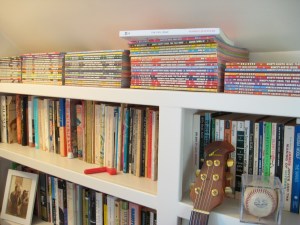 If print does disappear, I will be only partially responsible. I’m doing my part to keep a few print publications healthy. But I can’t subscribe to everything. The question is always the same: what to read and how. A loyal subscriber to The Believer, alas, my subscription has lapsed, and just prior to the 2013 music issue, which turned out to be jazz inspired. Bummer.
I’ve been comparing the cover changes over time of the New Yorker with the cover changes of the Rolling Stone. “Time is real,” Cornel West reminds us. But a few weeks ago, finding myself reading, with interest, no less, in the New Yorker, a “Tables for Two” eatery review of a restaurant I’ll never eat at, I decided I’d better augment the New Yorker and replace The Believer with something new. Meantime, I had discovered Kirill Medvedev, and noticed that n+1, which I follow, sporadically, on-line, was giving away the Medvedev “It’s No Good” book with a new subscription, so I went for it. And last week, the Fall 2013 n+1 print issue arrived, red dressed, calling itself the Evil Issue. Evil? Really? I felt the proverbial wince of buyer’s remorse.
I sat down and opened my n+1. I glanced guardedly through the table of contents, not one for haunted houses, horror films, that sort of thing. Something here by Marco Roth on politics, on drones – ok, that’s evil. A drama piece titled “sixsixsix.” Why do folks think Satan evil? Consider Blake’s “The Marriage of Heaven and Hell”: “The reason Milton wrote in fetters when he wrote of Angels and God, and at Uberty [a lot] when of Devils and Hell, is because he was a true poet, and of the Devil’s party without knowing it.” Still perusing the evil issue’s table of contents and glancing through the articles to see what I might want to start with, I came to something from the Stanford Literary Lab, titled “Style at the Scale of the Sentence.” I haven’t finished it yet, but I’ve decided it’s at the heart of the evil issue for a reason. Then I saw this, which took me by surprise: Alice Gregory’s article titled “Mavericks: Life and death surfing,” and soon found myself into the evil issue in earnest.
If the entire evil issue was instead titled “Mavericks” and filled with Alice’s writing about surfing I would be a happy reader. The only problem with the article is it’s only ten pages, which means back to the Literary Lab’s “Sentence” article too soon. Maybe I should have renewed The Believer, after all, seen if they’d send me the music issue I missed. On jazz! Jazz in the evening can turn an evil day good. Wondering about the etymology of the word evil, I found this in Wiktionary: “from Proto-Indo-European *upo, *up, *eup (“down, up, over”).” Ah ha! That’s a definition of surfing. One of the best pieces of journalistic writing on surfing I’ve ever read came in the New Yorker, back in 1992, written by William Finnegan, himself a surfer. “Surfing is not a spectator sport,” he says in the second of the two-week, long article. In the first week, Finnegan had said, describing the surf at Ocean Beach, off San Francisco, “The waves were big, ragged, relentless, with no visible channels for getting through the surf from the shore.” Conditions in the water, often fast changing, are difficult to read from the shore. Waves always seem bigger to the surfer in them than to the spectator watching from the beach or from a cliff high above the water. I read the long Finnegan piece twice before mailing my two copies with the articles to an old surfing buddy, not much of a reader, who later called me, totally stoked.
Preparatory to surfing, back in the day, hey-hey, kids growing up in South Santa Monica Bay rode skateboards: literally, the wheels removed from old roller skates and nailed to the bottom of a two by four, crude vehicles compared to today’s boards. I lived on Mariposa, at the bottom of a long, steep hill, followed by a short straightaway, then an easy hill ending at my house on the corner. The houses on Mariposa backed up to railroad tracks (since removed). Between the railroad tracks and the back fences was a path the local kids called “Devil’s Path” or “Devil’s Pass,” a shortcut toward downtown. We regularly rode skateboards up and down the mild Mariposa hill, but to ride a board from the top of Mariposa was considered a daredevil feat.
One day, my friend Pete Ponopsko, a few years older than me, took a skateboard to the top of upper Mariposa. He was going to ride down the big hill and would pick up enough momentum to carry him through the straightaway and down the lower hill all the way to the bottom. A small crowd of skateboard aficionados positioned themselves mid straightaway, where we could watch Pete whiz by on his way to the lower hill.
One of the problems with early skateboard technology was shakiness. At fast speeds, the boards wobbled side to side. Another problem had to do with the metal, roller skate wheels. A pebble might catch under a wheel and brake it, stopping the board and throwing the rider forward. We never knew for sure what went wrong with Pete’s ride down the upper hill. Some said the board shimmied so severely he simply could not keep his balance. Others said he hit a rock and pearled. Still others said Pete chickened out and tried to jump off. Whatever the cause, the effects included a startling array of raspberry red scrapes and bruises along one side of Pete’s body, from his ankle to his ear. It was said Pete slid on the sidewalk a distance equal to the length of a 1956 Ford station wagon. It was an evil wipe out, and it was a long time before anyone tried to ride upper Mariposa again, but by then skateboards were wider and thinner and longer and fitted with smooth rubber wheels and stable wheel bearings, and Pete was already an old-timer.
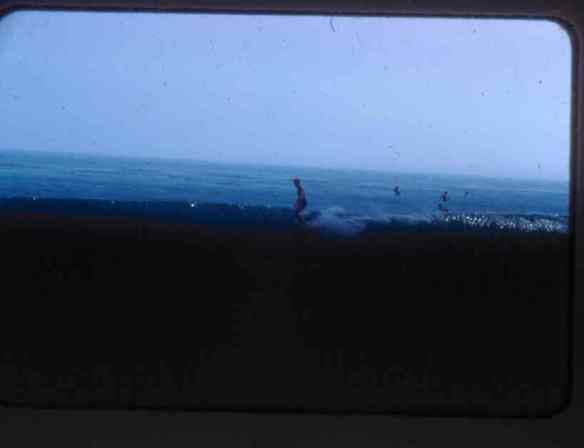
Joe at the top of an evil wave. Well, an evil photo, anyway. Follow Up: n+1 has put the Alice Gregory Mavericks piece on-line, 9 Oct 13.
-
Susan Among the Zen Monks in the Gorge
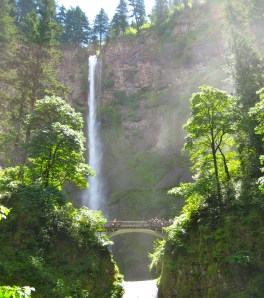 One summer, we drove into the Gorge to view the falls. There are several falls along the way. Multnomah Falls is the tallest, and is now a major tourist attraction, complete with gift shop, food carts, and a fancy restaurant where a few years ago Rachel Ray filmed a segment of a food show. Summer falls, and it’s hot in town and in the Gorge, but the mist from the falls is cool.
There are two falls at Multnomah Falls, an upper and a lower. To get to the pool at the upper falls, you hike a switchback trail up to an old bridge. The pool below the upper falls is now off limits, but you can view the upper falls and the pool below from the bridge. We used to climb down the trail and wade into the pool, but you can’t do that any more. Wading into the pool, you could get soaking wet just from the mist from the falls. The falls don’t take the place of waves, the smell of salt-water breezes. In the Gorge, in the summer, if there’s no wind, the air seems thick and heavy, but if you take the old highway, you pass along cliffs of shade and green fern groves growing under the fir trees. And the falls are always a cool surprise.
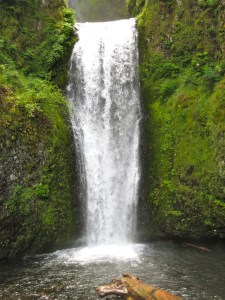 Anyway, this last time we stopped at Multnomah Falls, Susan decided not to make the switchback hike to the top. On my way up, I passed a group of men coming down. Their heads were shaved. They wore robes and sandals. I didn’t think much of it; monks, I assumed. I nodded as we passed on the trail. When I got to the bridge, I spent some time looking at the upper falls and turned around and crossed the bridge to look down on the lower falls and below to the trailhead to try to spot Susan. And there she was, sitting on a stone bench, surrounded by the monks. I waved and waved some more and finally caught her attention, and she waved back, and all of the monks waved too. I took a picture of her in the middle of the monks, all waving. Then they all stopped waving and went back to talking with Susan. Later, Susan told me they were Zen monks. And this morning I’ve spent probably 30 minutes looking for that photo. Alas, it seems to have disappeared. I think in a past life Susan may have been a Zen monk who attained enlightenment.
 -
Your Poem Will Start in 21 Seconds
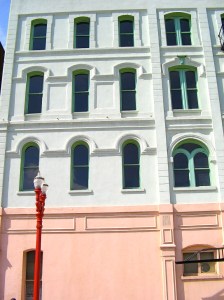 Your poem will start in 21 seconds.
You can skip this ad in 5 seconds.
Or now: click away. Or watch video:
A two-tone building, seen from the street, light lime green with aqua-mint green trim over sunned-pink, with red double lamppost, a scotch of blue sky, a wedge of blue, a swizzle of blue. Just past noon shadows. Jet black ladder.
Your poem will start in 21, 21 videos Your poem will start in 21 days Your poem will start in 21 years Your poem will start in 21 centuries Your poem will start, but it will not end: The rest of the poem is below the paywall, mercifully. -
Hummingbird
 Anna’s hum must be a drum
Syllabifying wings she pauses
Asks for a brush of water.Gusto the loin cat curls
Garnished in the parsley
Paws brown under yellowOrange marigold sprinkle.
Curling green garlic stalks
Stop hear the red head humOiled garden buzz
Quicken the quiet morn humus
Yeses of soft dry feathers.Break blossom drift
Brood across rouse salsa
Word warm worm release. -
Two Ocean Surfing Poems at Berfrois – and a gallery of old ocean photos
“Ray, 1956” and “Watermarks from a Night Spring,” two poems with themes of the ocean, surfing, and working, were posted at Berfrois a couple of days ago, along with a few old surf photos.
Paddle on over to Berfrois and check out the surf poems.
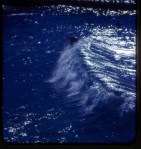
And below find a gallery with more photos from the late 60’s thru mid 70’s. Most of these photos were taken with an Exakta 500 single-lens reflex camera (East German), with a 120 portrait lens, both purchased used and cheap to take surfing photos at local spots on Santa Monica Bay. Most are scanned from slides, Kodachrome or Ektachrome, and one is from a black and white print. The portrait lens was an affordable workaround at the time used as a kind of telephoto, and it worked ok. The camera was abused though, tossed in the sand, and over time the shutter began to stick. The photos starting coming out black. Some viewers may feel these the best photos. See etched drawing on one of the black slides. These are not “big” waves, and the surfers are locals, but the ocean is huge and alive and old and every morning new. Click any photo to see the gallery. And don’t forget to check out the poems.
Fishing barge washed in off of Redondo, Palos Verdes in background (circa 1969). 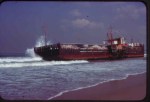
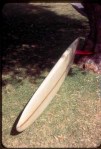
Jacobs re-shaped board on rail. 
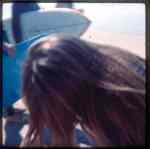
The first Boogie Boards were hand made from kits. That’s a blue skinned Boogie Board behind this photo of Susan’s hair! 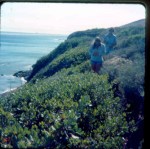
Susan & John above cliffs at Gaviota, north of Santa Barbara. 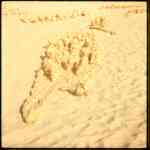
Dinosaurs on beach in Venice. 
Grand Ave. El Segundo. 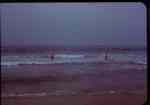
Walking out into El Porto mush. 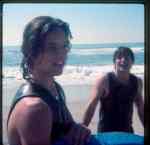
John w boogie at El Porto. 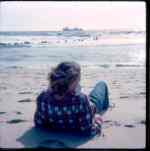
John, Grand Ave. Beach. 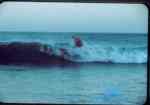
Leo Carillo. 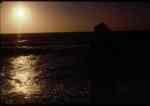
El Porto. 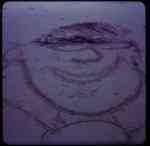
Seaweed Hair w Sand Face. 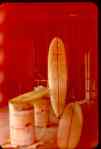
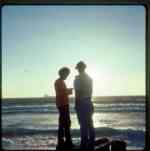
w John, Grand Ave. Beach. 
Shutter Stick. 
Boogie. 
El Porto. 
El Porto. 
El Porto. 
El Porto. 
South to El Porto from Grand. 
Leo Carillo Beach. 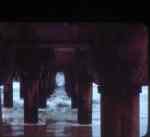
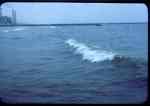
South from Grand Ave. Jetty. 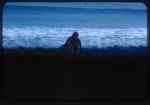
Leo Carillo Beach. 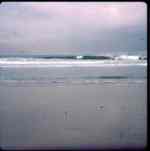
El Porto. 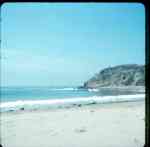
The Point at Refugio Beach. 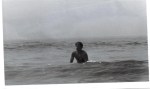
Related: Watermarks from a Night Spring & Ray, 1956
-
Memories and Hallucinations, Real Nostalgia: Bill Bryson’s “The Life and Times of The Thunderbolt Kid”
 The notion things change fast doubles in intensity roughly every two days. It takes a couple of days for most changes to sink in. “Who moved the cat dish?” I ask, combing out dry crumbs from between my toes. “Oh, I changed that the other day,” Susan says. Moore’s law observed amplifying speeds doubling every two years. Too bad the Market hasn’t managed as well. If we understand the laws influencing changes, we’re able to merge smoothly into the new wave. Joe’s law says internal speeds slow inversely to external speeds. As the speed of life increases, what we’re feeling inside slows to a crawl. I can feel the cornstarch thickening in my spinning stomach. The waves keep coming. We can roll under, ride up and over, dive through, or turn around and catch one. We get out of the water and consider our memoir, what just happened, what just changed. The waves look different from the beach, not what we remember at all. We get our breath back. We consider the last wipeout.
What is change? Do things actually change, or do we simply wake up one morning and remember things differently? Oliver Sacks, in “Speak, Memory” (New York Review of Books), his title borrowed from Nabokov’s memoir, said, “There is no easy way of distinguishing a genuine memory or inspiration, felt as such, from those that have been borrowed or suggested.” Our experiences – real, imagined, vicarious, read, heard – become stories we retell. “Memory is dialogic,” Sacks says (made from communication with others), “and arises not only from direct experience but from the intercourse of many minds.” I’ve only read a portion of Sacks’s latest book, “Hallucinations,” an excerpt, “Altered States: Self-experiments in chemistry,” in the 27 Aug 2012 New Yorker. How does Sacks remember anything? Stories like Sacks’s always remind me of a Salvador Dali interview. When asked if he took drugs to produce his surreal art, Dali responded: “Why should I take the drug? I am the drug.” But Sacks obviously has a good memory, or memories. What’s a good memory?
Speaking of hallucinations and memories, I’ve just finished a Bill Bryson book, recommended by Susan, “The Life and Times of the Thunderbolt Kid: A Memoir” (Random House, 2006). Bryson was born in 1951, and the book is about him growing up in Des Moines, Iowa, in the 1950’s. We see his memory at work, his memory assisted by a bibliography of books about the world he was born into. That world is given particular focus through his witty anecdotes of home, neighborhood, school, and town, personal reflections mixed in with the historical, researched view. It’s an easy to read, enjoyable book, almost subversive the way he works into the telling what might otherwise be a dry history book. We learn, or are reminded, of much of 1950’s culture, politics, family and societal values. Most of the telling, while written for an adult audience, sounds like it’s coming from a kid’s attitude. The kid reports what’s happening to him, but he doesn’t always understand why it’s happening – several levels of irony at work. Susan set me up. “Read this page,” she said, handing me the book one day, “out loud.” I did, and when I got to the bottom I laughed out loud. I didn’t see the joke coming. Bryson figures things out, like the rest of us, a kid on the go. It helps to remember some things. Other things, it helps to forget. “Grape was the one flavor that could actually make you hallucinate; I once saw to the edge of the universe while drinking grape Nehi” (278) Bryson says, blending Dali with Sacks.
Bryson is a prolific writer with an encyclopedic style. It’s sometimes hard to keep track of all the details, facts, numbers, all startling, though you might have been there, too. The chapter on the Bomb brought back memories of the classic classroom aid raid drills where kids practiced scrunching under their school desks in preparation for atomic attack. No wonder the generation grew cynical. Really, these desks were going to protect us? From what? Not from our memories. Here’s an example of how Bryson blends the personal with the researched: “I watched a lot of television in those days. We all did. By 1955, the average American child had watched five thousand hours of television, up from zero hours five years earlier” (279). And then he lists his favorite shows, a bunch of them. His favorite show was the “George Burns and Gracie Allen Show,” which pretty much spanned the 50’s. The key word back there is average, which Bryson was not, but no one is average. Individuals are too unique for any kind of averaging that makes sense (“People are Strange,” sang The Doors, a decade later). For one thing, it doesn’t sound like Bryson watched much TV with his family, but alone, in his bedroom, after he had collected enough cash on a paper route to buy his own TV. Most families I knew had but one television set, and it occupied the living room, an electronic shrine. In our house, it was a shrine, a statue of Mary on top standing on a doily and leaning against the antennae – its tips wrapped in tin foil to improve reception. For a time, it’s where we prayed the rosary together, for which the TV had to be off, though. But the concept of average is a Madison Avenue marketing ploy, and in school, average was a way of keeping kids in line. Anyway, remember the end of the broadcast day, the eerie signal that accompanied the black and white lined diagram on a field of gray, the tubes glowing red-orange like stationary fireflies? Or did I hallucinate that? Then came the teen years and kids grew subversive by not watching TV, while their parents watched the war every night around 6, just before prime time.
The notion that decades of years fix boundaries of anything is silly, but as we leave Bryson’s book on the 1950’s, we are reminded that everything the decade is remembered for is all gone. There is nothing left of the 1950’s. Everything has changed, and while the 1950’s certainly rang up a toll of bad stuff, all dutifully set down by Bryson, the fact that everything changed is not necessarily a good thing. Gone is the closeness, the walks downtown to the grand theatres, the churchyard dinners, the thousands of family owned farms, the tiny farmhouses under trees alongside two lane roads that passed through small towns. Bryson’s view of the 1950’s is a view of a kid growing up in the 50’s. His preference for something like the “Burns and Allen Show” points to something important: George and Gracie were not products of the 1950’s. They came from a different era, their TV show an example of McLuhan’s theory that every new technology takes its content from the content of a previous form: picaresque to vaudeville to radio to TV. It might have looked new, but it was already old. But today things move so fast that we can hardly calculate those changes. Certainly it doesn’t any longer take a decade. Already everything from two days ago is changed, if not two hours ago, if not from the beginning of this post. Dang! I just put my foot down into the kitty litter box. I would like to say I’m going for a swim, but someone moved the ocean.
-
It’s No Good; It’s All Good – at Berfrois
The Toads review of Kirill Medvedev’s book, “It’s No Good,” has been reposted at Berfrois. Slide on over and check out the situation at Berfrois.


 The Coming of the Toads