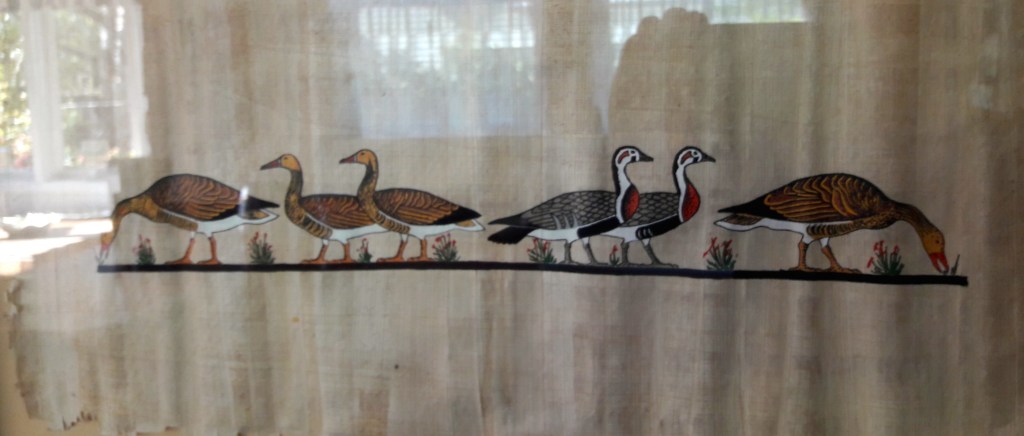
| I will write you a flower every morning to read with your coffee a bright yellow squirt the coffee oily blue green bubbles on top You sleep with a cat whose soft purr gives you pleasure all the joy of color impressions for the day You are soft like warm butter barely melting down a scone topped with a couple of firm red raspberries The butter surrounds the berries a light pigment an open place to play with lips and tongue – wait you didn’t think this was really a flower did you? Here are two flowers the one calls a honey bee the other falls asleep petals lips open blowing softly. |
There is so much silence hear the rustle of ants hustling across the counter for sugar and sweet stuffs see the apple blossoms opening feel the bees approach touch the molten lava freeze it you can but no matter Once we admired use of one another of the now tossed the cast laugh the tassels flipping flopping bouncing from rear view mirrors Now we adhere to a silence that deafens touch asks for oh be dunce I’m sitting in the corner face to the wall wearing the cap. |
Category: Writing
-
Two Open Places
-
Love is an Idiocy
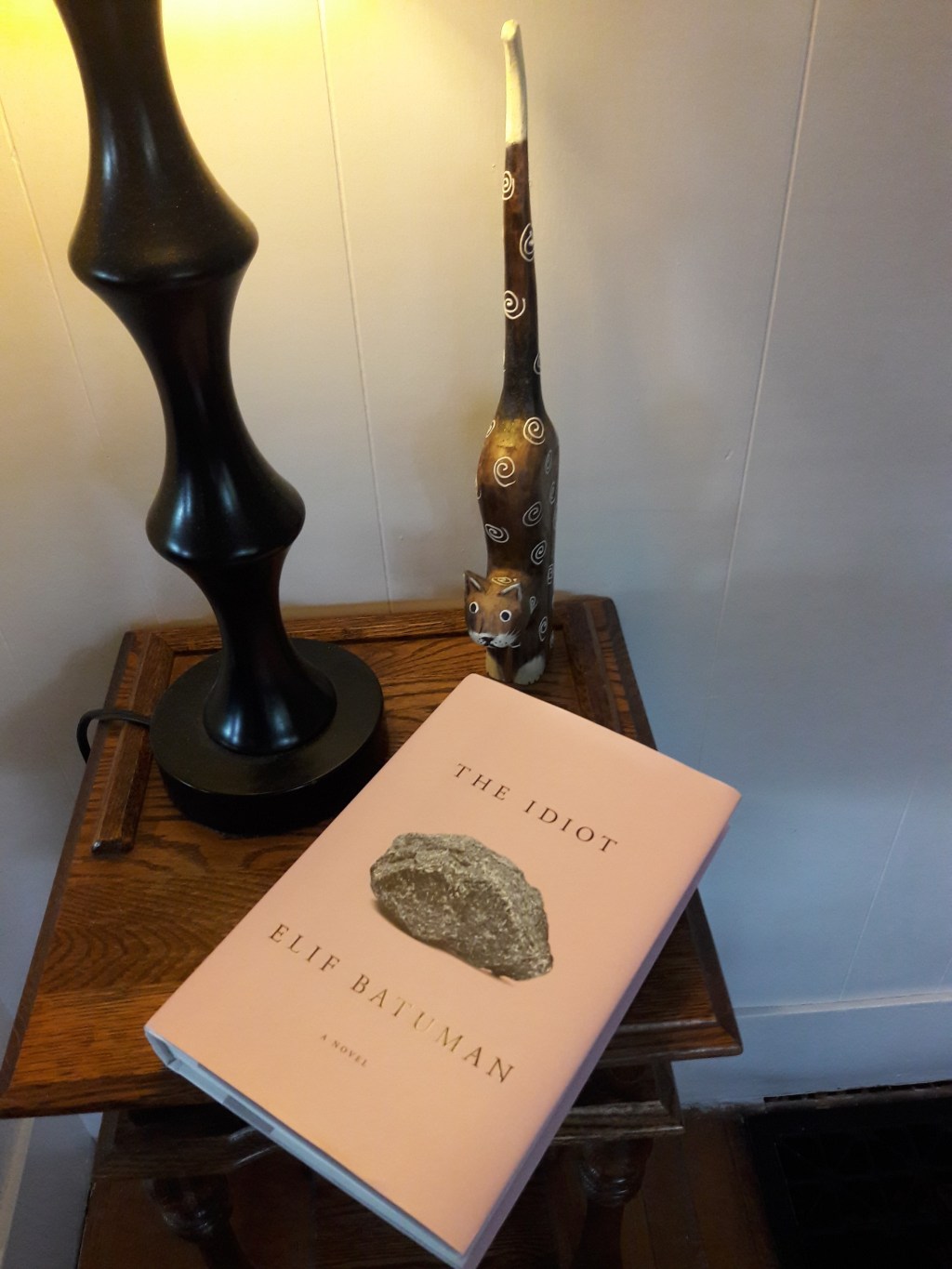
I talk about Elif Batuman’s novel “The Idiot” at Berfrois. Seesaw on over and see Selin fall from the top of the seesaw?
-
Comics
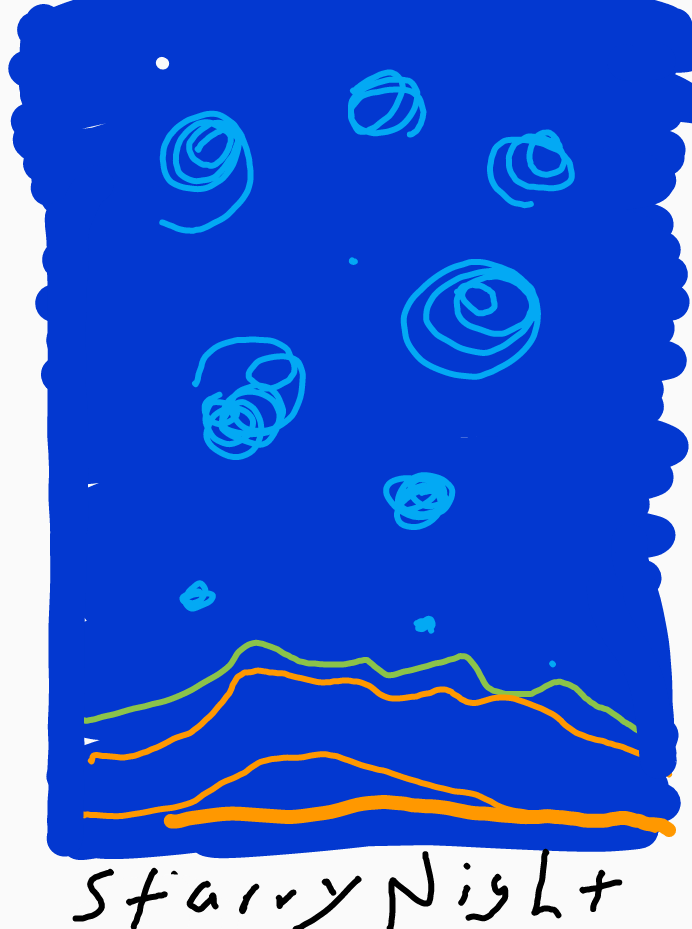
Comics page update. Still having fun with a perfect mobile device art form. The drawings are made using fingers and thumbs on Memo Draw on the cell phone. I’ve added to the Comics page of The Coming of the Toads a few of the more popular recent drawings.
-
The Buddha and Jesus Stop at a Starbucks
The line was long, a slow Monday morning.
They waited patiently, neither taking cuts
nor giving up position. At a table were two
policemen, fully garbed, sipping espressos.“Raspberry mocha with a peppermint
twist, triple shot with cinnamon sticks,
make it three: Grande, Venti, and Trenta,
and a plate of twelve fresh breadsticks.”“A jar of pickled pettitoes and a Tall
glass of water, please.”“I’m sorry, Sir, but you must
stick to the menu.”“A mushroom latte, then,
hold the whipped cream.”One of the policemen looked up,
the other did not.
The barista gallant,
tattooed with Galgulta across
her upper chest,
called out the orders with a voice
so young and joyful and beautiful
Jesus wept, and the Buddha smiled.


-
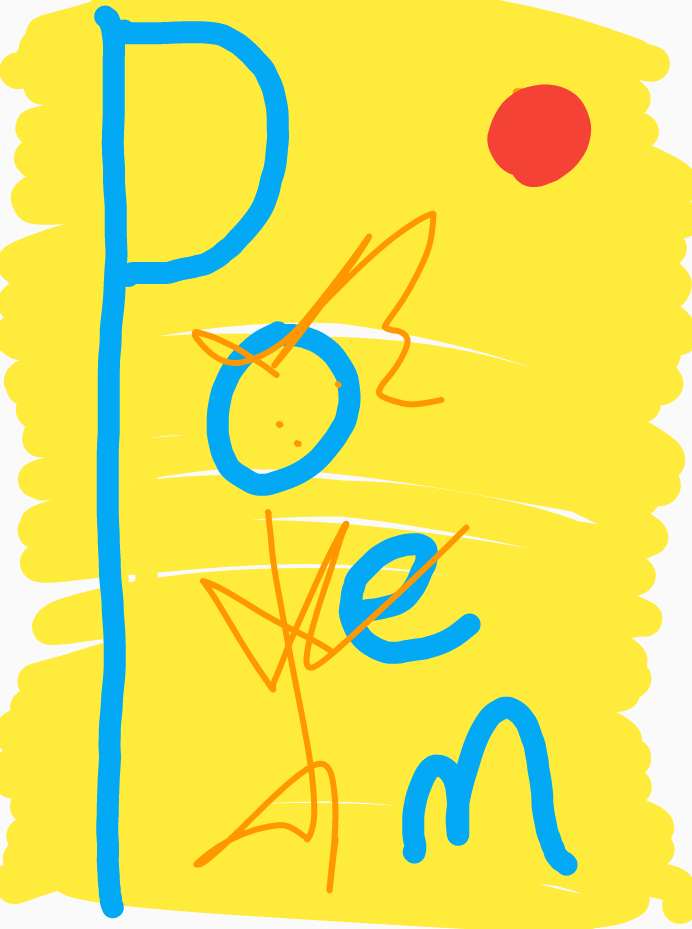
Jesus and Buddha
Jesus and Buddha
stopped for a beer.“Half pour of IPA
for me, dear,and for my friend,
a pint of emptiness.” -
The Decoy of Art
 A duck hears a quack that sounds a bit out of whack and decides to hide in the reeds. The duck call recedes. Later, a duck decoy floats by, and our duck hears that queer cracker again, now from the far side of the pond. The prattle, it skiffs across the smooth water, sounds not propelled by a voice – and that’s the art of the duck call.
Museum art, discovered, sold, and resold, donated now so someone can get their name on a room, where “infinity goes up on trial” (Dylan, 1966, Blonde on Blonde, “Visions of Johanna“), hangs by the imprimatur (“let it be printed”) of money.
Why, when art is capable of producing such wealth and covetousness, does it still require public funding? Because anyone can make art and the average duck can’t tell the decoy from the real thing? Or is it because the decoy is the real thing?
Is the philanthropist involved in a clean form of money laundering? But this is neither the time nor place for a conspiracy theory. Do we breathe our art together, or solo? You can’t make a duck out of lead, at least not one that will float. That requires a pencil.
Does art require genius (En attendant Godot)? Every child has an attendant and attentive muse. Genius is the ability to listen with ears open, even when filled with wax, to see with eyes clear, even when they are closed. “You can look but don’t touch” is the beginning of art criticism. One day, the muse disappears, and the child no longer makes art. Instead, she buys it, or tries to. She applies for a grant.
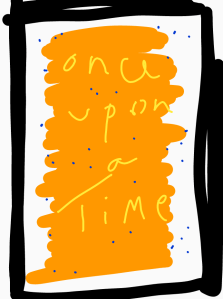 A friend who is a close reader, noting correctly my sudden obsession with my text-drawings done with the phone app, asked, “Having fun yet?” Once upon a time, art was fun, which is to say the making of art was fun. Writing was fun. The two together a blast!
Cooking is not the same thing as eating. Sewing a dress is not the same as wearing one. A colleague once said to me, “Everyone should write a book no one will read.” Maybe they do. How would we not know?
Meantime, my attendant must be on spring break, vacationing here. Can’t seem to get rid of her. I’m not sure if she’s another starving artist or just a decoy.
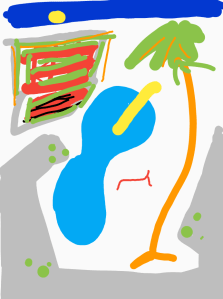
Note: with thanks to our regular reader from down under (who goes by “B”) for the inspiration behind the LA Home with Swimming Pool after Hockney mini-pic.
-
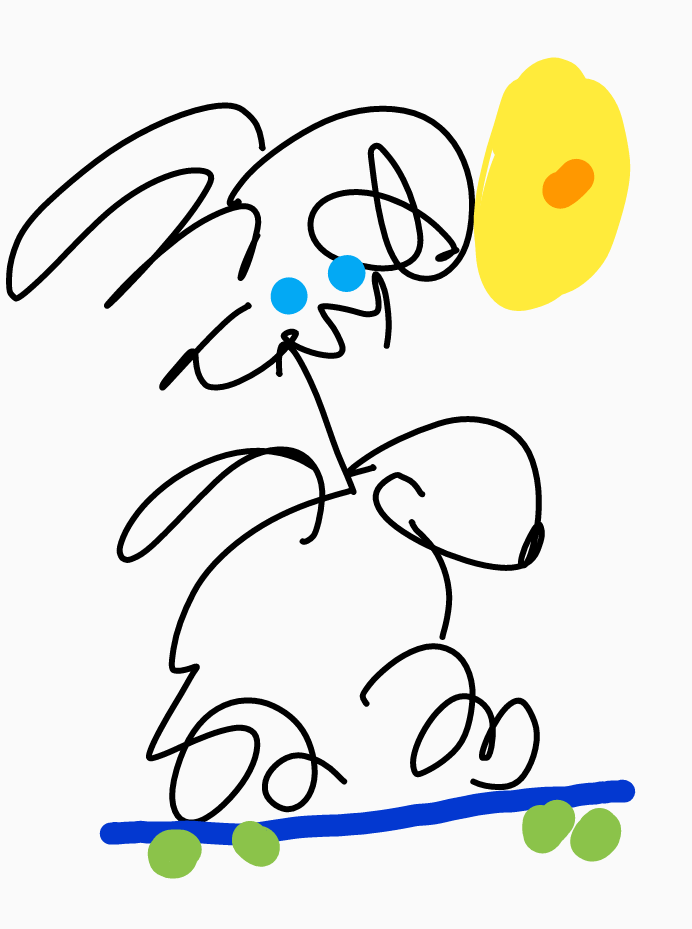
Poster Pic Doodle Comics
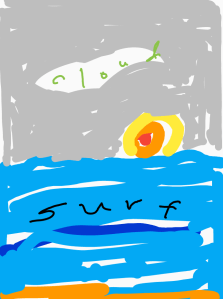
The old phone took quarters to make a call. I can doodle with fingers pictures on the new phone. I’ve been working on some Mini Poster Pics. Check out Comics page for large versions.


-
Toward a Rhetorical Ocean
 When does a bummer become a hell? For the average surfer, an ocean with no waves is but a bummer of a morning. The lull will pass. Need to pull some maintenance on the surf rig, anyway. But one can’t escape the hell of other surfers when the swell does come in.
“All those little crystals flew behind us in drifting angel trails.”
We’re on page 226 of Daniel Duane’s “Caught Inside: A Surfer’s Year on the California Coast” (North Point Press, 1996, paperback 1997).
“We all paused a moment, pictured it. Willie and Vince looked at each other: angel trails . . . metaphor or assertion?”
It’s a good question that’s answered by Duane’s rhetorical decision to write about the real ocean, not a metaphorical one. If a surfer mistakes a wave for something it’s not, someone might drown. “Caught Inside” is a researched book combined with the one year memoir, with appearances by the likes of Richard Henry Dana Jr (“Two Years Before the Mast”) and Ed Ricketts (“Between Pacific Tides,” “Cannery Row,” “The Log from the Sea of Cortez”). These by writers who almost never took something for what it was not, but catalogued and described in terms of scientific method – observing objectively, identifying, naming. And Duane is good at following suit. He’s interested in local observation, behavior, and faithful reporting:
“…and John Steinbeck intentionally socks it to Ricketts with a moral about those who would romanticize the wild: ‘Here a crab tears a leg from his brother . . . Then the creeping murderer, the octopus, steals out, slowly, moving like a grey mist, pretending to be a bit of weed, now a rock, now a lump of decaying meat while its evil goat eyes watch coldly.’ It’s Melville’s universal cannibalism of the sea, where Ricketts sees in the horror of the glassed-over pool a ‘lovely, colored world” – tide pool as evasive simulacrum” (230).
Nor does the shark pull on a pair of Hang Ten trunks before drifting with the tide toward a breakfast of those yummy looking frog legs dangling off that funny looking abdomen with its upside-down fin. That’s not a frog. That’s a surfer, and the fin is the skeg of his surfboard.
Alongside the historical beachcombers, Duane populates his book with local surfer aficionados he meets along the surfer’s way, most of whom follow the surfer codes. Surfing, annoyingly, is a social activity (much valuable surfing time is spent driving up and down the coast road searching for a preferred spot where no surfers are already out), which means if we want to be something more than shark bait or flotsam flown against barnacled rocks by an unheralded outsider, we must adhere to standards and conventions of behavior – in the water, up on the beach, and in the stingy community where being a surfer bum is economically and socially a monk’s life. Affordable beach city pads are already extinct in most popular areas, just about anywhere along the 800 mile California coastline, and dedicated surfers, the true aficionados, those who plan on spending every single morning in the waves if not also every single afternoon and evening glass-off, sacrificing relationships, careers, jobs, family, the crab traps of “benefits,” don’t have much time left over to load the 16 tons, even if they wanted to.
How should we spend our time which becomes our lives? Thoreau spent two years living in his monk’s shack on Walden Pond, alone, but within walk of the city. And he had a few visitors and neighbors. Thoreau didn’t surf, but he did walk through the woods eight miles every day. Those kinds of pursuits (surfing and walking) place obvious limits on other options, finding a job, raising a family, going out for pizza and a movie every now and then, not to mention finding the time to read a book about some surfer’s year at the beach. Maybe hell is an ocean with waves but none you can take off on, none for you, caught inside a commute. Quit daydreaming about the surf and get back to work. You can always read about the ocean, in bed, before sleep, before falling into the deepest ocean of them all.
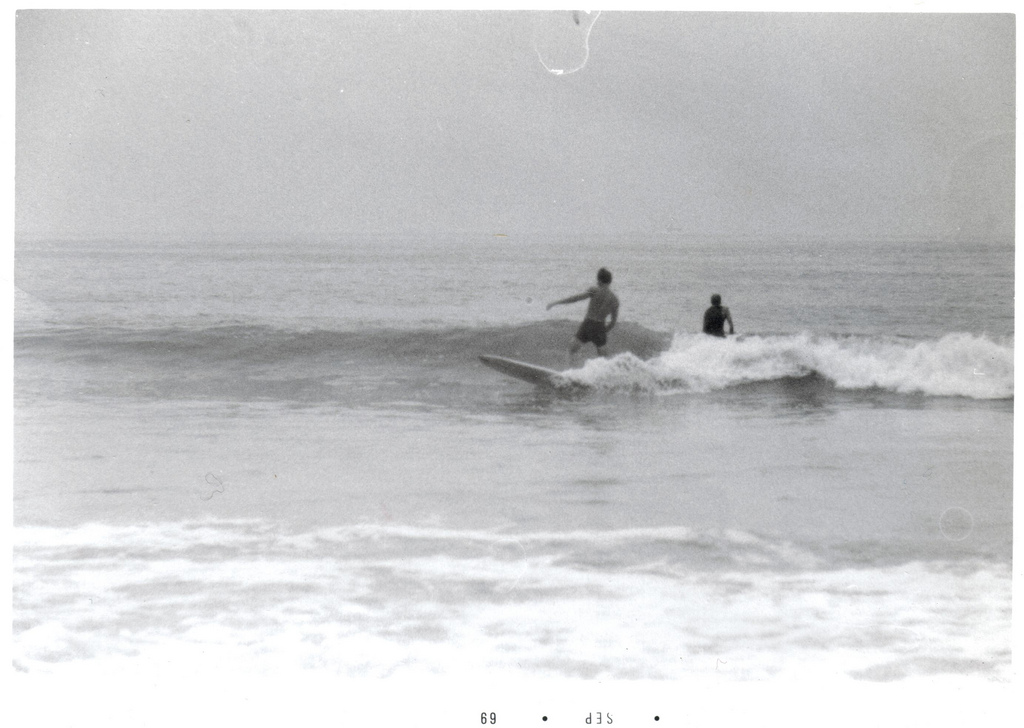
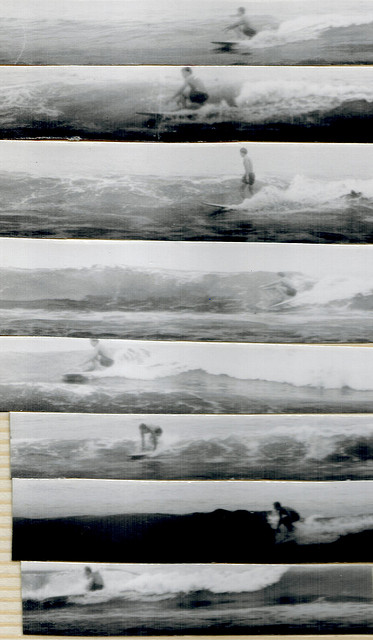
With thanks to my brother John’s friend Lisa who brought “Caught Inside” to my attention. Black and white photos in this post include featured photo of me on wave (without wetsuit) with surfing buddy sitting outside at El Porto, 1969. Collage of waves with me on my Jacobs Surfboard, same day. Those were typical waves for an El Porto foggy summer morning. The aficionados would have taken a look and continued their search, leaving the slop all to us!
-

After Words
After whirls listen
whale hush comes
the cat jigs the bat
for your cares ward
off dangerous asks.For love these old letters
wild bedraggled wag around
nest of gnarled grunts
mosses bones hair vines.The old alphabetical guard
strains in place at attention
runes assigned ward beds
grand command inspection.Sparse words heal
after wounds foraged
forward in a land
of odd angles
accentuated by red pencils.Winds mean about
we know not what
if in the end this
is an end or a start.“It’s like a new
pair of ears,”
after words wishes
remains unspoken. -
A Loss of Intimacy

How does one create a sense of intimacy with a blog? The very word, blog, heavy and lugubrious, suggests something one may not want to get too close to. Does intimacy imply a kind of secrecy, like the sharing of handwritten letters over time between two persons who have never met in propria persona? The Latin mass seemed intimate, and when, following Vatican II, local masses were said in the vernacular, I felt a loss of intimacy. The words in English had lost their secrecy. The mystery of the mass was no longer much of a mystery, no longer a magic show. The priest talked just like everybody else. This should have led to a greater degree of intimacy, but it did not.
One characteristic of the Internet is its ubiquitous presence, McLuhan’s “global village” realized, but for anyone who’s ever lived in a small town, the Internet might seem its opposite, an absurdly large, strange village, more like something Kafka might have dreamed rather than Sherwood Anderson’s “Winesburg, Ohio.” But the paradox of “Winesburg” is found in the irony that one feels intimacy most when one feels most lonely. It is the loss of intimacy when one feels the value of the familiar, of something made known especially for you. But “over the Internet” intimacy is spread as thin as Emily’s gossamer gown.
One blog I follow that seems to have created a sense of intimacy for or with its readers is Spitafields Life. Does follow suggest intimacy? But what if one is followed by a multitude? That would seem hardly the suggestion of intimacy. Yet the Spitafields blog is written by “The Gentle Author,” whose actual name we don’t know. Note the note of secrecy that seems to draw the normally distant intimacy near. The Gentle Author offers a course on how to write a blog. The next one is advertised at Spitafields for May. Maybe I should cross the pond and attend, buy a copy of one of The Gentle Author’s signed books, find out if The Gentle Author is male or female, not that it matters – would that knowledge increase or diminish a sense of intimacy?
Blogs come in many disguises and intents, purposes vary. The lifespan of the average blog is probably not very long, could be as short as a day or two, indeed, an hour or two. One might quickly discover the blogger’s life contains the secret of a crushing intimacy, more sad and forlorn than a single tweet could ever hope for. The sound of the whippoorwill.
So it came as some surprise to see the comment of one distant but familiar reader who found the new format I’m working on for The Coming of the Toads, “less intimate.” The folks who started the Internet, huddled over their code, as anonymous as a telephone pole on a country road, surely must have been among the least intimate of the ones to whom one might want to write. Or I just might have that backwards. IDK. The bloggers among us who prefer writing with words rather than with CSM must rely on canned templates to fulfill our visions! Admittedly though, I’m not even sure what CSM is, but I think it has something to do with the difference between visual and HTML. And so I leave you, no doubt, gentle reader, about as far from intimacy as I can get in this particular post.



 The Coming of the Toads