Category: Writing

  • Notes on Julian Gallo’s “The Penguin and The Bird”

    Notes on Julian Gallo’s “The Penguin and The Bird”

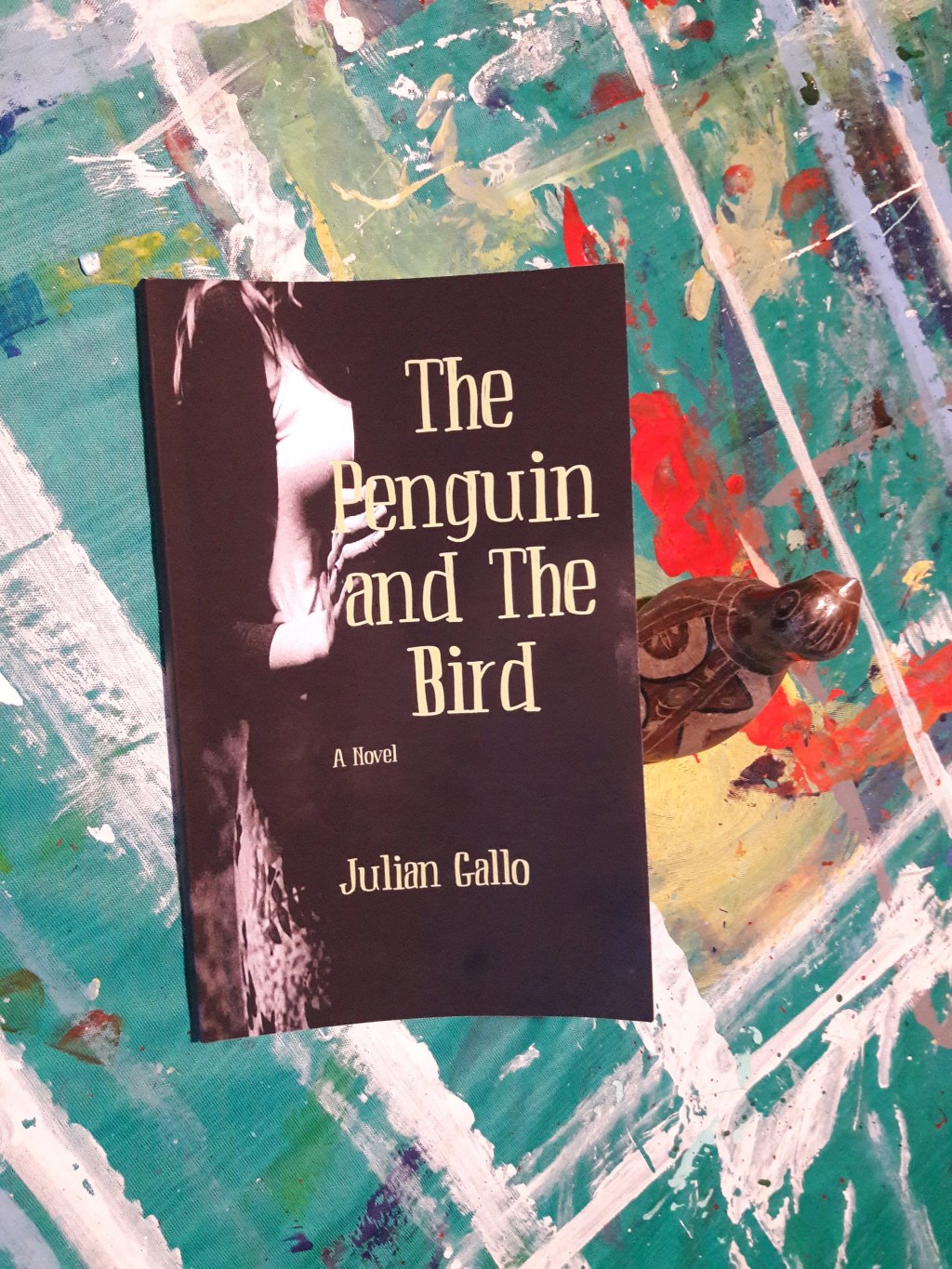
    Julian Gallo’s “The Penguin and The Bird” (2018, New Horizons Editions) is an impressionistic work. It functions as a graphic novel, but one without the drawings. There are 72 short chapters spread across 122 pages of text. The chapters are organized into four parts: “Her Mother’s Violin Early Autumn, 1979,” which concludes with Chapter 13, subtitled “New York City, Ten Years Later”; the second part is titled “Diamond Street, Brooklyn New York Mid Spring 1989”; the third part is titled “Under Black Light Late Spring-Late Winter, 1990″; and the fourth and final part is titled “The Penguin and The Bird Early Spring, 1991.” These named parts allow for a traditional structure to an otherwise experimental form. Narration shifts from third person omniscient to a second person who seems to be talking both to himself and to someone else, and taken together sometimes seem to merge briefly into a third person plural. Each short chapter functions as a kind of graphic novel thought balloon, but again, without the mechanical drawing. Other characteristics of traditional genres are employed, including plot and character development, the protagonist a dynamic character who changes significantly from beginning to end, and there are traces of noir and mystery genres, Bildungsroman, minimalism, and a kind of anti-writing, a writing that both discovers and develops itself in an improvisational jazz style while at the same time destroying the very expectations it creates, and in that sense the writing is realistic. But the impressions created while reading last, and the novel must be read from an appropriate distance: too close, and the strokes won’t properly merge to create the impressions; too distant, and a reader’s preconceived ideas of what a novel should be will interfere.

    The chapters in part one transition in turns from the protagonist, at the time a 13 year old boy trying to write and draw comics, to the antagonist, a Polish immigrant we will come to know as Nadja. They are sixteen years apart in age. They don’t know one another, but they will meet. The narration withholds information; or, rather, the information necessary to follow the plot unfolds to the reader as it does to the protagonist. The opening juxtaposition of the boy’s and Nadja’s situations, their predicaments, reflect the theme we will later see resolved in the last part of the novel, in Chapter 67, where Nadja tells the story about the penguin and the bird, which offers up a traditional meaning for readers who might be in need, while adding another layer to the form’s structure.

    Other techniques creating symmetry are employed, and the novel takes on a sophisticated, well-structured form. The language follows the form, beginning with the short, staccato-like sentences of the boy in the beginning, followed by the visceral, sour, and surreal hallucinations of the boy’s, now 23 years old, unrequited, unparalleled, and phantasmagorical fantasies of love and sex in the “Black Light” section. Nadja may be seen as moody, but the temperament of the young man, irrational and even non-rational, his complaints, editorial asides, and tortuous though short monologues, become increasingly angry, fearful, bitter, cynical. At times, the reader may feel like the episodes are being written from Desolation Row. But the writing appears to reflect the costs or risks involved for these characters. These middle chapters are written in a kind of diarist form, self-castigating, accusing, questioning, exploring, wanting, rejecting. This is not a superficial book; its aim is discovery and honesty.

    The novel ends in Flushing, New York, the style of the writing returning from the Poe-like intensity of some of the middle chapters to a settling and sober epiphany that is calm and even tender in its resolution, language, and tone. Certain scenes from other parts of the novel are repeated, but with more information now at the disposal of the reader (and protagonist).

    The novel’s atmosphere is noir and nouvelle vague. There is a romantic ending, but not of the Hollywood type. While the controlling theme throughout might be love, the love theme also contains naiveté awoken and the coming of age discoveries that dispel fantasy, or at least mixes it with frustration. We see a love turn to rage as love’s perfection is seen as unattainable, unrequited, even viewed as abuse. Metaphor is used throughout to create these impressions. Because of the aphoristic style of the many short chapters, the reader begins to realize the creation of an overall rhetorical device, where one is reminded of details that did not seem all that detailed to begin with. This is another technique that adds to the impressions. Included in the setting is the Poland background history of Nadja and Lena (a foil character if there ever was one). Repetition is another rhetorical device effectively used throughout the novel, in places both in terms of plot presentation and in sentence structure. The language always follows the feeling.

    There is an air of intellectualism that blows lightly over parts of the novel, exhibited by often obscure literary and popular references, and the primary characters are made interesting in part by their intellectual pursuits of, or involvement in, culture, but they are not academic intellectuals, which makes them even more interesting. They may not be even necessarily accurate in every reference, but their predicaments are alive with feeling and emotion, with comprehension coupled with lack of understanding that results in a realistic depiction of the human in love and in fear. That depiction also gives them a realistic bohemian character, an avant-garde spirit often it seems forced upon the immigrant. They have lived as well as read about their literary adventure. That life contains so much irony is another of the novel’s themes. There is also much that is witty and sarcastic, sharp and soft, in the writing. Nadja’s meeting the parents after the tryst is an example of such a scene. Though they may all maintain their “little secrets,” it’s hard to keep private in a novel.

    Julian Gallo is a prolific writer, but this is the first of his twelve novels I’ve read. I’ve read a few of his shorter pieces online. “The Penguin and The Bird” is a well-designed paperback, its format of short chapters natural and contemporary for today’s online habituated readers. The mix of literary and popular culture also seems a strategic choice for marketing a novel these days. There are references to The Kinks and to The Sundays. The many references to other writers will provide readers potential reading and listening lists, Vonnegut, for example, though when our hero meets Lena, he seems to have been a bit distracted from his Mr. Rosewater, or maybe I missed a gender bender jab there? In any case, the novel may be said to borrow its short chapter format from some Vonnegut examples, also its distancing, and there’s mention of Konwicki, and Cortazar, not to mention the French Sinatra, Aznavour.

    I very much enjoyed reading Julian Gallo’s “The Penguin and The Bird.” Its range is wide, from what might be called the sentimental to the gritty and uncompromising.

    For more on Julian Gallo, readers may refer to his website at www.juliangalloo66.blogspot.com
     

  • Notes on Jessica Sequeira’s “A Furious Oyster”

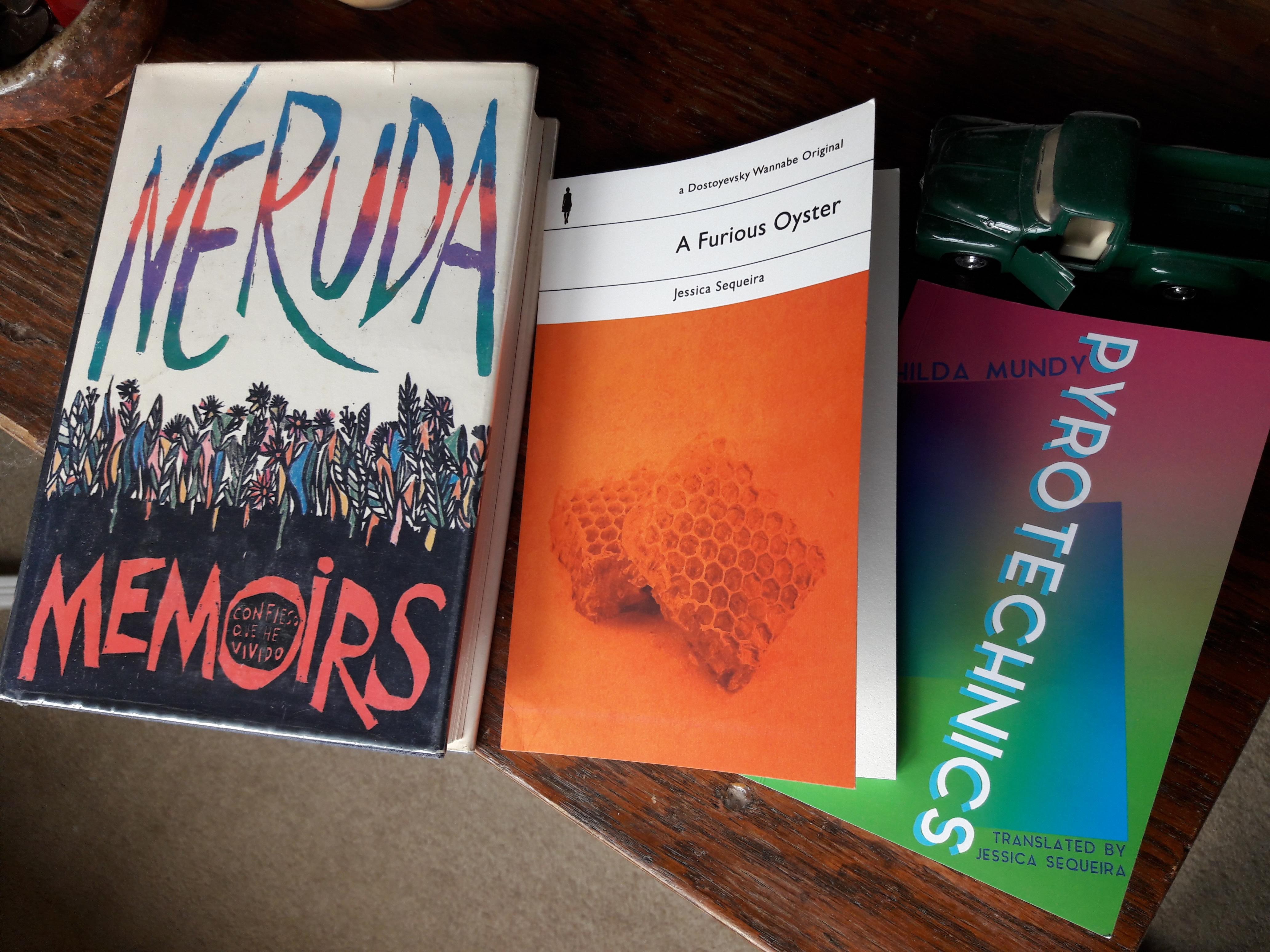
    20180916_100653I was reading Jessica Sequeira’s debut novel, “A Furious Oyster” (Dostoyevsky Wannabe, 2018), when the 30 August London Review of Books arrived in the day’s mail. A book review should reveal something unexpected, but to do that the book under consideration must be heard in a whisper.
    I turned to the review of Zadie Smith’s latest collection of essays; the LRB reviewer, Thomas Chatterton Williams, quotes from Zadie’s foreword:

    “‘I have no real qualifications to write as I do. Not a philosopher or sociologist, not a real professor of literature or film, not a political scientist, professional music critic or trained journalist … My evidence – such as it is – is almost always intimate. I feel this – do you? I’m struck by this thought – are you?’”

    Later in the review, we might recall that quote and think Zadie is telling us something more, but on the slant, that where she comes from, who she is, who her parents were, the various markings often used for identity, also don’t necessarily serve as “real qualifications”:

    “‘Who am I to speak of this painting? I am a laywoman, a casual appreciator of painting, a dilettante novelist, a non-expert – not to mention a woman of lower birth than the personage here depicted … I am still the type of person who will tend, if I am in a public gallery, to whisper as I stand in front of the art.’”

    That ‘whisper’ is often precisely both unexpected and unheard. The whisper follows no code of style. The whisper comes after the existence of the writer, and describes her essence, her choices, her existential leanings, what she has decided to follow. The whisper is the writer’s breath. The whisper might also be how something is said, and is often paradoxical. The whisper breaks the piece, ruins the lecture, calls from the pit, stops the show. The whisper might be a prayer of praise or a heckle in time with popular opinions.

    There’s something else, too, about the whisper; it’s what most of us do who have no real qualifications. And out of all those whispers (the all but silent blogs, the self-published and distributed broadside, the furious but funny poem in the on-line lit-wall), which ones should we home in on? And why would someone whisper when already no one’s listening?

    Sometimes, of course, the whisper “goes viral,” bounces and echoes off walls, scampers up trees, drifts through subway tunnels. But who or what is the host for that sometimes poison, at times the scent of lavender? And it’s well known, though often not accepted, the virus does not respond to antibiotics, the stubborn use of which weakens the resistance.

    All noise dissipates into whisper, so it should not surprise us that John Cage’s 4’ 33’’ goes briefly viral upon each new discovery. We realize even the Big Bang was a silent singularity. Not only might the world end not with a bang but a whisper, as Eliot almost said in “The Hollow Men,” but the world probably began with a whisper.

    A whisper is not a whimper. A whimper is what comes out of a giant mouth at the end of a rant. A whisper is a careful timing of breath, a largo escape, patient. The whisper goes easy and around.

    “Although that isn’t quite right either: how to describe something like the voice of a person just out of sight?” (A Furious Oyster, 92).

    Hilda Mundy’s voice was far out of sight when Jessica Sequeira brought it back: “I don’t want them to punish me with comments” (Mundy, Pyrotechnics, trans. Sequeira, We Heard You Like Books, 2017, 17). “Them,” the “three-dozen readers laughing at the pages of my failure” (17).

    The whisper never fails: “I began to hear people whispering things to help me, advice. I don’t know whether those voices were really there or not, but they brought me serenity. They helped talk me through my situation, suggesting new paths, pointing out what I needed to do” (A Furious Oyster, 92).

    “I have great respect, in contrast, for the metaphor. This is that” (118). So when we are told Pablo Neruda has ridden a wave of energy from an earthquake or the ocean or some great storm to enter the realm of the living, we believe. “This is my body.” This voice, this word. The metaphor transfigures.

    Sequeira’s “A Furious Oyster” is diary, memoir, investigation, document, thesis, mystery, love story. Let’s “be clear,” there are “other realities” (55). The reality of the metaphor, for example. “Strong wills work even in the shadows of the afterlife” (Mundy, Pyrotechnics, 29). Does every word contain its erotic origin? “How pleasant and suggestive a couple in love is!” (Mundy, 34). “Would I want to live forever in this particular moment, this precise patch of time?…Her kisses alternate, soft and hard. I wrap my arms around her, but already her shoulders feel less firm; our time is nearly up. We must go back now, I know, I know. I know, and how I wish I did not” (A Furious Oyster, 38).

    “A Furious Oyster” is a story of two famous poets in Chile, Pablo Neruda and Pablo de Rokha, literary adversaries, it seems, but both driven by the sufferings and loves of the people of a place, a land, a geography, a structure, to reach out, to reach. The geography of Sequeira’s book reveals her interests in shapes: “Sometimes at night, I dreamed of these theoretical shapes – the rhombuses, the ovals, the diamonds, the ellipses of sub-arguments within the prose. I kept only one notebook, and the diary of my personal life merged smoothly into the most abstract of notes on these Chilean poets, here and gone before my time” (55). “A Furious Oyster” is also the story of a writer researching, composing, working, in a relationship, watching, listening. And it’s the story of a place, Santiago de Chile.

    Sequeira possesses that most unique of minds, the one able ambidextrously to move easily from the hard academic to the soft poet (or is it the soft academic to the hard poet?) within the same shape. The flow of “A Furious Oyster,” its style, is redolent of the Duras of the “Four Novels,” or Lispector’s way of creating mystery while unveiling surprises. I also thought of the modernism of Djuna Barnes and Anais Nin. Jessica Sequeira is a translator, a scholar, a writer. She both understands and comprehends literature. For those of us who can only comprehend, but feel we are indeed also “struck with this thought,” we can only whisper in her shadow that you really should read “A Furious Oyster.”

  • The Bananafish

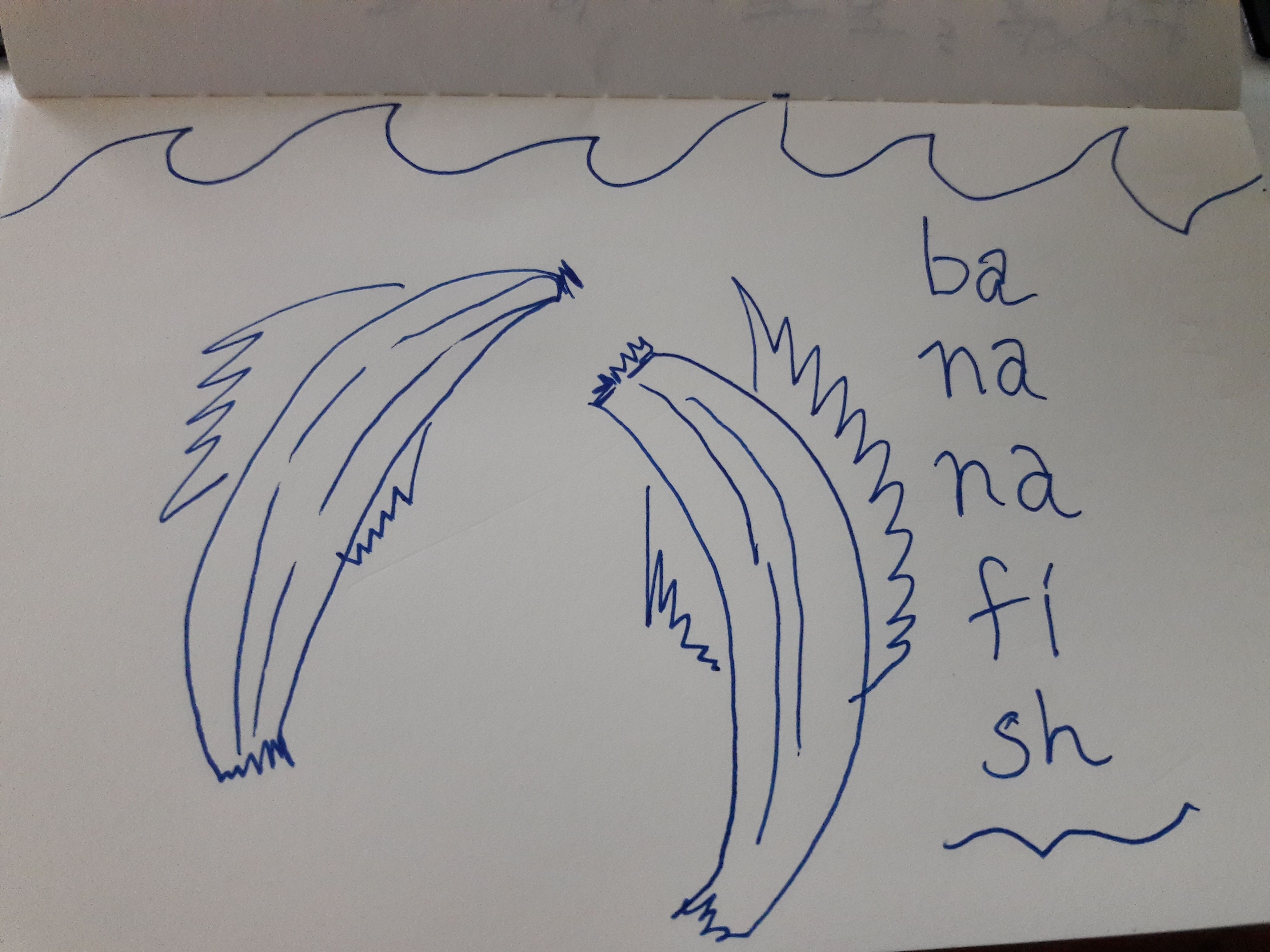
    A popular fish in some schools the deep
    sea swallower called the bananafish:
    Sansjawdsalumpigus.
    Though it lives on the floor of the aphotic zone,
    it is not bioluminescent; in fact, it’s invisible.
    Rising to the surface with changes of tide, mind,
    and mood, it’s worse by tens than the burbling
    Jabberwock. A bananafish is never caught;
    it slips you, and you are capsized.

    The bananafish sees without eyes things
    that disappear, hears sounds in the depths
    of silence, lives on even when squished
    or peeled or baked into bread or spread
    in undigested seeds. They live in clusters,
    but it only takes one to upend your plans
    for a day, a week, or a lifetime. Nevermind
    the Jabberwock; beware the brilliant
    brainy glare of the bananafish.

    What bites but has no teeth?
    What smells but has no nose?
    What swims without fins,
    goes loopy if left to shelf,
    barmy as the froth of beer?
    Ans: the double-dealing
    bluff bunko, the sly hoax
    of Sansjawdsalumpigus,
    commonly called the bananafish.

    20180826_085709

  • Hermit Crabs

    A hermit crab leaves
    home for a new dig
    again and again gig
    after gig sea busker.

    From her mitt he falls
    web of empty shell
    on the beach combs
    a low tide husker.

    In a shell in a cave
    floor of the sea
    hermetically rich
    rarely distressed he.

    20180823_092058


  • Too Much of Nothing

    You say too much
    too much you lose
    the way and the
    universe seems
    too much for you.

    Not to make too much
    of this to make much
    of time, of hot,
    of cold, like a year
    in Chicago.

    Say you see
    her eyes move
    like stars way
    too slow and too
    much of nothing.

    20180709_161602


  • Words of Love

    Honey,
    I’ve looked everywhere
    for the lost words
    telling your love for me
    in the kitchen compost bin
    in the basement of my heart
    in the attic of my ass (what
    a Fantastic Voyage that was!)
    through the crawl space
    between my breasts
    in the curls of my hair
    in the fishnets between my legs
    between my toes and under my nails
    Alas! nowhere to be found,

    she said, subtle armpits open
    to the heat of the night

    Baby, she went on,
    I can’t love you if I can’t
    find the right words of love
    come back tomorrow or next week
    I’ve got the College Dictionary
    here and the Bible
    and a stack of noir paperbacks
    I’ll find your words of love
    if it’s the last thing I do

    Up my nose, under my eyelids
    around and around my ears
    maybe stuck in earwax I’m thinking
    his words of love where could they be
    could someone have stolen them
    who would want them
    someone else’s words
    could they be buried
    in the cushions of the couch
    lost in the halo of my navel
    tangled in the curlers tossed
    across my dresser in the old
    35 millimeter slide box
    in the china cabinet in the corner
    (which has not been opened
    over a decade of Thanksgivings)
    in the medicine chest upstairs
    in the hall closet
    in the glove box of the Buick
    under the rug
    in the dirty clothes hamper

    Maybe, Sweetie, you told them
    too slant, or to another
    words of love must be true
    if they are to come back to you.

    20180705_185322


  • Scrap start with a comma

    , and the Doodles on the radio
    just before the power grids out
    sing of the last rhino ringed.
    The past is not enough to live on
    to make ends meet.

    The colony runs consistent lanes
    running in opposite directions
    like lines of ancient text
    the queen home her future
    near but never quite here.

    20180628_083449

  • The Good Earth

    Let’s make our planet good again
    think pigeons their T Rex origin.

    Oh wings of flesh and steel to fly
    you must first grow feathers.

    What cares the sloth slug squished
    by dino or sprayed with Ortho?

    As for Anthro won’t he be petrified
    up to his waste in his own coprolite?

    Rid us our original sins
    let us be innocent again.

    Imagine no water no fire no air
    worse called in sick your au pair.

    Earth responds ever was I a grand hotel
    now is checkout time fare-thee-well.

    The Good Earth

  • Survival Manual

    I was walking in Mt Tabor Park the other day, on a path rarely taken, steep on the south side, affording views of the college campus, its low buildings in the shade of the giant trees, the wide swath of grass between Gray and the cafe green but empty. I paused to reflect, praying peace, happiness, and lightness of spirit might fall like gentle rain onto my old colleagues and former students, and just before I moved on, I spied a small blue pocket notebook, partially buried in the brush under a bush. I pulled it out and dusted it off.

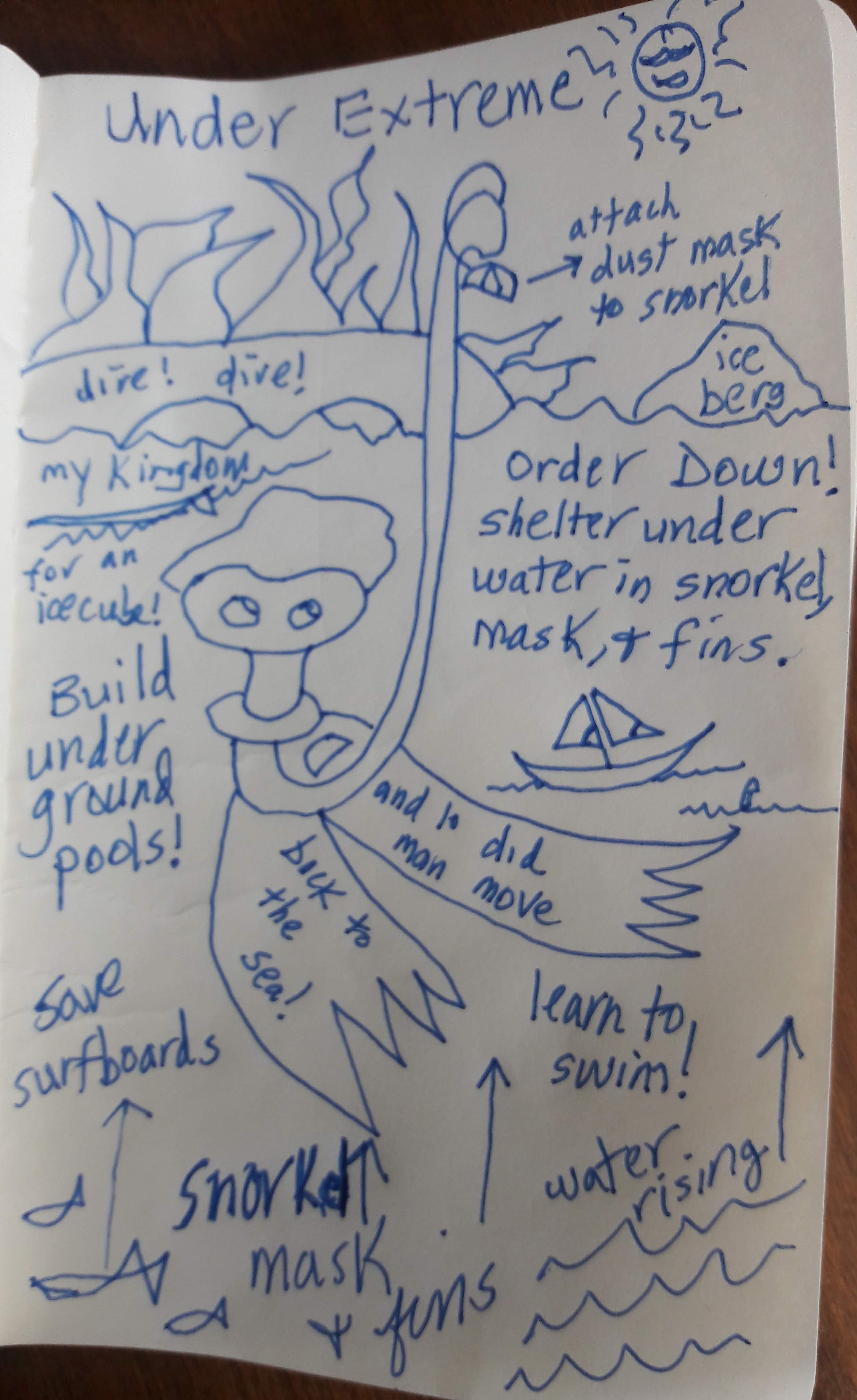
    On the cover was handwritten, in a swirling cursive style, “Survival Manual.” I paged through the little notebook, about the size of a hand, about 40 pages or so, unlined, filled with handwritten notes, instructions, recipes, doodles, lists – places to go, things to do, people to see, books to read, movies liked or disliked, and short poems with simple drawings, every page crammed full of such stuff until, like a Jackson Pollock painting, there seemed not a single space left for another drip or word. There being no place nearby to sit comfortably and study the notebook further, I stuck it into my back pocket and walked on, wondering what catastrophe, big or small, might have resulted in the notebook’s author having lost it.

    Home from the walk, I tossed the Survival Manual, not feeling, perhaps naively, mortally threatened at the moment, onto my desk in the dining room, already askew with bad reading and writing habits, books with bookmarks stuck in the middle, notebooks covered with dust still full of the promise of empty pages. “Write in me!” someone had finger-written in the dust of one. Magazines and journals weeks, months, quarters old. Before long, “Survival Manual” was buried beneath more pressing, unfinished projects.

    A few weeks drifted by, catastrophes here and there, near and far, sudden, usually unexpected turns throwing people overboard whatever ship they happened to be sailing at the time. Still, I lacked the necessary closeness at hand to bring me to my senses and recognize the plight of our planet includes, indeed, all of us, including me. I mean to say, I’m aware of our current risks, dangers, follies and what ifs, but what really am I proactively doing to come to the aid of our planet? I mean to say, is showering only every third day or so and recycling properly, enough? Then came, locally, yet another heat wave record, and finding that I was confined by the heat outdoors to the house, even in the evening, when the sun had gone down, I decided to direct an electric fan toward my dining room desk and clear the clutter. If I had to be so hot, I would at least be neat about it. The fan, of course, produces heat as an unnoticed but negative side effect, as does the laptop on which I’m now typing these notes, bringing to you, too, dear reader of the Toads, a mere suggestion from the “Survival Manual.”

    I uncovered the survival manual, immediately set aside my goal for a clean desk, and sat down in front of the fan with the manual in hand to take a closer look. I decided the notebook to be the work of a genius or madman. Of course, now that we are old and among the awakened ones, we realize the two are often one and the same. The survival manual author, who I will now refer to as SMA, wrote in a kind of shorthand style, skipping superfluous parts of speech, using fragments ignoring subject or predicate, adding icon doodles to illustrate ideas, inventions. SMA apparently possessed an ironic kind of sense of humor, too. A few of the drawings were captioned with hopeless and unexpected explanations: “Planet Senile”; “Moving to the Moon – what to take along”; “Breaststroke for polluted waters”; “How to recycle the non-recyclable.”

    I paused at a page titled “Under Extreme [Heat].” Rather than describe it, I’ve attached a pic taken with my cell, to wit: 20180729_113151

    It suddenly dawned on me that “Survival Manual” is a book of cartoons.


  • Pig Roast

    In backyard rock lined pit dug underground for roasting of pig.

    This yr pig day a hot one. The pig on a spit put into the pit by two strongest men, kneeling over the mouth, where a wood fire burning overnight has heated the rocks molten. The prepared pig at rest in the hot rocks, a sheet metal lid pulled over the hole. The pig cooks in the ground all this long hot day.

    Waiting while pig cooks, drinking beer, young men throwing horse shoes, kids playing capture the flag in the closed street, salads prepped inside in the kitchen (where a ceiling fan famously spins), watermelon slices and water balloon toss in the front yard.

    The pig pulls out early evening, after the old folks nap in the shade of the dusty eucalyptus.

    The planet spins, spit pointed this pole toward the sun, one hot stone roasting a pretty blue pig, green apples popped in its mouth.

    General agreement this yrs pig tastiest on record.

    “This heat keeps up, soon be fixing swine in the shade of the sun,” Mr. Picbred says, mouth swill of pig, popping a fresh beer, sitting in front porch rocker, plate on lap, feet up, breathing from his belly, watching our sun go down.

    global warming

  • An Old Cat

    He ate no more,
    “Please me no tuna
    dish at your open door,”
    around the room a moat
    filled with stone worms.

    For bait he’d chummed
    kittens cutely perched
    in nooks of paper cut hearts.
    A trawler he rowed to catch
    the bones of relict relish.

    He went on like this and on,
    a sophist uttering disgruntled
    guttural grunts mistaken
    for charms by gullible
    attendants on holiday for good.

    His gig whirled on the briny beach,
    bodies of ditched sea snails filling
    with new fats and oils and muscle.
    He stow away in a cave,
    plenty likes to last a new day.