Category: Reading

  • J. D. Salinger’s Advice to Adelia Moore: Write as a Child

    Adelia Moore, apparently an old fashioned English major, knew Jerry, had tea and lunch with him, even argued with him (over Vietnam), and received this stunning bit of advice from him, when she was but 20 years old: “If you haven’t published by age 21, you might as well forget it.” Adelia calls it “…his blunt advice about writing.” But is it advice about writing, or sarcasm about publishing? Was it meant to be taken literally, a literal cutoff – as if to say, “If you haven’t published by the time you’re old enough to drink, forget about it.” Or is it a practical kind of cynicism, as if to say, “You want to make it early, so like me you can kick back and not have to write anything more.” Salinger’s first short story was published in 1940, when he was 21. His last published work was in 1965, when he was 46. He died, a little over a month ago, at the age of 91. In “Tea with Jerry” (March 1, Christian Science Monitor), Moore shares her experience with the private writer in 1969, four years after his last published work. Did he know at the time – might he have added, “As for me, I’ll never publish another word”?

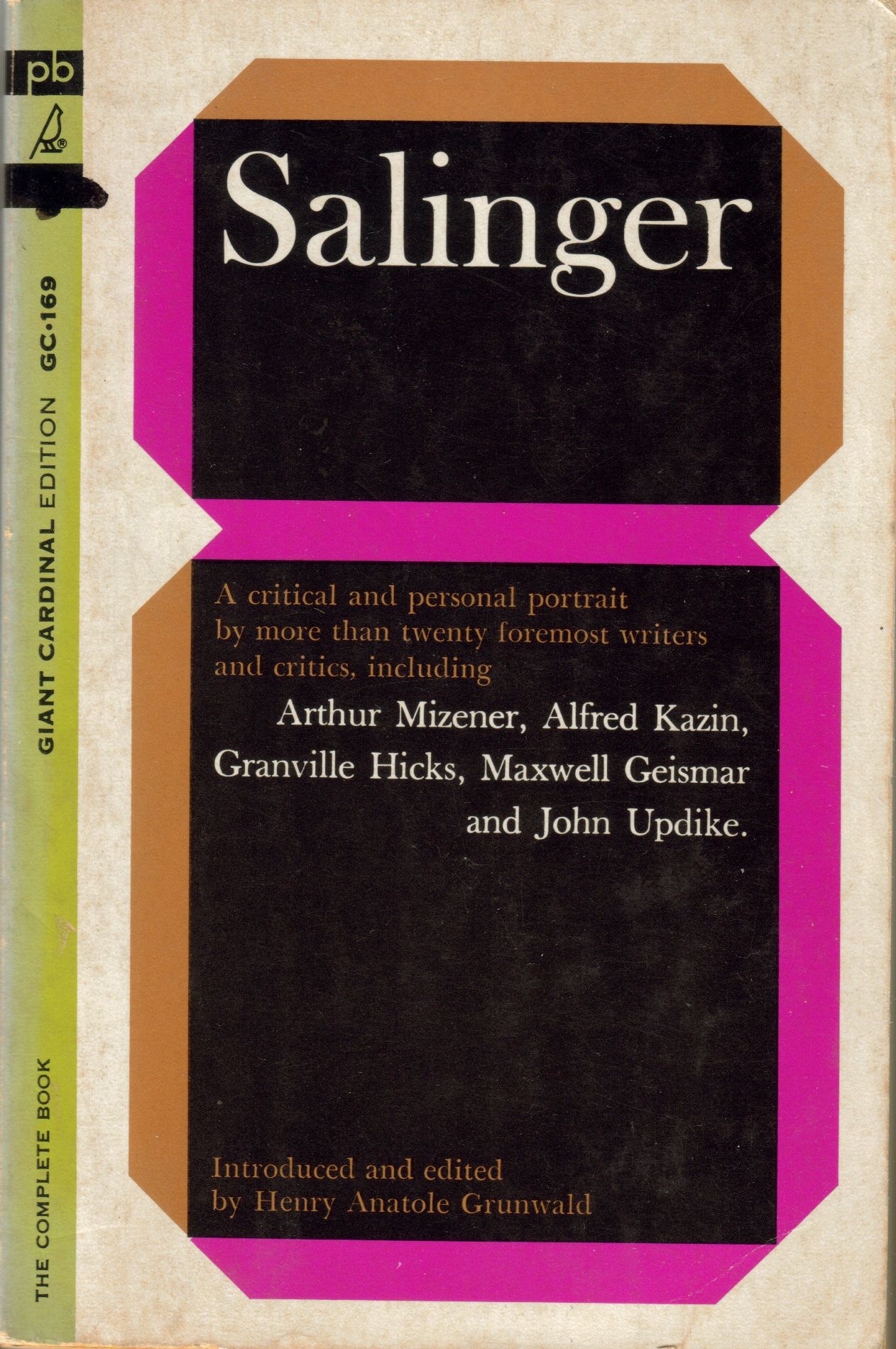
    “There is a feeling in many quarters that altogether too much fuss is being made about J. D. Salinger,” Henry Grunwald wrote in his introduction to the 1962 collection of critical pieces titled Salinger: A Critical and Personal Portrait, a major effort to explain a “good minor writer,” whose popularity with the general interest reader rankles some of the critics. Salinger wrote at a time when the general interest reader still read stories, when the New Yorker still opened its pages, after The Talk of the Town section, with a couple of short stories, and general interest readers looked forward with general interest to a Saturday afternoon with The Saturday Review. No doubt the twittering in those days went on at Saturday night cocktail parties, face to face, where faces were faces and books were books, even if the faces were books to be read and not the other way around. And Monday one met with one’s shrink to purge the weekend’s bluish-bile.

    I don’t know if Adelia Moore became a writer or not. Perhaps “Tea with Jerry” is her magnum opus, the satisfaction of a writer’s spring aspirations killed by a late frost growing back in fall. One of Grunwald’s chapters is called “The Cures for Banana Fever,” a reference to Salinger’s short story, “A Perfect Day for Bananafish,” where we get Seymour Glass’s breaking: “The disease has two symptoms: a kind of incapacity to purge one’s emotions, and a chronic hypersensitivity or sense of loss” (p. 126). These symptoms describe a childhood disease.

    Why would Salinger have told Adelia to “forget about it” if she had not published by age 21? Perhaps the answer is found in Leslie Fiedler’s piece in Salinger, “The Eye of Innocence”: “The notion that a mere falling short of adulthood is a guarantee of insight and even innocence is a sophisticated view, a latter-day Pastoralism, which finds a Golden Age not in history but at the beginning of each lifetime” (p. 242). Perhaps what Jerry was trying to tell Adelia was that she had to write as a child; it would be no good to write as an adult.

  • The Bare Bodkin of the English Major

    “To be, or not to be; that is the bare bodkin,” says Mark Twain’s duke as he prepares to take down the house with an encore of Hamlet’s soliloquy. Where’s an English major when you need one? They were no doubt in short supply in the Mississippi Valley in the early nineteenth century, and their heyday from the late twentieth appears now to be in full wane. What can restore their numbers?

    To take the meds, or not to take the meds; that is another question. Before you answer, read Louis Menand’s recent review, “Head Case: Can psychiatry be a science?,” in the March 1 New Yorker:  “These complaints [confusion over what causes and cures depression] are not coming just from sociologists, English professors, and other troublemakers” (68). To be an English major or not to be an English major; whether ‘tis nobler in the mind to go broke reading or to take arms with others in self-incarceration in a corporate complex – but alas, those late twentieth century opportunities to cause trouble too are in full wane. What’s a poor boy to do?

    Work, for one: “…people on the West Coast work,” Kenneth Rexroth said. “Ginsberg when he came out here, as he said in interviews, was working as a market researcher, which is just a shit job. It’s like being a floorwalker in a dime store. I said, ‘Why don’t you work? How much are you making? Forty-five dollars? You can’t live on forty-five dollars in San Francisco. That’s not money. Why don’t you go to work, get a job?’ Ginsberg said, ‘What do you mean?’ And I said, ‘Ship out…’ You come back with more bread than you know what to do with!’ In the East people don’t think like that” (Meltzer, 1971, p. 12*).

    Some did, but many seem now to have forgotten this. A past issue of Reed College’s Reed Magazine, for example, contained an article by one of their English professors selling the English major; unfortunately, it was clear that the professor had never worked outside of academia, and had not much idea what one would do with one’s English major aside from finding shelter in academia – but that’s all over. Yet no mention in the article of Kafka’s time as a claim investigator for the Worker’s Accident Insurance Institute for the Kingdom of Bohemia (where he invented the hard-hat); of Ted Kooser’s stint at Lincoln Life; of Wallace Stevens’s career at The Hartford; of Tom Clancy maintaining his Life license even after he became a best-seller.

    “Questions like these [being and nothingness, as Sartre put it] are the reason we have literature and philosophy. No science will ever answer them” (Menand, p. 74). Yet as most of today’s Hucks head out for the territory of science and technology, leaving the books to turn to dust, some professors seem to be hunkering down; how do you like this solution: “…it [solving the crisis in the Humanities] means finding creative ways to make life instructively hard, for a few years, for the broadest range of talented people of all sorts and conditions whom we can educate and then employ productively and decently”? This non-profound non-market solution comes to us courtesy of Anthony T. Grafton of Princeton who seems to miss the working point that Rexroth talked about and proves Menand’s point of stubborn resistance.  In his New Republic critical reaction to The Marketplace of Ideas: Reform and Resistance in The American University (Menand, 2010), Grafton makes graduate school sound like joining the Jesuits; but who provides financial support for the Jesuits? For the young Ginsberg just starting out today, a job as a market researcher might be a sweet assignment.

    “Oh, God,” Hamlet says, “I could be bounded in a nutshell and count myself a king of infinite space were it not that I have bad dreams.” No bad dreams, no harrowing questions, no need for the philosopher or the English major. But while the meds, according to Menand’s review, might help some with some of the bad dreams, the harrowing questions persist.

    *Meltzer, D. (1971). The San Francisco Poets. New York: Ballantine Books.

  • John Cage and Attitudes Toward Reading Today

    In John Cage’s A Year from Monday, a 1969 collection of his then New Lectures and Writings, we find a delightful, short piece titled “Seriously Comma,” and we are told the article was in answer to an inquiry regarding “attitudes toward Serial Music Today.” We find it difficult to pass on articles with the word “comma” in their title, seriously. In addition to our interest in commas, we are still concerned with the “reading crisis” topic The Coming of the Toads jumped on at the inception of the blog.

    “Seriously Comma” is an arrangement of 18 paragraphs separated by irregular spacing and layout and given further unity using Cage’s rhetorical mode of varying type font. Each paragraph might be read as a different voice in a contrapuntal arrangement – the piece might also be seen as the mosaic layout of a newspaper page. The second paragraph, quoted in its entirety (italics Cage’s):

    McLuhan insists on the newspaper front-page as the present existence type. Reading, we no longer read systematically (concluding each column, or even turning the page to conclude an article): we jump” (26).

    McLuhan’s work sums the effects of technology on the human sensorium – technology changes us. For McLuhan, the great example was the printing press. For Nicholas Carr, it’s the personal computer. Carr believes that internet skimming is changing our brain for the worse; the idea is getting ink, but it’s still a hypothesis. Do we read differently on-line? Yes, but as Cage on McLuhan illustrates, our jumping around somewhat skittishly while reading predates the personal computer. Perhaps the mosaic of the newspaper prepared us in some way for the mosaic of television and computer screens. What will happen next? The disappearance of newspapers and our adaptive brain evolving to a new way of  reading:

    “Invade areas where nothing’s definite (areas – micro and macro – adjacent the one we know in). It won’t sound like music – serial or electronic. It’ll sound like what we hear when we’re not hearing music, just hearing whatever wherever we happen to be. But to accomplish this our technological means must be constantly changing” (27).

    We are all musicians whenever we make noise; what are we whenever and however we read?

    “Dealing with language (while waiting for something else than syntax) as though it’s a sound-source that can be transformed into gibberish” (29).

    What is “computer literacy,” and how does it differ from traditional reading? In the late 30s and early 40s, the WPA produced posters encouraging, among other activities and ideas of benefit to local communities, reading, traditional reading, the book you’ve always meant to read. We agree with Carr that traditional reading slows things down; why not kick back and enjoy a slow Spring with a book? When we make noise we make music; when we read, we make time.

  • Grammar Hammer: Vertigo Swinging the Grammar Pickaxe

    My Dad once told me that a man could work himself to death with a pickaxe. I don’t know if he knew the John Henry ballad; probably he knew it, but I do know he had swung a pickaxe. But his claim was one of fact, not value. It wasn’t necessarily a bad way to die, on the swinging end of a hammer. But he may have been using the pickaxe as a metaphor. A man kills himself whatever he does, and if not, as Woody Guthrie sang, “Some [men] will rob you with a six gun, others with a fountain pen,” so there’s little hope of escaping either end of the pickaxe. My Dad knew his tools, but he didn’t know an existential wrench from an existential clause (there was no dummy pronoun grabbing hold of that handle), and so he never mentioned a man could work himself to death studying grammar.

    John Henry didn’t swing a pickaxe, but a sledge hammer. Same idea. But what kills him isn’t the hammer, but the race pitting the hand-tool hammer to beat the new technology of the steam hammer. It’s not the tool, but the fight that gets you, and the race is always against technology – which you created to make things easier, thinking the tool would be irrelevant. In any case, while we probably won’t be hearing the Ballad of John Computer, or the Ballad of John Grammar, anytime soon, we’re here to tell you that the study of grammar will take its toll.

    Consider the semantically singular they, for example. It’s OK, stay with him. You both can and may use a they following everyone. And don’t worry about for whom the bell tolls; whoever it tolled for, they’ve heard it by now, which brings us to that non-personal head that’s really only a problem for a comma king. Moreover, did you know that “the danger from adjunct non-finite clauses with missing subjects that are not syntactically determined is often exaggerated” (p. 209)? We will miss that dang dangling modifier.

    We’re in no race to quickly finish Pullum’s Grammar – a good thing, too, because we’re cutting through it with a pickaxe (for as the back cover tells us, this is a “groundbreaking textbook”), and we don’t want our grammar hammer to be the end of us too soon, Lawd – Lawd. “Let the hammer do the work,” my Dad advised whenever he saw me overswinging and looking dizzy. While I try today to apply that advice to grammar, if you’ve not had enough grammar fun this morning, try this.

  • Piracy off the Coast of Gramarye

    Huddleston and Pullum’s English Grammar liberates grammar studies from the prescriptivists. Pullum boards the jolly, unsuspecting ship Elements of Style, captained by the evil E. B. White, and ransacks it, taking no prisoners. Pullum is now king of Gramarye, having deposed White and his motley crew of prescriptive pirates. A Student’s Introduction to English Grammar is the dinghy version of the piratically priced mother ship, The Cambridge Grammar of the English Language.

    Why study grammar? Most native speakers will get “dog, the, away, ran” correct (correctness is not, contrary to popular notion, the language spoken in Gramarye – correct is what serves one’s purpose; now if we have that wrong, we are still deliberating; we’re not sure who the true pirates are in this story).

    “The, dog, ran, away” is the first exercise in Dinghy. There are 24 possible arrangements of the four words; only three will be grammatical, and they are not difficult for the native speaker to recognize, for, as it turns out, if we speak the language, we know the grammar. So why study grammar?

    We are given eight reasons in the preface to Dinghy, only a couple very convincing, at least one political, having to do with the declining student population of Gramarye. I wish they had talked about how they got into the study of grammar, why they became grammarians and linguists; there’s little passion in the reasons they submit. Pullum did a study early in his career analyzing popular song lyrics – he could have talked about that! There is a whiff of passion in the middle of the preface, where they talk about their lunch discussions, and the “pronouncements unchallenged for 200 years [that] are in fact flagrantly false.” We’re all for exposing the tyranny of the old kings and their minions, but Dinghy’s preface is no match for Roger Angell’s (White’s stepson and another New Yorker writer) forward to the fourth edition of Elements.

    Pullum seems bent on defending his reign, and more power to him, for it will be some time before his prescriptive grammar alerts are heard and understood throughout the land, but he sounds like a Fox News commentator when he says “We linguists should not be shy about speaking out and condemning this opinionated [Elements], influential, error-stuffed, time-wasting, unkillable zombie of a book for all the harm it has done.” *

    One of the problems with Pullum’s claim that Elements has done “real and permanent harm,” and that it has been “deleterious to grammar education in America,” * is the assumption that every high school kid in the land has been subjected to it, and having been subjected to it, has successfully incorporated it into their language skills, and that their teachers taught it as a literal reading of the bible – or that their teachers taught it at all. In any case, it might be a good thing if a style book, even a flawed one such as Pullum accuses White’s of being, had anything close to such a profound effect on the general reading public. And there’s the rub. Pullum goes after White because he’s not a text-book. Pullum proves that as a grammar Elements is way off course. Why doesn’t Pullum go after the text-books? White is only a puppet king.

    White’s an easy target. Elements is a commercial effort, something CGEL will never be (my copy of English Grammar, purchased from Amazon for just under $30, does not have a price anywhere on its cover – it’s a text-book). I do like English Grammar. I first tried paddling straight through, but got only about half way before the swell of terms started to swamp my boat; I recommend that the general interest reader begin with the “Prescriptive grammar notes” – that’s where the new constitution is being written.

    What grammar studies needs isn’t a Pullum, but an Andy Warhol, someone who can show us and popularize what we already know to be true – Gramarye is our land.

    *Pullum’s article explicating Elements, “Prescriptive grammar in America: The Land of the Free and The Elements of Style,” (Dec. 2009), is posted on his website, along with links to his other works, including CGLC and EG. Pullum blogs with other linguists at Language Log, an entertaining pirate hangout.

  • Sister Mary Annette and Shakespeare’s Ambiguous Advice

    “Those friends thou hast, and their adoption tried, grapple them to thy soul with hoops of steel”: Sister Mary Annette read Hamlet to our 8th grade class, and since Polonius’s advice had the imprimatur of both Sister and Shakespeare, we took it to be infallible. Sister’s point, if not Polonius’s, was that we would all wind up friendless, friends dropping like flies as we evolved into our self-centered young adult lives, this being the way of the world, and thus if we were lucky enough to hatch a true friend, we should latch on to them. But who wants to be grappled with a hoop of steel? One grapples an antagonist, but one’s friend?

    Why did Shakespeare feed so much seemingly sage advice to the mouths of fops or bumbling fools? There’s an argument over Polonius – was he shrewd or foolish? But when it comes to the play, as Harold Bloom observes, “It is very difficult to generalize about Hamlet, because every observation will have to admit its opposite” (409).

    Perhaps our aversion to grappling hooks explains our independence. And here’s another piece of Polonius advice, and where would today’s bankers and the stimulus package be if we adhered to it?: “Neither a borrower nor a lender be.” This Polonius pearl is often repeated without the character’s explanation: “For loan oft loses both itself and friend, And borrowing dulls the edge of husbandry.” The stimulus package is the thing wherein we’ll catch the conscience of the banker king. It’s not clear that Polonius follows his own advice, for “Give thy thoughts no tongue” he ignores, though he does “Give every man thy ear”; in fact, that’s his undoing.

    Though our 8th grade long preceded Facebook, perhaps Sister foreshadowed Facebook’s hoops. She also read to us that year A Tale of Two Cities and David Copperfield (her favorite Copperfield characters were Mr. Micawber and Mr. Dick, whose optimistic and practical advice always found an appropriate place in our classroom), so we had more on our minds than old Polonius. Alas, we cannot befriend Mary Annette now in this Facebook, but she knew, as did Shelly, that “We look before and after, And pine for what is not.” Of Facebook, she surely would remind us of the closing of Act III, scene iii, that “Words without thoughts never to Heaven go,” and who would know better than a murderous king?

  • Grammar Shock: Person, Tense, Time, and Sense

    For most of us, grammar is like electricity; we use it all the time, usually correctly, but we don’t really know what it is or how it works, but we do know it can be dangerous. We wouldn’t want to discuss inflection while standing barefoot in a pool of water, or mix tenses when changing fuses.

    We are advised in a discussion of  the verb paradigm, in Huddleston and Pullum’s English Grammar, that “The relation between tense and time in English…is by no means straightforward.” I never doubted it, but it’s always nice to hear that your hunches have friends.

    And so it came as no surprise to find Roger Angell, in the February 15 & 22 issue of the New Yorker, in what he calls “another strange journalistic effort,” mixing memory and desire and person and tense, a dangerous business. “We are getting ahead of ourselves,” Angell says, slipping into first person plural, in what might be an imitation in present time or a nostalgic nod to his stepfather, E. B. White, and a tradition that he apparently disliked but that came to define a certain style and journalistic era. (I read recently somewhere of some editor taking out the old knob and tube of White’s first person plurals and replacing them with modern conduit; we trust they wore gloves).

    Angell switches person in his present piece in part because like his subject, “Mac [St. Clair McKelway],” he “knew them when.” And, as Angell deftly illustrates in his piece, keeping one’s tense and person straight is basic to nursing our sanity, particularly during wartime, but as well afterwards when we might be haunted by the decisions and indecisions that changed our lives forever. “It keeps you awake at night,” Angell says (now hiding behind the second person), after he’s diagnosed that sleep deprivation was no doubt a major contribution to “Mac’s madness, Mac’s fugue – let’s call it a flight, in this story….” Just so, English Grammar points out that “The usual definition found in grammar books and dictionaries says simply that the past tense expresses or indicates a time that is in the past. But things are nothing like as straightforward as that. The relation between grammatical category of past tense and semantic property of making reference to past time is much more subtle.”

    There is a tense, most usefully expressed in music, but sometimes also in writing, where we can’t seem to locate our precise situation in time. The inflections all come together into one person and tense that seems some crazy mix-up of all possible persons and tenses. Perhaps this tense is properly called sleep. But when you can’t sleep, it’s called ungrammatical, a kind of linguistic power surge.

  • Super Bowl Debriefing: the Tribal Culture of Television

    McLuhan explains that the printing press created the individual, while television returns us to the tribal. No one’s on the margins watching television. You’re either in or you’re out, and games on television up the ante. “Games are popular art, collective, social reactions to the main drive or action of any culture” (1964, p. 208). Art is magic, transference, transubstantiation of the base metals of our daily lives into something beyond us, beyond the daily bread and the process that brings bread to the table. Literacy, McLuhan argued, created individual point of view, eliminating the tribal view that was all inclusive. Games return individuals to a tribal mode, creating a “situation contrived to permit simultaneous participation of many people in some significant pattern of their own corporate lives” (p. 216). Games on television are a nonliterate art form.

    Turn on the TV, put the game on, and join the crowd. The TV screen is a mosaic of dots compelling audience participation: no knitting, no reading – everyone’s paying attention. TV works like a cartoon drawing; the viewer sees only a few of the many dots and must fill in the rest. TV is all at once and ongoing, unlike a book, which is sequential, like a long train ride, each passenger in a private, individual seat. TV performs its violence by capturing the viewer, who can not turn away.

    McLuhan explains why baseball is individual and literate and a poor game to watch on TV while football is tribal and all inclusive and trumps baseball as a TV sport: “The characteristic mode of the baseball game is that it features one-thing-at-a-time. It is a lineal, expansive game which, like golf, is perfectly adapted to the outlook of an individualist and inner-directed society. Timing and waiting are of the essence, with the entire field in suspense waiting upon  the performance of a single player. By contrast, football, basketball, and ice hockey are games in which many events occur simultaneously, with the entire team involved at the same time. With the advent of TV, such isolation of the individual performance as occurs in baseball became unacceptable” (p. 284). The players in football are non-specialists (compared to the players in baseball). The team moves at once, together, in the same direction. All the players are viewed on the screen at once – this is almost impossible to do with a TV camera at a baseball game.

    Baseball is a snooze on television, while football is an ecstatic TV game. Baseball is slow, the game of languorous summer, like reading a book. The reader can put the book down and pick it up again later; there’s no clock, so there’s no need for an official time out. In baseball offense, the players sit in the darkened dugout like unread pages in a book, while on the TV gridiron the all inclusiveness is all involving as both offense and defense assume their roles simultaneously.

    The popularity of baseball is declining, as reading is declining, and for the same reason. Football’s ascendance in popularity parallels and mimics what’s happening in the culture, the increasing need for a game that is all inclusive, tribal in nature, and an all-at-once experience – a game that is nonliterate.

    McLuhan, M. (1964). Understanding media: The extensions of man. New York: New American Library.

  • The Value of Time and Pressure

    A lump of coal has more intrinsic value than the far more expensive diamond it might someday become. Part of the value of diamonds derives from their rareness, but a diamond’s value comes primarily from the desires of a particular community, whose members want to sparkle and cut the glass eyes of their friends with envy, and believe in metaphor.

    But diamonds are easy. The girl’s best friend can be purchased, pocketed, and sported away in a short shopping spree, later slid slowly onto the empty, waiting finger at the top of some Ferris wheel. Rhinestones are a guy’s quick getaway; there’s a reason the girl wants the real thing, as Marilyn Monroe and Emmylou Harris sing in “Diamonds are a Girl’s Best Friend,” lyrics cued from the Anita Loos novel, Gentlemen Prefer Blondes (1925). Evolutionary psychologist Satoshi Kanazawa, writing in Psychology Today (2008, May 29), explains the friendship: “The courtship gift for the purpose of screening dads from cads must not only be costly but also lack intrinsic value. Diamonds make excellent courtship gifts from this perspective because they are simultaneously very expensive and lack intrinsic value.”

    Kanazawa doesn’t mention the Styne and Robin movie lyrics or the Loos novel, and his explanation doesn’t quite seem to square with the original lyrics: “Men grow cold / As girls grow old, / And we all lose our charms in the end. / But square-cut or pear-shaped, / These rocks don’t loose their shape. / Diamonds are a girl’s best friend.” But Kanazawa argues “Of course, diamonds and flowers are beautiful, but they are beautiful precisely because they are expensive and lack intrinsic value, which is why it is mostly women who think flowers and diamonds are beautiful. Their beauty lies in their inherent uselessness; this is why Volvos and potatoes are not beautiful.” This is not psychology; it’s advertising. The smart, working class mom won’t buy it. She knows it takes time, pressure, and heat to turn her lump of coal into a diamond. A diamond can be purchased in the heat of the moment with a piece of plastic; it takes time and pressure and heat to turn a lump of coal relationship into a marriage.

    Time and pressure have intrinsic value, but value that can’t be easily purchased or traded. It took J. D. Salinger ten years to write The Catcher in the Rye. It took James Joyce seven years to write Ulysses and seventeen years to write Finnegans Wake. But here we are online, where the demand is for speed and constant change, instant access, diamonds without a hard core process. We want instant gratification: flipping houses and cars; constantly checking stock prices and email; texting our latest thoughts without giving them time to simmer and develop. We want instant success, so it’s instant success that we’ve come to value. We’ve become a culture of quickie junkies.

    Yet we are each of us a lump of coal in the process of becoming a diamond. A diamond is hard and pure and difficult to adulturate; it takes a lifetime to turn a marriage into a diamond, and you can’t wear it on your finger. We should not value diamonds – it’s too easy; we should value time and pressure. And if we value time and pressure, we’re more likely to realize the diamonds that we are, that we have already become – through wear and tear, through life-learning experience, through the pressure and time required to go back to school, to try something new, to forget and forgive and let go – to value our own experience. Then, after all that time underground, we surface with the epiphany, and it feels sudden, but we “…know my song well before I start singing” (Dylan), realizing the opportunity to do what we were born to do, realizing the diamond that is buried deep in our lump of coal, as Paul Potts, 2007 Got Talent winner, explains. The soul is not a diamond; the soul is a lump of coal.

    Notes: The photo used in this post can be found at the Library of Congress site, in their American Memory collection, under “Culture, Folklife.” The Paul Potts reference (follow link) is to a mini-doc. video of his performance. After his song, Judge Amanda Holden says she thinks Potts is “a little lump of coal going to turn into a diamond.”

  • On the Trail of Diaper Fish Wraps and Hot Hot Dogs

    Larissa MacFarquhar’s “Busted” (New Yorker, Feb 1) opens and closes with dialog, a kind of journalistic Roddy Doyle: “Crrrcchh,” in which everything is revealed and nothing is resolved. The spool is running, and we are told that New York City’s Department of Investigation is on the prowl, overseeing those on the make. The DOI’s apparently a productive unit. They “arrested a group of sanitation inspectors…they arrested half the city’s taxi inspectors…they infiltrated a gang of parking-meter attendants.”

    The central drama of the piece focuses on the sidewalk food vendor industry. Inspections and permits of the food carts fuel a thriving underground economy. And no wonder: “Food venders [sic] can make a hundred thousand dollars a year,” MacFarquhar says. Yet a permit cost only a couple hundred bucks, but since they are limited and distributed by lottery might be sold on the black market for thousands. Calling the vendors an industry is not hyperbolic: According to a Slate article (Simons, Aug 12) “A hot dog vendor was kicked from the curb outside New York City’s Metropolitan Museum of Art last week for failure to pay his monthly rent—of $53,558.” So no surprise the vendors have organized into the Street Vendor Project, providing education, support, and outreach for some 10,000 street vendors working in the city.

    I’m not thinking of opening a food cart, in spite of the obvious potential for profits, but I do occasionally, out on one jaunt or another, smell and contemplate the odd hot dog, sense the greasy-good butter soaking up a bag of popcorn, see the summer day in a spool of cotton candy. What would it be like to step up to the cart and order one, I wonder, and then to actually eat it?

    The potential for profitable characters attracts the entrepreneurial writer. In Roddy Doyle’s hilarious The Van, the unemployed Barrytown Dubliners have purchased a used food vendor van with a fryer on board and have outfitted it as a fish and chips restaurant on wheels: “It’s not fish, said Bimbo. – …What is it? – It’s white, said Jimmy Sr. – It’s a nappy! The man told him. – Wha’!… – He’s righ’, Jimmy, said Bimbo – it’s a Pamper; folded up. My God, that’s shockin’. – Shut up! Jimmy Sr hissed at him. – I must have put it in the batter – Shut up! – What is it? said Sharon. The man wasn’t angry-looking now; he looked like he needed comfort.”

    And then there’s John Kennedy Toole’s Ignatius, the anti-hero of A Confederacy of Dunces. Ignatius works for a time for Paradise Vendors, pushing a hot dog cart around the quarters of New Orleans. But he seems to eat more hot dogs himself than he sells to customers. And having eaten his stock, he concocts a story about being robbed to explain the situation to his boss: “How much money did he get?” “Money? No money was stolen. After all, there was no money to steal, for I had not been able to vend even one of these delicacies. He stole the hot dogs.” Later, Ignatius is under investigation by the inspection board: “They seen you picking a cat out the gutter on St. Joseph Street.” “It was a rather appealing calico. I offered it a hot dog. However, the cat refused to eat it. It was an animal with some taste and decency.” 

    The sidewalk food vendor business is full of characters and complicities; indeed, what business is not?

  • Nicholson Baker, Nicholas Carr, and Googling Clothespins

    Nicholas Carr might argue I got stupider this week, and I admit that I did spend more time than usual on Google. Carr’s influential Atlantic article, “Is Google Making Us Stupid?” (July, 2008), has been picked up by the English teaching gaggle to promote reading. I’m going to save that argument for another time and place. One of the first to use Carr’s article, I did not use it to promote reading, but to discuss the elements of argument; for now, I want to explain why I spent more time than usual on Google this week, and show what I found. The first is easy to explain; I discovered Google Patents. The second is easy to show – clothespins. Here’s what happened.

    I came across one of my old Joseph Mitchell tri-folded reporter note sheets and realized I had never followed up on a note I had made to research a section in Nicholson Baker’s The Anthologist, a novel about a procrastinating poet, whose ruminations, while stalling to write an introduction to a new poetry anthology he’s put together and found a publisher for, produce, in the end, the introduction itself. My note was to research something I found interesting on page 116 of Baker’s novel. Baker’s poet, Paul Chowder, staggers into a discussion of clothespins, and makes this claim: “There was a factory in Vanceborough, Maine, that made eight hundred clothespins a minute in 1883.”

    I boarded Google but failed to find the factory. Growing stupider by the minute, I looked up clothespins in Wiki, where a claim is made that the Shakers invented the clothespin, but they didn’t patent their inventions. Patented or not, it would seem that the clothespin, technologically an extension (as McLuhan might explain) of the human finger and thumb clamp, must surely predate the Shakers.

    The paperclip might be an evolutionary relative of the clothespin, as shown by my research in Google patents. To the left, is a drawing of a patent by A. W. Burch, dated July 2, 1907. The pin is made of wire, and appears to have been inspired by the paperclip.

    Many patents seek to improve upon ideas already patented and manufactured; for example, Roy V. Shackelford, of Long Beach, California, was granted a patent in 1939 for a clothespin that “attached to a line in such a manner that the clothes which are fastened in the pin never come in actual contact with the clothes line.”

    Sarah J. Miley, in 1898, wrote a patent that discouraged traditional one piece bifurcated wood clothespins from splitting in half, through the addition of a metal  “stay plate” in the handle end (drawing left).

    It might have been a stupid week, but I will never look at a clothespin the same again, nor a paperclip, for that matter, nor the possibilities for the extensions of the human for inventions that we call technology.

    As for Nicholson Baker’s factory, how many clothespins do we need? The answer to that might be found in A. R. Stewart’s invention (drawing below), patented in 1874. It’s not a clothespin; it’s a machine to make clothespins. The Shakers didn’t need to patent their clothespin because they had no intention of mass producing and marketing it; if they needed another clothespin, they would simply make a new one. Manufacturing, like specialization, leads to extinctions.

    Stewart’s patent application, titled “Improvement in Machines for Making Clothes-pins,” does not mention the number of clothespins the machine is capable of producing per minute, but instead describes a machine “capable of forming a perfect clothes-pin at each downward movement of the saw and cutters, and, as the finished pins are removed by the same upon their upward stroke, no other attention is necessary except to supply the blanks to the hopper.” The improvement seems to be found not in the quantity of clothespins produced, but in the saving of labor required to produce them. I thought of Melville’s Bartleby: Ah technology! Ah, humanity!