Category: Reading

  • Notes on Percival Everett’s “James”

    In Percival Everett’s “James,” we read Mark Twain’s “Adventures of Huckleberry Finn” overdubbed with newly invented first person narration by Twain’s character Jim, who becomes the protagonist, changing his name to James – “Just James,” he introduces himself at the end, when asked what his last name is. Or maybe, in Everett’s telling, James is his last name, and his first name is Just.

    Huck becomes a secondary main character, a deuteragonist. “James” is not the first book to take a foil character from another book and reverse foils. Mark Twain did it himself when Huck, who first appears in “The Adventures of Tom Sawyer,” becomes the narrator of his own story. The full title of Huck’s work is “Adventures of Huckleberry Finn (Tom Sawyer’s Comrade).”

    The antagonist remains the same as in the Mark Twain book James comes from: slavery in the US mid 19th Century – or more specifically, slave traders or sellers, owners, and others benefiting or attempting to leverage for some advantage from the arrangement. In one of many ironic ideas in “James,” James and his friend Norman come up with a plan: sell James, James escapes, sell James again, repeat again and again as they move north – the idea first suggested to James by the Duke of Duke and Dauphin infame, here presented as far more evil than in Twain. They are brought nearby, and the slapstick is not funny. The early chapters of Everett’s book more closely follow Twain’s narrative than the later chapters, where we find new adventures of James and his reflections on what’s happening to him, why, and what can he possibly do about it as the book spirals into fantastical end chase scenes.

    But Everett might have left James without a surname to underscore the existential adventure James embarks upon when he decides to leave his wife and child when he hears of his owner’s intent to sell him downriver; if sold he fears he’ll be separated from his family never to see his wife or child again. But to be without a surname is to be free from predispositions, assumptions, or any kind of argument about who you are or might be, where you come from or where you might be going. Language is a primary theme of “James,” as is writing and reading, and to give names to people, places, things, is to establish their reality, particularly if named via writing:

    My name is James. I wish I could tell my story with a sense of history as much as industry. I was sold when I was born and then sold again. My mother’s mother was from someplace on the continent of Africa, I had been told or perhaps simply assumed. I cannot claim to any knowledge of that world or those people, whether my people were kings or beggars. I admire those who, at five years of age, like Venture Smith, can remember the clans of their ancestors, their names and the movements of their families through the wrinkles, trenches and chasms of the slave trade. I can tell you that I am a man who is cognizant of his world, a man who has a family, who loves a family, who has been torn from his family, a man who can read and write, a man who will not let his story be self-related, but self-written.

    With my pencil, I wrote myself into being. I wrote myself to here.”

    Percival Everett, “James,” Doubleday, 2024, p. 93 (italics in original).

    What does James mean by “self-related,” and what does it mean to be “self-written“? And how do the two terms differ? He doesn’t mention self-published, or any kind of publishing, and how he might have to rewrite, edit, embellish his story to get it published. But he seems to feel it is published as soon as he writes it down. Self-written. “Adventures of Huckleberry Finn” begins differently. We’re six paragraphs in before we learn Huck’s name, which we get indirectly, from the Widow Douglas. Huck begins by telling us we don’t know about him unless we’ve read “Tom Sawyer,” which contains some lies, Huck says, which doesn’t matter, everyone lies, he says. James presumably will not lie, not to his reader.

    To be a writer is to make choices, to string together those choices. The above quote, from page 93 of “James,” is a rewrite of an earlier draft:

    Then I wrote my first words. I wanted to be certain that they were mine and not some I had read from a book in the judge’s library. I wrote:

    I am called Jim. I have yet to choose a name.
    In the religious preachings of my white captors I am a victim of the Curse of Ham. The white so-called masters cannot embrace their cruelty and greed, but must look to that lying Dominican friar for religious justification. But I will not let this condition define me. I will not let myself, my mind, drown in fear and outrage. I will be outraged as a matter of course. But my interest is in how these marks that I am scratching on this page can mean anything at all. If they have meaning, then life can have meaning, then I can have meaning.”

    p. 55.

    Huck is not much given to such reflections in his book. That’s not why he writes. Maybe he’s too young yet. Why does he write? He simply jumps in and rambles on, telling of things as they happen, his eye for detail and ear for dialog both as acute as an owl’s. He doesn’t recognize or reveal his indebtedness to his creator, but he does mention him:

    “That book [Tom Sawyer] was made by Mark Twain, and he told the truth, mainly.”

    Huck has no need to lie to his reader. He’s enough to relate without lying.

    James’s use of the term self-related could be a reference to the autobiography of Venture Smith, mentioned above in the quote from “James” page 93. Smith’s self-account begins as follows:

    “The following account of the life of VENTURE, is a relation of simple facts, in which nothing is in substance to what he relates himself. Many other interesting and curious passages of his life might have been inserted, but on account of the bulk to which they must necessarily have swelled this narrative, they were omitted. If any should suspect the truth of what is here related, they are referred to people now living who are acquainted with most of the facts mentioned in this narrative.

    The reader is here presented with an account, not of a renowned politician or warrior, but of an untutored African slave, brought into this Christian country at eight years of age, wholly destitute of all education but what he received in common with other domesticated animals, enjoying no advantages that could lead him to suppose himself superior to the beasts, his fellow servants. And if he shall enjoy no other advantage from perusing this narrative, he may experience those sensations of shame and indignation, that will prove him to be not wholly destitute of every noble and generous feeling.

    The subject of the following pages, had he received only a common education, might have been a man of high respectability and usefulness; and had his education been suited to his genius, he might have been an ornament and an honor to human nature. It may perhaps, not be unpleasing to see the efforts of a great mind wholly uncultivated, enfeebled and depressed by slavery, and struggling under every disadvantage. The reader may here see a Franklin and a Washington, in a state of nature, or rather, in a state of slavery. Destitute as he is of all education, he still exhibits striking traces of native ingenuity and good sense.

    This narrative exhibits a pattern of honesty, prudence, and industry, to people of his own colour; and perhaps some white people would not find themselves degraded by imitating such an example.

    The following account is published in compliance with the earnest desire of the subject of it, and likewise a number of respectable persons who are acquainted with him.”

    The Project Gutenberg eBook, A Narrative of the Life and Adventures of Venture, a Native of Africa, But Resident above Sixty Years in the United States of America, Related by Himself, by Venture Smith.

    That is not like the book Percival Everett is helping James to write. In any case, self-related might also refer to concepts or ideas of the self discussed by Kierkegaard. Percival Everett gives his reader homework assignments. James in dream reveries has discussions with Voltaire and Locke. Does the common reader simply gloss over these references? Google them? Do they provide argument for James’s own conclusions and rebuttals regarding economics, ethics, slavery? Are they meant to explain the behavior of Judge Thatcher, who presumably has read these same writers (James gets the books from the judge’s library)?

    “Kierkegaard does not think of the human self predominantly as a kind of metaphysical substance, but rather more like an achievement, a goal to strive for. To be sure, humans are substances of a sort; they exist in the world, as do physical objects. However, what is distinctive about human selves is that the self must become what it is to become, human selves playing an active role in the process by which they come to define themselves.”

    Soren Kierkegaard. 2. Kierkegaard’s Analysis of Human Existence: Despair, Social Critique, and Anxiety. Retrieved 7 Apr 24. Lippitt, John and C. Stephen Evans, “Søren Kierkegaard”, The Stanford Encyclopedia of Philosophy (Summer 2023 Edition), Edward N. Zalta & Uri Nodelman (eds.), URL = <https://plato.stanford.edu/archives/sum2023/entries/kierkegaard/&gt;.

    Language is the great theme of Percival Everett’s book. It’s about writing, what to write about and how. It’s about how people talk, often adopting or adapting a style they might think is suitable to their audience – or what they think their audience might want to hear. Language is marketing. Even when talking to ourselves, we might often feel like we’re selling something, or being sold something. The rhetorical flourishes in “James” both stir the emotions and logically persuade; and who can argue with James’s first hand ethos reliable and credible experience? James is a statement, a claim, to which there can be no rebuttal. His backing is impervious. Percival seems to want to write (as James does) something of both human affairs (history) and economic activity (industry). When James kidnaps Judge Thatcher, the judge asks James three times over the course of several pages, “Why are you talking like that?” – referencing James speaking out of the expected slave-speak language and instead using the judge’s own language. The judge can’t get over it, can’t understand, is utterly confused by James’s ability to speak out of (what the judge believes to be) character. James’s rhetorical skills mean, for one thing, the judge’s view of James has been and remains wrong. The foundation of his excuse for slavery is undermined, and he caves in on himself, though he keeps acting like a judge. In terms of the dual language scenario Everett has created, the judge might just as well be suddenly talking to an alien. He is talking to an alien.

    While language is the great theme of “James,” the pencil is the great symbol. James at one point thinks he’ll adopt the last name of FABER, it being stamped on the stub he’s using:

    “I studied the small stick that had cost so much. I had no way of knowing whether Young George’s beating had stopped short of his death. I knew I owed it to him to write something important. The pencil lead was soft and made a dark mark. I resolved to use it with a light touch to have it last as long as possible. Stamped on it was the name FABER. Perhaps that would be my last name. James Faber. That didn’t sound too bad.”

    p. 102.

    Did Percival Everett consider putting the name THOREAU on the pencil, after Henry David Thoreau’s father’s pencil making company, where Henry worked a good part of his life? The pencil appears again and again during James’s journey, almost always at a cost incommensurate with its size and weight and feel. If symbol, what does the pencil stand for? If you’re going to write, as James wants to, you need an implement, and paper, which James also acquires though not quite at the same cost as the pencil. The pencil is a tool. We would probably discard without thinking twice a pencil already whittled down to the stub size of the one James holds on to almost to the end. The feel of the pencil in his pocket gives him comfort, he says. Later, he notes the pencil has “survived.” Others have not.

    But note how quickly James seems to move from the sacrifice of Young George for the pencil to thinking some more about choosing his name. James has the ego of a writer. Huck had a story to tell, but he had no aspirations of becoming a writer. Ironically, Huck has no use for books, in Twain or in Everett. Can books make you good? Is reading sublime? Is James a good man or a good character or both or neither, or does that matter? He wants out of his birth predicament. What he wants is not arcane: he wants to live in peace and independence and freedom with his family. Notably not included in Everett’s version is the scene in “Adventures of Huckleberry Finn” where Jim scolds his daughter for leaving a door open, asks her to close it, and when she ignores him, he hits her, only to discover she can’t hear. She didn’t hear him telling her to close the door. Twain’s Jim feels the remorse of pathos, and we feel it too as he recalls the event to Huck. Would a similar scene, if included in “James,” come before or after the “Papa, Papa, Papa,” that comes at the end of Everett’s chase? Writers make choices because they have choices. That’s the reason James wants to become a writer. Slavery can’t prevent James from writing.

    “James” is full of sarcasm, wit, irony, satire – but it’s not humor as Twain wrote humor. For example, at the end of “James,” Graham, the evil owner of a slave breeding plantation, upon being rousted out of his house to find his cornfield ablaze and his slaves in revolt and escaping, his overseer dead on the ground, James’s gun in his face, says, “What in tarnation?” Really? Tarnation? Isn’t that a clown’s word, an alteration, euphemism, for damnation? Is tarnation what Graham would have said? But it was a word used circa 1850’s, as indicated by Google’s Ngram analysis:

    Use over time for: tarnation

    And, note, tarnation is making a resurgence.

    Or does Percival have Graham say tarnation to mock him before James shoots and kills him? Is its use in “James” intended as humor? Graham has no idea, as Judge Thatcher did not, not clue one, of what’s happening. Tarnation, indeed.

    I stepped in front of him.
    “Who the hell are you?”
    I pointed my pistol at him. “I am the angel of death, come to offer sweet justice in the night,” I said. “I am a sign. I am your future. I am James.” I pulled back the hammer on my pistol.
    “What in tarnation?” He cocked his weapon.

    p. 302.

    Maybe it’s farce? A pun? It’s a mixture. Depends on how you hear it, not necessarily on how it’s said – not necessarily the same as how it’s said. But James (the word, Biblical) means supplanter. While James professes no interest in the God of his oppressors, he clearly knows the Bible.

  • The Best of the Toads

    The gravity of social media at times it seems profoundly influences our every move. By gravity I mean that mutual attraction force that pulls us under and down, down rabbit holes, sink holes, the vortex created by following. By social media I mean to refer here to the sites that are for the most part vertically inclined, up and down, the newest appearing at the top, the oldest nudged down to an endless bottom where they are forgotten relics or remaindered in the fossil record. These social media sites are not formatted as mosaics, like newspapers, but like scrolls – though scrolls, even the most ancient, were often formatted horizontally as well as vertically. And the newspaper could be taken apart and shared: “Who has the funnies?” By profoundly I mean the unlimited hours an addiction to social media at any site soaks up the dark energy of our otherwise beachcombing days.

    There are the followers and the following, not always the same, and often as not unknown to one another. How many and how often seen or read? And there’s the rub. I’ve been working on a formula. What number of followers or following beyond which to say one is actually following in any meaningful sense of seeing and responding to even if only to think about without comment or response – beyond which any significant number of posts, tweets, pics, etc., is no longer possible?

    In other words, for example, the Instagramer I might follow who posts daily several pics multiplied by 100 other Instagramers I also follow equals hours of staring at Instagram until I can no longer honestly say I’m following all the number of individuals my account accounts for. Something like that. I could say, attending a live football game in the huge arena where sit 80,000 fans, that I’m following them all. Likewise, the social media follower who says they are following me back but who also follows say 5,000 others can’t possibly be paying much attention to me. Thus Instagram, recognizing we’ve a problem here, initiates a feature like close friends. Close friends, good neighbors, faithful followers, on the same team, family (though of course this latter often may come fraught with unfollowing in biblical proportions).

    What has all this to do with “The Best of the Toads”? Just this: Here too the posts have been falling, a long way down, since my first post in December of 2007, and at least monthly since. There are now 1,463 posts. Where did they all go? And which ones might a reader most enjoy, find interesting, not to mention well written? The latest post is not necessarily the best.

    So, I’ve made a Best of the Toads page, that visitors to the blog might be able at a glance to view the most successful posts since the beginning of the blog in 2007, successful as defined by number of views, but also including some posts that are my favorites no matter the number of views. You can view the new page here, or click on it in the blog menu. Happy falling!

  • How to Sketch Your Novel

    Place

    Pretend you’re sitting atop the water tower of a town. A bird. You look around and with a questioning caw fly off and glide about. What do you see? To the north, an airport; to the south, a factory; to the east, manufacturing, and a few fields as yet undeveloped (in one grow strawberries, in another horseback riding stables, in another a few dirt bike trails); to the west, sand dunes covered with ice plant flow down to the ocean.

    That’s a good start. Now you’re sitting with paper and pencil, it doesn’t matter where, and begin to sketch. In paragraph one, above, you defined the edges of your place, edge as a kind of border or margin. We see the airport north, the dunes and ocean west, the factory south, and the industrial area east. These mark the outer edges of the paper.

    Now sketch within those edges streets and buildings, houses and apartments, schools and parks, churches, a downtown area with shops and a few offices. The place is hilly. A winding railroad track enters from the east and ends near the downtown business section, at a small rail station housing a post office. A road passes the railroad station and leads out of town and over the dunes, curving down to the beach. A north-south four lane highway passes on the east side of town, separating the residential area from light manufacturing buildings and offices.

    So far, we could be just about anywhere. If you want, you can pencil in a particular school or park, a baseball diamond, a police station, a bowling alley or pool hall, a tavern or two on the outskirts, at the edges. Notice the more detail we add, the more we limit ourselves to a particular place and time.

    Time

    You are a night bird. It’s 3 or 4 in the morning as you fly over looking down on your place. A few people might still be awake, and a few others are just waking up. But most of the population is still asleep, and the place is night dark, a few lights on here and there, one or two traffic lights, a few street lights on the main streets. But the factory to the south is well-lit (twenty-four hours a day), and spews smoke from stacks, while the airport to the north is lit but quiet for now, but the first planes are gearing up for early morning take off. The beach is dark, but you see the foam from the waves brushing toward shore.

    Is your place in the past, present, or future? Or a mix of times. If in the past, what year? You don’t need to be specific. You might think of the time of place as before or after a war, during the 1950s, or some time before or after the coming of the Internet. Above, we said some of the fields on the east side of town are still undeveloped. That might suggest mid-century. For now, let’s go with the 1950s. We see two little league baseball fields, one on the east side, one on the west side, so again with more detail we limit our options. That’s ok. It creates focus.

    If we think 50s, we might spot a milk man delivering bottles to residential homes in the early morning hours. There are station wagons in the driveways, bicycles left out in the yards, clothes left on outdoor clotheslines. There are empty lots and a number of small wood frame structures that house factory workers. The factory whistle blasts twice a day, morning and evening, another indicator of time. A custodian opens a school. It’s morning. A priest leaves his rectory for the church sacristy to say early morning mass to a bevy of nuns. A castaway sleeping under a lifeguard tower on the beach awakes, rolls up his bag, and continues his trek south. A boy folds the morning papers in the driveway of one of the little houses on the west side of town. He pauses to glance at a headline, but doesn’t read the story. He wraps each folded paper in a rubber band and sticks the folded paper into a satchel hanging from the handlebars of his bicycle. The bicycle is painted royal blue, a one speed with coaster brakes.

    Also as part of time we should consider which of the four seasons we want to start with. And here we might as well begin to think about how these kinds of details influence our purpose. Spring suggests new, birth, optimism; while winter suggests the opposite. If we begin our novel in spring, will we end it in winter, or continue it into the following spring? Again, all we need for now is a sketch. We might move through several springs, but we’ve got to end somewhere, even if our ending is going to suggest a sequel. Because a novel should have a beginning, a middle, and an end. It’s a bundle. For now, let’s keep it simple – one cycle of the four seasons, beginning and ending with spring. If it’s spring, we can now sketch in flowers, cherry trees in bloom, a nursery in the center of town busy with pots and bags of compost.

    Speaker

    Spring brings out the population, from which you’ll pick a talker, the speaker, the voice who tells the story. You might pick more than one, but for now, again, let’s keep things simple and pick only one. To decide on a talker, it will be helpful to first look in and see who’s there, in your place. We’ve already started to sketch in characters. At 3 am, we noticed a high school kid climbing out a first floor apartment window on the edge of town, near the airport, and we watch him walk to a house in the center of town, open the unlocked door, and go inside without turning on a light. He could be our talker. Or we could sketch out who he might have left in the apartment he climbed out of. Maybe she should be our talker. Again, we don’t need to pen it in yet. We can continue to sketch in pencil. We also see the night shift leaving the factory and the day shift come on. Lunch pails. Thermoses.

    Notice though, that once we pick a single speaker, we’re limited to talking about only what that speaker can see and hear. Of course, any one individual can see and hear just about everything by talking to others, listening to the radio, inferring from clues, but we might also consider a speaker who appears to see and know everything – we’ll let the bird introduced up above be our speaker. But that speaker won’t be from the place, even though they’ll seem to know everything about the place. That kind of speaker might seem easier to develop at first, but readers will want to know why, out of everything the speakers see and know, they pick only a few people or things or events or activity to talk about.

    Activity

    If we see activity, we might begin to realize the development of a plot. We already saw the kid climbing out a ground floor apartment building in the early morning hours, before dawn. What was he doing? Did anyone else see him? The factory is changing shifts. We can follow one worker home or another to his workplace. The priest and nuns are at mass. What are they thinking about? A milk man makes his rounds, moving in quick spurts like a second baseman.

    To those activities we might add: a cook and waitress open a cafe in the downtown block – let’s go ahead and give that street a name: Main Street. A man in a uniform of some sort opens a dutch door to the little train station building, though there is no train. Let’s put the train station on Railroad Road. Two school busses leave the city yard, located near the train station. One heads east, the other west. Also in the city yard appear three mechanics, a street sweeper operator, a squad of seven city maintenance workers, and a hungover supervisor wearing a crumpled suit and dirty tie and an out of shape fedora hat. The hat could be a detail we might follow later.

    What else do we see going on? A line of cars enters the airport parking lot. A plane takes off over the dunes and out over the water begins a wide turn to the north. About 20 minutes later, another plane takes off, low over the beach, disappears in the western sky. This goes on all day long. The place is noisy. Noise becomes a character. On the side of the beach road, a surfer climbs out of a station wagon, pulls his surfboard from the rack on the car roof, and walks down to the water near a rock jetty. Two neighbors meet on a sidewalk and stop to talk.

    Dialog

    People talk, to one another, and, if no one else is around, to themselves. What do they say? Depends on who they’re talking to. To a neighbor, they might talk about family and friends, goings on about town, fashion and fads, magazine and newspaper articles, who’s getting married and who’s separating, sickness and health, songs, jobs, who just moved out and who’s moving in, the weather, the upcoming spring rummage sale at a local church, Easter hats and dresses, the new 1955 Chevrolet Bel Air the supervisor down at the city yard just drove by, his hat crushed, it was noticed.

    People talking is a kind of action. They can talk anywhere, anytime. To write effective dialog, you have to listen to a lot of different people, and you’ll notice no two talk exactly alike or say exactly the same thing the same way twice. Unless they’re trying to sell you something. Enter the door to door salesman who parks his car at the end of a block, pulls his sample case out the trunk of his car, smokes a cigarette at the curb, and walks up to door number one and knocks, hat in hand.

    Finished Sketch

    You’ve been sitting up on the water tower for some time now. Post the sketch on the wall over your writing space. Focus in on one of the structures or persons. Clock in time, date, location relative to place, and start writing.

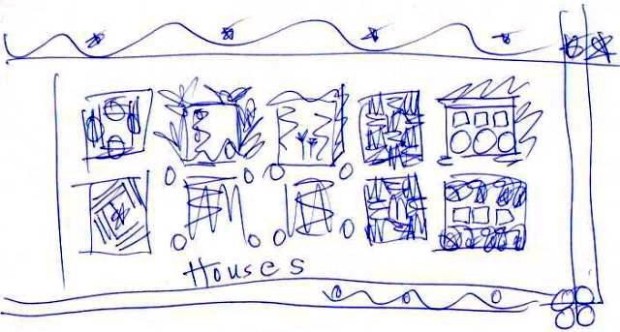
    Houses

    Think you know this place described above? Leave a comment!

  • Relaxing Reads

    Barbara Pym’s novels are relaxing reads. I found her while reading and following Penelope Fitzgerald, Elizabeth Taylor, Elizabeth Bowen – other 20th-century British female writers I’ve been reading and have grown to appreciate and like and want to share. I finished the Hermione Lee biography of Penelope some time ago. Writers, like the rest of us, don’t always lead exceptional or excellent lives. And a biographer needs tools and supplies to work with. I recently read Susan Cheever’s biography of e. e. cummings – much material for a biographer to work with there: Harvard and its takes and mistakes; both World Wars and post-war worlds; the Great Depression; the eccentric poet at work and play; the effects of criticism and changing popular and academic tastes on a writer’s occasions for work; notes and diaries; interviews; and correspondence. But readers interested in 20th Century British history and literature will find good reference and enjoyable works among these women writers: Bowen was born in 1899, Taylor in 1912, Pym in 1913, and Fitzgerald in 1916. They are not modernists in the sense of James Joyce or Samuel Beckett or Virginia Woolf or Gertrude Stein, even if they constitute a newer generation. Their novels are characterized by realistic prose and dialog, and as for history, the settings are often domestic, about family and relationships, work, church as social community place (think jumble sale, what here we call rummage sale), not so much about historical events as about the effects of the great tides on individuals in society, but of the person in an outlier sense. Consider Nenna in “Offshore,” living on the barge Grace on Battersea Reach on the Thames with her two young girls, estranged from her strange husband who in a final desperate argument-ending-blow, yells at her, “You’re not a woman!”

    I ordered a copy of Paula Byrne’s Pym biography, “The Adventures of Miss Barbara Pym” (2021, William Collins, London). I’m on page 179 of the close to 700 page tome. I started out reading the inside cover blurb on the author, Paula Byrne, which mentions, “She is founder and lead practitioner of ReLit, the charity for literature and mental health.” Having never heard of ReLit, I looked it up and found a site illustrating a small organization’s devotion to using literature to assist those struggling to handle the slings and arrows of daily life, whether king, knight, or knave. From ReLit’s About page:

    “ReLit is the Foundation for bibliotherapy: the complementary treatment of stress, anxiety and other conditions through slow reading of great literature, especially poetry. We believe in the power of words to restore and relight the human mind.”

    Apt words have power to assuage / The tumors of a troubled mind / And are as balm to festered wounds (John Milton, Samson Agonistes)

    ReLit: reading for wellbeing, retrieved 7 Feb 24

    I discovered on the ReLit site, and ordered from Alibris a used copy, a book titled “Stressed, Unstressed: classic poems to ease the mind” (2016, William Collins, London). The poems are indeed for the most part classic, the youngest poet included born in 1952, Linton Kwesi Johnson. The book is divided into 12 chapters devoted to themes related to dealing with stress, for example, “meditating,” “feeling alone,” “living with uncertainty,” “positive thinking.” (Stressed, unstressed also of course about the forms of poetic syllabication and lines.) Each chapter is introduced by a short explanatory essay on the given theme. The book is not an escape portal, though. The poems may or may not help the afflicted in a time of need. But as Jonathan Bate says in his introduction: “If words can do the work of drugs, what is to lose by putting them in our mental health first aid kit? There is nothing to lose and everything to gain.” Of course there are many different kinds of poetry and poetic definitions. The book “Stressed, Unstressed” uses the Wordsworth definitions: “the spontaneous overflow of powerful feelings” or “emotion recollected in tranquility.” Further into the book, we find mindfulness strategies discussed, and I was reminded of the Thich Nhat Hanh “how to books” (e.g. “How to Relax”), which focus on calm breathing and attentiveness to the moment.

    I think I might prefer, to the poetry as a means toward relaxation, the novels of Barbara Pym as well as Penelope Fitzgerald, Elizabeth Taylor, and Elizabeth Bowen. Too often, for me, poetry, like the classic country western song, often plays upon the emotions in the way of pathos, stirring the emotions rather than calming them. In any case, all of the subject of this post has me wondering if readers here at The Coming of the Toads find for the most part relaxing reads or stuff that gets the dander up. My hope is for the former, the relaxed, the three breaths you take while waiting for the page to change.

  • How I Spent My Artificial Vacation!

    Dear Ai! Quick! Quick! Quick! Lickety-split! I need about a 500-word paragraph on how I spent my last summer vacation! I totally spaced this stupid assignment! If I don’t get it in by today the teacher, Mrs. Millgillicutty, not that her name matters much, won’t accept any more late papers! Something about we’re almost to next summer vacation. Anyway, I remember when we first got this assignment, and I was like, I didn’t do anything on my last summer vacation but lay on the beach at El Porto listening to a transistor radio! What’s to write about that! And I watched the surfers come and go and the waves blow all froth like the bottoms of cutoff jeans and the jets from LAX taking off over the bay looking way too fat to fly like the Dodo and the oil freighters off El Segundo and a few sailboats in the offing a word that was on our last vocabulary quiz by the way. Anyway, one day, one of the hottest, ever, you couldn’t even walk barefoot down to the water the sand was so blistering hot and I dropped my towel and jumped on it every few steps to keep my feet from turning toast until I got to the wet sand near the water and all was cool. I don’t like to take a bunch of stuff to the beach. Just my towel and my bag. In my bag I stuff an extra suit, a pair of shorts and an extra tshirt, my transistor radio, a bottle of water, an apple or an orange, suntan lotion, a comb, a Nancy Drew book (I had a summer goal to read 12 Nacy Drew books, and I actually ended up reading 17), a pair of binoculars, a foldup sand chair, a small umbrella, a pair of flipflops, and my purse. Oh, yeah, but I was going to talk about that one day, the hottest on record. I usually get to the beach around noon, after I’ve finished my chores, make breakfast, take out the trash, straighten up, empty the ashtrays. I live up on Gull in El Porto so all I have to do is walk out of the apartment and down to the beach and usually I’m the first down but soon there are the others my friends all strangling down like they had a bad night or something but the reality is the worst they might have done is stay up late watching movies on the all night movie channel. Of course there are parents, or parent, and they can be unsettling, what with their bickering and worrying and criticizing and stopping off at bars on the way home until you have to get your own dinner but not everyone’s home is like that in fact each home is quiet different even if the parents seem the same. Anyway, back to how I spent my summer vacation and the one hottest day I remember it’s like branded on my behind. Jocko the beach’s best surfer ever stops where I’m sitting and asks can he leave his board with me while he goes in for a dip the blackball flag is up and all boards have to be out of the water. I’m stupified. He’s never even noticed me before. But I’m totally chill and like if you want whatever and that kind of stupid self conscious response and off he goes into the water where he stays like three hours! I’m like HELLO! how long am I supposed to watch your stupid surfboard and it was that day I decided how I would spend the rest of my summer vacation and it wasn’t watching some stupid minihunk’s surfboard while he dolls his afternoon away in the waves. I’m not some sort of artificial doll, you know. I’m real. With something real to talk about. About 500 words is all I need! Thanks!

    Sincerely, Beach Bum Betty

    Dear Betty, Here you go:

    I didn’t do anything on my last summer vacation but lay on the beach at El Porto listening to a transistor radio! What’s to write about that! And I watched the surfers come and go and the waves blow all froth like the bottoms of cutoff jeans and the jets from LAX taking off over the bay looking way too fat to fly like the Dodo and the oil freighters off El Segundo and a few sailboats in the offing a word that was on our last vocabulary quiz by the way. Anyway, one day, one of the hottest, you couldn’t even walk barefoot down to the water the sand was so blistering hot and I dropped my towel and jumped on it every few steps to keep my feet from toasting until I got to the wet sand near the water and all was cool. I don’t like to take a bunch of stuff to the beach. Just my towel and my bag. In my bag I stuff an extra suit, a pair of shorts and an extra tshirt, my transistor radio, a bottle of water, an apple or an orange, suntan lotion, a comb, my cell phone, a Nancy Drew book (I had a summer goal to read 12 Nacy Drew books, and I actually ended up reading 17), a pair of binoculars, a foldup sand chair, a small umbrella, a pair of flipflops, and my purse. Oh, yeah, but I was going to talk about that one day, the hottest on record. I usually get to the beach around noon, after I’ve finished my chores. I live up on 44th in El Porto so all I have to do is walk out of the apartment and down to the beach and usually I’m the first down but soon there’s the others my friends all strangling down like they had a bad night or something but the reality is the worst they might have done is stay up late watching movies on the all night movie channel. Of course there’s parents, and they can be unsettling, what with their bickering and worrying and criticizing and stopping off at bars on the way home until you have to get your own dinner but not everyone’s home is like that in fact each home is quiet different even if the parents are the same. Anyway, back to how I spent my summer vacation and the one hottest day I remember it’s like branded on my behind. Jocko the beach’s best surfer ever stops where I’m sitting and asks can he leave his board with me while he goes in for a dip the blackball flag is up and all boards have to be out of the water. I’m stupified. He’s never even noticed me before. But I’m totally chill and like if you want whatever and that kind of stupid response and off he goes into the water where he stays like three hours! I’m like hello how long am I supposed to watch your stupid surfboard and it was that day I decided how I would spend the rest of my summer vacation and it wasn’t watching some stupid hunk’s surfboard while he dolls his afternoon away in the waves. I’m not some sort of artificial doll, you know. I’m real! With something real to talk about!

    Good luck, Ai

  • The Poetry Game

    Is poetry a game? A game of solitaire. But inasmuchas one might anticipate an audience, a gnip gnop match. Or on a polo grounds, the sport of kings, but some riders on stallions and others on donkeys. But if poetry is a game, or even if just at times it might be considered a game, in a certain environment or context, so what?

    How does one play poetry? What are the rules of the game? A chase, in pursuit of meaning. Or mere entertainment, in which meaning may or may not play a role. We read that Wittgenstein found game useful in his thoughts on language. From the Stanford Encyclopedia of Philosophy:

    “Language-games are, first, a part of a broader context termed by Wittgenstein a form of life (see below). Secondly, the concept of language-games points at the rule-governed character of language. This does not entail strict and definite systems of rules for each and every language-game, but points to the conventional nature of this sort of human activity. Still, just as we cannot give a final, essential definition of ‘game,’ so we cannot find “what is common to all these activities and what makes them into language or parts of language” (PI 65).”

    Biletzki, Anat and Anat Matar, “Ludwig Wittgenstein”, The Stanford Encyclopedia of Philosophy (Fall 2023 Edition), Edward N. Zalta & Uri Nodelman (eds.), URL = <https://plato.stanford.edu/archives/fall2023/entries/wittgenstein/&gt;.

    Is poetry maybe a “language-game”? Looking around for a suitable answer, I found this in the online “Wittgenstein Initiative”: Wittgenstein said,

    “Philosophy should really be written only as one would write poetry.”

    WRITING PHILOSOPHY AS POETRY: LITERARY FORM IN WITTGENSTEIN 7 July 2015 ARTICLES
    by Marjorie Perloff, Stanford

    But reading on, I find this not all that helpful to our opening question (Is poetry a game?). And it didn’t take long to be subsumed online by articles relating to Wittgenstein and our use of words, in poetry or otherwise. But another maybe significantly different translation, by the way, shows Wittgenstein saying,

    “Philosophy ought really to be written only as a form of poetic composition.”

    Ioana Jucan. Date: XML TEI markup by WAB (Rune J. Falch, Heinz W. Krüger, Alois Pichler, Deirdre C.P. Smith) 2011-13. Last change 18.12.2013.
    This page is made available under the Creative Commons General Public License “Attribution, Non-Commercial, Share-Alike”, version 3.0 (CCPL BY-NC-SA)

    Will come back to form, but for now, so I backed out of search mode and returned to my own thoughts, if I can be said to own a thought, which of course is absurd. But to move on.

    But even if we are to satisfactorily say what a game is, it would still be left us to consider a definition for poetry. A search for a definition of poetry of course brings into view a petri dish full of ideas. Then this, again from the Stanford Encyclopedia of Philosophy:

    “Hegel considered a mode of understanding fundamental nature to be more advanced the more that it abstracts from concrete sensuous presentation and the more that it can turn contemplation back onto itself. There is a scale within types of art in this respect; visual art is less advanced than music, which is itself less advanced than poetry (1807 [1979]). While self-conscious Romantic poetry allows us to see our rational self-determining nature as minded beings, it nonetheless remains imperfect as a mode of knowledge of spirit. Philosophy, in its endless capacity for self-conscious reflection, “is a higher mode of presentment” (in Cahn and Meskin 2007, p. 181) and can ultimately supplant art as a mode of knowing the world’s essential structure.”

    Peacocke, Antonia, “Aesthetic Experience”, The Stanford Encyclopedia of Philosophy (Spring 2023 Edition), Edward N. Zalta & Uri Nodelman (eds.), URL = <https://plato.stanford.edu/archives/spr2023/entries/aesthetic-experience/&gt;.

    I include form as a rule of poetry. Poetry is first a game of forms. Form still may not be enough to make poetry a game. But to cut to the chase, poetry I claim shares many of the characteristics of a game: competition (for publication, recognition, awards); rules (of form and content, even if self-made and one-off, but historically many rules of form); players and spectators; a field (the page, a stage). But that is all in the game world of entertainment, one might argue – what of the world of art?

    Well, art is the biggest game of all. But again, so what? I’m not using game there as a pejorative. We take it as a given that games are useful, productive, redeeming forms of human experience and expression. But there might be a pejorative sense in some context of using the word game to describe poetry. One cheats, one competes unfairly, engages in gamesmanship, one joins the politics of academia and writes up yet more rules to ensure one’s seat is not taken or shaken, one cancels another often for reasons the critic can’t find jurisdiction over or legal standing for in terms of the writing itself, one joins a group or school of poets or poetry where surely games are played. One questions purpose, occasion, argument, claims. One finds that a poem is an argument, with its statements and claims clothed in metaphor or other hide-and-go-seek maneuvers. And out of bounds we find the critics who act as line judges.

    But what about poetry as art and art as sacred? Poetry with a capital P that stands for Word – with a capital What? Yes, the screed of the scrawl. Of course, any game can be perverted, which is why amateur games may be preferable to professional games, usually better. To play for financial gain or fame sometimes puts a burden on the player to maintain the integrity of the game. Betting and lotteries bring in another round of running about where most folks lose. The worse for wear is when pretensions creep onto the field, or when one pretends to gain access to the field. And of course one can always be ejected from the game, or kicked off the team, sent back to the minors. The values of poetry change from time to time.

    And the question arises, if poetry is a game, what of the other genres: fiction, memoir, the essay. Just earlier tonight, watching Walter Matthau with Glenda Jackson in the film “Hopscotch” (1980), and Matthau’s character sits down to write a book. His memoirs, he tells Jackson. He says he’s going to tell the truth. Oh, she replies, fiction. Why do we so often equate poetry with truth? Aren’t poets as capable of lying (and pretension) as the rest of us? Of playing games in that pejorative sense? And in the positive sense of game I’ve tried to propose above, borrowing in part from Wittgenstein, the poet who can’t play the game of poetry won’t be a winning poet.

  • Notes on Christian Wiman’s “Zero at the Bone: Fifty Entries Against Despair”

    Wiman’s title comes from an Emily Dickinson poem, about a snake, “A narrow Fellow in the Grass” (1096). Diabolic, symbolic, and fearful (particularly for those with no fear of spiders), snakes glide through the grasses of Wiman’s prose. Self-deprecating, Wiman attempts to hide his ego in the grass of selected poems (his own and by others), copious quotes, anecdotes and memoir, and essays. He begins with a dedication based on “a whole new naivete,” that one might profess to know more having eaten the fruit of the tree of poetry. (“Zero at the Bone” is also, unfortunately, the title of a true thriller. I’ve not read that one, but it also sounds like it deals in despair.) The Zero in Wiman’s title suggests the silence of God. Shame figures throughout, beginning with an epigraph, a quote from Wordsworth: “…to my shame I speak.” The book begins and ends on Zero, the snake swallowing its tail, having shed skin over the fifty entries. “I have no idea what this book will be,” Wiman says in the opening entry, titled “Zero.” Various themes will interweave throughout the book. It is a quilt being sewn, a mosaic, or menagerie. It would have made an interesting blog. The prose does growl along though, as he warns us in the opening “Zero”: “And what, pray tell, is the source of this slowly rousing growl?” That we will discover.

    For readers looking to assuage their own despair, this is probably not the book. It’s not a self-help book. It’s not a bromide. It provides few closed answers and not much good news. Wiman doesn’t appear to believe in Happiness. In this, of course, he’s not alone. Still, to say “One doesn’t follow God in hope of happiness,” hardly seems to go on the offensive against despair. And why shouldn’t one hope for happiness? Why should we not be happy? The opposite of despair is not happiness, but awe, Wiman suggests. There is no panacea. Depression is here to stay. But we can still be awed.

    In entry 1, Wiman mentions a night when his daughter could not sleep. Every time she closed her eyes she had unwanted thoughts. Wiman suggests “she pray to God.” Seriously? The idea of something “erases what it asserts” appears again and again, like “comfort and anguish.” One begets the other: we all need comfort who are anguished, and if we are not tormented, we feel not comfort. There’s this constant dichotomy at work. No permanence save good and evil, the parents of despair. Build it up to take it apart. The kids go to a daycare, “so my wife and I could write.” Maybe writers should not have kids, if that’s how it is. But why can’t a good writer write with the kids around? Joyce did. No art equals no god, no perfection. But if god is so perfect, why the mess? The question of religion, but is faith an answer? This is what comes of taking poetry too seriously.

    In entry 2, we find Wallace Stevens, “Domination of Black,” a poem about, I thought, camping out? Wiman says he doesn’t know what it means, but then goes on to say what it means, erasing what it asserts in so doing, and says it’s about death. Still, with Stevens in the campsite, this is a good entry: “Unreal things have a reality of their own, in poetry as elsewhere.” That is Stevens explaining the human imagination. How to live free from God, not just free from strictures.

    Entry 3 is a single poem, ending “unraptured back to man.”

    In Entry 4 we find Kandinsky again, mentioned with his wife in Entry 2. More quotes, out of context like threads, making the quilt, or is it a jigsaw puzzle, these pieces, not visions. Fragments. What’s the point, if you want to talk about points, of quotes out of context? Wiman’s audience may in large part be made up of divinity students whose lot it will presumably be to balance out angst and joy.

    Dostoyevski fans might remember his line, “Suffering is the sole origin of consciousness.” I kept waiting for Wiman to quote it. But why not of joy? Why can’t joy be an origin of consciousness? Remember, we’re making a quilt here. “One grows so tired, in American public life, of the certitudes and platitudes, the megaphone mouths and stadium praise, influencers and effluencers and the whole tsunami of slop that comes pouring into our lives like toxic sludge.” No kidding, and we’re only on page 30. Then there’s the dinner party honoring Lucille Clifton. Poetry never had it so good. But why does Wiman have to criticize e. e. cummings in his effort to praise Clifton, comparing their use of small case i instead of I? idk. And why take it out on the faces of the waiters? What might be interesting is how the waiters might have described the faces of the poets. For that, we’d need Samuel Beckett, but he’s been dismissed as a trap for minor writers. And there it is, the hierarchy of the cannon, with Dodo and Didi at the bottom of the heap, self-published but nevertheless awaiting instructions from the top.

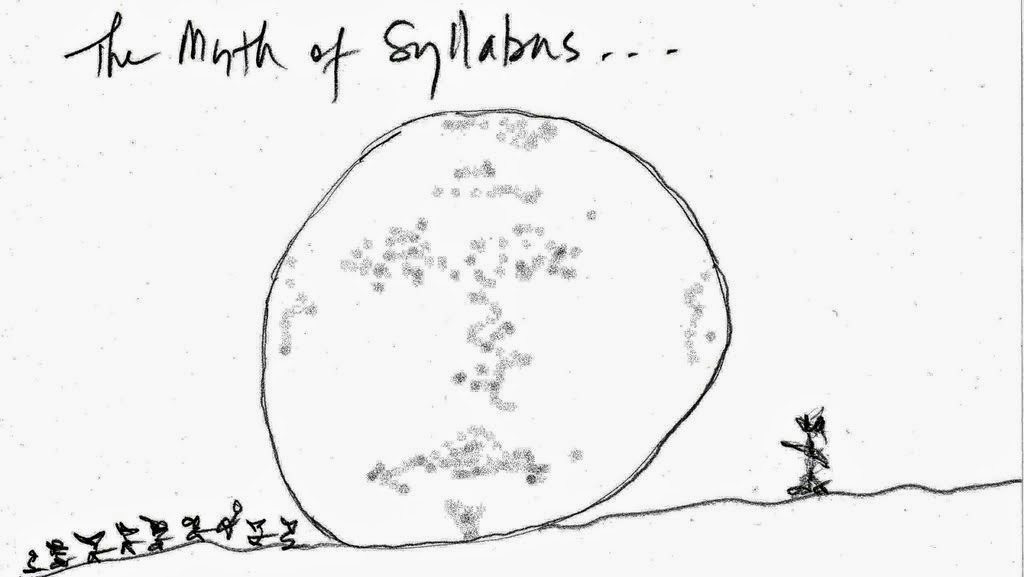
    And Nietsche? Why not Kirkegaard, Augustine, or Buckminster Fuller – whose treatment of the Our Father prayer is instructive and entertaining and most certainly against despair. But Nietsche is imminently quotable, and Wiman is given to quotes. The quilt makes for a hefty syllabus.

    The poet’s dog. The Holocaust. The bullet we all feel lodged somewhere in the skin muscle of our soul. Christ walks in us. A sermon. Sometimes he walks right through us. Doesn’t stay long.

    It’s a death quilt. Not sorrow. Sorrow is not at zero nor at the bone. Sorrow remains above freezing. Sorrow is a song that doesn’t get sung. Some people can’t sing. A poem says, “Tragedy and Christianity are incommensurable,” in entry 7, then, we get, “The story of Jesus is, in an inescapable sense, a tragedy.” I remember the “Laughing Jesus” image appearing in the church we attended at the time. But Wiman says, “Suffering and death, at some point, will be all that we know.” How does one move against that?

    A poem, “a lullaby of bone,” and “dawn a scald of joy.” Sounds like despair against which nothing can hold back. Where’s the against here?

    Another poem. No comment. Throughout the book, single poems, collections of poems, like posters stapled to a telephone pole advertising little concert events already passed. And comes Ted Hughes, of all poets, singing of joy. Sort of. “Joy! Help!” The Beatles sang it better. Ah, and here’s Kirkegaard: “What is a poet? An unhappy person who conceals profound anguish in his heart but whose lips are so formed that as sighs and cries pass over them they sound like beautiful music.” And I’d like to read more of Norman MacCraig, who says: “I am a happy man…and nearly all the poems I write are in fact praising things.” Entries of quotes and poems. Remember, we’re making a quilt.

    So he disses Samuel Beckett. But Beckett was a happy man. A humanistic writer, a kind man. But who are the “minor talents” Wiman refers to in his diss of Beckett? Bloggers? “This is a toy despair. It’s entertaining, brilliant at times, but it cannot help me.” Wiman explains the meaning of “against” in the title: “By ‘against’ in the subtitle of this book I don’t mean to imply a ‘position.’” A leaning, then. Shoulder against the wheel.

    Yet another poem. No comment.

    Dichotomy. There are two kinds of writers, we’re told. Yes, minor and major. Like guitar chords. Diminished and augmented. Wiman seems unforgiving about Virginia Woolf. Why even mention her if you can’t say something nice? He doesn’t mention her depression, her womanhood, the war raging. For someone who really is suffering from despair, as Virginia obviously was, this book by Wiman won’t be helpful. It might even make matters worse, as his response to Woolf’s suicide makes clear: “A prison gets to be a friend.” Wiman says she “embraced the oblivion that she had spent a lifetime creating out of, and in spite of, and against.” That is a complete misreading of everything. And mean-spirited to boot.

    Wiman says, “Me, I can’t conceive of a god who can’t laugh.” Well, let us hear some laughter, then.

    Another poem. Shooting pool. More despair. Haven’t we enough?

    At the gym. This is a kind of Roland Barthes entry, or a topic Barthes would have used, like his American wrestling piece. “I’ve never been in a gym I didn’t like,” Wiman says. I’ve never been in one I did like. The smell of sweaty socks. Exercise going on but apart from any obvious need, like digging a ditch to lay a sewer line. Honest work. Of course one can be assigned physical therapy, and a gym comes in handy for that. But we should get outside for our exercise, and work for a living. But I can easily see why a writer might need a gym. Get away from the solo desk and into some camaraderie, even if you don’t actually meet or talk to anyone. Maybe even hire a coach, a trainer. But Rocky’s raw eggs? Really? And then we get some humor, finally, or at least some talk about humor. We missed a good chance with the Beckett stuff – well, that was just a footnote, anyway. But now, Wiman showers us after the gym with: “It [humor] can have existential reach and significance, can imply a world in which the comic, not the tragic, is ultimate.” This entry ends, by the way, with a footnote referencing Langston Hughes, a little quote from a letter he wrote. Fine, but Langston should have an entry all his own.

    And now we’re back to snakes again. “Why does one create?” Wiman’s italics, not mine. Some to sound important. And of course the snake anecdote brings us round “commodious vicus” to Adam and Eve, story which with the help of Larkin, Wiman conflates with sex, not knowledge of good and evil. “Then, friend…” First, don’t call me friend. I’m your reader. It’s Eve creates consciousness. Hmm. And then God is the snake. What version is Wiman reading from? And then comes the Weil paradox. Destruction of the I. Hard to understand I guess for a poet, whose sole purpose is the creation of the I. And then it’s sustenance. And what of the others? If I drink it to death? And then comes the snake in the mouth. “There is nowhere to stand and see, nowhere to escape the stink of being human.” One must love that stink as Jesus did. And then this absurd comment: “Poetry is the only sanity.” Really? Then why does so much of it sound so crazy?

    So, an Ars Poetica follows. “If I could let go / If I could know what there is to let go / If I could chance the night’s improvidence / and be the being this hard mercy means.” The work song.

    Hearing music is better than poetry, sans words. Save the sound of a poem’s words.

    More circularity. “The knowledge of love and the knowledge of death are the same, and neither is knowledge.” Is Wiman just trying to sound important here? Like a philosopher might? What indeed is the point? Yes, back on page 3: “To write a book against despair implies an intimate acquaintance with the condition. Otherwise what would be the point?”

    And now more quotes. Bloggishness.

    A six-line poem.

    Loneliness and its solution.

    William Bronk, at the expense of Wallace Stevens. Potato chips. Betcha can’t write one. Aphorisms, like this one from page 118: “Nothing is worth saying, nothing is worth doing except as a foil for the waves of silence to break against.” Yes, and “our ears are now in perfect condition,” John Cage said in his manifesto for music. As for Bronk, metaphor is everything and nothing, since it can point to what is, or what might be, but can never actually be that person, place, or thing. Buckminster Fuller: “I seem to be a verb.” That is not found in Wiman. Instead, we get, via Bronk: “I deal with despair because I feel despair. Most people feel despair but they are not prepared to deal with it except pretend that it’s not there. I think it’s there metaphysically, that it is not a matter of an individual predicament. It’s in the nature of reality and not to be denied.” Another sadist who wants people to think for a living. Isn’t it better to work for a living? “…a man lashed to a mast in his own living room,” is Wiman’s final statement on Bronk.

    Barely bearable. Yes, because there is no “ugly” landscape. It’s all tremendous and awe full. That is the nature of Beckett’s landscapes. Only the human remains.

    Pascal – the dedication to Wiman’s book is now explained, “a whole new naivete,” explained or illuminated.

    Another poem.

    Etheridge Knight. What poetry maybe can do is what “Jesus promises.”

    Poem. “toot” (ish) footed.

    Why is “common reader” in quote marks? Contradictions. Contraindications. Don’t mix this poetry with… Rabbits. Hot rats. “Poetry makes nothing happen.” Yes, precisely. “In the beginning…was the word.” Was. What now? Out of nothing something happened. But why this something? Why not some other happier circumstance? Burning worlds.

    Another poem.

    Out of “this tumbleweed nowhere” now here. And ends in laughter, really is, this entry, “against despair.” This is the autobiographical piece, the memoir, writing worth the price of admission. The memoir piece where Wiman describes his father and sister living like Becket characters trapped in a Southern Gothic play, is the heart of the quilt. Wiman has already tried to dismiss Faulkner’s characters, yet here they are, living a Flannery O’Connor dream. Here Wiman is at his best when it comes to the writing. It’s an American quilt.

    Another poem: hailstorm.

    “I am tired of the word ‘despair,’” Wiman says on page 170. No kidding. Me too. And we three? Remember the speaker is not necessarily the author. We might keep that in mind when we’re hearing voices.

    Another poem. More rats.

    Writing in the sand. Could he write? “Against closure.”

    “Who ever anywhere will read these written words” (Joyce).

    Poem. Hamburger.

    Assumptions and predispositions – toward despair? “Ouroboros.” Our boring into belief. Burrowing? Borrowing from?

    All quotes. “Faith becomes an instrument.” A tool? A piano stool?

    Sermon calling. “Was it your own idea or were you poorly advised?” Funny. Either or. “Who do you say I am?

    25 more quotes. Quip qwop gnip gnop.

    Poem.

    Traces. A play. “What’s the point, then…” Yes, of reading anything at all, never mind writing. What’s the point of worrying over points?

    Entropy. Loss of the big. Who cares about “poise?” At a time like this? At anytime. Well, we’ve got to attend to the niceties. We aren’t in our own living room. And what of the obsessive and the compulsive and the disorders? Will Jesus cure us of those too?

    A poem about pain.

    10 more quotes. What’s the point? Like Melville’s “Moby Dick.” He wanted to write a big book.

    A four-line poem on unbelief?

    A found poem, created by “delineating” a piece of prose. Ok. Mentions Meister Eckhart.

    One’s personal Jesus. Love – what is it? A miracle. Agape. Mouth open. Prayer for, as opposed to prayer against. The universe more strange than we can even ever imagine. In which Wiman reconciles science (physics) with the spirit. Fragments of a big bang. Of course, since it was the only bang, how would one know if it was big or small? Doesn’t matter.

    Wiman makes clear to be against despair is not necessarily to be for joy. His book is not a 7 habits of highly joyful people. But why can’t joy create consciousness as easily as despair? Is humanity an experiment in anhedonia?

    “…want want.” Not, not. Knotty. “Woman With Tomato,” poem.

    Poem. Family. “buoys”

    Cancer and television. “Why must my mind…” I get that. “I’m not chipper…” And the children of war? Children and cancer in the war zones. Wiman teaches a class called “Suffering.” He’s had an overdose of it. But is there another class he might teach called “Joy”? But Wiman says suffering and joy are alike. It’s the same class, turns out. The cancer chair. And Eli Whitney. Job (The Book of) and poetry. Values. Joy over despair. “Of course, of course, of course.” This renders a lot of comments – put your hands down. “One considers the meaning of…” (I’m on page 277 if you want to follow along – in Entry 49.) Not quite true, otherwise placid, readers of this book may attest.

    Comes to a sum, page 278. “…feeds in blood” (281).

    And a final poem: Bewitched, bothered, and bewildered.

    Coda: Zero again. Nothing, nothing.

    Not a book for someone trying to stare down despair. There’s the personal, individual kind of suffering, the stuff of sitting in the cancer chair. There’s the universal, general kind of suffering – “the sole (soul) origin of consciousness.” And there’s the week work and war and worry that wears most of us weary.

  • Another Year from Monday

    Sometimes it seems a step backward is the way to go, but I’m not sure painting over yesterday’s canvas is movement forward or reverse. But why think in these lineal terms to begin with? In spite of tidal waves of news pouring in from every mode, it seems keeping informed about what’s going on is ongoingly increasingly difficult. At the same time, as John Cage said in his essay on Jasper Johns, “Why does the information that someone has done something affect the judgment of another? Why cannot someone who is looking at something do his own work of looking?”

    Today, later this evening, to be more precise, is the solstice. If all goes as planned, the days will begin to grow longer again. There’s no keeping still, even if forward and backward amount to the same thing. In fact, I read just last night, the sun has already been going down later in the day in these environs, but the sun has still been coming up a bit later each day, and will continue to do so for some time yet, despite the solstice. So the moment, the epiphanic slice, the exact time of the solstice, when you feel the bump at the top of the amusement ride just before the reverse tilt comes true, you probably won’t feel.

    Nevertheless, we celebrate the solstice, for reasons old and new, and take the opportunity to consider what new lectures and writings, poems and songs, essays and cartoons we might make up between now and the coming spring equinox, which is planned for Tuesday, March 19th (Saint Joseph’s Day, if you’re keeping track of that too). New ways of measuring time are always being considered. But if you adopt a new calendar, you’ll have to then come up with a proleptic view. So we might anticipate objections before they’re even brought up. Remarks.

    The proportion of ideas might be considered important. If an idea is too big, or too small. To warrant further development. I thought I might try some reconnections, might even write a few letters, though my initial attempts at this, very much no doubt excited by the solstice, have met with instant failures to communicate. The art of the steel sculpture. Then again, I’ve never been much of a letter writer, not like the folks in the old days who might spend half the day reading mail and the other half answering mail. Pastime. Mail which had taken days or even weeks to arrive during which time rendered moot much of its news, feelings, ideas.

    Speaking of letter mail, the kind written on paper and requiring a postage stamp, we get very little here these days. Even junk mail seems to have diminished. We’ve received two Christmas cards, both kept on prominent display. Of course, one must send mail to receive mail; not always, but usually. As for blog exchange, comments are problematic. They aren’t really letters in reply, and often say more about the commenter than what’s being commented on. The art of the quip, the comeback, the rejoinder, retort, riposte. But that’s the cynic in me coming out. Get back! Get back! The blog, “The Coming of the Toads,” turns 16 this month. I’m not even sure what a blog is anymore.

    The most effective blogs (or whatever they might be called) seem those dedicated to a single purpose: photography (and photos about something specific – e.g. birds, architecture, surfing), politics, poetry, how to, music, art, opinion, travel. But the personal essay seems the most resilient form of writing (personal essay as illustrated, for example, in Philip Lopate’s anthology “The Art of the Personal Essay.”) I’m not sure where the idea of a pic necessary to accompany every piece of blog post writing ever came from. The Header, I guess. In case you’ve not noticed, The Toads has for some time now sported a minimalist attitude illustrated by a mostly blank white page dotted with black text – might be one way to describe the setup. This allows for the least distraction for both reader and writer. Indeed, blog posts past, I spent more time coming up with an appropriate pic than I did on the writing. Back when the blog began, most readers read on a computer screen. The display of any post is now changed by format depending on what kind of device the reader’s using: phone, tablet, computer – so what you see is not always what the reader gets or what the writer might have intended (a problem which of course is not new to any kind of writing).

    Anyway, I’d like to take this opportunity to restate a few of the underlying interests of the writing here. It’s original, without recourse, it must now apparently be officially stated, to any borrowing from an Artificial Intelligence (AI). That includes all the essays and pics, cartoons and poems, songs, unless of course specifically quoted and cited yada yada yada. That’s not to say influences won’t be discerned: John Cage, Marshall McLuhan, Buckminster Fuller, James Joyce, Samuel Beckett, the Beats, Guitar and Music in all its forms but increasingly Gypsy Jazz guitar – to name a few.

    But back to the solstice! Happy Solstice to all of you writers and readers. Please feel free to leave a comment if you still have time.

  • Notes on “How to Know a Person” by David Brooks

    David Brooks’s latest book, “How to Know a Person: The Art of Seeing Others Deeply and Being Deeply Seen,” in the tradition of how-to books, suggests a panacea – it’s about how to cure social ills caused by failures toward wisdom, wisdom being the ability to know and see others. Of course everyone knows and sees others. But deeply is a metaphor that Brooks uses to mean wisely. This is where the wise guy gets wise and sheds the skin of the old self. Brooks suggests if one examines one’s life, as Socrates explained is the ticket to a life worth living, a good place to start is to examine the life of someone else. To know oneself means to cut through the fog of one’s birth situation and predicament, and, in the existential meaning of existence precedes essence, define for oneself what one’s existence amounts to, while simultaneously to know oneself means to understand the limitations and privileges handed down by the many hands of one’s cultural birth and upbringing and accept that view as true and unassailable. The ability to handle this apparent contradiction is necessary if one wants to be wise. The symbiotic relationship between one’s self and others is necessary for those who would wise up. You can’t be wise alone. You can’t know yourself without knowing another, and you can’t know another without knowing yourself.

    The Brooks book is a compilation of research in the fields of biography, psychology, philosophy, sociology, as well as neuroscience and field work, with ample anecdotal evidence and life experience examples that add support for claims and provide for reading enjoyment. There are seeming contradictions. Brooks eschews stereotypes, for example, but spends significant time categorizing personality types and other shorthand ways of talking about and seeing people. But at the same time he discards old ways of thinking and suggests better ways to experience one’s self and others. The naming of others and things is problematic. For example, we call a person an extrovert or introvert. What does this tell us about that person? There is a chapter titled “How Not to See a Person.” Brooks introduces new terms: Illuminator and accompaniment. He suggests there are wrong questions to ask – not, for example, what do you do (for a living), but, “What crossroads are you at?” Brooks acknowledges discouragement, but his book is positive and optimistic. He wants to be an illuminator, one who is wise, who knows others, sees and is seen. The book is not all that hard to understand. The challenge is to grow away from either the torment of self-doubt, of self-criticism, or the curmudgeonly habit of naming people to put them in their place, of holding people to rules that you yourself are not required to follow. Are you at peace or have you regrets that make you despair?

    “Despair involves bitterness, ruminating over past mistakes, feeling unproductive. People often evade and externalize their regret. They become mad at the world, intent on displacing their disappointment about themselves into anger about how everything is going to hell.”

    207

    Brooks distinguishes between smart and wise. And what is wisdom?

    “Wisdom at this stage of life [at the crossroads of peace, integrity, and despair] is the ability to see the connections between things. It’s the ability to hold opposite truths – contradictions and paradoxes – in the mind at the same time, without wrestling to impose some linear order. It’s the ability to see things from multiple perspectives.”

    207

    The wise don’t impose or regulate and tell you what to do. They listen. They are experts at listening:

    “Wisdom isn’t knowing about physics or geography. Wisdom is knowing about people. Wisdom is the ability to see deeply into who people are and how they should move in the complex situations of life. That’s the great gift illuminators share with those around them.”

    248

    There are identities we create, names we name ourselves, and narratives we stick to (or revise, as circumstances evolve), even as the plots don’t make any sense, one event not rationally leading to the next, like a walk through a circus. Like clowns, we “prepare a face to meet the faces,” as Eliot’s Prufrock said. Whereas, we might say simply, as Brooks summarizes:

    I had some early blessing. I saw the suffering of others. I realized my moral purpose. I endured periods of suffering. I grew from my pain. I’m looking toward a beautiful future. If you’re talking with an American and you want to get a sense of who they are, find out if their life story falls into this pattern, and if not, why not.”

    223

    Or we could sing a simple song. This is not in the Brooks book; I just thought it might be a fun way to end these notes:

    “Getting to know you,
    Getting to feel free and easy
    When I am with you,
    Getting to know what to say

    Haven’t you noticed
    Suddenly I’m bright and breezy?
    Because of all the beautiful and new
    Things I’m learning about you
    Day by day.”

    “Getting to Know You” is a song from the Rodgers and Hammerstein musical The King and I (1951). The song itself is “free and easy” and “bright and breezy.” That there is an underlying irony in the history behind the play it’s from may or may not say something about getting to know people:

    “In 1861, Mongkut wrote to his Singapore agent, Tan Kim Ching, asking him to find a British lady to be governess to the royal children. At the time, the British community in Singapore was small, and the choice fell on a recent arrival there, Anna Leonowens (1831–1915), who was running a small nursery school in the colony. Leonowens was the Anglo-Indian daughter of an Indian Army soldier and the widow of Thomas Owens, a clerk and hotel keeper. She had arrived in Singapore two years previously, claiming to be the genteel widow of an officer and explaining her dark complexion by stating that she was Welsh by birth. Her deception was not detected until long after her death, and had still not come to light when The King and I was written.”

    Wikipedia, The King and I, Retrieved 11 Nov 23
    Persons
  • Googling Wake

    Yesterday, reading James Joyce’s Finnegans Wake again, and find a Joyce neologism, now normalized for the common roider, as follows: “googling.” Of course I’m not the first to find it, as googling quickly showered me.

    Neverthelees, I mention it here thinking an article I saw also yesterday, (while googling “googling,” tho from March 26, 2013, of all saint’s day, in Associated Press but picked up everywhere) gives it renewed interest, to wit, the story goes, as I found it in news environs and accordingly summarize:

    Apparently, Sweden has a council that every year publishes new words being used frequently by Swedes. And, in its December 2012 new words list, the council declared “ogooglebar” a Swedish word that had been ensconced in daily use. “Ogooglebar” being Swedish for anything that can’t be found by googling it, aka, looking it up. But, the company, Google, objected, wanting to limit the term “to google” (something) to actually using Google to google it. Something like that.

    In other words, if you used Bing, you’d have to say, “Bing it.” And Swedes could then say, “obingbar.” Or, maybe you could simply say, calling out to look something up, “Search Engine it.” And, if not found, then you could say, “Bingless,” or, “Unenginable.”

    In any case, the council decided to delete the word “ogooglebar” from their list rather than cower to a company’s attempts to control words on the street.

    The two “googling” findings in Finnegans Wake are as follows:

    One chap googling the holyboy’s thingabib and this lad wetting his widdle.

    His mouthfull of ecstasy (for Shing- Yung-Thing in Shina from Yoruyume across the Timor Sea), herepong (malad venture!) shot pinging up through the errorooth of his wisdom (who thought him a Fonar all, feastking of shellies by googling Lovvey, regally freytherem, eagelly plumed, and wasbut gumboil owrithy prods wretched some horsery megee plods coffin acid odarkery pluds dense floppens mugurdy) as thought it had been zawhen intwo.

    Finnegans Wake, James Joyce, 1922-1939, p. 620 (first entry above) and p. 231 (second entry), Viking Press, Thirteenth Printing, August, 1976.
  • Field Notes 28 Aug 23

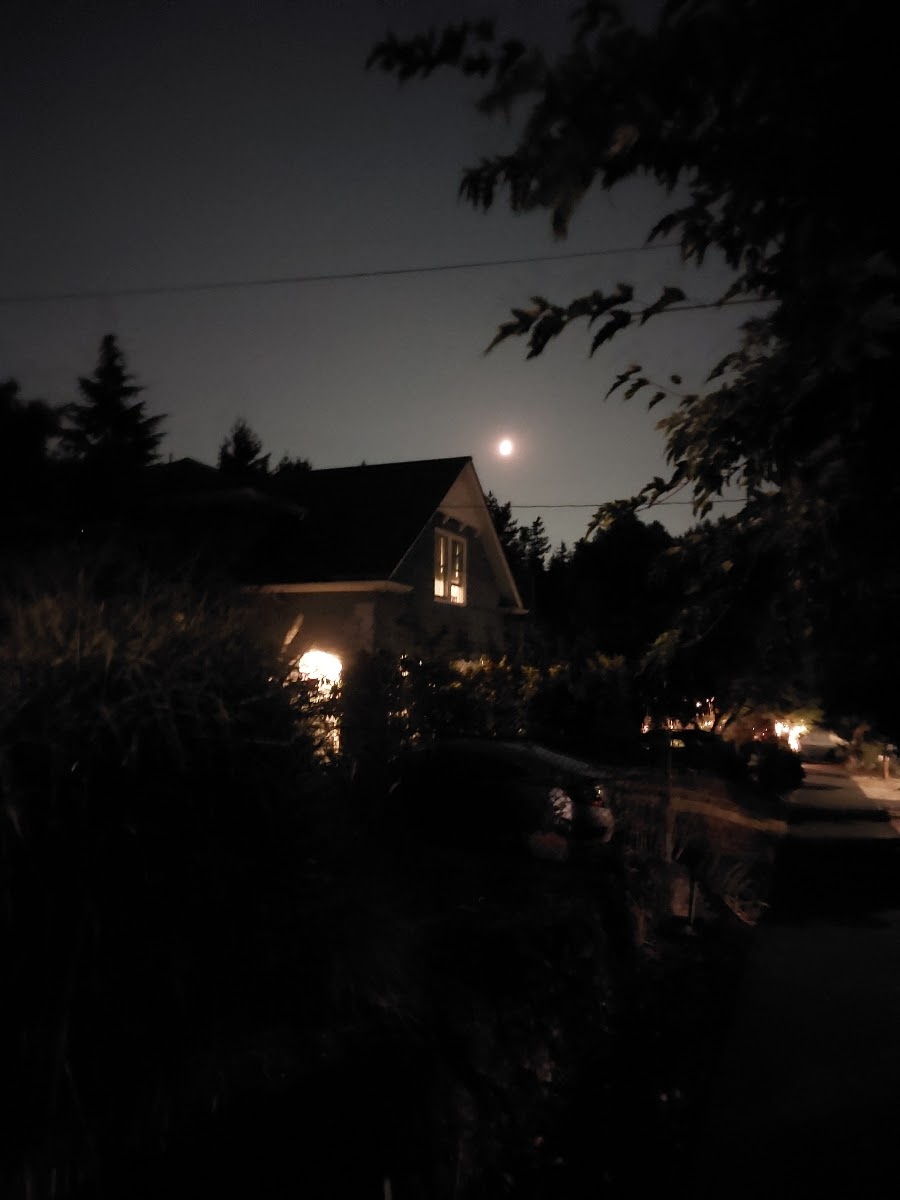
    Walked a mile last night with Eric, curlycue around the neighborhood streets late in the evening, the blue moon rising over the houses and over the firs up on the dark volcano, first cool evening in awhile, feeling the ocean air arrive like an old steamship foreshadowed by tugboats pushing and pulling against a tide. Earlier had sat out in the drive with the guitar, disturbing the universe, though no one seemed to mind, a few passersby walking dogs giving me a nod, the International Play Music on the Porch Day passing locally like any other day.

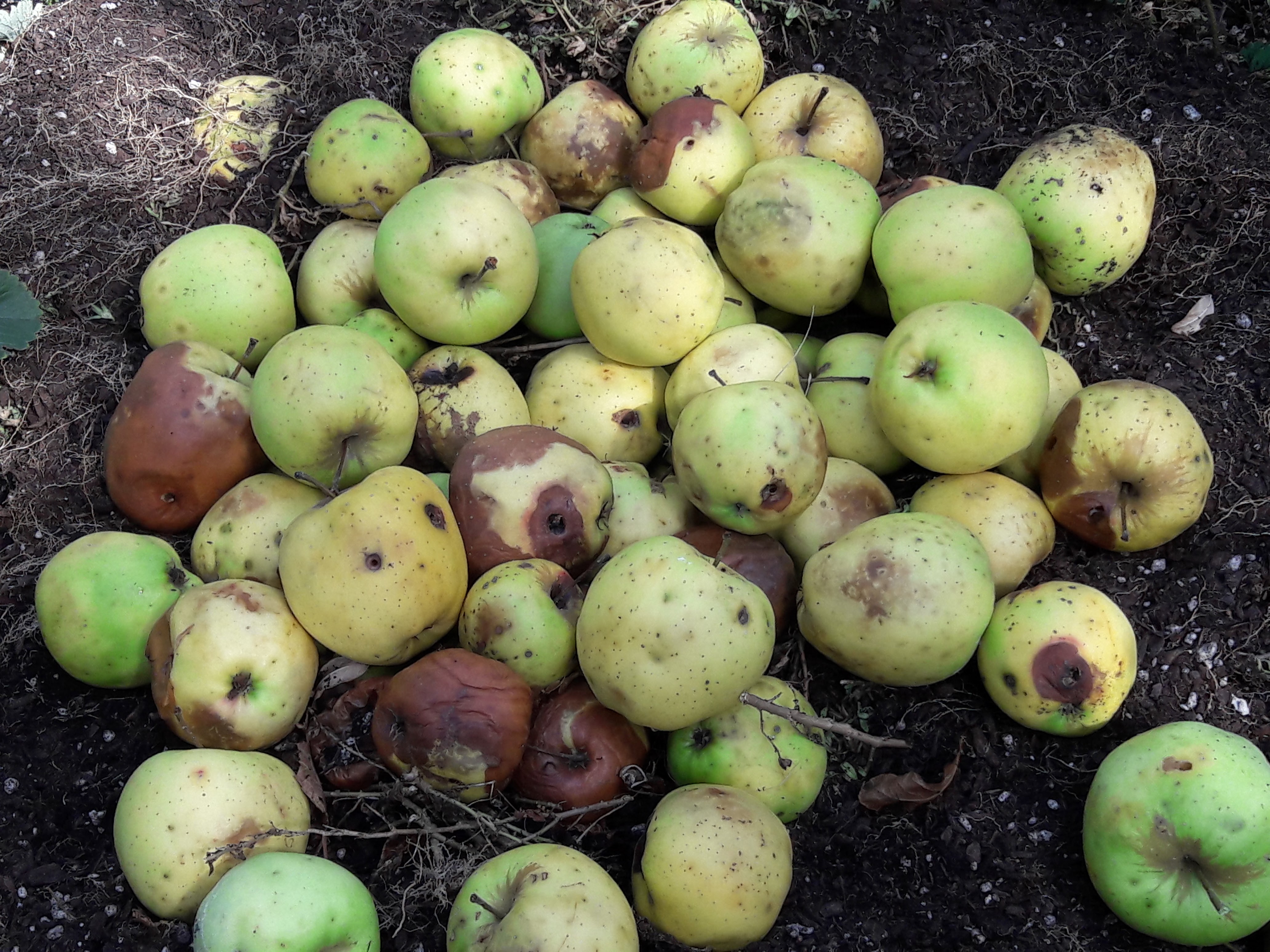
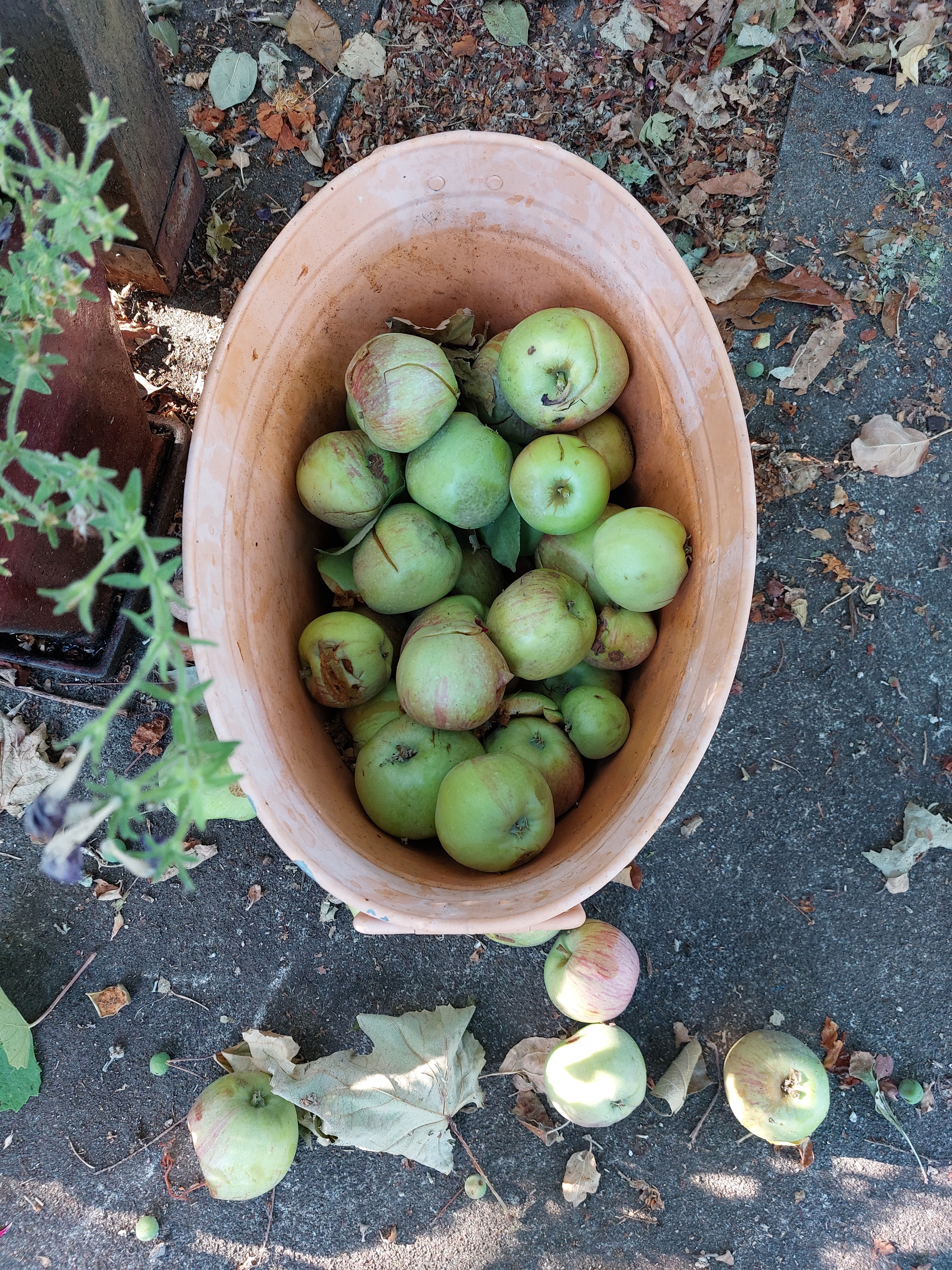
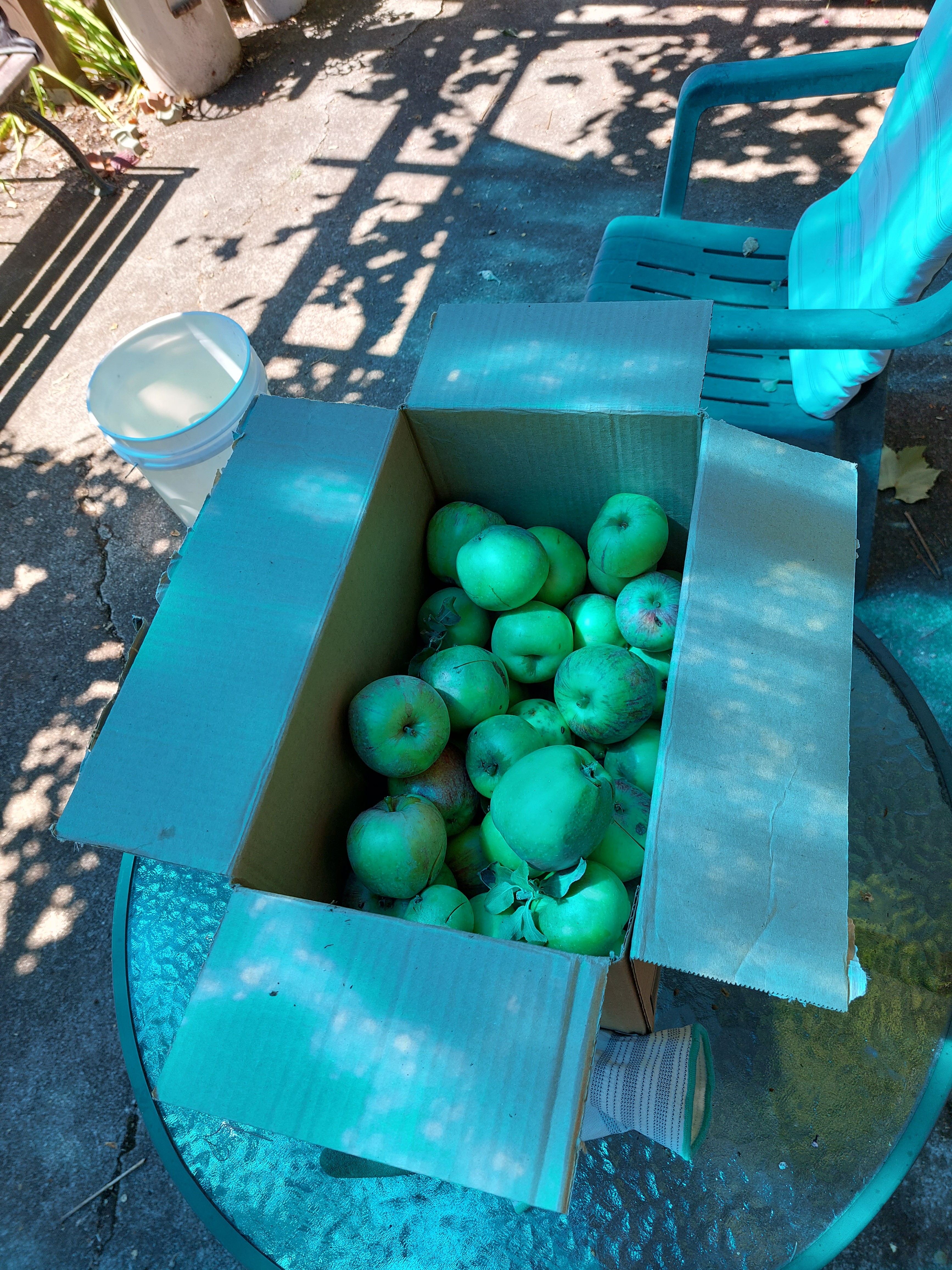
    The neighbor’s Brobdingnagian apple tree, high up above the border wall, half of which hangs out and over our grape pergola, too high to pick, seems to have come close to finishing its self-harvest drop, around a dozen or more bushels falling on our side of the wall this year, a bumper crop, peck after peck after peck we’ve picked up and bagged.

    Meanwhile, peaches are in season. Fresh peaches, juicy and tender, slightly fuzzy, plump, pink and red and yellow and orange. Nectarines are also peaches, but without the fuzz, smooth, and the pit of the peach is akin to an almond. This is what comes from looking things up, a new pastime. Of the numerous poets who have tried to get their hands around a peach, perhaps none have squeezed as close yet stayed afar as Andrew Marvel, in his poem titled simply “The Garden” (circa 1650), where he seems to prefer the actual peach to any metaphor that might point elsewhere for one’s fuzzy orbs:

    “What wond’rous life in this I lead!
    Ripe apples drop about my head;
    The luscious clusters of the vine
    Upon my mouth do crush their wine;
    The nectarine and curious peach
    Into my hands themselves do reach;
    Stumbling on melons as I pass,
    Ensnar’d with flow’rs, I fall on grass.”

    Andrew Marvel

    Why “curious”?

    “I grow old … I grow old …
    I shall wear the bottoms of my trousers rolled.

    Shall I part my hair behind? Do I dare to eat a peach?
    I shall wear white flannel trousers, and walk upon the beach.
    I have heard the mermaids singing, each to each.

    I do not think that they will sing to me.”

    from “The Love Song of J. Alfred Prufrock,” T. S. Eliot, 1911

    One of these days, I’ll compose my own poem to the peach, maybe “Portrait of a Peach,” which is to say, one you cannot eat, dare or not. Lately, Susan’s been offering ripe peaches on a plate to nibble through the slow afternoon, so soft, so cool, so sweet, so refreshing. Love peaches, love to see two, side by side, each to each, within easy reach.

    Speaking of growing old and wearing trousers rolled, yesterday, lightly working outside, I came close to falling twice. The first time, I caught my pant cuff on a hook under the outdoor couch. I nearly fell into a cluster of flower pots. The second time, the foot whose turn it was to move forward on the porch somehow stuck in place, and the pot I was carrying was tossed so I could stop my fall with the arm that was holding it. The pot fell and broke in two, splattering the walk with potting soil. And somehow I found myself sitting on the porch step. Not quite a fall, then, a sit?