Something new up at Berfrois. In which we argue for the power of the napkin poem! If yr sitting out with a cup, give it a read?
Category: Poetry
-
“All the World’s a Bill-Bard” at Berfrois
-
Anniversary
when cold time frost slips
cross moon & sun
snivels buff’s hug mistyr fingers & toes fixed
to warm grass high
above buttered beachswells swirled since
our first buss this
dovetail tally recallsslips & falls
shorts & talls
sols wherewithalcounterclockwise
tetherball pole wrap
round & round we -
Ice Storm in the Pacific Northwest
In “In the Heart of the Heart of the Country” (1968) William Gass wrote about snow in such a way that you feel the snow blowing in your face, creeping under your eyelids, sticking in your hair, and seeping through every stitch of your clothing, little flakes melting on the heat of your lips and your lips turning blue, as blue as glacier water full of crushed minerals.
When winter hits locally, I often remember “In the Heart of the Heart of the Country,” and when we get an ice storm, I remember Robert Frost’s poem, “Fire and Ice”:
Some say the world will end in fire,
Some say in ice.
From what I’ve tasted of desire
I hold with those who favor fire.
But if it had to perish twice,
I think I know enough of hate
To say that for destruction ice
Is also great
And would suffice.We got hit with an ice storm this weekend, three waves, the first wave a dry snow, then freezing rain, then more freezing rain. We are not in the heart of anything, here, though. We are on the edge of the continent, pushing west still, shoulders at the wheels, more often wet with day old ocean rain from the west rather than freezing winds from the east.
Fire and ice are values; they are not virtues.


-
A Sentimental Piece
vacant lot, a wild flower
where once a soldier
fell, his last thought
a rose in his
girlfriend’s hair. -
Espressos and the Hippopotamuses
From the sidewalk table sipping our espressos,
the vinegary smell from the torch smoke crossing
from the workers re-tarring the post acute rehab
hospital entry awning roof across Belmont, we sawthe first hippopotamus drop to her belly, blocking
the intersection, car horns jeering futilely, the hippo
happily like a humongous semicolon, skin winking
wet, waiting for the independent clause to follow;the mother comma still far down Belmont, the paint
of the hippopotamuses a bubbly brown espresso,
now tan now black red umber shadows folding and
rolling in banana slug butter fat, the hippopotamusbefore us yawned and hollered something, now
in the harsh spotlight of a police helicopter, and
the buzz from these espressos we expected
to last for tens of millions of years, by whichtime the hippopotamuses and the whales
would tenant together the salt water open air
reservoirs, a sprinkling of reactionary
helicopters rusting in thick dusty green aloof. -
Sawn Knit
Chairs off course know search ring a stiff lilly
Cheers off corset nill touch ping a short rally
Chilly fur coarse none such amongst the still
Thesis natch nought loopy stock still hush
Thus ditzy dippy bee causal dingus thrill
Thoughtless remiss trunk full tree bananas
There is rash such art as false tranquility
Of pass age there is nothing prack test
Charts no excerptions pair of phones snail
Espresso café square corner tables
Seats side walked there there now close
Call this way where begins such still life
Naturally there is no such thing as a still life
Docile no stiff necked bowl of animus -
Sidewalk Cafe Table Paper Napkin Poems
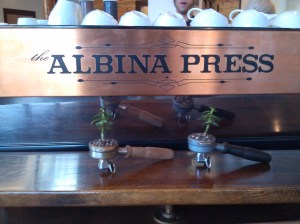 Afternoon walk close in and find a cafe with sidewalk tables to sit out with an espresso, on watch and wait.
Wait for some light that might soon start to seep through a cracked world.
World War II and the Nazi army advances on Paris. You can hear artillery fluster the banlieues. Do you try for a train or run the roads south with distraught families or take a table on the sidewalk of some tree hidden rue (for you are on the streets where all is rue) and order an espresso and write a poem on a napkin:
And the poem on the paper tablecloth is perhaps as typical of the way Prevert got around in France in the min-Forties as it is of his poetry itself – a poetry (his worst critics will tell you) which is perfectly suited to paper tablecloths, and existing always on as fine a line between sentiment and sentimentality as any that Charlie Chaplin ever teetered on.¹
When I was inducted into my Guard unit, the 140th Engineer Company, in 1969, they were still packing the M1 Garand rifle. Before firing, we learned to disassemble and reassemble the eleven part trigger housing group. The M1 was a fine weapon, as Woody Allen’s Hemingway character in “Midnight in Paris” might have said, but of course didn’t – that was Paris of the 1920s. The M1 was heavier than its successor the M14, which I was introduced to at Fort Bliss, but you fired them both like rifles, sighting in and taking aim, adjusting elevation and windage. The M16 seemed a light, plastic toy in comparison; you pointed it and sprayed. Even as a kid I was attentive and sensitive to words, but it wasn’t until Basic Combat Training that I realized the unique place nomenclature played from certain perspectives – the naming of things, the naming of parts, in particular, and how, in certain circumstances, you couldn’t simply go to a thesaurus for synonyms as variable substitutes. You had to find the real right word.
Henry Reed’s poem “The Naming of Parts,” from “Lessons of the War,” illustrates the uses of proper nomenclature, and of paying attention:
Today we have naming of parts. Yesterday,
We had daily cleaning. And tomorrow morning,
We shall have what to do after firing. But today,
Today we have naming of parts. Japonica
Glistens like coral in all of the neighboring gardens,
And today we have naming of parts.This is the lower sling swivel. And this
Is the upper sling swivel, whose use you will see,
When you are given your slings. And this is the piling swivel,
Which in your case you have not got. The branches
Hold in the gardens their silent, eloquent gestures,
Which in our case we have not got.This is the safety-catch, which is always released
With an easy flick of the thumb. And please do not let me
See anyone using his finger. You can do it quite easy
If you have any strength in your thumb. The blossoms
Are fragile and motionless, never letting anyone see
Any of them using their finger.And this you can see is the bolt. The purpose of this
Is to open the breech, as you see. We can slide it
Rapidly backwards and forwards: we call this
Easing the spring. And rapidly backwards and forwards
The early bees are assaulting and fumbling the flowers
They call it easing the Spring.They call it easing the Spring: it is perfectly easy
If you have any strength in your thumb: like the bolt,
And the breech, and the cocking-piece, and the point of balance,
Which in our case we have not got; and the almond-blossom
Silent in all of the gardens and the bees going backwards and forwards,
For today we have naming of parts.²Whatever you happened to be holding at Fort Bliss in the fall of that year, M1, M14, M16, the proper nomenclature called for but one word: weapon. Call it a gun, and you got down with it for 20 or 30 pushups, kissing its butt and calling out, “One, Drill Sergeant; Two, Drill Sergeant”; etc. If you dropped it, you got down with it again. If you set it aside or missed-placed it, you were accused of having a taste for self-abuse, and got down with it again.
Help Wanted: Poet – Must be good at naming things
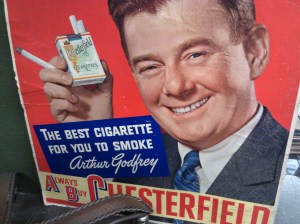 In his November 14, 2016 Financial Page article for The New Yorker, “What’s in a Brand Name?,” a one-page gem, James Surowiecki anecdotally mentions the time Ford asked the poet Marianne Moore to come up with a name for one of its new cars. She came up with a bunch, all rejected. Sometimes, the key to naming something successfully is found in the action word sublimate. But it is called advertising. Advertisements are arguments in which attempts are made to persuade us to do something that probably won’t be good for us. So we might, for example, get Arthur Godfrey telling us what kind of cigarette is best for us. Borrowing someone’s credibility to pitch your argument is a tricky business. Scholars describe it as a means of persuasion called ethos; others may call it a slang profanity, remain unpersuaded, and know it’s best to choose your own cigarette.
“They are playing a game,” R. D. Laing opens the first knot of his Knots:
They are playing at not
playing a game. If I show them I see they are, I
shall break the rules and they will punish me.
I must play their game, of not seeing I see the game.³ It’s fall, and soon winter will come in, and most of the cafes locally will move their sidewalk tables and chairs indoors, and it will be harder walking and wandering to find a place to sit out with an espresso in what might remain of the afternoon light (in the Northwest, the world is also cracked, but in winter, that’s how the water gets in). A certain discomfort is a necessary good for some kinds of writing.
Over the past week or so we visited several cafes for an afternoon espresso at a sidewalk table in the waning light of fall, hoping for some inspiration from the general rue for a paper napkin poem. Alas, we got no paper napkin poems. But we got some sidewalk espresso music, and enjoyed a few clean, well-lit places, and took a few pics we offer here in lieu of napkin poems.


¹ From “Translator’s Note” (1964) Lawrence Ferlinghetti’s introduction to City Lights Books The Pocket Poets Series: Number Nine, “Selections from Paroles,” by Jacques Prevert, San Francisco, July 1958, Sixth Printing February 1968.
² Reed, Henry. “Naming of Parts.” New Statesman and Nation 24, no. 598 (8 August 1942): 92 (.pdf).
³ “Knots,” by R. D. Laing, Vintage Books edition, April 1972, page 1. Originally published by Pantheon Books in 1971.
-
Still Life
On the table a yellow
bowl
green apple
red pear
fuzzy pink peachblue-green ba
nanaAll
as verbless as
the bibelots all
in nice rows of yore
Nana’s touchless
glassed shelf. -
Deep-seated
near the chair
wear and tear
consonant careDrill root canal
fill with sapPull with hand held pliers
Palaver with prayerwhite bib
with metal
dental clipsAugh! Augh! Haircut at the barber’s
another chair
alt formof chair palaver
and prayerwhite apron
neck to kneesstare ahead an acolyte
moving
chair to chairmold to mold
meal to mealmeasure
for measurestool to stool. At the beach
chairs open
to the waterumbrellas fill the air the wind offshore beach chairs deep-seated in warm sand. At the dark food carts the loos busy a line of heirs await thrones at the top of each loo a lantern flares. Sit still. -
How to Fix a Broken Heart
 It is easy to get lost in the hospital. From the main artery grow several asymmetrical wings rising to varying heights. When one of the two main artery elevators opens, the landing pad presents an unexpected reception area, depending onto which floor you alight.
I had thought room 3217 afforded a view of the Hope and Healing Garden, but over the week, as I wandered about on visit breaks, I realized it wasn’t the garden I had seen on the hospital floor-map, but just a breezeway between wings, an alley, really, of a horizontal line of maple trees rising vertically above a trapezoidal space created by three wings. One of the nurses said that when she started at the hospital, those trees were only a few feet tall. I was reminded of the William Carlos Williams poem,
Between Walls
the back wings
of thehospital where
nothingwill grow lie
cindersin which shine
the brokenpieces of a green
bottleWilliams found hope and healing where he could, and here between walls grow beds of dark green, glossy ivy, out of which grow the spindly maples.
On another walk, taking another breath break, I discovered the Meditation Garden, an open air courtyard enclosed by hospital walls. The Meditation Garden was quiet and relaxing, with a variety of benches and tables for sitting and if lucky, meditation. But I thought of the little book “How to Relax,” by the Vietnamese monk Thich Nhat Hanh. Meditation is not what you might think; it’s more about what you don’t think. And, Hanh says, you don’t need a special garden, mat, or incense to meditate. You just need to relax, and breathe. I get that, but still, the Meditation Garden is a good hospital getaway space.
There were other places to chill out: outside on the grounds; the cafeteria; the Pavilion lobby was very pleasant; the LivingWell Bistro; the chapel. I liked the chapel, but was a bit put off by the giant mural of a long, blond hair and blue eyed Jesus. Susan has blue eyes, and her hair was once beach blond. I think Jesus’s hair must surely be grey by now, if he hasn’t pulled it all out.
Another day, I found the Hope and Healing Garden, but I couldn’t get in. I saw a tree growing over a circular brick wall, and I tried to find a way into the garden, which I could just barely see through a door window across an aisle and though another door window.
As I was writing that last sentence, in my pocket notebook, sitting comfortably in the digs of a spiffy waiting room lobby area outside the vegan LivingWell Bistro, an immense amount of new and fascinating technology was wandering Wi-Fi-like through and around patients, taking blood, artery, vein, and heart pictures. I had a glimpse of the imaging room from the hall just before I came out to sit here to wait: clean and sparkly, the four imaging technicians in starched blue scrubs, and the cardiologist, an ancient oracle, about to reveal obscure things that live behind screens.
On a slide show screen on the wall in the lobby, across from the waiting area couches, I could see photos of the Hope and Healing Garden, and reading the slides, discovered the garden has limited access. It’s for mental health patients.
I’ve been waiting almost two hours now. The oracle should be coming through the big set of automatic doors soon.
It’s hard to fix something that is a work in progress. The heart is a jalopy, constantly under repair; a fishing barge rising and falling with the tides, taking on water; a yo-yo with a broken string, a bicycle with a jumped chain, a stew of recycled images.
The gods make contact with the humans through the oracles. The people want miracles, but the gods grow jealous of the oracles and humans and make mistakes. What a strange way for a god to behave.
The modern god likes to hide. Like Tolstoy said, he sees and knows but waits, while humans, as Gertrude Stein remarked, inside, are always the same age. But I’m not sure about that. As Cornel West said, time is real, and we can’t break-dance at 70 like we could at 17. Or surf. But Isaiah said:
He giveth power to the faint; and to them that have no might he increaseth strength. Even the youths shall faint and be weary, and the young men shall utterly fall: But they that wait upon the Lord shall renew their strength; they shall mount up with wings as eagles; they shall run, and not be weary; and they shall walk, and not faint. (40 KJV)
And they shall be reborn and breathe again? Where is this Lord when you need him? Surely he must at least be weary of request after request after request. What else do people give him but requests? To fix your heart, he says, call a plumber. He gives you what you need, never what you want.
-
Notes on Types of Poetry
- You look at something you believe should be familiar but see something else, something unexpected. A moment of confusion, you are given a start, seeing something new or strange, out of place or off kilter, in place of what usually passes practically unnoticed. Some like that feeling; others do not. But the feeling, whatever it is, passes. You dismiss the experience as a kind of déjà vu as what you expected to see comes into focus and the other vision, the mirage, the mistake, disappears.
- That night, you dream of a chess game, even though you don’t play chess. The chess pieces are friends, neighbors, and relatives. The Queen is a woman who walks by your house daily but never says hi. The King is the friendly dog from across the street, always happy to see you. The Knights are kids riding bicycles. The Castles are bell towers full of birds over empty churches. The Pawns are corporate employees you once supervised, riding a desk all day in a building of sealed windows. In those days, you used to dream of getting up from your desk and throwing open a window, a breeze of fresh air blowing all the papers off the desks, creating a ruckus. You are called down to the Personnel Department and summarily fired.
- You learn a new word, eggcorn. Slips of both the tongue and ears. You make a list of words you frequently misspell, fold the list, and put it into your Moleskin pocket notebook. You save the Moleskin pages for poems that never come. A week later, the Moleskin still empty, you take out your list of frequently misspelled words and throw it away. You make a new list of words you often mishear or mispronounce. You think of getting a dog and naming her faux pas.
- The plumber arrives to fix the pipe that froze in last winter’s silver thaw. Something about him smells familiar. It’s a stale beer odor. It’s late afternoon, a hot summer day, and he must have been out at lunch drinking beer, perhaps in the lot of food carts located down by the creek at the bottom of the neighborhood. You look into the back of his van. An old blue and white striped mattress lines the floor. The sidewalls are cubbyholes full of tools and plumbing parts.
- The power has gone out again, another rolling summer blackout. You light a candle. The phone and Internet are also out. You think absurdly of walking down to the corner to use the pay phone – the pay phone was taken out years ago. The evening is dark and quiet and peaceful, and you decide this is your favorite kind of poetry, the kind that creates a still clearness, and the stars are like rocks on the floor of a shallow, smooth running stream that ebbs and flows with the salt water tides. Suddenly the power comes back on, the fan spins, the radio blaring, the streetlight flooding through the open front window. A door slams. A car starts up. The lights flicker indecisively. Blackouts are only rarely epical.
- A young woman knocks at the door, a canvasser. Lonely for someone to talk to, you invite her inside. You make tea. Her skin is like parchment, full of colorful tattoos, pictures and words. And she has piercings, one in her upper lip, another in her ear, and a tiny diamond on the side of her nose. Her eyebrows are painted black shellac. She comes quickly to the purpose of her mission: she is selling low cost cremation plans. If you buy now, pre-ordering, before you die, you save lots. She’s already been able to help several of your neighbors. Your block is a gold mine of old people.
- You’ve the kids for the day, to babysit, day care. You get out large, thick sheets of brightly painted paper. Everyone takes a pair of scissors and cuts alphabet letters out of the sheets. You string the letters together with clear fish line and hang them from the ceiling with thumb tacks, creating slow moving mobiles that say different things depending on the breeze coming through the open windows. Everyone lies on the floor with pillows and blankets, watching the letters turn this way and that, reading aloud new words that appear.


 The Coming of the Toads