Category: Poetry

  • Alma Lolloon: 5th Installment of Work in Progress – Epigraphs

    The novel “Alma Lolloon” opens with two epigraphs, both of which serve the ordinary purpose of the epigraph but are also part of the fiction being created. In each, the original is given, followed by an “interpretive translation” by the narrator of “Alma Lolloon,” who is Alma Lolloon:

    Experience, though noon auctoritee
    Were in this world, is right ynogh for me
    To speke of wo that is in marriage…
    But yet I praye to al this compaignye,
    If that I speke after my fantasye,
    As taketh not agrief of that I seye,
    For myn entente nys but for to pleye.

    from Chaucer’s The Prologe
    of the Wyves Tale of Bathe

    What atrocity this insult of experience
    As if somehow right for me and all
    Wode talk woe of the marriage camp.
    But complain not in present company,
    For all tales told in pitiful woe
    Tell not a whole story
    If want is not to please.

    from interpretive translation of Chaucer,
    by Alma Lolloon, 1966

    Die Erste Elegie

    Wer, wenn ich schriee, hörte mich denn aus der Engel Ordnungen? und gesetzt selbst, es nähme einer mich plötzlich ans Herz: ich verginge von seinem stärkeren Dasein.

    from Duineser Elegien by Rainer Maria Rilke

    The First Elegy

    Who, if I cracked my little mouth, would listen to me in the din of rules of angels? And quickly so near his heart home of pounding hammers, sparkling nails, and gargantuan waves, I would fade in the muscle of his gaze, or in the back seat of his dark ride.

    from Duino Elegies, interpretive translation of Rilke,
    by Alma Lolloon, 1996.

    I’m still working on editing and proofing and design.
  • Plein-air on Mt Tabor

    Plein-air on Mt Tabor

    Late summer in the Northwest finished hot and dry, smoke and ash drifting from the wildfires drizzling down onto our outdoor evening tête-à-têtes in the city. The Gorge fire was the closest to us. Ash blew with the east winds and if windows were left open you awoke with ash on the sills and furniture and floor. Down south one of my brothers and his family were safe but dramatically affected by the wine country fires. Now in Portland we’ve had a few days of sweeping rains, and suddenly flood alerts replace air quality alerts, but today is a lovely fall day, and I took a walk through Mt Tabor Park.

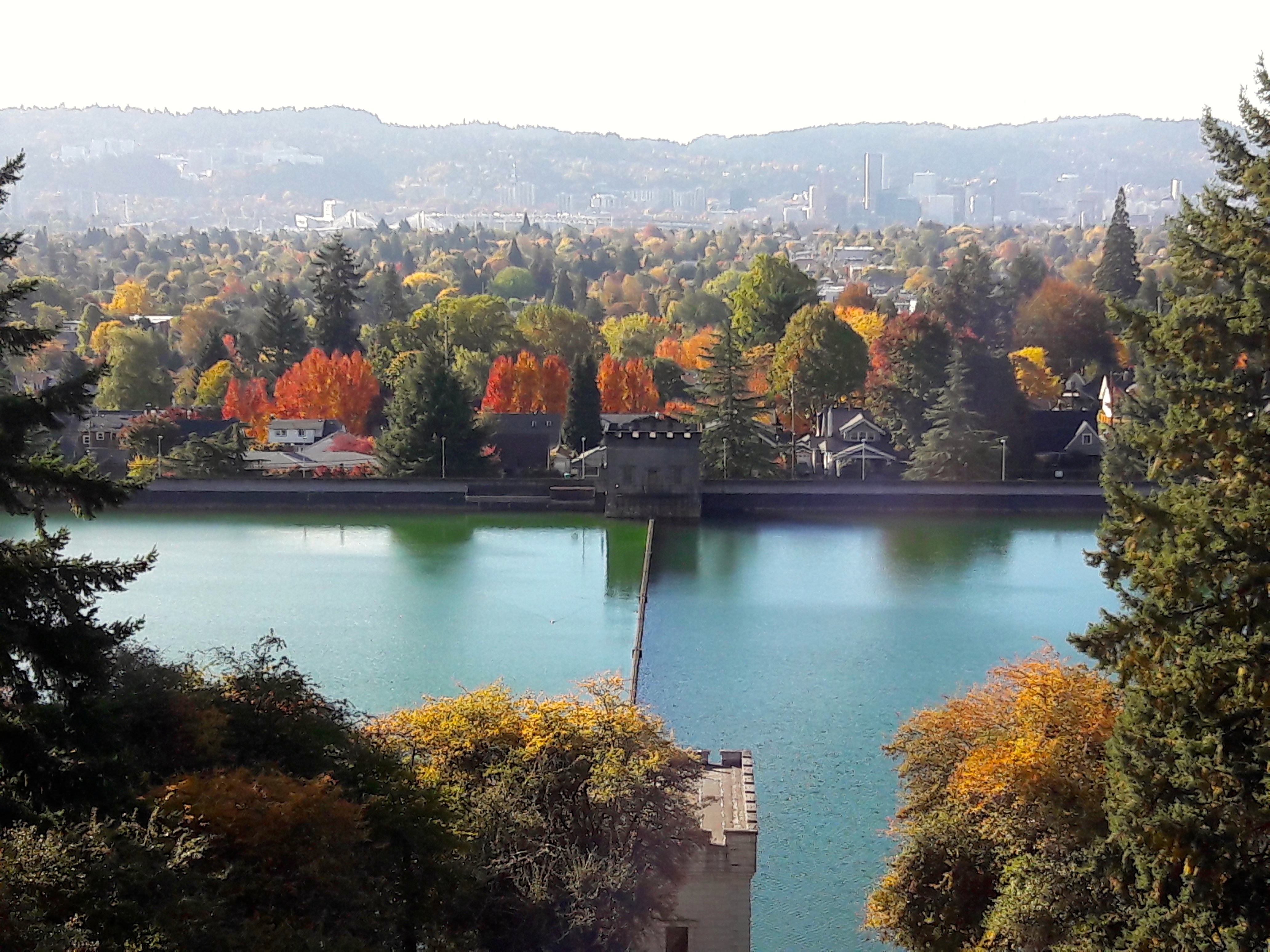
    I wanted to walk in the sun, so in the afternoon I climbed over to the road above Reservoir Number 5, around its south end, to the flat road up above Reservoir Number 6. I stopped to take a picture overlooking the water, across the Hawthorne neighborhoods to the city and West Hills beyond. Now walking north, I noticed an artist standing at an easel, working.

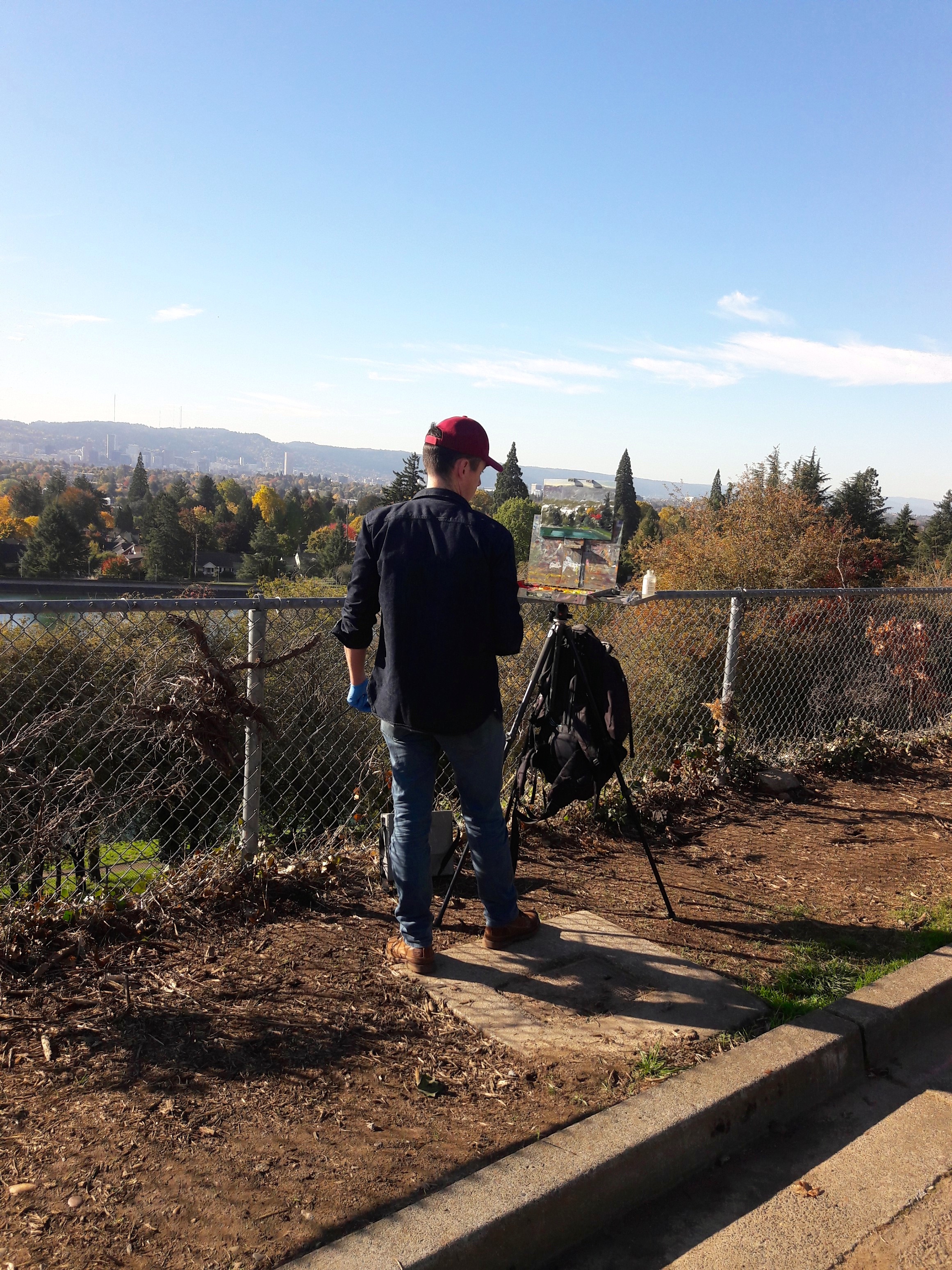
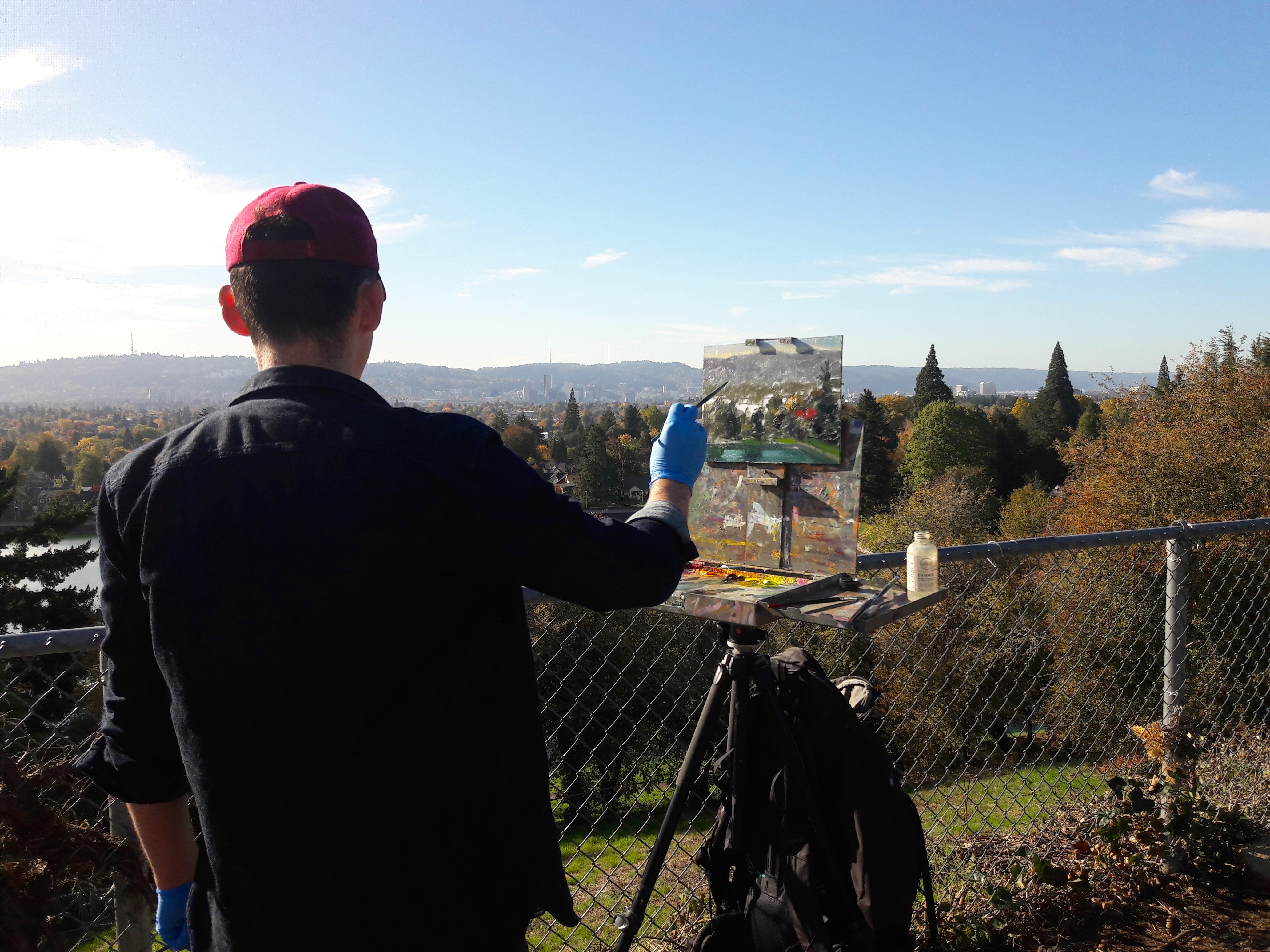
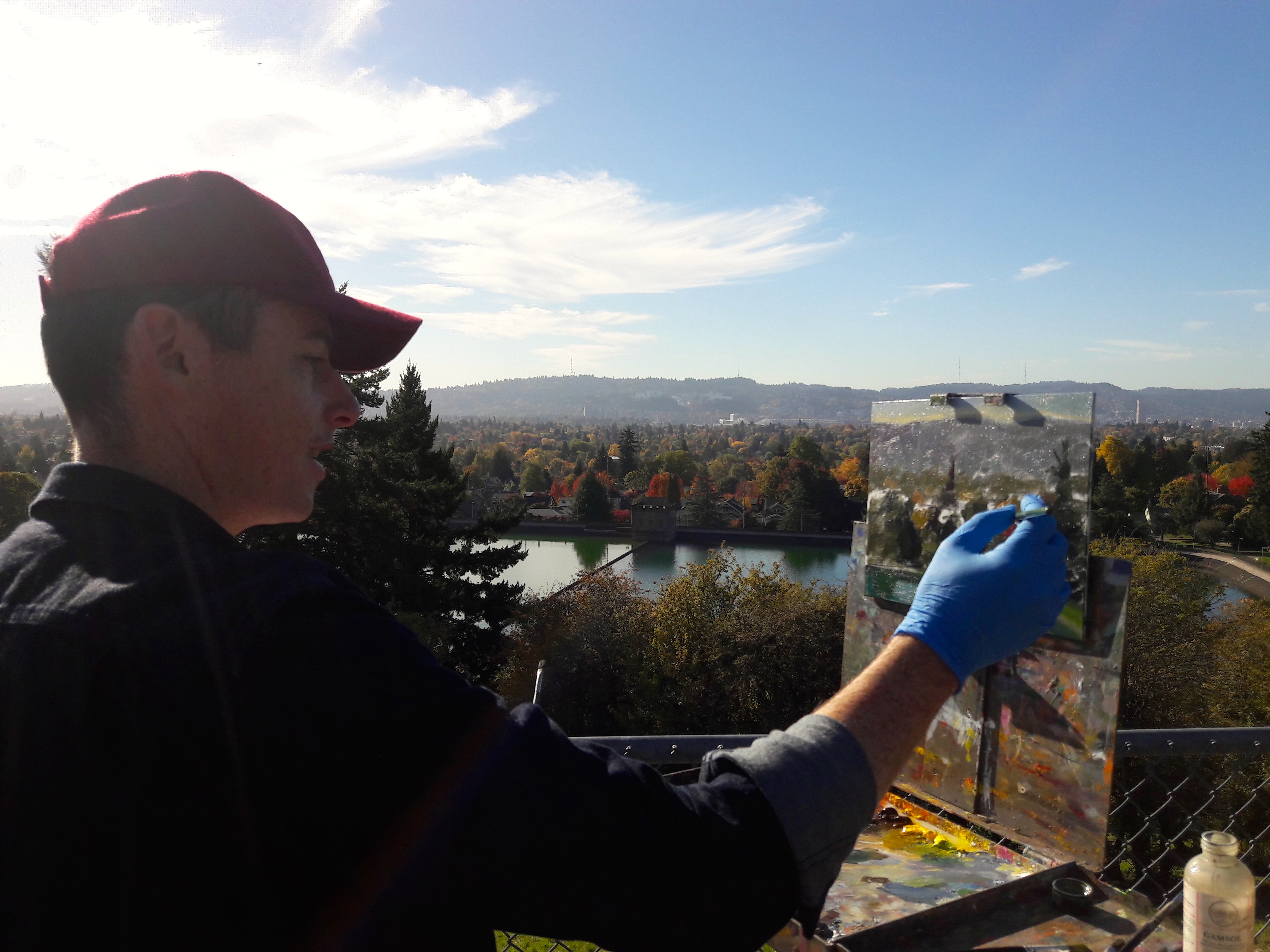
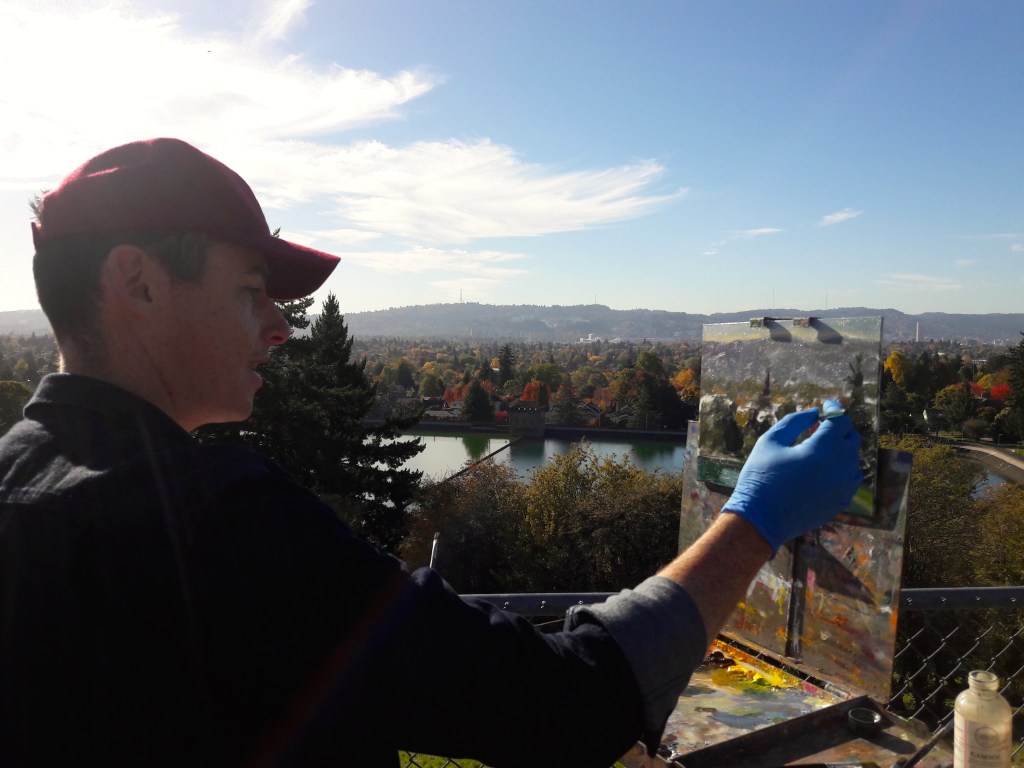
    I took a few pics of him working and got his permission to post them to my blog. The artist is Jonathan Luczycki, who paints in the plein-air style, which means he paints outdoors and tries to catch the light and colors, shadows and shapes, of a particular moment, before that exact image changes and is lost forever. I thought to myself, “This guy is a poet who paints.” Jonathan explained the plein-air artist must work quickly before the moving lights and colors change. It strikes me as a very physical kind of painting. Because of the speed with which they must work, the plein-air artist canvas is often smaller in size.

    Painting from a photograph will not produce the same effects the plein-air artist achieves. For one thing, a camera rarely captures true color (indeed, what even is “true-color,” when we all see things so differently). More importantly, the camera is too quick, works too fast, freezes the image. The plein-air work breathes, catches subtle changes, of a human view.

    I talked with Jonathan for just a few minutes, and he continued to work as we talked. But he was personable, friendly, outgoing. That is the beauty of working outdoors. I promised myself I will get back to writing some sidewalk cafe poems, some plein-air poems.

    looking west over Res 6 and SE Portland 24 Oct 2017Jonathan Luczycki Mt TaborJonathan Luczycki Mt Tabor 3Jonathan Luczycki Mt Tabor 2


  • The Flags of Our Dispositions

    The Flags of Our Dispositions

    Some talk again
    about the end
    of this world
    but yr rapture
    might not be
    his rapture &
    maybe he’ll be
    happy as hops
    to see you go.

    Kneel, stand, or
    dodge the show
    weekend TV
    questions for
    the status quo
    diversion plays
    reductio ad absurdum
    the flags of our
    dispositions.

    More disposed
    to please or dis
    now a word
    from the sponsor
    who decides
    penultimately
    what is ok
    & what
    unacceptable.

    The crickets’
    crackles
    diminish
    lights off but
    sounds off
    continue
    the broadcast
    day now
    infinite.

  • Starting with No

    Starting with No

    Starting out at nine
    in search of yes watches
    synched to 21:00
    another night problem
    to hug and home by one.

    Starting out at no
    thing was ever what
    it seemed to be
    the toilet by the back gate
    not plant pot nor art.

    Starting out ending up
    in the same place

    it might have been
    most anywhere

    but here the sound plenty
    of yeses in the hibiscuses
    and sitting on the big
    maple tree branch
    all the kids ever were

    hanging out watching
    for the yeses to come
    home game tied
    one yes to one no not
    anyone scores promises.

  • Center of Totality

    Center of Totality

    Between you and the solarium
    this hottest of summer mornings
    cools a path across the countryside

    an eye floater moon receding
    in the salt tide of shrunk space
    as you wait in your circle

    rooted in angst
    for the darkness
    to dissolve.

    What old fear
    draws you here
    to this perfect sphere,

    the moon you want to see
    or the sun you can’t
    inhabit?

  • The Beauty of Prayer

    The beauty of prayer
    is anywhere,

    pewless,
    without candle or book
    or holy water.

    We can pray in a mall
    or in the stall
    on our way
    or off the wall.

    Even just the wish
    to pray, Thomas Merton says,
    is a gift of great grace.

    Pray at work,
    pray at play.
    Thich Nhat Hanh says,
    relax.

    That’s the way to prayer
    like holding a garden hose
    full of spright spray
    against a wildfire.

  • A Country Western Song, 90 Miles Inland

    I saw you come and fell to my knees,
    waves opened and mermaids sang,
    Oh, Lord, this boy’s in love.

    You opened your mouth,
    and my tongue swam in,
    church bells rang
    about living in sin,
    Oh, Lord, this boy’s in love.

    At the altar somewhat late,
    the flowers turned to wine.
    Suit and tie, to work on time,
    Oh, Lord, this boy’s in love.

    For old anxiety, my love,
    for old anxiety,
    we’ll meet again
    on time’s back porch
    for old anxiety.

    I was reading the latest
    self-help book, “How to Breathe
    in Public.” Chapter Three
    was particularly helpful:
    “Breathing with Others
    at a Garden Party.”

    Anonymous breaths
    if anyone was breathing
    no one seemed to notice
    almost like being homeless
    breathless with others.

    Bar up to the belly and down
    dancing eels in the grass
    when down at the heels
    one flights with one’s heels
    giddy the best betrayal
    their emerald anxiety.

    In an air of gnats the breasts
    pair off, pretending not
    to anticipate any boast
    guests wait & snip & go.

    In the end, but
    it doesn’t end here
    comes another crop,
    one “a retired drunk,”
    the stinger deposited
    with baby’s breath
    to question any
    possibility
    of breathing with others.

    With merit the bobbers go
    to static like a radio
    that won’t tune in clearly
    breaths of static.

    As David Tutor replied
    to John Cage, when
    asked why he didn’t
    join the others:
    “I haven’t left;
    this is the way I keep you
    entertained.”

    Just so, the well wrought
    snub, quick merciless wit bit,
    the sidewalk flight of poems,
    the thick porcelain
    urinals as big as steamboats
    sharing a pissy river,
    the old cigarettes,
    the stale ale,
    the slow morning snores,
    tugboats pulling from shore.

    We begin to envision
    an end to retail
    as we now know it.
    Nothing to buy,
    no place to go,
    we gather in a garden
    and learn to breathe
    together.

  • Body Talk

    Body Talk

    Mr. Body awoke feeling poky.
    “It’s your diet,” Mrs. Body sd.
    “I eat the same crap as everybody.”
    “Just as you say.”

    “What are those gold chains
    about their necks all about?”
    “True that. Tiffany’s on steroids.”
    “What are the qualities

    of good plumbing?”
    “You don’t hear the pipes
    growling in the walls.”
    “No leaks, but you can get

    to the pipes if you need to
    repair one without having
    to wreck the dwelling.”
    “The pipes don’t poison

    the water.”
    “Urge.”
    “I beseech thee,
    where’s the coffee?”

  • The Phenomenology of Error

    The Phenomenology of Error

    The Phenomenology of Error[i]

    A solo Mission at the Ranger Station before group poetry night, hoping
    for a good napkin poem. When we read like police we make a criminal[ii]
    shot with red pencil corrections, the poet apprehended, booked.

    Pull over the rotting rhymester! Handcuff this conceptualist clown.
    Arrest that academic asshole. Ticket the doggerel running off-leash.
    Slipknot a sleeping surrealist. Deny the pop songwriter his award.

    We might read like Mother Theresa[iii] anointing the sores of lepers,
    becoming the other for the time saving takes then letting go.
    The poverty of poets paves the way to the cornucopia of poetry.

    Line 14 stops and a pretty woman[iv] hops off in bright orange shorts.
    She’s poetry in motion[v], no idea of me, and could not care less
    what I’ve done to this napkin. For her, a perfect reader, I must error not.


    [i] “The Phenomenology of Error” is a study by Joseph M. Williams showing when we read self-consciously we do so with bias from personally invested conventions that often have nothing to do with the reality of the text at hand (May, 1981). http://www.english.illinois.edu/-people-/faculty/schaffner/Williams%20Error.pdf

    [ii] In “Seeing Through Police” (n+1, Spring 2015), Mark Greif says, “Police spend a large part of their time distributing crime to the sorts of people who seem likely to be criminals.” https://nplusonemag.com/issue-22/police/seeing-through-police/

    [iii] Mother Theresa was canonized by Pope Francis in September, 2016, amid ongoing criticism of the quality and quantity of her work with the poor.

    [iv] Any resemblance to the Roy Orbison song (1964, “Oh, Pretty Woman”), or to the Julia Roberts film (1990), is purely coincidental.

    [v] Line 14 is the Hawthorne bus. Poetry in Motion places poems on buses.

  • Summer Notes: 7 – Shoeless

    Summer Notes: 7 – Shoeless

    Discalced order of children
    running aground barefoot,
    the beach sand so hot we
    flip flopped like fish out of
    the water close at hand.

    When you did not know
    what a thing was,
    you gave it a name,
    then you knew it.

    Flip-flops went everywhere,
    named for their sound,
    rubber sole held to the front
    of the foot with a cross strap
    and thong between hallux
    (big toe, thumb of the foot)
    and pointer toe (the dowsing
    rod used to test the ocean
    water temperature), causing
    the heel (no ankle strap) to stay
    put (flopped)
    then flip up (flip),
    slapping the bottom
    of the heel,
    also went
    by other names.

    My father called those shoes
    “come-alongs,” the body
    perhaps a pulled
    object. Imagine thinking
    of the body as winch
    and ratchet for pulling
    and hoisting, but that
    was his world.
    They were also named
    “go aheads,” polite,
    easy-going, relaxed shoes.

    Thongs, shower shoes,
    simple sandals, flip-flops,
    like so many other things
    we used to use (and do),
    and may still use (and do),
    are not good for you.

    Better, it turns out,
    to go barefoot, risking
    the stubbed toe, the bee
    sting, the rusted nail,
    the beach tar, the hot
    sand, loving the cool
    green grass, the ice
    plant you could pick
    and squeeze the jelly
    juice over your callouses.


  • Summer Notes: 6 – Vinyl Eve

    Summer Notes: 6 – Vinyl Eve

    Ray on
    Polly & Ester over
    Shell lack, the beach so far
    It’s a Beautiful Day
    for the Blues.

    His story film earlier
    Text I’ll yarn
    Den I’m hep
    Woe vane
    All dyed felting.

    More hair
    Flee C
    Mad as a more curious
    hatter,
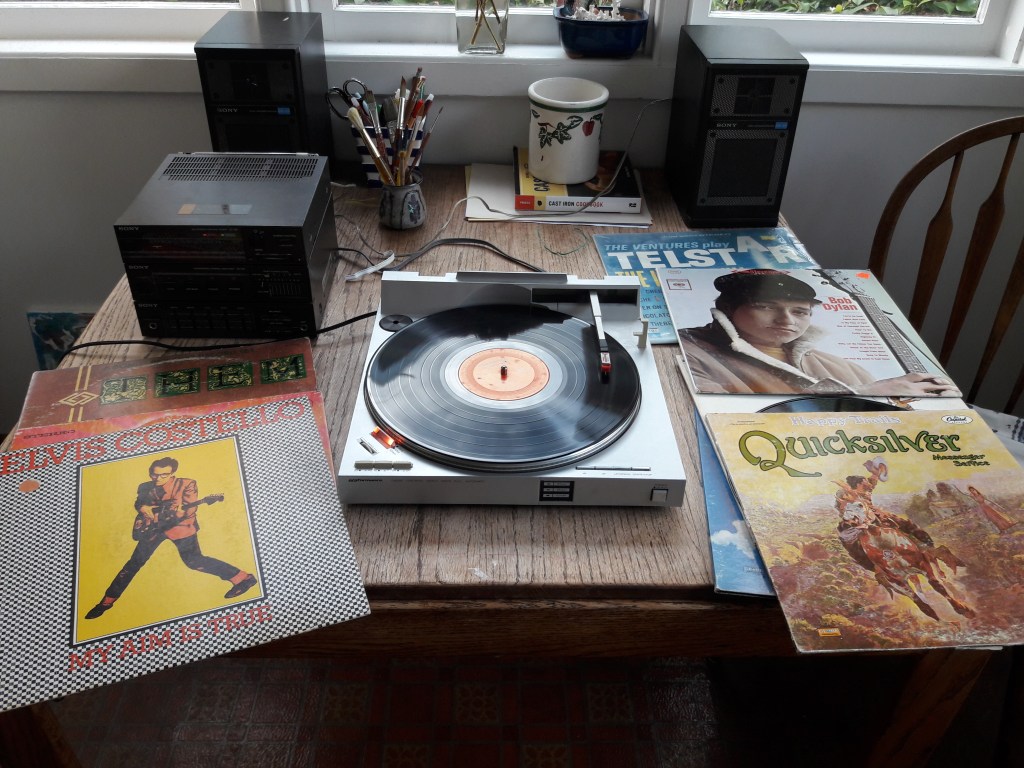
    a chord eon.