Author: Joe Linker

  • Poem Quick Start Guide

    Relax. You can do this
    anywhere, any time
    on a bus, in line
    in church, in a lurch
    alone, in a crowd
    or in the clear.

    Make a list of things
    you see and hear
    & from all the sounds
    isolate one
    give it a name
    & write it down.

    What do you smell?
    Fill in the blank:
    smells like _______.

    Lick the back
    of your hand,
    what do you taste?
    Give it a name
    & write it down.

    Keep in mind
    you’re making a list,
    don’t write
    sentences,
    use punctuation
    only if you feel the itch.

    Reach out
    & touch
    something:
    wood, plastic
    paper, glass
    a blade of grass
    your wife’s sitzfleisch
    (it might help
    to keep a dictionary
    handy – but don’t
    get lost in it).

    Add a bit of word
    picture to your list
    not too much
    just a pinch
    pebbled, smooth
    cold, humid
    sweat –
    that’s enough
    for now.

    Then answer
    the only questions
    you know
    about one of the things
    you just named:
    what does it look like?
    what sounds is it making?
    what does it feel like?
    what does your mouth
    do when you taste it?
    & does its odor cause you
    to shrink or come closer?
  • He’s No Good

    He can’t deal with a spider
    permits it to crawl away
    and he won’t listen
    to the talk of the day.

    He’s no good at fixing things
    and can’t swing a hammer
    but makes up more rules
    than the Code of Hammurabi.

    He’s moody as the moon
    and his back goes out
    monthly when it’s time
    to take out the compost.

    His idea of sport
    is TV from a couch
    but he’s too busy
    to empty the litter box.

    He smokes drinks
    goes out with the guys
    never fires up the barbecue
    and doesn’t like poems –

    well, I guess that’s good.
    He’s not much under the hood
    dribbles on the floor and can’t
    get up to answer the door.

    His name is Bromide
    he’s a politician
    a judge and legislator
    blames it all on the exec

    who tricks the will
    of the people
    into thinking just
    like him.


  • After the Rodeo

    One who behaves bears
    want and likes we hear
    called a good neighbor

    not so with old friends
    whose schisms gone
    seeded of bickernesses

    the aplomb the plums
    you ate so cool and self
    defining the sad clown

    you know well long
    after the greasepaint
    has worn to raw down

    and now we can laugh
    at the one who slipped
    and fell unexpectedly

    but it’s canned laughter
    the harmful joy
    of this rodeo

    where the cowboy
    limps away to lick
    his wounds

    in the trailer
    behind the tavern
    plays a country song:

    “I don’t know why
    I married you.
    I like you, but
    I don’t love you.

    It was just timing,
    really, and I still
    thought of you and
    your friends as boys,

    not men, the mean
    characters my mom
    went out with, and boys
    could take you away

    from the messiness of home
    at least for a little while –
    it wasn’t until later and
    too late I thought

    maybe I did love him
    but by then I found out
    it doesn’t take long
    for most boys to become

    men and now wonder
    how and who is going to
    take me away from
    this old song again?”

  • The Urge

    To bed, to bed, but quietly said,
    with a quaint taste of ardour
    and a slight touch here and there.

    To wed, to wed, a bug to brush
    away this so called love
    of the troubadour,

    whose quick amour
    one does not miss
    nor that tremendous bliss

    of crushed roses steeped
    in the gooey remains
    of a Holy Grail lost,

    whose love for itching
    broke out in hives
    along the flushed skin.

    Temperature about the same
    as yesterday,
    rhyme outlook low.
    Appears tropical
    depression here to stay.
    10 day forecast
    too far out to say.
    One never knows,
    near or far,
    but no one seems
    in jeopardy tonight
    who sleeps alone
    in a bed of stone.

  • A War with a View

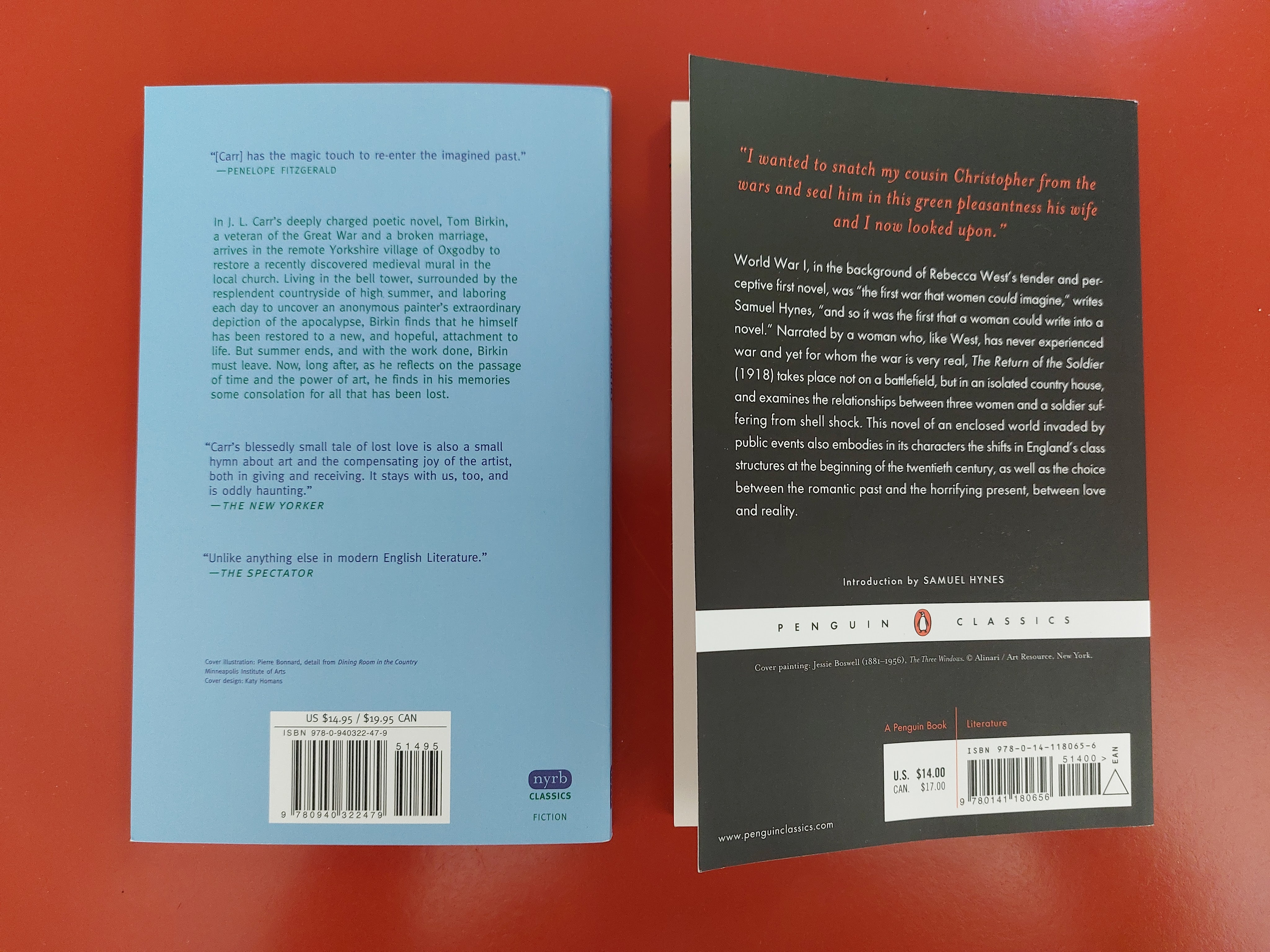
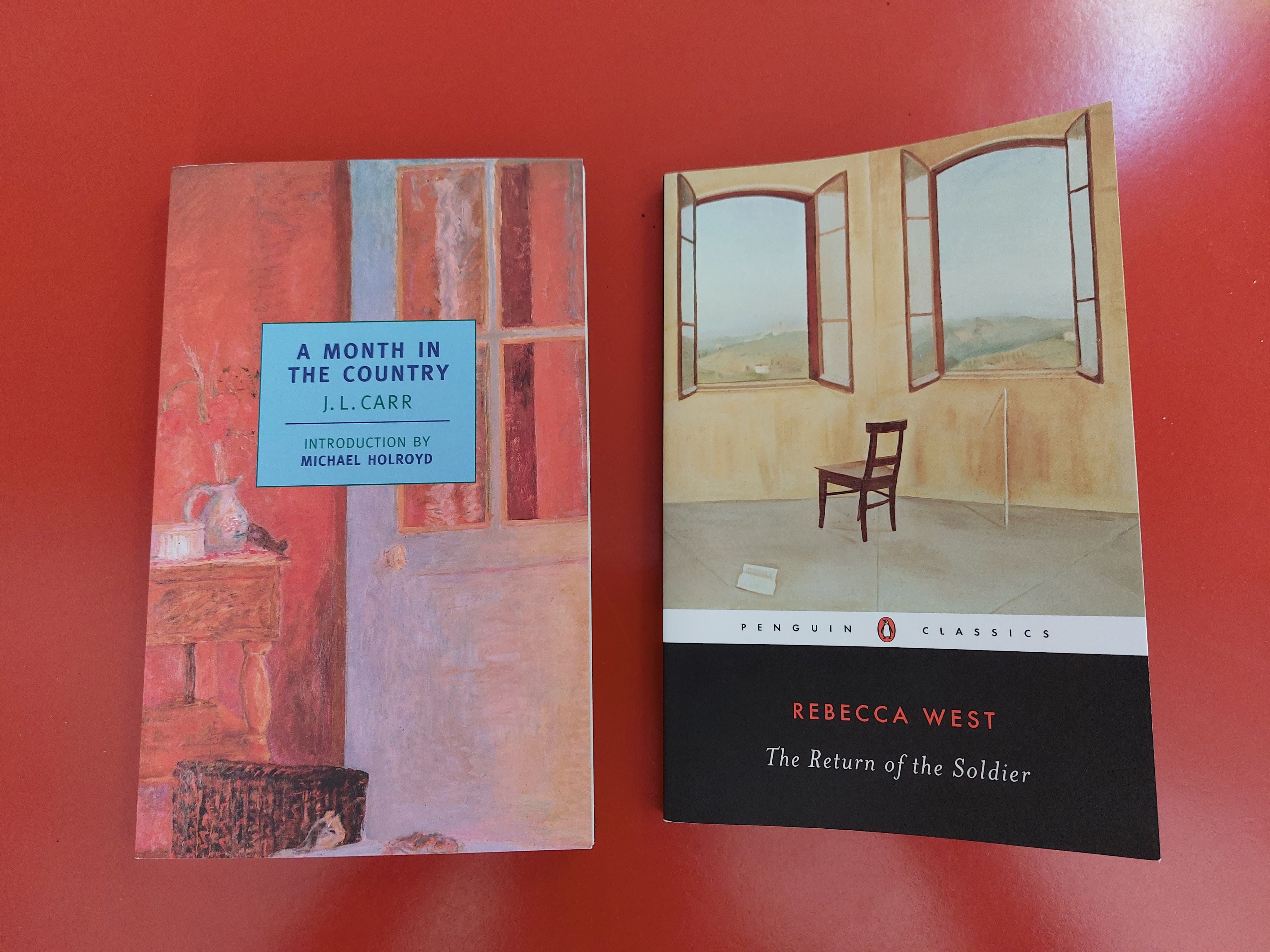
    These are two very different books, but so close in flavors and effects. Both concern a soldier recently returned home from World War One duty. Rebecca West wrote “The Return of the Soldier” when she was only 24, living with her three year old, in 1916, the war still on and in some of its deadliest and darkest hours. J. L. Carr’s “A Month in the Country” was published in 1980, when he was in his late 60’s, WW1 at that time superseded by a number of other high and mighty events.

    This is not a book review, that lockstep genre one learns in literary basic training. War narratives often exaggerate plot and action. The truth is action, if it comes at all, stops time, stops waiting, lifts the soldier off the ground or water, suspends. There is no plot to that moment. If he remembers anything of the action the memory stirs smells, sounds, touch, taste. World War 1 is memorable for its suspension of progress, the soldiers on both sides stalemated in their trenches for days, weeks, months, years, the most significant action perhaps a slow moving cloud or fog hugging the ground and when it gets to you takes the skin off your face. And of course in any war for every soldier that experiences what I am here calling action there are several others who experience only the waiting. Both experiences take their toll and can leave soldiers, whatever their experience, broken machinery.

    In any case, for the most part, these books avoid that portrayal of action, and take place in beautiful natural settings, far from any action of the war. Both returned soldiers suffer from emotional trauma, but are able to enjoy life returned away from the front. They don’t suffer from anhedonia, usually the result of not enough action. Both books are necessarily novellas, because so much has been left out. Both concern a small cast of characters in a little window of time and action out of view of the mainstream. Rebecca West has her character Jenny narrate, so it’s a first person but not the soldier returned who talks, while Carr’s book is told first person by the returned soldier, Tom Birkin. Both books are love stories surrounded by nature in lovely landscaped settings mostly unspoiled. The writing is clear and concise, natural and unaffected but poetic, impressionistic, descriptive. Both books touch on class as a theme, work, and all the trappings and dressings of diversions and social nakedness.

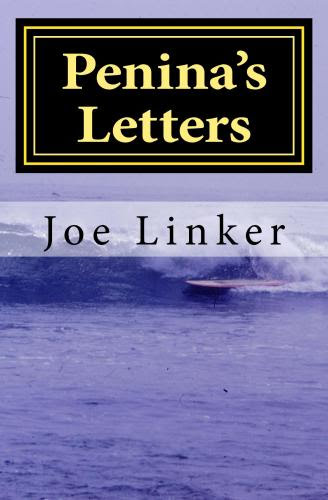
    “Penina’s Letters” too touches on those themes and uses some similar techniques to get its soldier returned story going and told, but I suppose its author may not have seen enough action, and so had to substitute satire for reality, or maybe should have relied on someone else to tell his story, Penina perhaps.

  • A Swimmer

    When selfishly young
    swimming up the waiting
    tree the melons hung out
    short tongue patient
    and the bird pauses
    in flight the voice unhooked.

    Tongues burned for fun
    and born with a bit of wit
    at last fall off
    into the bottomless pit
    where the seafarer goes
    to taste the fleshy fruit
    and with a lick of luck
    lives on but never
    tells the tale.

    We lived across a dusty tracks
    (to make a quick cliche of this)
    with the others who solely minded
    their own one on one business
    looking the other way
    and waiting the proper time
    to mow the ready hay
    and bale for the coming fall.

    Now older and just aging
    a bit here and there
    watered down and humbled
    in a room in Opportune Pass
    it’s all I can do
    to bite my own inflamed
    tongue when the urge comes
    to untie me undone
    turning and turning
    on the moontide spit.

  • Displacement

    Adrunk
    he becomes
    the drinker
    who drank him.

    Take this cup
    all of you
    and drink
    its whine the engine

    of the cat
    contemplating
    her contempt for her
    need for you.

    Adrift
    on a sea street
    starry eyed
    night
    ears black holes
    no sound
    escapes.

    And the nose tastes
    hours of laundromat fuzz
    falls a third time
    near the blue dumpster
    behind the fishmonger’s
    by the cold chain links
    in a bed of weeds gone to seed
    spreading like a hatch
    of artificial flies.

    One he swallows
    caught
    hooked through the lip
    jumps pulls and runs
    down the path
    to where the deep water
    creeps awake
    in the darkness
    its thick jelled
    mass motions.

  • Out of Season

    Barely visible
    the cat acting
    like a tourist
    out of season.

    Breeze so soft
    blow & rain shifts
    the other way
    out of season.

    In the grass melan
    choly whose happy
    sound the birds
    squirrels

    coyotes laired
    late in the park
    talk in their sleep
    out of season.

    This too out
    all up to snuff
    toffee nosed
    pretension

    a pretend friend
    bends to expose
    truth its own pretense
    out of season.

  • Nothing in its Proper Place

    Nothing is the proper place of poetry
    the nothing that is and the nothing
    that is not, to slightly misquote Wallace
    Stevens, now nothing but a book on a shelf.

    Things seem round, but close reading
    show oblong, egg shaped, ellipsoid,
    particularly in the topological poem,
    where nothing expands and retracts.

    The universe is a closed knot
    the poet tries to unknot
    to pull his shoe on without
    twisting his tongue.

    Think pretzel, which is non-trivial,
    while the poem is a wild knot,
    unable to untie itself,
    non-rational, but linked within.

    What a mess, and I can’t find
    the beginning of the thread,
    nor the ending, for that matter,
    but incomprehensible I am not.

  • Nothing, Cont.

    Speaking of nothing, Henry Green wrote a novel titled “Nothing” (1950). “Nothing” shares some of the characteristics of the early radio and television soap operas. It’s nearly all dialog; one can’t see the narrator, but the storyteller sees the reader. “Nothing” is about the nothing that is the something at the center of human activity. One forgets the narrator is watching one’s every move. From dialog only the characters are drawn, succinctly and diversely, such is the clarity of their voices – that they talk mostly of nothing is nothing. It only matters what one says. By nothing is not meant something insignificant; on the contrary – it is only through the direct encounter of nothing, where the characters are stripped of all their lies and workarounds, diversions and investments, that the essence of true life is revealed.

    Yet it’s 1948, and these “Nothing” characters don’t seem as affected by the recent war as Barbara Pym’s characters in similar settings. “Nothing’s” John, knowing his daughter Mary “was to be out of London the next forty-eight hours on some trip in connection with her Government job” (133) – but we find out little to nothing about that job or what the connection is. The war of course was an unpleasant affair, its results mostly visible in the everyday details of work-a-day life: the difficulty of finding a suitable flat or flatmate, parsing wardrobes, the reopening of restaurants as places of interest, the local church the center of social, cultural, familial life (think jumble sales, lectures, and clubs of all sorts), and the shortage of marriageable men or men with the proper attitude toward marriage. Thus stripped of diversion and meaningful advertisement these folks on the edge of nothing seem a peculiar precursor to our time when commercialism and popular culture, and the adulation of the famous for being famous and nothing more, seem to reckon yet another coming.

  • What to do

    “Nothing to be done,” Didi and Gogo bicker, essentially about what to do, like an old couple of a long suffering, loving marriage. Nature is no refuge; the one tree in their world seems sick. They can’t go anywhere, for fear of missing their appointment with Godot. They hang out and talk, express various physical complaints, visit the past, ask questions they can’t answer.

    The play, Samuel Beckett’s “Waiting for Godot,” is famously about nothing. Nothing fills the stage, informs the dialog. If they carried cell phones, their batteries would surely be dead. In any case, they’ve no one to call, and no one to call them.

    The two (often described as tramps, bums, or hoboes of some kind, clowns of some sort, lost from their circus, or stripped to being human without diversion down-and-outs) might be among the last few of a pandemic, or simply retired, their pensions just enough to enable them to do nothing but talk freely, which is everything in a world of nothing.

    It’s not easy – doing nothing. Even contemplating nothing can be a nerve-racking business, fraught with anxiety. Consider, for example, what nothing is. Nothing is what is not. In the beginning – well, just before the beginning, all was nought, and from naught came all.

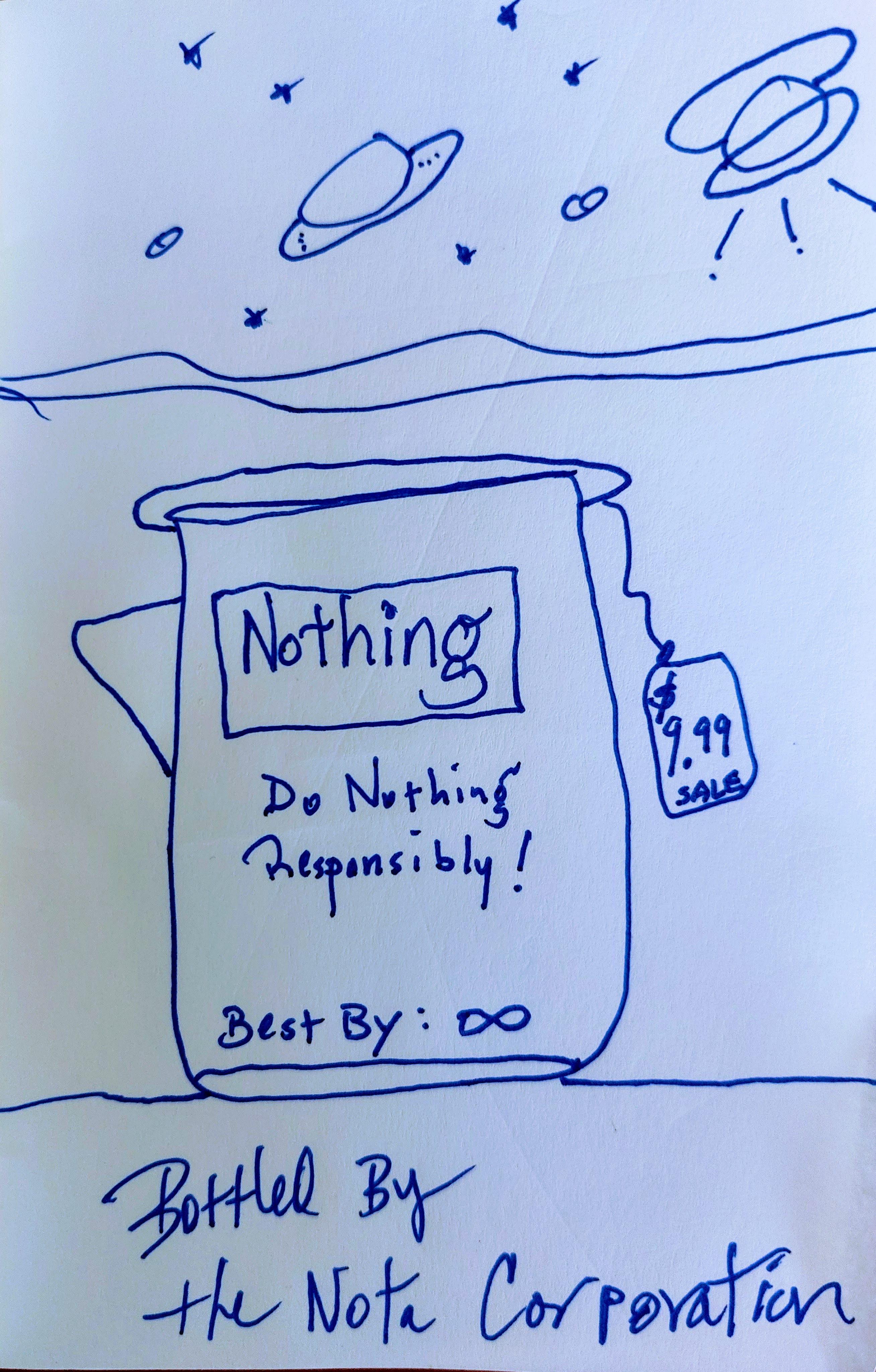
    And it’s not easy doing nothing responsibly. nān thing. And yet, if you make a practice of it, you are called a do nothing. But there is no such thing as nothing. Nature overkills. If the universe is infinite, and the universe is composed of things, there can be nothing within, and nothing without.

    Consider a bottle out of which you suck everything, leaving nothing, and you cap it, a bottle of nothing. Would it be dark in there? Like dark matter? For if everything is taken out, light too must be absent. If scarcity creates value, what could be more precious than nothing? And Didi and Gogo are its brokers.