Author: Joe Linker

  • Simple Studies # 3

    Rapidly: Or As Fast as You Can
    
    Dock da do yes tin toy cheese gig gas go  
    inch arch hip zone scraunch beam coo boo bass ball bell 
    
    Fish milk jump bowl thrutch boast screech no oil roof 
    nail lip arch moon crawl drift dig gag gear voice 
    
    Beam damp rain inch hep silk sparse scrooch sour neat 
    Cry egg bee boost zoo pee bot chop chill drink 
    
    Deem dress kiss be moo ba oak mouth nest peach 
    bald air calm gog lunch poem here now be it said cut 
    
    Bath peace game sleep shy tone boot bike dust dew 
    leaf mold mad merge fruit fly thick toe hoe mow oh ho  
    
    Cheat dum sheet awk guide dum read coop rope spring 
    Near leg far soft flesh scar how can you tell 
    
    Down then turn whole work wide tool toss 
    Wet watch beach bow bow. 
    
    
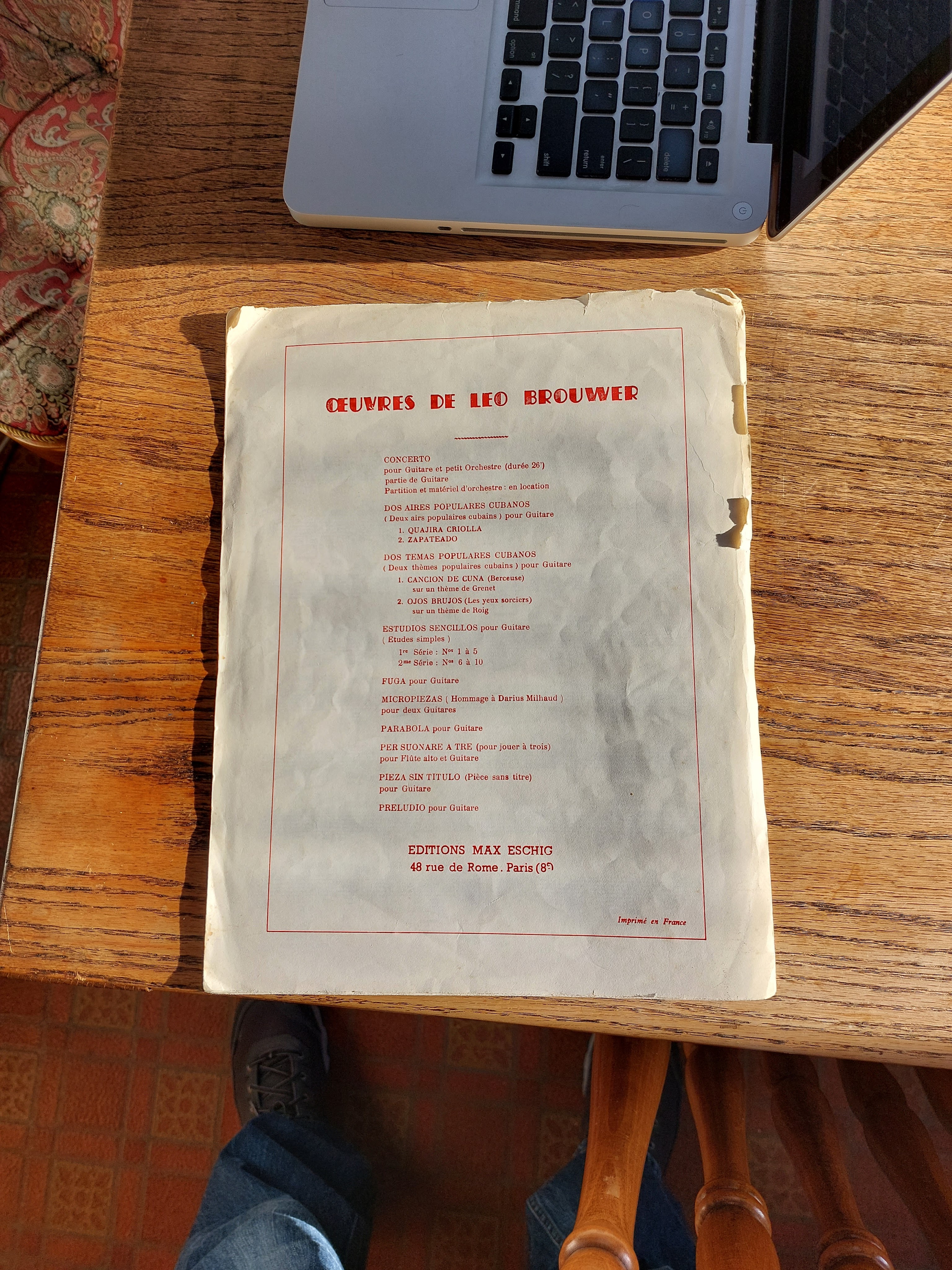
    (being a transcription 
    of Leo Brouwer's 
    Etudes Simples #3)
  • Simple Studies # 2

    Slow, but not lugubrious
    
    [wait a moment]    here   now 
    here    nut     classical 
    here    nut     spring all 
    spring sound spring now now 
    here    there   tuned tuned 
    tuned   a boat a 
    slow  turn ing 
    where   there   fingering 
    good    soil    try try 
    sharp   nut     dampening 
    rose    nut     here there 
    rose    nut     sharpening  
    rose    nut     roseate 
    there
    
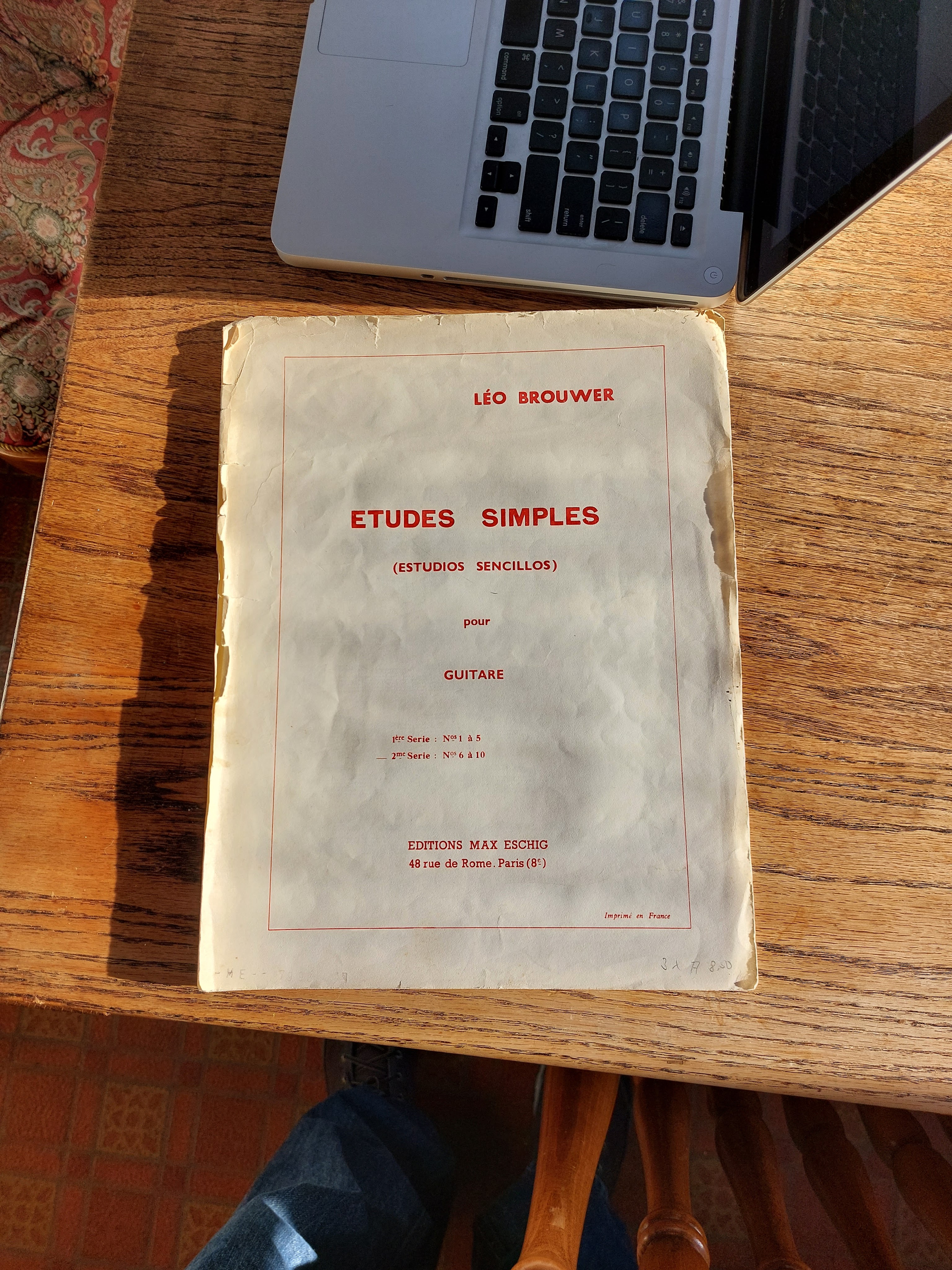
    (being a transcription 
    of Leo Brouwer's 
    Etudes Simples #2)
  • Simple Studies # 1

    Fast, but not as fast as possible
    
    plonk glunkglunk dank glunk dank dink glunk 
    ink glunk blat app glunk cat glunk blat 
    plonk glunkglunk dank glunk dank dink glunk 
    ink glunk blat app glunk cat glunk blat
    
    plonk glunkglunk cat glunk plonkplonk glunk 
    cat glunk plonkplonk glunk cat glunk blat 
    plonk glunkglunk cat glunk plonkplonk glunk 
    cat glunk plonkplonk glunk cat glunk blat
    
    plonk glimpglimp glinkglink appapp gat 
    gat glimpglimp glinkglink appapp dank 
    dank glimpglimpglimp  dling dling dling 
    plonk drankdrank cat drank plankplank 
    
    dlink dlonk ackack dlunk cot drink plank 
    flonk dlonkdlonk drank drank ackack cat 
    cat drankdrank ab ba blat blat plonk 
    plonk dlonkdlonk cap drip drip 
    plunk dripdrip cap drip drip 
    
    plonk glunkglunk dank glunk dank dink glunk 
    ink glunk blat app glunk cat glunk blat 
    plonk glunkglunk dank glunk dank dink glunk 
    ink glunk blat app glunk cat glunk blat
    
    plonk glunkglunk cat glunk plonkplonk glunk 
    cat glunk plonkplonk glunk cat glunk blat 
    plonk glunkglunk cat glunk plonkplonk glunk 
    cat glunk plonkplonk glunk cat glunk blat
    plonk glipglipglip  glip    glip
    
    (being a transcription 
    of Leo Brouwer's 
    Etudes Simples #1)
  • Between Train and Town

    There’s nothing to fear
    said the son of King Lear
    but the mode of being
    sidesteps what’s seen.

    The trains towned being
    the question put to citizenry
    between the time this train
    pulls out and the next.

    To inquire after acquire
    after all who will refuse
    walked in the waste of time
    like a gerund absent his ing.

    This is but a stub
    no answer here
    but yore context
    cud be helpful.

    One forages
    another forges
    both rant and run
    day in night out.

    The question from above
    having to do with what to do
    between trains
    nothing to be done

    but eat drink and be merry
    avoid dairy in your dotage
    save the food for the hungry
    water for the thirsty

    words for the wise work
    for the restless wagon
    for the weary to do
    and see in Petty France.

  • One Night on the South Bay Strand

    I walk past Willy’s Wine Bar, its surf blue
    umbrellas hung over the wall, pointing
    to the water, patio piano
    jazz diminished by the incoming tide.
    The noise crashes, a wave through pilings.

    Mabel, the waitress, I used to know her,
    does not say hello, busy with cheese plates,
    her white apron purple stained thin cotton,
    her silver hair held behind her long ears.
    Years younger the torched sommelier tattooed

    head to toe oranges and lemon yellows
    over a bed of ivory azure.
    Happy she looks even joyful against
    brave Mabel’s bluejeans rustling all night long
    amongst the grape aficionados.

    A line for a table, fifty dollar
    cover charge, and Komos, a cruel bouncer,
    pushes me along to keep clear the Strand,
    where people still adhere to atmosphere
    of theatrical scenery, putting

    off the real ocean as it floods the set,
    rising up the old dunes to the green palms,
    centurions on display bend and sway,
    the Sergeant of Police, “Tarantara”!
    recalls the popular air of pirates.

    The ocean recedes and Mabel soon swoons,
    soldiers in pirate costume sing cadence:
    “Tarantara!” When danger is afar
    leaves its deepest scar and never comes close
    to the body but the mind’s eye closes.

  • Li Po’s Restless Night: Improvisations on a Theme

    Florence showed me what she called the most famous of Chinese poems. She had made her own translation from a Chinese language newspaper clipping. The poem was accompanied by a cartoon-like drawing of a man lifting up from a cot, the moon in his face and eyes, the moonlight coming through an open window and shining on the cot and a bedroom floor. Florence explained the poem to me, and wanted me to help her work on her translation of the poem into English, and we enjoyed sharing language lessons. For some time after I left the school, I kept in touch with Florence, but it’s been many years now. I used to hear from her every Christmas; she would send me a long, handwritten letter in impeccable penmanship and flawless English grammar, and usage and sentence structure, and ask me to “correct” the writing for her.

    I knew the Chinese poet, Li Po, who wrote the original poem. The poem has been variously translated to describe the speaker awake at night, or awakening, thinking, far from home, or perhaps far from the past, thus perhaps rethinking the past, or what we call remembering, or reflecting. The poem might suggest a bittersweet homesickness; a longing. Usually, in translations, there’s moonlight and frost, one mistaken for the other in the night, and a mountain and a moon, a confused awakening at night with thoughts of home. Just as the moonlight is mistaken for frost, the setting is mistaken for home. Or perhaps there is no mistake. The speaker awakes, and then drops back to sleep and dreams of home. Florence said that most Chinese of her generation would recognize the poem. She invited me over to her place. She wanted to present me with a few books. The books were old and travelled. One was titled Chinese Phrase Book, published by the War Department and dated “December 10, 1943.” Another was titled Chinese Military Dictionary, also published by the War Department and dated “26 May 1944.” They were military vocabulary manuals, small enough for a foot soldier to carry in a pocket. The word poem was not included in either one.

    I first met Li Po in a Chinese literature in translation class at Cal State Dominguez Hills. One of our texts was the first Evergreen edition (1967) of the 1965 Grove Press Anthology of Chinese Literature: from early times to the fourteenth century, edited by Cyril Birch. I still have this book, but Li Po’s poem about the moonlight and frost and thoughts of home is not included. It is included in Robert Payne’s The White Pony: An Anthology of Chinese Poetry From the Earliest Times to the Present Day, Newly Translated (1947). The translation Payne includes of the Li Po poem is the only one I’m aware of that mentions a “couch,” and the speaker’s thoughts are of the “earth,” not explicitly of home. It’s possible to read that the speaker is sleeping outdoors.

    Florence inspired me to begin writing a series of variations on the theme of Li Po’s poem. I called them “improvisations,” to give a more clear idea of the method of composition, and to suggest my interest in jazz and John Cage. I started the variations, or improvisations, after I left my full-time position at the school where I had met Florence for what the Chinese poet Han Shan called the “red dust” of business (see Gary Snyder, below). And during my red dust years, I worked the Li Po theme into over 100 variations, adding to and reworking the lot of them several times over the years. Florence was very interested at the time in my decision to leave teaching. More, she was concerned. She rode the bus over to my place to visit.

    Business jobs often take would be poets on the road, on one-night- or long stays in motels, where the travelling businessperson might learn something new about night thoughts and remembrance.

    I do not speak or read Chinese, but I remember a few of the insights Florence gave me into the character of Chinese writing. Poetry should be an everyday occurrence, not necessarily a scholarly effort or something for a classroom, but a habit of mind, like a simple melody one might hum to oneself while pulling weeds in the garden, or like random thoughts while drifting off to sleep, the kind that turn into dreams, where memory is mixed with the present, and ordinary happenings, like a blanket slipping off the bed, assume momentous images, like running up a beach to escape a giant wave.

    This poetry as a habit of mind might resemble the kind of poetry the Chinese lived with when writing and reading poetry was commonplace. Poems were written, we learn from Gary Snyder’s translation of the Lu-ch’iu Yin preface to the poems of Han-shan, “…on bamboo, wood, stones and cliffs…on the walls of people’s houses.” Li Po is not included in either of Kenneth Rexroth’s One Hundred Poems from the Chinese books. Rexroth seems to have preferred Tu Fu. The Li Po poem Florence taught me is included in Arthur Cooper’s Penguin Li Po and Tu Fu (1973). I also have in my library the Seaton and Cryer Li Po and Tu Fu: Bright Moon, Perching Bird (1987), which includes the Li Po poem; Vikram Seth’s Three Chinese Poets (1992), which includes the poem under the name Li Bai, which may more closely approximate the Chinese pronunciation of Li Po’s name (and Seth’s is the only translation I’ve seen to use the word “hoarfrost”); and Eliot Weinberger’s The New Directions Anthology of Classical Chinese Poetry (2003), which includes two translations of the Li Po poem, one by David Hinton and one by Ezra Pound.

    Florence used the newspaper drawing to help explain Li Po’s poem to me, but it seemed that she read the drawing in almost the same way that she read the poem written in Chinese that appeared in the newspaper next to the drawing. The drawing may have been a kind of prose paraphrase of the poem’s Chinese characters. How many poems do we know whose essence can be depicted in a drawing? In any case, Li Po’s poem is clear and concise enough that most of the translations vary from one another only slightly and with little contradiction. This is not true of, for example, the Tu Fu poem also about night thoughts. Rexroth gives us, “My poems have made me famous…”; Hinton, “…How will poems bring honor?”; and Seth, the seemingly contradictory, “Letters have brought no fame.” But if we had only the drawing depicting the Li Po poem, our interpretation would be limited, a different kind of reading experience.

    Florence’s reading suggested blending image and cultural artifact. Still, the experience is limited by distance, by the exercise of translation, by the evolution of vocabulary, by forgetfulness, and by the confusion created from metaphor. There are two urging metaphors in Li Po’s poem. One likens moonlight with frost; the other compares a present setting with one absent or past. The relationship of the two metaphors was important to Florence’s reading. Fall term had just begun, and it was clear Florence was thinking of home in a variety of contexts. It was clear she had experienced Li Po’s poem.

    How might today’s readers experience the Li Po poem in their own lives, rather than making a study of it as an example of Chinese literature? We might discuss the idea that informs the poem, perhaps an effective and efficient way to both experience and study poetry, as Kenneth Koch suggested in his book Rose, Where Did You Get That Red?, written from his experience teaching what he called “great” poetry to children in New York City schools. After getting the idea of the great poem, Koch’s students then wrote their own poem versions illustrating that idea. One idea that might be found in Li Po’s poem, of an awareness that comes to one in the present time of something experienced in the past, is surely a common occurrence, which might explain the popularity and longevity of Li Po’s poem. Another idea found in Li Po’s poem is the common experience of awakening and initially forgetting that we fell asleep not in our own bed. That we live in an age where many of us have neither the time nor the inclination to be reflective merely accentuates those times when, falling asleep away from home, we are awakened by the illumination of some foreign light, but in our sleepiness, we might easily confuse the light with some other light, or our current bed with some other bed.

    My original poems that were variations and improvisations on Li Po’s poem were handwritten in a pocket size, blank book. I reached one hundred handwritten variations, and I started to type them up. I went to one hundred and one. One hundred and one seems excessive, but an excess I fancy Li Po would have approved. I’ve continued to make changes, mostly minor but some major, to date. But I have kept to the order of the original little notebook. The variations do not follow a literal chronology, for the memory knows no order, at least mine doesn’t. My strategy was to write in a way that would be accessible to the general reader, and while the variations are personal, most if not all of them should be as easy to reach as Li Po’s original poem. The Chinese poets were artists in drawing as well as in writing. I have had only to write; yet I hope drawings are suggested. I used the word theme because I like the idea that thesis states and theme explores, and I’m more interested in exploration than statement. And so the variations continue to explore the theme Li Po set up so long ago and that Florence gave to me, long ago, now, also.

    But we live in the Late Irony Age now, and the age is collapsing upon itself, and our quiet night thoughts may begin to assume more bizarre variations in forms of remembering home. I now imagine a graphic novel, “Li Po’s Restless Night,” yet another variation. Two characters now occupy the little cot. One, lifting up in the moonlight, in the first panel, says: “Near my bed moonlight spreads silver paint across the bare fir floor. I fall back to sleep, far from the warm dunes of home.”

    In the second panel, both characters are now awake, the moon throwing the bed in shadowed relief, the drawing stark, black and white contrasts: “If you had not fallen asleep so drunk, you would know the difference between moonlight on the floor and frost in the grass.”

    Third panel: “I awoke with a clear mind, wind through water. This would not have happened were I in my own, sober bed. Listen, it’s the waves rising down in the cove. No! It’s the train rattling across the trestle. No, still, it’s the cold wind in the pine grove.”

    Fourth panel: “Go back to sleep. It was your own stupid snoring that awoke you. Quit thinking of home. It’s all gone now.”

    Fifth panel: “I’m getting up and going for a walk. It’s what Li Po would have done.”

    Sixth panel: “You are not Li Po, nor do you know the first thing about Li Po. Get back into bed before you go out and slip on the ice and crack your stupid skull.”

    Seventh panel: “That’s not nice, and that’s not ice! That’s moonlight on the parchment.”

    It is early evening, and I hike up into the dunes above the beach that reminds me of yet another time long ago. The surf seen from the silence of the dunes curls over a few surfers still in the water in the evening glass off. What’s become of my brothers and sisters? The house is empty without them. With a flop swish, the blue waves fall below the silence of the dunes. In the back yard, a lost moon throws figures into shadows. Two figures are playing a chess game. A Ping-Pong ball clips and clops back and forth across a net. A plastic ball shuffles high up into a tree. And what of my father, cactus, and my mother, twisted cypress shadow, alone on a hill in California, the sun falling now before them? These images appear and reappear throughout the variations. Drinking beer in the golden air behind the tavern, near the dry creek bed, an old couple sits talking, in the shade of a blossoming plum tree.

    Eighth panel: “Why a moon, anyway? And why just one?” Why not two, as I lie awake thinking of Li Po and Tu Fu, of Florence, Son House, and misconstrue.

    ~ ~ ~

    Note: First published at Berfrois on September 29, 2015, "Li Po's Restless Night" was expanded and published in small book format (115 pages) on December 16, 2020: available in ebook or paperback format.
  • In My Easter Bonnet

    A friend of mine writes he’s broken a rib. The circumstances (he doesn’t recall how it happened) remind me of Genesis:

    The Lord God caused a deep sleep to fall upon the man, and he slept; then he took one of his ribs and closed up its place with flesh. And the rib that the Lord God had taken from the man he made into a woman and brought her to the man. Then the man said, “This at last is bone of my bones and flesh of my flesh; this one shall be called Woman, for out of Man this one was taken.” Therefore a man leaves his father and mother and clings to his wife, and they become one flesh. And the man and his wife were both naked, and were not ashamed.

    New Oxford Annotated Bible, Full Revised Fourth Edition, Oxford University Press, 2010.

    A lot gets done in that first week of the Bible, at the end of which even God apparently needed a rest (and, in like miraculous manner, my friend with the broken rib somehow still got the tree pruned and the ladder put away). Readers might well question the facts of the matter. But in the introduction to Genesis in the Oxford, we get this:

    In the modern era, Genesis has been an important battleground as communities have worked to live out ancient faiths in a modern world. For example, much discussion of Genesis, at least among Christians in the West, has focused on whether the stories of Genesis are historically true. Astronomers, biologists, and other scientists have offered accounts of the origins of the cosmos and humanity different from those in Gen 1-2. Some believers, however, insist on the importance of affirming the historical accuracy of every part of Genesis, and have come to see such belief as a defining characteristic of what it means to be truly faithful. This definition is relatively new: the historicity of Genesis was not a significant concern prior to the rise of modern science and the historical method; in fact, in premodern times, the stories of Genesis were often read metaphorically or allegorically. Moreover, many would argue that an ancient document such as Genesis is not ideally treated as scientific treatise or a modern-style historical source. Instead, its rich store of narratives offer nonscientific, narrative, and poetic perspectives on values and the meaning of the cosmos that pertain to other dimensions of human life.

    page 10.

    Yet one may still argue, as Mary Midgley does in “What is Philosophy For?” for a single dimension, a holistic approach that accepts one without discounting the other:

    For instance, adding or removing the idea of God is not just changing an empirical detail, like adding or removing Australia from the map of the world. It is much more like changing the idea of that world as a whole. … In actual life, each of us has a world with a great background which our culture makes ready for us, including a whole population of human and non-human creatures, forces, atmospheres, opportunities, customs, tendencies, ideals, dangers and challenges. As Irish Murdoch has sharply pointed out, this ‘culture’ is not just a matter of a few recent films and fashions; it contains everything that we believe in, including our fashionable views about science itself:

    It is totally misleading … to speak of two cultures, one literary-humane and the other scientific, as if they were of equal status. There is only one culture, of which science, so interesting and so dangerous, is now an important part. But the most essential and fundamental aspect of culture is the study of literature, since this is an education in how to picture and understand situations. We are moral agents before we are scientists, and the place of science in human life must be discussed in words (Murdoch, The Sovereignty of Good, 34).

    Midgley, What is Philosophy For? Bloomsbury, 2018, 54-55.

    While it might make modern sense (scientific or otherwise) to read Genesis as allegory, what are we to make of the Resurrection? If read as metaphor, of what? As allegory, with what hidden meaning, and why hide it to begin with? Does being born again free us from that “great background which our culture makes ready for us”?

    One of the most interesting books I’ve read during the pandemic is Shusaku Endo’s “A Life of Jesus” (Paulist Press, 1973). At its close, having written about the life of Jesus as actual biography, Endo returns to metaphor and allegory:

    Where Mark and Matthew have written that the whole earth shook when Jesus died, and that the high curtain split in two, the evangelists are not recording events which actually happened, but are rather expressing the lamentation of the disciples and their consternation at the death of Jesus….Did Jesus therefore accomplish nothing? Was Jesus simply helpless after all? Was God silent? Was the sky merely dull? In the end, was the death of Jesus really no more than the death of any other powerless ineffectual man?

    154

    And then Endo, when it comes to the Resurrection, puts the allegory to test:

    Did these events actually take place? Are they historical facts, things that really happened? Or is this a fiction produced by the early Christian Church, perhaps an episode written to inculcate through symbols the undying memory of the Christ?

    157

    Endo questions how the disciples could have behaved so cowardly during the crucifixion but later turn about and emerge as courageous martyrs for the fledgling church. Was there some incredible but undeniable event that explains their conversion? Yet, Endo asks:

    But the concept itself of resurrection – did the idea even exist in the age of Jesus and his disciples? And if it did exist, what did the concept actually involve?

    161

    But don’t go out and buy and read Endo’s book thinking he has the ultimate answer. Once one has proof, one no longer needs faith. And Endo, in his reflective conclusion, says:

    For all I know, there may well be an analogy here between their [the disciples] inability to understand Jesus during his lifetime and our own inability to understand the whole mystery of human life. For Jesus represents all humanity. Furthermore, just as we, while we live in this world, cannot understand the ways of God, so Jesus himself was inscrutable for the disciples. His whole life embraced the simplicity of living only for love, and because he lived for love alone, in the eyes of his disciples he seemed to be ineffectual. His death was required before the disciples could raise the veil and see into what lay behind the weakness.

    178

    As for broken ribs, my father once broke seven at once, buried in a cave-in, where he was crushed against a huge underground concrete pipe, a project he’d been working on, the deep ditch he was down in inadequately shored. I sent my friend with the recent broken rib a copy of the newspaper account, as proof. How my father escaped further serious injury is one of the mysteries of his life. From Midgley again:

    During the past century, philosophers have provided enquirers with one more alternative: mysterianism. This is the view that there are some questions which our minds are simply not fitted to resolve, and that free will is one them. In order to resolve this metaphysical puzzle Noam Chomsky adopted the name ‘mystery’ for these cases, apparently from a pop group called Question Mark and the Mysterians. He suggested that these unmanageable questions are not really problems at all but mysteries, situations in which scientists should stop saying (as they always do at present), ‘We do not have the answer to this yet,’ and should simply say instead, ‘This one is beyond us.’ He adds that this limitation is not surprising since the cognitive capacities of all organisms are limited, which indeed is true.

    Will this do? It is surely a relief to hear the learned admitting that there are some kinds of things that they do not and cannot know. But we need to ask next, which ones are they? And why?

    33
  • Weather or Not

    Last week, contemplating a drive south, I looked up road closures on a couple of routes. At the same time, I was reading Elizabeth Taylor’s “In a Summer Season”:

    “As a person much confided in, she had learnt how to let her mind wander a little on a tether, and now she looked out of the taxi at the sun flashing high on buildings and thought what a lovely late afternoon it was. The trees in Portman Square were hazy with buds and the sky was as pale as pearls. It was the first spring-like day there had been; behind were months of icy winds, little bouts of snow, thawings, then freezings, a wretched time since Christmas.”

    Page 15, Virago Press 1983 edition, first published 1961.

    I look out my window. Here in Portland, not to be confused with Portman Square, we have not yet come to “this first sunny evening of the year, the house had all its windows thrown open, as if of itself, like a flower, it had responded to the sun” (p. 19).

    Elizabeth Bowen’s “In the Heat of the Day” also begins in London with weathering words, but at the other end of the cycle:

    “The season was late for an outdoor concert; already leaves were drifting on to the grass stage – here and there one turned over, crepitating as though in the act of dying, and during the music some more fell. … War had made them idolise day and summer; night and autumn were enemies.”

    Page 3, first Anchor Books edition, July 2002, originally published 1948.

    With every passing day, the past recedes like a tide, images of shells, seaweed, colorful beach towels – open umbrellas grow out of the sand like sea anemones, barnacle dressed rocks litter the floor of our thoughts, night and day, and the waves break farther and farther out but go on and on “like the drip drip drip of the raindrops,” Cole Porter said. But to get back to the Bowen: “The incoming tide was evening. Glass-clear darkness, in which each leaf was defined, already formed in the thicket behind the orchestra and was the other element of the stage” (p. 4).

    Elizabeth Bowen’s “The Death of the Heart” also begins in weather:

    “That morning’s ice, no more than a brittle film, had cracked and was now floating in segments. These tapped together or, parting, left channels of dark water, down which swans in slow indignation swam. The island stood in frozen woody brown dusk: it was now between three and four in the afternoon. A sort of breath from the clay, from the city outside the park, condensing, made the air unclear; through this, the trees round the lake soared frigidly up. Bronze cold of January bound the sky and the landscape; the sky was shut to the sun – but the swans, the rims of the ice, the pallid withdrawn Regency terraces had an unnatural burnish, as though cold were light. There is something momentous about the height of winter. Steps rang on the bridges, and along the black walks. This weather had set in; it would freeze harder tonight.”

    Page 3, Anchor Books, May 2000. First published 1938.
  • Unfinished & Untitled

    Some works live day in
    day out works in progress
    others abandoned
    put out to the curb
    or basement deferred

    The sun sets indecisively
    returning over and over
    a reliable locomotive

    The moon shifts shape
    curls and hides
    augments or diminishes
    the work of the night

    The best we finish is suggestion
    an impression its precision
    unreal if felt permanent

    Light a river of silence
    fished for colors
    after the snowmelt
    down in the valley

  • On Beauty

    What is Beauty, that Beast in all caps?
    The beauty of beauty is beauty
    (“Rose is a rose is a rose is a rose”)
    wants no thought, bears no meaning.

    We may begin by stating what beauty
    is not: beauty can not be purchased,
    beauty is not style nor fashion,
    beauty is not transitory nor fixed,
    serves no function, is non-cultural.

    Beauty is cosmopolitan, universal.
    Beauty is humble, avoids museums.
    Beauty is not needy, invites no convo.
    Beauty is meaningless, for sense,
    that human construct, usurps beauty
    of its principal pleasure.

    Meaning (definition, interpretation,
    reveal, tell-tale) translates forms,
    the essence of beauty, into human
    terms, where it loses its native essence.

    We can not paint the soul, nor post
    a pic of it.

    Beauty is not the opposite
    of ugly, tho ugly walks hand in hand
    with beauty, speaks with beauty,
    but beauty has no answer,
    no comment.

    And yet, Eco says:
    “…an orgy of tolerance, the total syncretism and the absolute and unstoppable polytheism of Beauty.”
    Which is to say, “Beauty! Get out of Dodge!”

    Beauty is not a value, but a virtue.

    We can of course get more involved:

    But we grow weary of wearing
    that same old tattered dress,
    and find little tenderness
    in your tries and stays.

    We close our talk on beauty
    with a beautiful poem
    by e. e. cummings:

    [O sweet spontaneous]

    BY E. E. CUMMINGS

    O sweet spontaneous
    earth how often have
    the
    doting

                 fingers of
    prurient philosophers pinched
    and
    poked

    thee
    ,has the naughty thumb
    of science prodded
    thy

            beauty      how
    often have religions taken
    thee upon their scraggy knees
    squeezing and

    buffeting thee that thou mightest conceive
    gods
             (but
    true

    to the incomparable
    couch of death thy
    rhythmic
    lover

                 thou answerest

    them only with

                                  spring)

    E. E. Cummings, “O sweet spontaneous” from Tulips & Chimneys. Copyright © 1923 by E. E. Cummings. Reprinted by permission of Public Domain. Copied from Poetry Foundation.

    PS: We have been waiting
    overtime
    for your answer
    this year.

  • Beboparebopawoebot

    Worst may happen words will be wasted
    but when the Old Kingdom cattle count
    comes around you’ll be taxed every one
    so omit unnecessary parts of speech
    and craft each comment in mindfulness

    As for punctuation use sparsely as if
    on a desert plain flat and dry and open
    for readers are offended by periods1
    while snowflakes fall like plumules
    to cover the withered words of summer

    Do not read for meaning but for beauty
    for you cannot stop the flow of words
    the catastrophe of thought fills space
    with light and shadow dappled colors
    The purpose of poetry is clerestory

    a window you can’t see out allows
    light to fill the air enclosed inside
    worthy even if you have to hear organs
    groan like donkeys through the lovely
    indoor sky and nothing you suspicion

    1“Woebot tends to avoid periods at the end of texts, because user research has suggested that people experience them as aggressive”

    The New Yorker, “Can A.I. Treat Mental Illness? New computer systems aim to peer inside our heads—and to help us fix what they find there.” By Dhruv Khullar. February 27, 2023.