As a child can only be tangential to its parental revolution, what happens when the citizen is a child of the state that follows, the state that insists on adopting parental authority, never relinquishing its hold? The child learns to walk and talk in the surveillance of its parental shadows. Some children learn to escape into other families, baseball or boxing, music or resistance. Most want a narrative of their own. They must go off on a tangent.
It may seem some sort of performance is required: “The self does not belong to its possessor…A person is a mask which has grown into the body, grown one with the body” (from chapter V Person, “Love’s Body,” Norman O. Brown, 1966). A state, too, may be such a mask.
And when that self belongs to the state, is the state, revolution may become the mask. And the mask must be kept alive, at all costs. This is the state as a person, the corporation as a person. Symbols wash up with the tide. If states and corporations are people, what becomes of an actual person of substance? In practice, the further actual persons can move from the state or corporation claiming itself to be a person, the less likely the actual person is to be totally subsumed in the umbra of public eclipse.
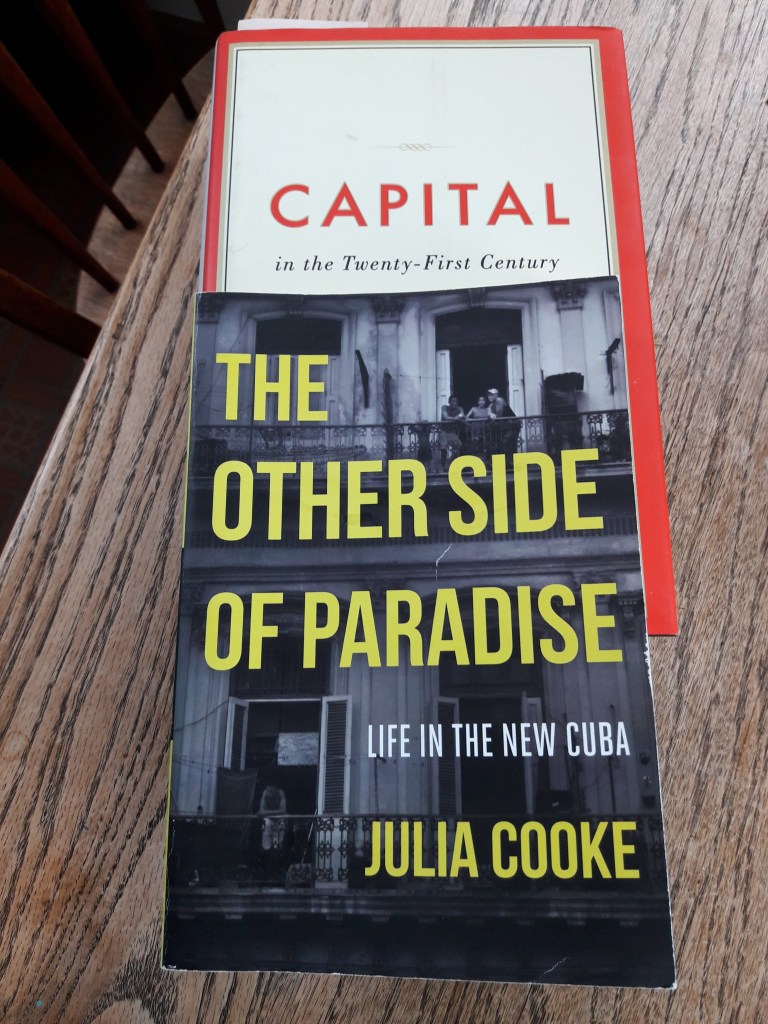
A few weeks ago, rummaging through the neighborhood library box down around the corner, I pulled out “The Other Side of Paradise: Life in the New Cuba” (2014), by Julia Cooke. The book is a first person narrative of Cooke’s time living in Cuba on the local economy amid actual persons of substance, each with their own personal narrative, all complicated by the paranoia often created by the inability to completely know another person (let alone a state or a corporation), particularly when that person lives within the shadows created by a repressive rule.
One of the ideas in Norman O. Brown’s “Love’s Body” is the state shaped like a body. Thus we get the head of state and the seat of government, the long arm of the law. And the body is huge, its shadow gigantic. And of course we get metaphor. And metaphor too becomes enmeshed in the narrative.
The reductio ad absurdum of the gentrified neighborhood is an urban street lined with posh restaurants. And that’s it. No locksmith. No shoe repair. No bookstore or record shop. No hardware store. No haberdashery or hatter. No luthier, plumber, or deli. No butcher, no baker, no candlestick maker. And the sidewalk has been swept clean of buskers. Poverty is the inability to make something, for lack of skill and resources. Dire poverty, fearsome and terrible, is a state of constant need. The one surplus is time, a resource persons of wealth can never get enough of. Persons with time but nothing else can only wait. Poverty is the inability to start something up while waiting.
Consumption of time is what corporations like Facebook peddle. It seems many persons have lost the ability to spend time doing nothing. Thomas Piketty argues that as capital continues to grow exponentially, income of persons with no capital falls (“Capital in the Twenty-First Century,” 2014). The poor will still have their labor power, but the 21st Century is already seeing needs for human labor diminish. What becomes of the poor person when he has not even his labor to sell? The block fills with Bartlebys. From page 531 of “Capital”:
“With zero return on capital, man (or the worker) finally threw off his chains along with the yoke of accumulated wealth. The present reasserted itself its rights over the past. The inequality r>g was nothing but a bad memory, especially since communism vaunted its affection for growth and technological progress. Unfortunately for the people caught up in these totalitarian experiments, the problem was that private property and the market economy do not serve solely to ensure the domination of capital over those who have nothing to sell but their labor power. They also play a useful role in coordinating the actions of millions of individuals, and it is not so easy to do without them. The human disasters caused by Soviet-style centralized planning illustrate this quite clearly.”
And one of those disasters, given Piketty’s view, has been Cuba, and the details, the description, of the specific and authentic person to person human disaster is one of the themes of Julia Cooke’s book. Of course there’s still the problem of narrative, the stories we create as we try to explain our predicament to others. Cooke lives among common persons coming of age in Cuba as Cuba is forced to change in its old age, personified by the aging and death of Fidel and the subsequent changes in leadership. The crash of the USSR, upon which Cuba had relied for economic aid, precipitates and rushes in local change. Still, the common person, the worker, seems occupied with two choices: wait for the opportunity to leave Cuba or stay and wait for more substantive change. Leaving is possible, though not easy, through both illegal and legal means. Both options are fraught with and rely upon bureaucratic and random chance happenings. And the motivation for each relies on a future narrative fictionalized in the present. Will I be glad I left or happy I stayed?
Happiness is another theme. What is it? Do I mistake a general malaise and inertia resulting from dissatisfaction of wants and values with a permanent state of unhappiness? I seem happiest when hanging out with a few friends drenched in the heat of a Havana evening drinking bad rum out of improvised cups, listening to music, telling and listening to one another’s stories, discussing past, current, and the possibilities of future events, plans gone awry and the hopefulness of a new plan. But the extent of that telling and listening depends on who else is in the room, who else might be listening. And why they are listening. Paranoia lurks everywhere yet you’re never sure exactly from where it comes. Yet life in Cuba seems in some ways accessibly enjoyable: the weather, the sea and beach, one’s friends and family, the happy occasion of food. The lack of resources, without the boundless activities that seem to occupy persons elsewhere surrounded by sophisticated toys, pro sports, stadium rock, sponsored opera, and all the latest consumer stuff, the latest myphone, forces one into a different mode of life, but it doesn’t seem the case that this mode is unhappily different from the existential mode of unhappiness experienced when stuck in traffic in your 50 thousand dollar car in the latest but still inadequate infrastructure unable to find a good radio station in Los Angeles, Seattle, Miami, or Houston, illegally texting while driving to tell your kids you’ll be late, unable to get them to pick up their cell phones busy creating stories on Facebook and Instagram. And while you can afford not one but two 50 thousand dollar rigs, you’re pissed your health care options suck.
Cooke’s book seems journalistic in intent, but is memoiristic in style and employs a creative, literary sentence structure and narrative form, including descriptive prose and conversational dialog. The book is also scholarly, researched, with a bibliography of sources and other references as backing and useful for further study. And the book is also something of a mystery. Cooke is in Cuba to experience and report on the changes in society and the effects on everyday citizens. To what extent are her subjects representative? For the most part, the focus is Havana, where she lives and keeps track of those she meets and lives among and with. But she’s interviewing them, clandestinely, with seemingly some degree of risk to everyone involved. Add to that the romantic Havana evening – but she’s quick to dispel romantic views of life within an oppressive, repressive, almost invisible regime. Practically no one she meets owns a rebuilt ’56 Chevy glistening down a Havana street. And she doesn’t hear, she reminds us several times, the Buena Vista Social Club playing Cuban jazz on every corner, if any corners. And the Cuban health care system is one of the best in the world.
Even music, maybe especially music, and art, and literature, comes wrapped in narrative.
“Adela hadn’t left Cuba. I had often wondered, in the year since I’d left Havana, if I really knew who Adela was…Once, drunk at a party with Lucia, a friend of hers had slurred to me that no one around me was who they said they were. He’d dated an American and the secret police had knocked on his door the day after she’d spent the night for the first time to interrogate him. I’d dismissed his words as boozy hyperbole, but the reality was, any one of my sources could have been someone spinning false stories of spliced families and sodden dreams” (207).
There are universal truths regardless of where a narrative originates or how it changes from person to person. That business of “spinning false stories” could easily apply to conversations with anyone here in the States.
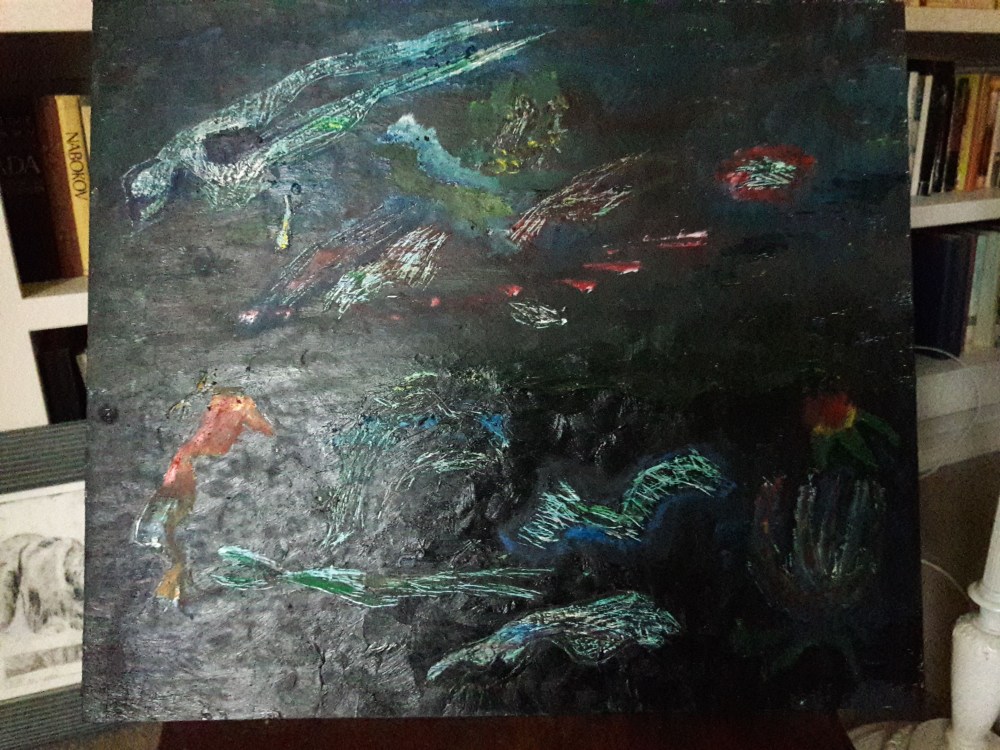
 The Coming of the Toads