• The Man With the Blue Guitar

    The guitar, given the day would be green, could not have been any other color. The sky would blaze orange when the guitar mixed its sounds with the day.

    Wallace Stevens was not a poet born in squalor, though he would have savored the metaphor. He was schooled and trained as a lawyer and spent his working life with Hartford Insurance where he rose to be a Vice President of Claims.

    One day, one of his colleagues entered his office with a book of poems Stevens had apparently written. That Stevens was a poet was not well known inside the insurance setting of his day job. He often walked to work, a route which took him through a local park, and he composed in his head as he walked. Stevens, his colleague exclaimed, holding forth his book, you’re a poet! But what does it all mean? Never mind, Stevens replied. You are far too literal.

    Like houseplants, Poetry can pose dangers. A reader might contact some sort of chemical dermatological poison just by holding a book of poems in his hands. The cautious, casual reader might want to wear gloves and put on a pair of solar eclipse glasses.

    Because the man with the blue guitar drifts afar:

    The man bent over his guitar,
    A shearsman of sorts. The day was green.
    
    They said, "You have a blue guitar,
    You do not play things as they are."
    
    The man replied, "Things as they are 
    Are changed upon the blue guitar."
    
    And they said then, "But play, you must,
    A tune beyond us, yet ourselves,
    
    A tune upon the blue guitar
    Of things exactly as they are."
    

    Quote from “The Man with the Blue Guitar,” by Wallace Stevens. Pictured: A Baby with a Blue Guitar.

    Speaking of guitar, I’ve struck up a live at 5 (PST) guitar gig evenings on Instagram. Random, improvised, distractions. Check it out here.

  • The Poet’s Tale

    The poet is born in squalor, his first love. Some of the poet’s favorite words include seedy, shabby, seamy. These are words made with a hissing sound. In phonics, that sound is called a sibilant, and is produced by forcing the tongue toward the teeth, with the lips near closed, forcing air out like a snake whistling. But opposite words are equally valued by the poet: classy, stylish, exclusive. Even if the reader uses words without really caring about words as such much. The poet is not primarily concerned with getting a point across, and is held harmless if some point hurts its object in the bargain, even if so much the better. If an annoying sound appears to sharpen the point, there’s value added. The poet is in love with words.

    But it’s easy to confuse poetry with sarcasm, satire, or irony. And the true cynicism of poetry often gives way to stoicism. This may occur when the poet realizes there is no point to anything, including his own poetry. Innuendos may still be highly valued (particularly where points may be scored), for all words have their beginning in figures of speech, which is to say, metaphor. That is precisely what an eye for an eye and a tooth for a tooth is meant to solve. Words disallow mistake when artificial trade-offs are refused. But language is no place for despots, try as they might to exert control, to establish absolute authority. Who controls the movement of words over space and time?

    Words are all substitutes. No one can claim dominion. One is as good as another. Language is democratic. And that is why the poet is married to shame, his own mother, at once virgin and harlot (that is to say, vagabond, a beggar for words). In a truly democratic society, where everyone is equal and all words hold common sway, and competition without compromise is useless, it may begin to appear the only way to have a-leg-up-on is to attempt to subject another to shame. But shame has never worked as a measure of control. And that is why poetry can be so hard to get, and why hard times come so often to poets.

    The poet stands accused of nothing and nonsense. His love of words and sound and color is scorned and mocked. He is the scapegoat for confusion.

  • In a Frenzy

    Why are the TV newscasters shouting, frantic, frenetic, in a frenzy, like callers at auctions, preachers at land’s end, the newsboy on the corner hawking papers: Extra, Extra, Read All About It! It now being this constant state of emergency, impossible to keep up with, put on loops. Truth be told, it’s torture. Truth be bold, it’s boring.

    The news so quickly grows old, must keep it from petering out. So stories and comments on loops, ostinato. Even when the story seems about to change, the background keeps looping, looping around the talking head, the face masked in makeup, the expert, the one we might trust, still wearing a suit and tie, a dress, symbols of serious purpose, uniform press. On location, back to you, Jack, in the studio. Thank you, Jill.

    “Oh, when there’s too much of nothing
    No one has control” (Bob Dylan).

    Usually, ahead of disaster, a catastrophe, people go on the run, head for the hills, or run down to the water, pick up and go, evacuate. Or shelter in place until it’s passed – the hurricane, tornado, earthquake, battle, swarms of locusts.

    But this one’s different. We are told to stay in, and if we do go out, to keep our distance. There is no safety in numbers. On the contrary. We must go it alone. When has there been a more existential crisis? We must decide for ourselves what to do, what’s news.

  • Weeds in the Garden of Truth

    Browsing the occasional poem or two every now and then found in a magazine or tripped over somewhere online is a different experience from reading a handheld book of poems straight through as if it were a novel. Even if most books of poems are collections of pieces previously published in magazines or journals, added to those poems a few new ones, so the purchaser of poetry feels he’s getting his money worth. Not always; some books of poems appear like a wildflower meadow suddenly erupted bloomed in one’s untended backyard.

    A friend of mine, a true lover of poetry, a man of poems, who believes in transcendence by the word and the divine mystery at the heart of the rebirth of all things, but is not, therefore, make no mistake here, necessarily a poetry churchgoer, recently gave me a large bin and a bag of books, most of them poetry books. He and his wife are culling, a new pandemic leisure pastime.

    Around the same time, I watched some neighbors carrying two of what appeared to be bookcases out to the curb in front of their house. In our neighborhood, such culling is a call for first come first served of items no longer of use or interest to their owners but with such value still probably somebody will swing by and pick them up.

    One couldn’t, or shouldn’t, do such with an old couch or bed mattress, of course. Someone would call the local no-dumping-here police and you’d soon have a ticket for littering and who knows how many other violations of municipal ordinances one might be prey or heir to.

    In any case, the neighbor’s bookcases didn’t last long at the curb. I mentioned to Susan the new development, and the next thing I knew I was carrying the two said bookcases into our house. One was temporarily temporary, because another neighbor also had had an eye on it, and it seemed only fair to share a giveaway, but it was subsequently decided she had no room for it, while Susan wanted to give it to Eric. So it sits empty, in Eric’s old, empty room, awaiting removal to his new digs, a change of venue which might have to wait out the pandemic.

    The other of the two bookcases is now fitted snugly up against the back of the living room couch, waiting to see what will appear on its shelves. Not, necessarily, books. Recently, Susan asked me what she should do with my books after I die, “burn them, or bury them with you”?

    I’ve another friend who claims to dislike poetry. He doesn’t understand poetry, he says, and, anyway, poems don’t do anything for him. Why anyone would feel such a statement necessary I don’t know. Something about a bad teacher he once had. Of course, only a very few like poetry. But poetry is such an easy target for the meanstruck cynic bent on pulling the weeds from the suburban lawn of literature. But such blanket statements are made with a sentiment similar to the neighbor who covers his lawn with chemicals to kill the weeds, the moss, the quackgrass. I hate weeds, he might say. Of course, only a very few like weeds. And those, not trying to cultivate a lawn.

    I’ve decided to let our yard grass grow. When we moved in, but that was over thirty years ago now, the yard might still have had what might have been called a lawn. Then came the successive summers of drought when the municipality banned the watering of lawns. The grass returned to its natural habit of turning brown like hay in the late summer, dying back, but quickly recovering its green when the rains returned in the Fall. I continued to go through the motions of mowing as the green stuff reached a certain height during the Spring, but it would be presumptuous and pretentious to call what it is now a lawn.

    In any case, the pandemic strikes us individually, it seems, such that some of us cull while others let stack up. Me, I’m letting my yard grass, and whatever else the yard might contain, grow. This is not to say without some thought and design. I was recently reading again about how the US suburban lawn grew into a values game, how clover came to be considered an evil, how more harmful chemicals were gradually poured annually into lawns than into agricultural hectares. And what one might do about it.

    Take the lawn out, of course, as many of our neighbors have been doing for the past few years, and put in native plants, grasses that don’t need much water, fruit trees, raised beds, vegetable or flower or herb gardens. All of which we’ve done some, hit and miss, with receding lawn grass space. It’s just a yard, one of many. But I’d like to think that to a few birds and bees flying over, it’s an open invitation to a safe landing zone. And I’d like to think of the yard as a poem, inviting its critical readers, passersby, to tarry, wondering what it’s all about, what it means, looking for a design.

    But like the abandoned mattress put out to a curb, there are municipal curbs on what one might do with one’s yard. To wit, locally, grass may not be let grow longer than twelve inches tall. My gardening plan is to let my yard grow (and everything else that might be in it) until around mid-July, when it begins to die back naturally, and then cut it. And cut again once or twice in the Fall, and see what comes up next Spring. Likely, more of a meadow, a wildflower kind of meadow would ensue, if properly left alone. If one applies no rules, save that of not cutting. You mean a field of weeds, the cynic replies, like in an abandoned lot.

    Yards, the keeping and maintaining of yards, the cutting and trimming and reading of lawns and grasses, are, after all, like poems. Some poems are like putting greens, mowed as short and as tight and flat as the flattop of your father’s Fifties barbershop cut, with just a bit of an edge held up by a touch of jell above the forehead, a tiny wave, a ringlet no breeze will disturb, no bird or rodent will nest in. Other yards are like the beehive hairdos or the bebop poems of around the same era. We get disparate yards and poems, no two exactly alike, yet we do find types: the suburban lawn poem, all the weeds pulled or killed with poisons, really the rulebound cynic out to make a point; the wildflower meadow poem, really the lazy man’s excuse for trading in the mower for a new chaise lounge where he can kick back with a beer and read a few poems in the shade of a summer’s day, surrounded by the soft call of the wild neighborhood bugs, undisturbed by the local cat creeping through the high grass, looking for a quiet place to nap. He too will nap, this new anti-lawn man, his book of poems fallen from his lap into the tall weedy grass.

    A poem, Robert Frost said, is a momentary stay against the confusion of the world. True, no doubt, for his own poems. But what of the poems that seem a momentary departure from the sanity of the manicured lawn? Or at least from the trim and clean look of the cut yard, the heads of all the weeds whacked off?

    The cynic wants to understand everything, and when he comes across something he can’t seem to get, or gets no immediate pleasure or reward from, he declares it presumptuous or pretentious or fraudulent. And the casual reader begins to think, fallacy of false dichotomy, that there are but two kinds of life, two kinds of yards, two kinds of poems, and one gets by in life only by pulling weeds from the garden of truth.

    But, at risk of ending the post too aphoristically, truth is weeds.

    And weeds is poetry.
  • The Epic Virus and Examined Life

    Nothing like an Epic Virus to remind one how connections work. Members of this current batch of humans share just about everything of themselves, like it or not, even their money, some more some less than others.

    Life swarms with sounds we can’t hear, and teems down pouring itself empty with flying bugs and crawling things, birds and fishes, and the smallest creatures invisible to the naked eye that can make bread rise and turn grapes to wine and hops to beer, life that enters and exits the great smoking and stoking train of the body, riding one car to the next, to and fro, round trips, never holding an official ticket. Life is idiomatic.

    In Astra Taylor’s film Examined Life, Kwame Anthony Appiah reflects on how the ways in which humans are connected have changed over time. Gone are the days, Appiah explains, when the only people you ever saw in your entire lifetime were the members of your own family or small tribe:

    “As a species that was designed for living in bands of a hundred-odd people for much of its evolutionary history, we have to figure out how we’re going to live in a planet with 6, 7, 8 billion people. Billions not divided into lots of little bands of a hundred, but constantly interacting – and interacting in units of hundreds of millions. The United States, for example, has a population of 300 million right now. So as an American, you exist in this kind of virtual relationship with 300 million people. If you’re lucky enough to be Chinese, your virtual relationships are soon with 1.5 billion people or something like that” (p. 88, Examined Life: Excursions with Contemporary Thinkers, Edited by Astra Taylor, The New Press, 2009; Interviews from the film Examined Life, 2008).

  • Every Writer Has A Thousand Faces

    I first met the poet David Biespiel sitting in the green wooden bleachers at a Southeast Portland Little League baseball game. His son Lucas was on the same team as my son Eric. I had climbed out to get something from the snack shack, and when I got back, Susan pointed out to me the guy sitting a few rows down from us watching the game while reading a book of poems by Dylan Thomas. After the game, I said hello and asked what was up with Dylan Thomas. I didn’t that season get to know David, but neither did I forget his telling me about his Attic writing studio. I was working my corporate gig at the time, where poetry, unless you had X-ray vision, remained hidden behind any number of cubicle kept faces.

    Over a decade later, finding “myself growing grim about the mouth,” as Melville’s Ishmael said, I took early retirement, returned to adjunct work, and eventually found my way back to David at his Attic studio, where I volunteered to help build bookshelves and organize the library, and also joined a seven month writing cohort called “Hawthorne Fellows” (the Attic being located in digs on the second floor of an old building on Hawthorne Boulevard), where I worked on “Penina’s Letters.”

    I started reading David’s work, attended the book launch reading at Powell’s on Hawthorne of his Charming Gardeners, later putting some notes up on the Toads about that experience. I stayed in touch with a few of my cohort acquaintances made in the Hawthorne Fellows, dropped out of the Attic library volunteer work, growing increasingly busy with new adjunct work. It wasn’t hard finding adjunct gigs that provided no benefits or job security, and pittance pay, and while the work was hard, I felt at home in my newfound community, and found more time but more importantly more desire to write. And I continued to learn – about writers, about the academic tyranny of composition rules, about writers and readers, about writing and reading venues and communities.

    I read a number of popular as well as hard to find how to books: Stephen King, On Writing; Annie Dillard, The Writing Life; William Zinsser, On Writing Well; Walter Mosley, This Year You Write Your Novel; Ted Kooser, The Poetry Home Repair Manual; Francis Christensen, Notes Toward a New Rhetoric; The Use and Misuse of Language, an old paperback from my shelves, edited by S. I. Hayakawa; Verlyn Klinkenborg’s Several short sentences about writing; and Every Writer Has A Thousand Faces, by David Biespiel.

    Any kind of writing can be a good teacher to a discerning reader. We’ve as much to learn from bad writing as from good writing. But we can’t know bad from good if we don’t know how to read. And most of us are poor readers, particularly of our own writing. That’s because, in part, it’s harder to read our own writing, to proofread our own writing, than it is to read another’s writing. We don’t see what we don’t expect to see. And we read for our favorite mistakes, and happily call them out, as if that criticism somehow makes us better writers or more discerning readers. And, as we don’t necessarily see ourselves as others see us, our pictures of who we are or what we look like don’t match up, so too we don’t see our own writing as others see it.

    And all of that is what I like most about David Biespiel’s Every Writer Has A Thousand Faces. It’s as much about how to read as it is how to write. In it, David talks about looking:

    “What Phil created in that time was version after version of my face, throwing dozens upon dozens of discards onto the floor of his studio or hanging them up on the wall until he came to a point of an understanding about drawing my face that provided him with, well, further understanding about drawing my face. He wasn’t going to revise to make a finished product. He was going to make versions from the same material in order to make more versions from the new material. One version of my face after another” (page 68 of the 2010 edition).

    And that might help explain why the 10th Anniversary edition of Every Writer Has A Thousand Faces, launching today, March 30, 2020, from Kelson Books, adds four more faces to the cover of the 2010 edition, pictured here:

    I’ve ordered a copy of the 10th anniversary edition, and I hope you do, too. In doing so, you’ll be supporting more than just David. You’ll be supporting a writing community. But that’s not the main reason for showing an interest in it. And, as David makes clear in his book, it may or may not help improve your writing. But it will help you look at yourself and what you’re trying to do in different ways and means. It will help you discover new faces of yourself.

    Check out a copy of the new 10th anniversary edition of Every Writer Has A Thousand Faces at one of these venues: Broadway Books Annie Bloom’s Powell’s Amazon SPD Kelson Books

  • Home-word Bound #1

    Social distancing guidelines now include no more than 10 people gathered together in one place, and, anyway, to stay home. I grew up one of ten kids. The doors and windows to our house were never locked. I never even had a key to the place. And friends and friends of friends roamed freely across the threshold, in and out. A restriction of no more than 10 at any one time might have come as a welcome rule for my parents – but they rarely objected to visitors.

    I’ve lived at 19 different addresses over time, never alone, not including the room in the garage at the back of our lot my dad and I built when I got back from the army and found my digs in the house usurped by younger siblings.

    But I’ve lived in the house I’m in now for 30 years. It was built in 1907 in what was then a mostly truck farming community or trolley commute from downtown Portland. The street name is now Southeast 69th Avenue, but it was originally named East View Street. A house this old comes with stories, particularly one that has been home to several households over the years. Those stories are often told by neighbors who have overlapped stays with other neighbors.

    Not long after we first moved in, I was digging around in the backyard and uncovered a large clam shell. The occupants just prior to us lived in the house 12 years before we moved in. The shell, we learned from one of our old-timer neighbors, predated those years. There had been a family, lived in our house, who hosted South Pacific sailors who regularly came to port for the annual Rose Festival (the first Rose Festival Parade was held downtown in 1907). One year, one of the sailors brought the shell as a gift for the house hosts. We learned from that same old-timer neighbor that another year one of the sailors died in the house. He collapsed from a heart attack in the entry room. His name was Joe. His host would later also die in the house, in the downstairs bathroom, also from a heart attack. His name was also Joe.

    Lately, homebound by local decree, I’ve increased my walks around the neighborhood, reflecting on houses. Local neighborhood lore tells of one house that was once a tuberculosis sanatorium, another that was a brothel, another that was a small barbershop, another that was a local post office. It’s not a neighborhood of any spectacular historical interest. While a few of the houses might maintain historical value, there’s no doubt that in another hundred years they will all be replaced. The clam shell might still be somewhere around, though. Maybe something still will be living in it.

    From Shakespeare’s “Hamlet,” Act II:

    Ham. Then is doomsday near: but your news is not true. Let me question more in particular: what have you, my good friends, deserved at the hands of Fortune, that she sends you to prison hither?

    Guil. Prison, my lord!

    Ham. Denmark’s a prison.

    Ros. Then is the world one.

    Ham. A goodly one; in which there are many confines, wards and dungeons, Denmark being one o’ the worst.

    Ros. We think not so, my lord.

    Ham. Why, then, ’tis none to you; for there is nothing either good or bad, but thinking makes it so: to me it is a prison.

    Ros. Why, then, your ambition makes it one; ’tis too narrow for your mind.

    Ham. O God, I could be bounded in a nut-shell and count myself a king of infinite space, were it not that I have bad dreams.

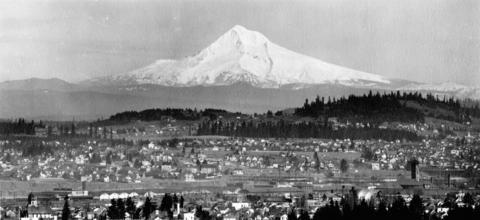
    East Portland, 1907. Mt Tabor is dark, tree covered hill, middle right.
    Photo: Oregon Historical Society.
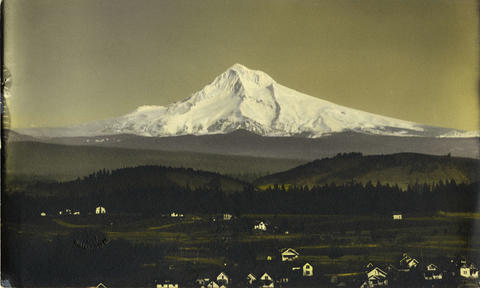
    East Portland, 1891 (OHS). View looking east from Mt Tabor.
  • Roofbug

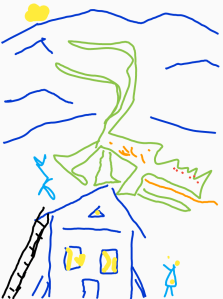
    – There’s a BIG BUG on the ROOF!
    – Keep calm. It will go away.”
  • Motti, Lazzaro, and Django

    The Awakening of Motti Wolkenbruch (Swiss, 2018) is a coming of age story, Motti’s single marital status of existential concern to his mother, who tries to set him up with any number of, for Motti, unsuitable but available girls whose mothers are equally concerned about the marriage status of their daughters. But Motti has his own ideas about attractions and family values, even as his young and tender heart is yanked from his body by the carefree girl he falls off a cliff for, and a parental sponsored trip to Israel banking on his finding a girl the family can approve of only makes matters worse. Expect much laughter, and crying, out loud, with actors speaking German, Yiddish, and Hebrew. The Awakening of Motti Wolkenbruch is about the surprise of life.

    Happy as Lazzaro (Italian, 2018) is another coming of age story. Lazzaro does, literally, fall off a cliff, but not for love, and his heart remains surreally whole, inviolate, even as his body is bruised and abused. He’s a static character, the same at the end as at the beginning, even as life around him changes dramatically. The dwelling settings, country and city, are brutal but beautiful. The lives of the sharecroppers, under imprisonment and later emancipated but just as poor, still captives of poverty, illustrate that poverty is protean, affecting both the poor and the wealthy.

    Django (French, 2017). A dramatization of the life of the guitarist Django Reinhardt and his family during World War II. The Nazis persecuted the Gypsies, many of whom tried to flee to relatively safe zones, joined the resistance, or were caught, killed on the spot, or transported via train to the Nazi concentration camps. The film focuses on Django’s one attempt to escape France, and while he did try to escape to Switzerland, according to the book Django: The Life and Music of a Gypsy Legend (2004, Michael Dregni, Oxford University Press), Django spent most of the war in Paris, where he was allowed to continue playing his music because by then he and his music had become so popular. But he had to play for the occupiers as well as for the locals, his safe treatment thus coming at the cost of a kind of debt bondage. From the book:

    “Hitler bore a deep hatred for Gypsies…From 1933, German Gypsies were doomed. The Nazis barred Romanies from cities, shuttling them into settlement camps. Nazi doctors began sterilizing Romanies as early as 1933. And German Gypsies were required to wear a brown triangle sewn on their chest marked with the letter “Z” for zigemer, German for “Gypsy” – a precursor of the yellow Stars of David pinned to Jews (168)….Yet in Paris, Django was flourishing. Never did he have so much work or live in such sumptuous surroundings. Just as the Germans permitted jazz in Paris, they allowed Romany musicians to continue to play – and paid to come hear them every night” (169).

    Still, Django worried for his family and for his own life, and if some considered him a hero, others thought of him as a conspirator: “Being in the spotlight saved him from the fate awaiting other Gypsies, but Django began to sweat under the glare” (182). Django takes off with his pregnant wife and his mother. They get caught and are imprisoned, but then, in the absurd way these things seem to happen, Dregni says, “A miracle arrived in the unlikely form of the German kommandant. He was a jazz fan, and when he came to question his new prisoner, he was astonished. ‘My good Reinhardt,’ he said, ‘whatever are you doing in this fix?’ Django promised not to try to escape again, and was freed” (184).

    Django the film is must see for anyone interested in Gypsy jazz. But it’s also just a classic film – the acting, the setting, the timing, the war, the family and country drama and suspense. It features much magnificent music, including the organ “Mass” piece Django created. Django the book by Dregni should also be read. Django never learned to read or write, save at a most rudimentary level, and that late in his life (he died age 43). The book reveals a deep history of jazz music in Europe, particularly Paris, including stories of the many Black American musicians who traveled through Europe, most stopping in Paris, many playing with Django, following both World Wars. It covers the business of music and recording and performance management, popular success and failure, the changing style of jazz as musicians work to assimilate new music experienced from new exposures.

  • Ocean Crag

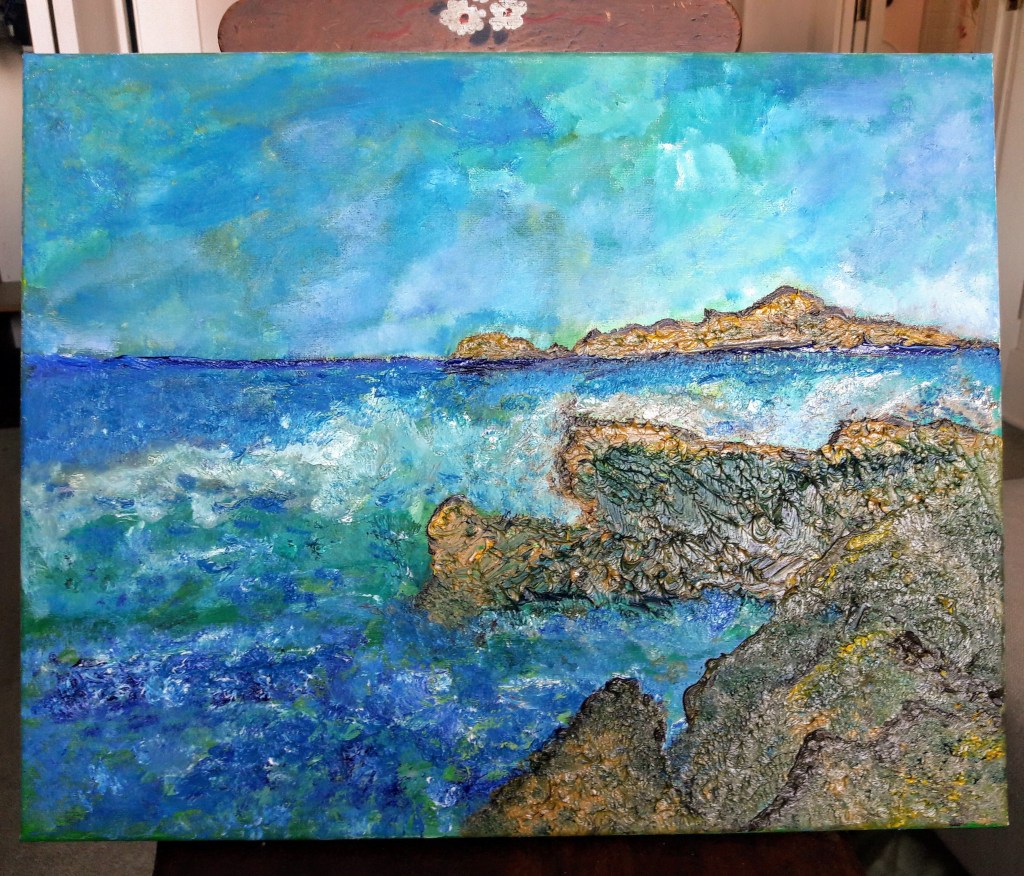
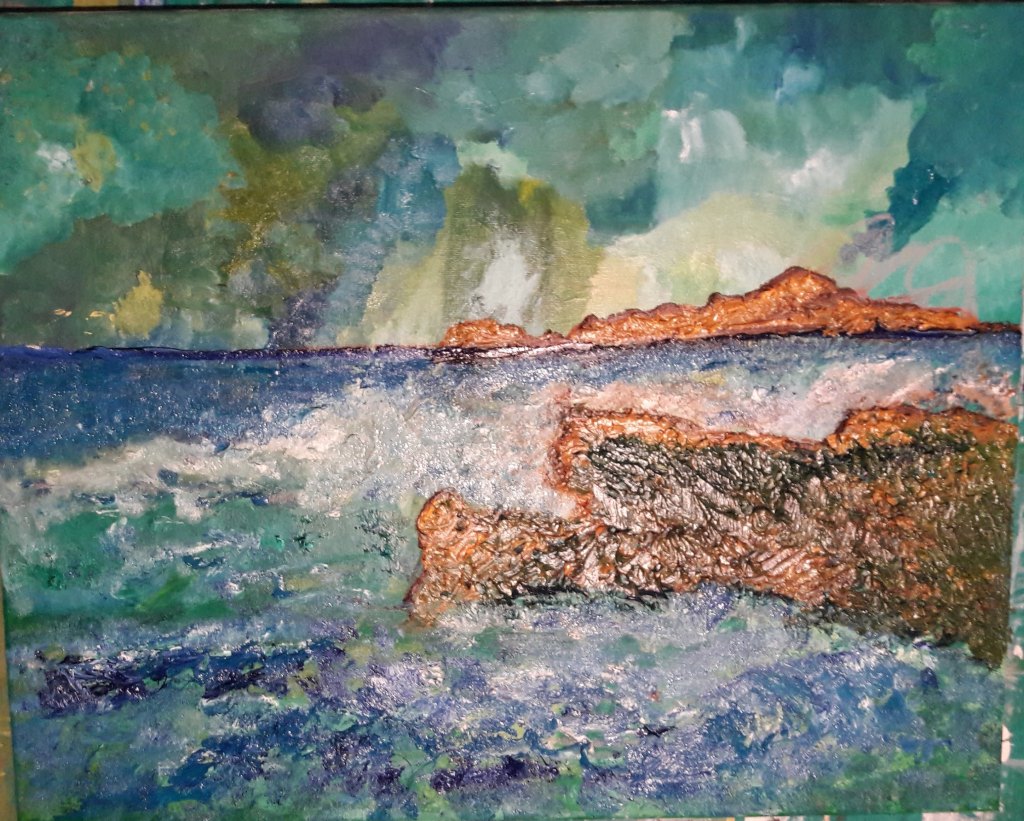
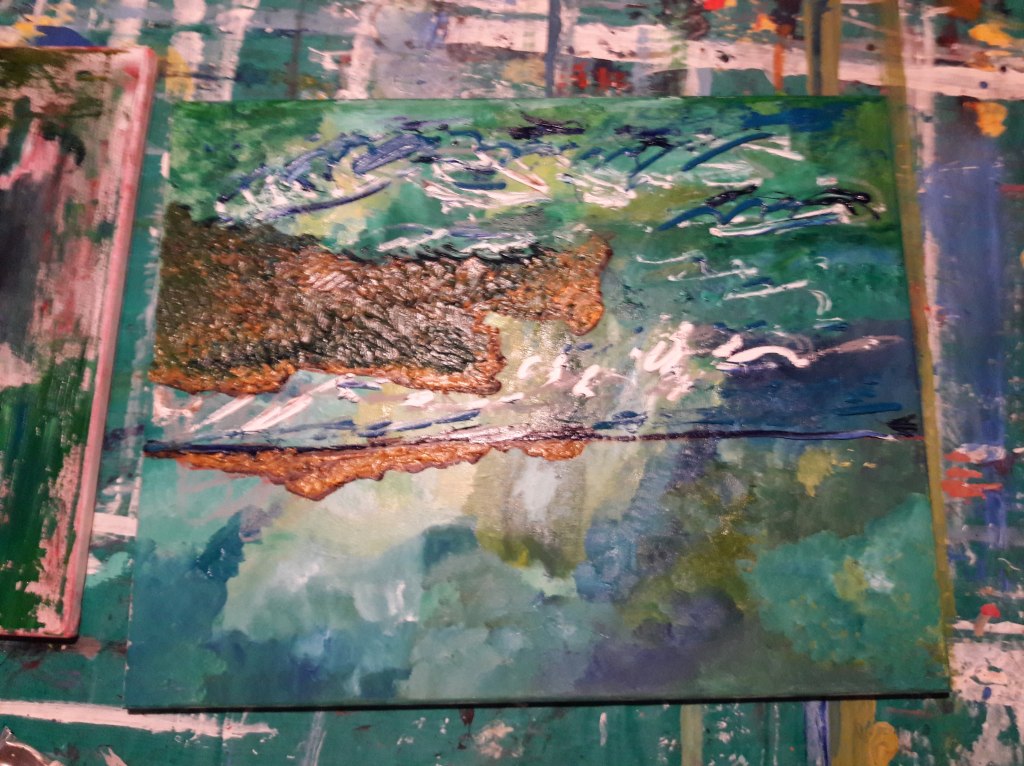
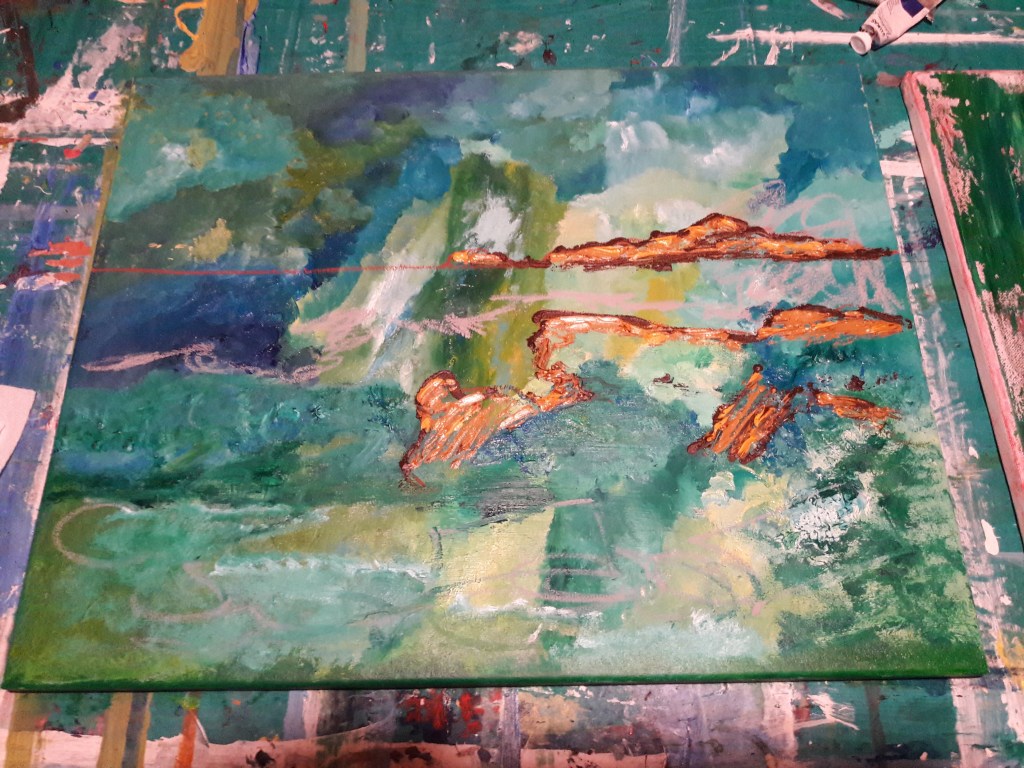
    “Ocean Crag” pictured in stages. Oil on canvas, 16″ by 20.”