• On the water writing

    Meeting with the whaleThere’s nothing better than being on the water. Another blog we’ve been following recently, Transparent Sea, is chronicling an open ocean paddle following the migration path of whales off the coast of Australia, and features some close-in photos and videos of whales, dolphins, and surfers.

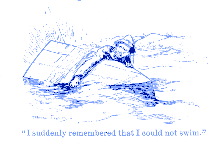
    I suddenly remembered I could not swimWe are reminded of Joshua Slocum’s classic, Sailing Alone Around the World. Slocum could not swim, yet he spent just over three years and 46,000 miles alone on the water. 

    Writing sometimes feels like being alone on the water, unable to swim.

  • Hemingway surfing and writing

    Timing is everything
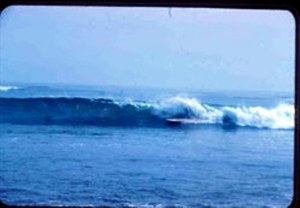
    at Leo Carillo, 1969.

    We’ve been enjoying the El Porto Fridays blog. We can still feel the El Porto sand beneath our feet, the foam rushing over our board, the morning glass, the afternoon chop, the evening glass-off. We surfed there in the 60’s and 70’s, before heading out, like Huck Finns, for the territory, ahead of all the rest; well, ahead of some, behind others. The El Porto Fridays blog recently put up a post titled “5 Ways to Improve Your Surfing.” It had us thinking of Shaun Tomson’s Surfer’s Code, and of Hemingway and writing. 

    A sentence is like a wave, as Hemingway often illustrated; Hemingway didn’t surf, but he does have Jake Barnes in The Sun Also Rises body surfing, and this famous sentence from the short story “Cross Country Snow” illustrates what could be a surfer on a wave:

    “George was coming down in telemark position, kneeling; one leg forward and bent, the other trailing; his sticks hanging like some insect’s thin legs, kicking up puffs of snow as they touched the surface and finally the whole kneeling, trailing figure coming around in a beautiful right curve, crouching, the legs shot forward and back, the body leaning out against the swing, the sticks accenting the curve like points of light, all in a wild cloud of snow.”

  • Double Shot, Hold the Book

    The end of books is closer than we thought. A short article in today’s Christian Science Monitor discusses a private high school that has replaced the books in its library with a $12,000 espresso machine, three sports bar like TVs, Kindles with e-books, and laptops.

    Apparently, the old, hard copy books were not being checked out and read, anyway. Though the article does not mention Google, we look forward to a riposte from Carr. He thinks Google’s giving us the jitters now; imagine adding a little espresso to the formula.

    While we’re on the subject of books disappearing, another related piece in today’s mail threatens to amuse, from the New Yorker’s Book Bench blog, a review of cartoonist Bruce McCall’s new book, Fifty Things to do with a Book (Now that Reading is Dead).

    And our brief survey and latest Reading Crisis entry would not be complete if we didn’t remind readers of our own past post, “What we will miss when newspapers disappear.”  

    But doesn’t the espresso disturb their nap time?

  • New Outbreak of Grammar Influenza

    We’ve only just noticed someone else coming to the aid of the mistreated E. B. White – Jennifer Balderama, in a Times review of Mark Garvey’s Stylized. We find Simon & Shuster’s description of Elements and its influence hyperbolic, but they’re trying to sell a book, not grammar, while it does sound like Garvey misses neither the point of Elements nor that of the grammarians. Get your grammar shot; school’s back in session.

  • Rolling Stone’s 50 Reasons to Watch TV

    The cover story of the September 17 issue of Rolling Stone gives us the best reasons to watch television. It’s all about content, of course – not a word about form.

    Marshall McLuhan, in Understanding Media, gives us the real best reasons for watching TV.

    “With TV, the viewer is the screen,” McLuhan says (p. 272), and he foreshadows the same arguments that currently occupy Nicholas Carr and others. “The introspective life of long, long thoughts and distant goals…cannot coexist with the mosaic form of the TV image that commands immediate participation in depth and admits of no delays” (McLuhan, p. 283).

    Carr recently blamed the end of book culture on internet habits. McLuhan was writing before the invention of the personal computer, but Carr’s focus still repeats McLuhan’s claim: “The phenomenon of the paperback, the book in ‘cool’ version, can head this list of TV mandates, because the transformation of book culture into something else is manifested at that point” (McLuhan, p. 283). But then Carr goes off track. Carr thinks print culture is about deep thinking, but it’s about living on the railroad, and has little to do with all of Carr’s deep sea metaphors, as McLuhan explains: “The American since TV has lost his inhibitions and his innocence about depth culture” (p. 283).

    McLuhan illustrates that it’s impossible to be illiterate in a non-literate culture. It’s not yet clear what this might mean placed into the socially ubiquitous phenomenon of PC literacy. E. L. Mayo gives us a clue perhaps with his political (and perhaps the best yet) reason for watching TV in his short poem “The Coming of the Toads,” where TV, while perhaps the ugliest medium a book cultured person can fathom, flattens social stratification.

  • Robert Frost and the LHC

    We’re happy to hear the great collider is up and running again. The BBC informs us the LHC is “…one of the coldest places in the Universe.” And it’s right in our backyard, Universe speaking. “Colder than deep space,” the BBC says, like our downstair’s bathroom in the morning in late Fall before we finally give in and kick on the furnace. Colder than hell, we might add; we’re reminded of the Frost poem, “Fire and Ice,” first published in Harper’s Magazine, in 1920. The physicists working the LHC hope to gather evidence of the state of things immediately following the Big Bang, when Fire married Ice.

  • Bio-Lego-Land: Building a Better Body thru Metaphor

    In the September 28, 2009 issue of The New Yorker, we meet synthetic bio-Lego-boys Drew Endy and Rob Carlson: “Some of my best work has come together in my mind’s eye accompanied by what I swear was an audible click, ” Carlson tells New Yorker’s Michael Specter, who says Endy has never forgotten “…the secret of Legos – they work because you can take any single part and attach it to any other – in 2005 Endy and colleagues…started BioBricks Foundation…to register and develop standard parts for assembling DNA” (61).

    What if Norman O. Brown had grown up playing with Legos? Would he have named Love’s Body, Lego’s Body? In Chapter XV, “Freedom,” Brown says that “Metaphor is mistake or impropriety…a little madness…a little seizure or inspiration” (244). 

    “The glory of God is to conceal a thing, but the glory of the king is to find it out…,” Brown quotes Bacon in McLuhan (Gutenberg Galaxy, 190).

    “Feet off the ground. Freedom is instability; the destruction of attachments; the ropes, the fixtures, fixations, that tie us down” (Brown, 260). 

    William Blake, in The Marriage of Heaven and Hell, drew the modern man: “The head Sublime, the heart Pathos, the genitals Beauty, the hands & feet Proportion.” Let’s hope the synthetic biologists mix their metaphors mercifully, for “A fool sees not the same tree that a wise man sees,” Blake said; nor the same Lego, for that matter.

    More on the genome of metaphor.
  • Styled Obsolescence: New Editions for APA and MLA

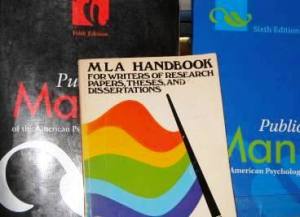
    Style GuidesStudents often wonder aloud at the minutiae of publication manuals. New editions of both the APA and MLA classics were announced this summer. The APA sixth edition, trimmed to 272 pages, at least promises to lighten the backpack when compared to the heavyweight fifth edition, which weighed in at 439 pages – still no match though for our 1977 first edition, first printing copy of the MLA Handbook, a trim 163 pages. The new, 7th edition MLA Handbook is 292 pages. 
    One looks for motive. MLA now suggests one space after a period ending a sentence, but one of the changes in the new APA manual returns us to two spaces after a period at the end of a sentence (pp. 87-88). 

    There are of course other styles, but APA and MLA still appear to be the heavyweights, so when they announce a rematch, we want to be ringside. 

    We learn to march in cadence; if what we want is a style of our own, one pervious to whimsy, we can always try poetry, the perfect antidote to the poison of style.

  • Yevtushenko Vinyl and the Freedom of Discernment

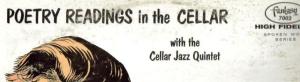
    Jazz Readings in the CellarAgain at PCC, thirty years ago…. Several Russian students began dropping by my ABE workshop on a regular basis, for English lessons, and one day I brought a couple of record albums to class to play on our record player, a small cardboard box with a simple needle (the arm weighted down with a penny held on by a rubber band) that scratched across the grooves, spitting sound through a single tinny speaker. The albums were poetry readings. One of the records included Yevgeny Yevtushenko reading his poem “Babi Yar” with Lawrence Ferlinghetti. The other album was Poetry Readings in the Cellar, with the Cellar Jazz Quintet, featuring Kenneth Rexroth and Ferlinghetti.

    YevtushenkoI played the Yevtushenko, and during the “Babi Yar” poem, nine minutes long on the album, I noticed that one of the Russian students was crying. Later, I apologized, concerned that the poetry had suggested some bad memories. But that wasn’t the reason for his crying at all, he told me. It was the fact that we could listen to this record in our classroom without feeling any kind of fear. “What a country I have come to,” he said. “We can play this record in our classroom and no one even cares.”

    It seems too cryptic to end this post there, yet there was no ambiguity in his meaning, but now, thirty years later, how does one care? At the risk of falling into a nostalgic fallacy, one does care; the current reading crisis, informed in part by changing technology, which in turn seems to be changing values (what we want), may soon have us yearning for a time when we had the freedom to read and write, and to talk and listen, and we tried to exercise that freedom with discernment.

  • Precursor to Garrison Keillor

    Imagine my surprise when Susan hands me this morning’s Oregonian, nonchalantly telling me Garrison Keillor has plagiarized my stroke article. As it turns out, it’s just another example of great writers thinking alike, or older folks sharing experiences – I guess; as I said, my ER doctor told me “we see them all the time.”

    My article ran in the Oregonian’s Aug. 29th print edition (it ran the day before on the Oregonian web site), and Garrison had his stroke on Labor Day, Sept. 7. His article ran in today’s Salon, and is of course picked up by any number of papers through syndication, including today’s, Sept. 16th, Oregonian (B7).

    In any case, I assured Susan that while some writers will take risks to get stories, I don’t think Garrison had a stroke just to write an article. I know I didn’t.

    I’m glad to hear that Garrison is doing well. I enjoyed his article, and of course agree with his conclusion – “We are all in the same boat….”

  • Stanley Fish, Full of Ethos

    Few bloggers are as full of ethos as Stanley Fish – as he frequently reminds us. He’s lately been waxing on the teaching of writing. He’s simply trying to challenge his community.

    We like that Fish recently invoked Francis Christensen’s generative rhetoric (though he doesn’t mention Erskine). And Fish didn’t trash E. B. White, though he did question our ability to annotate him meaningfully for the modern student who knows no terms, and he seems to have skipped over White’s dictum to “omit needless words.”

    Stanley’s wrestling with the protean snake of the sentence strikes us as heroic, a last stand against the philistines who would text, twitter, and roll rather than read to the floor of the ocean, write cursively, on paper, and stroll.

    Speaking of music: if one aspires to be a musician – classical, jazz, rock, zydeco – one listens; one listens to the music of the discipline. Why would it not be just so with one who aspires to be a writer? An aspiring writer should read, just as an aspiring musician listens.