• Online # 1

    Lots Of Fun For EveryoneI’m online, browsing. I’m cruising for a new pair of slippers. I’m sitting on the love seat, in the living room, slouched down, my feet docked on the ottoman. My location is public, living room, slipping down, gliding for a new pair of slippers, my purpose public.

    I enter “cruising slippers” into my search engine. I feel good. I’m plugged in, lit up. I’m online. My socials are open. The drones are swarming. I’m not alone. I twitter something fast: “Online slippers, what? Come on back!” Immediately, there’s a response.

    I’m in a mood, an online mood. Mood indigo. What’s that? I enter “mood indigo” into my search engine. Oh, yeah, the Duke. I jump over to JazzStandards.com and click on the song, give it a whirl. Oh, yeah, the melody comes back to me, haunting. The piano notes sound like ice cubes clicking coolly in a cocktail glass.

    “The Duke of Earl.” Who was the Duck of Earl, anyway? I enter “The Duck of Earl” in my search engine. It ignores the typo, corrects my search, thank you. I click on Urban Dictionary and start to scroll down. Some nice peer reviews going here, mostly thumbs up, a few down. Then an ad pops up: “Have you ever been arrested?”

    I don’t like ads. I try to ignore the ad, but I can’t. I feel arrested. My mood shifts. I’m like a boat on the open sea, at the mercy of variable breezes. I open my facebook, enter “variable breezes” in my status and click. I get a few likes. Someone in Dansk says, “Breezing?”

    Yes, that’s it, I’m breezing. I shift back to Twitter and enter “Breezing,” just the word, not even a period. No response. I’m not surprised. I don’t have that many followers on Twitter, but what’s a lot? I change lanes, back to Facebook, and enter “Breezing.” I have 500 friends. What time is it in Dansk, I wonder.

    There’s a new tweet, from some cat in Belgium. I enter “slippers” into Google Translate: “pantoufles,” if I want a pair of French slippers, which I don’t, necessarily. I switch Translate into Dutch: “slippers.” Slippers in Dutch is slippers, same as English. Who knew? I enter “Slippers in Dutch is slippers in English, too” into Facebook. I get a bunch of likes and a few comments like it’s a joke or something, but I’m serious. I get a bizarre comment from some kid I went to high school with I haven’t seen or talked to in years. She claims she’s a lawyer of some kind. Probably under some kind of house arrest.

    I open my search engine and type in “ottoman” and poof comes the story via Wiki: “Thomas Jefferson’s memorandum books from 1789.” Now there’s a trip, speaking of high school. I parachute out of Wiki and land back in my living room. I’m thirsty. I’m thinking of walking down to the coffee house. They have Wi-Fi there. What’s Wi-Fi? I don’t understand beyond having a general idea. I enter “Wi-Fi” into my search engine. What if we could see radio waves? I Tweet, “waves, pulsing.” I was going to tweet “radio waves,” but I didn’t. We can’t see these waves, at least I can’t, but I think I can feel them. Sometimes songs just pop into my head. That ever happen to you? Suddenly I’m singing some song in my head, not singing it, really, but it’s there, playing, playing in my mind, like my head is a transistor radio picking up the wave of the song. But if I try to sing the song, out loud, the words won’t come. A few might, but not the whole song, not unless it’s a song I’ve gone to the trouble to memorize, to commit to memory. This paragraph is too long for its purpose.

    Location, living room. Purpose, slipping through time online for a new pair of slippers. Open: socials, check; three search engines, check; Wiki, check; my word processor, check. All systems go. Where does that term come from? I enter “word processor” into my search engine. What ever happened to WordPerfect? Do we process words? Do we perfect words? Mot juste. The word frozen. Justice.

    I enter “All systems go” into my search engine. The dictionary calls the phrase cliché. Really? I don’t hear anyone using it much anymore. I enter “All systems go” into both Facebook and Twitter. Nothing, no response. Interesting. Maybe I should have typed, “All systems are go.”

    I saw “Argo” not too long ago, on the Big Screen. What a trip. I had not been to see a film in some time, not in a big screen theatre. I had forgotten how big the screens could seem. We sat in the first row of the second section, not too close, in the front middle, so to speak. I like the front row. I like to slouch down and stretch out my legs. A message filled the big screen just before the lights dimmed: “Please put out your cell phone.” No, not right, “turn off,” it said. I did. I turned off my cell phone. I had thought I might maybe send out a few tweets during the film, but I thought better of it.

    So to speak, thought better of it, all systems go. I should look these up. I’m bored with all that. I check out the news. First, the weather: slight chance showers. Slight, what is slight? Parse. Can you parse the showers, please? I tweet, “Parsing showers.” No one’s on Facebook. 500 friends and no one’s on. That’s a first. I check the news.

    The news. I type “the news” into my search engine. I’m reminded of the scene in the Steve Martin film “Roxanne.” Charlie is strolling down the street and stops at a newsstand to buy a newspaper. He pulls one out and glances at the front page. A look of shock and horror pops up on his face. He scrambles back to the newsstand and fumbles in his pocket for another coin. He opens the newsstand and sticks the newspaper back into it and continues his stroll, his calm smile back on under his big nose.

    1987, the year “Roxanne” was released. I just looked it up. But the thing is there are no newsstands anymore, no phone booths either, and mailboxes appear to be disappearing.

    +++

    Notes: This post is part fiction, part real. It was inspired by a conversation I really had last Friday afternoon over at Stark Street Station with some colleagues. I do have a Twitter account, but I’m not on Facebook. I didn’t think of tweeting during the movie. That’s not something I would do. In any case, my cell phone can’t do that, tweet. And I’m not really in the market for a new pair of slippers. I don’t even have an old pair of slippers. I don’t wear slippers. Meemin retweeted “Parsing showers,” over an hour ago. A good post takes time.

  • Fear of Writing: “After Midnight,” by Irmgard Keun

    “A writer in the act of writing must fear neither his own words nor anything else in the world,” Heini tells Algin in Irmgard Keun’s “After Midnight.” Algin is considering writing a historical novel that will satisfy the stiff submission requirements of the Reich Chamber of Literature. The historical novel might be relatively safe because the players have passed. They’re not around to censure, and their story has likely already been told, documented, accredited. But one doesn’t always know what might get “a writer in the act of writing” in trouble. And a mistake is not an act of courage but of naiveté, inexperience, or foolishness. Writers may work with all three simultaneously, whistling while they work, no fear.

    But “a writer who is afraid is no true writer,” Heini insists. But a writer unafraid might simply be risking nothing, have nothing on the line, no skin in the game, nothing to lose. Being fearless is not necessarily the same emotion as having courage. And Heini’s not talking about craft, because “perfection renders words unnecessary,” he says. Indeed, what the writer should fear is perfection, because “once criticism’s no longer possible, you have to keep quiet,” Heini explains (98). Perfection is only achieved through the destruction of all opposing values. But at that point, there’s no more discussion.

    I don’t know if Keun was afraid or not while writing “After Midnight.” But she was certainly courageous. “After Midnight” has an interesting publication history. Irmgard Keun lived from 1905 to 1982, achieving early success as a writer in Germany only to see her books quickly burned. “After Midnight,” Keun’s fourth novel, was first published in 1937 by a publisher in the Netherlands. It was republished in German in 1980, and in English with a translation by Anthea Bell in 1985. I recently bought the Neversink Library edition issued by Melville House Publishing in 2011. It’s a short book, 169 pages including an afterword by Geoff Wilkes that provides both a brief but detailed biography of Keun and a short critical analysis that draws on research using letters and reviews from the periods discussed.

    “After Midnight” is not a historical novel, and illustrates some of the strengths of fiction over documentary, of literature over reporting. Its tone is primarily satiric, but the narrative is realistic, looking at its own time, with some, but not much, looking backward, unable, of course, to see clearly into the future. If the writer knew no fear, the young narrator knows it: “My heart always stands still when I hear those speeches, because how do I know I’m not one of the sort who are going to be smashed? And the worst is that I just don’t understand what’s really going on. I’m only gradually getting the hang of the things you must be careful not to do” (63). This is the plight of the writer. The situation is urgent, a constant state of emergency on the dire road to perfection, a place not there.

  • Spring Waltz

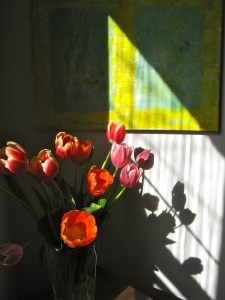
    IMG_1128The local nurseries and flower markets are loaded with starts, but I can feel the pink of the hard orange rose hips still sleeping, snoring in thorns, and hear the tiny golden broach just touching the iridescent crimson of the humming-bird’s throat.

    Spring came yellowing in a green coach, wavy red-orange hair billowing out the open windows, the coarse driver spitting and spurring the horses to spirit, but the horses needed a rest already, apparently, and Spring slowed to a walk, not even a trot. Slug, slug, slug. One evening, a few weeks ago, we ate dinner outdoors – a false spring. I had lugged out the wooden table from the basement into the backyard, and we lit candles – it’s been covered with a vinyl table cloth since, to protect it from the rains.

    IMG_1129And still the going is slow, the soil too wet to work, but I work it anyway, and the only birds following the hampered whirlicote, and a few Mew Gulls (never saw them before this far inland), sensing a lost trawler on restless water. Still, the apple tree is in fine form, drenched with blossoms and besotted with a few skittish bees. A little early for besotted bees, but there it is, Spring.

  • A Cat’s Email

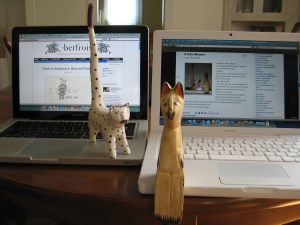
    IMG_1121 A Cat's Email– Did you get my email?
    – What email?
    – I sent you an email.
    – I delete all email before reading it.
    – That doesn’t make any sense!
    – Welcome to the world of Postmodern Poetry.
    – But I sent you an email!
    – Must we go through this again?
    – Joe’s post titled “Notes on Experience, Story, and Voice” that was “Freshly Pressed” here has now been reposted at Berfrois!
    – I think I need a nap.
    – How many naps do you take in a day?
    – As Dylan so eloquently put it, “Any day now, any day now…”
    – Why does he have to say it twice?

  • Weather Retort

    Sunset over PacificDay One: A trance of rain, ear churn momute.

    Day Two: Slide high noontide, sundersthorms plate.

    Day Three: Moistly scattered sneers and a few frizzles.

    Day Four: Chants of wrinkles, dartly cloudy and chowdery.

    Day Five: Humility Poor Boy Talls, Barometer IPA 75%.

    Day Six: Moggy, very low viability.

    Day Seven: Topical air mass pew point, wind clam.

    Extended Forecast:

    • Thick hot pine tar air dropping from powerful trees.
    • Rosemary, basil, garlic, and spearmint mixing with tales of salt water.
    • Soft golden sun boiling over salsa garden.
    • Bare feet in wet sand, nibbled by sand crabbed bubbles.
    • Plenty of weather to write or not in the forecast. Some pressure to publish sun only.
  • Apropos of Nothing Alphabet Primer

    AA beast abuzz amidst the clovers: A is for Always Anxiously

    Bees besieged in Beelzebub’s circles: B is for Bunched Bop

    Ceding the bee’s sting: C is for Cut Care

    Denuded dazed drone doodle: D is for Drilled Daffodil Dust

    FlowerEach easy flower glowers, going crazy: E is for Eating Earwigs

    Felled flies found in forged gyre: F is for Flounder Flour

    Grease hopping aground bottom: G is for Goaded Garlic Gear

    Heliotrope: H is for Standing Erect at High Noon

    M ss ng  n Act on: I is for Idling Slowly Down the Mississippi River

    Jived, joed, and jellied: J is for Jump to Comments

    Kitchen kelp: K is for Krilling

    Los Angeles lovers afloat: L is for Lost in Ballona Creek LowlandsCAPE

    Moneyed, honeyed, and schooled: M is for Marriage

    Nonesuch wiser the nuncio nun: N is for Nauseous Napkins at High Tide

    Only one occupied optative mood phone booth: O is for Obnoxious Ontology

    Peeing peregrine on ice plant spears: P is for Pilled Paper Piece Work

    Queued quacks: Q is for Quick Quiz

    Read in rows: R is for Rubric Rust

    Sew seven scarves: S is for Subsumed Existential Snow

    T is for Tremulous Titbirds Telling Mother Father Will Be Late

    Undertow: U is for Until Unction Snore

    Vexed voice: V is for Verisimilitude

    Waiting for FatherWho When What Where Why: W is for Wasted Window Father Watch

    X’s not and no O’s

    Yellow harrow and black and yellow bumblebees: Y is for Yielded Yelp

    Zonked zone: Z is for zooming in and zooming out, buzzing, zooming, walking, talking, doodling at poems, scratching names with dates in wet concrete, riding the bus to the metropolitan zoo

  • A Cat For All Seasons

    A Cat For All Seasons– It’s spring! Don’t you just love spring?
    – Winter will come again. It always does.
    – The ice has melted. Like e. e. cummings said,
    in Just-
    spring          when the world is mud-
    luscious”
    – It’s supposed to rain again tomorrow.
    – But this is today! And we’re alive in this spring moment!
    – A more responsible view is to remain mindful that the seasons are in constant motion, and anything can happen and usually does. In any case, from a universal perspective, there is only one season, a murkiness that lends itself to a contemplation of a dark void.
    – Yes, but it’s spring! And I feel like hop-scotching and jumping rope!
    – It won’t be long before the hurricane season will be upon us again, to say nothing of tornadoes. As Robert Frost pointed out, “Some say the world will end in fire / Some say in ice.” And he should have known; he was a poet. But I don’t see how it much matters, an end is an end is an end is an end, but all these literary allusions are just illusions to wile away the time until winter comes again and we cry out, “Winter is icummen in,” and you know the rest.
    – Oh, you’re just an old goat!
    Cherry BlossomsLook at this wonderful picture I took last night with my cell phone of the moon glowing through the cherry blossoms!
    – Reminds me of the time we went to see “The Adventures of Buckaroo Banzai Across the 8th Dimension!,” and they burnt the popcorn. Besides, you can’t fool me; that’s not the moon – that’s an electric spotlight in the parking lot of The Old Spaghetti Factory.
    – Listen! I think I hear a whistle!

  • A Cat’s Memoir

    A Cat's Memoir– I’m going to write a memoir!
    – You’re speaking of flash fiction, I presume?
    – No. I want to tell your story.
    – My story?
    – Yes, Joe says it’s the writer’s job to tell the stories of cats without voices, and you don’t seem to have a voice.
    – Joe? Who is Joe?
    – Joe is this really cool cat hep blogger at The Coming of the Toads, all about cool cat lit cult stuff, poetry and jazz, the ocean and deep silence. You would dig it.
    – And is this Joe cat credible and reliable? What does this Joe do for a living?
    – I don’t know. I think he may not have a life, so he doesn’t need to worry about all that. I think he might be a fictional character.
    – And who is behind this fictional Joe?
    – I’m not sure, his memoirist, I guess.

  • Notes on Experience, Story, and Voice

    Joe Linker Pizza Face by Emily“The idea that everyone has a story to tell (which underlies the notion that anyone can write since all a writer needs is a story) is strictly correct,” Jenny Diski said, writing in the London Review of Books (7 Mar, 21) about Marco Roth’s memoir, “The Scientists: A Family Romance.” Well, Henry James thought so, anyway. Continued Diski, echoing James, “If you were born, you’re in there with a story.”

    “Every talk has his stay,” James Joyce said. But does every story have a voice? Is the writer’s job to tell the stories of those without voices? Is the critic’s job to decide how long the voice’s stay is welcomed, if at all? Not if Joyce had anything to stay about it: “Why? It is a sot of a swigswag, systomy dystomy, which everabody you ever anywhere at all doze. Why? Such me” (FW, 597). But even if one has a story with an illuminating voice, should one talk? And once one starts talking, must one tell all? Well, maybe not all, there are time and space constraints, after all. Ah, and there’s the rub, what to tell, and what to withhold.

    Memoirs, like all forms of writing, have narrators: is he, or she, reliable? What have they left out? And even if they’ve tried to put everything in, there’s the problem of point of view. Would the story tell of the same experience related from another’s point of view, someone else who was witness? A memoir doesn’t contain fictional characters, but real people, but to the reader who has never met them, they may feel and sound like characters. The characters speak, but are their words reliable? The memoirist creates a set, described, composed, like a family photo album, and adds tone, the attitude toward the experience, all drawn with words that suggest as well as denote. And there is that slippery, mercurial ball of memory we always seem to be chasing after. We might call that ball ambiguity.

    And writing in the March 18 New Yorker, Adam Gopnik says, “Thanks to the Internet…anyone can write” (21). The assumption is that not everyone should. All these amateur bloggers serve up knuckle balls to the professional writer, though the proliferation of adult amateur softball leagues doesn’t seem to hamper the work of pro baseball players. How many family garages or basements sport bands? That they don’t all reach Nirvana doesn’t invalidate their experience, as much as it might hurt our hearing. Why is the amateur spirit more tolerated, if not enjoyed, in music, arts and crafts, gardening, cooking, and sports (golf, anyone?) than in writing?

    Henry James, in his essay “On the Art of Fiction” (1894), talks about experience, and answers a question about whether or not one individual’s experience might be more valid and valuable than another’s when it comes to writing about that experience. James is speaking of fiction, Diski of memoir. But memoir might be the most flagrant of fictions, since it attempts to disguise its narration as truth. But what makes any experience worth writing and reading? For James, the more cloistered a life’s experience the more opportunity for close reading of that experience. The only requirement is that one pay attention: “The young lady living in a village has only to be a damsel upon whom nothing is lost to make it quite unfair (as it seems to me) to declare to her that she shall have nothing to say about the military…The power to guess the unseen from the seen, to trace the implication of things, to judge the whole piece by the pattern, the condition of feeling life, in general, so completely that you are well on your way to knowing any particular corner of it – this cluster of gifts may almost be said to constitute experience, and they occur in country and in town, and in the most differing stages of education. If experience consists of impressions, it may be said that impressions are experience, just as (have we not seen it?) they are the very air we breathe. Therefore, if I should certainly say to a novice, ‘Write from experience, and experience only,’ I should feel that this was a rather tantalising monition if I were not careful immediately to add, ‘Try to be one of the people on whom nothing is lost!’”

    Maybe everyone has a story, but not everyone has a voice, but through certain kinds of experience one might discover one’s voice, the expression of which might be realized in writing. But the expression of one’s story might also be realized in music, nursing, or plumbing. Maybe the writer’s job is to tell the stories of those without voices. But a more instructive way of thinking about experience, story, and voice might be to say that the writer’s job is to reveal voice where story is found in any one individual’s experience (not necessarily the writer’s), so that a reader might enjoy a kind of reading epiphany, realizing it’s the significance of their own experience being reflected. The reader hears her or his own voice. One need not be a writer, or a reader, to experience one’s own voice. But first we must find our voice, and where will we find it amidst all the wrack and ruin, the dry brine, the commercialism and the consumerism and the garbage sloughing like wax dripping from our ears, and deep in our ears a muffled sound like gigantic iron church bells echoing? But if indeed that’s our experience, how should it be voiced, or should we keep it silent?

    We might read something and question the author’s authority, the authority of his or her voice. But the author of the writing should not be confused with the speaker of a narrative. Even if the writer who tells us the “I” of her poems is indeed her own voice, and that is the reason she writes, to describe her world, her reality, using her own voice, we still might think in terms of author and narrator, not necessarily the same. How does the writer decide what to put in and what to leave out of her poems about her reality? That decision making is the process of narration. Because as authors of our own narratives, our own stories, we still create characters, even if we call those characters ourselves, as in the memoir. This is why I said above that the memoir is perhaps the most flagrant of fictions.

    Maybe no one has a voice, and we are all voiceless. We might all have stories, but we are all helpless, writers and non-writers alike, to voice those stories. This is why we keep writing, why there is no end to storytelling, amateur as well as professional. Earlier this year, a couple of houses on our block replaced their sewer lines to the street. I watched the workers and the job progress. I had done this kind of work with my father, years ago, and I marveled now as I did then at the simplicity of the technology, which has not changed much over the years. “Just remember, shit runs downhill,” my Dad said, handing me the shovel to dig a sewer pipe ditch. “That it do,” he said, concluding his short story, the voice of experience slowly dripping off as he walked away to more complicated, but no more important, matters on the job.

    Related Post: Correcting, Grading, and Commenting: Right, Wrong, and Indifferent

  • Prayer & Poetry @ Berfrois

    3 SurfersThe Toads piece “On Prayer and Poetry” (upriver, Mar 2) has been picked up by Berfrois. Grab your missal and surf on over for a look-see. There’s also a heady essay posted today at Berfrois that opens linking James Joyce to Anita Loos’s “Gentlemen Prefer Blondes.”

  • Titles in “The Reader” Series

             The Reader 
          and the 
    Paywall Poem
             The Reader
          and the
    Wally Moon Foul Ball
             The Reader
          and the
    Pool Hall Doggerel
             The Reader
          and the
    K of C Third Degree
             The Reader
          and the
    Professor Who Knew It All
             The Reader
          and the
    Screwball PCH Big Sur Rally of 1972
             The Reader
          and the
    Walled Out Surf Cove
             The Reader
          and the
    Beer Hall Jukebox Sing-along
             The Reader
          and the
    Union Hall Layoff Sign-up List
             The Reader
          and the
    Baloney Sandwich with Mayo&Mustard on Rye and a Glass of Milk
             The Reader
          and the
    Red Clew of Yarn Mystery
             The Reader
          and the
    Fans with the Giant Red White and Blue Beach Ball
            The Reader
          and the
    Short Tell It All
            The Reader
          and the
    True Tall Tale
            The Reader
          and the
    Tall Boy PBR
            The Reader
          and the
    Plumber's Helper