An instrumental guitar version of the old folk song, “Old Blue,” recorded impromptu using Garage Band on the laptop, two tracks, each recorded using Telephone Vocal, then copied and pasted twice, for a total of six tracks, the pasted tracks each using a different Garage Band library voice (including Deeper Vocal, Dublin Delay, Surfin’ in Stereo, and Mystery Chorus). Check it out!
Month: February 2016
-
Flashing Lights and Random Noise in the City of the Brain
The ophthalmologist asked if I was still seeing the flashing lights. Rarely, but hard to predict. So the brain has gotten used to them, and is ignoring them, she said, and I immediately wondered why that same brain couldn’t ignore the tinnitus sounds also.
Sophisticated sound systems increase chances of distraction from random noise. If you must cough, wait until the crescendo is about to peak. Clarity of sound is valued. Increase pixels, dots, from cartoon to photograph. Whatever might muddy the waters is considered distraction. Clarity is a value that dithers. We must learn to connect the dots.
But what is distraction? And when might distraction be desirable? Rocks viewed through water look different after the creek dries out. The transistor radio is the perfect transmitter of the three minute basement tape composition recorded on a single track hand held device. Form may distort or obscure content so that we might hear, see, feel, smell, or taste what we might otherwise have missed, though the effort often fails.
Kindness, sense of humor, forgiving, joy of life.
Culture provides for cloistered clarity, photographs viewed through filters, the eye a sieve. The ear a strainer. We may not wince quite as much from scenes in a film when intoxicated from the smell of buttered popcorn.
“How do you know but every bird
that cuts the airy way
Is an immense world of delight,
closed by your senses five?”Just so, but in any case,
“A fool sees not the same tree that a
wise man sees.”(Two quotes above from William Blake’s The Marriage of Heaven and Hell).
I first heard of random noise working with some actuaries on multivariate analyses. In the context, noise is unpredictable and therefore unreliable. Random noise does not appear to correlate, nor can its causes or effects be accurately tracked or explained. Probability becomes problematic. The treatment is the same as for tinnitus, where smoothing or dithering renders the unwanted noise invisible. Random noise is asymmetrical, or anti-symmetrical, and expressed by numbers, sounds, colors, or any other output, a given sequence of random noise probably cannot be duplicated.
Things are rarely right on, but approximate; why then the need for clarity, for perfection, for proper grammar, pronunciation, spelling, punctuation? Prescription is an attempt to clarify, but description is far more accurate.
“Bright lights, big city, gone to my baby’s head” (Jimmy Reed, 1961).
Here is a four stanza composition, each stanza four lines long, expressing random noise in hexadecimal format. The piece can be played musically if each letter is expressed as a note and each number expressed as a duration (the absence of g might be noted, because the base is 16). There are no more instructions. The fewer instructions, the more random the results. Randomness may be the prefect solution for writers with copyright issues. Interested readers may reproduce the exercise below at the ANU Quantum Random Numbers Server, but no matter how many times you try, you will probably never come up with the same sequence shown below. Plus, each line below has been truncated from its original. Other arbitrary changes made to the original output from the server include all zeros removed, and spacing and line breaks added.
Dither # 1
1ee 9f 9f7454 cd2 a a77114 da a4
6f2 8eab 4fc1 bad b9a13 c8 d23
19f e3 5a 27bd 4c361 e8 dec c211
b3 6a f5 4645407 d85 9 fa 35 efcbbacb86c c3 681 d5 f5 74bc c3a 8ee8 6 f2 92 c5
91 c5 1 b3 4 b7 f68793753 dd 38ba 34f1e2d
814 eff c6884 aa 30d4 e1 a8 dc5 6c 4b
182986 bfd 982 d5 805854 c7fc6 6e2172 eab fb 2b5
74 4afef c8 40 c57 c9 4 bab 1
b86fa 8c 4 9a 39 ffba 99ac 89 bd5 be
97 b8 8c f79 477 a c5 7d 9d d 13b 253 79 53 d3 61d3b178c68882aa 6 cefbbf77
d8b449 efaf 73fa8917 bfb 473774ffc1 d7 d9dfe8
1d3c c8 99761685 c21cd9 2569935ca2de6b7 ebb
23513e76b828b a5 acAnd the lines below were copied from “The matrix” streamed live from the AUS Lab and pasted without changes, except to color – the original contains the matrix green flavor, but it wouldn’t copy, so I’ve approximated the color with a font change. As I read through the composition, I could find no distractions, but upon preview of the post, it appears that WordPress coding has been added, probably because of the change I made to the font color. I find the result distracting.
È[Õ‚‚ω9(C∫}¾„õ°v¸JËBؾ{ΨÉŠq®ψξ
.Ó½ïpÚ±/zò→‹πɲ˼ΦÏ‚óæ;MIÅ<9Ð9š֑±ªGæ↔Ñ
ïΧ8β)hDœa1tR˜Χε¯Š4∫ÈQ”R/Ì),¦êí‰f9õÚ¯Xîé:
#¿7{‘‡ÆÙ™κë‹g¡ÖÀoªyÖ‡ƒPiDë»öÝ√üÄΩ¹+∪ÊDγÌ
xKòÁNπ:∂t-Eh픉#.=φðρ—yœ9UR—λY¤ω→ÂZãé}:σ
öÝ=±¨Íθ*Ší%τ~νËÍ[&αζF7ÏòUœκ_λωW#θ‡ûqº•Ëã
ú‡LêμÞÑÖ2:λ∂F↓°ψÌ¡pΤ›e–à.N!ÎûƒûˆhqÔÏa?ƒ</span>ÄO“jJω
<span style="color:#00ff00;"> ↔ζÆ~8ΤºÇ!#∄8ÃLLØθ¡&∪ß|cZk±xÁúο@∪ÏDÜþè'¡{</span>
<span style="color:#00ff00;"> ù’;θfÑÆÏ7ψμE„<ºÙ∃’a√ÖΧŠΣσÕ¢¥æÆ5ÆρReaders often ask what a poem means. Usually, if nothing else, what poetry means, in spite of repetition in form and sound and sense, is that you can’t guess what comes next:
What is correct in quantum indeterminacy?
One year, we went to hear the jazz trumpeter Donald Byrd at the Ash Grove in Los Angeles. But he was too loud, and we had to leave. I’d already had some hearing damage, forgetting my ear plugs at the Fort Bliss rifle range, working the jack hammer from the compressor truck without plugs, thinking I guess that I was born with immortal hearing. Should have known better; my father suffered from ear damage. The high school I attended, Saint Bernard, in Playa del Rey, sat next to the runways of LAX, the planes taking off often a welcome break to a hard-boiled lecture.
My father often heard what was said, but muffled, without clarity. He taught himself to read lips. He was a good listener, and an avid talker, in spite of a stutter. I suspect he stuttered because he was unsure of pronunciations, the result of his hearing difficulties. Or maybe because he could not hear himself talk. One year, hearing aid technology having improved, he had surgery on both ears, to clear out rotted bone and crud, and was fitted with new hearing aids. In no time, his stutter disappeared. My mother was sure this was a miracle.
We went back to the Ash Grove to hear the guitarist John Fahey. We were seated in front. John came out with his guitar and a giant Bubble Up bottle. He sat down and drank the entire bottle of Bubble Up in one long swig, its neck stuck deep under his duck-like protruding upper lip. He put the bottle down on the floor and began to play guitar. I thought maybe he might use the Bubble Up bottle for some bottleneck guitar, but he did not. He said not one word the entire evening, nor do I recall a single burp. In short, he was not too loud. I still have his “The Yellow Princess” in vinyl album format, the one where you can hear the door close and footsteps.
The ophthalmologist asked me if my eyes felt like sandpaper. She said one of my optic nerves was larger than the other. I told her I also had asymmetrical hearing, which she apparently considered a distraction. She suggested artificial tears for the dry grit in the eyes feeling.
The brain is a megacity of flashing lights and random noise, a conurbation of neighborhoods in various stages of going to seed.
-
Migrations
 “Not far from seedy Sandy Boulevard,” a local newspaper article read, some time ago, attempting to describe a seeming paradox of a nice neighborhood limited by the desolation of the average urban street, where Easter bonnet parades have given way to noir glassed evenings, streets that help distinguish the right from the wrong side of the tracks, spring from winter, beauty from irony.
The planet Earth seems a benevolent seedy place, and how from this abundance of fruit and flowers moved easily about by breeze and bees come the ideas of poor taste, of good form, of appropriate policy and procedure, of social mores?
History is an argument whose occasion has lapsed, the audience mesmerized, hypnotized, and a quick exit of pathos, the persuasion a torn curtain. For Joyce’s Stephen, in “Ulysses,” history was “a nightmare from which I am trying to awake.”
Part of that nightmare might include migrations: caused by drought or famine; escape from prejudice and persecution; exile from war; fallout from economic, climate, or technological calamity; eviction notice from landlord; or perceived opportunity, where the grass simply looked greener on the other side of the street. There is an ongoing, small but worldwide, migration of corporate workers essentially homeless from forced relocation every few years, happily scattered about though, rare seeds, often heirlooms.
The nightmare is humanity’s pollinator, its vector, its wind and breeze, river and sea, bee and fly.
Gentrification causes migrations. Local news recently broke of a 127 year old building to be torn down on Belmont, where the century old trolley rail lines occasionally reappear, rising through the wear and tear in the asphalt street. By local standards, a 127 year old building is old, but not so old, maybe, by Parisian standards. Some might see the old Belmont building as having gone to seed, seedy, associated with sleazy; others might see history, a story that cannot be razed or covered. Whether it’s torn down or fixed up, the building’s current occupants will have to find new digs.
But what is seediness? Why is the seedy scorned? Who creates the seedy? And how does seediness move? Who moves toward the seedy rather than away from it? How is life different for those gone to seed from the well bloomed and harvested? Behind the façades, however rich or seedy they might appear, is life in the back of the five star hotel the same as life behind the one star motel? Is five star bitterness five times more bitter than one star bitterness?
One year, in Los Angeles on a boondoggle, we met up with some of the old gang for a couple of days adventuring in the façade capital of the world, Disneyland. We got rooms at a local hotel. The lobby looked friendly, the lounge ready for a beer, the courtyard intimate, the rooms dark but plush. Not five star, but not one star, somewhere in between, we imagined. We settled in for a nap with plans to reconvene later in the lobby and head out for some gumbo at the Blue Bayou.
And then we saw the rats scurrying up and down and all around the courtyard palm trees, arms length from the balcony, plump, healthy looking rats, but did we want to share the night with them? We rustled up the energy to confront the front desk clerk concierge, and checked out free and clear for a clean well lighted place without rats. It did not take long to relocate and we were happily ensconced in a new place apparently fortified against rats. I did not disturb the group’s peace of mind, but I wondered where management might have kept the rats in this new place. In an urban landscape, one is never more that fifty feet or so from a rat. Something is always going to seed, never mind the season.
The classy squirm away from the seedy, the swank from the stink. But they often meet in the noir. The cancer of cynicism does not distinguish the posh from the pinched. Textbook history often sounds like it was written from an airplane circling over a city cleansed of its seeds, and we see nothing of the city’s underground, where we might come face to face with its rats.
“To become imbued with shades of grey, to blend into the drab obscurity of blind spots, to join the clammy crowd that emerges, or seeps, at certain times of day from the metros, railway stations, cinemas or churches, to feel a silent and distant brotherhood with the lonely wanderer, the dreamer in his shy solitude, the crank, the beggar, even the drunk – all this entails a long and difficult apprenticeship, a knowledge of people and places that only years of patient observation can confer.”
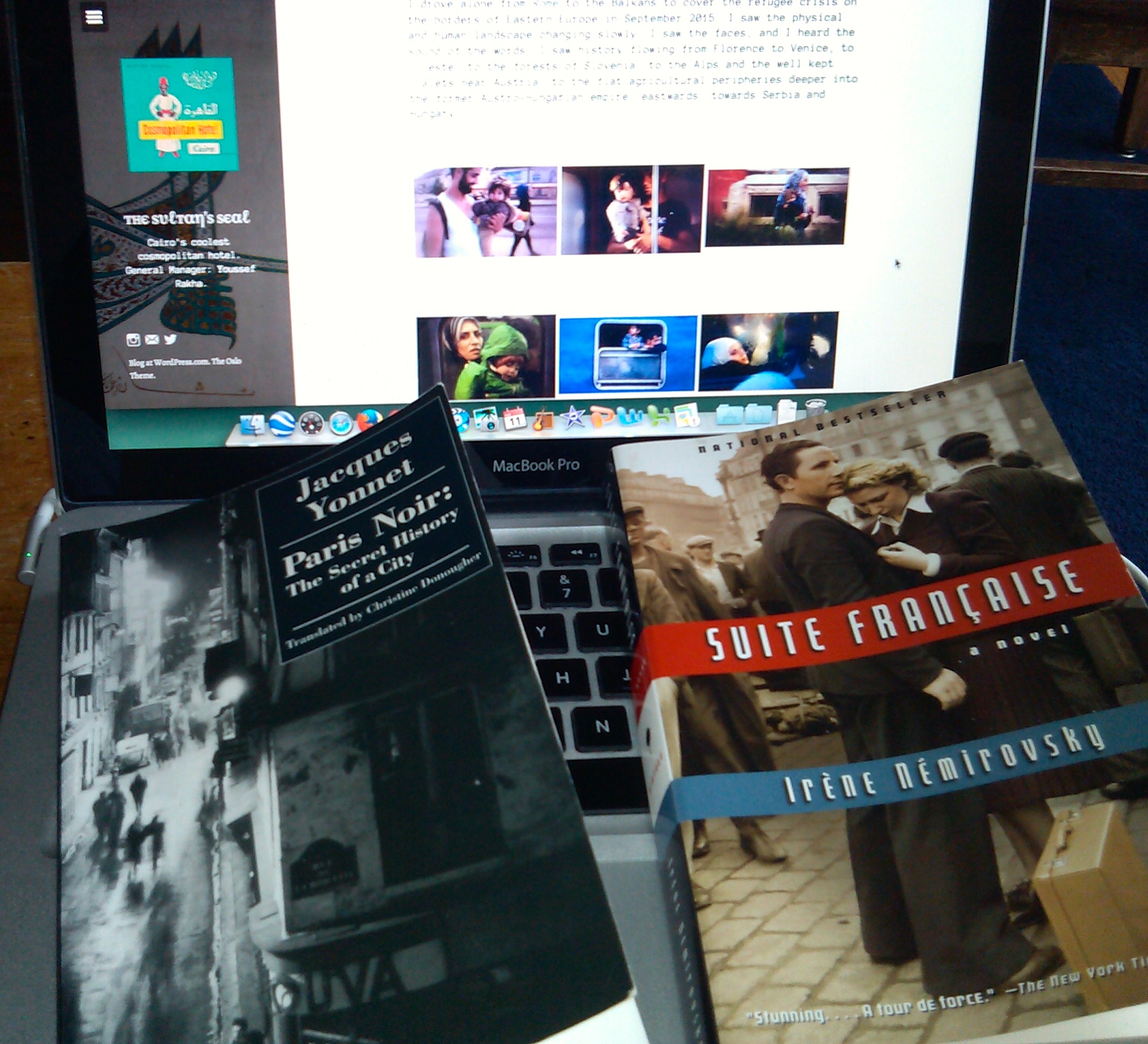
We are in Nazi occupied Paris, in Jacques Yonnet’s “Paris Noir: The Secret History of a City.”[i] Most able Parisians have escaped and are on the run, many at the last minute, by train or car, bicycle or walking, long crowded lines moving generally south to southwest, ahead of the advancing Nazi army about to reach Paris. This migration is of course history: dates, names, and numbers dutifully recorded, but for a bird’s eye view of the ordinary trauma, conversations, blunders, hopes, and fears of the average Parisian fleeing the city, many packing as if for a vacation to the Midi, turn to “Suite Francaise,” a recently uncovered account in the form of a novel by Irene Nemirovsky, who died in Auschwitz.[ii]
Yonnet’s book takes place in Paris during the occupation and after. The narrator works for the Resistance, running several missions and establishing connections and communications, always an eye on the patrolling Nazis, living in squalid conditions, associating with all kinds of gone to seed characters with names like “Keep on Dancin’.” The narration reads like a journal or diary.
For the characters in Nemirovsky’s book, the trip out of Paris is a nightmare. Food is quickly scarce, as is petrol, cars are abandoned, train schedules uncertain, everywhere long lines of refugees on the move, unable to carry much, villages and towns empty of provisions, families sleeping out, feeling lucky it’s June and the nights warm, but then again it’s too hot. There’s nothing to drink, nothing to eat. A few enemy planes buzz overhead, explosions heard in the distance, and a few bombs drop near, the strategy uncertain, apparently to take out train stations, rail lines, fuel depots, but there are civilian casualties and injuries. And throughout the telling of it, Nemirovsky focuses close in, describing ordinary people caught unprepared in extraordinary circumstances.
Samuel Beckett and his life long partner Suzanne would have been on the road out of Paris, walking, sleeping out, hiding by day, moving at night. Later, it would be said the roadside scenes in “Waiting for Godot” might have been first suggested to Beckett on his way out of Paris. And James Joyce and his family would have been on their way out of Paris, for Switzerland, Joyce concerned that the war would distract people from reading his latest book, “Finnegans Wake.”
Some of Nemirovsky’s characters describe their predicament as horrible, nothing like it ever seen before, but they are reminded by others they are not the first, nor likely to be the last.
New ethical environments quickly evolve, wrongs are met with a patient retribution, if not justice, both in Yonnet’s occupied Paris among the down and out, the deadbeat and seedy, the sick and infested, the fallen, and in Nemirovsky’s trail of humanity moving away from Paris, away from the city, away from an old life toward something new and unknown.
Back in mid-January, the Egyptian writer Youssef Rakha posted to this blog, “The Sultan’s Seal,” a photo essay by the Reuters cameraman Antonio Denti (@antclick on Instagram). Titled “Upstream,” Denti’s essay begins:
“I drove alone from Rome to the Balkans to cover the refugee crisis on the borders of Eastern Europe in September 2015. I saw the physical and human landscape changing slowly. I saw the faces, and I heard the sound of the words. I saw history flowing from Florence to Venice, to Trieste, to the forests of Slovenia, to the Alps and the well kept chalets near Austria, to the flat agricultural peripheries deeper into the former Austro-Hungarian empire, eastwards, towards Serbia and Hungary…”
Denti’s photo essay focuses on the parents and children of the recent migration and refugee crisis. He calls his project a photo diary. It is “terrifying and beautiful.”
[i] Jacques Yonnet, Paris Noir: The Secret History of a City, translated and with an introduction and notes by Christine Donougher. First published in France in 1954, first Dedalus edition in 2006, reprinted in 2009. 280 pages, paperback.
[ii] Irene Nemirovsky, Suite Francaise, a novel, translated by Sandra Smith. Originally published in France in 2004, first Vintage International Edition, May 2007, 431 pages, paperback.
 The Coming of the Toads