Tag: Writing

  • From bookface to facebook

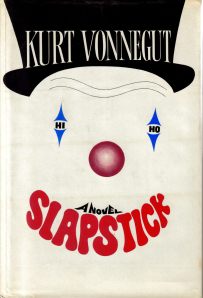
    SlapstickWhy facebook? Why not faceweb? The web is not a book. Then again, what is a book? What is a web? The web is like an illuminated manuscript.
     

    We used to call prolific readers bookworms, their faces buried in books. Bookworm is a misnomer; worms are quite social, as my compost pile reveals. But the bookworm does prefer the warmth of an open, airy book, lives within the book. The bookworm feeds on the book, a moist book, an organic book, destroying the book in the process of reading it, a deconstructionist.


    facebook…facebook, face + book, already a metaphor, specialized. Books are sequential, linear; facebook is mosaic, multidirectional: The face as book, borrowing book as ethos for the face that is prepared, so a face with credibility, reliability, with a fixed point of view. Really? Eye contact; I contact, enter-face. “Manuscript culture is conversational if only because the writer and his audience are physically related by the form of publication as performance” (McLuhan, [The Gutenberg Galaxy], 1962, p. 105). Webworm.

  • From the Gutenberg to a Gatesian Galaxy

    the Gutenberg galaxyMadison Avenue was first to show interest in McLuhan’s ideas. What were those ideas? He did not argue an aesthetic, as Nicholas Carr seems to want. McLuhan would certainly miss books, if change came to that. Every new technology alters the sensorium. Is Google making us stupid? Who’s us? What is stupid? Google’s effects are more political than aesthetical: Blessed are the dull for they shall watch television; blessed are the sharp, for they also shall watch television. Blessed are the stupid, for they shall google.
    And what of the internet? McLuhan would argue that the internet has not yet invented its content. Every new technology fills with the content of the old; Google’s book project is the reductio ad absurdum of this McLuhan tenet. If the printing press resulted in nationalism, marginal man, individualism, privacy, what will the effects of the internet be? Certainly to reinforce the concept of individualism, but without the privacy (facebook, blogging) – truly a global village, a political effect.

    When we think, we are already googling. Every technology is an extension of our senses or body, as McLuhan said and showed, and he would have argued that the internet is an extension of our central nervous system. Sitting at the internet, we are watching the reflection of our central nervous system at work. What do we think of that, and how does that make us stupid?

  • Jesus and the Jazz of Being Existential

    Existentialism 1There is no place to hide in the existentialism of Sartre and Beauvoir, but one does not go there to hide, but to realize. Jesus was the first existentialist (as Kierkegaard showed), and the early Christians lived by choice, reborn in an existential rejection of a status quo existence, rejecting their birth rights (and wrongs), if they had any, their birth situation, for a choice that gave meaning to their lives. The early Christians chose choice; they chose freedom, and the choice was all encompassing.
     

    Beauvoir is far more devastating than Sartre in criticizing roles, lifestyle as identity, faces prepared to meet faces. She obliterates the sub-man, the serious man, the nihilist, the adventurer, the passionate man.


    Jazz is the music of the existentialist. The jazz musician takes up his instrument, develops a musical attitude. His tone reveals his attitude toward the piece, an attitude that must change with each playing. The music is constantly being reborn, the jazz musician improvising, every measure a rebirth, every performance one of doubt – otherwise, why play it yet again, yet again differently?


    Where is the religion that might do for Christianity what jazz has done for music?  “To will oneself free is also to will others free” (Beauvoir, The Ethics of Ambiguity).

  • Eca de Queiros and a Metaphysical Googlelarity

    McLuhan, The Medium is the Massage: An Inventory of EffectsWe know technology changes us, rearranges the sensorium; the printing press, for example, gave the eye dominance over the ear, as McCluhan explained. But is technological change bad for us? What do we value? What do we want? We survive by our abilities to adapt; change is irrelevant. The question shouldn’t be “Is Google Making Us Stupid?” but, is Google making us happy?

    In Eca de Queiros’s The City and the Mountains (1895, new Margaret Jull Costa translation from New Directions, 2008) civilization is defined and confined by its “machines and instruments” (p. 50): “Defeated, my Prince slouched into his study and did the rounds of all those machines intended to complete or facilitate Life – the Telegraph, the Telephone, the Phonograph, the Radiometer, the Graphophone, the Microphone, the Writing Machine, the Adding Machine, the Electric Press, the Magnetic Press, all his tools and tubes and wires…” (p. 120).

    There’s even a link, 1895 version: “Then, desperately, he linked No. 202 up with the telegraphic wires of The Times, so that his study, like a heart, would pulsate with the whole Social Life of Europe” (p. 114-115).

    But the ruling class isn’t happy, and getting on their machines does nothing to improve their foolishness: “Like some icy, melancholy sun, the Electricity blazed down on the silence and on the pensive immobility of all those backs and all those décolletages. From each attentive ear, cupped by a hand, hung a black wire, like a piece of intestine…superior, civilized beings devoutly and silently drinking in the obscenities Gilberte was bleating down the line at them from beneath the soil of Paris, through wires buried in the gutters, close by the sewers…” (p. 62-63). They are all logged on, severally, to the “Theaterphone.”

    The problem is the city, civilization, machines that lack the ability to bestow grace: “But the City has its most deleterious effects on Man’s Intelligence, which it either imprisons in banality or drives into wild extravagance” (p. 93). The city lights do not illuminate most of its inhabitants: “If the illusion of the City could at the very least make all the people who maintained it happy, but it patently fails!” (p. 94). And so they leave for the mountains of the title, taking only a small part of the “super-civilized Prince’s sumptuous collection” with them.

    Were it 2009, would they be taking their laptops, which, like Stevens’s jar in “Anecdote of the Jar,” would likely jar the nature of the mountains and their own alike, like nothing else in Portugal? We find out in the second half of The City and the Mountains.

  • John Cage, Cowboy Surf Shop, and Garage Jazz

    John Cage was the first garage musician, freeing music at once from the academy, from high culture, from ubiquitous radios, from naturalism – from preconceived notions of what sounds should sound like. Cage valued sounds; he desired sounds, required sounds. Cage captured sounds he found in his environment and remixed them in his garage, creating a philosophy of music that encouraged listeners to experiment, restoring sound to primeval element. Cage’s music is not devoid of sentimentality, and heralds both warnings and callings – electronic blasts to the chest, bees dancing in the labyrinths of our ears.


    We are anxious to hear the sounds we make, our own voice, which we hear in unison, subverting our self-consciousness. The echo, reverb, was the first natural recording. Garage Band allows us to extend the range of our voice, format, and get loopy – all Cageian values. We’ve been listening for a long, long time; how much training do we require?


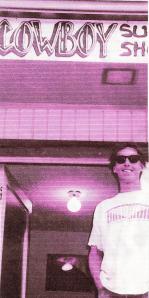
    Cowboy Surf ShopJohn Linker’s Cowboy Surf Shop employs his various interests – folk, alternative, literature, surfing, and playing guitar as something to do with your hands. In one piece, “Rock ‘n Roll Eden,” a Lou Reed cover, we hear a voice reading from Jack London (Jack’s ranch, in the Valley of the Moon, is not too far from John’s place). A diversion from teaching duties, John’s project is a demo, a rough draft, experimenting with loops, voice-overs, a variety of instruments (sans drums – bass picks up both rhythm and percussion), and improvisation on covers and originals.


    When in the Army in the late 60’s we used to hang around the motor pool after hours playing guitar. Spec. 4 Martin, who had worked at Fender, offered this criticism: “You never play the same thing the same way.” As we’ve discussed, Cage was not a jazz fan, but what we require now is garage jazz, inviting thought: what is garage; what is jazz.


  • Distance of First Person Plural

    For some time we’ve been thinking of addressing the blog’s use of the first person plural. Are we a group blog, or command central for some multiple personality? Are we looking for safety in number?

    At St. Anthony’s in the early sixties we lined up outdoors in front of our classrooms following recess, shortest in the front to tallest in the rear, boys stage left, girls stage right. Reverend Mother called out “Distance: 1, 2, 3.” On 1, we placed our left hand, extending our arm, on the left shoulder of the student in front of us; on 2, we extended our right arm, the line pressing backward and up the hill as we distanced ourselves from each other, so the tallest in the back became taller still, and a kind of order overcame and stilled the playground. The unruly mob dissipated; the shouts on the street diminished. And on 3 we dropped our arms to our sides and stood silently at attention, individuals now, each responsible for I. We disappeared from view. Deviations deserved detention; no one wanted to be a you. All was still, until a whistle blew, and we marched into the classrooms.

    Readers familiar with The New Yorker may recall the editorial “we” of the early “Notes and Comment” section of that magazine, to which E. B. White often contributed, writing, against his intuition, in the first person plural, the required editorial voice of the section. White apparently thought the practice silly; nevertheless, we recommend you try writing in the first person plural as a writing exercise.

    You might enjoy the distance of the joke, a kind of detachment that comes from not taking yourself too seriously, though some suggest that’s just non-committal. You can get trapped in we, and that’s not good. But losing yourself in we might make for a good writing experience, might even improve your writing. The assumption that most academic writing of course should stay out of it altogether, whence the “one” of the formal academic style, as in “one wonders what this is all about,” ignores the results – often directionless and unfriendly prose. One wonders who this one is too, and if there might be a more clear and concise way to identify oneself and one’s view. It’s a question of distance.

  • Flannery O’Connor and the Coen Brothers

    Three for FlanneryThe mixture of violence with comedy in Flannery O’Connor’s stories offers up an absurd exaggeration of the ordinary. The Coen brothers must be fans, and Flannery a precursor to their film style. Flannery’s ritual, taken from the church and put out on the street, in the fields, or confined to crowded houses, yet still proudly clad in the absurd array of ecclesiastical colors, seems to undermine any serious attempt at self-discovery, yet speaks to where we come from, who we are, where we might be going, and who might be watching.  

  • Susan Sontag and a Valentine for Flannery O’Connor

    Flannery O’Connor’s stories stir a natural absurd mix of violence and comedy. Characters argue and alienate themselves from one another. They have difficulty communicating, and they torment one another. Yet, throughout the stories, we find humor – comedy in situation, language, and setting. What better day to read a Flannery story than Valentine Day?

    In O’Connor’s short story “Parker’s Back,” Parker, having experienced the epiphany at the scene of the tractor crash, drives straight to the tattoo parlor, where he’s a frequent visitor, yet the tattooist at first doesn’t recognize Parker, and there’s humor in their brief exchange, Parker calling out that surely the tattooist must know him. “You must have been in jail” the tattooist says. “Married,” Parker answers.

    That “The world of the absurd delighted her” (Sally Fitzgerald) is clear in any reading of Flannery’s stories. Albert Camus also delighted in the absurd. But it’s Susan Sontag who best illuminates “Parker’s Back.” Borrowing Sontag’s terms, from her essay on Norman O. Brown’s Life Against Death, Parker is body, and Sarah, his wife – well, is not body, but what is she?

    Sarah dislikes color, and color, for Flannery, is sacramental raiment; her stories create a collage of peacock feathers. “Christian asceticism,” O. Brown writes, “can carry punishment of the fallen body to heights inconceivable to Plato, but Christian hope is for the redemption of that fallen body.” Sarah, who is “saved,” rejects Parker’s vestmented body. “…by putting his ideas in the framework of Christian eschatology,” Sontag tells us, “…Brown’s analysis, by allying itself with some of the submerged promises of Christian eschatology, opens up the possibility of a psychoanalytic theory of history which does not simply reduce cultural history to the psychology of individuals.”

    Of course, Sontag also gave us this – from “Against Interpretation”: “…interpretations of art today poisons our sensibilities. In a culture whose already classical dilemma is the hypertrophy of the intellect at the expense of energy and sensual capability, interpretation is the revenge of the intellect upon art…it is the revenge of the intellect upon the world. To interpret is to impoverish, to deplete the world – in order to set up a shadow world of ‘meanings.’” Happy Valentine Day, Flannery.

  • Albert Camus on the Economic Collapse

    RefugioAn old friend from our South Santa Monica Bay days writes, “Did I hear that right? 5 day forecast for around here is in the upper 80’s.  Visibility for miles.  Air quality is wonderful. But, this is January.”
    In the mornings we went surfing, and in the afternoons we played whiffle ball in the yard or in the street. Maybe we walked to the five and dime for a pack of baseball cards, but if there were no good cards in the pack there was still the bubblegum, the smell like a perfume. Summers we camped on the beach at Refugio and for days wore nothing but our swim-trunks. 

    Camus Lyrical and Critical EssaysWe are reminded again of Camus’s “The Sea Close By”: “I grew up with the sea and poverty for me was sumptuous; then I lost the sea and found all luxuries gray and poverty unbearable” (p. 172). And this, from “Return to Tipasa”: “In the depths of winter, I finally learned that within me there lay an invincible summer” (p. 169).

    Camus, Albert. (1970). Lyrical and critical essays. Vintage Books: New York.

  • E. B. White and the plumber

    By the Nose

    In December of 1930, E. B. White wrote a piece for the New Yorker about the garbageman. “They have the town by the tail and they know it,” White concluded, after a brief study of the can collector’s habits. We like to watch the trashman too, the descendants of White’s subjects, wrestling now with new regulations, recycling, knowledge of toxic waste, but still masters of noise and dust, their barking trucks heard for blocks, avalanches of glass announcing last call for trash. But while today’s garbageman may still have the city by the tail, surely it’s the plumber has it by the nose.

    My father was a plumber, and asked us to join him in the trade; shucks, I wanted to continue school. But I worked with him summers and accompanied him on enough evening calls to achieve a kind of apprentice status. A neighbor would knock, a friend would call, a parishioner, a friend of a friend – a brief diagnosis on the phone and I was told which tools to grab from the garage and we were off, a doctor making a house call. Dad almost never accepted money for these evening jobs. He would accept a beer, sit, and talk.

    No job was too awful, foul, or hard. With his bare hands he swept away monstrous crawl space spiders, reached into cold plugged up toilet bowls, chiseled oakum into cast iron joints – which I sometimes got to pour the molten lead into with the long handled ladle from the boiling pot. Our antagonists were usually stripped threads, worn washers, busted pipes, and all manner of backened slop. Dad did not relish repair work; by day he was a new construction plumber, working with new parts, not used. What he did relish was the opportunity to get out of the house and talk to people. He was the James Joyce of the plumbing trade. He could talk to anyone, for he had them, and he knew it, by the nose.

    Time passing and enter George, the veteran plumber we now call when wet to the knees and elbows but I still can’t fix it. We called George recently to help us with a pipe cracked during the big freeze and snows. After the job we sat with George in the living room; he did most of the talking, and we listened. Before the pipe broke, I had been reading E. B. White, but after George left, I let E. B. sit, and I paused to think of my father, the plumber, and my decision to continue school.

  • A word of one’s own

    Comfortably ensconced in our reading lair, hidden behind the arras of the Dec. 8 New Yorker, perusing the cartoons, time passing easily, and find our Eric has been at work on his French, annotating the Mankoff cartoon caption “A la Recherche des Cheveux Perdus” (p. 68) with the translation “Remember Hair Lost.”

    What is past is lost, but still we recall – writing is a lure; reading, a way of walking.

    Menand, Jan. 5: “Feiffer’s strips are about borrowed ways of talking, about the lack of fit between people and words, about the way that clichés take over” (p. 43).

    Blake: “No bird soars too high, if he soars with his own wings” (The Marriage of Heaven and Hell, “Proverbs of Hell”).

    Nabokov: “…minor readers like to recognize their own ideas in a pleasing disguise” (Lectures on Literature, “Good Writers and Good Readers,” p. 2).

    In Nabokov’s teaching copies, his annotations include his own translations; in his copy of  “The Metamorphosis,” for example, he substitutes the Muirs’s “uneasy dreams” with “a troubled dream,” and “a gigantic insect” with “a monstrous insect” (p. 250). Monstrous means marvelous and strange, and Nabokov starts his students off with a different view of Gregor, beginning with Kafka’s first sentence.

    Woody Allen: “Honey, there’s a spider in your bathroom the size of a Buick” (Annie Hall).

    For Nabokov, reading meant rereading in excruciating detail, never straying from the text, bringing to exact light and color the watermarks of the text, like working a coloring book.

    As for the uneasy, or troubled, dreams, Kafka reveals in the second paragraph that “It was no dream.”

    But one’s own words? Where does one find them? Sometimes a word of one’s own seems no more possible than a room of one’s own. For some answers, we might turn again to E. B. White’s Elements of Style, where we are warned to “Write in a way that comes naturally”; “Avoid fancy words”; and “Avoid foreign languages” (Chapter V).

    As for using words of one’s own to find lost time, Nabokov says: “…to recreate the past something other than the operation of memory must happen: there must be a combination of a present sensation (especially taste, smell, touch, sound) with a recollection, a remembrance, of the sensuous past” (p. 249). It took Proust 1.5 million words to illustrate that we are “…not free…to choose memories from the past for scrutiny” (Nabokov, p. 248).