Tag: Writing

  • Small Wave Riders 2009 annual surf trip video

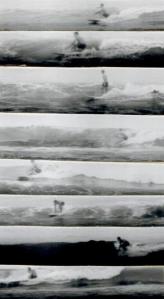
    Joe Waves at El Porto circa 1969
    El Porto waves, circa 1969, riding a modified Jacobs.

    Gregg Noll, the first of the modern big wave surfers, never lost sight of the fun to be found in small waves. In the early-60s, still in the original Gregg Noll surfboard shop, in Hermosa, when asked if he found small waves boring after having surfed the giants, he replied not at all, he would always have fun in the South Bay slop. I know that because I was there, a local kid dreaming of a new board, and I asked him.

    Having fun in small surf is the sentiment that fuels Small Wave Riders. There are other reasons – as we get older, paddling out gets harder. And there is the pulling archetype of the surf trip (on the west coast, this means a long cruise on Highways 1 and 101, and Pacific Coast Highway, and Highland Ave., checking out the surf spots along the way); and community, always local, throwing off the work clothes (if necessary) for jeans, t shirt, and sandals – trunks and a surfboard (for “Jesus was a [surfer] when he walked upon the water,” sang Leonard Cohen, or might have sang, had he been a surfer; he sang “…sailor…only drowning men could see him”) – living out of the surf rig, a tent, the occasional old friend’s place up from the beach, eating out of bags, or at the best (discovered word of mouth) local dives, body sticky with sand, wax, and salt; and the blue green grey lure of the ocean, of men going down to the sea.

    Of course, over time, conditions change. Jesus now wears a wet suit, including booties, hands, and hood, and every spot is crowded, even the spots where the waves are so small they can hardly be called waves. The locals are even more protective of their spots, so the surfer on safari is sometimes well-advised to select a less crowded spot, even if it means yet smaller waves. But “just get in [the water]” is brother John Linker’s mantra. Once in, once the glass is broken, there’s no closer union with nature, physically and mentally. One doesn’t think on waves, not in the normal sense of thinking; once in, one is guided almost by pure instinct, and the Cartesian split is temporarily taped.

    So we were delighted to receive in the mail this past week the 2009 Small Wave Riders annual surf trip video, this year titled 5 Point 5. The film technology continues to improve, as does the technique. The sound track is blended with the waves and action, and the sequences of driving, stopping to check out a spot, paddling out, catching waves, then kicking back after the set, create a structure that feels natural, allowing for hightened viewer engagement. Some of the technique is reminiscent of the best of the old surf films, the ones we used to see in the Hermosa Beach High School auditorium, the independent, locally filmed surf movies, and there are also reminders of the great, original Endless Summer. Of course, these days, the summers get shorter, not longer, let alone endless, and the trip comes to an end, again in the old surf film manner, too soon, after only 35 minutes of small wave surfing. But it’s enough. Our appetite for a wave is soaking wet.
  • Emily Post’s Rhetorical Garden: A Field of Claims, Evidence, and Warrants

    It’s too bad Emily Post was not a literary critic, for she was a whiz at rhetoric.

    This is as close as she comes to lit-crit, but who can disagree? “There is no better way to cultivate taste in words, than by constantly reading the best English. None of the words and expressions which are taboo in good society will be found in books of proved literary standing. But it must not be forgotten that there can be a vast difference between literary standing and popularity, and that many of the ‘best sellers’ have no literary merit whatsoever” (chap. 8, para. 7).

    Unfortunately, she does not give away the titles in her library, but her assumptions can be deadly: “It is difficult to explain why well-bred people avoid certain words and expressions that are admitted by etymology and grammar. So it must be merely stated that they have and undoubtedly always will avoid them. Moreover, this choice of expression is not set forth in any printed guide or book on English, though it is followed in all literature” (chap. 8, para 1).

    If you are looking for an exercise to practice identifying claims, evidence, and warrants (and who is not?), take a look at Emily Post’s original Etiquette (1922). Get ready to frolic in a field of assumptions.

    “Every house has an outward appearance to be made as presentable as possible, an interior continually to be set in order, and incessantly to be cleaned. And for those that dwell within it there are meals to be prepared and served; linen to be laundered and mended; personal garments to be brushed and pressed; and perhaps children to be cared for. There is also a door-bell to be answered in which manners as well as appearance come into play” (chap. 12, para. 1). And don’t we know it?

    “But the ‘mansion’ of bastard architecture and crude paint, with its brass indifferently clean, with coarse lace behind the plate glass of its golden-oak door, and the bell answered at eleven in the morning by a butler in an ill-fitting dress suit and wearing a mustache, might as well be placarded: ‘Here lives a vulgarian who has never had an opportunity to acquire cultivation’” (chap 12, para 4). We’ve a rule in our place that offending mustaches must be swept clean by eleven every morning (save Saturday).

    “Who does not dislike a ‘boneless’ hand extended as though it were a spray of sea-weed, or a miniature boiled pudding? It is equally annoying to have one’s hand clutched aloft in grotesque affectation and shaken violently sideways, as though it were being used to clean a spot out of the atmosphere. What woman does not wince at the viselike grasp that cuts her rings into her flesh and temporarily paralyzes every finger?” (chap. 3, para. 14).

    It becomes increasingly clear why Emily Post did not go into literary criticism. As George Bernard Shaw said, “Those who can, do; those who can’t, study etiquette, or rhetoric, or grammar, or some such thing.” And Emily’s Etiquette is a work of fiction, and she is a stunning, literary star. Had she placed her cartoonish characters into any kind of plot, she could have been as good as P. G. Wodehouse.

  • How Do Professors Think? More Crisis in the Humanities

    LiberationsAt the bottom of her n+1 review of Michele Lamont’s How Professors Think, Amanda Claybaugh laments that Lamont “fails” to answer the promise of her book’s title. Claybaugh appears to buy into the title’s assumption, that professors think differently than others. But why would professors think any differently than anyone else? Indeed, from the professor quotes offered in the review, they appear to think exactly like everyone else: “so sick [of hearing]”; “it’s hard to articulate”; “nothing is perfect”; “just still didn’t get it”; and the ubiquitous “[don’t] be an asshole.” 

    Claybaugh reads in the field of English; Lamont, sociology. It’s assumed one’s discipline amounts to a special pair of spectacles, and only through the lenses of the discipline can one fully appreciate, or aspire to, or do at all. Specialty is the extreme license: “…disciplines make a strong case for themselves when they unify around a shared method….” And to the extent that “English is seen as having no method of its own,” it also has no discipline, and its “…proposals …are seen as wandering into territory claimed by other disciplines.” Blame it on the essay, on Montaigne, all that wandering, those long trials. One English professor advances that close reading is a method, but in an apparent lack of self-confidence worries “…whether historians might not ‘know how to do this better’ after all.” Too bad; she might have mentioned Louis Menand and his American Studies or his The Metaphysical Club, or Caleb Crain’s American Sympathy, examples of English folks wandering afield successfully.

    Consider the end of Bradbury’s Fahrenheit 451. Montag, on the run and under the influence of the former English professor Faber, joins the radicals living outside the city, memorizing books. They become the book they digest, the ultimate specialist. That’s a cool ending, but for a professor, why wouldn’t, as Buckminster Fuller gives us, specialization lead to extinction?

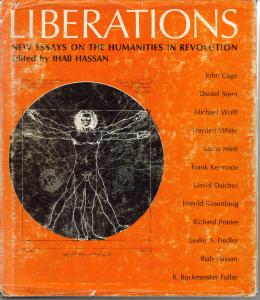
    In his preface to Liberations: New Essays on the Humanities in Revolution, Ihab Hassan asserts the professors have climbed out of their boxes: “The discomforts of the academy are already too much in the public eye. Yet how many see, I wonder, that we now strike past the college administration and campus guard, past the curriculum, past scholarship itself, at an older idea of man? The famous drawing of Leonardo, arms spread and legs apart, giving the human measure to circle, square, and universe, no longer takes our breath away. A post-humanism is in the making. What will be its shape?” Alas, that was 1971; the revolution is now in crisis.

    “For if the lingo gasped between kicksheets, however basically English, were to be preached from the mouths of wickerchurchwardens and metaphysicians in the row and advokaatoes, allvoyous, demivoyelles, languoaths, lesbiels, dentelles, gutterhowls and furtz, where would their practice be or where the human race itself were the Pythagorean sesquipedalia of the panepistemion, however apically Volapucky, grunted and gromwelled, ichabod, habakuk, opanoff, uggamyg, hapaxle, gomenon, ppppfff, over country stiles, behind slated dwellinghouses, down blind lanes, or, when all the fruit fails, under some sacking left on a coarse cart?” (Joyce, Finnegans Wake, p. 116).

    Where, indeed.

  • Where jazz and literature get encaged

    The 2009 Believer music issue (July/August 09) arrived yesterday, and there’s a perceptive interview with jazz guitarist Pat Martino:

    “BLVR: What do you think jazz’s place in American culture is today?”

    “PM: The only thing I can be definitive with is an example. Take the students of jazz in our conservatories and universities. They’re studying harmony and theory, which is not jazz, that’s music. Number two, they’re studying and transcribing artists of the past – past cultures, or stages of our culture, and that is not the reality of today. So it [jazz] is not alive the way it used to be. And they’re studying something that is encaged, and they’re analyzing it to participate in something that no longer exists” (p. 73).

    I was reminded of Louis Menand’s recent piece in the New Yorker (June 8 & 15, 2009), on creative writing programs: “Academic creative-writing programs are, as McGurl puts it, examples of ‘the institutionalization of anti-institutionality.’ That’s why institutions love them. They are the outside contained on the inside” (p. 108).

    And John Cage: “A newspaperman wrote asking me to send’im my philosophy in a nutshell. Get out of whatever cage you happen to be in” (M, Writings ’67 – ’72, p. 212).

  • From Iran: “Don’t send me no more letters no,” not unless you Twitter them.

    Iranian StampsOn 7 December 2006, the informative and engaging blog Steamboats Are Ruining Everything posted on scholarly journal offprints and stamps. I recently read the post in a book version of the blog titled The Wreck of the Henry Clay: Posts and Essays, 2003-2009, published by the blog’s author, Caleb Crain, and which I recently purchased at Lulu (now a regular reader of the blog, I didn’t discover it until sometime in 2007). Part of Caleb’s 2006 post reminded me of my own stamp collection, which I had not looked at in some time.

    I am not a philatelist. I saved the stamps more than collected them; they were given to me, each a small gift, by my students at the time, English as a foreign language students in the late 1970s and early 1980s. The saving of stamps began when a couple of students asked me to help them with translations of letters – they wanted to reply in English, or to gain more English by translating letters from home into English – and I commented on the stamps I was seeing. A rumor seemed to circulate that I collected stamps, and before long indeed I did, my students, for the most part dispossessed, disarrayed, and sometimes disappeared, happy for an opportunity to easily give their teacher something in return (though what I gained from my students, stamps or no, was more than anything I gave to them).

    A number of my stamps are from Iran around the time of the fall of the Shah, and several were given me by Zahra, an Iranian doctor who stayed briefly in the US after one of her sons was killed in the revolution. When I first met her, another of her sons introducing us, she reached out, looking deeply into my eyes, and held my face in her hands, to her son’s embarrassment, though I did not mind, and she said that I looked like and reminded her of her lost son. Later I learned that she had spent days looking for him, wandering around Tehran, searching through stacks of body bags in freezers. Zahra returned to Iran and wrote to me of the war on the Iraq front, where she had gone to doctor the injured. She talked of the age of the soldiers, the waves of certain casualties as the boys ran hopelessly across the desert battlefield (but I can’t find this letter; it’s possible my memory fails here, and that this impression is from another Iranian student from whom I probably asked for news of Zahra).

    But I have other letters from Zahra. In one, she wrote that rumors of shortages were unfounded. In February of 1981, she wrote: “Joe I didn’t write letter as an american or an iranian this is an outlaw letter, it is just as I feel like to write….” She asked that I “please write me letter in print with typewriter.” I grew reticent though, fearful the letters might put her at some kind of risk, and our correspondence ended. Her last letter to me closed with “…I miss you and I am looking forward to have letter from you and hear some thing about you.” She had written, “I think the people of Iran are big they’r tolerant and patient people. They can get along with all situation NO NO Joe all people are the same and all are in situation as iranian.” (I have copied from Zahra’s letters exactly as she wrote them, though she always asked me to send them back to her with corrections.)

    Now of course, the revolution, a dormant volcano, erupts again, but Twitter and other e-tools may make stamps and letters, like Caleb’s offprints, obsolete.

  • Where Marilyn Monroe meets Helmut Schmidt in a field of Mellow Yellow

    Few enterprises must ring more sentimental than the naming of roses, as a trip this week to the Portland Rose Garden illustrated. There was “Falstaff,” the floppy blooms droopy from the persistent showers, and “Jude the Obscure,” no blooms at all, and “09R207,” waiting to be named like a waggling puppy at the pound (we would name him “Clumsy Pink”). The “Ingrid Bergman” gave no scent. “Opening Night” yielded velvet, dark red petals. “Mellow Yellow” brought back that woeful Donovan tune. And “Helmut Schmidt” seemed peacefully at ease in its smoky yellow, inviting conversation. We passed easily by “Easy Does It,” and came to “Marilyn Monroe,” our favorite of the day, its reddish-berry pinks unfolding into ice-creamy-yellow pastels.

    By then we were fast at the game of anticipating any rose’s name, almost always surprised, though, if not disappointed, as in the case of the rose which surely should have been named “Peppermint Ice-cream,” its random, maroon stripes rippling through vanilla-white spoonfuls, but it was instead called “Sentimental.”

  • “A Grammar of Love”

    My poem “A Grammar of Love,” which appeared in the May 24, 2009 print edition of The Christian Science Monitor, and which you might enjoy, is now posted on the CSM website.

  • Ruth Reichl Comforts with Apples, Beckett with Words

    “How’s the carrot?” Vladimir asks. “It’s a carrot,” Estragon replies….“That’s what annoys me….I’ll never forget this carrot.”

    If a food writer describes an ice cream cone with such description that we can taste it – ah, but that’s just the problem, we can’t taste words. Words have shape, perhaps even texture. They fill our mouths, or used to, when we read like the monks, but words don’t have flavor. This is the existential predicament of the restaurant and food critic.

    Perhaps it explains the poetic license of their exaggerations. Reichl, explaining her resorting to fiction to enliven a restaurant review, explains to her editor at the LA Times, “Haven’t you noticed that food all by itself is really boring to read about?…It’s everything around the food that makes it interesting. The sociology. The politics. The history” (p. 250). Nevertheless, “…this won’t do,” her editor replies. “In journalism you have to tell the truth” (p. 250). She then goes on to describe the historic Hancock Park neighborhood of Los Angeles, where “…the houses were decrepit…” (p. 251). It’s been awhile since we’ve driven through Hancock Park, but surely only a food critic could describe the dwellings and lawns there as bedraggled.

    But then the perspective is from one for whom meals last five hours, and where “For great balsamico, the process takes an entire lifetime, the vinegar becoming more concentrated as it progresses through subsequent barrels of oak, chestnut, mulberry, and juniper” (p. 59). She can comfort with words, and the words do, for the most part, describe food.

    “Crritic!” says Estragon, “(with finality).”

    Reichl, R. (2001). Comfort me with apples [with recipes]. New York: Random House.

  • Kicking E. B. White When He’s Down

    To a neighborly inquiry, yes, we saw the vicious attack on the venerable E. B. White, first in the Chronicle, then, with several bystanders jumping on for a kick or two, in the Times. We first became aware of Pullum at Emdashes, where, we thought, Martin Schneider – omitting needless words – handled the matter clearly and concisely and to a close, but we like following links, so from Emdashes, we followed a link to Levi Stahl’s discussion; without explaining too much, he dismisses the academic Pullum to move on to a more tasteful topic, E. B. White’s letters.

    We are aware of the shortcomings of Elements, having on our own often tried to tackle the issue of what’s correct when. Pullum posts his own follow-up, fed up with the commenters (we have added his blog to our feeds). In his follow-up, he heads off going to his book, but it seems fair to ask if not White then what. Pullum’s book is a descriptive grammar, so it “…will not…make recommendations about how you should speak or write” (p. 3). It should come as no surprise to anyone that there are disagreements and conflicting opinions. For example, and as we’ve pointed out, White said to write with nouns and verbs; Erskine said to write with modifiers. Of course, the answer is to write with words, and good luck choosing the right ones, putting them in the right order, and separating them with the right punctuation.

    In the June 28, 2004 New Yorker, we enjoyed Menand’s dissing of Truss, and he helps explain why we prefer White to the standard grammar text. Menand (like White before him) writes as a generalist, not a specialist. Menand argues, and we agree, and we think that White also agreed, that the rules don’t really have much to do with effective writing. If they did, most academic writing would not be nearly so anemic. Pullum complains in his Chronicle piece that “Some of the recommendations are vapid, like ‘Be clear’ (how could one disagree?).” Yet much academic writing would improve if the writer would only make some attempt at following this obvious, White tenet. In Menand’s piece, titled “Bad Comma,” he has something more to say than corrections of Truss. We don’t find that Pullum has much more to say, at least not on the evidence of the two pieces we see here.

    We’ll ask White to help us with a close, from the March 4, 1944, New Yorker: “A good deal depends on the aims of a publication. The more devious the motives of his employer, the more difficult for a writer to write as he pleases. As far as we have been able to discover, the keepers of this house have two aims: the first is to make money, the second is to make sense”; two aims that academic writers are not usually saddled with. 

    None of which directly answers Pullum’s argument. Pullum has two points: one, that Elements is flawed; two, that the flaws have afflicted generations of students who as a result of their immersion in Elements cannot now write. Pullum provides support for his first point; his second is insupportable. There might be scores of students unable to write, but it doesn’t follow that it’s the fault of Elements. But what about our point that the argument is somehow embroiled in academic versus commercial ends, that Pullum’s secret thesis is the advancement of the purpose of his text – a poor advertisement if he wants to compete with the incredible ethos surrounding White, an ethos based not on Elements, but on his actual writing success. That point is irrelevant to Pullum’s argument. But we have two claims too: first, students can’t write because they’ve been taught writing from grammar handbooks and textbooks, wrong from the start; second, that the textbooks are unnecessarily academic and rarely involve the kinds of reading experience necessary for students to improve their writing skills (the textbook industry’s commercial success is driven in large part from forced new editions, captive student readers, and exorbitant pricing). 

    At the same time, there are academic efforts that have made both money and sense: for example, Zinsser’s On Writing Well; Toward Clarity and Grace, by Joseph Williams (whose “The Phenomenology of Error” is must reading for anyone seriously interested in this argument); and Notes Toward a New Rhetoric, by Francis Christensen. We never said Elements was the only book to read, just that it is a worthwhile book to read and carry. And we are grateful to Mr. Pullum for updating its errors – his analysis will add fuel to the discussion of the choices suggested in Elements.

  • E. O. Wilson’s Happy Ant in Mary Midgley’s Primate Picnic

    Human freedom creates morality, for to exercise our freedom we are held in a cage of motive. The stuff of motive is found in literature, and we thought we might there experience freedom unrestrained by complicity, and our awareness of others’ actions might be total. Through literature we would enjoy our freedom without ourselves being questioned as to our motives.

    Those are the sorts of things I found myself jotting down in my notebook while reading Midgley’s book. Why was I reading Mary Midgley? I’d been meaning to read some Midgley ever since her interview last year in The Believer – which she consented to only after being assured it was not a religious magazine.

    Midgley takes on E. O. Wilson, who viewed humanity as a dysfunctional ant colony, saw the potential for individual happiness from a sociobiologist’s viewpoint, the neurobiologist the queen of the ant hill. The Humanities work best when non-specialized, and acknowledging a plurality of motives, looking behind the Main Street facades, but enjoying the stroll. But when the Humanities also buy into reductive thinking, and fragment, capabilities are lost, for, as Buckminster Fuller showed, specialization leads to extinction – when the organism loses its ability to adapt. Midgley’s term of Wilson’s progress is “bilogicised,” where he excludes “amateur thinking,” and the “merely wise,” as if there is such a thing as an amateur human, people who live just as a hobby. But looking at today’s superhighways one wonders if Wilson wasn’t on to something with his ants. But do ants cry? Laugh? Stray from the scented path? Take irrational risks? Celebrate birthdays? Humans are not ants, even if they both do like to picnic. 

    Midgley explains that moral judgments are not only possible, but necessary, and not only necessary but mandatory, compelling, and binding: mandatory in that to be human is to be moral; compelling in that our moral judgments forge our path through the otherwise inhospitable jungle of the universe; binding in that we must live the results of our judgments – we can’t escape our own judgments.

    If we are in the universe, and we have a moral purpose, how can the universe not have a moral purpose? For why is there something? Why is there simply not something, but nothing? Does not this fact of something trump the possibility of nothing, and suggest a moral to the story? Perhaps we are short-lived, but if we are short-lived why have we evolved to a moral purpose, that moral purpose evolving consistent with our evolving consciousness? Perhaps we are the universe’s only chance at a moral purpose, of realizing a moral purpose for itself.

    If the human is denied a moral purpose, we lose our freedom, are literally “demoralized,” and we are our own cage, a bag of genes. 

    Specialization leads to extinction, which explains why the specialists practice reduction of their competitors, wanting to “cannibalize” every threat to the dominance of their singular point of view, and thus lose the ability to adapt. The cannibalization takes the form of propaganda, a disguised values’ trap, where one is led to miscalculate the future results of one’s current actions.

    Sung to the tune of Teddy Bears’ Picnic: If you go out in the woods today you’re in for a big surprise, for today’s the day the primates have their picnic.

    Midgley, M. (1994). The ethical primate: Humans, freedom and morality. New York: Routledge.

  • Where Crossan’s historical meets Beckett’s hysterical Jesus

    Crossan finds Jesus living on the wrong side of the tracks – among the politically oppressed and the socially shamed, low class cynics roaming homeless camps.

    Beckett’s Waiting for Godot begins with a gospel attestation analysis by Vladimir:

    Vladimir: One out of four. Of the other three two don’t mention any thieves at all and the third says that both of them abused him….But one of the four says that one of the two was saved….But all four were there. And only one speaks of a thief being saved. Why believe him rather than the others? (p. 9).

    As Crossan shows, they were not all there. Very few, if any, were there. The problem then, for Crossan, is one of attestation, correlation, cross referencing the varied and disparate stories for credibility and reliability, explaining the running editions, the omissions, the additions, the different emphases – the “theological damage control” of later traditions (p. 232). Crossan’s book begins with a remarkable story, taken from ancient Egyptian papyrus, about a common family, illustrating basic household transactions, including everyday hopes and disappointments. His research reveals the social, political, and religious landscape of the Mediterranean world, and discusses the survival skills practiced by ordinary households – the concessions, the breaking points, the sacrifices, the everyday hopes and fears.

    Out of this anthropological view emerges a Jesus walking a landscape consistent with Beckett’s typical stage directions – for Godot: Act I, “A country road. A tree. Evening”; Act II, “Next day. Same time. Same place.”

    “He was neither broker nor mediator but, somewhat paradoxically, the announcer that neither should exist between humanity and divinity or between humanity and itself. Miracle and parable, healing and eating were calculated to force individuals into unmediated physical and spiritual contact with God and unmediated physical and spiritual contact with one another. He announced, in other words, the brokerless kingdom of God” (Crossan, p. 422).

    Jesus was an existentialist; there is no Godot.


    Beckett, S. (1954). Waiting for Godot. New York: Grove Press.

    Crossan, J. (1992). The historical Jesus: The life of a Mediterranean Jewish peasant. New York: HarperCollins.