- Moon fresh ribbon
smooth platen
ball dust sea - Fastened to fish
risk bamboo
water chills - Homespun shark
teeth reek bark
oil tea tree - Screeched scrounge scrawn
crested pinch
ear reach thrills - Stringing brew broils
cooking pot
catch read bin - Critical swarm
goat bearded
bee attack - Smoked fuzz moss
yucky hot
sunder skin - Feet faintly sweet
& ditties
sour retract - Poised hipster red
shower cap &
surf sandals - Now turns one last
again then
salt pearls - Ask brack weed meme
vandal cleaned
type taste twirl - Spring Selene not
bald booby
care fool horse - Trifurcation
from dear morph
solo bliss - Under deep stays
curling waves
allusive
Tag: Writing
-
Oblique Obligato
-
Not one but two needs relish sweet sorrow
Not one but two needs relish sweet sorrow.
Wooden shoe wish new saga song bonnet?
Purple flower here now gone tomorrow.
One knows not lief, and if hair be sonnet,
Wold eat polka dotted cotton culotte.
Back seats escape too simple bounded rules,
Schemes where at smart turn deer quickly departs,
Shirking away from linked coupling rope pulls.
Gears thrown greased ball bearings plop soft thudded,
Rustling rough yon fat fig leaf yellowed grass
Into well palms of gleeful looped poet,
Frogs Voila! in deep wide throated bass:
Now twanged by gee sang plus web danced for thee,
Not two but three may now exclaim in glee.
-
Optotype
Line 15 currently detours across the Hawthorne Bridge due to a temporary weight restriction on the Morrison Bridge, which is under repair. I hopped off the bus at the west end of the Hawthorne Bridge, passed the Salmon Street Springs Fountain, and walked south along the Willamette to the eye clinic, just over a mile upriver. I saw some strange markings on the sidewalk, as if math really is fun. A gaggle of signs befouled the views, whispering orders, dangers, and cautions. I noticed there were no warning signs near the mooring bollards, and wondered how many people walking along ogling the view have tripped over them. Rarely do I have to yield to slower traffic.


Just south of the Hawthorne Bridge, I noticed an interesting, kind of improvised, lean-to-dock moored just off the west bank between the bridge and the park beach, downriver from the yacht harbor. The boat and dock set-up reminded me of Anais Nin’s “Houseboat,” and of Penelope Fitzgerald’s “Offshore.” And the usual gaggle of geese casually befouled the park beach area. I don’t mind the geese, though the city has been taking precautions to minimize the goose poop problem. But I was wearing the new Fila walking shoes Susan recently scored for me, and I wasn’t sure the goose path was how I wanted to break them in. Portland is called the City of Roses. You would think the roses wouldn’t mind the geese.


Modern accommodations for travel, appurtenances for getting around – what a mess! Just north of the Ross Island Bridge, workers were just about finished dismantling the Project Pabst Festival. It was a little early to be thinking of a cold PBR Tall Boy. I walked along “River Place,” above the small harbor, and passed by the “River Walk Cafe,” enjoying the cliches, and at the corner of Meade and Moody thought, how about “Mead Place,” or the “Moody Walk Cafe”?


A rowing crew rounded the pilings of the Marquam Bridge (a concrete brouhaha that spans and expands the definition of bridge), the submarine moored behind them on the east bank, below OMSI and the Portland Opera. The Pabst Horse trotted off on a trailer. The Portland Aerial Tram (constructed at a cost of $57 million), juxtaposed with the old Ross Island Bridge, reminded me of the 20th Century: “Turn! Turn! Turn! (To Everything There Is a Season)”.


-
Packsaddle Off


what is this sound sprinkling glow
yellow doilies weaving thru blue
fescue glass chandelier worm atrium
air city surf gas soup & jazz saladsitting under dwarf apple waiting,
waiting, wanting nothing save
green this wait as Thoreau’s
Wangle Dangle backyard rhetoricdrinking can of Okanagan
Spring: “natural, simple, & pure”
pale ale & all bronze
gone Henry’s lawnthis dog’s lair
cut once a year
then go to seed
rampant & wild
tainted earso much depends upon so little
take this green garden wagon
for example
go on, take it, really take it
grab the handle and pull
you’ll see the wagon is full
of ripe red tomatoes
kids’ toys
bucket of finished garlic
bowl of basil & cilantro
some zinnias to dry insidethere’s no one in that pink
ceramic bird house hanging
from the golden rain
tree imagine living
there your nest
waiting for your mate
come home yr turn
go to store & supperyou call the kids
Caw! Caw!
& they call back
Not Yet! Not Yet!
Summer! Summer!a cloud like a clown down
pillow on clean blue sheet
perhaps it will drop a load
somewhere near soon &
sweep weep sleep deep -
A Fourth of a Poem
All around us,
the plants whisper
in dry brittle voices,
“water us, water us.”Sotto voce,
there is no water,
and what falls is not wet
or gentle,but drops of chthonic fireworks,
urban, rural, coastal infernos.
The plants dig and pray to Hades,
and cooler therethan here in this air.
-
Notes on Youssef Rakha’s “The Crocodiles”
- Instead of page numbers, “The Crocodiles,” a novel by the Egyptian writer Youssef Rakha, is marked by 405 numbered, block paragraphs, the whole symmetrically framed by references to Allen Ginsberg, the US Beat poet, to his “The Lion for Real,” signed “Paris, March, 1958.”
- Opening Rakha’s book, one finds a hand drawn map labeled “The Crocodiles’ Cairo,” which includes a drawing of the head of a lion, which might somewhat resemble, in caricature, the photo portrait of Youssef Rakha that appears on the inside back cover of the book, at least the seemingly ironic smile of both suggests they know something one or the other or the reader may not.
- Napoleon’s March to Moscow, 1812: Description. Lineal novel. Variables. How to tell the story? What happened along the way, and back? They were marching through snow, in below freezing temperatures, and you want to know the exact temperature at daily geographical interval locations? Body counts alone won’t tell the story. How to present data and information? Multivariate analysis in a single photograph. How to revision history? On the way back, there were no ramparts, just fields of snow and a sea of time. Napoleon may well have dreamed of warmer days, when he lived in Egypt, of unlocking a language, and of a code that would provide protection for all against the cold. A wise leader rules with allowances, and instead of burning books, gets everyone reading.
- In Astra Taylor’s “Examined Life,” Michael Hardt sets out in a rowboat in a privileged pond to argue the meaning of revolution. What does it mean to make revolution? What is the relationship between freezing temperatures, direction, and a line of march that grows thinner with each step each man takes? “Carte Figurative.” Data flow, “one ruling elite replaced with another” (Hardt), credits and discredits following, merits and demerits, kudos and kicks upside the head. Note: Hardt rows backwards – he can’t see where he’s going – at one point “…running aground, shipwrecked.” Figurative language, the hyperbole of revolution.
- “Carte Figurative.” Figurative language. Not to be taken literally. And don’t confuse Minard the author (cartographer) with Napoleon the character. Regression analysis becomes necessary. What is the relationship between the author and the narrator? Perhaps none, except that one sees what the other does not. Irony. “The Crocodiles” is a figurative map of multiple variables that attempts a regression analysis to explain past events and predict future probabilities. Note that Rakha is also journalist and photographer; each paragraph of the novel may be taken as a still photograph, a variable, part of a portfolio.
- “On the Road” with Kerouac (para. 248) and Bonaparte. My kingdom for a 1949 Pontiac Chieftain. Interactive notes: what was the cost of a 1949 Hudson new using the value of today’s poem to that of a muscle car driven by a youthful single male in 1964? Sal knew to take a southern route on his winter trip: The novel as map of a trip.
- Custom as costume. Napoleon as grammarian, his Code a multivariate blending of revolution, revelation, and reform. The novel as procedure that everyone can follow, the interaction of nouns with verbs. Custom as vernacular, empire as formal attire. Due process as drug.
- The Beatnik as attitude, beatitude. Jazz as revolution, the novel of improvisation. Notes out of context. Bonaparte’s men dropping (like) seeds (para. 256). Napoleon as lion.
- At times, reading “The Crocodiles” is like watching a foreign film with subtitles, because while all the common characteristics of the novel are included (plot; narration; characters – major, minor, dynamic, static, protagonist, antagonist, foil; dialog – though sparse, and blended with the prose, the paragraphs all block formatted; setting – places, times, seasons, dwellings, streets; diction that creates style; irony, satire, and sarcasm), something strange appears, and that strangeness is what the Crocodiles’ group calls poetry: “self-sufficiency…desire…intention” (para. 316).
- Like Minard’s “Carte Figurative” of Napoleon’s march to and from Russia (1812-1813), Rakha’s “The Crocodiles” is a figurative coming of age graphic that plots multiple comings and ages (decades, variables) packed into a single view.
- The juxtapositions of disparate subjects and actions (of real Lions with Visions of Lions; of Beats with Crocodiles; of poetry with prose; of people with bridges – para. 80) connote something new, new views: the flower children having dropped their petals now sticks of thorns (“just ask the nearest hippie,” Scalia).
- Transparency does not necessarily lead to transcendence. Neither honor nor shame stand alone as values, but they are the crossroads at which people gossip, tell stories, barter and eat and drink.
- Affinities, themes, motifs: the Beats, poetry, revolution, change, maturation, growth, body, sex, predicament, society, margins (paragraphing, units of composition, sentences), ambiguity, protest, independence, exploitation, reflection, writing, file, premature, people, obstacles, brain, chemicals, women, work, matrix, publishing, poverty and ignorance, position in group, generations (lost, beat, hippie, next), translation, drugs (real and imagined), neighbors, values, wants, needs, humor, music, violence, aggression, excuses, decadence, pop culture, misinformation, criticism, destruction, suicide, sacrifice, counter-culture, lion (cat), crocodile, logic, argument, howl, pain, Ginsberg (Howl and Moloch), dissolution, analysis, invasiveness, love, ambition, relationships, disdain, synchronicity, human nature, signifiers.
- There is something too of the noir to “The Crocodiles,” a mystery, with the narrator, “Gear Knob,” whose nickname suggests some 1950’s hard-boiled detective story character, assuming the role of the detective as corrective if not moral force. But noir is cartoon. Or “The Crocodiles” might have been a graphic novel. Instead, it is a poetic novel that breaks with genre convention and creates formal purpose and revisions value, what people want.
“The Crocodiles,” by Youssef Rakha, 2013. English translation 2014 by Robin Moger, Seven Stories Press, New York, November 2014.


-
Retro Surf Trip
At their usual spot,
the point at Refugio,
the surf was flat,
so they boogied down
in the cove,the fronds of the palms
fat and glassy green,
the rocks at the edge
smooth with rust moss hair,
the nose of his boardthrust up and curling
and curling in the blue
air of smiling swells,
but still the waves
would not breakinto hysterical laughter:
“There are no trees
on the sea,” she said,
holding a cream white
pink mophead hydrangea.“You look for shade
under the cool curl,”
he said, recalling their first
time – as soon as he stood
he wiped out,his board pushed in
with the soupy surf,
he wore no leash,
paddled out again,
and she lotioned in the sand.


-
Happy Bloomsday Interview at Queen Mob’s Tea House
Russell Bennetts, editor extraordinaire (Berfrois, Queen Mob’s Tea House), interviews the Prince of the Toads for his popular series “Poets Online Talking About Coffee.” Head on over for a cup and check it out.
Below: “The Dance Lesson,” 32 x 64, oil paint and oil pastel over acrylic:


-
Equanimity
When at last after the long ordeal,
betrothed to bed, full of ale and meal,
she knelt and put her face to the must
of the cedar chest red to her touch,she lifted the lid, its hinges oiled true,
and out came do, I, know, and you.
She reached for forever which broke apart,
and with the letters she sewed her heartand the lid closed on the squelching words
help, hero, laugh, and sword.
“Why me, Lord?” she asked. “Why pick
me to stick with equanimity? This a trick?”
-
Raspberries and Baseball
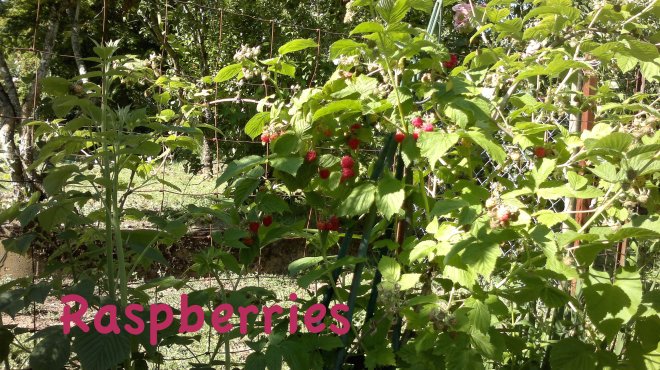
A bowl of vanilla
ice cream
as white as the apple
of your eye.Topped with
nine
lost in the wild
red
raspberries.Game-Time Weather:
Fresh yellow of daisies, not the father orange of July, nor the old man red-orange of August, or still older bleached-orange of Fall,not the infant one of March, but the teeming one of late Spring, teasing practical joker.
One day your scout
has your attention
then disappears
for a week, sends a postcard
from the Road.“Wish you were here! The sun is a marshmallow on a stick in a fire on the beach, the wave mister going
‘Miss you!’”The simple
raspberry
crumbling nodes.Vestigial poem:
100 drupelets.
And here’s the pitch –
Tart fruit!Swung on
and there’s a drive,
deep left center,
Davis at a gallop,
dives,
one hands it!Warm,
right off
the green cane. -
Photograph of Providence Urgent Care Waiting Room at Noon
Waiting room Center seat Back to window Squeeze my fingers Under a bitter blanket Opposite counter Vertigo Where? Merry-go-round stops. Wall clock running backwards You seem to have crossed some divide, a distance between following expectations and surprising the reference books on shelves marked Must Remain in Reference Room: No Check Outs – For Scholars Only! Those were the days of craves Dizzy and Monk and Bird ears. We never worried ears, blood pressure, what gave rise to touch, an orange scarf, blue waterfall behind bridge. Nurse station The nurse walks you to the scale, weighs you, takes yr blood pressure, pulse, and temperature. “The doctor will be with you shortly to hear yr confession,” and she leaves you alone to study the posters of the cross sectioned body pinned to the wall. The doctor knocks and comes in dressed in stole and stethoscope, just like on TV. “I only handle venial issues. Only a specialist can give absolution. But what good is freedom that leads to wild thoughts?” Waiting Room Families and individuals. Names called. An ambulance arrives. Para-techs wheel in empty stretcher, disappear into sanctuary. A fire truck appears. Six firemen walk through waiting room like a Rubik’s Cube. Two men in Texas gear waltz across the lobby. A boy plays with the automatic door. His father. His sister figures it out. A yell and a sigh. A woman crumbles at the nurse’s counter, a Beckett ploy that gets her plenty of attention. Valet Parking The sign says No Tips. I hand the parking attendant an Ace which he pockets. Good man! The drive home. What the Doctor said She wanted to see my pocket notebook. “I knew you were dizzy as soon as I laid eyes on you sitting out in the lobby taking pictures of the patients, word pictures.” In the waiting room waiting continues. Kids run around and play games, laughing. A few people look worried. A couple of folks look hurt, or hurting. A father falls asleep. The Clinic Closes for the Day A husband weeps. A mother changes a dirty diaper. 


 The Coming of the Toads