Tag: Writing

  • Pronunciation Checker

    What do you do when you hear a snobbish correction of someone’s pronunciation, and of a word you know both pronunciations in question to be acceptable in standard usage? You don’t want to snub the snob, yourself becoming a snob, but neither do you want any damage to go unrepaired. Worse, the situation where the corrector pretends not to recognize the thing the mispronounced word refers to. What can be more pretentious?

    As we age, do we grow less tolerant of one another’s foibles, and chop for the weakest part of their blade to snap in half?

    There’s the person who when a youngster carries a mean streak. As they age, they may sublimate that mean desire into some other equally strained habit, like correcting malapropisms or mispronunciations every chance they get, pretending to be helpful when actually drawing the shame sword from its sheath.

    I readily admit, and anyway the prescient reader will already suspect, that my own articulations, enunciations, and right pronunciations often run afoul of the standards of others.

    So much so, in fact, that I was encouraged and felt all is not lost when I saw the following quote from the poet Diane Suess, a finalist for the 2024 National Book award for poetry:

    “You have to be willing to self-educate at a moment’s notice, and to be caught in your ignorance by people who will use it against you. You will mispronounce words in front of a crowd. It cannot be avoided.”

    “My Education,” from “Modern Poetry,” 2024, by Diane Suess.

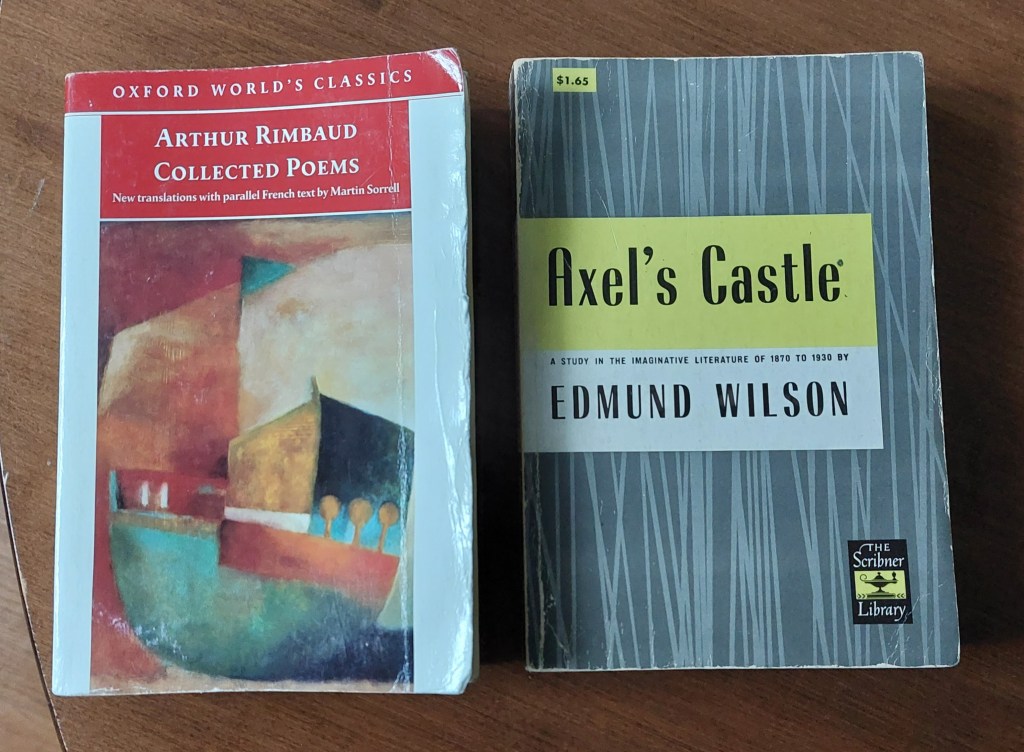
    The first thing we do when we’re not sure of a right pronunciation is to break down the syllables and pronounce them phonetically. But that doesn’t always work. I once pronounced, to a professor no less, the poet Arthur Rimbaud’s name wrong. I said rim bawd, instead of ram boh. The professor pretended not to know the poet I was referring to. She even later repeated in an anecdote form my mistake in front of the whole class. I’ve never forgotten the lesson.

    Neither do I know how to pronounce the poet Diane Seuss’s last name. Is it Seus like Zeus, my first guess, or is it Zoice, rhyming with Voice, or Soice, a variant of Sauce – as the story goes, apparently most everyone mispronounced the famed Dr. Seuss’s name, so often that the mispronunciation became the right pronunciation, and if you pronounce it correctly, you’ll likely be corrected.

    My father was, as he put it, “hard on hearing.” When he was three years old, he came down with scarlet fever, which caused sensorineural hearing loss. His ears drained a thick and slimy yellow-greenish kind of phlegm or mucus, filling the ear canal and dripping down the lobules. His teachers often consigned him to the back of the room, where of course he couldn’t hear anything. He developed a stutter, which magnified his mispronunciations. Later in life, after ear surgery, his stutter disappeared. Meantime, he had learned to read lips, and he was good at selective hearing. He was also a good talker, could talk to anyone, and did. He used to cup his palm around his ear and bend it forward making an ear trumpet to amplify voices, but it usually doesn’t help to yell at the hearing impaired. It’s often lack of sound clarity that’s the problem. It’s the sound frequency that must change.

    Loss of hearing is not loss of sound, as victims of tinnitus know. When the ears don’t work right, the brain fills in the blanks. It’s that internal sound no one else can hear that’s called tinnitus, a symptom of something wrong with one’s hearing. Tinnitus, we were informed last summer, is pronounced ti·nuh·tuhs, not, as we were saying it, ti.night.iss. Of course, the correct pronunciation is the one the listener hears without issue and lets the conversation move on. And what’s the point of being right when no one else is?

    A truly miscreant corrector like the one referenced in paragraph one above might then ask the poor pronouncer to spell the thing in question, thus pulling out a dagger of humiliation to accompany the sword of shame, but even a correct spelling will do little to clarify or solve what is to begin with a faked miscommunication.

    I’m not an expert speller, either, by the way, but we’ll save that issue for another day.

    Sounds can be errie, and we build our exotic or occult vocabularies in aeries at the tops of cliffs and the tallest of trees. Our vocabularies become nests of familiarity, even if no one else espies them. But there’s a difference between hearing and listening, and if I’m a poor pronouncer of words, I don’t think I can blame it on my hearing. But pronunciation is, I think, physical, and not mental in any intellectual sense. Or is being smart (if accurate pronunciation is indeed a sign of smartness) actually a physical thing? I don’t know. Maybe it is. You might have trouble pronouncing a word correctly like you have trouble rubbing your stomach while patting your head simultaneously. In any case, we have to hear something correctly before we can repeat it correctly – does that sound right?
  • Heavy Metal

    Sounds industrial, like the noises in a factory made repetitive by machines, the floor covered with curling steel shavings. And a kind of marching music, an industrial march, urban with trams and busses, honks and trucking heaves. Heavy Metal is the four piece rock band’s alternative to the symphonic orchestra. The full brass and woodwinds, operatic vocals, orchestral percussion – all accomplished with guitars and drumkit, pedals, and amplifiers. Heavy Metal music can sound like lead stretched thin as wire, or walking on the Earth’s crust with steel spiked boots, the band poised like the Levitated Mass over an arena crowd.

    Our latest guitar quest (Live at 5 now already seems as old as the Ed Sullivan Show) has moved to YouTube where in partnership with metal expert CB we record short videos of original pieces or answers to various musical challenges, about one to three minutes, CB taking Metal Monday while I have Telecaster Tuesday (Washboard Wednesday still open). I posted a couple of Telecaster Tuesday short videos here at the Toads – as I continue to find myself drifting further and farther from words, but I’m not sure the blog is the best place for music activity. For one thing, videos are space hogs, while links to anything outside the blog can wind up for the reader like getting on a wrong bus to the zoo.

    I’m not sure it has anything to do with hearing impairment, though it might, but I’ve often had trouble hearing lyrics clearly, the vocals sounding like another instrument, which of course they are, but without sharp definition – in my ears. Maybe that’s why I’ve steered away from loud rock, but any type of music can be played loud, or too loud. But you don’t have to play music loud to feel it. At a Red Hot Chili Peppers concert some years back, I could literally feel the sound in my chest – that’s a bit too much, though I get that it might be necessary if one wants the full effect. But often one wants to hear the breeze over the “The Eolian harp” sitting on an open window sill. Still, as evidenced in some of CB’s videos, the loudness has passed, and now rings like a train rounding a corner in the distance, its ringing still vibrating on the track:

  • Bananas

    When Samuel Becket wrote “Krapp’s Last Tape” (1958), could he have picked any fruit other than the banana for Krapp to cram in his pocket? Were bananas a fave in Paris at the time? Did Beckett eat daily bananas? Surely at Somewhere U there’s a thesis on this. By the time of Krapp’s writing, WWII rations had ended in Europe, the new concern, regarding bananas, tariffs and costs. How much would one pay for a banana? What is it about the banana that inspires both commodious jokes and serious art as well as market speculation and spectacle?

    Or all of the above. Reference the recent banana art installation that apparently sold at auction for $6.2 million. The banana is taped to the wall with duck tape. (Where’s Andy Warhol when you need him?) The duck taped to wall banana used the traditional gray colored duck tape. But duck tape now comes in various colors, and we would have picked a bright blue, which might suggest, mixing with the yellow, green, the color of money, which is what it’s all about, though at the same time, ok, it might say something about art, or art collecting, anyway.

    The duck taped banana, titled “Comedian,” is acoustic, unlike the “electrical banana” in Donovan’s 1966 song titled “Mellow Yellow.” We won’t go into the suggestive meaning behind the banana electric, but it is easily looked up. In any case, an electric neon lit banana might have fetched even more than the $6.2 MM, with a wire dangling down to an outlet, perhaps requiring one or two additional strips of tape to secure it to the wall.

    No telling what Beckett might have thought of all the current brouhaha over the banana. But “Krapp’s Last Tape” does contain both banana and tapes, at last count at least three bananas, all eaten, the peels discarded on the stage.

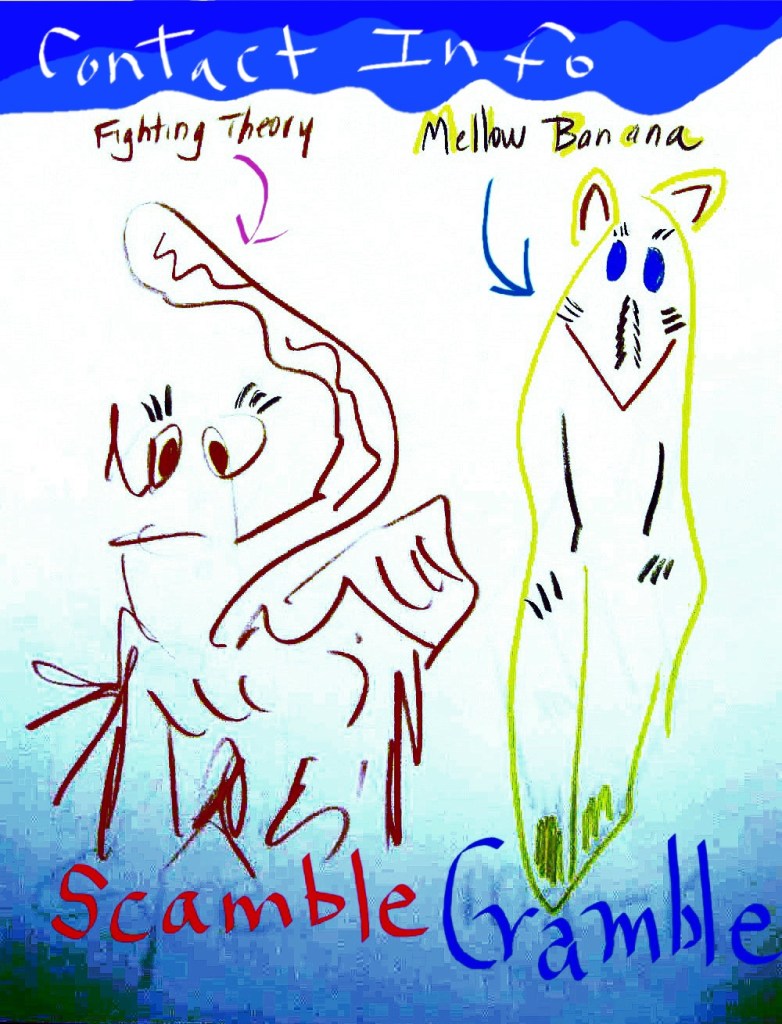
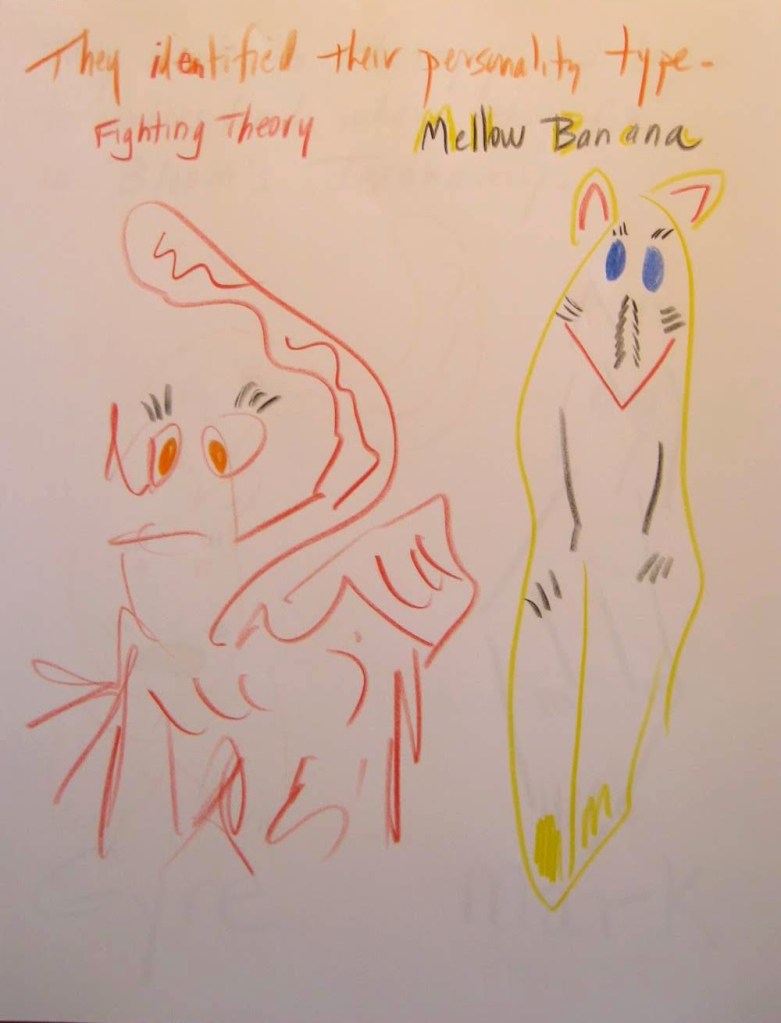
    Speaking of bananas, below is a page from a draft sequel to “Scamble & Cramble: Two Hep Cats and Other Tall Tales.”

    And below, a newer draft, in which the cats get hep to social media:

    And this morning, bananas and coffees with Susan:

  • Outtakes

    Once upon a space.

    These are souls that try men’s times.

    Give me liberty or a couple pints after close.

    To see or not to see, to knock to hear
    all the rot and rub, to touch and shock,
    stop here not there in such nonesuch.

    Let’s stay in tonight then, you and I,
    blue light spread against the walls,
    and stream Seinfeld reruns.

    Of Engelond, to wander wonder they wende,
    twas the 60’s and bell-bottoms they wore.

    To define behavior is to limit freedom.
    Give me a clone.

    Through the fence he watched the absurd land usurpers playing golf, and when one of them yelled Caddie, it set off a chain link reaction as he was bombarded with memory particles.

    You are all a fond generation.

    The overfed Buck came up to shave and ruck a go at Catsbody.

    The day was blue
    the guitar green
    he tossed all he’d seen
    of words for notes.

    And they all loved hoppily ever before.

     Sources:

    1. Folk Tales
    2. Thomas Paine: “The American Crisis”
    3. Patrick Henry, speech attribution
    4. Shakespeare, Hamlet
    5. T. S. Eliot, The Love Song of J. Alfred Prufrock
    6. Chaucer, The Canterbury Tales
    7. Oscar Wilde, The Picture of Dorian Gray
    8. William Faulkner, The Sound and the Fury
    9. Ernest Hemingway, A Moveable Feast
    10. James Joyce, Ulysses
    11. Wallace Stevens, The Man with the Blue Guitar
    12. Folk Tales
  • Goodbye to Whom

    To Whom it May Concern:

    Thru with Whom
    to the absurdity of it
    pretending to know Whom
    when know not any whoms

    And it isn’t clear is it what it
    is it to whom it may concern;
    is it this something to come
    below to whom it may concern?

    Ought to be done with it
    with it too to whom it may
    concern the dummy subject
    there is that which is it

    It begins the beguine
    a long rail whine
    perchance a spell
    to diminish concern

    Consider for example
    For Whom the Bell Tolls
    it tolls loudest when one
    least listens last to it

    Anyway done with it
    call it non-standard or
    informal ungrammatical
    or what whom will

    Not to be imperative
    or directive nor
    anything goes
    just this about whom

    Whom who knows not
    who comes from
    where and returns
    there far too soon.

    XVII. MEDITATION.

    PERCHANCE he for whom this bell tolls may be so ill, as that he knows not it tolls for him; and perchance I may think myself so much better than I am, as that they who are about me, and see my state, may have caused it to toll for me, and I know not that. The church is Catholic, universal, so are all her actions; all that she does belongs to all. When she baptizes a child, that action concerns me; for that child is thereby connected to that head which is my head too, and ingrafted into that body whereof I am a member. And when she buries a man, that action concerns me: all mankind is of one author, and is one volume; when one man dies, one chapter is not torn out of the book, but translated into a better language; and every chapter must be so translated; God employs several translators; some pieces are translated by age, some by sickness, some by war, some by justice; but God’s hand is in every translation, and his hand shall bind up all our scattered leaves again, for that library where every book shall lie open to one another. As therefore the bell that rings to a sermon, calls not upon the preacher only, but upon the congregation to come, so this bell calls us all; but how much more me, who am brought so near the door by this sickness. There was a contention as far as a suit (in which both piety and dignity, religion and estimation, were mingled ), which of the religious orders should ring to prayers first in the morning; and it was determined, that they should ring first that rose earliest. If we understand aright the dignity of this bell that tolls for our evening prayer, we would be glad to make it ours by rising early, in that application, that it might be ours as well as his, whose indeed it is. The bell doth toll for him that thinks it doth; and though it intermit again, yet from that minute that that occasion wrought upon him, he is united to God. Who casts not up his eye to the sun when it rises? but who takes off his eye from a comet when that breaks out? Who bends not his ear to any bell which upon any occasion rings? but who can remove it from that bell which is passing a piece of himself out of this world? No man is an island, entire of itself; every man is a piece of the continent, a part of the main. If a clod be washed away by the sea, Europe is the less, as well as if a promontory were, as well as if a manor of thy friend’s or of thine own were: any man’s death diminishes me, because I am involved in mankind, and therefore never send to know for whom the bell tolls; it tolls for thee. Neither can we call this a begging of misery, or a borrowing of misery, as though we were not miserable enough of ourselves, but must fetch in more from the next house, in taking upon us the misery of our neighbours. Truly it were an excusable covetousness if we did, for affliction is a treasure, and scarce any man hath enough of it. No man hath affliction enough that is not matured and ripened by it, and made fit for God by that affliction. If a man carry treasure in bullion, or in a wedge of gold, and have none coined into current money, his treasure will not defray him as he travels. Tribulation is treasure in the nature of it, but it is not current money in the use of it, except we get nearer and nearer our home, heaven, by it. Another man may be sick too, and sick to death, and this affliction may lie in his bowels, as gold in a mine, and be of no use to him; but this bell, that tells me of his affliction, digs out and applies that gold to me: if by this consideration of another’s danger I take mine own into contemplation, and so secure myself, by making my recourse to my God, who is our only security.

    from Devotions by John Donne (1624)

    For Whom the Bell Tolls
  • A Sweet Derangement of the Senses with a Sour Finish

    What did Rimbaud mean by dérèglement of the senses? Trouble ahead, for one thing, as he intends to deregulate language:

    “He does go on to speak of the unknown (l’inconnu), objective poetry’s aim, which can only be attained by the ‘systematic disordering of all the senses‘ (his italics)” (Sorrell, xvii).

    And not just language, but in an iconic spirit of rebel without a cause, to untangle from his life predicament: family, school, country and war, literary ambition, expectations – but relatively quickly then even his newly chosen lifestyle, as he heads out for the territory, leaving any predicaments for others to unravel.

    But in one meaning, his derangement of the senses is not difficult to understand, and gives the reader an assist to unusually difficult writing. Sorrell provides a few clues in his Introduction to the collected poems:

    “In synaesthesia an effect normally received through one of the senses is experienced directly through another. Thus, in Baudelaire’s sonnet perfumes sound as soft as oboes” (XX).

    But in my copy of Baudelaire’s “The Flowers of Evil,” Richard Wilbur translates the line in question, from the poem titled “Correspondences,” as follows:

    “Perfumes there are as sweet as the oboe’s sound” (12)

    The perfumes don’t make sound, literally, and don’t directly sound like oboes; perfumes smell sweet, and that sweetness is compared to the soft sound of an oboe. But can we smell sweetness? The perfumes are also

    “Green as the prairies, fresh as a child’s caress”

    Baudelaire’s poem relies on a poetic device, metaphor, nothing new there. We might say: The grapes were as plump as purple; or, my eyes drank a sour finish as I watched the falling leaves through a broken window; or, I heard summer leaving as the night filled my eyes with silence.

    In Baudelaire’s poem, taste relies on smell, and smell doesn’t function as well if taste is lost. Without smell or taste, the brain tries to find some other way to experience the missing sensation. Victims of the Covid virus might understand this from the experience, the strangeness, of losing one sense but not the other. Metaphor becomes a compensation for something lost in translation.

    And the Baudelaire poem points to McLuhan’s idea of a sensorium, any one sense not dominated by any of the others:

    “Like dwindling echoes gathered far away
    Into a deep and thronging unison
    Huge as the night or as the light of day,
    All scents and sounds and colors meet as one.”

    And what does McLuhan say? From Chapter 9, “The Written Word: An Eye for an Ear” in “Understanding Media”:

    “Consciousness is regarded as the mark of a rational being, yet there is nothing lineal or sequential about the total field of awareness that exists in any moment of consciousness. Consciousness is not a verbal process” (87).

    We might reread then, Rimbaud, and consider his idea of derangement, with McLuhan’s analysis of media in mind:

    “The same separation of sight and sound and meaning that is peculiar to the phonetic alphabet also extends to its social and psychological effects. Literate man undergoes much separation of his imaginative, emotional, and sense life, as Rousseau (and later the Romantic poets and philosophers) proclaimed long ago (90).

    It made sense then for Rimbaud to suggest the way to recover the imagination was to derange the senses.

    “Today the mere mention of D. H. Lawrence will serve to recall the twentieth-century efforts made to by-pass literate man in order to recover human ‘wholeness.’ If Western literate man undergoes much dissociation of inner sensibility from his use of the alphabet, he also wins his personal freedom to dissociate himself from clan and family (McLuhan, 90).

    But we hasten to remind that Rimbaud gave it all up as futile, poetry and his idea to derange language. Nevertheless, he might still sit at the head of a poet’s table (Ashbery’s, for example), even as he ended his own poetic meal with a sour finish.

    “Language extends and amplifies man but it also divides his faculties. His collective consciousness or intuitive awareness is diminished by this technical extension of consciousness that is speech.

    Bergson argues in Creative Evolution that even consciousness is an extension of man that dims the bliss of union in the collective unconscious. Speech acts to separate man from man, and mankind from the cosmic unconscious. As an extension or uttering (outering) of all our senses at once, language has always been held to be man’s richest art form, that which distinguishes him from the animal creation” (McLuhan, 83).

    Metaphor allows for looking at one thing, an object, or some sensory effect, and seeing something different. That’s how much poetry works, anyway. And when we compare two disparate objects, we fancy we learn more about each. Still, one wonders at that “richest art form,” and whether or not it’s worth the trouble it creates (Rimbaud apparently thought not), and that’s the sour finish to this post.

    Derangement of the Senses

    “Arthur Rimbaud: Collected Poems.” Translated with an Introduction and Notes by Martin Sorrell, Oxford University Press, 2001.

    “Charles Baudelaire: “The Flowers of Evil.” Selected and edited by Marthiel and Jackson Mathews (1955, 1962) – Rev. ed., New Directions (NDP684) 1989.

    “Understanding Media: The Extensions of Man.” Marshall McLuhan, 1964, McGraw-Hill.

  • World Not Serious

    Following Baseball, one finds a respite from the vicissitudes of world calamity. Then comes the 2024 World Series, and the 5th Inning of Game 5, when the wheels fall off the Yankee machine. In a sense, that inning was a baseball cartoon, three errors by the Yankee fielders, a fourth error if failing to cover first base on a right-side infield grounder is counted, and the Dodgers catch up from a no hit 5 to 0 deficit to tie the score 5 to 5. The Yankees then go ahead 6 to 5 in the 6th, but the Dodgers go ahead 7 to 6 in the 8th, which they hold for the win, taking another storied series 4 games to 1.

    “Back, back, to the wall!…and it’s gone! A home run!”
    The New York Yankees baseball team is a big book of stories, every year a new chapter.
    5th Inning, Game 5: The wheels fall off the Yankee Machine
    The Los Angeles Dodgers, since 1958, first season after moving out West from Brooklyn – along with millions of others from around the States, pouring into Gold Rush Country.
    Celebration Parade, Downtown Los Angeles
  • On the End of the Road with Rimbaud

    It wasn’t enough for Rimbaud to disassociate himself from his society, which he found decadent, hypocritical, false – in a word, selfish. He would also derange his language and senses, and when he was finished, or abandoned, that writing life project, but which would survive to influence so many still working on literature, he moved on and rejected his and all other writing:

    “When a friend asks him [Rimbaud] whether he is writing nowadays, he replies with annoyance and scorn: ‘I don’t do anything with that anymore’; and when, on the eve of his departure the next spring, he hears one of his friends congratulate another on having just bought some Lemerre editions – Lemerre had been the publisher of the Parnassians – he bursts out: ‘That’s a lot of money wasted. It’s absolutely idiotic to buy books – and especially books like that. You’ve got a ball between your shoulders that ought to take the place of books. When you put books on your shelves, the only thing they do is cover up the leprosies of the old walls’” (Wilson, 279).

    For Edmund Wilson, the question of lighting out for the territory ahead of the rest meant reading and sitting down to his journal. (What might Wilson have done with a blog?) He quotes Yeats, from his “Vision”:

    “It is possible that the ever increasing separation from the community as a whole of the cultivated classes, their increasing certainty, and that falling in two of the human mind which I have seen in certain works of art is preparation….It will be concrete in expression, establish itself by immediate experience, seek no general agreement, make little of God or any exterior unity, and it will call that good which a man can contemplate himself as doing always and no other doing at all….Men will no longer separate the idea of God from that of human genius, human productivity in all its forms” (291-292).

    The problem then, for Wilson, is indeed what to do:

    “Nor can we keep ourselves up very long at home by any of the current substitutes for Rimbaud’s solution – by occupying ourselves exclusively with prize-fighters or with thugs or by simply remaining drunk or making love all the time….The question begins to press us again as to whether it is possible to make a practical success of human society, and whether, if we continue to fail, a few masterpieces, however profound or noble, will be able to make life worth living even for the few people in a position to enjoy them” (293).

    Quotes from “Axel’s Castle: A Study in the Imaginative Literature of 1870 to 1930,” by Edmund Wilson. Scribner Library, 1931, 1959.

  • Nose

    Where the nose goes
    nobody knows
    its downslope bent
    uncurls merriment

    After a bout of virus
    it won’t awake
    the nose laments all
    smells of peppermint

    At night it runs around
    amid roses and fishes
    lemons and cloves but
    the schnoz has anosmia

    In the morning it sleeps
    like a cat in a ring
    if it can’t smell
    maybe it can sing

    Thar she blows
    as big as a whale
    in a hurricane gale
    our well placed nose

    If this short tale
    got up your nose
    tell me please
    how’s it smell?

    Nose Rings


  • Old Haunts

    Old Haunts, all with current links, focused on core subjects: art, technology, music, science, and literature, but first, a brief explanation:

    Moving continuously toward more minimalist formats (which if not stopped could result in disappearance altogether), blogs may risk losing some appeal, particularly to readers who enjoy liking, commenting, and linking or sharing – in short, conversing – as well as indulging in pingbacks and reblogging, and who enjoy perusing sidebars, widgets, clicks and plays, slide shows, and sharing up and down the crowded street of social media sites and apps. An example of such minimalist drift, here at the The Coming of the Toads, might be the removal, some time ago now, of listings and links of followed blogs and favorite sites, what I called in the sidebar heading over the list of links: “Back Roads to Far Places,” the title from Ferlinghetti’s book.

    I use the WordPress Reader to subscribe to sites, and currently I’m subscribed to 146 – but not many of which post frequently or are still active at all, which sparks the idea behind this post, which might have been subtitled: and Other Broken Links. While I don’t currently post a widget of followed blogs or sites, I do manage my subscribed sites in the WordPress Reader, and I also maintain the “Links” feature in the WordPress Dashboard for my own use. There are currently 33 links. But links don’t always stay current or active, while others click to surprise, a site grown or morphed into other projects or disappeared (Page Not Found), and still others remain useful resources or pleasant places to visit, like old friends. Or the link simply breaks and you get sent who knows where and who knows what’s happened. Sites often change over time, and it can be hard and takes time keeping up with the changes.

    Anyway, I thought I’d share an update of just a few of the sites that do continue to work well and that I try to follow and that offer pleasant visits and are creative and resourceful:

    Marginalia and Gracia and Louise I first discovered in “High Up in the Trees,” a blog by the Australian artist Gracia Haby. It’s now called “Marginalia.” I like everything about it – font work, photography, text content, collage and other art work, the work Gracia and Louise do with animals. And there’s another site they maintain, called Gracia and Louise, full of things to see and wonder at. The sites probably work best on desktop, but the creativity in doing more with the drop-down necessities of on-line viewing is unparalleled (of that, here is a specific example, called Reel).

    McLuhan Galaxy always produces a profoundly puzzling experience in that there seems no end to his ideas and the ramifications of effects of media on society and culture – and yet here we go, linking and following, but where? The Blogroll will keep you occupied for hours of intellectual fun.

    I don’t have John Cage ears, but I’ve always enjoyed his writing, and much of his music I do enjoy. Kuhn’s Blog is not often updated, but the site resources remain available and loads of fun, with several interactive features (try Indeterminacy, for example). The John Cage Personal Library is itself a phenomenal work.

    The Buckminster Fuller Institute shares hope for the world from a worldwide perspective. The site may provide a new awareness for what’s going on worldwide to improve conditions, predicaments, problems – near and far. If your not familiar with Bucky, here’s a good place to start: Big Ideas.

    Words Without Borders features world wide writing in a variety of formats. Browse by country, theme, or genre.

    Old Haunts, all with current links, focused on core subjects: art, technology, music, science, and literature.

  • The Humorous Short Sketch

    The easiest piece to write is sarcasm. The difference between sarcasm and satire is that satire has a point, while sarcasm has none, except maybe to offend, at worst, or rib, at best. Sarcasm is a backbite often confused with humor. “It’s not funny,” the bitten one says, the sarcastic one curling up smiling like Uriah Heep in his sorry ways, heaping more free helpings upon his plate to stowaway for future use.

    Irony can be used as a tool to tickle or torture, its mixture of satire with sarcasm effective as a rhetorical device, intended at bottom to persuade, of what, exactly, the audience might remain unaware, this too funny: A muse meant nothing by it. What was meant or not its placement lost can only confuse.

    Hemingway utilizes irony in his book “The Sun Also Rises”:

    “Show irony and pity.”
    I started out of the room with the tackle-bag, the nets and the rod-case.
    “Hey! Come back!”
    I put my head in the door.
    “Aren’t you going to show a little irony and pity?”
    I thumbed my nose.
    “That’s not irony.” (102)

    Later, Bill and Jake replace irony with utility, but it’s the same idea:

    “Let us rejoice in our blessings. Let us utilize the fowls of the air. Let us utilize the product of the vine. Will you utilize a little, brother?”
    “After you, brother.” (109)

    Irony is explained by Charlie in Steve Martin’s film “Roxanne,” in the scene where he’s walking with Roxanne back to her place to help her regain entry after she’s locked herself out. Charley pretends not to understand why Roxanne turns down his offer of a coat on such a cold night. She explains she was being ironic, and Charley says he didn’t understand that because they don’t use irony in the town anymore. He was the last one to use it, and he gave it up because people were staring at him. Irony often means the opposite of what’s said. It can be confusing. Martin’s film is a rewrite of “Cyrano de Bergerac,” the 1897 play (which takes place in 1640 France) by Edmond Rostand. I only mention that now should any readers think I was unaware of Martin’s source. “Cyrano” was assigned reading in the 10th grade in the high school I attended. It’s theme is panache, which I doubt I understood in the 10th grade. Not sure I understand it now, ten decades later. More irony there than I care to pursue further at this point.

    The so-called dry sense of humor is favored by the higher class comic, whose main focus is to keep out of the pit, where things get wet and muddy. In that sense, the dry humorist is aristocratic, surrounded by the minion followers who protect his repressed emotions with gratuitous likes and guarded comments. The noir detective sometimes makes use of the dry sense of humor, though hardly an aristocrat, but he often finds himself in service to society’s higher-ups. A dry wit seems to suit a hard boiled attitude, and the Dick has many followers, among them many cynics.

    The facetious humor accountant will often make fun of himself, pretending, for example, to be stupid – but that’s to show actually his superiority to his target. He will be droll, flirting around with what’s considered serious or not, with what is serious or not. Tongue-in-cheek provides a vivid cartoon illustration opportunity.

    Then there’s the wisecrack, the comment, usually shouted but as effectively whispered, croaked anonymously from the audience, which may have come to resent being pandered to, the speaker now a standing joke and nothing further said can mollify or sooth the hurt feelings of failure. But, after all, it was only a sketch. But when does sketch become sketchy? A standalone wisecrack probably won’t qualify as a sketch, more the property of the cartoon.

    Charles Dickens wrote sketches, though not necessarily with humorous intent. In his preface to “Sketches by Boz,” written long after the sketches were first published in newspapers and magazines, Dickens almost apologizes for their style or substance, in spite of their obvious popularity. He said the sketches were “sent into the world with all their imperfections (a good many) on their heads,” and that he’s “conscious of their often being extremely crude and ill-considered, and bearing obvious marks of haste and inexperience.” But again a Boz sketch purpose was not primarily humor. They were accompanied by drawings and were essentially goings on about his London parish at the time – the 1830s. The subtitle of the book collection reads “Illustrative of Every-Day Life and Every-Day People.” And within the Dickens sketch anyone indeed could have, probably already did, see or observe the very thing Dickens was writing about. But to see it in print, Illustrated, no less, not as news, by which is meant an edited selection of events to emphasize a certain viewpoint (selection itself – among all the events of a day – being an editing process, and the birth of bias), but as the familiar and close and therefore noteworthy and comment worthy, where one saw oneself or someone one knew and understood but probably with not quite the same focus as found in the sketch. Or one saw a street or alley or place or person one knew about but only as some mystery yet to be solved, which the Boz sketch resolves. The Boz sketches often go indoors.

    Mark Twain did much to popularize the humorous sketch as a newspaper feature. It was Twain’s intent to write humor, so we find embellishment and variations on the truth of things, exaggerations. Exaggeration, hyperbole in rhetorical diction, is a comedian’s tool, as is its counterpart, understatement, litotes, first cousin to euphemism. Here is a sample excerpt from a Twain sketch featuring an unexpected subject, titled “Speech on Accident Insurance“:

    “Certainly there is no nobler field for human effort than the insurance line of business—especially accident insurance. Ever since I have been a director in an accident-insurance company I have felt that I am a better man. Life has seemed more precious. Accidents have assumed a kindlier aspect. Distressing special providences have lost half their horror. I look upon a cripple now with affectionate interest—as an advertisement. I do not seem to care for poetry any more. I do not care for politics—even agriculture does not excite me. But to me now there is a charm about a railway collision that is unspeakable.”

    Insurance for accidents occurring to individuals riding a train was first introduced in England, and insurance as an industry grew expansively in the latter half of the 19th Century, but it wasn’t then nor is it now considered by many to be a subject of humor. Twain was able to find humor in just about any subject. Twain’s use of the word cripple in his context would not be acceptable today, and indeed humorists are inevitably at risk of their word choices landing as offences.

    It’s interesting, thinking now of insurance, how some things, like the old saying goes, never change, in spite of what Twain says below, from his visit to a barbershop:

    “All things change except barbers, the ways of barbers, and the surroundings of barbers. These never change. What one experiences in a barber’s shop the first time he enters one is what he always experiences in barbers’ shops afterward till the end of his days. I got shaved this morning as usual. A man approached the door from Jones Street as I approached it from Main—a thing that always happens. I hurried up, but it was of no use; he entered the door one little step ahead of me, and I followed in on his heels and saw him take the only vacant chair, the one presided over by the best barber. It always happens so.” 

    If you want to write a humorous sketch, it might work best to start with something familiar, that any reader should recognize. Otherwise, you might too soon and too easily drift off into a piece redolent of surrealism, which is seldom very funny. If the easiest piece to write is sarcasm, it might be because the only skill required is mean-spiritedness, which probably comes from a deficiency of generosity. There’s also a tradition of vindictiveness associated with some humor, sublimated in the speeches at roasts that ridicule the honored guest. But writing humor is not easy. Not everyone is a wit. Nor wants to be a twit.

    References:

    “The Sun Also Rises” by Ernest Hemingway (1926). Quotes from 2022 Penguin Classics Deluxe Edition.

    Mark Twain Project Online. In discussing what is meant by a written sketch, the editor Edgar Branch, from the Introduction to “Early Tales and Sketches” Volume 1, has this to say:

    “The great preponderance of short items, however, are sketches—and these range from ambitious magazine articles several thousand words long to short, hundred-word trifles tossed off by the newspaperman during a working day. The sketches include comic letters to the editor, hoaxes, exaggerated accounts of the author’s personal activities, burlesques of many kinds, comic or satirical feuds with fellow journalists, ingeniously contrived self-advertisements, commentary in a light and personal vein, descriptive reporting, reminiscences of past pleasures and adventures, and so on—but neither this nor any other list can easily be exhaustive.” 

    Sketches New and Old,” by Mark Twain, link to Gutenberg e-Book.

    Sketches by Boz,” by Charles Dickens, link to Gutenberg e-Book.