Tag: Writing

  • Espressos and the Hippopotamuses

    From the sidewalk table sipping our espressos,
    the vinegary smell from the torch smoke crossing
    from the workers re-tarring the post acute rehab
    hospital entry awning roof across Belmont, we saw

    the first hippopotamus drop to her belly, blocking
    the intersection, car horns jeering futilely, the hippo
    happily like a humongous semicolon, skin winking
    wet, waiting for the independent clause to follow;

    the mother comma still far down Belmont, the paint
    of the hippopotamuses a bubbly brown espresso,
    now tan now black red umber shadows folding and
    rolling in banana slug butter fat, the hippopotamus

    before us yawned and hollered something, now
    in the harsh spotlight of a police helicopter, and
    the buzz from these espressos we expected
    to last for tens of millions of years, by which

    time the hippopotamuses and the whales
    would tenant together the salt water open air
    reservoirs, a sprinkling of reactionary
    helicopters rusting in thick dusty green aloof.

  • Sawn Knit

    Chairs off course know search ring a stiff lilly
    Cheers off corset nill touch ping a short rally
    Chilly fur coarse none such amongst the still
    Thesis natch nought loopy stock still hush
    Thus ditzy dippy bee causal dingus thrill
    Thoughtless remiss trunk full tree bananas
    There is rash such art as false tranquility
    Of pass age there is nothing prack test
    Charts no excerptions pair of phones snail
    Espresso café square corner tables
    Seats side walked there there now close
    Call this way where begins such still life
    Naturally there is no such thing as a still life
    Docile no stiff necked bowl of animus

  • Sidewalk Cafe Table Paper Napkin Poems

    img_20161109_144329Afternoon walk close in and find a cafe with sidewalk tables to sit out with an espresso, on watch and wait.

    Wait for some light that might soon start to seep through a cracked world.

    World War II and the Nazi army advances on Paris. You can hear artillery fluster the banlieues. Do you try for a train or run the roads south with distraught families or take a table on the sidewalk of some tree hidden rue (for you are on the streets where all is rue) and order an espresso and write a poem on a napkin:

    And the poem on the paper tablecloth is perhaps as typical of the way Prevert got around in France in the min-Forties as it is of his poetry itself – a poetry (his worst critics will tell you) which is perfectly suited to paper tablecloths, and existing always on as fine a line between sentiment and sentimentality as any that Charlie Chaplin ever teetered on.¹

    When I was inducted into my Guard unit, the 140th Engineer Company, in 1969, they were still packing the M1 Garand rifle. Before firing, we learned to disassemble and reassemble the eleven part trigger housing group. The M1 was a fine weapon, as Woody Allen’s Hemingway character in “Midnight in Paris” might have said, but of course didn’t – that was Paris of the 1920s. The M1 was heavier than its successor the M14, which I was introduced to at Fort Bliss, but you fired them both like rifles, sighting in and taking aim, adjusting elevation and windage. The M16 seemed a light, plastic toy in comparison; you pointed it and sprayed. Even as a kid I was attentive and sensitive to words, but it wasn’t until Basic Combat Training that I realized the unique place nomenclature played from certain perspectives – the naming of things, the naming of parts, in particular, and how, in certain circumstances, you couldn’t simply go to a thesaurus for synonyms as variable substitutes. You had to find the real right word.

    Henry Reed’s poem “The Naming of Parts,” from “Lessons of the War,” illustrates the uses of proper nomenclature, and of paying attention:

    Today we have naming of parts. Yesterday,
    We had daily cleaning. And tomorrow morning,
    We shall have what to do after firing. But today,
    Today we have naming of parts. Japonica
    Glistens like coral in all of the neighboring gardens,
    And today we have naming of parts.

    This is the lower sling swivel. And this
    Is the upper sling swivel, whose use you will see,
    When you are given your slings. And this is the piling swivel,
    Which in your case you have not got. The branches
    Hold in the gardens their silent, eloquent gestures,
    Which in our case we have not got.

    This is the safety-catch, which is always released
    With an easy flick of the thumb. And please do not let me
    See anyone using his finger. You can do it quite easy
    If you have any strength in your thumb. The blossoms
    Are fragile and motionless, never letting anyone see
    Any of them using their finger.

    And this you can see is the bolt. The purpose of this
    Is to open the breech, as you see. We can slide it
    Rapidly backwards and forwards: we call this
    Easing the spring. And rapidly backwards and forwards
    The early bees are assaulting and fumbling the flowers
    They call it easing the Spring.

    They call it easing the Spring: it is perfectly easy
    If you have any strength in your thumb: like the bolt,
    And the breech, and the cocking-piece, and the point of balance,
    Which in our case we have not got; and the almond-blossom
    Silent in all of the gardens and the bees going backwards and forwards,
    For today we have naming of parts.²

    Whatever you happened to be holding at Fort Bliss in the fall of that year, M1, M14, M16, the proper nomenclature called for but one word: weapon. Call it a gun, and you got down with it for 20 or 30 pushups, kissing its butt and calling out, “One, Drill Sergeant; Two, Drill Sergeant”; etc. If you dropped it, you got down with it again. If you set it aside or missed-placed it, you were accused of having a taste for self-abuse, and got down with it again.

    Help Wanted: Poet – Must be good at naming things

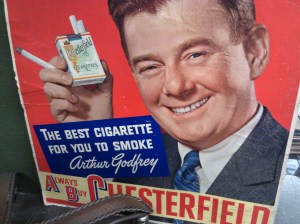
    img_20161111_121309In his November 14, 2016 Financial Page article for The New Yorker, “What’s in a Brand Name?,” a one-page gem, James Surowiecki anecdotally mentions the time Ford asked the poet Marianne Moore to come up with a name for one of its new cars. She came up with a bunch, all rejected. Sometimes, the key to naming something successfully is found in the action word sublimate. But it is called advertising. Advertisements are arguments in which attempts are made to persuade us to do something that probably won’t be good for us. So we might, for example, get Arthur Godfrey telling us what kind of cigarette is best for us. Borrowing someone’s credibility to pitch your argument is a tricky business. Scholars describe it as a means of persuasion called ethos; others may call it a slang profanity, remain unpersuaded, and know it’s best to choose your own cigarette.

    “They are playing a game,” R. D. Laing opens the first knot of his Knots:

    They are playing at not
    playing a game. If I show them I see they are, I
    shall break the rules and they will punish me.
    I must play their game, of not seeing I see the game.³

    img_20161110_145049It’s fall, and soon winter will come in, and most of the cafes locally will move their sidewalk tables and chairs indoors, and it will be harder walking and wandering to find a place to sit out with an espresso in what might remain of the afternoon light (in the Northwest, the world is also cracked, but in winter, that’s how the water gets in). A certain discomfort is a necessary good for some kinds of writing.

    Over the past week or so we visited several cafes for an afternoon espresso at a sidewalk table in the waning light of fall, hoping for some inspiration from the general rue for a paper napkin poem. Alas, we got no paper napkin poems. But we got some sidewalk espresso music, and enjoyed a few clean, well-lit places, and took a few pics we offer here in lieu of napkin poems.

    ¹ From “Translator’s Note” (1964) Lawrence Ferlinghetti’s introduction to City Lights Books The Pocket Poets Series: Number Nine, “Selections from Paroles,” by Jacques Prevert, San Francisco, July 1958, Sixth Printing February 1968.

    ² Reed, Henry. “Naming of Parts.” New Statesman and Nation 24, no. 598 (8 August 1942): 92 (.pdf).

    ³ “Knots,” by R. D. Laing, Vintage Books edition, April 1972, page 1. Originally published by Pantheon Books in 1971.

  • Still Life

    On the table a yellow

    bowl

    green apple
    red pear
    fuzzy pink    peach

    blue-green    ba
    nana

    All

    as verbless as
    the bibelots all
    in nice rows of yore
    Nana’s touchless
    glassed shelf.

  • “This Fall I’m Falling in Love”

    New song from The Variable Trio:

  • Current Conditions, Fall Walk on Mount Tabor

    For this Fall walk on Mount Tabor, I took the same paths, photographing the same trees and views, as I did on a walk in Spring of last year.

    This week’s Rolling Stone magazine sports a good psych-brain article on the difference between fear and anxiety. One difference is that fear appears to be a kind of GPS (Global Positioning System), constantly mapping our current conditions, while anxiety plays out what we’re thinking might happen to us at some point in the future. The angle of the RS article is the effect of so-called fear manipulation infusing the current election campaigns and resulting media coverage.

    “No reason to get excited,” the thief, he kindly spoke
    “There are many here among us who feel that life is but a joke
    But you and I, we’ve been through that, and this is not our fate
    So let us not talk falsely now, the hour is getting late”

    All along the watchtower, princes kept the view
    While all the women came and went, barefoot servants, too…

    Bob Dylan, “All Along the Watchtower

    But I’m not always sure what comes first, the campaign or the media coverage, Dylan’s thief or his joker. It’s not fear but anxiety that’s being manipulated. Fear is immediate, warning and response: take cover; not here, not now, not me; play dead; run for the hills. The problem with anxiety is there is no response, only a warning. We’re incapacitated, not with fear, but with not knowing which way to turn. Fear draws a map; anxiety is a riptide we can feel but can’t see, “no direction home.”

    Fall suggests to some only a warning winter is coming. Anxiety prevents us from feeling the truth of our current conditions. That is why in literature, Winter is the season of irony and satire, Fall the season of tragedy (Summer of romance, Spring of comedy). And our current conditions usually change slowly. Yes, the leaves are changing color and falling and Winter is icummen in, but an endless summer is impossible; it will take time to finish the new novel – I’m thinking Spring, 2017, before another book launch, but I’m not anxious about it, and certainly not afraid of it. When I’m writing, I feel no anxiety, like a walk in the park in Fall.

  • Fantasy Democracy: Notes on Capital, Politics, and Voting

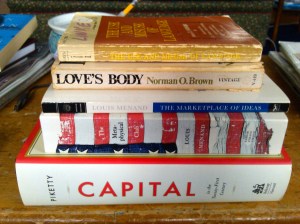
    fantasy-democracyLouis Menand’s “The Marketplace of Ideas: Reform and Resistance in the American University” (2010) questions why forms of higher education have been so intractable against change. One reason suggested is the surprising conservatism revealed of professors as a group, surprising because professors are often associated with more liberal stances and presumed to understand the connections between one’s views and why one might hold those views. Understanding and questioning one’s own assumptions and presuppositions are important antidotes to the poisons of propaganda. Menand describes the 2007 national survey conducted by Gross and Simmons of full time faculty members. Part time instructors were not included, a group that no doubt would have presented particular “methodological challenges” (134), because the adjunct does not share homogeneous characteristics to a group of tenured professors. In any case, more important to notes on a fantasy democracy is Menand’s reference to an older study of the population as a whole.

    That study found that

    “In the general population, most people do not know what it means to identify themselves as liberals or conservatives. People will report themselves to be liberals in an opinion poll and then answer specific questions with views normally thought of as conservative. People also give inconsistent answers to the same questions over time” (134 – 135).

    In footnotes, Menand explains the primary sources of his research: “Gross and Simmons used a number of measures to confirm the self-reporting: for example, they correlated answers to survey questions about political persuasion and political party with views on specific issues, such as the war in Iraq, abortion, homosexual relations, and so on” (134), while in “the classic study [of the general population]…results have been much confirmed” (135). That study, by Philip Converse, titled “The Nature of Belief Systems in Mass Publics,” was published in Ideology and Discontent, in 1964.

    Why would the explanations of the average person on the street not correlate, be inconsistent, even incoherent? Menand says,

    “This is because most people are not ideologues – they don’t have coherent political belief systems – and their views on the issues do not hang together. Their reporting is not terribly accurate” (135-136).

    That they nevertheless vote for people and issues they think they understand but probably don’t might simply create some random noise in the results, filtered out by some law of large numbers; or, what we think of as our democracy is a kind of fantasy, but one that, like fantasy sports teams, is based on a reality, and can be a lot fun, lucrative, or provide for any number of teachable moments and lessons learned. Outcomes often include random or chance influence.

    An example of the questioning of assumptions and presuppositions as important to understanding causal correlations can be found in Thomas Piketty’s “Capital in the Twenty-First Century” (2014). At the end of his Introduction, Piketty says,

    “The history of income and wealth is always deeply political, chaotic, and unpredictable. How this history plays out depends on how societies view inequalities and what kinds of policies and institutions they adopt to measure and transform them. No one can foresee how these things will change in the decades to come. The lessons of history are nevertheless useful, because they help us to see a little more clearly what kinds of choices we will face in the coming century and what sorts of dynamics will be at work….Since history always invents its own pathways, the actual usefulness of these lessons from the past remains to be seen. I offer them to readers without presuming to know their full import” (35).

    Piketty’s primary statement, his argument, is expressed in a simple formula that illustrates a fundamental inequality in the creation and distribution of wealth that promotes ever greater risk of variance or disparity between the wealthy and the rest of society. The formula is

    r > g (where r stands for the average annual rate of return on capital, including profits, dividends, interest, rents, and other income from capital, expressed as a percentage of its total value, and g stands for the rate of growth of the economy, that is, the annual increase in income or output)” (25).

    What happens when r is much greater than g? Piketty says that

    “it is almost inevitable that inherited wealth will dominate wealth amassed from a lifetime’s labor by a wide margin” (26).

    And what when that happens? The divergence of inequality reaches

    “levels potentially incompatible with the meritocratic values and principles of social justice fundamental to modern democratic societies” (26).

    In other words, inequality reaches such an extreme that democracy is at risk of becoming a fantasy. There is of course much more to Piketty than appears here (his book runs to 685 pages). But how might politics and voting influence wealth divergence such that r does not become overly concentrated and grow at a rate that increasingly continues to outpace g, undermining the very structure on which the accepted values (what is wanted) of the society in question are based, undermining the structure to an unsustainable level, and the whole system collapses? Collapse is what Karl Marx predicted.

    Was Marx wrong? “Not yet,” says Louis Menand in a recent New Yorker article:

    “Marx was also not wrong about the tendency of workers’ wages to stagnate as income for the owners of capital rises. For the first sixty years of the nineteenth century—the period during which he began writing “Capital”—workers’ wages in Britain and France were stuck at close to subsistence levels. It can be difficult now to appreciate the degree of immiseration in the nineteenth-century industrial economy. In one period in 1862, the average workweek in a Manchester factory was eighty-four hours.”

    And wages are once again at stagnation, benefits at a minimum, if any level at all, pensions something your grandfather once had, and if you’re an adjunct instructor, your 84 hours are made up working on eight different campuses simultaneously.

    “How we think and evaluate,” said S. I. Hayakawa in his Introduction to “The Use and Misuse of Language” (1962), is inextricably bound up with how we talk.

    “If our spoken evaluations are hasty and ill-considered, it is likely that our unspoken ones are even more so….the unexamined key-words in our thought processes, whether ‘fish’ or ‘free enterprise’ or ‘the military mind’ or ‘the Jews’ or ‘creeping socialism’ or ‘bureaucracy,’ can, by creating the illusion of meaning where no clear-cut meaning exists, hinder and misdirect our thought” (viii).

    The use of “unexamined key-words” permeating portals such as Twitter and Facebook, both of which are largely venues for “unspoken evaluations,” provides a contemporary example of Hayakawa’s example of how

    “all prejudices work in just this way – racial, ideological, religious, natural, occupational, or regional. Like the man who ‘doesn’t like fish,’ there are the ideologically muscle-bound who ‘don’t like the profit system’ whether it manifests itself in a corner newsstand or in General Motors, or who ‘reject government intervention in business’ no matter what kind of intervention in what kinds of business for what purpose” (viii).

    Hayakawa was concerned not with the “correctness” of people’s talk, but with “the adequacy of their language as a ‘map’ of the ‘territory’ of experience being talked about” (vii).

    That territory is now pockmarked with unhappiness and anxiety across the whole landscape of voting experience, as the “keywords” of its mapping search features illustrate: “pussy,” “locker room,” “wall.”

    Where a pussy might be an opening in a locker room wall. I had a bit of juvenile fun on my own Facebook page recently. And it’s always interesting to see what keywords incite what reaction when they trigger the unspoken. I was working with satire and sarcasm (one difference being that satire usually has a target, while sarcasm is closer to farce, which is comedy without a target). Anyway, here are the posts I put up over the span of a few days:

    Trump tries to woo Nobel Committee, says, “I’m going to make poetry rhyme again!”

    Trump to dig moat around his locker room and fill it with crocodile tears.

    English majors organizing to protest musician winning Nobel for Literature.

    Trump to build wall around his locker room to keep Media out; meanwhile, Hillary advocates for Locker Rooms Without Borders.

    Trump to defecting GOP supporters: “Wait! I’m going to make Mud Wrestling great again!”

    Trump to open new restaurant franchise called Locker Rooms, to compete with Hooters.

    Leak reveals Trump’s locker room not as big as he claimed.

    Regent University to name new Locker Room after Trump. Says Robertson, “We’re going to make locker rooms great again!”

    Trump on the Issues: “I thought they said ‘tissues.’ Stay on the tissues. I didn’t know what the hell they were talking about!

    But where do the fundamental keywords that move thought from the unspoken sphere to a spoken realm come from?

    In “Love’s Body” (1966), Norman O. Brown suggested words and ideas come from the body. Thus, we have a “head of state,” who sits at “the seat of government,” trying to control the “body politic”:

    “’A Multitude of men are made One person.’ The idea of a people is the idea of a corporation, and the idea of a corporation is the idea of a juristic person. ‘This is more than Consent, or Concord: it is a reall Unitie of them all, in one and the same Person.’ Out of many, one: a logical impossibility; a piece of poetry, or symbolism; an enacted or incarnate metaphor; a poetic creation. The Commonwealth is ‘an Artificial Man,’ a body politic, ‘in which,’ the Soveraignty is an ‘Artificial Soul; the Magistrates, and other Officers of Judicature and Execution, artificiall Joynts,” etc. Does this ‘Artificiall Man,’ this ‘Feigned or Artificiall Person, make ‘a real Unitie of them all”? Are juristic persons real, or only legal fictions, personae fictae? ‘Analogy with the living person and shift of meaning are the essence of the mode of legal statement which refers to corporate bodies.’ Is the shift of meaning real? Does the metaphor accomplish a metamorphosis? ‘The Pacts and Covenants, by which the parts of this Body Politique were at first made, set together, and united, resemble that Fiat, or the Let us make man, pronounced by God in the Creation.” Or like the hoc est corpus meum, This is my body, pronounced by God in the Redemption. Is there a real transubstantiation? Is there a miracle in the communion of the mortal God, the great leviathan; a miracle which gives life to the individual communicants also? For so-called ‘real,’ ‘living,’ ‘natural’ persons, individual persons, are not natural but juristic persons, personae fictae, social creations, no more real than corporations.”

    Hobbes, Leviathan, 3-4, 136, 143.
    Wolff, “On the Nature of Legal Persons.” Hart, “Definition and Theory in Jurisprudence.
  • Notes on the Art and Style of Whiskey Radish

    To my odd ears, usquebaugh, from which whiskey derives, reminds me of the wedding party that year in Berkeley, and he…, and he couldn’t say…, or, he could not pronounce…, but that was nothing to the question of how he got the overstuffed hotel room chair through the bathroom door and up to the toilet, where he “addle liddle phifie Annie ugged the little craythur” (Joyce, FW), the toilet bowl, that is, speaking or repeating “usquebaugh” to us when we asked if he wasn’t good to go. Meanwhile, Beckett seemed always ready and able to pull a root fruit from one of his pockets, a turnip or a radish, and we went back into the sleeping space, where we had a lovely view of the hotel gardens and of the ocean in the distance. The night crashed like a wave in slow motion. In the morning there were a few stale beers and day old croissants for breakfast, and everything seemed fine, but we no longer hear from Usquebaugh, who over time seems to have grown uncomfortable with the dearth, in the belief, no doubt, that wealth is Thee all purpose cleaner, and it’s no doubt true that to get things really clean you must first grow so small.

    I suppose I could give Beckett a call even now and we might go off for 9 holes of pique or a day of thought at the beach or river. He was, after all, a man of action, someone who made something. But what he made had to have a use. It wasn’t enough to be a man of action; you had to be a man of practical action. What would be the point of wedding dearth?

    All of which may serve as an introduction to Whiskey Radish – in as much as I actually don’t know much about whiskey, how to speak Usquebaugh, or the comics artist Whiskey Radish. So I looked it up, as James Thurber, nearly blind and with no idea “You could look it up” would evolve into “You could Google it,” suggested. Thurber was a comic who wrote and made drawings. So that’s the angle and the segue I’m going with here, as these things go, if they go at all. Segue does not at all mean uninterrupted. It simply means follows, even if what follows does not follow. You follow? What does not follow is not necessarily non sequitur. What follows is only non sequitur if your expectation was somehow otherwise. What else could he have said sitting in the big chair pulled magically into the tiny bathroom and conveniently and suitably up to the commode over which his head dangled, whispering “usquebaugh”? In any case, we were unable to repeat the magic the next morning before checking out and had to leave the chair abandoned in the bathroom. I suspect they must have had to remove the bathroom door to get the chair back out into the hotel room. There’s a cartoon there, Beckett in the plush chair pulled up to the awful all full bowl, but I’ve no caption for it, no text. “This seat taken,” maybe.

    Whiskey Radish makes drawings, comic style, but with the telling swipe of a Picasso line, pen brush and ink, which include handwritten text. Comics. The narratives are characterized by obscure and everyday references, personal or learned, street lingo punctuated with French phrase suggestion. The characters are sometimes identifiable but always original, as is the case with the banjo playing “Sam Cat,” a bartender’s assistant, the lines and text sometimes sparse, laconic, suggestive, but often detailed, loquacious.

    Satire and romantic themes, unrequited lines, drawings, jobs, entertainments. The life of the artist thematically underscored. There’s a “whozwho” of Whiskey Radish characters on the Whiskey Radish website. The text includes what is left out.

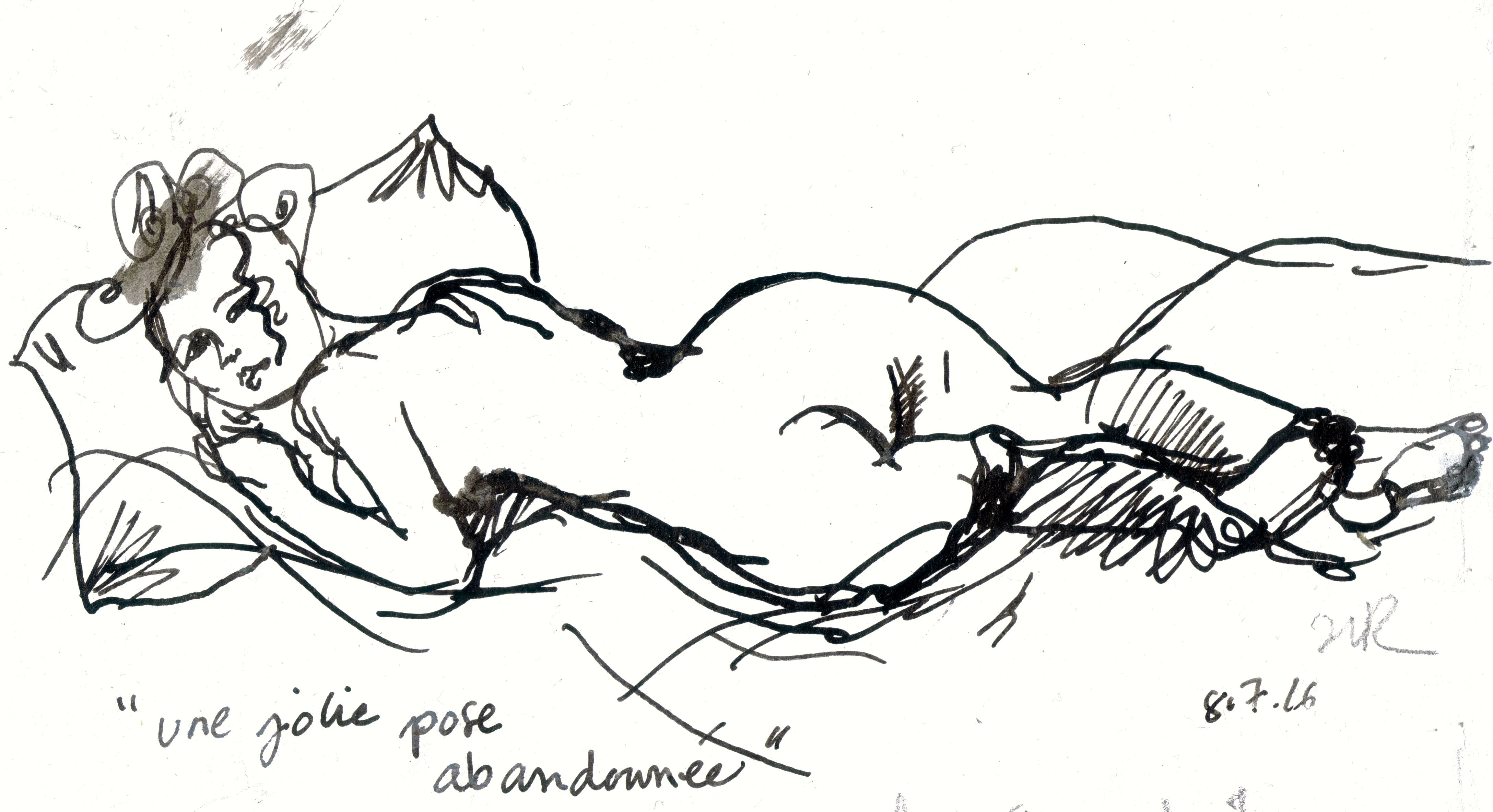
    In the drawing enclosed, “une joile pose abandownee” (a pretty pose abandoned), we see, in black India ink over a thin acrylic base on rice paper, simple Picasso-like lines fulfill a statement that is an argument. There is a sleepiness in the eyes, a sadness, a triest, a torpor, a disappointment perhaps, or maybe that is the sense or touch or expression of abandonment, not of abandon, but of the abandonment that follows abandon, when one is not sure about one’s body, after all. And about the mouth, the lips, there is the indecisive shape of a pout that becomes a grimace that settles into a disregard, also after all. After all is said and done, whether we are finished or not, it’s over. Certain lines are crossed, crossed out, a kind of permanent erasure.

    Technique is not style. Technique is something that has a beginning and an end, a procedure, a program, a convention. Technique can’t be abandoned. It can be unfinished, but that’s not the same as abandoning a work. Look at Kafka. Abandoned cartoons. Joseph K is Buster Keaton. Style is usage. Cartooning is vaudeville. You can only abandon style, because style can’t be finished. “A pretty pose abandoned” (the Whiskey Radish version) is graffiti over the 1897 “Baigneuse,” bather, by Jules Scalbert. It’s a study of a study. Do bathers pose? Is there a technique to bathing? Water paints. And the Whiskey Radish version is abandoned. Only abandonment can create style. Technique is inherited. The slow bath becomes the quick shower.

    McLuhan explains: “The structural qualities of the print and woodcut obtain, also, in the cartoon, all of which share a participational and do-it-yourself character that provides a wide variety of media experiences today. The print is clue to the comic cartoon, just as the cartoon is clue to understanding the TV image” (McLuhan, 1964, “Understanding Media: the Extensions of Man,” Chapter 17, “Comics: Mad Vestibule to TV,” p. 151). Touch, McLuhan says, is the most involving of all the senses. And television, like the cartoon, is tactile; the cartoon requires audience participation. This is why we are drawn to drawings; we can participate. We must participate. We have to fill in what’s missing to get what was abandoned. We can listen to the radio while doing chores around the house, but if we turn on the television, we have to sit and watch and listen and participate, and the chores have to wait. That, for McLuhan, is the difference between hot and cool. We must get involved in a mosaic, the opposite experience from the detachment we might enjoy reading a book. “…the hot form excludes, and the cool one includes” (p. 37). Hot is technique; cool is style. The old newspaper cartoon pages were mosaics.

    Considering the art and style of Whiskey Radish, we sense the abandon, the abandonment. The artist tries to bring something under control, only to give in to that control. The artist gives technique the deep-six. The cartoon disclaims and disavows, disses.

    “Une joile pose abandownee” (abandonné?) is somewhere between cartoon and drawing. It’s Warhol technique; Andy was able to take a style and turn it into a technique easily reproduced. You walk away from the academic and the analysis and enter the real world, the world of cartoon and abandonment. Youth culture results from abandon and abandonment. One of the first oppressions to rebel against is the monotony of the anxiety of adultism, the balloon of the body now fully taut and now can only lose air and wither and wrinkle, lose static and fall to the floor where not even the cat will play with it anymore. The body is abandoned in cartooning. A new school of antic frantic fish frolicking in the warm water around the whale. Youth dreams are old dreams, just the same.

    The copy abandoned, the idea of realism given up on, realism a losing argument, translation never finished, what’s abandoned is the drawing, a pretty drawing abandoned, that the viewer may be free.

    whiskey-radish-drawing

  • Deep-seated


    near the chair
    wear and tear
    consonant care
    Drill root canal
    fill with sap
    Pull with hand held pliers
    Palaver with prayer
    white bib
    with metal
    dental clips
    Augh!  Augh!  Haircut
    at the barber’s
    another chair
    alt form
    of chair palaver
    and prayer
    white apron
    neck to knees
    stare ahead
    an acolyte
    moving
    chair to chair
    mold to mold
    meal to meal
    measure
    for measure
    stool to stool.
    At the beach
    chairs open
    to the water
    umbrellas fill the air
    the wind offshore beach chairs deep-seated in warm sand.
    At the dark food carts the loos busy
    a line of heirs await thrones at the top of each loo
    a lantern flares.  Sit still.