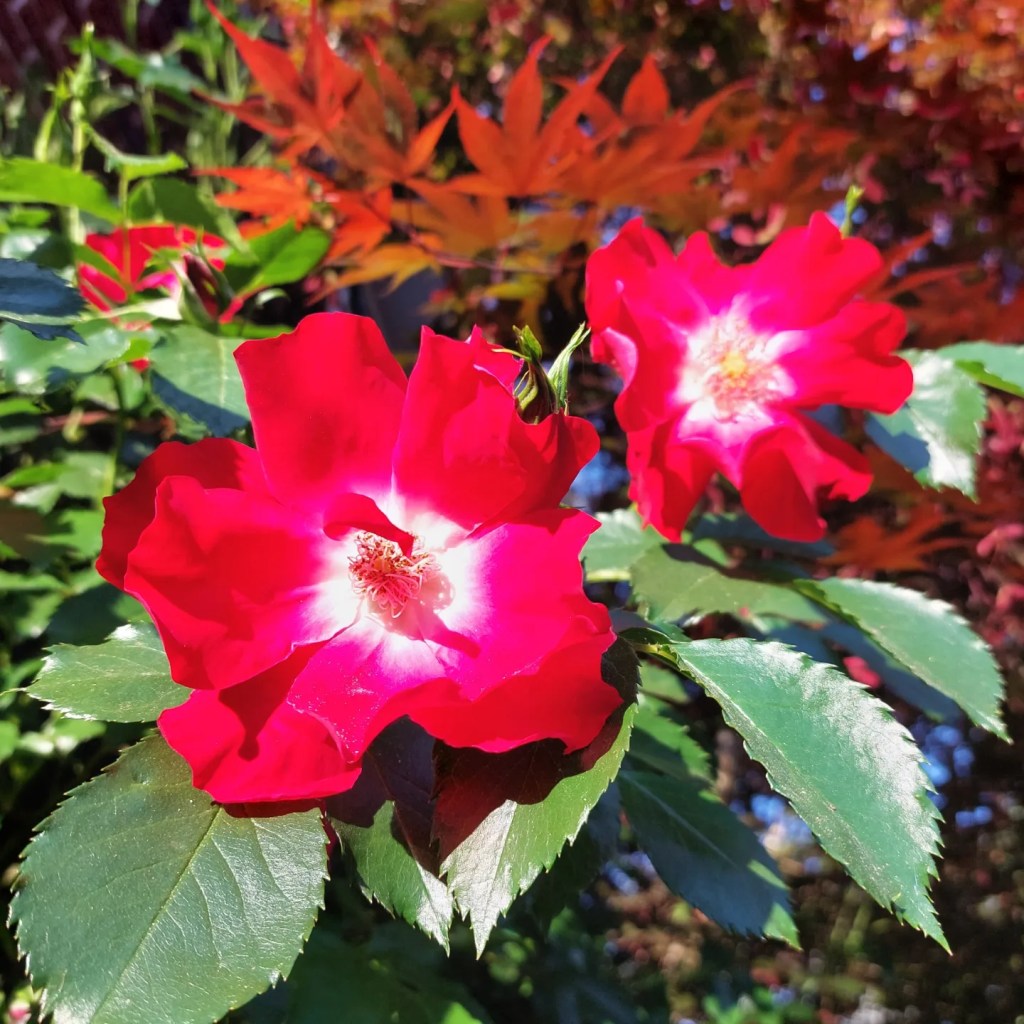
Roses are not nearly as old as rocks. Rocks have their beauty too, but they don’t usually make good Valentine’s Day gifts. But roses do go way back, in botany and in poetry. We find roses in the ancient myths of Aphrodite and Venus. And by the late 18th century, when Robert Burns wrote “A Red, Red Rose,” the rose, used by medieval courtly love troubadours to express romance and devotion, was deeply rooted in poetry, and would soon be grafted by Victorian writers onto the secret language of floriography. But a big secret in the poem Burns wrote is that he never quite explains how his love is like a rose; in fact, he walks away from the rose into song and never gets back, but he does mention rocks in stanza three. 1
O my Luve’s like a red, red rose,
That’s newly sprung in June;
O my Luve’s like the melodie
That’s sweetly play’d in tune.
Kenneth Koch’s “Rose, Where Did You Get That Red?: Teaching Great Poetry to Children” (1973) takes its title from a poem written by one of his elementary school students. The assignment was to take the question idea from Blake’s “The Tyger” and ask it of some other entity, “a mysterious and beautiful creature” (36), something that can’t answer back. Adults will learn something about poetry from Koch’s book too, if they work the exercises.
Or your love might be like a crabapple, a wild, wild rose, one that wants pruning and dusting and its canes tied up. Koch’s student poet asked but one question of the rose, spending the rest of her five line poem on questions to a dog, a dragon, a kitten, and a bird, but we might never tire of asking questions of the rose, once we get going:
Rose, where did you get that sepal?
Rose, where did you get that prickle?
Rose, where did you get that yellow?
Rose, what have you done to your trellis?
Rose, get back into your obelisk;
Rose, what kind of trick is this?
Blake recognized the vulnerability of the rose. His rose is crimson. The root of crimson contains some mystery: a red dye made from crushed insects, once mistaken for worms:
The Sick Rose
O Rose thou art sick.
The invisible worm,
That flies in the night
In the howling storm:Has found out thy bed
Of crimson joy:
And his dark secret love
Does thy life destroy.William Blake, 1794
Blake’s poem is from his “Songs of Experience.” Anyone with experience growing roses might at some point have asked some of these questions:
Rose, where did you get that feathery blackspot?
Rose, did I pour you too much fish emulsion?
Rose, oh, my, your grand floribunda!
Rose, where did you get that Japanese beetle?
Rose, where did you get that powdery mildew?
Rose, oh, Rose, are you going to turn blue?
Roses are favorites on Valentine’s Day, but Dorothy Parker said, don’t send for me a rose; send for me a limo:
One Perfect Rose
A single flow’r he sent me, since we met.
All tenderly his messenger he chose;
Deep-hearted, pure, with scented dew still wet—
One perfect rose.I knew the language of the floweret;
“My fragile leaves,” it said, “his heart enclose.”
Love long has taken for his amulet
One perfect rose.Why is it no one ever sent me yet
One perfect limousine, do you suppose?
Ah no, it’s always just my luck to get
One perfect rose.Dorothy Parker, 1926
No end to questions we have for roses, or poems:
Rose, where did you get that big pot?
Rose, how did you survive that long war?
Rose, where did you get that spider mite?
Rose, where did you get that whipped cane?
Rose, where did you get that green aphid?
Rose, where did you get that hippopotamus?
~~~
- The Red, Red Rose
O my Luve’s like a red, red rose,
That’s newly sprung in June;
O my Luve’s like the melodie
That’s sweetly play’d in tune.
As fair are thou, my bonie lass,
So deep in luve am I;
And I will luve thee still, my Dear,
Till a’ the seas gang dry.
Till a’ the seas gang dry, my Dear,
And the rocks melt wi’ the sun:
I will luve thee still, my dear,
While the sands o’ life shall run.
And fare thee weel, my only Luve!
And fare thee weel, a while!
And I will come again, my Luve,
Tho’ it were ten thousand mile!
Robert Burns, 1794
↩︎


 The Coming of the Toads