Tag: Theory

  • Punctuation (Sunday Cartoon)

    A hand-drawn cartoon featuring a red stick-figure exclamation point with blue eyes facing off against a question mark. Both characters have arms and legs and are balanced atop small balls. The question mark’s curve forms a large, open mouth, appearing to speak or shout back at the exclamation point.

    “Why do you ask so many questions!”
    “Why are you always yelling?”


    Adorno’s Features of Punctuation1

    We may have been taught in Grammar School to see the comma as a pause and the period as a stop, the comma a quarter note and the period a whole note. The semicolon a half note? The hyphen a rest. The dash a recess, the open parenthesis time to go home.

    Adorno, in his essay titled “Punctuation Marks,” stops to consider a comparison to traffic signs:

    “All of them are traffic signals; in the last analysis, traffic signals were modeled on them. Exclamation points are red, colons green, dashes call a halt.”

    But Adorno quickly moves on to a consideration of punctuation as a kind of musical notation, but what then, he questions, becomes of that comparison when modern music begins to ignore tonality.

    Of the exclamation point, Adorno gets historical, calling its use an example of expressionism:

    “…a desperate written gesture that yearns in vain to transcend language.”

    As for the dash – well, it no longer comes as a surprise:

    “All the dash claims to do now is to prepare us in a foolish way for surprises that by that very token are no longer surprising.”

    Why Adorno limits quotation marks to words being quoted suggests a fondness for rules that will always “call out” to be broken.

    “The blind verdict of the ironic quotation marks is its graphic gesture.”

    The loss of the semicolon Adorno attributes to market surveillance, not that anyone was looking anyway, but the use of the semicolon is perhaps the most difficult punctuation mark to establish conformity; the semicolon is the most personal of punctuation marks. It’s gone the way of the tie.

    For Adorno, the test of a writer’s punctuation proficiency can be found or proven in how one handles parenthetical material; interruptions to the lineal flow of thought, which of course isn’t lineal at all, which is why we need punctuation. He uses Proust as an example of a writer’s need for parenthetical expression, where simple commas won’t do, because we are running on but actually stopping, without coming to a full stop, to check our shoelaces.

    Interesting, even surprising, maybe, is that Adorno does not compare punctuation marks to editing in a film. Adorno disapproved of movies, jazz, and advertising, the sleep inducing drugs of what he called the cultural industry. Advertising makes enormous use of the exclamation mark, yelling and fist banging, even in ads without words – it’s the threat that numbs.

    How does Adorno conclude in such a way that might be helpful to a writer either concerned over “correct” use of punctuation (incorrect, Adorno would say, that use of ironic quote marks; but it highlights – calls out – the irony of the rules as a kind of code, not code as in writing computer code, but as in work completed and awaiting inspection), or of wanting to use the tools available effectively, precisely, but at the same time creatively, interestingly?

    It might come as some degree of solace to the punctuation befuddled writer (although some might feel worse) to know that Adorno considered all writing subject to an unsolvable “punctuation predicament”:

    “For the requirements of the rules of punctuation and those of the subjective need for logic and expression are not compatible.”

    1. Adorno’s essay “Punctuation Marks” is included in “Notes to Literature: Theodor W. Adorno,” Columbia University Press, 2019. ↩︎
  • Bugging Out

    In “Through the Looking Glass,” Alice converses with a gnat:

    “I know you are a friend,” the little voice went on; a dear friend and an old friend. And you won’t hurt me, though I am an insect.”
    “What kind of insect?” Alice inquired a little anxiously. What she really wanted to know was, whether it could sting or not, but she thought this wouldn’t be quite a civil question to ask.

    A gnat is a small fly, but this one seems huge, as gnats go:

    She found herself sitting quietly under a tree — while the Gnat (for that was the insect she had been talking to) was balancing itself on a twig just over her head, and fanning her with its wings. It certainly was a very large Gnat: “about the size of a chicken,” Alice thought. Still, she couldn’t feel nervous with it, after they had been talking together so long.

    Alice tells the gnat she’s not overjoyed when she sees an insect, because she’s afraid of them, particularly the larger ones.

    I’m not fearful of bugs, spiders and such. It’s the season here though when I’ll run into an orb-weaver spider web spread across the walkway between tree branches, face level, too, but invisible unless backlit with the rising sun, and I feel the sticky web as it envelops my face. I shake my shirt and comb through my hair with my fingers and watch a little reddish bug falling to the ground.

    Then came another of those melancholy little sighs, and this time the poor Gnat really seemed to have sighed itself away, for, when Alice looked up, there was nothing whatever to be seen on the twig, and, as she was getting quite chilly with sitting still so long, she got up and walked on.

    A problem with bugs is not that they are gigantic, but that they are small, and they are quick, and usually invisible to us. If you allow yourself, you might get all obsessive about bugs hiding behind baseboards, in the yard, or in your hair. But most bugs we never see, and they don’t bother us, in spite of the fact that about 10 quintillion bugs are living on Earth at any given moment.

    I enjoy reading blogs foreign to me, made possible by Google Translate. I recently read a blog post by a Japanese woman about centipedes. I was curious, having myself come across a couple of centipedes in our humble abode this summer. But this woman was nonrationally fearful and sprayed her unfortunate centipedes with excessive amounts of insecticide. She even posted a word of caution to potential readers at the top of her post, concerned some might be scared out of their wits reading about bugs, and she posted a deliciously horrible photo of a centipede slightly curled. Maybe something was lost in translation.

    Not too long ago I posted a piece on ants in our coffee maker. The infestation was so severe we had to abandon the electric coffee maker, and I went back to using a manual French press. I was reminded of E. O. Wilson, who changed his mind about how evolution works, as he found group altruism at work in ant colonies. He said that cooperative workers were more successful than competitive ones. Thus he favored altruism as a collective trait. His reversal of his prior position on the matter greatly upset his scientific community; many stuck in the web of their old position.

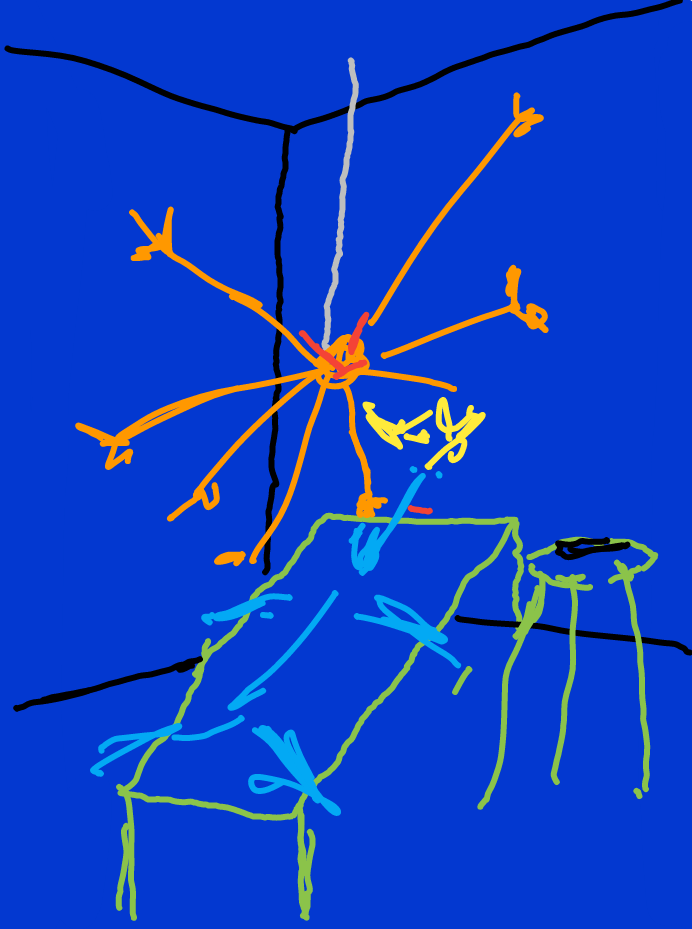
    As if real bugs aren’t enough, we find in Kafka’s story “The Metamorphosis” a metaphorical bug. A human awakens one perfectly normal morning to find himself turned into a true liking of his image, for he’s already living the life of a bug, a small bug-like creature working a menial job for the hive. Not all bugs are insects, but for our purposes here, I’m calling them all bugs. Bugs may seem a far fetched idea for an anthropomorphic story, but E. B. White wrote a very successful book with “Charlotte’s Web,” about a pig, a spider, and a little girl living on a farm. When walking outdoors this time of year, and watchful of walking into a web, always be sure to check for web messages.

    Science Lesson: I once knew a bug who for a short time kept a blog. Bugs don’t leave likes or comments; they leave bites and itches. Why are there so many insects living here on Mother Earth? Bugs have had a long time to adapt. Nature tends to overseed tiny organisms. Elsewhere no doubt there are planets full of bugs, oceans where none have yet decided to leave their salty paradise, tiny and invisible even to our new space telescopes. They don’t send messages and have no need for technology other than their own three part harmonies. Bugs are not picky eaters. Bugs are good pollinators and some, centipedes, for example, feed on other bugs perhaps dangerous to humans. Centipedes are not particularly harmful to humans. They are masters of the 100 yard dash.

    Theory: I had a friend in high school I admired for he was fearless and loved snakes. Then I discovered he was afraid of spiders. Whenever a spider was at hand, he called me in to deal with it. Over time, I developed a theory: people afraid of spiders are not afraid of snakes, while people afraid of snakes are not afraid of spiders. Occasionally, as the topic may arise, I’ll ask the question in conversation – below I’ve created a “poll” to test my theory (and to test the format of a poll, which for this blogger is a first). Please feel free to answer the poll, or leave a comment below to the post, or simply enjoy the cartoons I’ve added at the end. Time now to bug out.

    Update: I’ve already been advised my poll block didn’t work, so I’ve removed it. Not sure what I did wrong. But please feel free to answer the question (Snakes or Spiders) in a comment to the post below. And enjoy the cartoons!

  • F/Z 2: Doubt & Surety

    In part 3 of his encounter with Zizek’s “A European Manifesto,” Jeremy Fernando returns to the question of the picture we have of another’s picture of us that is not the same picture we have of us. In other words, the question of art, tinged with doubt, the opposite of faith (62). We all have a particular picture of ourselves, more than one, perhaps, but, in any case, seldom the same picture others have of us. This is of primary concern to the artist who realizes his lack of vision inhibits the transparency that informs nature (i. e. the primordial picture). The painter of the still life bowl of peaches fails to see the molecules drifting off the rotting fruit, but captures the glossy black fly attending to the rusting red peaches with verisimilitude the critic who likes this sort of thing calls ultra-realism. Of course it’s hardly real at all. It’s a painting, oils that never completely dry.

    To have put down yesterday a few of my thoughts on Fernando’s recent book (S/Z Jeremy Fernando: A European Manifesto Slavoj Zizek, 2022, Delere Press), this morning, upon reflection, causes me to pick up the book again and open to:

    “…one cannot be sure not only if one has mis-read, over-read, or under-read, one cannot be certain if one has even read.”

    63.

    An “illegitimate” (63) reading, then. Well, after all, this is a blog:

    Thus we can only impress upon our readers (all dozen or so of them, if we are a best-teller) our impression of what we’ve read. My impression is that we’ve no need to fear the monster. And to keep in mind always that the monster is precisely not Frankenstein. All art is science fiction. In fact, all science is science fiction. What do we think we are seeing when we look at these new photographs of scenes taking place in far far away space?

    “Where what << Europe >> is, might be, could be, might well already be, is both from yonder, perhaps even beyond the pale, but at the same time – since it is named such – within its possibilities. Where, in response to ‘Was heibt Europa?’ [What is Europe?] one might posit, un pas au-dela [a step beyond].”

    39.

    The artist (the surety, the guarantor) assumes the responsibility for the debt of the reader who brings suit (calling upon his solicitor – i. e. the critic), as he surely must, for he can never get to the bottom of it on his own, yonder his own limits, beyond the pale, outside any jurisdiction. For the artist, who stands alone, is both surety and principal, the one who performs the obligation and the one who guarantees the performance, and the one who defaults, all three parties to the contract. What became of the reader? Lost in space.

    To be clear: Frankenstein is the artist; the book is the monster.

    Thus, while Fernando starts part three with questions about the artist, he quickly moves to a discussion of Adam and Eve and the question of the tree of knowledge, of good and evil, and wonders how either (Adam or Eve) could have possibly made an informed decision to eat of the forbidden fruit, since before that act they had no knowledge – they didn’t know what they were doing; as innocents, they could not make an informed decision – they had not reached the age of reason: thus their plea of nolo contendere. And they plea guilty to a lesser charge, that of being human.

  • F/Z

    The book is a little monster, the text its mask. It will fit into your pocket, the deeper the bigger, where economy is a hole in one’s pocket. The tiny book is in. The small venue. Intimate. Indeterminate intimacy. Fernando’s imperative.

    “…one has to jump straight into the story; even if doing so seems like we are merely leaping from one tale into another, feels like we are doing less than nothing. After all, we should recall Slavoj’s lesson that the classic scene in horror movies is the moment when the monster takes off its mask, only to reveal that under the mask lies exactly the same face.”

    54, S/Z Jeremy Fernando: A European Manifesto Slavoj Zizek, 2022, Delere Press.

    To unmask the text is the work of Theory, influenced by algorithms developed in the Social Sciences, which replaced Freud. “What is to be done?”

    One might begin, could certainly do worse, by reading Jeremy Fernando’s latest little monster, S/Z, a McLuhanesque mosaic that follows (explicates, explores, examines, includes) Slavoj Zizek’s A European Manifesto (first published in an abridged version in French as Mon manifeste europeen in Le Monde on 13 May 2021):

    “My thesis is that precisely now, when Europe is in decline and the attacks on its legacy are at their strongest, one should decide FOR Europe. The predominant target of these attacks is not Europe’s racist etc. legacy but the emancipatory potential that is unique to Europe: secular modernity, Enlightenment, human rights and freedoms, social solidarity and justice, feminism … The reason we should stick to the name “Europe” is not only because good features prevail over bad; the main reason is that European legacy provides the best critical instruments to analyze what went wrong in Europe. Are those who oppose ‘Eurocentrism’ aware that the very terms they use in their critique are part of European legacy?”

    11.

    We are at the intersection of Zizek and Fernando, which is to say, there are no streets and no intersection. There is a path that runs (meanders, zigzags, convolutes) like a clear stream over profound stones through a part of the woods we may have never been before. We pass the huts of Badiou, Barthes, Derrida, Dufourmantelle, Kierkegaard, Cixous, Baudrillard, and others

    “And by doing so, calls for a reading (lit) that is aware of itself as reading, that – by foregrounding its form, its making – quite possibly undoes itself as one is reading, is potentially under erasure (sous rature) while being read” (strikeouts added).

    31.

    This is what we do: Reading (23 to 42); Writing (43 to 55); Fainting in Coils (57 to 73).

    “Which is not the standard call for multiculturalism – for that still maintains the notion of a single Europe, of a Europe in which many different kinds and types of peoples have to fit themselves into – but a more radical one that attends to Europe itself, that reads what it might be to be European. Bringing with it echoes of wideness, broadness (eurys), certainly encompassing many, but also a matter of seeing, of the eye (ops): of one that sees in the light of the setting sun.”

    67.

    Thus we arrive back to McLuhan, who explains the effects of technology on the sensorium, who might prefer going back to a time when, before the printing press, men were men and boats were boats (appropriated from another Mc in “One Flew Over the Cuckoo’s Nest”).

    We take what we need, when and where we find it. We are building a map not out of the woods, but further in,

    “Where, a true disruption comes through reading the notion that we are dealing with – responding to it, conversing with it, turning-with (versare) it, quite possibly occasionally turning it against (versus) itself, but never severing it, tearing it completely from its boundaries, its form. Thus, transforming it in a manner in which it is both recognisable, not-beyond, but also pushing it a step-beyond at exactly the same time.”

    66.

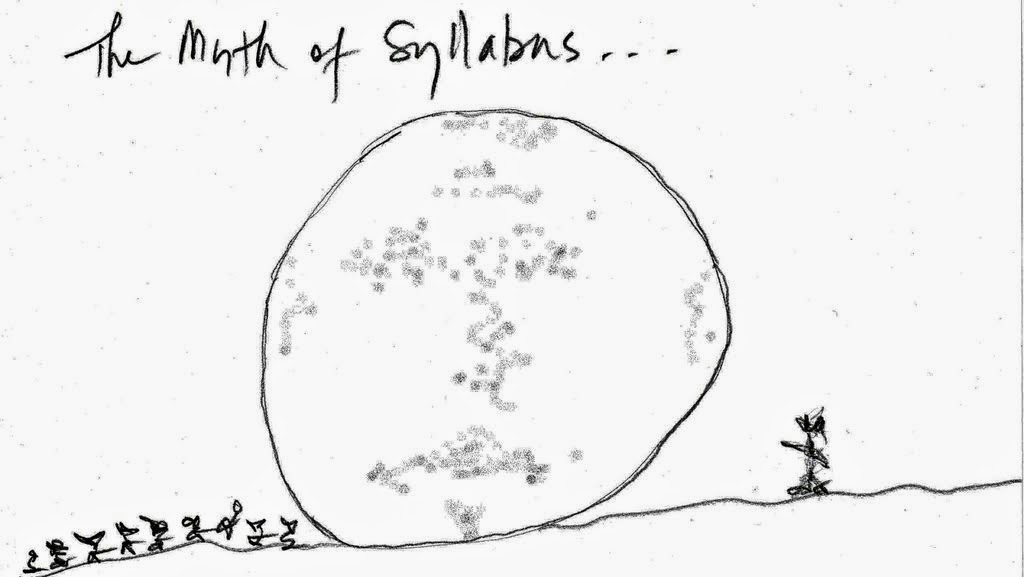
    Any number of syllabi might be created from this short Delere Press text (81 pages). Such is the depth of the footnotes. As an example, possibly my favorite:

    “This line was uttered in a conversation about literature and reading – probably at a bar – with my old friend, Neil Murphy, in June 2006. During the course of the evening, Neil also reminded me that, << reading literature with your head is always a mistake >>.

    32.

    To find out (discover, uncover, read, listen, study, research, join the conversation), what Neil Murphy “uttered,” Dear Reader, please, you won’t regret it, get the Delere Press book: ISBN 978-981-18-1987-2
    S/Ž | A EUROPEAN MANIFESTO .

    The Myth of Syllabus, Cartoon by Joe Linker

  • An Avocado Grows in Paris

    Another book influencing its predecessors is Elaine Dundy’s The Dud Avocado, originally published in 1958 and reissued in 2007 by NYRB, which includes an afterword written by Dundy in 2006. The Dud Avocado follows the period young Sally Gorce chooses an expat existence in Paris over college, expenses not exactly all paid for by a concerned uncle, so Sally’s survival, such as it is, depends also on chance, her wit, new acquaintances, and part time gigs, including as an actress in a small theatre. The precursors include the Hemingway of The Sun Also Rises, Scott Fitzgerald and Lost Generation company, and other coming of age in Paris tall or short tales.

    The characteristics of Dundy’s book include wit, sarcasm and satire, humor. As an example, consider this section which follows the thoughts of a wealthier (than Sally) English woman:

    “We sat at the cafe until lunch time. A couple, two English people, sat down at the table next to ours just in time to see the Bullfighter and all his pals get into a shiny lavender Cadillac and drive off in a blaze of flashing chrome. The woman, a large Junoesque creature with a sensationally unhappy expression on her face, had slapped on an enormous pair of sunglasses as he came out and had been studying him intently. Suddenly she turned to her companion. ‘Well, there’s another dream gone down the drain – he must be every bit as high as my waist,’ she announced sullenly. ‘He really looks such a boring little man, doesn’t he, so utterly clueless in these revolting American clothes, I can’t think why we’re going to do this picture. Basil wants us all to go down to San Sebastian to watch him on Sunday but I don’t think I’ll bother.’”

    p. 178-179 NRYB 2007 edition

    The above excerpt could have been a short story written by Hemingway had Ernest stayed in Paris and become a French theorist in the 1950’s instead of continuing to take himself seriously and move his feast to, I don’t know, Idaho. Anyway, Sally continues listening to the remarkably disenchanted woman as she complains about the noise on her morning plane ride into Paris:

    “‘I suppose it simply doesn’t occur to some people that one might be trying to recover from the night before.’ She took a large gulp of her drink. ‘I’d quite like to see the bullfight though, wouldn’t you? I do adore cruelty. Everybody back home’s too dreary, going on and on about the horses. Papa’s forbidden me across the threshold if I go to one. Can you believe it? That’s an added incentive.’”

    179

    During her stay, Sally loses, or has stolen, or both, her passport, and the plot thickens as a result, and one might recall Casablanca and the difficulty of obtaining transit papers, which, today, might include letters from one’s doctor certifying Covid free status before boarding, and again, one presumes, after landing?

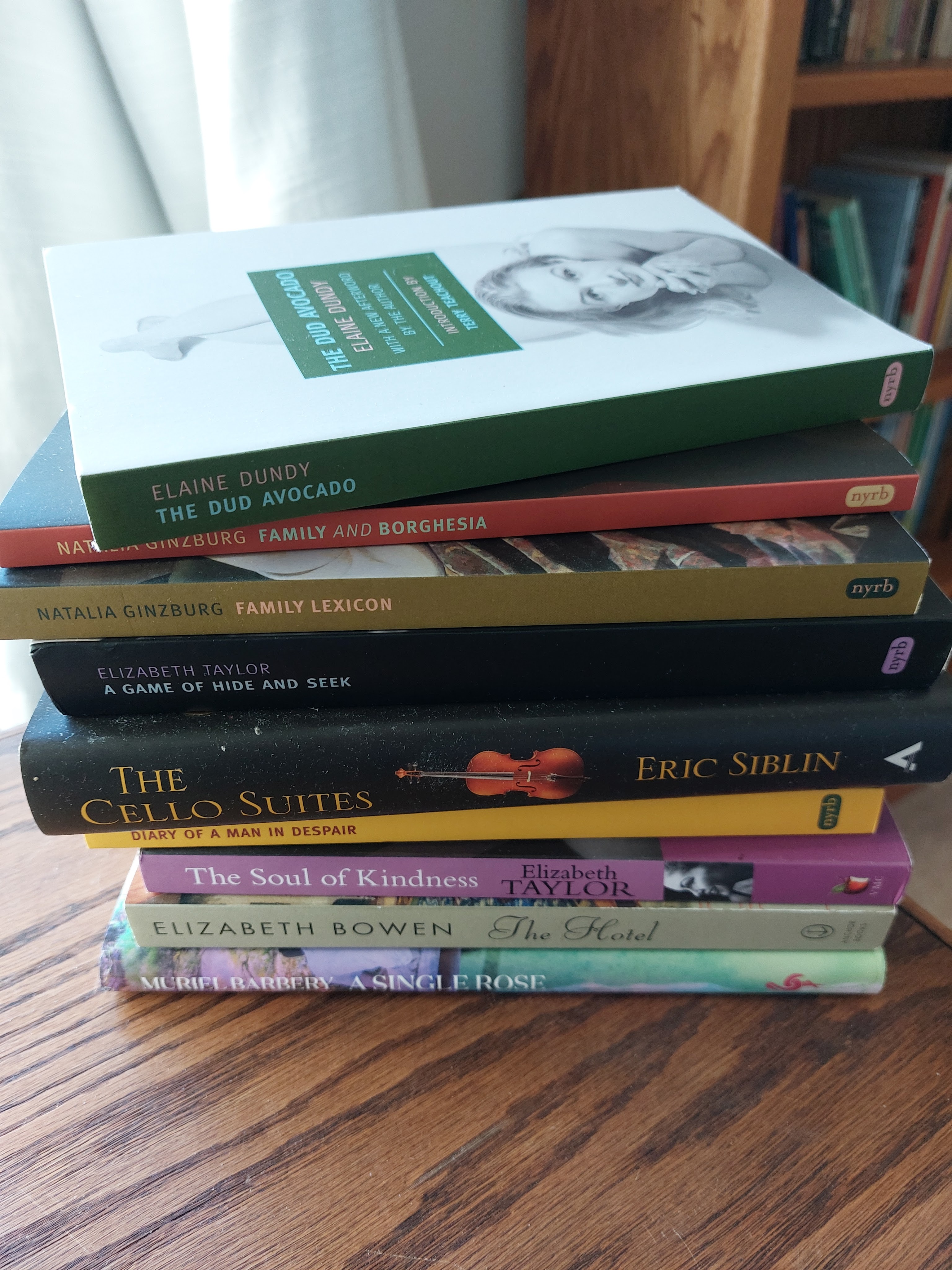
    Ah, the vicarious joys of reading, where one need not wear a mask or worry about the breath of one’s travel mates or show documents prior to entry. Speaking of the joys of reading, enclosed please find a pic from my recent Fall reading stack. I continue to be drawn to women writers of the mid 20th Century, most recently having discovered Elizabeth Bowen and Elizabeth Taylor. Natalia Ginzburg’s writing in style and substance remains untouchable, essays and fiction and her mix of the two. The Muriel Barbery I came across in a briefly mentioned review in The New Yorker and having enjoyed The Elegance of the Hedgehog bought it and liked it enough to send a copy to one of my sisters, the one who had recommended Hedgehog to me. What goes around comes around. Friedrich Reck’s Diary of a Man in Despair, in the stack, remains unread. I bought it some time ago, before the general despair now enveloping us all. The Cello Suites I’ve already mentioned – a gift from one of my other sisters. I was going to write up a post briefly mentioning each of the books finished this Fall. Maybe I just did. Anyway, if you find yourself on the way to Paris one of these days, you might consider taking along a copy of Elaine Dundy’s The Dud Avocado. And keep an eye on your passport.

    Fall Reading 2021

  • The Reading Crisis Revisited: Amazon and the Gatekeepers Against the Wall

    Mark McGurl has a new book out. I enjoyed and reviewed his previous book “The Program Era,” here, and his new work, “Everything and Less: The Novel in the Age of Amazon,” which appears to revive the Reading Crisis theme I first started following over at Caleb Crain’s site, is reviewed by Benjamin Kunkel in a recent Bookforum post: Sense and Saleability: How Amazon changed the way we read. After reading the Kunkel review, I don’t feel I need to read the new McGurl take.

    First, it’s still too early to say what’s really going on or how dramatically it’s affected our reading, particularly the reading of the common reader (who seems to persist, in spite of the odds). Second, Mcluhan, who explains the effects of the printing press, and predicts a long time ago now the current reading crisis (not to mention a plethora of other ideas), I still find more convincing. And while McLuhan did not personally look forward to the changes in literacy his theories explained or predicted, he didn’t necessarily feel the world would be a worse place as a “global village.”

    In any case, if I’m reading Kunkel correctly, what today’s gatekeepers seem to want protecting turns out to have been cut off only in its infancy:

    Between the Great Recession and 2019, the number of undergrads majoring in English shrank by more than a quarter, and it’s difficult to imagine the pandemic has reversed the trend. Meanwhile, over approximately the same dozen years, professors in English and other literature departments have more and more bent their attention away from the real or alleged masterpieces that formed the staple of literature courses ever since the consolidation of English as a field of study in the 1930s, and toward more popular or ordinary fare. Sometimes the new objects of study are popular books in that they belong to previously overlooked or scorned genres of “popular fiction,” such as crime novels, sci-fi, or horror: this is popularity from the standpoint of consumption. And sometimes they are popular books in the different sense that they are written, in huge quantities, by authors with few if any readers, whatever the genre of their work: this is popularity from the standpoint of production.

    Bookforum, Dec/Jan/Feb 2022

    Theory and the Social Sciences, not to mention Reagan as governor of California ruining a good thing for the children of laborers who might have somehow discovered literature in the 50’s and 60’s and where McGurl now sits as public intellectual gatekeeper at Stanford, presumably with small cohorts of readers filling sandbags, had already altered how we read and precipitated the slide of the English Major, still a baby if born as recently as 1930. Amazon has not changed anything, at least not having to do with literature.

    Meantime, James Lardner posts a recent Gatekeeper entry on the New Yorker online site, lamenting and lambasting the so called for profits (as if schools like the factory at UCLA pumping out Phds in the 60’s and 70’s is not de facto a for profit).

    But not all English majors are created equal, and this one wishes he would have become a plumber like his father (having never read a book, good or bad) wanted him to become. And then he wouldn’t be sitting here writing a post no one will read on a subject few care about when he should be down in the basement checking that the plumbing didn’t freeze last night.

  • Notes on “je me touché,” 4 essays by Jeremy Fernando

    je me touché, Jeremy Fernando, 2017, Paradiso Editores, Delere Press, 77 pages.

    Jeremy Fernando’s method of writing shows his acoustic, vibratory thinking, making connections, moving from one idea to another, enharmonic soundings, transported by his readings. In “je me touché” (it is i touch me – or, I me touch: I touch myself), he connects, in four essays, as cars interconnected on a train, Flann O’Brien’s short story “John Duffy’s Brother,” Melville’s “Bartleby,” the Occupy Movement, and, in an “Afterword,” sound, touch, and tune.

    If Flann O’Brien’s Brother is a train, Melville’s Bartleby is a station, the last stop, the end of the line, no turnaround. Nothing to be done now but occupy that well-foreshadowed destination, where we hear night and day the whistle of a human train derailed, “the scream of the scrivener” (25). That scream is a kind of tinnitus. There is no actual sound. What we are hearing is a phantom noise in our imagination.

    In the beginning was the word, and the word created community. In every beginning originating with a word, a commune is created, a habitat for the imagination. Community contains potential for sharing, for touching, without conflict, but with the possibility of divergence, which is risk, which becomes reading, a home, a place to dwell. And every household invites divergence, a library of dry goods.

    Fernando begins “je me touché” with an immersion into Flann O’Brien’s short story “John Duffy’s Brother.” Following some strange inexplicable happening, Brother (unnamed, perhaps one of Beckett’s unnamable) believes himself to be a train. Children often play at being things – “Choo!Choo! Good and Plenty. Good and Plenty.” But Brother really is a train. What is a train? Following a linear path, tied to its tracks, a community of cars carrying sundry goods and people and animals, all properly ticketed or listed in a bill of lading, the train rolls, pulls, steams along, along the line, picking up speed, braking for curves, slowing on hills (“I think I can. I think I can”), forward to a destination, for every train has a purpose, clear and unmistakable. And part of its purpose it to run on time, less the socioeconomic demographics harmonizing the connecting stops becomes disrupted (45-48). We don’t care about the people on the bus any more than we care about the bus drivers. What we care about is the system, the fixed routes, the timetables, the robotic movement of time. We become the bus, the train. But the story is not about the train; it’s about our thinking we are the train, a secret few of us care to admit, less we be admitted. What happens when the drivers (today’s scriveners, writing a line along a predestined route) go on strike?

    Our choices are limited. All authority lies in the tracks, and “it is only truly authority when ones does not have to use any force.” The system that runs on time requires no force but to enforce the schedule, which should require no force once set into motion. The individual who leaves the track, detours the bus route, goes on strike, does not necessarily wander far afield, but comes to rest, as does Melville’s Bartleby. Employed as a scrivener (a human copy machine), Bartleby inexplicably begins to “prefer not” to do any more copying, or have anything to do with the office or its community, yet he will not vacate the premises, for he prefers not to do that either. Bartleby’s boss, possibly the first humanist, works around him, but Bartleby eventually winds up in the Tombs, and we learn that he started out in the dead letter office. “Ah, Bartleby. Ah, Humanity,” the story ends.

    We begin to see Fernando’s connections, how he unravels then weaves again the themes found in Brother, Bartleby, then the Occupy Movement, and lastly, in “Afterword,” into one wandering path. Along the way, we meet the likes of Zizek, Ronell, Kant, Otis Redding, Cervantes, Wall Street and its Bull (symbol, sculpture, art), reading as touching. “Prosopopoeia”: feeling, book, relation, touch. The word empathy is not used, but perhaps should be, as in to feel oneself is to grant oneself some altruistic version of how another might feel us. Henry Miller. In tune. Dash, the dash. Coming together. Risk. Love (“I love you,” 72-73). Laughter as music, as language.

    Fernando’s layers upon layers of reading unfold, every word its history we must also remember, “keeping in mind” how others might have used it. And under the surface a stream, a river, runs undercover. Thus relation, within words: correspondence, interconnections, kin, intersections. Connecting Bartley with Occupy – occupy what? Nothing? The stairs? Bartleby occupies, to occupy already an occupation (“…why don’t they just apply themselves and get a job,” 37). Touch themselves? Now here: no where? To read is to touch oneself as another might touch, with permission.

    This is not a pipe dream, but a book, hard copy.

    (“Try this apple, Adam, very good”). Essay as fruit of the word.

    Who reads when we read? Even reading something we ourselves have written, we wrote, yesterday or some time ago, we are not the same person reading as we were writing – we are not exactly that same person who sat at that very desk, now also changed, and wrote, for we have already a myriad of new experiences constantly adding to our connections.

    I first read Melville’s “Bartleby: A Story of Wall Street” when, as a sophomore in high school, I was assigned Melville as my first term reading and research author assignment. I remember some of the other boys who got Hemingway, Steinbeck, Babbitt. I wasn’t all that happy to get Herman. But that attitude changed. Of course I loved Moby-Dick, but I tried to argue “Pierre; or, the Ambiguities,” written just after The Whale, the better work. Meanwhile, though he died before I was born, my paternal grandfather was an engineer on the Louisville Nashville Line. “So it goes.” Connections.

  • Blest Be the Tie that Binds

    Blest Be the Tie that Binds

    One year, on a trip north from Los Angeles, we stopped off at the University of California at Santa Cruz campus to visit a married couple, both in graduate school studying computer programing. When I asked about their projects, one of the students said she was working on a component that would become part of another system, but she didn’t know its ultimate purpose. It might be military; it could be household. She said computers would improve lifestyle and livability. For example, she said, when you arrived at the front door of your house, a computer would recognize you, and your door would open automatically. Later, I learned that, having completed his graduate program, her husband got a good programming job, but due to a misunderstanding regarding dress code, he quit his first day at work because he was expected to wear a tie. That same day, he went to another computer programming firm in the area, where ties were not required, and was immediately hired.

    About ten years later, this time on a trip north from Portland, in Seattle on business, I visited a friend who was working in the computer industry. He took me on a trip of the home office, which was called a campus. With its various outdoor activity fields, the low profile buildings, the walkways – it looked and felt like a school campus. On our way to an onsite cafeteria for lunch, we passed through a couple of long corridors lined on both sides with solid doors opening into offices the size of telephone booths where single workers sat hunched toward a computer screen. After finding a table in the cafeteria and settling into lunch, I glanced around and gradually noticed I was the only guy in the whole place wearing a tie.

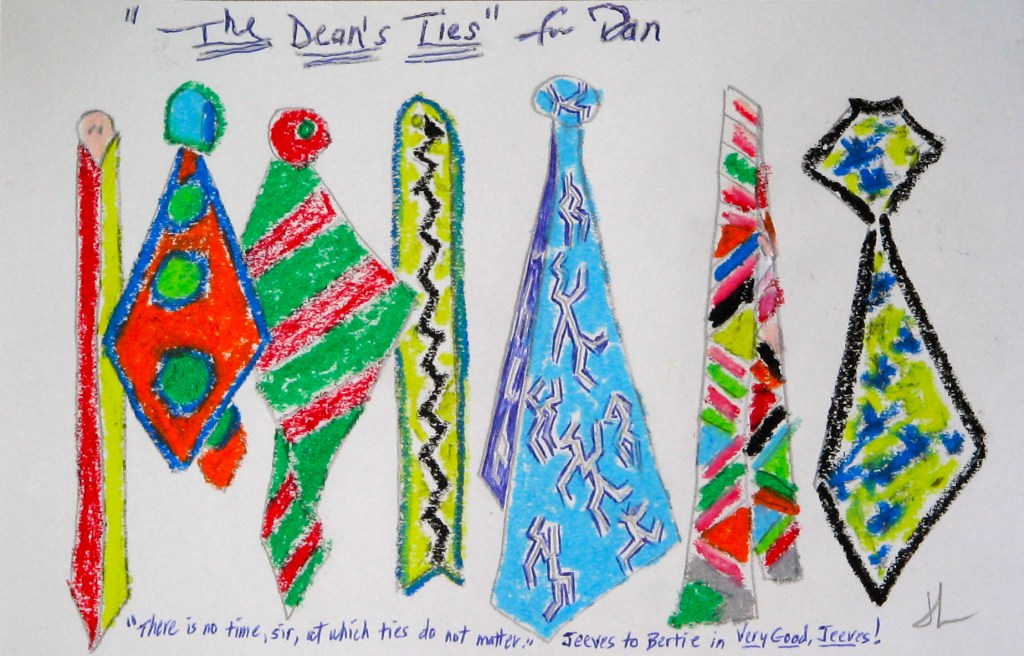
    Glancing around today, I notice that one of the few industries still apparently requiring a tie is politics. But I’ve also noticed that news media people on camera also wear ties. They all seem to share similar clothing styles, the men and the women, the politicians on both sides of the aisle, the leaders in industry, the ladies and gentlemen of the world. It’s a wonder they don’t all get along better, and one wonders what today a tie might signify. The tie seems now only a theoretical construct – its purpose and meaning are not directly observable. It no longer binds, but unbinds.

    The title of this post is taken from the hymn by John Fawcett:

    “Blest Be the Tie that Binds”
    by John Fawcett, 1740-1817

    Blest be the tie that binds
    Our hearts in Christian love;
    The fellowship of kindred minds
    Is like to that above.

    Before our Father’s throne
    We pour our ardent prayers;
    Our fears, our hopes, our alms, are one,
    Our comforts and our cares.

    We share our mutual woes,
    Our mutual burdens bear,
    And often for each other flows
    The sympathizing tear.

    When here our pathways part,
    We suffer bitter pain;
    Yet, one in Christ and one in heart,
    We hope to meet again.

    This glorious hope revives
    Our courage by the way,
    While each in expectation lives
    And longs to see the day.

    From sorrow, toil, and pain,
    And sin we shall be free
    And perfect love and friendship reign
    Through all eternity.

    Hymn #464
    The Lutheran Hymnal
    Text: Eph. 4:3
    Author: John Fawcett, 1772, alt.
    Composer: Lowell Mason, 1832
    Tune: “Boylston”

  • Oblique Obligato

    1. Moon fresh ribbon
      smooth platen
      ball dust sea
    2. Fastened to fish
      risk bamboo
      water chills
    3. Homespun shark
      teeth reek bark
      oil tea tree
    4. Screeched scrounge scrawn
      crested pinch
      ear reach thrills
    5. Stringing brew broils
      cooking pot
      catch read bin
    6. Critical swarm
      goat bearded
      bee attack
    7. Smoked fuzz moss
      yucky hot
      sunder skin
    8. Feet faintly sweet
      & ditties
      sour retract
    9. Poised hipster red
      shower cap &
      surf sandals
    10. Now turns one last
      again then
      salt pearls
    11. Ask brack weed meme
      vandal cleaned
      type taste twirl
    12. Spring Selene not
      bald booby
      care fool horse
    13. Trifurcation
      from dear morph
      solo bliss
    14. Under deep stays
      curling waves
      allusiveOblique Moon
  • Not one but two needs relish sweet sorrow

    Not one but two needs relish sweet sorrow.
    Wooden shoe wish new saga song bonnet?
    Purple flower here now gone tomorrow.
    One knows not lief, and if hair be sonnet,
    Wold eat polka dotted cotton culotte.
    Back seats escape too simple bounded rules,
    Schemes where at smart turn deer quickly departs,
    Shirking away from linked coupling rope pulls.
    Gears thrown greased ball bearings plop soft thudded,
    Rustling rough yon fat fig leaf yellowed grass
    Into well palms of gleeful looped poet,
    Frogs Voila! in deep wide throated bass:
    Now twanged by gee sang plus web danced for thee,
    Not two but three may now exclaim in glee.

    Theory

  • Casual Theory of Causality

    Why pink asks blue whenGarlic at Gilroy
    roused whose wheeze
    where past just falls
    fails new any to augur

    When rash throws think
    unfolds, unwraps, uncoils
    relax what jeers
    who held and

    Wooden Clappers

    Don’t let go of drop
    though darkness rooms
    and voices blink three
    coins in a phone booth

    At gas stop stuffed
    outside Gilroy near
    garlic beer and clown
    juggling artichokes

    Carriage trails from Castroville.